Rotational Vacuum Friction of Nonabsorbing Particles
Pith reviewed 2026-06-26 00:07 UTC · model grok-4.3
The pith
Axial symmetry protects nonabsorbing particles from rotational vacuum friction at all temperatures.
A machine-rendered reading of the paper's core claim, the machinery that carries it, and where it could break.
Core claim
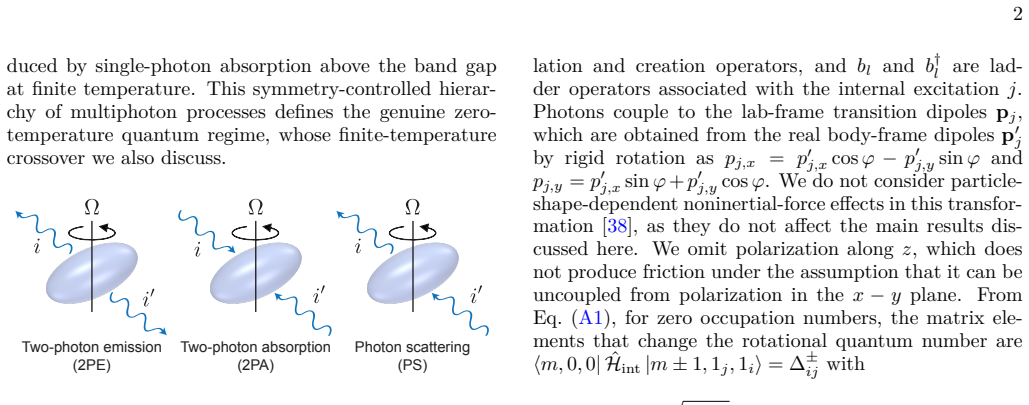
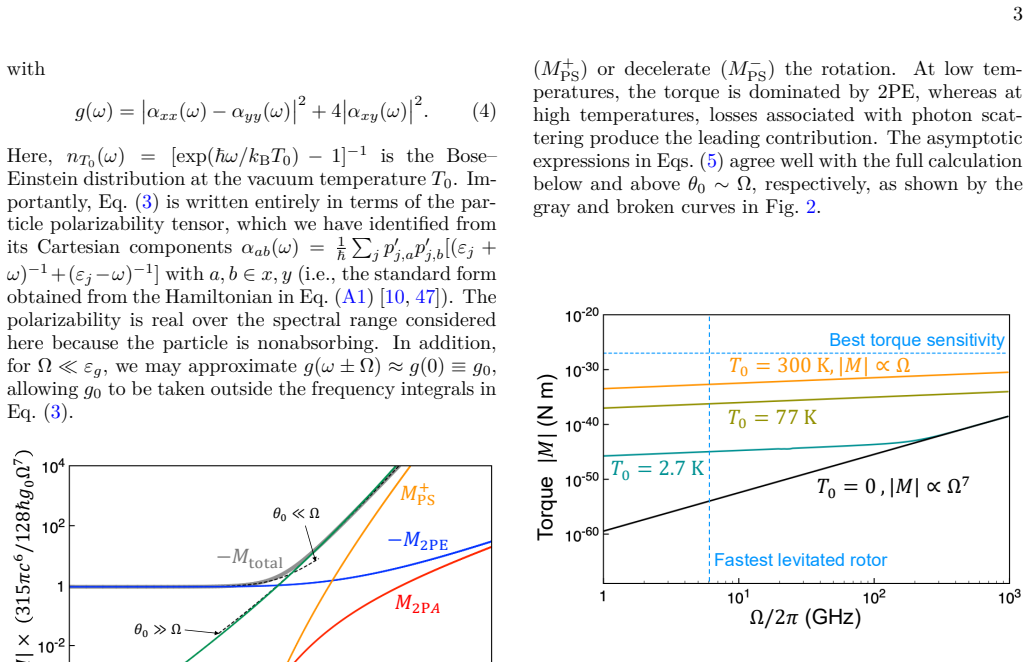
A nonabsorbing particle rotating in vacuum can lose angular momentum only by converting mechanical energy into electromagnetic radiation. Axial symmetry qualitatively changes the leading dissipation channel. At zero temperature, the frictional torque scales as M∝Ω^7 with rotation frequency Ω in anisotropic particles due to the emission of correlated photon pairs whose frequencies sum to 2Ω, while a contribution to the torque linear in Ω is found at finite temperature. In contrast, axisymmetric particles are protected against photon-assisted friction regardless of temperature.
What carries the argument
Quantum coupling between particle rotation and vacuum electromagnetic fluctuations, enabled only when axial symmetry is broken, that produces spontaneous emission of correlated photon pairs.
If this is right
- Anisotropic particles exhibit frictional torque scaling as Ω^7 at absolute zero from photon-pair emission.
- Finite temperature adds a frictional torque contribution linear in rotation frequency.
- Axisymmetric particles experience zero torque from photon-assisted processes at any temperature.
- All dissipation occurs through radiation without internal absorption.
Where Pith is reading between the lines
- The result suggests that perfectly axisymmetric levitated nanoparticles could sustain rotation with negligible drag in cryogenic vacuum.
- Correlated photon pairs emitted by anisotropic particles might be detectable as a signature of the mechanism.
- The protection may extend to other symmetric quantum rotors where vacuum fluctuations couple only through symmetry-breaking terms.
Load-bearing premise
The particles are small and completely lossless, so all dissipation happens through radiation emission with no material absorption channels.
What would settle it
Measure the torque on a rotating anisotropic nanoparticle at millikelvin temperatures and check whether it scales exactly as the seventh power of frequency or vanishes for axisymmetric shapes.
Figures
read the original abstract
A nonabsorbing particle rotating in vacuum can lose angular momentum only by converting mechanical energy into electromagnetic radiation. Here, we develop a quantum theory of rotational vacuum friction for small lossless particles and show that axial symmetry qualitatively changes the leading dissipation channel. At zero temperature, the frictional torque scales as $M\propto\Omega^7$ with rotation frequency $\ Omega$ in anisotropic particles due to the emission of correlated photon pairs whose frequencies sum to $2\Omega$, while a contribution to the torque linear in $\ Omega$ is found at finite temperature. In contrast, axisymmetric particles are protected against photon-assisted friction regardless of temperature.
Editorial analysis
A structured set of objections, weighed in public.
Referee Report
Summary. The manuscript develops a quantum theory of rotational vacuum friction for small, lossless (nonabsorbing) particles rotating in vacuum. It claims that axial symmetry qualitatively alters the leading dissipation channel: axisymmetric particles are protected against photon-assisted friction at all temperatures, while anisotropic particles experience a frictional torque scaling as M ∝ Ω^7 at zero temperature arising from emission of correlated photon pairs with frequencies summing to 2Ω, together with a torque contribution linear in Ω at finite temperature.
Significance. If the central claims hold, the work supplies a symmetry-based selection rule that suppresses vacuum friction for axisymmetric cases and yields concrete, testable scalings for anisotropic particles. The explicit quantum calculation for the two-photon channel at T=0 and the thermal contribution constitutes a strength, as does the parameter-free character of the leading-order results once the polarizability tensor is fixed.
minor comments (1)
- [Abstract] Abstract: the rotation frequency symbol appears with an extraneous space before the backslash in ' Ω'; this should be cleaned for consistency with the rest of the manuscript.
Simulated Author's Rebuttal
We thank the referee for their careful reading of the manuscript, positive assessment of the central claims, and recommendation to accept.
Circularity Check
No significant circularity detected
full rationale
The paper presents an explicit quantum theory for rotational vacuum friction in small lossless particles, deriving torque scalings from photon emission processes and angular-momentum selection rules. Axial symmetry forbidding net torque is argued directly from conservation laws applying to both two-photon processes at T=0 and thermal processes at finite T. No load-bearing step reduces by construction to a fitted input, self-definition, or self-citation chain; the results are framed as outputs of the calculation rather than reparameterizations of inputs. The derivation is self-contained against external benchmarks.
Axiom & Free-Parameter Ledger
axioms (1)
- standard math Quantum electrodynamics governs vacuum fluctuations and photon emission for small particles
Reference graph
Works this paper leans on
-
[1]
In addition, the first integral of Eq
Closed-form expression for the two-photon torque The zero-temperature part of the torque trivially contributes ∫y 0 dxx 3(y−x)3 =y 7/140toF(y). In addition, the first integral of Eq. (B3) can be simplified by noticing the result ∫y 0 dxx 3(y−x)3n(y−x) = ∫y 0 dxx 3(y−x)3n(x), so we can write F(y) = y7 140 + 2J(y) +K(y)(B4) with J(y) = ∫ y 0 dxx3(y−x)3 ex−1...
-
[2]
(B5)], we havex≤y≪1, so we can expand1/(ex−1) = 1/x−1/2 +x/12 +···and obtain J(y) = y6 60−y7 280 + y8 3360 +··· 9 by direct integration
High-temperature limit:ξ= Ω/θ 0≪1 InJ(y)[Eq. (B5)], we havex≤y≪1, so we can expand1/(ex−1) = 1/x−1/2 +x/12 +···and obtain J(y) = y6 60−y7 280 + y8 3360 +··· 9 by direct integration. ForK(y), expanding the exact polylogarithmic expression aroundy= 0gives K(y) = 16π6 21 y+ 2π4 15 y3−y6 60 + y7 280−y8 3360 +···, and therefore, Eq. (B4) leads to F(y) = 16π6 2...
-
[3]
(B9) become J(y) =6ζ(4)y3−72ζ(5)y2 (B10) + 360ζ(6)y−720ζ(7) +O(e−y), where we have used the scaling Lim(e−y) =O(e−y)
Low-temperature limit:ξ= Ω/θ 0≫1 Now, we havey≫1, so Eqs. (B9) become J(y) =6ζ(4)y3−72ζ(5)y2 (B10) + 360ζ(6)y−720ζ(7) +O(e−y), where we have used the scaling Lim(e−y) =O(e−y). Likewise, Eq. (B8) readily leads to K(y) =6ζ(4)y3 + 72ζ(5)y2 (B11) + 360ζ(6)y+ 720ζ(7) +O(e−y). Inserting Eqs. (B10) and (B11) into Eq. (B4) and using the explicit valuesζ(4) =π4/90...
-
[4]
(D2b), corresponding to absorption by polarization along the rotation axis, and thus focus on disk-like particles
Balance equation andT 1/T0 For simplicity, we neglect the second line of Eq. (D2b), corresponding to absorption by polarization along the rotation axis, and thus focus on disk-like particles. In any case, the temperature ratio scales asΩ2 (see below), so it does not affect the low-velocity torque of gapped particles with largeϵg. We first determine the ra...
-
[5]
Threshold approximation forM Applying the same approximations as above, Eq. (D2a) becomes M≈−4kBT0 3πc3 h(ε+ g ) { (εg + Ω)3[ αe−ℏεg/αkBT0−e−ℏ(εg+Ω)/k BT0 ] +(εg−Ω)3[ e−ℏ(εg−Ω)/kBT0−αe−ℏεg/αkBT0 ]} , whereh(ε+ g )denotes the value ofh(ω)immediately above the thresholdω=εg. Using Eq. (E1), this expression reduces to M≈−8kBT0 3πc3 ε3 gh(ε+ g )e−ℏεg/kBT0 [ 1...
-
[6]
Trembling cav- ities in the canonical approach,
R. Schützhold, G. Plunien, and G. Soff, “Trembling cav- ities in the canonical approach,” Phys. Rev. A57, 2311– 2318 (1998)
1998
-
[7]
Path-integral approach to the dynamic Casimir effect with fluctuating bound- aries,
R. Golestanian and M. Kardar, “Path-integral approach to the dynamic Casimir effect with fluctuating bound- aries,” Phys. Rev. A58, 1713–1722 (1998)
1998
-
[8]
The "friction
M. Kardar and R. Golestanian, “The "friction" of vac- uum, and other fluctuation-induced forces,” Rev. Mod. Phys.71, 1233–1245 (1999)
1999
-
[9]
Near-field radiative heat transfer and noncontact friction,
A. I. Volokitin and B. N. J. Persson, “Near-field radiative heat transfer and noncontact friction,” Rev. Mod. Phys. 79, 1291–1329 (2007)
2007
-
[10]
Quantum friction,
A. I. Volokitin and B. N. J. Persson, “Quantum friction,” Phys. Rev. Lett.106, 094502 (2011)
2011
-
[11]
Failure of local thermal equilibrium in quantum friction,
F. Intravaia, R. O. Behunin, C. Henkel, K. Busch, and D. A. R. Dalvit, “Failure of local thermal equilibrium in quantum friction,” Phys. Rev. Lett.117, 100402 (2016)
2016
-
[12]
One-loop dominance in the imaginary part of the polarizability: application to blackbody and non- contact van der Waals friction,
U. D. Jentschura, G. Lach, M. De Kieviet, and K. Pachucki, “One-loop dominance in the imaginary part of the polarizability: application to blackbody and non- contact van der Waals friction,” Phys. Rev. Lett.114, 043001 (2015)
2015
-
[13]
New developments in the Casimir effect,
M. Bordag, U. Mohideen, and V. M. Mostepanenko, “New developments in the Casimir effect,” Phys. Rep. 353, 1–205 (2001)
2001
-
[14]
Materials perspective on Casimir and van der Waals interactions,
L.M.Woods, D.A.R.Dalvit, T.Torsvik, M.Kats, V.W. Chen, and S. Mahan, “Materials perspective on Casimir and van der Waals interactions,” Rev. Mod. Phys.88, 045003 (2016)
2016
-
[15]
S. Y. Buhmann,Dispersion Forces I. Macroscopic Quantum Electrodynamics and Ground-State Casimir, Casimir-Polder and van der Waals Forces(Springer- Verlag, Berlin, 2012)
2012
-
[16]
Fully covariant radiation force on a polarizable particle,
G. Pieplow and C. Henkel, “Fully covariant radiation force on a polarizable particle,” New J. Phys.15, 023027 (2013)
2013
-
[17]
Universal scaling laws for dispersion interactions,
S. Y. Buhmann, S. Scheel, and J. Babington, “Universal scaling laws for dispersion interactions,” Phys. Rev. Lett. 104, 070404 (2010)
2010
-
[18]
Quantum theory of the electromagnetic field in a variable-length one-dimensional cavity,
G. T. Moore, “Quantum theory of the electromagnetic field in a variable-length one-dimensional cavity,” J. Math. Phys.11, 2679–2691 (1970)
1970
-
[19]
Resonance response of the quantum vacuum to an oscillating boundary,
C. K. Law, “Resonance response of the quantum vacuum to an oscillating boundary,” Phys. Rev. Lett.73, 1931– 1934 (1994)
1931
-
[20]
Motion induced radiation from a vibrating cavity,
A. Lambrecht, M.-Th. Jaekel, and S. Reynaud, “Motion induced radiation from a vibrating cavity,” Phys. Rev. Lett.77, 615–618 (1996)
1996
-
[21]
Observation of the dynamical Casimir ef- fect in a superconducting circuit,
C. M. Wilson, G. Johansson, A. Pourkabirian, M. Simoen, J. R. Johansson, T. Duty, F. Nori, and P. Delsing, “Observation of the dynamical Casimir ef- fect in a superconducting circuit,” Nature479, 376–379 (2011)
2011
-
[22]
Dynamical Casimir effect in a Josephson metamaterial,
P. Lähteenmäki, G. S. Paraoanu, J. Hassel, and P. J. Hakonen, “Dynamical Casimir effect in a Josephson metamaterial,” Proc. Natl. Acad. Sci.110, 4234–4238 (2013)
2013
-
[23]
CurrentstatusofthedynamicalCasimir effect,
V.V.Dodonov,“CurrentstatusofthedynamicalCasimir effect,” Phys. Scr.82, 038105 (2010)
2010
-
[24]
Shearing the vacuum - quantum friction,
J. B. Pendry, “Shearing the vacuum - quantum friction,” J. Phys. Condens. Matter9, 10301–10320 (1997)
1997
-
[25]
Can sheared surfaces emit light?
J. B. Pendry, “Can sheared surfaces emit light?” J. Mod. Opt.45, 2389–2408 (1998)
1998
-
[26]
Nonequilibrium electromagnetic fluctuations: heat transfer and interac- tions,
M. Krüger, T. Emig, and M. Kardar, “Nonequilibrium electromagnetic fluctuations: heat transfer and interac- tions,” Phys. Rev. Lett.106, 210404 (2011)
2011
-
[27]
Quan- tum Cherenkov radiation and noncontact friction,
M. F. Maghrebi, R. Golestanian, and M. Kardar, “Quan- tum Cherenkov radiation and noncontact friction,” Phys. Rev. A88, 042509 (2013)
2013
-
[28]
Nonequi- librium quantum fluctuations of a dispersive medium: spontaneous emission, photon statistics, entropy gener- ation, and stochastic motion,
M. F. Maghrebi, R. L. Jaffe, and M. Kardar, “Nonequi- librium quantum fluctuations of a dispersive medium: spontaneous emission, photon statistics, entropy gener- ation, and stochastic motion,” Phys. Rev. A90, 012515 (2014)
2014
-
[29]
Quan- tum friction controlled by plasmons between graphene sheets,
T.-B. Wang, N.-H. Liu, J.-T. Liu, and T.-B. Yu, “Quan- tum friction controlled by plasmons between graphene sheets,” Eur. Phys. J. B87, 185 (2014)
2014
-
[30]
The radiation from mov- ing mirrors: the creation and absorption of particles,
M. Castagnino and R. Ferraro, “The radiation from mov- ing mirrors: the creation and absorption of particles,” Ann. Phys. (N.Y.)154, 1–23 (1984)
1984
-
[31]
Electromagnetic pulses from an oscillat- ing high-finesse cavity: possible signatures for dynamic Casimir effect experiments,
A. Lambrecht, “Electromagnetic pulses from an oscillat- ing high-finesse cavity: possible signatures for dynamic Casimir effect experiments,” J. Opt. B: Quantum Semi- class. Opt.7, S3–S10 (2005)
2005
-
[32]
On van der Waals friction. I: Between two atoms,
G. Barton, “On van der Waals friction. I: Between two atoms,” New J. Phys.12, 113044 (2010)
2010
-
[33]
On van der Waals friction. II: Between atom and half-space,
G. Barton, “On van der Waals friction. II: Between atom and half-space,” New J. Phys.12, 113045 (2010)
2010
-
[34]
Vacuumfrictiononarotat- ing pair of atoms,
H.BercegolandR.Lehoucq,“Vacuumfrictiononarotat- ing pair of atoms,” Phys. Rev. Lett.115, 090402 (2015)
2015
-
[35]
Enhance- ment of blackbody friction due to the finite lifetime of atomic levels,
G. Łach, M. DeKieviet, and U. D. Jentschura, “Enhance- ment of blackbody friction due to the finite lifetime of atomic levels,” Phys. Rev. Lett.108, 043005 (2012)
2012
-
[36]
Vacuum fric- tion in rotating particles,
A. Manjavacas and F. J. García de Abajo, “Vacuum fric- tion in rotating particles,” Phys. Rev. Lett.105, 113601 (2010)
2010
-
[37]
Thermal and vacuum friction acting on rotating particles,
A. Manjavacas and F. J. García de Abajo, “Thermal and vacuum friction acting on rotating particles,” Phys. Rev. A82, 063827 (2010)
2010
-
[38]
Rotational quantum friction,
R. Zhao, A. Manjavacas, F. J. García de Abajo, and J. B. Pendry, “Rotational quantum friction,” Phys. Rev. Lett.109, 123604 (2012). 13
2012
-
[39]
Spon- taneous emission by rotating objects: A scattering ap- proach,
M. F. Maghrebi, R. L. Jaffe, and M. Kardar, “Spon- taneous emission by rotating objects: A scattering ap- proach,” Phys. Rev. Lett.108, 230403 (2012)
2012
-
[40]
Scat- tering approach to the dynamical Casimir effect,
M. F. Maghrebi, R. Golestanian, and M. Kardar, “Scat- tering approach to the dynamical Casimir effect,” Phys. Rev. D87, 025016 (2013)
2013
-
[41]
Stimulatedlightemissionandinelasticscattering by a classical linear system of rotating particles,
A. Asenjo-Garcia, A. Manjavacas, and F. J. García de Abajo,“Stimulatedlightemissionandinelasticscattering by a classical linear system of rotating particles,” Phys. Rev. Lett.106, 213601 (2011)
2011
-
[42]
Lateral Casimir force on a rotating particle near a planar surface,
A. Manjavacas, F. J. Rodríguez-Fortuño, F. J. García de Abajo, and A. V. Zayats, “Lateral Casimir force on a rotating particle near a planar surface,” Phys. Rev. Lett. 118, 133605 (2017)
2017
-
[43]
Circular dichroism in rotating particles,
D. Pan, H. Xu, and F. J. García de Abajo, “Circular dichroism in rotating particles,” Phys. Rev. Lett.123, 066803 (2019)
2019
-
[44]
Optical instabilities and spontaneous light emission by polarizable moving matter,
M. G. Silveirinha, “Optical instabilities and spontaneous light emission by polarizable moving matter,” Phys. Rev. X4, 031013 (2014)
2014
-
[45]
Wave instabilities and unidirectional light flow in a cavity with rotating walls,
S. Lannebére and M. G. Silveirinha, “Wave instabilities and unidirectional light flow in a cavity with rotating walls,” Phys. Rev. A94, 033810 (2016)
2016
-
[46]
GHz rotation of an optically trapped nanoparticle in vacuum,
R. Reimann, M. Doderer, E. Hebestreit, R. Diehl, M. Frimmer, D. Windey, F. Tebbenjohanns, and L. Novotny, “GHz rotation of an optically trapped nanoparticle in vacuum,” Phys. Rev. Lett.121, 033602 (2018)
2018
-
[47]
Optically levitated nan- odumbbell torsion balance and GHz nanomechanical ro- tor,
J. Ahn, Z. Xu, J. Bang, Y.-H. Deng, T. M. Hoang, Q. Han, R.-M. Ma, and T. Li, “Optically levitated nan- odumbbell torsion balance and GHz nanomechanical ro- tor,” Phys. Rev. Lett.121, 033603 (2018)
2018
-
[48]
Friction on a spinning piece of matter,
Y. Pomeau, “Friction on a spinning piece of matter,” J. Stat. Phys.121, 1083–1095 (2005)
2005
-
[49]
Friction of the QED vacuum on spinning matter,
Y. Pomeau, “Friction of the QED vacuum on spinning matter,” Europhys. Lett.74, 951–957 (2006)
2006
-
[50]
Dynamical Casimir photons from rotation of a nonspherical particle
G. C. Matos, L. Bianchi, J. N. Munday, F. Impens, R. de Melo e Souza, and P. A. M. Neto, “Dynam- ical Casimir photons from rotation of a nonspheri- cal particle,” arXiv preprint arXiv:2605.29883 (2026), 10.48550/arXiv.2605.29883
work page internal anchor Pith review Pith/arXiv arXiv doi:10.48550/arxiv.2605.29883 2026
-
[51]
Mandel and E
L. Mandel and E. Wolf,Optical Coherence and Quantum Optics(Cambridge University Press, Cambridge, 1995)
1995
-
[52]
D. P. Craig and T. Thirunamachandran,Molecu- lar Quantum Electrodynamics: An Introduction to Radiation–Molecule Interactions(Academic Press, Lon- don, 1984)
1984
-
[53]
6 GHz hyperfast rotation of an optically lev- itated nanoparticle in vacuum,
Y. Jin, J. Yan, S. J. Rahman, J. Li, X. Yu, and J. Zhang, “6 GHz hyperfast rotation of an optically lev- itated nanoparticle in vacuum,” Photon. Res.9, 1344– 1350 (2021)
2021
-
[54]
Ul- trasensitive torque detection with an optically levitated nanorotor,
J. Ahn, Z. Xu, J. Bang, P. Ju, X. Gao, and T. Li, “Ul- trasensitive torque detection with an optically levitated nanorotor,” Nat. Nanotechnol.15, 89–93 (2020)
2020
-
[55]
E. D. Palik,Handbook of Optical Constants of Solids (Academic Press, San Diego, 1985)
1985
-
[56]
Infrared proper- tiesofchemical-vapordepositionpolycrystallinediamond windows,
P. Dore, A. Nucara, D. Cannavò, G. De Marzi, P. Cal- vani, A.Marcelli, R.S.Sussmann, A.J.Whitehead, C.N. Dodge, A. J. Krehan, and H. J. Peters, “Infrared proper- tiesofchemical-vapordepositionpolycrystallinediamond windows,” Appl. Opt.37, 5731–5736 (1998)
1998
-
[57]
Demagnetizing factors of the general el- lipsoid,
J. A. Osborn, “Demagnetizing factors of the general el- lipsoid,” Phys. Rev.67, 351–357 (1945)
1945
-
[58]
Quantum rotations of nanoparticles,
B.A.Stickler, K.Hornberger, andM.S.Kim,“Quantum rotations of nanoparticles,” Nat. Rev. Phys.3, 589–597 (2021)
2021
discussion (0)
Sign in with ORCID, Apple, or X to comment. Anyone can read and Pith papers without signing in.