REVIEW 4 major objections 6 minor 5 cited by
Tinker: Diffusion's Gift to 3D--Multi-View Consistent Editing From Sparse Inputs without Per-Scene Optimization
T0 review · 4 major / 6 minor · reviewed 2026-08-05 · deepseek-v4-flash
Pith's one-line read A two-stage diffusion pipeline edits a 3D scene from one or two images without per-scene fine-tuning, by propagating a reference edit through depth-conditioned video completion.
desk verdict Tinker has a good idea and real components, but the core reconstruction-to-editing transfer is never directly tested, and the 'no per-scene optimization' framing overstates what is actually per-scene. read the letter →
The pith
A machine-rendered reading of the paper's core claim, the machinery that carries it, and where it could break.
The reading
What carries the argument
The referring multi-view editor is FLUX Kontext with LoRA (rank 128) trained on 250,000 filtered samples in which an unedited image is concatenated with an edited reference from another view; the model must edit the unedited image to match the reference. The any-view-to-video synthesizer is Wan2.1 1.3B retrained as an image-to-video completion model: input tokens are noisy latents, depth-map tokens, and reference-view tokens concatenated along the sequence dimension, with reference views assigned the same positional embedding as their target frames, and a flow-matching loss is computed only on the noisy latents. Depth maps come from Video Depth Anything and provide the geometric constraint t
What would settle it
Run Tinker on a scene with a single edited view whose edit is far outside the reconstructed-video training distribution (for example, adding a new object with a large geometric deformation). If the completed views fail to reproduce the edited reference appearance across viewpoints, or if optimizing the 3DGS from them produces ghosting and inconsistent geometry, the 'editing-through-reconstruction' premise is refuted.
Extended reading notes
Core claim
On its own terms, the discovery is that multi-view consistency for 3D editing does not have to be enforced by optimizing the scene or generating dozens of consistent inputs per scene. Instead, a LoRA-fine-tuned FLUX Kontext learns reference-driven editing from a curated dataset of horizontally concatenated image pairs, and a depth-conditioned Wan2.1-based scene completion model is trained to reconstruct a video from sparse views plus depth. At edit time, the edited reference views are fed into that completion model, and the completed views are used directly to optimize the 3DGS. The 'editing through reconstruction' step is what makes the pipeline zero-shot: the model never sees edited scenes
Load-bearing premise
The scene completion model is trained to reconstruct original videos from sparse views and depth, and the whole method depends on that training transferring to edited appearances it never saw; if an edited style or object is too far from the reconstruction model's distribution, the completed views will be inconsistent and the 3D edit fails.
Editorial extensions
If this is right
- Users can edit an existing 3DGS scene from one or two rendered views in about 15 minutes on one 24 GB consumer GPU, with no per-scene fine-tuning.
- The same framework handles object-level and scene-level edits, including large style changes, and can refine blurry renderings by treating quality enhancement as an edit.
- The depth-conditioned completion model reconstructs a full video from one key frame plus depth maps, so the pipeline doubles as a video reconstruction and compact representation tool.
- The introduced 250,000-sample referring-editing dataset lets a large image-editing model learn to follow an edited reference across viewpoints, improving global consistency from DINO 0.862 to 0.943 in the reported evaluation.
Reading between the lines
- Editorial inference: The method's edit vocabulary is bounded by the base editing model's capacity plus the reconstruction model's ability to stay on-distribution for the edited appearance; failure modes should appear as style drift or ghosting when the edit changes geometry.
- Editorial inference: One-shot propagation should accumulate error with each iterative reference round, so the maximum usable camera baseline is a testable quantity; measuring per-step DINO consistency would reveal it.
- Editorial inference: The first-frame-plus-depth representation points to a lossy video codec for rendered content; a bitrate-quality comparison against standard codecs would be a direct test of the paper's compression suggestion.
Editorial analysis
A structured set of objections, weighed in public.
Referee Report
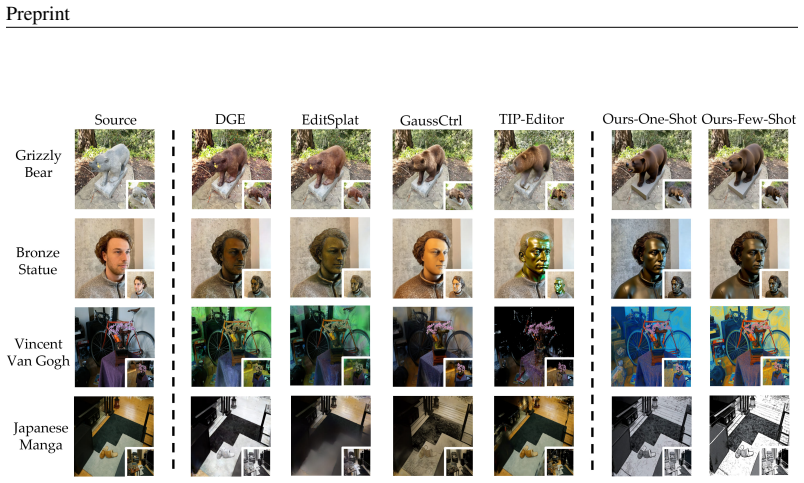
Summary. The paper proposes Tinker, a two-stage pipeline for text-driven 3D editing from one or two views without per-scene fine-tuning of generative models. It first fine-tunes FLUX Kontext with LoRA on a synthesized multi-view referring-editing dataset to propagate text-driven edits across sparse views. It then trains a Wan2.1-based scene-completion model conditioned on depth maps and reference views to reconstruct the remaining views. The completed edited views are used to optimize a 3D Gaussian Splatting scene. The paper reports state-of-the-art comparisons on Mip-NeRF-360 and IN2N, ablations, and additional applications to video reconstruction and quality refinement.
Significance. If the core generalization holds, this is a practically significant contribution: it removes per-scene fine-tuning of generative models for 3D editing and demonstrates one-shot/few-shot editing with diffusion priors. The proposed dataset and data pipeline are potentially valuable community resources. The paper also provides thorough ablations of the editing model and depth conditioning. However, the central empirical claim rests on an untested transfer assumption, and the quantitative evidence in the main comparison is thin. The paper does not ship code or proofs, but the claims are concrete and testable.
major comments (4)
- [§3.3, Eq. (4), Table 3] The central assumption that a scene-completion model trained on original views transfers to edited views is not directly tested. The model is trained on original views and evaluated only on original-video reconstruction (Table 3) or depth-conditioned generation with original references (Table S1). No experiment feeds edited reference views into the completion model and checks whether generated views follow the edited appearance. Because edited references are out-of-distribution, the model may fall back to reconstructing original content, which would collapse the sparse-to-dense editing pipeline. I request a direct probe: apply a deterministic appearance edit (e.g., color/relighting) to reference views, run the completion model, and measure whether generated views match the edited appearance using independent metrics and qualitative inspection.
- [§4.1, Table 1] The main quantitative comparison reports only three aggregate scores on two datasets with no error bars, per-scene breakdown, or significance tests. Several reported differences are very small (e.g., DINO 0.958 vs 0.959; CLIP-dir 0.143 vs 0.157), so the claim that Tinker 'consistently outperforms' is not supported. Please report per-scene values with standard deviations over multiple runs, or use paired significance tests. The same issue applies to Table S1 and Table 2.
- [§3.2, Eq. (2); §4.1/§4.2, Tables 1-2] DINOv2 similarity is used both to filter the training data (threshold τmv = 0.9) and as the primary multi-view consistency metric in Tables 1 and 2. This is circular: the editing model is explicitly trained to increase inter-view DINO similarity on pairs that were selected for high DINO similarity. Thus the reported DINO gains may reflect optimization of the evaluation metric rather than genuine geometric/view consistency. Add an independent consistency metric, e.g., epipolar/geometric reprojection error or a human study, and report it alongside DINO.
- [§3.1 one-shot protocol; §3.3 reference sampling] The one-shot protocol propagates edits by using generated views as subsequent references. However, the completion model is trained only with original views as references (always the first frame, plus 0-2 random original views). Generated and edited references are never seen in training, so errors are likely to accumulate in the iterative procedure. I request an error-accumulation analysis and, ideally, training or validation with simulated edited references (e.g., color-shifted original frames) to ensure that the completion model can actually use edited references as conditioning.
minor comments (6)
- [§1/§5] The phrase 'without per-scene optimization' is misleading because 3D Gaussian Splatting optimization per scene is still required. Clarify that the claim concerns per-scene fine-tuning of generative models, not the final 3D representation fitting.
- [Table 1] The 'On 24G GPU' column uses Yes/No without defining what is measured. Clarify whether this indicates feasibility, memory usage, or something else, and specify the GPU model.
- [§3.3] The fixed constant text embedding used during scene-completion training is not described in detail. State how it is obtained and whether it affects conditioning.
- [§4.2, Table 2] The before/after comparison would benefit from error bars and a description of how the 20 images per prompt per scene are selected and aggregated. Currently only a single average is shown.
- [Appendix A.1] Please report the dataset size per source and describe how duplicates or overlaps with the evaluation datasets are avoided, beyond the stated OpenVid-1M exclusion.
- [Figure 6] Qualitative comparisons are limited to favorable examples. Include representative failure cases for both one-shot and few-shot editing, especially cases where the completion model may ignore the edited reference.
Circularity Check
DINO-consistency gain is partly baked into data filtering; otherwise the pipeline is self-contained.
-
fitted input called prediction
[Section 3.2 (data filtering, Eq. 2) and Section 4.2 (Table 2); echoed in Table 1 and Table S1]
"we evaluate the similarity between the two edited views by smv = sim(fdino(I′a), fdino(I′b)), and filter out samples with low inter-view consistency below a threshold τmv by smv < τmv. ... We then compute the DINO similarity Oquab et al. (2023) among the generated images for each prompt in each scene and take the average across all scenes, which serves as a measure of cross-view consistency."
The same DINOv2 similarity that filters training pairs (smv > τmv, with τmv=0.9) is later used as the primary cross-view consistency metric in Table 2 and the main comparison in Table 1. The LoRA training target is Concat(I′a, I′b), where I′a and I′b are edited views already selected for high DINO inter-view similarity. Thus fine-tuning directly teaches the model to produce images that are DINO-similar to the given reference. Reporting the resulting DINO increase (0.862 to 0.943) as evidence of improved multi-view consistency is therefore partly a restatement of the data-selection criterion, not an independent measurement of generalization.
full rationale
I reviewed the derivation chain in Sections 3.2–3.3 and the experiments. The only concrete reduction I can exhibit is the DINO filter/evaluation overlap: the data pipeline uses DINO similarity both to keep training pairs and to score consistency improvements. This makes the reported DINO gains partially by construction, though the main 3D-editing claim also depends on scene completion and 3DGS optimization, which are not directly circular. The scene-completion step ('editing through reconstruction') is an untested generalization assumption rather than a circular derivation: Eq. 4 trains on original videos, and the paper explicitly states the goal of generalizing to edited scenes. That is a risk, not a circularity. The citation of Diception is for a preprocessing choice (treating depth as RGB tokens), not for a load-bearing claim. The fact that the dataset is generated by the same base model that is later fine-tuned (FLUX Kontext) is self-training, not logical circularity; it does not make the framework equivalent to its inputs. Overall, the DINO-metric circularity is partial and limited to one evaluation axis; the sparse-to-dense pipeline and the 'no per-scene finetuning' claim retain independent empirical content.
Assumptions & free parameters
free parameters (2)
- tau_noedit =
0.95
- tau_mv =
0.9
assumptions (5)
- domain assumption Pretrained FLUX Kontext produces high-quality multi-view consistent editing when given two concatenated views.
- domain assumption Depth maps from Video Depth Anything are sufficiently accurate to condition scene completion.
- domain assumption Training a reconstruction model on original videos generalizes to reconstruct edited scenes.
- domain assumption Wan2.1 video diffusion priors are strong enough to complete novel views from sparse inputs.
- standard math Flow matching loss and LoRA fine-tuning are valid training techniques.
Cite this review
Pith. "Pith review of Tinker: Diffusion's Gift to 3D--Multi-View Consistent Editing From Sparse Inputs without Per-Scene Optimization." pith.science (2026). https://pith.science/paper/BTXY3IEL
@misc{pith2026250814811,
  author       = {Pith},
  title        = {Pith review of: Tinker: Diffusion's Gift to 3D--Multi-View Consistent Editing From Sparse Inputs without Per-Scene Optimization},
  year         = {2026},
  howpublished = {\url{https://pith.science/paper/BTXY3IEL}},
  note         = {Machine review of arXiv:2508.14811}
}
read the original abstract
We introduce Tinker, a versatile framework for high-fidelity 3D editing that operates in both one-shot and few-shot regimes without any per-scene finetuning. Unlike prior techniques that demand extensive per-scene optimization to ensure multi-view consistency or to produce dozens of consistent edited input views, Tinker delivers robust, multi-view consistent edits from as few as one or two images. This capability stems from repurposing pretrained diffusion models, which unlocks their latent 3D awareness. To drive research in this space, we curate the first large-scale multi-view editing dataset and data pipeline, spanning diverse scenes and styles. Building on this dataset, we develop our framework capable of generating multi-view consistent edited views without per-scene training, which consists of two novel components: (1) Referring multi-view editor: Enables precise, reference-driven edits that remain coherent across all viewpoints. (2) Any-view-to-video synthesizer: Leverages spatial-temporal priors from video diffusion to perform high-quality scene completion and novel-view generation even from sparse inputs. Through extensive experiments, Tinker significantly reduces the barrier to generalizable 3D content creation, achieving state-of-the-art performance on editing, novel-view synthesis, and rendering enhancement tasks. We believe that Tinker represents a key step towards truly scalable, zero-shot 3D editing. Project webpage: https://aim-uofa.github.io/Tinker
Figures


Figures from the paper (7 more)




Forward citations
Cited by 5 Pith papers
-
Information-Regularized Constrained Inversion for Stable Avatar Editing from Sparse Supervision
A conditioning-guided constrained inversion method restricts avatar edits to a low-dimensional part-specific subspace and uses an information matrix spectrum from pipeline linearization to predict and ensure stability...
-
FluSplat: Sparse-View 3D Editing without Test-Time Optimization
FluSplat trains a model with geometric alignment constraints on multi-view edits to produce consistent 3D scene edits from sparse views in a single forward pass without test-time optimization.
-
TRACE: High-Fidelity 3D Scene Editing via Tangible Reconstruction and Geometry-Aligned Contextual Video Masking
TRACE anchors a video-diffusion editor to 3D meshes to perform consistent part-level edits on 3D Gaussian scenes in about 10 minutes per edit.
-
Edit in 2D, Verify in 3D: Reinforcement Learning for Multi-view Consistent Scene Editing
RL3DEdit fine-tunes FLUX-Kontext with GRPO using VGGT confidence and pose rewards to produce multi-view consistent 3D scene edits in a single pass.
-
DINOv3 with Test-Time Training for Medical Image Registration
A frozen DINOv3 encoder plus test-time optimization of the deformation field reaches Dice 0.790 on Abdomen MR-CT and 0.769 on ACDC cardiac MRI without any model training.
Reference graph
Works this paper leans on
-
[1]
Generate prompts covering various styles, weather, lighting, color changes
-
[2]
Do not suggest edits that severely distort or warp the shape of main objects
-
[3]
Return object-level editing prompts only when there are same objects in 2 images
-
[4]
Keep each prompt short and direct
-
[5]
, keep the other things unchanged
Every prompt MUST end with: ", keep the other things unchanged"
-
[6]
Omit all other text, including introductions and conclusions
Your response must only contain prompts. Omit all other text, including introductions and conclusions. ===================================== Generate editing prompts for this image: Change style to Vincint Van Gogh, keep the other things unchanged. Change the weather to snowy winter, keep the other things unchanged. Change the house to golden, keep the ot...
-
[2023]
for 3DGS optimization and rendering. B A DDITIONAL RESULTS B.1 A DDITIONAL VISUALIZATIONS We employ NeRFStudio (Tancik et al., 2023) to optimize the 3D Gaussian Splatting using the edited views as input, as illustrated in Figure S1. In this section, we further present additional one-shot and few-shot 3D editing results in Figure S4, S5, S6, S7. These comp...
work page 2023
-
[2025]
in Figure S3 and Table S1, which shows that our model better understands camera motion and more faithfully respects depth constraints. In addition to supporting depth-guided video genera- tion, V ACE also allows controlling the editing region via masks. We compare our method against both of these capabilities. For depth-guided video generation, the result...
Reviewed August 5, 2026 · model on record in the stance chip above.
Discussion (0). Sign in to comment.