REVIEW 1 major objections 4 minor 38 references
Asymmetric quantum multicast network coding: asymmetric optimal cloning over quantum networks
T0 review · 1 major / 4 minor · reviewed 2026-08-14 · deepseek-v4-flash
Pith's one-line read This paper constructs quantum network coding protocols that multicast 1→2 and 1→3 optimal asymmetric universal clones of a $q^r$-dimensional state, with constant shared entanglement.
desk verdict The 1-to-3 protocol looks genuinely sound, but the printed 1-to-2 proof has a coefficient error in Eq. (28) that breaks the main claim; the swap criticism in the report does not survive contact with the paper. read the letter →
The pith
A machine-rendered reading of the paper's core claim, the machinery that carries it, and where it could break.
The reading
What carries the argument
The load-bearing object is a compression–reconstruction pair of unitaries that fits a branch state carrying the clone information into a $q$-dimensional transmission. On the source side, after the cloning isometry and ancilla measurement, the unitary $\Upsilon^{(r)}$ rotates the conditional state into a single $d$-dimensional register; on the receiver side, the partial swaps $\Gamma^{(r)}$ together with $V^{(r)}$, $\Delta^{(r)}$, and $\Lambda^{(r)}$ redistribute the $r$-dependent components between the $d$-dimensional GHZ-shared systems and small two-dimensional systems, so the clone branches are rebuilt locally. The pre-shared entanglement between targets supplies the two-level routing degrees of freedom that the transmitted $d$-dimensional state cannot carry.
What would settle it
Apply the protocol with $q=3$ and measurement outcome $r=3$, and track the component $\cos\eta\,|2\rangle_E|3\rangle_F$ through Step 7: since $\Gamma^{(3)}$ is the identity whenever the control register is not in $|3\rangle$, this component stays in $EF$ and never moves to $GH$, so Eq. (34) fails, and the final reduced state on $EF$ would show a fidelity below the predicted optimal asymmetric bounds.
Extended reading notes
Core claim
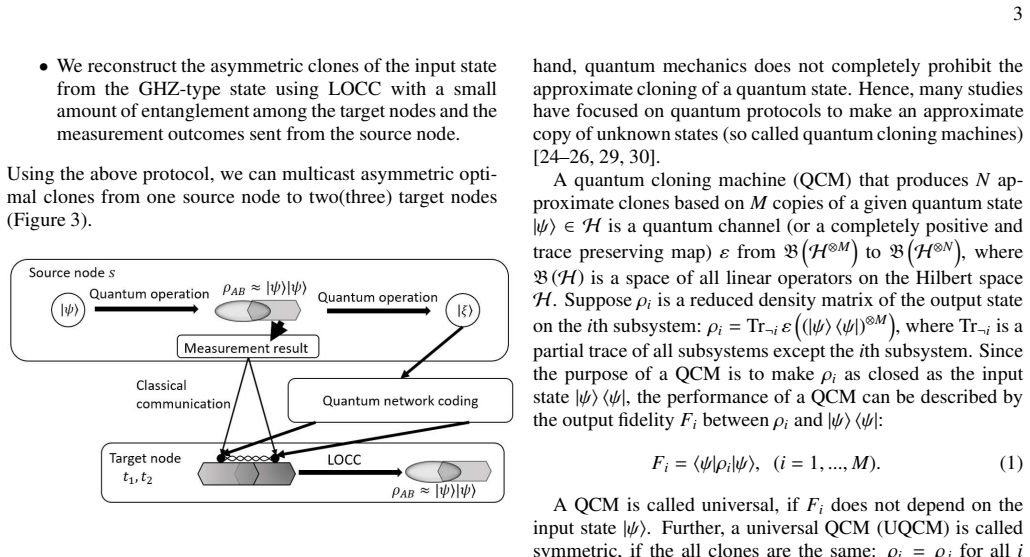
The central claim is that optimal asymmetric universal quantum cloning can be implemented as a distributed network protocol: the source applies the 1→2 (or 1→3) asymmetric cloning isometry, measures the ancilla, and compresses the conditional branch state into a single $d=q^r$-dimensional register; this register is multicast to all targets using a previously established quantum multicast subroutine that yields a shared GHZ-type state; and receivers then reconstruct their individual clones by local unitaries and measurements, using shared entangled pairs and the classical measurement outcome from the source. The protocol is claimed to end with the two (three) target nodes holding exactly the reduced states of an optimal asymmetric UQCM, with fidelities matching the optimal formulas, and with entanglement cost bounded by a constant independent of $q$. The 1→3 case is handled by a two-branch argument depending on whether the two ancilla measurement outcomes are equal or distinct.
Load-bearing premise
The 1-to-2 protocol assumes that the partial swap $\Gamma^{(r)}$ of Eq. (23) moves the $d$-level states $|r-1\rangle$ and $|r\rangle$ out of systems $E$ and $F$ into the two-dimensional systems $G$ and $H$ after Step 5, even though the swap as written acts only on the $|0\rangle,|1\rangle$ subspace.
Editorial extensions
If this is right
- If the claim holds, any quantum network with a solvable rate-$r$ classical linear multicast code on an acyclic orientation can multicast asymmetric clones, making clone-fidelity asymmetry a tunable network feature.
- The entanglement overhead is constant in $q$, so the cost of multicast cloning does not grow with the dimension of the cloned state; only the classical coding rate $r$ grows.
- For sufficiently large $q$, the classical-code existence condition is equivalent to each target's min-cut from the source being at least $r$, so the protocol applies from network-topology data alone.
- Setting the cloning parameters equal ($a=b$, or $\alpha=\beta=\gamma$) recovers symmetric optimal clone multicast as the symmetric limit of the same protocol.
- The 1-to-3 protocol explicitly branches on whether the two ancilla outcomes coincide, so the same transmitted $d$-dimensional state is decoded by two different reconstruction circuits.
Reading between the lines
- If the partial-swap reconstruction for general $r$ is repaired, for example by extending $\Gamma^{(r)}$ to move arbitrary $|r-1\rangle,|r\rangle$ pairs into the two-dimensional registers, the same scheme could plausibly extend to $1\to n$ clone multicasts for $n\ge 4$, since the $n=2,3$ cases need only $O(1)$ extra local dimensions.
- The protocol effectively realizes a flagged quantum state split: the ancilla outcome $r$ selects which computational branch is amplified, and the small shared entanglement carries only this flag; this suggests a general template in which any optimal cloning machine with a discrete flag can be multicast with constant entanglement.
- A concrete numerical test of the 1-to-2 protocol at $q=3$ would be to compare the two output reduced fidelities to $F_A=1-b^2(d-1)/d$ and $F_B=1-a^2(d-1)/d$; a mismatch for $r\notin\{1,2\}$ would locate exactly where the branch reconstruction fails.
Signed reviews
Editorial analysis
A structured set of objections, weighed in public.
Referee Report
Summary. The manuscript proposes quantum multicast network coding protocols that distribute optimal asymmetric universal quantum clones (1→2 and 1→3) from one source node to two or three target nodes. The protocols combine Cerf's asymmetric cloning isometry, Kobayashi et al.'s quantum multicast network coding for GHZ-type states, local compression via controlled operations, teleportation, and a constant amount of preshared entanglement. The main claimed result is that, under the stated assumptions on the underlying classical network code, the protocol multicasts optimal asymmetric clones of a q^r-dimensional state while consuming entanglement that does not scale with q.
Significance. If the central claim held, this would be a meaningful extension of Owari et al.'s symmetric-cloning multicast protocols to asymmetric cloning and would give a constructive, constant-overhead quantum network-coding scheme for this task. The 1→3 protocol appears more robust and I did not find a comparable algebraic error there. The paper also benefits from grounding the protocol in the independently established optimal asymmetric cloning results, so there is no circularity in the performance check. However, the 1→2 proof contains a load-bearing normalization error in Eq. (28) that invalidates the central claim as written; the error is local and appears fixable.
major comments (1)
- [III B, Eq. (28)] The coefficients β_j and β_r printed in Eq. (28) are reciprocals of the values required by the actual state after measuring M in Step 2, and consequently Eq. (29) is false as stated. Directly tracing the outcome branch from Eq. (2) gives the unnormalized state d^{-1/2}[(a+b)α_r|rr> + Σ_{j≠r} α_j(a|jr> + b|rj>)]. Since cosη = a/c and sinη = b/c with c² = 1 - 2ab/d, this branch is β_r|rr> + Σ_{j≠r} β_j(cosη|jr> + sinη|rj>) with β_r = α_r(a+b)/√d and β_j = α_j c/√d, not the expressions in Eq. (28). With the printed β values, the trace of the left-hand side of Eq. (29) on a normalized input is d/(a+b)² + d(d-1)/c²; for example, for d=2 and a=b=1/√3 this trace is 9/2 instead of 1, so the channel is not trace-preserving and Eq. (29) cannot hold. This error propagates through Eq. (30) and the final state (39), so the 1→2 multicast claim in Section V is unsupported as printed. Replacing Eq. (28) with the correct coefficients above is a local fix and restores the intended argument.
minor comments (4)
- [III A] The description of the preshared entanglement says "cosη|0>_E|1>_E + sinη|1>_E|0>_F is shared between E and F"; the first term should be |0>_E|1>_F, matching Eq. (31).
- [II A, Eq. (10)] The third fidelity in Eq. (10) is labeled F_A but should be F_C, since it concerns the output system C.
- [III A, Protocol 2, Steps 8-10] The transition from Eq. (34) to Eq. (35) assumes that quantum teleportation delivers the state on H to T1 without a Pauli byproduct. The protocol should state explicitly that the standard teleportation corrections are applied; otherwise the derivation skips a necessary step. This is easily fixed given the assumption of free classical communication.
- [Throughout] There are many typographical errors, including "procol" (Section III heading), "faor" (Section IV B), "differs" in the introduction, and inconsistent comma usage in Protocol 3 Step 2. The duplicate references [25]/[37], [26]/[38], and [30]/[39] should also be merged.
Circularity Check
No material circularity: the protocol is verified against the externally established optimal asymmetric cloning channel; self-citations are motivational only.
full rationale
The paper's central claim is that its network protocol reproduces the known 1→2 and 1→3 optimal asymmetric universal quantum cloning channels. The derivation is a constructive verification, not a circular one. The starting point is the externally given isometry U_{1→2} of Cerf (Eq. (2)) and the externally established 1→3 cloner of Iblisdir et al. (Eq. (7)); the paper's Eq. (26) expands the cloner output, and Eq. (27)-(29) decompose the post-measurement branches into states |Ψ_2^{(r)}⟩. The protocol then shows, step by step, that the network operations (V^{(r)}, Δ^{(r)}, Γ^{(r)}, Θ, Λ^{(r)}, Fourier measurements) transform the compressed GHZ-type state back into exactly those branch states (Eqs. (31)-(39)). This is a reduction of the network protocol to the known cloner, not an assumption of the conclusion. The only self-citations are Owari et al.'s symmetric-clone patents, refs. [11]-[13], used in the introduction and conclusion as background and motivation; no load-bearing lemma or uniqueness theorem is imported from them, and the correctness proof is self-contained. The potential defect identified in Eq. (28) (reciprocal normalization of β_j, which would break Eq. (29)) is a derivation/correctness error, not a circularity: the claimed identity does not reduce to its own input; it merely fails to hold for the printed coefficients. Thus no circular step can be exhibited, and the paper is self-contained against external quantum-cloning benchmarks.
Assumptions & free parameters
assumptions (4)
- domain assumption Optimal asymmetric universal quantum cloning machines with fidelities given by Eqs. (6) and (10) exist and are universally optimal.
- domain assumption Kobayashi et al.'s quantum multicast protocol correctly produces the required GHZ-type state on target nodes under the stated graph and classical-code conditions.
- standard math The classical linear multicast network code existence theorem, including the max-flow min-cut condition, holds over finite fields.
- domain assumption Free classical communication and noiseless quantum channels are available on the network.
Cite this review
Pith. "Pith review of Asymmetric quantum multicast network coding: asymmetric optimal cloning over quantum networks." pith.science (2026). https://pith.science/paper/BU3UE75M
@misc{pith2026190800705,
  author       = {Pith},
  title        = {Pith review of: Asymmetric quantum multicast network coding: asymmetric optimal cloning over quantum networks},
  year         = {2026},
  howpublished = {\url{https://pith.science/paper/BU3UE75M}},
  note         = {Machine review of arXiv:1908.00705}
}
abstract
In this study, we consider a quantum version of multicast network coding as a multicast protocol for sending universal quantum clones (UQCs) from a source node to the target nodes on a quantum network. By extending Owari et al.'s previous results for symmetric UQCs, we derive a protocol for multicasting $1\rightarrow 2$ ($1\rightarrow 3$) {\it asymmetric} UQCs of a $q^r$-dimensional state to two (three) target nodes.Our protocol works under the condition that each edge on a quantum network represented by an undirected graph $G$ transmits a $q$-dimensional state. There exists a classical solvable linear multicast network code with a source rate of $r$ on a classical network $G'$, where $G$ is an undirected underlying graph of an acyclic directed graph $G'$. We also assume free classical communication over a quantum network.
Figures

Reference graph
Works this paper leans on
-
[1]
Tracey Ho and Desmond S. Lun. Network Coding: an introduc- tion. Cambridge University Press (2008)
work page 2008
-
[2]
Information Theory and Network Cod- 14 ing
Raymond W. Yeung, “Information Theory and Network Cod- 14 ing”, Springer (2008)
work page 2008
-
[3]
Ahlswede, Ning Cai, Shuo-Yen Robert Li, Raymond W
R. Ahlswede, Ning Cai, Shuo-Yen Robert Li, Raymond W. Ye- ung, ”Network information flow”, IEEE Trans. on Inf. Theor. 46, No.4 (2000)
work page 2000
-
[4]
M. Hayashi, K. Iwama, H. Nishimura, R. Raymond, and S. Ya- mashita, “Quantum Network Coding,” in STACS 2007 SE - 52 (W. Thomas and P . Weil, eds.), vol. 4393 of Lecture Notes in Computer Science , pp. 610–621, Springer Berlin Heidelberg, 2007
work page 2007
-
[5]
Prior entanglement between senders enable s per- fect quantum network coding with modification,
M. Hayashi, “Prior entanglement between senders enable s per- fect quantum network coding with modification,” Phys. Rev. A, vol. 76, no. 4, 40301, 2007
work page 2007
-
[6]
On multicast in quantum networks
Y . Shi and E. Soljanin. “On multicast in quantum networks ” in 40th Annual Conference on Information Sciences and Systems , page 871-876, 2006
work page 2006
-
[7]
Gen- eral Scheme for Perfect Quantum Network Coding with Free Classical Communication,
H. Kobayashi, F. Le Gall, H. Nishimura, and M. R¨ otteler,“Gen- eral Scheme for Perfect Quantum Network Coding with Free Classical Communication,” in Automata, Languages and Pro- gramming SE - 52 (S. Albers, A. Marchetti-Spaccamela, Y . Ma- tias, S. Nikoletseas, and W. Thomas, eds.), vol. 5555 of Lecture Notes in Computer Science , pp. 622–633, Springer B...
work page 2009
-
[8]
Per- fect quantum network communication protocol based on clas- sical network coding,
H. Kobayashi, F. Le Gall, H. Nishimura, and M. Rotteler, “ Per- fect quantum network communication protocol based on clas- sical network coding,” in Proceedings of 2010 IEEE Inter- national Symposium on Information Theory (ISIT) , pp. 2686– 2690, 2010
work page 2010
Show all 38 references
-
[9]
Quantum Network Communication; The Butterfly and Beyond,
D. Leung, J. Oppenheim, and A. Winter, “Quantum Network Communication; The Butterfly and Beyond,” IEEE Transac- tions on Information Theory , vol. 56, no. 7, 3478–3490, 2010
2010
-
[10]
Con- structing quantum network coding schemes from classical no n- linear protocols,
H. Kobayashi, F. Le Gall, H. Nishimura, and M. Rotteler, “Con- structing quantum network coding schemes from classical no n- linear protocols,” in Proceedings of 2011 IEEE International Symposium on Information Theory (ISIT) , pp. 109–113, 2011
2011
-
[11]
Multicast quantum network coding on the butterfly network
M. Owari, G. Kato, M. Murao, “Multicast quantum network coding on the butterfly network” Japan patent JP2013-201654 A (in Japanese)
-
[12]
Multicast quantum network coding
G. Kato, M. Owari, M. Murao, “Multicast quantum network coding” Japan patent JP2014-192875A (in Japanese)
-
[13]
Multicast quantum netowk co d- ing
G. Kato, M. Owari, M. Murao “Multicast quantum netowk co d- ing” Japan patent JP2015-220621A (in Japanese)
-
[14]
Quantum Router with Network Coding
Michael Epping, Hermann Kampermann, Dagmar Bruß, “Quantum Router with Network Coding”, New Journal of Physics, vol.18, 103052 (2016)
2016
-
[15]
Owari, G
M. Owari, G. Kato, and M. Hayashi, Secure Quantum Networ k Coding on Butterfly Network, Quantum Science and Technol- ogy, vol. 3, 014001 (2017)
2017
-
[16]
G. Kato, M. Owari, and M. Hayashi, Single-Shot Secure Qu an- tum Network Coding for General Multiple Unicast Network with Free Public Communication, In: Shikata J. (eds) 10th International Conference on Information Theoretic Securi ty (ICITS2017). Lecture Notes in Computer Sci...
-
[17]
Quantum Network Cod e for Multiple-Unicast Network with Quantum Invertible Line ar Operations
Seunghoan Song, Masahito Hayashi “Quantum Network Cod e for Multiple-Unicast Network with Quantum Invertible Line ar Operations”, Proceedings of 13th Conference on the Theory of Quantum Computation, Communication and Cryptography (TQC 2018) (2018)
2018
-
[18]
Secure Quan- tum Network Code without Classical Communication
Seunghoan Song, Masahito Hayashi, “Secure Quan- tum Network Code without Classical Communication” arXiv:1801.03306 (2018)
2018 arXiv
-
[19]
Analysis of Quantum Network Coding for Realistic Re - peater Networks
Takahiko Satoh, Kaori Ishizaki, Shota Nagayama, Rodne y V an Meter, “Analysis of Quantum Network Coding for Realistic Re - peater Networks” Physical Review A vol.93, 032302 (2016)
2016
-
[20]
Analysis of Measurement-based Quantum Net- work Coding over Repeater Networks under Noisy Condi- tions
Takaaki Matsuo, Takahiko Satoh, Shota Nagayama, Rodne y V an Meter, “Analysis of Measurement-based Quantum Net- work Coding over Repeater Networks under Noisy Condi- tions”, Physical Review A, vol.97, 062328 (2018)
2018
-
[21]
Network coding for distrib uted quantum computation over cluster and butterfly networks
Seiseki Akibue, Mio Murao, “Network coding for distrib uted quantum computation over cluster and butterfly networks” IEEE Transaction on Information Theory vol.62, pp. 6620 - 6637 (2016)
2016
-
[22]
Network Coding for Multiple Uni- casts: An Approach based on Linear Optimization
Danail Traskov Niranjan Ratnakar ; Desmond S. Lun ; Ralf Koetter ; Muriel Medard “Network Coding for Multiple Uni- casts: An Approach based on Linear Optimization”, Proceed- ings of 2006 IEEE International Symposium on Information Theory (ISIT2006), pp. 1758-1762 (2006)
2006
-
[23]
Wootters, Wojciech H
William K. Wootters, Wojciech H. Zurek, Nature, 299 (19 82)
-
[24]
Vladimir Buzek, Mark Hillery, Phys. Rev. A, 54, 1844 (19 96)
-
[27]
Gri ffiths, Phys
Chi-Sheng Niu, Robert B. Gri ffiths, Phys. Rev. A , 58, 4377, (1998)
1998
-
[28]
Cerf, Acta
Nicolas J. Cerf, Acta. Phys. Slov., 48, 115, (1998)
1998
-
[29]
Nicolas J. Cerf, J. Mod. Opt., 47, pp.187-209, (2000)
2000
-
[30]
Iblisdir, A
S. Iblisdir, A. Ac´ ın, N. J. Cerf, R. Filip, J. Fiur´ aˇ se k, and N. Gisin, Phys. Rev. A, 72, 042328 (2005)
2005
-
[31]
Hayashi, Group Representation for Quantum Theory , Springer (2017)
M. Hayashi, Group Representation for Quantum Theory , Springer (2017)
2017
-
[32]
Qu an- tum network communication – the butterfly and beyond
Debbie Leung, Jonathan Oppenheim, Andreas Winter. “Qu an- tum network communication – the butterfly and beyond”, IEEE Transactions on Information Theory 56, pp.3478 - 3490, (2010)
2010
-
[33]
General Scheme for Perfect Quantum Net- work Coding with Free Classical Communication
Hirotada Kobayashi, Franc ¸ois Le Gall, Harumichi Nish imura, Martin R¨ otteler, “General Scheme for Perfect Quantum Net- work Coding with Free Classical Communication”, In ICALP 2009, 5555 of Lecture Note in Computer Science , pp.622-633, (2009)
2009
-
[34]
Constructing quantum network coding schemes from classical nonlinear protocols
Hirotada Kobayashi, Franc ¸ois Le Gall, Harumichi Nish imura, Martin R¨ otteler, “Constructing quantum network coding schemes from classical nonlinear protocols”, Information The- ory Proceedings (ISIT), 2011 IEEE International Symposium on, (2011)
2011
-
[35]
Perfect Quantum Network Communication Protocol Based on Classical Network Coding
Hirotada Kobayashi, Franc ¸ois Le Gall, Harumichi Nish imura, Martin R¨ otteler, “Perfect Quantum Network Communication Protocol Based on Classical Network Coding”, Proceedings 2010 IEEE International Symposium on Information Theory (ISIT 2010), pp. 2686-2690, (2010)
2010
-
[36]
Multicast quantum ne t- work coding
Go Kato, Masaki Owari, Mio Murao, “Multicast quantum ne t- work coding”, Japan-Patent, Tokkai 2015-220621 (2015)
2015
-
[37]
Quantum cloning
V alerio Scarani, Sofyan Iblisdir, and Nicolas Gison, “ Quantum cloning”, Rev. Mod. Phys. 77, pp.1225-1256, (2005)
2005
-
[38]
241-322, (2014)
Heng Fan, Yi-Nan Wang, Li Jing, Jie-Dong Y ue, Han-Duo Sh i, Y ong-Liang Zhang, Liang-Zhu Mu, Physics Reports 544, pp. 241-322, (2014)
2014
-
[39]
Multipartite asymmetric quantum cloning
S. Iblisdir, A. Ac´ ın, N. J. Cerf, R. Filip, J. Fiur´ aˇ se k, and N. Gisin, “Multipartite asymmetric quantum cloning” Phys. Re v. A 72, 042328 (2005)
2005
-
[40]
Teleporting an unknown quantum state via dual classical and Einstein- Podolsky-Rosen Channels
Charles H. Bennett, Gilles Brassard, Claude Cr´ epeau, Richard jozsa, Asher Peres, and William K. Wootters, “Teleporting an unknown quantum state via dual classical and Einstein- Podolsky-Rosen Channels”, Phys. Rev. Lett. 70, (1993)
1993
Reviewed August 14, 2026 · model on record in the stance chip above.
Discussion (0). Continue with ORCID to comment.