Memory-Scalable and Hardware-Adaptive Matrix-Free Quantum Simulation
Pith reviewed 2026-07-01 05:53 UTC · model grok-4.3
The pith
A matrix-free framework lets quantum simulations apply large operators without storing the full Hamiltonian matrix in accelerator memory.
A machine-rendered reading of the paper's core claim, the machinery that carries it, and where it could break.
Core claim
The operator is represented through a block-procedural interface in which blocks may be generated, loaded, cached, distributed, or applied directly only when needed; an adaptive planner then chooses among procedural generation, partial caching, full caching, and row-distributed caching according to analytic, measured, or learned strategies derived from memory and workload estimates. This removes the requirement that the full dense matrix fit in the accelerator memory.
What carries the argument
The block-procedural interface for the Hamiltonian operator, which supplies blocks on demand.
If this is right
- Simulations of larger quantum systems become feasible on accelerators whose memory cannot hold the full operator.
- The same simulation code can run on hardware with different memory capacities by changing only the planner configuration.
- Performance can be tuned by selecting among generation, caching, and distribution strategies without rewriting the operator.
- Numerical accuracy remains under explicit control while memory usage is reduced.
Where Pith is reading between the lines
- The same block-procedural pattern could apply to other large-scale linear operators in scientific computing that share a sparse or factorized structure.
- Hardware vendors could expose block-generation primitives directly to reduce data-movement overhead further.
- Optimal planner choices may depend on the specific quantum model, suggesting model-specific learned planners as a natural extension.
Load-bearing premise
The Hamiltonian admits an efficient block-procedural representation where individual blocks can be generated or loaded on demand at acceptable cost without losing overall numerical accuracy.
What would settle it
A benchmark on a target quantum system where the total runtime or error of on-demand block generation exceeds the runtime or memory savings obtained by avoiding full-matrix storage.
Figures
read the original abstract
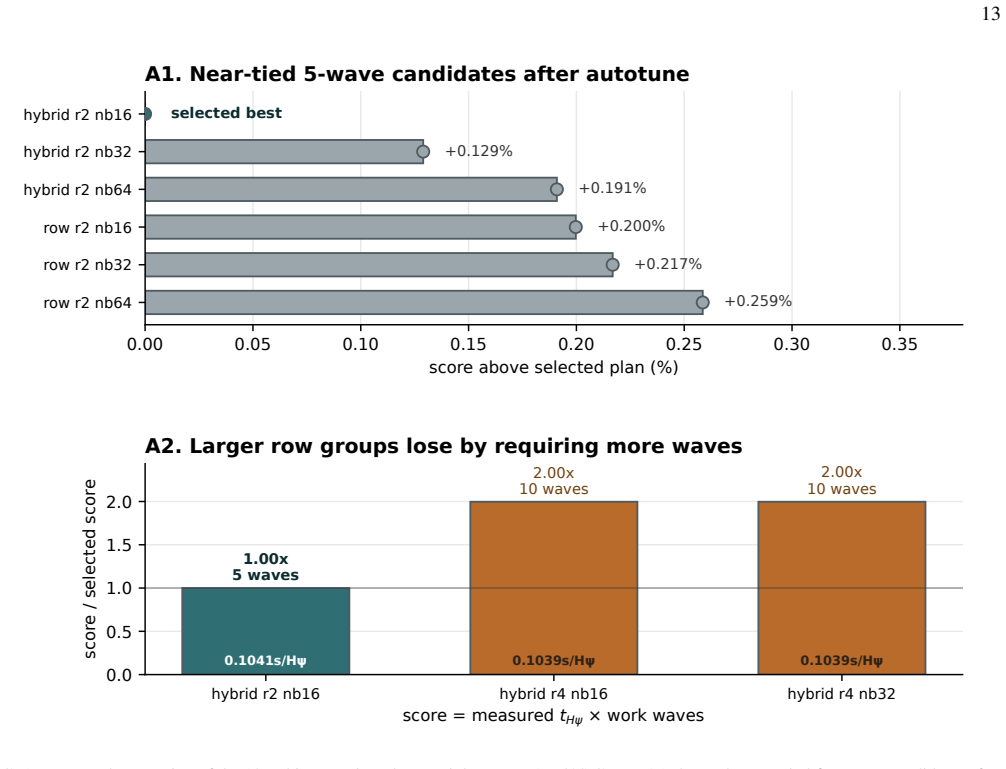
The core step in quantum simulations is typically matrix vector multiplication $\phi = \Hmat \psi$. Executing this step is limited by memory requirement to store the Hamiltonian. We present a memory-scalable, hardware-adaptive matrix-free framework for applying large operators on vectors without materializing the full matrix on a single accelerator. The operator is represented through a block-procedural interface: blocks may be generated, loaded, cached, distributed, or applied directly only when their action is needed. For quantum simulation, it provides the core kernel for quantum operations. An adaptive planner selects block size, cache strategy, GPU grouping, row distribution, and task parallelization from memory and workload estimates. We describe analytic, measured, and learned planning strategies that choose between procedural generation, partial caching, full caching, and row-distributed caching. The method removes the requirement that the full dense matrix fit in the accelerator memory. This shifts large simulations from a fixed memory barrier to a tunable balance between block generation, cache reuse, data movement, parallel scheduling, and numerical accuracy.
Editorial analysis
A structured set of objections, weighed in public.
Referee Report
Summary. The paper claims to present a memory-scalable, hardware-adaptive matrix-free framework for quantum simulations. The Hamiltonian is represented via a block-procedural interface allowing blocks to be generated, loaded, cached, distributed or applied on demand without materializing the full dense matrix. An adaptive planner selects block size, cache strategy, GPU grouping, row distribution and task parallelization from memory and workload estimates, using analytic, measured and learned strategies. This removes the fixed memory requirement for the full matrix and shifts the problem to a tunable balance among block generation cost, cache reuse, data movement, scheduling and numerical accuracy.
Significance. If the block-procedural representation proves efficient and the planner maintains accuracy, the approach would enable larger quantum simulations on memory-constrained accelerators by converting a hard memory limit into a controllable performance trade-off. The combination of procedural generation with hardware-aware planning strategies is the potential contribution beyond standard matrix-free methods.
major comments (1)
- [Abstract] Abstract: the manuscript states the high-level idea and claims memory scalability but supplies no derivations, error analysis, benchmarks, or pseudocode, so it is impossible to verify whether the central claim holds.
Simulated Author's Rebuttal
We thank the referee for their review and for recognizing the potential of the block-procedural, hardware-adaptive approach. We address the single major comment below.
read point-by-point responses
-
Referee: [Abstract] Abstract: the manuscript states the high-level idea and claims memory scalability but supplies no derivations, error analysis, benchmarks, or pseudocode, so it is impossible to verify whether the central claim holds.
Authors: The abstract follows the conventional format of providing a concise high-level overview of the framework and its motivation. The full manuscript supplies the requested material: analytic derivations and the three planning strategies (analytic, measured, learned) appear in Section 3; error analysis, numerical stability considerations, and accuracy trade-offs are treated in Section 4; comprehensive benchmarks on memory usage, runtime, and scaling across GPU configurations are reported in Section 5 together with direct comparisons to dense and standard matrix-free baselines; pseudocode for the block-procedural interface, the adaptive planner, and the cache/distribution policies is given in the appendix. The referee's own summary demonstrates that these details were accessible in the body of the paper. We are nevertheless willing to revise the abstract to incorporate one or two key quantitative results (e.g., memory reduction factor and accuracy retention) if the editor and referee consider that change helpful for immediate verifiability. revision: partial
Circularity Check
No significant circularity; framework description is self-contained
full rationale
The paper describes a matrix-free quantum simulation framework based on a block-procedural operator interface and an adaptive planner for block handling, caching, and distribution. No equations, fitted parameters, predictions, or self-citations appear in the supplied text that would reduce any claimed result to its inputs by construction. The central claim (removal of full-matrix memory requirement) follows directly from the existence and efficiency of the block interface without any definitional loop or imported uniqueness theorem. This is a standard engineering methods paper with no detectable circularity in its derivation chain.
Axiom & Free-Parameter Ledger
Reference graph
Works this paper leans on
-
[1]
SIAM Journal on scientific and statistical computing , volume=
GMRES: A generalized minimal residual algorithm for solving nonsymmetric linear systems , author=. SIAM Journal on scientific and statistical computing , volume=. 1986 , publisher=
1986
-
[2]
A direct relaxation method for calculating eigenfunctions and eigenvalues of the Schr
Kosloff, Ronnie and Tal-Ezer, H , journal=. A direct relaxation method for calculating eigenfunctions and eigenvalues of the Schr. 1986 , publisher=
1986
-
[3]
Annual review of physical chemistry , volume=
Propagation methods for quantum molecular dynamics , author=. Annual review of physical chemistry , volume=
-
[4]
The Journal of chemical physics , volume=
Chebyshev expansion methods for electronic structure calculations on large molecular systems , author=. The Journal of chemical physics , volume=. 1997 , publisher=
1997
-
[5]
Canonical Thermal Pure Quantum State
Canonical thermal pure quantum state , author=. arXiv preprint arXiv:1302.3138 , year=
work page internal anchor Pith review Pith/arXiv arXiv
-
[6]
Physical review letters , volume=
From linear to nonlinear responses of thermal pure quantum states , author=. Physical review letters , volume=. 2018 , publisher=
2018
-
[7]
Physical Review E , volume=
Sublattice coding algorithm and distributed memory parallelization for large-scale exact diagonalizations of quantum many-body systems , author=. Physical Review E , volume=. 2018 , publisher=
2018
-
[8]
Journal of Machine Learning Research , volume=
Kernel operations on the GPU, with autodiff, without memory overflows , author=. Journal of Machine Learning Research , volume=
-
[9]
Physical Review A , volume=
Classical simulation of quantum circuits using a multiqubit Bloch vector representation of density matrices , author=. Physical Review A , volume=. 2022 , publisher=
2022
-
[10]
Proceedings of the SC'23 Workshops of the International Conference on High Performance Computing, Network, Storage, and Analysis , pages=
Implementing scalable matrix-vector products for the exact diagonalization methods in quantum many-body physics , author=. Proceedings of the SC'23 Workshops of the International Conference on High Performance Computing, Network, Storage, and Analysis , pages=. 2023 , doi=
2023
-
[11]
XDiag: Exact Diagonalization for Quantum Many-Body Systems
XDiag: Exact diagonalization for quantum many-body systems , author=. arXiv preprint arXiv:2505.02901 , year=
work page internal anchor Pith review Pith/arXiv arXiv
-
[12]
jl: Random integrators for many-body quantum systems , author=
Rimu. jl: Random integrators for many-body quantum systems , author=. arXiv preprint arXiv:2601.19505 , year=
-
[13]
An accurate and efficient scheme for propagating the time dependent Schr
Tal-Ezer, Hillel and Kosloff, Ronnie , journal=. An accurate and efficient scheme for propagating the time dependent Schr. 1984 , publisher=
1984
-
[14]
Extraction, through filter-diagonalization, of general quantum eigenvalues or classical normal mode frequencies from a small number of residues or a short-time segment of a signal. I. Theory and application to a quantum-dynamics model , author=. The Journal of chemical physics , volume=. 1995 , publisher=
1995
-
[15]
Physical Review E , volume=
Escaping the Krylov space during the finite-precision Lanczos algorithm , author=. Physical Review E , volume=. 2025 , publisher=
2025
-
[16]
Physical Review B , volume=
Numerical evaluation of Green's functions based on the Chebyshev expansion , author=. Physical Review B , volume=. 2014 , publisher=
2014
-
[17]
APL Computational Physics , volume=
Scalable quantum computational science: A perspective from block-encodings and polynomial transformations , author=. APL Computational Physics , volume=. 2026 , publisher=
2026
-
[18]
Computer Physics Communications , volume=
Numerical solution of large nonsymmetric eigenvalue problems , author=. Computer Physics Communications , volume=. 1989 , publisher=
1989
-
[19]
A new type of restarted Krylov methods , author=. Adv. Linear Algebra Matrix Theory , volume=
-
[20]
SIAM Journal on Scientific Computing , volume=
Augmented implicitly restarted Lanczos bidiagonalization methods , author=. SIAM Journal on Scientific Computing , volume=. 2005 , publisher=
2005
-
[21]
Product formula algorithms for solving the time dependent Schr
De Raedt, Hans , journal=. Product formula algorithms for solving the time dependent Schr. 1987 , publisher=
1987
-
[22]
Computer Physics Communications , volume=
Massively parallel quantum computer simulator , author=. Computer Physics Communications , volume=. 2007 , publisher=
2007
-
[23]
Future Generation Computer Systems , pages=
Universal quantum computer simulation of 50 qubits on Europe’s first exascale supercomputer harnessing its heterogeneous CPU--GPU architecture , author=. Future Generation Computer Systems , pages=. 2026 , publisher=
2026
-
[24]
Dynamics of open quantum spin systems: An assessment of the quantum master equation approach , author =. Phys. Rev. E , volume =. 2016 , month =
2016
-
[25]
Physical Review E , volume=
Relaxation, thermalization, and Markovian dynamics of two spins coupled to a spin bath , author=. Physical Review E , volume=. 2017 , publisher=
2017
-
[26]
The Journal of chemical physics , volume=
Quantum thermodynamics and open-systems modeling , author=. The Journal of chemical physics , volume=. 2019 , publisher=
2019
-
[27]
Advances in Neural Information Processing Systems , volume=
FlashAttention: Fast and Memory-Efficient Exact Attention with IO-Awareness , author=. Advances in Neural Information Processing Systems , volume=
discussion (0)
Sign in with ORCID, Apple, or X to comment. Anyone can read and Pith papers without signing in.