REVIEW 2 major objections 5 minor 39 references
DFingerNet: Noise-Adaptive Speech Enhancement for Hearing Aids
T0 review · 2 major / 5 minor · reviewed 2026-08-10 · deepseek-v4-flash
Pith's one-line read DFingerNet shows that adding a noise-fingerprint encoder to a pretrained hearing-aid DeepFilterNet improves speech enhancement, and that the gain survives selectively disabling the fingerprint during training.
desk verdict Two things to know: the VCTK-FSD gain is probably inflated by near-oracle same-file fingerprints, and the more realistic DEMAND benchmark shows DFiN losing to the base model. read the letter →
The pith
A machine-rendered reading of the paper's core claim, the machinery that carries it, and where it could break.
The reading
What carries the argument
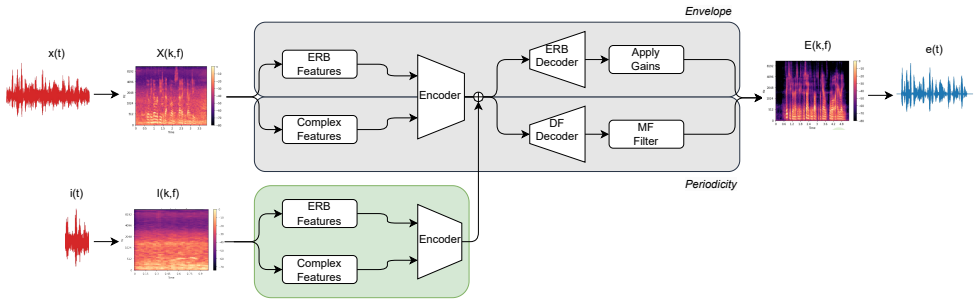
The load-bearing piece is the fingerprint encoder $F_{\mathrm{fing}}$, a second encoder that takes the spectrum of a short background-noise clip and produces an embedding $E_{\mathrm{fing}}(k,f')$. This embedding is fused into the main DeepFilterNet encoder output $E_{\mathrm{main}}(k,f')$ by simple additive fusion averaged over the fingerprint's time frames, as in Eq. (5): $E(k,f') = E_{\mathrm{main}}(k,f') + \frac{1}{K}\sum_{l\le K}E_{\mathrm{fing}}(l,f')$. The fused embedding then flows through the pretrained DeepFilterNet decoder, which estimates ERB-domain gains and multi-frame filters. The paper's design choice is to keep the main encoder and decoder fixed from the pretrained hearing-aid model and train only the new encoder, so the adaptation is an add-on rather than a retrained monolith.
What would settle it
Retrain DFiN on AudioSet noise after explicitly removing every FSD50K clip from the training pool, then rerun the VCTK-FSD evaluation; if the reported 0.5 dB SI-SDR gain over DFN is preserved, the conclusion stands, and if it collapses, the headline result was an artifact of train and evaluation noise overlap.
Extended reading notes
Core claim
The central claim is that a DeepFilterNet optimized for hearing aids can be made noise-adaptive by conditioning it on a fingerprint of the environment, and that this improves enhancement without requiring a larger model: on VCTK-FSD, DFiN improves SI-SDR by 11.35 dB over the noisy mixture versus 10.84 dB for the base DFN, with PESQ delta 0.39 versus 0.31 and STOI delta 0.07 versus 0.05. The authors further claim that the simplest configuration, a randomly initialized encoder with the same architecture as the main encoder plus additive fusion, performs best, and that selective disabling of fingerprints during training (DFiN-Sel) keeps the benefit when fingerprints are available while degrading gracefully when they are not. Stress tests show the fingerprint acts as a noise-profile signal: using clean speech as the fingerprint hurts performance (10.61 dB) whereas using the true noise helps (11.46 dB).
Load-bearing premise
The paper's main benchmark rests on the assumption that its training noise from AudioSet and its evaluation noise from FSD50K do not overlap, yet because FSD50K is drawn from AudioSet and the paper does not state that FSD50K clips were explicitly excluded from the AudioSet training pool, this separation is not verified.
Editorial extensions
If this is right
- A hearing aid could leave the fingerprint encoder off-device: the fingerprint can be captured by a phone or watch and streamed to the aid, since fingerprints taken up to two minutes before the mixture still work on DEMAND.
- Selective training (DFiN-Sel) makes the add-on safe in the field: with fingerprints absent, the model still improves SI-SDR by 11.11 dB instead of falling below the unadapted baseline, and with fingerprints present it matches full DFiN at 11.34 dB.
- The mechanism behaves as a noise-profile conditioner: replacing the fingerprint with clean speech degrades performance to 10.61 dB, while supplying the actual noise raises it to 11.46 dB, bracketing what the model can extract from the conditioning signal.
- The simplest configuration wins: a randomly initialized fingerprint encoder with additive fusion outperforms weight sharing (DFiN-SE), a pretrained audio-tagging encoder (DFiN-Cnn14), and cross-attention fusion (DFiN-XAtt), so the low-cost option is also the best supported by the data.
Reading between the lines
- Going beyond the paper: the fingerprint mechanism is not architecturally tied to DeepFilterNet, so a natural test is whether the same additive-embedding conditioning transfers to other low-complexity enhancement backbones; the paper only demonstrates it on the DFN family.
- Going beyond the paper: because FSD50K is a subset of AudioSet, an explicit exclusion test that retrains with all FSD50K clips removed from the AudioSet training pool would separate genuine adaptation gains from leakage of evaluation noise into training.
- Going beyond the paper: the paper leaves open whether noise fingerprints interfere with or complement speaker-adaptation conditioning; a combined conditioning experiment would clarify whether the two adaptation signals can be stacked.
Signed reviews
Editorial analysis
A structured set of objections, weighed in public.
Referee Report
Summary. The paper proposes DFingerNet (DFiN), a modification of the DeepFilterNet (DFN) speech-enhancement model for hearing aids. A separate fingerprint encoder consumes a recording of background noise and injects its averaged embedding into the pretrained DFN encoder before decoding. The authors compare several fusion and initialization variants (DFiN, DFiN-SI, DFiN-SE, DFiN-Cnn14, DFiN-XAtt), a selectively trained version DFiN-Sel, and stress tests with speech/noise fingerprints, on VCTK-FSD, VCTK-DEMAND, and VCTK-ESC. They report that DFiN improves over DFN on VCTK-FSD (ΔSI-SDR 11.35 vs 10.84 dB) and that DFiN-Sel retains most of the gain when fingerprints are randomly disabled during training, while acknowledging that DFN is better on VCTK-DEMAND.
Significance. If validated, the contribution is a lightweight, optional adaptation module for an existing hearing-aid-oriented speech enhancement model. The manuscript's main strengths are its systematic variant comparison, the selective fingerprint-use training scheme, and the upper/lower-bound stress tests. However, the main evidence currently rests on a single benchmark whose fingerprint protocol gives the model near-oracle same-file noise information, and no uncertainty quantification is provided. I also note that the specific concern about FSD50K being a clip-level subset of AudioSet does not land, because FSD50K is a Freesound-derived dataset; the same-file fingerprint issue is the substantive concern.
major comments (2)
- [Section II (Evaluation datasets), Table III, Fig. 2] The headline VCTK-FSD result is obtained with fingerprints cut from the first second of the same noise file whose remainder is mixed with speech. This is not an independent environment fingerprint; it is a segment of the exact noise realization to be removed. Table III shows the upper bound obtained by using the full noise signal as fingerprint (ΔSI-SDR 11.46 dB), and DFiN's VCTK-FSD score is 11.35 dB, i.e., within 0.11 dB of that bound. In the more realistic DEMAND setup with fingerprints taken 3–120 s before the mixture, the paper reports that the base DFN achieves ΔSI-SDR 11.85 dB, exceeding DFiN. Therefore the central claim that DFiN improves over DFN in realistic hearing-aid conditions is not established by the current evidence; please report VCTK-FSD with temporally separated fingerprints, or otherwise quantify the performance gap when the fingerprint is not drawn from the same noise realization.
- [Section III (Results), Tables I–III] All reported metrics are single-run point estimates without error bars, confidence intervals, or significance tests. The main differences are modest (ΔSI-SDR 11.35 vs 10.84 dB; ΔPESQ 0.39 vs 0.31; ΔSTOI 0.07 vs 0.05), and no seed variation is reported. Since the fingerprint encoder is randomly initialised and the mixing procedure is stochastic, multi-seed training or at least bootstrap resampling over test items is needed to show that the gains are stable.
minor comments (5)
- [Section II, Eq. (5)] The time indices are inconsistent: Eq. (4) uses k and k', Eq. (5) sums over l, and K is described as the total duration of the fingerprint; please define these quantities precisely and use matching notation.
- [Table I] The PMOS column is not defined in the text; only DNSMOS is introduced in Section II, so please state whether PMOS is a separate metric or a short-hand for the DNSMOS P.808 output and whether the table reports raw or delta values.
- [Fig. 3] The radar chart aggregates ESC-50 categories, but category-level sample sizes are not reported; please state the number of files per category or add confidence intervals, since some categories may contain very few files.
- [Section III (Robustness to distribution shift)] The sentence stating that the base DFN outperformed DFiN on DEMAND should be reflected in the abstract and conclusion as a limitation, because it undercuts the broader claim of 'superior performance on various benchmarks'.
- [Section II (Training dataset)] Please state explicitly whether any FSD50K recordings were filtered out of the AudioSet training sample; FSD50K is not a clip-level subset of AudioSet, but a precise exclusion statement would remove ambiguity about the claimed separation of training and evaluation noise sources.
Circularity Check
No circular derivation: the paper reports measured improvements of a noise-conditioned model against an external baseline, with no fitted quantity renamed as a prediction.
full rationale
The paper's central claim is empirical: adding a fingerprint encoder to a pretrained DeepFilterNet yields measured gains on VCTK-FSD and other benchmarks. There is no analytic derivation whose conclusion is equivalent to its premises. The fingerprint is an input feature by design, not a fitted parameter later reported as a prediction; the fusion rule in Eq. (5) is an architectural choice, and the dropout probability p=0.5 is hand-selected without being tuned to the reported test results. The same-file fingerprint protocol on VCTK-FSD is a legitimate benchmark-validity concern because the fingerprint may be near-oracle side information, but the paper does not claim to derive the improvement from the definition of a fingerprint; it reports measured model outputs. Moreover, the paper discloses the DEMAND result where the base DFN outperforms DFiN, providing a falsifiable contrast rather than a forced conclusion. Citations to prior work by the same group ([14], [17]) are used to identify the base architecture and prior noise-embedding methods, not as load-bearing uniqueness theorems or as substitutes for the reported experiments. Therefore no circular step can be exhibited, and the appropriate finding is no significant circularity.
Assumptions & free parameters
free parameters (3)
- fingerprint duration =
1 second
- fingerprint dropout probability p =
0.5
- training epochs =
30 (60 for DFiN-Sel)
assumptions (3)
- domain assumption Additive noise model x(t) = s(t) + n(t), with noise uncorrelated to speech.
- domain assumption A fingerprint recording i(t) shares the same noise profile as the noise n(t) in the mixture, though it is not identical.
- domain assumption The pretrained DFN encoder and decoder provide a beneficial initialization for fine-tuning.
Cite this review
Pith. "Pith review of DFingerNet: Noise-Adaptive Speech Enhancement for Hearing Aids." pith.science (2026). https://pith.science/paper/BUS4CMQF
@misc{pith2026250110525,
  author       = {Pith},
  title        = {Pith review of: DFingerNet: Noise-Adaptive Speech Enhancement for Hearing Aids},
  year         = {2026},
  howpublished = {\url{https://pith.science/paper/BUS4CMQF}},
  note         = {Machine review of arXiv:2501.10525}
}
read the original abstract
The DeepFilterNet (DFN) architecture was recently proposed as a deep learning model suited for hearing aid devices. Despite its competitive performance on numerous benchmarks, it still follows a `one-size-fits-all' approach, which aims to train a single, monolithic architecture that generalises across different noises and environments. However, its limited size and computation budget can hamper its generalisability. Recent work has shown that in-context adaptation can improve performance by conditioning the denoising process on additional information extracted from background recordings to mitigate this. These recordings can be offloaded outside the hearing aid, thus improving performance while adding minimal computational overhead. We introduce these principles to the DFN model, thus proposing the DFingerNet (DFiN) model, which shows superior performance on various benchmarks inspired by the DNS Challenge.
Figures

Reference graph
Works this paper leans on
-
[1]
Marketrak viii: The efficacy of hearing aids in achieving compensation equity in the is workplace,
S. Kochkin, “Marketrak viii: The efficacy of hearing aids in achieving compensation equity in the is workplace,” The Hearing Journal, vol. 63, no. 10, pp. 19–24, 2010
work page 2010
-
[2]
Some experiments on the recognition of speech, with one and with two ears,
E. C. Cherry, “Some experiments on the recognition of speech, with one and with two ears,” The Journal of the acoustical society of America , vol. 25, no. 5, pp. 975–979, 1953
work page 1953
-
[3]
Speech enhancement using a minimum-mean square error short-time spectral amplitude estimator,
Y . Ephraim and D. Malah, “Speech enhancement using a minimum-mean square error short-time spectral amplitude estimator,” IEEE Transactions on acoustics, speech, and signal processing , vol. 32, no. 6, pp. 1109– 1121, 1984
work page 1984
-
[4]
Segan: Speech enhancement generative adversarial network,
S. Pascual, A. Bonafonte, and J. Serra, “Segan: Speech enhancement generative adversarial network,” arXiv preprint arXiv:1703.09452, 2017
arXiv 2017
-
[5]
Audio Enhancement for Computer Audition -- An Iterative Training Paradigm Using Sample Importance
M. Milling, S. Liu, A. Triantafyllopoulos, I. Aslan, and B. W. Schuller, “Audio enhancement for computer audition–an iterative training paradigm using sample importance,” arXiv preprint arXiv:2408.06264 , 2024
work page Pith review arXiv 2024
-
[6]
Dccrn: Deep complex convolution recurrent network for phase- aware speech enhancement,
Y . Hu, Y . Liu, S. Lv, M. Xing, S. Zhang, Y . Fu, J. Wu, B. Zhang, and L. Xie, “Dccrn: Deep complex convolution recurrent network for phase- aware speech enhancement,” arXiv preprint arXiv:2008.00264 , 2020
arXiv 2008
-
[7]
Ultra low complexity deep learning based noise suppression,
S. S. Shetu, S. Chakrabarty, O. Thiergart, and E. Mabande, “Ultra low complexity deep learning based noise suppression,” in ICASSP 2024- 2024 IEEE International Conference on Acoustics, Speech and Signal Processing (ICASSP). IEEE, 2024, pp. 466–470
work page 2024
-
[8]
Low latency speech enhancement for hearing aids using deep filtering,
H. Schröter, T. Rosenkranz, A.-N. Escalante-B, and A. Maier, “Low latency speech enhancement for hearing aids using deep filtering,” IEEE/ACM Transactions on Audio, Speech, and Language Processing , vol. 30, pp. 2716–2728, 2022
work page 2022
Show all 39 references
-
[9]
Conv-tasnet: Surpassing ideal time– frequency magnitude masking for speech separation,
Y . Luo and N. Mesgarani, “Conv-tasnet: Surpassing ideal time– frequency magnitude masking for speech separation,” IEEE/ACM trans- actions on audio, speech, and language processing , vol. 27, no. 8, pp. 1256–1266, 2019
2019
-
[10]
A perceptually-motivated approach for low-complexity, real- time enhancement of fullband speech,
J.-M. Valin, U. Isik, N. Phansalkar, R. Giri, K. Helwani, and A. Krish- naswamy, “A perceptually-motivated approach for low-complexity, real- time enhancement of fullband speech,” in INTERSPEECH, 2020, pp. 2482–2486
2020
-
[11]
A hybrid dsp/deep learning approach to real-time full-band speech enhancement,
J.-M. Valin, “A hybrid dsp/deep learning approach to real-time full-band speech enhancement,” in 2018 IEEE 20th international workshop on multimedia signal processing (MMSP) . IEEE, 2018, pp. 1–5
2018
-
[12]
Deepfil- ternet: A low complexity speech enhancement framework for full-band audio based on deep filtering,
H. Schröter, A. N. Escalante-B, T. Rosenkranz, and A. Maier, “Deepfil- ternet: A low complexity speech enhancement framework for full-band audio based on deep filtering,” in ICASSP 2022-2022 IEEE International Conference on Acoustics, Speech and Signal Processing (ICASSP) . IE...
2022
-
[13]
Deep- filternet: Perceptually motivated real-time speech enhancement,
H. Schröter, A. N. Escalante-B., T. Rosenkranz, and A. Maier, “Deep- filternet: Perceptually motivated real-time speech enhancement,” in IN- TERSPEECH, 2023, pp. 2008–2009
2023
-
[14]
Deep multi-frame filtering for hearing aids,
H. Schröter, T. Rosenkranz, A. N. Escalante-B., and A. Maier, “Deep multi-frame filtering for hearing aids,” in INTERSPEECH, 2023, pp. 3869–3873
2023
-
[15]
A simultaneous denoising and dereverberation framework with target decoupling,
A. Li, W. Liu, X. Luo, G. Yu, C. Zheng, and X. Li, “A simultaneous denoising and dereverberation framework with target decoupling,” in INTERSPEECH, 2021, pp. 2801–2805
2021
-
[16]
Supervised speech separation based on deep learning: An overview,
D. Wang and J. Chen, “Supervised speech separation based on deep learning: An overview,” IEEE/ACM transactions on audio, speech, and language processing, vol. 26, no. 10, pp. 1702–1726, 2018
2018
-
[17]
Scaling speech enhancement in unseen environments with noise embeddings,
G. Keren, J. Han, and B. Schuller, “Scaling speech enhancement in unseen environments with noise embeddings,” in 5th International Workshop on Speech Processing in Everyday Environments (CHiME) , 2018, pp. 25–29
2018
-
[18]
N-hans: A neural network-based toolkit for in-the-wild audio enhancement,
S. Liu, G. Keren, E. Parada-Cabaleiro, and B. Schuller, “N-hans: A neural network-based toolkit for in-the-wild audio enhancement,” Multimedia Tools and Applications , vol. 80, no. 18, pp. 28 365–28 389, 2021
2021
-
[19]
Complex ratio masking for monaural speech separation,
D. S. Williamson, Y . Wang, and D. Wang, “Complex ratio masking for monaural speech separation,” IEEE/ACM transactions on audio, speech, and language processing , vol. 24, no. 3, pp. 483–492, 2015
2015
-
[20]
Deep denoising for hearing aid applications,
M. Aubreville, K. Ehrensperger, A. Maier, T. Rosenkranz, B. Graf, and H. Puder, “Deep denoising for hearing aid applications,” in 2018 16th International Workshop on Acoustic Signal Enhancement (IWAENC) . IEEE, 2018, pp. 361–365
2018
-
[21]
Lightweight online noise reduction on embedded devices using hierar- chical recurrent neural networks,
H. Schröter, T. Rosenkranz, A. Escalante-B., P. Zobel, and A. Maier, “Lightweight online noise reduction on embedded devices using hierar- chical recurrent neural networks,” in INTERSPEECH, 2020, pp. 1121– 1125
2020
-
[22]
Deep filtering: Signal extraction and recon- struction using complex time-frequency filters,
W. Mack and E. A. Habets, “Deep filtering: Signal extraction and recon- struction using complex time-frequency filters,” IEEE Signal Processing Letters, vol. 27, pp. 61–65, 2019
2019
-
[23]
A multi-frame approach to the frequency- domain single-channel noise reduction problem,
Y . A. Huang and J. Benesty, “A multi-frame approach to the frequency- domain single-channel noise reduction problem,” IEEE Transactions on Audio, Speech, and Language Processing, vol. 20, no. 4, pp. 1256–1269, 2011
2011
-
[24]
Uniform polyphase filter banks for use in hearing aids: design and constraints,
R. W. Bäuml and W. Sörgel, “Uniform polyphase filter banks for use in hearing aids: design and constraints,” in 2008 16th European Signal Processing Conference. IEEE, 2008, pp. 1–5
2008
-
[25]
Deep- filternet2: Towards real-time speech enhancement on embedded devices for full-band audio,
H. Schröter, A. Maier, A. N. Escalante-B, and T. Rosenkranz, “Deep- filternet2: Towards real-time speech enhancement on embedded devices for full-band audio,” in 2022 International Workshop on Acoustic Signal Enhancement (IWAENC). IEEE, 2022, pp. 1–5
2022
-
[26]
Panns: Large-scale pretrained audio neural networks for audio pattern recognition,
Q. Kong, Y . Cao, T. Iqbal, Y . Wang, W. Wang, and M. D. Plumbley, “Panns: Large-scale pretrained audio neural networks for audio pattern recognition,” IEEE/ACM Transactions on Audio, Speech, and Language Processing, vol. 28, pp. 2880–2894, 2020
2020
-
[27]
Attention is all you need,
A. Vaswani, “Attention is all you need,” Advances in Neural Information Processing Systems, 2017
2017
-
[28]
The interspeech 2020 deep noise suppression challenge: Datasets, subjective testing framework, and challenge results,
C. K. Reddy, V . Gopal, R. Cutler, E. Beyrami, R. Cheng, H. Dubey, S. Matusevych, R. Aichner, A. Aazami, S. Braun, P. Rana, S. Srinivasan, and J. Gehrke, “The interspeech 2020 deep noise suppression challenge: Datasets, subjective testing framework, and challenge results,” pp....
2020
-
[29]
Audio set: An ontology and human- labeled dataset for audio events,
J. F. Gemmeke, D. P. Ellis, D. Freedman, A. Jansen, W. Lawrence, R. C. Moore, M. Plakal, and M. Ritter, “Audio set: An ontology and human- labeled dataset for audio events,” in 2017 IEEE international conference on acoustics, speech and signal processing (ICASSP) . IEEE, 2017,...
2017
-
[30]
The voice bank corpus: Design, collection and data analysis of a large regional accent speech database,
C. Veaux, J. Yamagishi, and S. King, “The voice bank corpus: Design, collection and data analysis of a large regional accent speech database,” in 2013 international conference oriental COCOSDA held jointly with 2013 conference on Asian spoken language research and evaluation (...
2013
-
[31]
The diverse environments multi- channel acoustic noise database (demand): A database of multichannel environmental noise recordings,
J. Thiemann, N. Ito, and E. Vincent, “The diverse environments multi- channel acoustic noise database (demand): A database of multichannel environmental noise recordings,” in Proceedings of Meetings on Acous- tics, vol. 19, no. 1. AIP Publishing, 2013
2013
-
[32]
Fsd50k: an open dataset of human-labeled sound events,
E. Fonseca, X. Favory, J. Pons, F. Font, and X. Serra, “Fsd50k: an open dataset of human-labeled sound events,” IEEE/ACM Transactions on Audio, Speech, and Language Processing, vol. 30, pp. 829–852, 2021
2021
-
[33]
Esc: Dataset for environmental sound classification,
K. J. Piczak, “Esc: Dataset for environmental sound classification,” in Proceedings of the 23rd ACM international conference on Multimedia , 2015, pp. 1015–1018
2015
-
[34]
Sdr–half-baked or well done?
J. Le Roux, S. Wisdom, H. Erdogan, and J. R. Hershey, “Sdr–half-baked or well done?” in ICASSP 2019-2019 IEEE International Conference on Acoustics, Speech and Signal Processing (ICASSP) . IEEE, 2019, pp. 626–630
2019
-
[35]
An algorithm for intelligibility prediction of time–frequency weighted noisy speech,
C. H. Taal, R. C. Hendriks, R. Heusdens, and J. Jensen, “An algorithm for intelligibility prediction of time–frequency weighted noisy speech,” IEEE Transactions on audio, speech, and language processing , vol. 19, no. 7, pp. 2125–2136, 2011
2011
-
[36]
Per- ceptual evaluation of speech quality (pesq)-a new method for speech quality assessment of telephone networks and codecs,
A. W. Rix, J. G. Beerends, M. P. Hollier, and A. P. Hekstra, “Per- ceptual evaluation of speech quality (pesq)-a new method for speech quality assessment of telephone networks and codecs,” in 2001 IEEE international conference on acoustics, speech, and signal processing. Proce...
2001
-
[37]
Dnsmos: A non-intrusive perceptual objective speech quality metric to evaluate noise suppressors,
C. K. Reddy, V . Gopal, and R. Cutler, “Dnsmos: A non-intrusive perceptual objective speech quality metric to evaluate noise suppressors,” in ICASSP 2021-2021 IEEE International Conference on Acoustics, Speech and Signal Processing (ICASSP) . IEEE, 2021, pp. 6493–6497
2021
-
[38]
Zero-shot personalized speech enhancement through speaker-informed model selection,
A. Sivaraman and M. Kim, “Zero-shot personalized speech enhancement through speaker-informed model selection,” in 2021 IEEE Workshop on Applications of Signal Processing to Audio and Acoustics (WASPAA) . IEEE, 2021, pp. 171–175
2021
-
[39]
Zero-shot test time adaptation via knowledge distillation for personalized speech denoising and dereverberation,
S. Kim, M. Athi, G. Shi, M. Kim, and T. Kristjansson, “Zero-shot test time adaptation via knowledge distillation for personalized speech denoising and dereverberation,” The Journal of the Acoustical Society of America, vol. 155, no. 2, pp. 1353–1367, 2024
2024
Reviewed August 10, 2026 · model on record in the stance chip above.
Discussion (0). Continue with ORCID to comment.