REVIEW 5 major objections 5 minor 24 references
Review of Blockchain-Based Approaches to Spent Fuel Management in Nuclear Power Plants
T0 review · 5 major / 5 minor · reviewed 2026-08-07 · deepseek-v4-flash
Pith's one-line read The paper argues that a three-layer consortium blockchain can resolve the conflict between confidentiality and transparency in spent nuclear fuel transportation, giving each stakeholder only the access it needs.
desk verdict A well-structured design proposal for blockchain-based spent fuel tracking, undermined by an abstract that claims results the paper does not contain. read the letter →
The pith
A machine-rendered reading of the paper's core claim, the machinery that carries it, and where it could break.
The reading
What carries the argument
The load-bearing mechanism is the multi-tiered consortium chain, and in particular the three sub-layers inside the blockchain layer: operational, supervisory, and public. Operational data (GPS position, radiation readings, route plans, security logs) is stored in private data collections so it is visible only to entities with a task-specific need-to-know; the supervisory layer stores compliance certificates and audit records that regulators can check using zero-knowledge proofs, which demonstrate a fact without revealing the underlying data; and the public layer holds aggregated statistics, anonymized summaries, and hash references that let any member of the public verify that the supervisory records have not been altered. IoT sensors feed the raw data streams, while smart contracts enforce the access rules and trigger alerts. This three-tier separation is what is supposed to dissolve the confidentiality-versus-transparency conflict.
What would settle it
Run the proposed architecture, or a faithful simulation of it, with a realistic workload: dozens of concurrent shipments each reporting GPS, radiation, temperature, and shock readings every minute into a permissioned blockchain with private data collections and zero-knowledge proof verification enabled. If measured transaction latency exceeds near-real-time bounds or throughput falls below the sensor data rate, or if ZKP verification does not scale to the data cadence, the central claim that the system can simultaneously guarantee real-time monitoring and strong privacy is refuted. The paper itself lists these exact metrics in Table 5 but supplies no numbers.
Extended reading notes
Core claim
The paper's central claim is that a single system can reconcile the rigorously opposed demands of spent fuel transport data management: strict confidentiality for real-time location, radiation dose, route and security plans, alongside the regulatory and public transparency needed to build trust. The proposed system couples IoT sensors on spent fuel containers with a consortium blockchain, and subdivides the blockchain into three tiers: an operational layer holding raw sensitive data accessible only on a need-to-know basis; a supervisory layer where regulators verify compliance through zero-knowledge proofs without seeing the underlying secrets; and a public layer carrying aggregated, anonymized statistics plus hashes that allow anyone to authenticate the supervisory records. On this basis the paper asserts that the architecture 'significantly enhances data immutability, enables real-time multi-sensor data integration, improves decentralized transparency, and increases resilience compared to traditional systems.' Because the paper reports no implementation or benchmarking, these are design-level claims supported by analogy to prior blockchain supply-chain and nuclear-safeguards prototypes.
Load-bearing premise
The claimed benefits rest on the unverified assumption that a permissioned blockchain can absorb continuous real-time multi-sensor data from spent fuel shipments while running private data collections and zero-knowledge proofs, without latency, throughput, or security failures.
Editorial extensions
If this is right
- Regulators would gain continuous, tamper-evident visibility into spent fuel movements without learning sensitive route or dose details, because the supervisory layer verifies compliance via zero-knowledge proofs.
- Distributed replication across authorized nodes would remove the single point of failure that characterizes centralized trackers such as TRANSCOM.
- Incident investigations and audits could rely on permanent, timestamped, cryptographically linked records rather than alterable database logs or manual reports.
- The public layer would let citizens and communities verify that oversight occurred, using hashes and aggregated statistics, without exposing security-critical data.
Reading between the lines
- A testable extension of the same pattern would apply the three-layer data separation to other regulated logistics, such as medical isotope shipments or hazardous chemical transport, where regulators need proof without full disclosure.
- The paper leaves the zero-knowledge proof scheme unspecified; benchmarking ZKP generation and verification against the sensor reporting cadence would show whether the privacy layer becomes the bottleneck.
- If the architecture were deployed at the stated scale, it would move the nuclear-industry discussion from whether blockchains belong in safety-critical state-regulated contexts to what membership and governance rules the consortium should adopt.
Editorial analysis
A structured set of objections, weighed in public.
Referee Report
Summary. The paper proposes a blockchain-IoT architecture for spent nuclear fuel transportation, featuring a three-layer consortium blockchain (operational, supervisory, and public) intended to reconcile the conflicting demands of data confidentiality and regulatory transparency. It reviews existing work, including SLAFKA and the Sellafield DLT Field Lab, and provides a qualitative comparison with the traditional TRANSCOM system. The abstract claims that 'results demonstrate' significant improvements in immutability, real-time multi-sensor integration, transparency, and resilience, but the manuscript contains no experimental measurements; Section 4.3 states that 'a comprehensive evaluation framework must be established' and only lists target metrics for future work.
Significance. The problem addressed is genuine and safety-critical, and the proposed layered architecture is a thoughtful conceptual response to the confidentiality-transparency tension in nuclear data management. However, the paper's contribution, as written, is a design proposal and an evaluation checklist, not a demonstrated system. The claimed outcomes—enhanced immutability, real-time integration, transparency, resilience, and safety—are not supported by any data, prototype, benchmark, or formal analysis. Prior work already explored blockchain for nuclear material tracking, making the incremental contribution limited to the specific multi-layer separation and the suggestion of private data collections and zero-knowledge proofs. If implemented and evaluated, this framework could be useful, but in its current form the paper does not substantiate its headline claims.
major comments (5)
- [Abstract] The abstract asserts that 'the results demonstrate that this approach significantly enhances data immutability, enables real-time multi-sensor data integration, improves decentralized transparency, and increases resilience compared to traditional systems.' No experimental or simulation results are presented anywhere in the paper. Section 4.3 explicitly states that 'a comprehensive evaluation framework must be established' and then lists target metrics without a single measurement. This is a load-bearing inconsistency: the central claim of the paper is unsupported by its content.
- [Section 4.3] The quantitative assessment section is a list of future evaluation criteria, not a report of results. For instance, Table 5 sets a target of 100% for unauthorized-access rejection and authorized-access success rates, and 'near 100%' for public data verification, without any evidence that these are achievable. The section offers no experimental setup, no measurements, and no baseline comparisons. Either the paper must report actual measurements using the suggested tools (e.g., Hyperledger Caliper) or it must clearly label Section 4.3 as proposed future work and temper all language that implies validation has occurred.
- [Section 4.2.3] The architecture relies on Hyperledger Fabric private data collections and zero-knowledge proofs to provide confidentiality while maintaining verifiability. The paper does not analyze whether these mechanisms can satisfy the throughput and latency demands of continuous multi-sensor data streams from spent fuel shipments, nor does it discuss the computational overhead of ZKPs in resource-constrained IoT and edge environments. These are load-bearing assumptions for the feasibility of the proposed system, and they need to be supported by either a quantitative analysis, references to relevant benchmarks, or an explicit statement that feasibility remains an open question.
- [Table 2] The comparison between TRANSCOM and the proposed IoT-blockchain system is entirely qualitative and speculative. Entries such as 'Distributed nature eliminates single points of failure' and 'Cryptographically enforced via hashing and consensus' are presented as established properties, but they are design goals rather than measured outcomes. The table should be explicitly framed as a conceptual comparison, or replaced with data from an actual implementation, to avoid misleading the reader about the system's demonstrated performance.
- [Section 5] The conclusion states that the proposed framework 'significantly improves the safety, transparency, and efficiency of the process.' This claim is not supported by any evidence in the manuscript, as no experiments or real-world deployment are described. The conclusion should be limited to summarizing the design and the proposed evaluation criteria, and should not assert improvements as if they had been demonstrated.
minor comments (5)
- [Section 3.2] Section 3.2 has the same title, 'Blockchain Characteristics,' as Section 3.1; the heading for Section 3.2 should likely be revised to something like 'Applications of Blockchain in Nuclear Waste Tracking' to reflect its content.
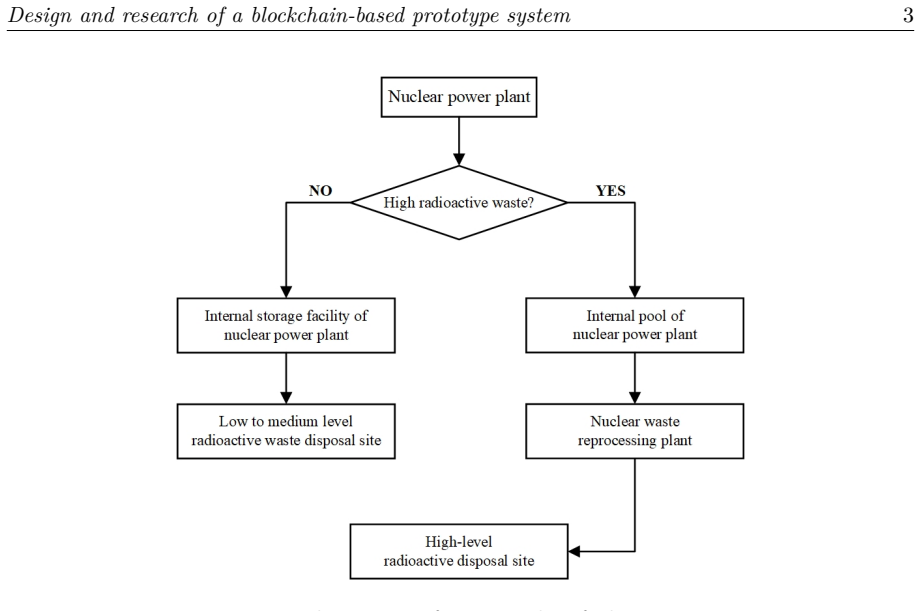
- [Figure 2] The caption of Figure 2 says 'The process of spent nuclear fuel treatment,' but the figure appears to illustrate the system architecture with IoT devices and blockchain. The caption should be corrected to match the actual content.
- [References] There are formatting errors in the bibliography and in-text citations; for example, '[1]Between 1993 and 2024' and '[2]The reasons' lack a space after the reference number. The manuscript should be carefully proofread for such issues.
- [Throughout] Several typos and missing spaces appear, such as 'tominimize' in Section 4.2.3 and 'low-level waste disposal strategies' in Section 4.2.1. A full editorial pass is needed.
- [Table 1] The entry for the 'Regulatory' row in Table 1 is vague ('Meet the regulatory' for consortium and private chains). It would be clearer to specify what aspects of regulatory requirements are met, or to rephrase the row header.
Circularity Check
No circularity: the paper contains no fitted parameters, no quantitative predictions, and no load-bearing self-citations; the abstract's unsupported 'results demonstrate' claim is a support gap, not a circular derivation.
full rationale
This paper is a design review and proposal for a multi-tiered consortium blockchain/IoT system for spent nuclear fuel transport. It contains no fitted parameters, no equations, no quantitative predictions, and no derivation chain that could reduce to its own inputs. The claimed benefits (data immutability, real-time multi-sensor integration, transparency, resilience) are asserted from general, externally cited properties of blockchain and IoT (e.g., refs [5], [8], [12], [23]) and from the stated design intent, not from any measurement or model developed in this paper. Section 4.3 explicitly describes a framework to be established and lists target indicators such as unauthorized-access rejection rate, TPS, latency, and ZKP soundness failure rate, but reports no experimental results; this means the abstract's 'the results demonstrate' sentence is unsupported, which is a correctness/support gap rather than circularity. No load-bearing self-citations appear: the references to prior blockchain-for-nuclear prototypes (SLAFKA, Sellafield DLT Field Lab, ref [8]) are external works, not by the present authors, and no uniqueness theorem or ansatz is imported from the authors' own prior publications. The architecture's benefits are plausibly inherited from the cited external properties of permissioned blockchains, but that inheritance is ordinary use of literature, not a circular reduction. Therefore the paper is not circular and receives score 0.
Assumptions & free parameters
assumptions (3)
- domain assumption Blockchain provides immutable, tamper-proof records.
- domain assumption IoT sensors can continuously collect accurate and reliable data over long transportation periods.
- domain assumption Hyperledger Fabric can support private data collections and zero-knowledge proofs to enforce the layered access model without unreasonable performance overhead.
Cite this review
Pith. "Pith review of Review of Blockchain-Based Approaches to Spent Fuel Management in Nuclear Power Plants." pith.science (2026). https://pith.science/paper/BUUHWXEP
@misc{pith2026250600677,
  author       = {Pith},
  title        = {Pith review of: Review of Blockchain-Based Approaches to Spent Fuel Management in Nuclear Power Plants},
  year         = {2026},
  howpublished = {\url{https://pith.science/paper/BUUHWXEP}},
  note         = {Machine review of arXiv:2506.00677}
}
read the original abstract
This study addresses critical challenges in managing the transportation of spent nuclear fuel, including inadequate data transparency, stringent confidentiality requirements, and a lack of trust among collaborating parties, issues prevalent in traditional centralized management systems. Given the high risks involved, balancing data confidentiality with regulatory transparency is imperative. To overcome these limitations, a prototype system integrating blockchain technology and the Internet of Things (IoT) is proposed, featuring a multi-tiered consortium chain architecture. This system utilizes IoT sensors for real-time data collection, which is immutably recorded on the blockchain, while a hierarchical data structure (operational, supervisory, and public layers) manages access for diverse stakeholders. The results demonstrate that this approach significantly enhances data immutability, enables real-time multi-sensor data integration, improves decentralized transparency, and increases resilience compared to traditional systems. Ultimately, this blockchain-IoT framework improves the safety, transparency, and efficiency of spent fuel transportation, effectively resolving the conflict between confidentiality and transparency in nuclear data management and offering significant practical implications.
Figures


Reference graph
Works this paper leans on
-
[8]
Olzhas Yessenbayev, Dung Chi Duy Nguyen, Taeseok Jeong, Ki Joon Kang, Hee Rey- oung Kim, Jonghyeon Ko, Jin-Young Park, Myung-Sub Roh, and Marco Comuzzi. Combining blockchain and IoT for safe and transparent nuclear waste management: A prototype implementation.Journal of Industrial Information Integration, 39:100596, May 2024
work page 2024
-
[1]
https://www.iaea.org/resources/databases/itdb, April 2019
IncidentandTraffickingDatabase(ITDB). https://www.iaea.org/resources/databases/itdb, April 2019
work page 2019
-
[2]
DETERRING NUCLEAR AND RADIOLOG- ICAL MATERIAL THEFT, SABOTAGE, OR ILLICIT TRAFFICKING
Olympia Hunt and Stephen V Mladineo. DETERRING NUCLEAR AND RADIOLOG- ICAL MATERIAL THEFT, SABOTAGE, OR ILLICIT TRAFFICKING
-
[3]
Juan Du and Xufeng Zhu. Regulatory transparency and citizen support for government decisions: Evidence from nuclear power acceptance in China.Journal of Environmental Policy & Planning, 25(6):766–780, November 2023
work page 2023
-
[4]
OECD and Nuclear Energy Agency. Transparency of Nuclear Regulatory Activities: Workshop proceedings - Tokyo and Tokai-Mura, Japan, 22-24 May 2007. Nuclear Reg- ulation. OECD, November 2007. Design and research of a blockchain-based prototype system 16 Table 5: Key evaluation indicators Evaluation dimension Index Description Emphasis Access Control Effecti...
work page 2007
-
[5]
Cindy Vestergaard, Edward Obbard, Edward Yu, Guntur Dharma Putra, and Gabrielle Green. SLAFKA Demonstrating the Potential for Distributed Ledger Technology for Nuclear Safeguards Information Management. Technical report, Stimson, November 2020
work page 2020
-
[6]
Spent fuel characterization analysis using various nucleardatalibraries
Dušan Čalič and Marjan Kromar. Spent fuel characterization analysis using various nucleardatalibraries. Nuclear Engineering and Technology, 54(9):3260–3271, September 2022
work page 2022
-
[7]
Rajamani Natarajan. Reprocessing of spent nuclear fuel in India: Present challenges and future programme.Progress in Nuclear Energy, 101:118–132, November 2017
work page 2017
Show all 24 references
-
[9]
A Review of the Principles and Applications of Blockchain Technology.Information Technology and Application in Scientific Research, 8(2):3–17, 2017
Zhongjiang Yao and JIngguo Ge. A Review of the Principles and Applications of Blockchain Technology.Information Technology and Application in Scientific Research, 8(2):3–17, 2017
2017
-
[10]
Blockchain Technology Implemen- tation in Supply Chain Management: A Literature Review.Sustainability, 16(7):2823, January 2024
Abdel-Aziz Ahmad Sharabati and Elias Radi Jreisat. Blockchain Technology Implemen- tation in Supply Chain Management: A Literature Review.Sustainability, 16(7):2823, January 2024
2024
-
[11]
A Blockchain-Based Access Control System for Secure and Efficient Hazardous Material Supply Chains
Yi Dai, Gehao Lu, and Yijun Huang. A Blockchain-Based Access Control System for Secure and Efficient Hazardous Material Supply Chains. Mathematics, 12(17):2702, January 2024
2024
-
[12]
https://www.digicatapult.org.uk/publications/post/harnessing-the-power-of- distributed-ledger-technology/
Harnessing the power of distributed ledger technology. https://www.digicatapult.org.uk/publications/post/harnessing-the-power-of- distributed-ledger-technology/
-
[13]
A survey on the adoption of blockchain in IoT: Challenges and solutions
Md Ashraf Uddin, Andrew Stranieri, Iqbal Gondal, and Venki Balasubramanian. A survey on the adoption of blockchain in IoT: Challenges and solutions. Blockchain: Research and Applications, 2(2):100006, June 2021
2021
-
[14]
ARG-US RFID FOR MONITORING AND TRACKING NUCLEAR MATERIALS - THE OPERATING EXPERIENCE
Brian Craig, John Lee, Hanchung Tsai, Yung Liu, and Jim Shuler. ARG-US RFID FOR MONITORING AND TRACKING NUCLEAR MATERIALS - THE OPERATING EXPERIENCE. In International Symposium on the Packaging and Transportation of Radioactive Materials, San Francisco, CA, USA, 2013
2013
-
[15]
SiLiF Neutron Counters to Monitor Nuclear Materials in the MICADO Project.Sensors, 21(8):2630, April 2021
Luigi Cosentino, Quentin Ducasse, Martina Giuffrida, Sergio Lo Meo, Fabio Longhitano, Carmelo Marchetta, Antonio Massara, Alfio Pappalardo, Giuseppe Passaro, Salvatore Russo, and Paolo Finocchiaro. SiLiF Neutron Counters to Monitor Nuclear Materials in the MICADO Project.Senso...
2021
-
[16]
Exploring Blockchain for Nuclear Material Tracking: A Scoping Review and Innovative Model Proposal.Energies, 17(12):3028, June 2024
Irem Nur Ecemis, Fatih Ekinci, Koray Acici, Mehmet Serdar Guzel, Ihsan Tolga Medeni, and Tunc Asuroglu. Exploring Blockchain for Nuclear Material Tracking: A Scoping Review and Innovative Model Proposal.Energies, 17(12):3028, June 2024
2024
-
[17]
Abu-Mahfouz
Oratile Khutsoane, Bassey Isong, and Adnan M. Abu-Mahfouz. IoT devices and appli- cations based on LoRa/LoRaWAN. InIECON 2017 - 43rd Annual Conference of the IEEE Industrial Electronics Society, pages 6107–6112, October 2017
2017
-
[18]
Hierarchical Multi-Blockchain Architecture for Scalable Internet of Things Environment.Electronics, 9(6):1050, June 2020
Yustus Eko Oktian, Sang-Gon Lee, and Hoon Jae Lee. Hierarchical Multi-Blockchain Architecture for Scalable Internet of Things Environment.Electronics, 9(6):1050, June 2020
2020
-
[19]
An Overview on Edge Com- puting Research
Keyan Cao, Yefan Liu, Gongjie Meng, and Qimeng Sun. An Overview on Edge Com- puting Research. IEEE Access, 8:85714–85728, 2020
2020
-
[20]
https://www.nrc.gov/security/info-security.html
Information Security. https://www.nrc.gov/security/info-security.html
-
[21]
Number no
Annette Schaper.Looking for a Demarcation between Nuclear Transparency and Nuclear Secrecy. Number no. 68 in PRIF Reports. Peace Research Institute Frankfurt, Frankfurt am Main, 2004. Design and research of a blockchain-based prototype system 18
2004
-
[22]
Security of Nuclear and Other Radioactive Material in Transport
INTERNATIONAL ATOMIC ENERGY AGENCY. Security of Nuclear and Other Radioactive Material in Transport. IAEA Nuclear Security Series. INTERNATIONAL ATOMIC ENERGY AGENCY, July 2024
2024
-
[23]
Xiaotong Chen, Songlin He, Linfu Sun, Yangxin Zheng, and Chase Q. Wu. A Survey of Consortium Blockchain and Its Applications.Cryptography, 8(2):12, June 2024
2024
-
[24]
Performance Eval- uation of Blockchain Systems: A Systematic Survey.IEEE Access, 8:126927–126950, 2020
Caixiang Fan, Sara Ghaemi, Hamzeh Khazaei, and Petr Musilek. Performance Eval- uation of Blockchain Systems: A Systematic Survey.IEEE Access, 8:126927–126950, 2020
2020
Reviewed August 7, 2026 · model on record in the stance chip above.
Discussion (0). Sign in to comment.