REVIEW 4 major objections 3 minor 46 references
Hierarchical Mask-Enhanced Dual Reconstruction Network for Few-Shot Fine-Grained Image Classification
T0 review · 4 major / 3 minor · reviewed 2026-08-06 · deepseek-v4-flash
Pith's one-line read HMDRN claims that fusing penultimate and last-layer features under a hard query-region mask consistently beats prior few-shot fine-grained classifiers on CUB, Stanford-Dogs, and Stanford-Cars.
desk verdict A useful incremental few-shot fine-grained method with a fixable test-set-selection problem and an overbroad consistency claim; worth refereeing. read the letter →
The pith
A machine-rendered reading of the paper's core claim, the machinery that carries it, and where it could break.
The reading
What carries the argument
Two modules carry the argument. The Masked Transformer Feature Enhancement Module (MTFEM) applies a three-layer, two-head transformer to tokenised feature maps; for query features only, it builds a hard binary mask $M_q = \delta(Q_{\text{scores}} > \bar Q_{\text{score}})$ from the squared $\ell^2$ norms of the attention query vectors, zeroing out all positions below the average before self-attention, while support features pass unmasked. The Cross-Level Attentional Reconstruction Module (CLARM) then reconstructs query features from support features independently at the last and penultimate layers using attention, measures Euclidean distance between original and reconstructed query features at each level, and combines the two negative distances with learnable weights $w_1, w_2$ and a temperature $\tau$ before softmax classification. Together, the hard mask sharpens the query representation, and the dual reconstruction makes use of both semantic and structural feature hierarchies.
What would settle it
Re-run the same training setup replacing the binary mask with a differentiable soft mask of matched capacity, for example a sigmoid-gated version of the same attention scores, and compare on CUB, Stanford-Dogs, and Stanford-Cars with both backbones; if the soft mask matches or beats the binary mask once its temperature is tuned, the paper's core claim that hard discretization drives the gains would be refuted.
Extended reading notes
Core claim
The paper's central claim is that complementary information from the penultimate and last network layers, combined with a spatial binary mask over query features, improves few-shot fine-grained classification. The penultimate layer is argued to spread activation over broader structural and local details, while the last layer concentrates on the most discriminative core regions; reconstructing query features from support features at both levels, and weighting the two similarity scores with learnable parameters, captures both kinds of information. The binary mask is computed by thresholding the mean of the squared $\ell^2$ norms of the query tokens' attention projections, keeping only positions above the threshold before the transformer's attention is applied. The paper reports that this full design outperforms prior state of the art on all tested settings except one, where C2-Net scores higher, and that ablation studies attribute the gains to both modules, with the mask reducing intra-class variation and the dual reconstruction improving inter-class separation.
Load-bearing premise
The method's reported gains rest on the assumption that a hard binary mask formed by thresholding the mean squared norm of query attention vectors reliably keeps the discriminative regions, and that masking only the query features is enough; because the threshold is fixed by this rule and the mask has no gradient at the threshold, the model cannot learn to adjust which regions survive.
Editorial extensions
If this is right
- HMDRN should be adopted as the comparison baseline for future few-shot fine-grained work on CUB, Stanford-Dogs, and Stanford-Cars, since it reports the highest numbers on nearly every 5-way 1-shot and 5-way 5-shot setting.
- Because the dual-layer design helps most when the penultimate layer is emphasized on CUB and Cars, methods that already use reconstruction can expect gains from adding a second, mid-level feature stream rather than only the final layer.
- The binary mask's advantage over the soft mask, if it persists, implies that thresholded hard attention is a usable design choice for fine-grained few-shot classification, not just a compromise forced by lack of differentiability.
- The reported 23.25M parameters and longer training time are the price of the accuracy gain; applications in resource-constrained settings would need the efficiency question solved before deployment.
Reading between the lines
- A natural extension the authors do not test is making the mask threshold learnable or using a straight-through estimator, which could let the network adapt the retention rate per dataset and per layer rather than using the fixed mean rule.
- The finding that the penultimate layer carries spatially dispersed local detail suggests that other reconstruction-based few-shot methods could be upgraded the same way; plugging a mid-level feature stream into ridge-regression reconstruction is a concrete experiment implied by the paper's hierarchy analysis.
- The paper leaves cross-domain and industrial scenarios untested; the strongest test of the central claim would be whether the mask-enhanced dual reconstruction keeps its edge under distribution shift, where the fixed threshold rule may select the wrong regions.
Editorial analysis
A structured set of objections, weighed in public.
Referee Report
Summary. The paper proposes HMDRN, a few-shot fine-grained image classification method that combines dual-layer feature extraction (from the penultimate and last layers of a backbone), a masked transformer feature enhancement module with a hard binary spatial mask applied to query features, and a cross-level attentional reconstruction module that combines reconstruction scores from both layers via learnable weights. The method is evaluated on CUB-200-2011, Stanford-Dogs, and Stanford-Cars with Conv-4 and ResNet-12 backbones, and the authors report consistent state-of-the-art or near-state-of-the-art accuracy in 5-way 1-shot and 5-way 5-shot settings. The paper also includes ablations of the two modules, a comparison of binary versus soft masking, a sweep over transformer layer/head configurations, computational cost comparisons, and feature reconstruction visualizations.
Significance. If the reported results are unbiased, the paper makes a reasonably useful empirical contribution to few-shot fine-grained classification: it integrates hierarchical features and a hard masking strategy within a reconstruction framework, provides code, and reports systematic ablations and configuration studies. The gains over strong baselines such as BiFRN and C2-Net are, however, modest and the central claim of 'consistent outperformance' is not established because the final architecture was selected using test-set performance and because one headline result (Conv-4, Cars 1-shot) is actually below C2-Net in the authors' own Table 1. The empirical methodology needs to be corrected before the results can be taken at face value.
major comments (4)
- [§4.6, Table 5] The final architecture is selected on the test set. The authors sweep transformer layers (1–4) and heads (1, 2, 4), report accuracies on the CUB/Dogs/Cars test sets, and then state that the 'optimal configuration (layers=3, heads=2)' is chosen because it 'delivers the best performance in almost all experimental settings.' The final numbers in Tables 1–3 therefore come from the winner of a test-set model selection, not from an unbiased evaluation. This inflates the reported margins over prior methods and invalidates the 'consistently outperforms' conclusion as stated. The authors should perform model selection on the validation set (or use nested cross-validation), report the configuration chosen that way, and re-run the comparisons in Tables 1–3 under that protocol.
- [Abstract, §4.3, §6] The claim that HMDRN 'consistently outperforms state-of-the-art methods' is contradicted by the authors' own Table 1: in the Conv-4, Cars 1-shot setting, HMDRN reports 77.88±0.19 while C2-Net reports 81.29±0.45. The abstract and conclusion make the unqualified claim, and even the discussion in §4.3 concedes this exception only in passing. The abstract and conclusion should state the result with this exception, and the comparison should be discussed in terms of which settings the method actually leads.
- [§3.4, Eqs. (6)–(8)] The binary mask mechanism has no learnable threshold and no gradient through the threshold decision. The mask is computed by thresholding the mean of squared L2 norms of query attention vectors with an indicator function, so the decision of which spatial positions to retain is a fixed statistic of the current query representation and is not directly optimized. The authors compare binary versus soft masking in Table 4 and report consistent gains, but the design choice is not otherwise justified. The authors should provide an analysis of how the hard mask receives learning signal (if at all), or compare against a differentiable hard-threshold variant (e.g., sigmoid annealing or Gumbel-style reparameterization) to show that the specific non-differentiable hard mask is necessary rather than incidental.
- [§4.4, Table 3] The ablation claims that the complete model achieves synergistic gains are not fully supported by the numbers. For example, in the Conv-4, CUB 1-shot case, (MTFEM+R2) reaches 83.00±0.19, which is higher than the full model's 82.55±0.19, and in several other settings the full model overlaps with (MTFEM+R2) or CLARM within confidence intervals (e.g., Conv-4 Dogs 5-shot: 82.06±0.14 vs 81.79±0.14; ResNet-12 Cars 5-shot: 97.56±0.05 vs 97.27±0.06 for CLARM). The text should either qualify the synergy claim, report significance tests, or explain why the full model is preferred when it is not the best in every configuration.
minor comments (3)
- [§4.3, Table 2] Several baseline entries in Table 2 (MCL-Katz, MCL-Katz+PSM) are reported without confidence intervals, which makes the comparison against HMDRN's intervals difficult. Please add intervals from the original sources or note that they are unavailable, and ensure the same evaluation protocol was used for all methods.
- [Figure 3 and reference list] There are typographical issues: 'Tansformer Block' in Figure 3 should be 'Transformer Block'; the reference list contains 'NerulPS' and 'NeurrIPS' variants for the same venue. These should be corrected.
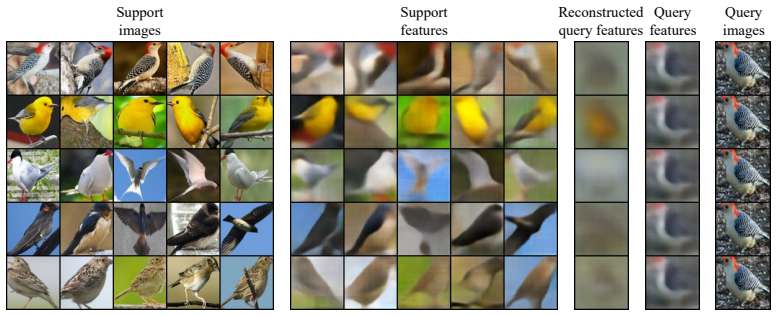
- [§4.7] The visualization comparison is qualitative and does not include quantitative reconstruction metrics or comparisons against other reconstruction-based methods such as FRN or BiFRN. Reporting a quantitative measure (e.g., reconstruction error or downstream classification accuracy using the reconstructed features) would strengthen the claim of 'superior reconstruction capability.'
Circularity Check
No significant circularity: the empirical SOTA claim is benchmarked externally and the stated protocol uses a validation split for configuration selection.
full rationale
The paper makes no first-principles derivation; its central claim is measured accuracy on CUB, Stanford-Dogs, and Stanford-Cars. The architecture is trained episodically and compared against external methods reported in the literature, so the evaluation is externally benchmarked. Section 3.1 explicitly states the protocol: 'The validation set D_val serves as the criterion for determining optimal model configuration, while comprehensive performance assessment occurs on tasks derived from the test set D_test.' Section 4.6's configuration sweep for Transformer layers/heads, though it does not restate 'validation' each time, is therefore covered by the stated protocol; no quote in the paper says the optimal configuration was chosen using test labels. The binary mask threshold (Eqs. 6-8) is a fixed architectural choice, not a parameter fitted to the test set and then renamed a prediction. There are no load-bearing self-citations, no imported uniqueness theorems, and no ansatz smuggled via citation. The skeptic's test-set-selection concern is an evaluation-protocol worry rather than an exhibited circular reduction; if the sweep had in fact used the test set, that would be a correctness risk, but it is not a circularity demonstrable from the manuscript text. Score 0.
Assumptions & free parameters
free parameters (3)
- w1, w2 (layer fusion weights) =
learned; CUB/Cars favor w2>w1, Dogs favor w1>w2
- tau (temperature) =
learned, initialized to 1.0
- MTFEM depth and heads =
3 transformer layers, 2 attention heads
assumptions (3)
- domain assumption Penultimate and last layer features are complementary and jointly more informative for fine-grained few-shot classification than either alone.
- ad hoc to paper The mean of the squared L2 norms of query attention vectors identifies the most discriminative spatial regions.
- ad hoc to paper Only query features need masking; support features can remain unmasked.
Cite this review
Pith. "Pith review of Hierarchical Mask-Enhanced Dual Reconstruction Network for Few-Shot Fine-Grained Image Classification." pith.science (2026). https://pith.science/paper/BUZ4BAB6
@misc{pith2026250620263,
  author       = {Pith},
  title        = {Pith review of: Hierarchical Mask-Enhanced Dual Reconstruction Network for Few-Shot Fine-Grained Image Classification},
  year         = {2026},
  howpublished = {\url{https://pith.science/paper/BUZ4BAB6}},
  note         = {Machine review of arXiv:2506.20263}
}
read the original abstract
Few-shot fine-grained image classification (FS-FGIC) is challenging as it requires distinguishing visually similar subclasses with extremely limited labeled examples. Existing methods suffer from critical limitations: metric-based methods lose spatial information and misalign local features, while reconstruction-based methods underuse hierarchical feature information and lack selective focus on discriminative key regions. We propose the Hierarchical Mask-enhanced Dual Reconstruction Network (HMDRN), integrating dual-layer feature reconstruction with mask-enhanced feature processing. HMDRN leverages complementary visual information from different network hierarchies via learnable weights, balancing high-level semantic representations with mid-level structural details. It incorporates a spatial binary mask-enhanced transformer module that selectively enhances discriminative regions while filtering background noise. On three fine-grained datasets, HMDRN consistently outperforms state-of-the-art methods with both Conv-4 and ResNet-12 backbones. Ablation studies validate each component's effectiveness, showing dual-layer reconstruction enhances inter-class discrimination while mask-enhanced transformation reduces intra-class variations.
Figures


Figures from the paper (3 more)


Reference graph
Works this paper leans on
-
[1]
11em plus .33em minus .07em 4000 4000 100 4000 4000 500 `\.=1000 = #1 \@IEEEnotcompsoconly \@IEEEcompsoconly #1 * [1] 0pt [0pt][0pt] #1 * [1] 0pt [0pt][0pt] #1 * \| ** #1 \@IEEEauthorblockNstyle \@IEEEcompsocnotconfonly \@IEEEauthorblockAstyle \@IEEEcompsocnotconfonly \@IEEEcompsocconfonly \@IEEEauthordefaulttextstyle \@IEEEcompsocnotconfonly \@IEEEauthor...
-
[2]
Z. Zha, H. Tang, Y. Sun, and J. Tang, ``Boosting few-shot fine-grained recognition with background suppression and foreground alignment,'' IEEE Transactions on Circuits and Systems for Video Technology, 2022
work page 2022
- [3]
-
[4]
S. Li, Y. Wang, W. Liu, L. Zhang, and C. Shen, ``Few-shot learning meets transformer: Unified query-support transformers for few-shot classification,'' IEEE Transactions on Circuits and Systems for Video Technology, vol. 33, no. 12, pp. 7789--7802, 2023
work page 2023
-
[5]
Snell, K
J. Snell, K. Swersky, and R. Zemel, ``Prototypical networks for few-shot learning,'' Advances in neural information processing systems, vol. 30, 2017
2017
-
[6]
O. Vinyals, C. Blundell, T. Lillicrap, K. Kavukcuoglu, and D. Wierstra, ``Matching networks for one shot learning,'' in NerulPS, 2016
work page 2016
-
[7]
F. Sung, Y. Yang, L. Zhang, T. Xiang, P. H. Torr, and T. M. Hospedales, ``Learning to compare: Relation network for few-shot learning,'' in Proceedings of the IEEE conference on computer vision and pattern recognition, 2018, pp. 1199--1208
2018
-
[8]
W. Li, L. Wang, J. Xu, J. Huo, Y. Gao, and J. Luo, ``Revisiting local descriptor based image-to-class measure for few-shot learning,'' in CVPR, 2019
work page 2019
Show all 46 references
-
[9]
X. Li, J. Wu, Z. Sun, Z. Ma, J. Cao, and J.-H. Xue, ``Bsnet: Bi-similarity network for few-shot fine-grained image classification,'' IEEE Transactions on Image Processing, vol. 30, pp. 1318--1331, 2020
2020
-
[10]
Huang, J
H. Huang, J. Zhang, J. Zhang, J. Xu, and Q. Wu, ``Low-rank pairwise alignment bilinear network for few-shot fine-grained image classification,'' IEEE Transactions on Multimedia, vol. 23, pp. 1666--1680, 2021
2021
-
[11]
Wertheimer, L
D. Wertheimer, L. Tang, and B. Hariharan, ``Few-shot classification with feature map reconstruction networks,'' in Proceedings of the IEEE/CVF conference on computer vision and pattern recognition, 2021, pp. 8012--8021
2021
-
[12]
X. Li, Y. Wang, W. Zhang, S. Huang, and W. Liu, ``Bi-directional feature reconstruction network for fine-grained few-shot image classification,'' in Proceedings of the Thirty-Seventh Conference on Artificial Intelligence (AAAI), 2023
2023
-
[13]
X. Li, Q. Song, J. Wu, R. Zhu, Z. Ma, and J.-H. Xue, ``Locally-enriched cross-reconstruction for few-shot fine-grained image classification,'' IEEE Transactions on Circuits and Systems for Video Technology, vol. 33, no. 12, pp. 7530--7540, 2023
2023
-
[14]
S. Yang, X. Li, D. Chang, Z. Ma, and J.-H. Xue, ``Channel-spatial support-query cross-attention for fine-grained few-shot image classification,'' in Proceedings of the 32nd ACM International Conference on Multimedia, 2024, pp. 9175--9183
2024
-
[15]
X. Li, Z. Li, J. Xie, X. Yang, J.-H. Xue, and Z. Ma, ``Self-reconstruction network for fine-grained few-shot classification,'' Pattern Recognition, vol. 153, p. 110485, 2024
2024
-
[16]
Krause, M
J. Krause, M. Stark, J. Deng, and F.-F. Li, ``3d object representations for fine-grained categorization,'' in Proceedings of the IEEE International Conference on Computer Vision (ICCV), 2013, pp. 554--561
2013
-
[17]
C. Wah, S. Branson, P. Welinder, P. Perona, and S. J. Belongie, ``The caltech-ucsd birds-200-2011 dataset,'' California Institute of Technology, Tech. Rep., 2011
2011
-
[18]
J. Xiao, J. Hays, K. A. Ehmann, A. Oliva, and A. Torralba, ``The sun database: Large-scale scene recognition from abbey to zoo,'' in Proceedings of the IEEE Conference on Computer Vision and Pattern Recognition (CVPR), 2011, pp. 3485--3492
2011
-
[19]
W. Zhu, W. Li, H. Liao, and J. Luo, ``Temperature network for few-shot learning with distribution-aware large-margin metric,'' Pattern Recognition, vol. 112, p. 107797, 2021
2021
-
[20]
Zhang, X
W. Zhang, X. Liu, Z. Xue, Y. Gao, and C. Sun, ``Ndpnet: A novel non-linear data projection network for few-shot fine-grained image classification,'' arXiv preprint arXiv:2106.06988, 2021
2021 arXiv
-
[21]
Y. Zhou, Y. Guo, S. Hao, and R. Hong, ``Hierarchical prototype refinement with progressive inter-categorical discrimination maximization for few-shot learning,'' IEEE Transactions on Image Processing, vol. 31, pp. 3414--3429, 2022
2022
-
[22]
X. Li, Z. Guo, and R. Zhu, ``A simple scheme to amplify inter-class discrepancy for improving few-shot fine-grained image classification,'' Pattern Recognition, vol. 156, p. 110736, 2024
2024
-
[23]
H.-J. Ye, H. Hu, D.-C. Zhan, and F. Sha, ``Few-shot learning via embedding adaptation with set-to-set functions,'' in Proceedings of the IEEE/CVF Conference on Computer Vision and Pattern Recognition (CVPR). 1em plus 0.5em minus 0.4em IEEE, 2020
2020
-
[24]
Doersch, A
C. Doersch, A. Gupta, and A. Zisserman, ``Crosstransformers: spatially-aware few-shot transfer,'' Advances in Neural Information Processing Systems, vol. 33, pp. 21\,981--21\,993, 2020
2020
-
[25]
Lee, C.-H
E. Lee, C.-H. Huang, and C.-Y. Lee, ``Few-shot and continual learning with attentive independent mechanisms,'' in 2021 IEEE/CVF International Conference on Computer Vision (ICCV), 2021, pp. 9435--9444
2021
-
[26]
S. Lee, W. Moon, and J.-P. Heo, ``Task discrepancy maximization for fine-grained few-shot classification,'' in Proceedings of the IEEE/CVF conference on computer vision and pattern recognition, 2022, pp. 5331--5340
2022
-
[27]
S. Lee, W. Moon, H. S. Seong, and J.-P. Heo, ``Task-oriented channel attention for fine-grained few-shot classification,'' IEEE Transactions on Pattern Analysis and Machine Intelligence, vol. 47, no. 3, pp. 1448--1463, 2025
2025
-
[28]
Zhang, Y
C. Zhang, Y. Cai, G. Lin, and C. Shen, ``Deepemd: Few-shot image classification with differentiable earth mover's distance and structured classifiers,'' in CVPR, 2020
2020
-
[29]
Chen, Y.-C
W.-Y. Chen, Y.-C. Liu, Z. Kira, Y.-C. F. Wang, and J.-B. Huang, ``A closer look at few-shot classification,'' in 7th International Conference on Learning Representations (ICLR). 1em plus 0.5em minus 0.4em New Orleans, LA, USA: ICLR, May 6-9 2019
2019
-
[30]
Q. Yang, J. Shi, J. Zhu, and S.-T. Xia, ``Few-shot learning via embedding adaptation with set-to-set functions,'' in Advances in Neural Information Processing Systems (NeurIPS), 2018, pp. 9776--9786
2018
-
[31]
Loshchilov and F
I. Loshchilov and F. Hutter, ``Sgdr: Stochastic gradient descent with warm restarts,'' in International Conference on Learning Representations (ICLR), 2017
2017
-
[32]
Z. Wu, Y. Li, L. Guo, and K. Jia, ``Parn: Position-aware relation networks for few-shot learning,'' in ICCV, 2019
2019
-
[33]
F. Hao, F. He, J. Cheng, L. Wang, J. Cao, and D. Tao, ``Collect and select: Semantic alignment metric learning for few-shot learning,'' in ICCV, 2019
2019
-
[34]
X. Li, Y. Wang, W. Zhang, S. Huang, and W. Liu, ``Multi-attention meta learning for few-shot fine-grained image recognition,'' in Proceedings of the Twenty-Ninth International Joint Conference on Artificial Intelligence (IJCAI), 2020, pp. 3938--3944
2020
-
[35]
X. Yu, Y. Wei, Y. Yang, and T. Mei, ``A few-shot fine-grained image classification method leveraging global and local structures,'' in Proceedings of the IEEE Conference on Computer Vision and Pattern Recognition (CVPR), 2020, pp. 10\,328--10\,337
2020
-
[36]
Huang, J
H. Huang, J. Zhang, J. Zhang, J. Xu, and Q. Wu, ``Low-rank pairwise alignment bilinear network for few-shot fine-grained image classification,'' IEEE Transactions on Multimedia, vol. 23, pp. 1666--1680, 2020
2020
-
[37]
Zhang, Y
Y. Zhang, Y. Peng, and X. Wang, ``Variational feature disentangling for fine-grained few-shot classification,'' in European Conference on Computer Vision (ECCV). 1em plus 0.5em minus 0.4em Springer, 2020, pp. 468--484
2020
-
[38]
X. Li, Y. Wang, W. Zhang, S. Huang, and W. Liu, ``Mixture-based feature space learning for few-shot image classification,'' in Proceedings of the IEEE/CVF Conference on Computer Vision and Pattern Recognition (CVPR), 2021, pp. 12\,345--12\,354
2021
-
[39]
Ma, Z.-D
Z.-X. Ma, Z.-D. Chen, L.-J. Zhao, Z.-C. Zhang, X. Luo, and X.-S. Xu, ``Cross-layer and cross-sample feature optimization network for few-shot fine-grained image classification,'' 2024
2024
-
[40]
Doersch, A
C. Doersch, A. Gupta, and A. Zisserman, ``Crosstransformers: Spatially-aware few-shot transfer,'' in NerulPS, 2020
2020
-
[41]
D. Kang, H. Kwon, J. Min, and M. Cho, ``Relational embedding for few-shot classification,'' in ICCV, 2021
2021
-
[42]
Y. Li, Z. Liu, C. Shen, and A. van den Hengel, ``Joint distribution matters: Deep brownian distance covariance for few-shot classification,'' in Proceedings of the IEEE/CVF Conference on Computer Vision and Pattern Recognition (CVPR), 2021, pp. 11\,442--11\,451
2021
-
[43]
Y. Wang, Y. Li, H. Zhang, W. Wang, and C. Qi, ``Learning to affiliate: Mutual centralized learning for few-shot classification,'' in Proceedings of the IEEE/CVF Conference on Computer Vision and Pattern Recognition (CVPR), 2021, pp. 12\,345--12\,354
2021
-
[44]
X. Liu, Y. Wang, H. Zhang, and C. Qi, ``Learning calibrated class centers for few-shot classification by pair-wise similarity,'' IEEE Transactions on Image Processing, vol. 31, pp. 1234--1245, 2022
2022
-
[45]
Zhang, Y
W. Zhang, Y. Wang, Y. Li, and C. Qi, ``Learning cross-image object semantic relation in transformer for few-shot fine-grained image classification,'' in Proceedings of the ACM Multimedia Conference (ACM MM). 1em plus 0.5em minus 0.4em ACM, 2022, pp. 1234--1243
2022
-
[46]
Y. Rong, X. Lu, Z. Sun, Y. Chen, and S. Xiong, ``Espt: a self-supervised episodic spatial pretext task for improving few-shot learning,'' in Proceedings of the AAAI Conference on Artificial Intelligence, vol. 37, no. 8, 2023, pp. 9596--9605
2023
Reviewed August 6, 2026 · model on record in the stance chip above.
Discussion (0). Continue with ORCID to comment.