REVIEW 4 major objections 5 minor 1 cited by
Behaviour Space Analysis of LLM-driven Meta-heuristic Discovery
T0 review · 4 major / 5 minor · reviewed 2026-08-06 · deepseek-v4-flash
Pith's one-line read This paper argues that behaviour-space metrics explain why a 1+1 elitist LLaMEA variant using simplify and random-new mutation prompts outperforms five rivals on BBOB functions.
desk verdict A credible, well-scoped empirical study of LLM-driven algorithm discovery that combines behavior metrics and code-evolution graphs, but its headline ranking rests on five runs and needs statistical support before it can be called a demonstration. read the letter →
The pith
A machine-rendered reading of the paper's core claim, the machinery that carries it, and where it could break.
The reading
What carries the argument
The load-bearing machinery is a set of scalar behaviour metrics computed from complete evaluation traces, plus two network visualisations built on them. The metrics include exploration percentage, average nearest-neighbour distance, coverage dispersion, distance to best, intensification ratio, convergence rate, success rate, longest no-improvement streak, and last-improvement fraction; they position any run as a point in a low-dimensional behaviour space. Search Trajectory Networks partition that behaviour space into hypercubes and connect successive states to show whether a configuration drifts, branches, or follows one improving path. Code Evolution Graphs link each generated algorithm to its parent and overlay static code features such as token count and AST complexity. Together these tools carry the argument that the measured search dynamics, not just final scores, distinguish the winning configuration.
What would settle it
Re-run the same six LLaMEA configurations on the same 10 BBOB functions with a substantially larger number of independent seeds, say 30, and compare mean AOCC with confidence intervals; if LLaMEA-4 is no longer the top-ranked configuration, the paper's central performance claim is refuted. A second check would repeat the experiment in higher dimension or with a different LLM and see whether the same behaviour-space signature still tracks the best performer.
Extended reading notes
Core claim
On the paper's own terms, the discovery is that behaviour-space analysis can explain the performance gap between LLM-generated meta-heuristics. Using the six LLaMEA configurations, the paper reports that LLaMEA-4 — the variant that combines 'refine and simplify' with 'generate a new algorithm' mutation prompts and runs a strict 1+1 elitist evolution strategy — achieves the best and most stable Area Over the Convergence Curve on the test instances. The trace metrics show its runs have lower exploration percentage, smaller nearest-neighbour distances, faster average convergence, higher intensification near the best solution, and less final stagnation than the population-based variants. Its search trajectory networks are compact elongated paths with few wasted branches, while its code evolution graphs show performance improving without code bloat. The paper presents this as evidence that an exploration-exploitation balance, protected by elitism, is what makes LLM-designed algorithms succeed.
Load-bearing premise
The ordering of the six configurations depends on five independent runs per configuration being representative, and the paper itself cautions that this limited run count means conclusions are drawn with care; if additional runs reshuffle the ranking, the claim that LLaMEA-4 is best would fall even though the behaviour-space method could remain sound.
Editorial extensions
If this is right
- Using two contrasting mutation prompts — refine-and-simplify alongside generate-new — is better than either prompt alone, because it keeps both exploitation and exploration pressure in the search over algorithms.
- An elitist (1+1) selection scheme is valuable when evaluating algorithms is expensive, since it guarantees the best discovered algorithm is never discarded.
- Behaviour metrics such as last-improvement fraction and no-improvement streak can diagnose why a design run failed — early stagnation or excessive exploration — without waiting for final performance.
- Keeping generated code simple is not just a stylistic preference; the Code Evolution Graphs associate lower token counts with continued performance gains and better generalisation.
- The same trace-based analysis tools developed for hand-designed meta-heuristics transfer to LLM-generated algorithms.
Reading between the lines
- An implication the authors leave implicit: the behaviour metrics could be computed online during evolution and fed back as an adaptive fitness signal, letting the system increase exploration when stagnation metrics climb.
- The behaviour-space footprints may transfer across problem suites: if an algorithm's metric profile predicts its AOCC on BBOB, the same profile could be used as a cheap pre-screen on new problems before full evaluation.
- Because the paper uses one LLM (GPT o4-mini), its ranking is entangled with that model's coding style; testing with other LLMs could reframe which prompt strategy is best even if the visualisation methodology survives.
- A cautious extension: with only five runs per configuration, the headline ranking should be read as provisional; the behaviour-space explanation is the more robust contribution.
Editorial analysis
A structured set of objections, weighed in public.
Referee Report
Summary. This paper presents an empirical study of six LLaMEA configurations for LLM-driven meta-heuristic discovery on 10 BBOB functions in 5D. The authors log optimisation traces, compute behaviour metrics (exploration, exploitation, convergence, stagnation), and visualize the results using parallel coordinates, Code Evolution Graphs, and Search Trajectory Networks. The central claim is that LLaMEA-4, which uses both simplification and random-perturbation prompts in a (1+1) elitist strategy, achieves the highest Area Over the Convergence Curve, and that behaviour-space analysis explains this advantage through more intensive exploitation, faster convergence, and less stagnation. The paper also presents qualitative comparisons of code evolution and search-trajectory structure across the six variants.
Significance. If the central ranking is robust, the paper makes a useful contribution by extending behaviour-space analysis, originally developed for human-designed metaheuristics, to LLM-generated algorithms. The combination of dynamic trace metrics with static code analysis (CEGs) is a genuinely novel angle, and the authors ship an implementation of the metrics in a public repository, which supports reproducibility. The conclusions are falsifiable and the methodology is transferable to other LLM-based algorithm discovery frameworks. However, the significance is currently limited by the statistical fragility of the headline ranking and by the qualitative nature of several behavioural claims; the paper's own limitations section acknowledges that only five runs were performed. The contribution is more of a case study than a definitive methodological validation, but it is a valuable template for future work.
major comments (4)
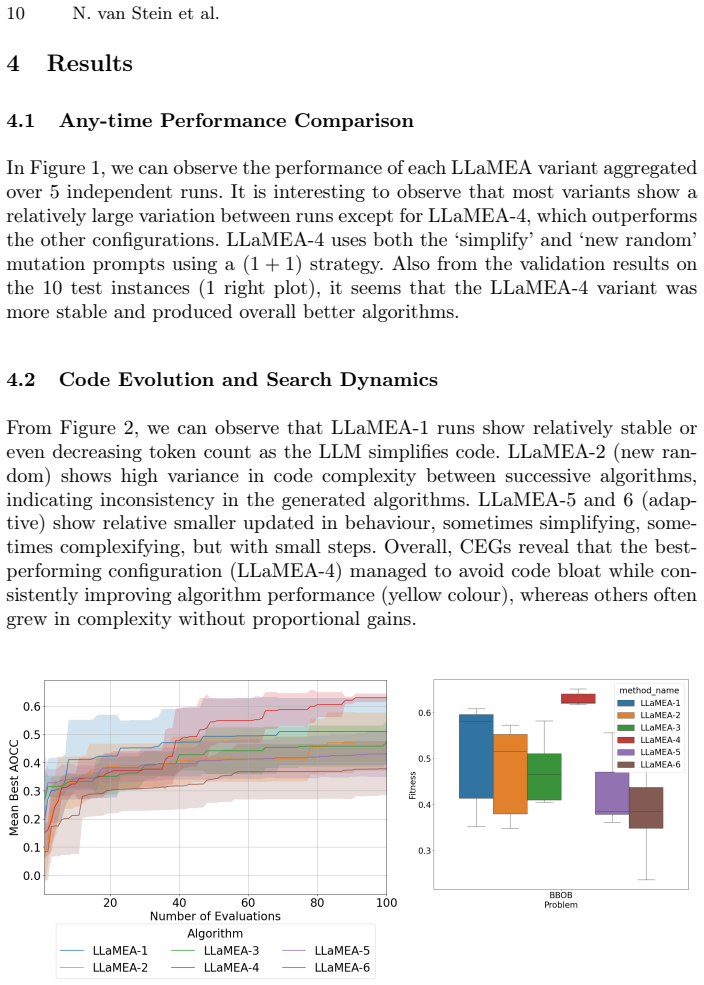
- [Section 4.1, Figure 1] The central claim that LLaMEA-4 achieves the highest AOCC is not supported by any statistical test. The mean AOCC curves in Figure 1 have overlapping 95% confidence intervals for most variants, and Section 4.1 itself states that most variants show a relatively large variation between runs except for LLaMEA-4. Because the behaviour-space explanation in Sections 4.3 and 5 compares higher-performing and lower-performing groups based on this ranking, an unstable ranking would invalidate the interpretation. Please add a formal comparison (e.g., paired Wilcoxon signed-rank or bootstrap on per-run aggregated AOCC values, with multiple-testing correction) and report per-function AOCC tables.
- [Section 3.2] The hand-chosen thresholds used to define the behaviour metrics are not justified: the intensification radius (10% of the search range), the chunk size K in the exploration percentage, and the STN hypercube dimensions 0.01 and 0.1 are selected without sensitivity analysis. The qualitative conclusions of Section 4.3, such as the distinction between bushy and elongated STNs, may depend on these choices. Please add a sensitivity study or otherwise demonstrate that the main ranking and behavioural contrasts are stable with respect to these parameters.
- [Section 3.1 and Section 4.1] The paper does not enumerate the 10 BBOB functions used for evaluation, although Section 3.1 says they were chosen to cover a range of landscapes. This makes it impossible to assess whether the aggregate ranking is dominated by a few functions; Figure 4 (right) shows different behaviour profiles for different functions, which further motivates a per-function breakdown. Please list the BBOB function IDs or names and report the AOCC values per function for each configuration.
- [Section 4.3 and Discussion item (1)] The behavioural explanation is largely qualitative. The claim that higher-performing algorithms exhibit more intensive exploitation, faster convergence, and less stagnation is based on visual inspection of parallel coordinate plots and STNs, with no quantitative comparison across performance quartiles. Moreover, the comparison of LLaMEA-3 and LLaMEA-4 confounds the mutation-prompt strategy with the evolutionary selection scheme (4/12 population vs. 1+1 elitist); since LLaMEA-6 is also 1+1 elitist but has wide confidence intervals, the paper does not establish that elitism is the decisive factor. Please quantify the metric differences between performance groups and address the confound explicitly.
minor comments (5)
- [Section 3.2] The display equation for D(S) has a garbled summation range: the expression "p<q xp,xq∈S" should be rewritten as a proper double sum over distinct pairs.
- [Figure 1] The right subplot does not label the y-axis; it should clearly state that the plotted quantity is the AOCC of the final generated algorithms evaluated on the test instances.
- [Section 4.3] There is a typo: "On the other and" should read "On the other hand".
- [Sections 2.2 and 3.3] The phrases "prefixed lower numerical precision" and "prefixed dimension" are ambiguous; please specify whether the STN hypercube side lengths are given in normalized units or in the raw units of the behaviour metrics.
- [Reference [1]] The repository link is anonymized in this version; in the final published version, the link should be made permanent and versioned so that the metric implementations are fully reproducible.
Circularity Check
No significant circularity: the central ranking is an empirical comparison on held-out BBOB test instances, with self-citations serving only as tooling.
full rationale
The paper's central claim is that LLaMEA-4 achieves the highest AOCC among six configurations. This is an empirical result, not a derivation: algorithms are evolved using AOCC on training instances (BBOB instances 1–5), while the reported final ranking is based on AOCC on held-out test instances (instances 6–15), as stated in Section 3.1: 'we use the BLADE experiment setup with training instances to evolve algorithms, then report performance on test instances for final evaluation.' No fitted parameter is recycled as a prediction, and no quantity is defined in terms of the outcome it is supposed to explain. The behaviour metrics (exploration, exploitation, convergence, stagnation) are computed post hoc from logged traces and are used for descriptive interpretation, not as fitness inputs. Self-citations to LLaMEA, BLADE, CEG, and the metrics repository are references to the authors' own tools and prior framework, but the load-bearing evidence for the ranking is an independent external benchmark (BBOB) with a train/test split; no self-citation is invoked as a uniqueness theorem or as a substitute for experimental support. The acknowledged limitation that only 5 runs were performed ('The still limited number of 5 runs also means that the conclusions of these work are made with caution') is a statistical robustness concern, not circularity. No circular step can be exhibited from the paper's own equations or citations.
Assumptions & free parameters
free parameters (3)
- Intensification ratio radius =
10% of the search range
- STN hypercube side length =
0.01 and 0.1
- Exploration-percentage chunk size K =
not specified
assumptions (4)
- domain assumption The defined behaviour metrics faithfully measure exploration, exploitation, convergence and stagnation for LLM-generated continuous optimizers.
- domain assumption Aggregating mean AOCC across the ten BBOB functions into a single scalar is a fair fitness signal for ranking algorithms.
- domain assumption Five independent runs per configuration are representative of each variant's distribution.
- ad hoc to paper Behaviour-space hypercube partitioning and the five selected metrics capture the relevant search trajectory topology.
Cite this review
Pith. "Pith review of Behaviour Space Analysis of LLM-driven Meta-heuristic Discovery." pith.science (2026). https://pith.science/paper/BVIYQ3AD
@misc{pith2026250703605,
  author       = {Pith},
  title        = {Pith review of: Behaviour Space Analysis of LLM-driven Meta-heuristic Discovery},
  year         = {2026},
  howpublished = {\url{https://pith.science/paper/BVIYQ3AD}},
  note         = {Machine review of arXiv:2507.03605}
}
read the original abstract
We investigate the behaviour space of meta-heuristic optimisation algorithms automatically generated by Large Language Model driven algorithm discovery methods. Using the Large Language Evolutionary Algorithm (LLaMEA) framework with a GPT o4-mini LLM, we iteratively evolve black-box optimisation heuristics, evaluated on 10 functions from the BBOB benchmark suite. Six LLaMEA variants, featuring different mutation prompt strategies, are compared and analysed. We log dynamic behavioural metrics including exploration, exploitation, convergence and stagnation measures, for each run, and analyse these via visual projections and network-based representations. Our analysis combines behaviour-based projections, Code Evolution Graphs built from static code features, performance convergence curves, and behaviour-based Search Trajectory Networks. The results reveal clear differences in search dynamics and algorithm structures across LLaMEA configurations. Notably, the variant that employs both a code simplification prompt and a random perturbation prompt in a 1+1 elitist evolution strategy, achieved the best performance, with the highest Area Over the Convergence Curve. Behaviour-space visualisations show that higher-performing algorithms exhibit more intensive exploitation behaviour and faster convergence with less stagnation. Our findings demonstrate how behaviour-space analysis can explain why certain LLM-designed heuristics outperform others and how LLM-driven algorithm discovery navigates the open-ended and complex search space of algorithms. These findings provide insights to guide the future design of adaptive LLM-driven algorithm generators.
Figures


Figures from the paper (3 more)


Forward citations
Cited by 1 Pith paper
-
A Systematic Survey on Large Language Models for Evolutionary Optimization: From Modeling to Solving
A literature survey that classifies LLM-based optimization research into modeling and solving, with solving divided into LLMs as optimizers, low-level components, and high-level managers.
Reference graph
Works this paper leans on
-
[1]
https://doi.org/10.5281/zenodo.15675581, https://doi.org/10.5281/zenodo.15675581
Anonymous: Behaviour metrics for llm-driven automated algo- rithm design (Jun 2025). https://doi.org/10.5281/zenodo.15675581, https://doi.org/10.5281/zenodo.15675581
-
[2]
arXiv preprint arXiv:2505.15741 (2025)
Chauhan, D., Dutta, B., Bala, I., van Stein, N., Bäck, T., Yadav, A.: Evolution- ary computation and large language models: A survey of methods, synergies, and applications. arXiv preprint arXiv:2505.15741 (2025)
arXiv 2025
-
[3]
ACM computing surveys (CSUR)45(3), 1–33 (2013)
Črepinšek, M., Liu, S.H., Mernik, M.: Exploration and exploitation in evolutionary algorithms: A survey. ACM computing surveys (CSUR)45(3), 1–33 (2013)
work page 2013
-
[4]
In: International Conference on Machine Learning (ICML) (2024), https://arxiv.org/abs/2401.02051
Fei, L., Tong, X., Yuan, M., Lin, X., Luo, F., Wang, Z., Lu, Z., Zhang, Q.: Evo- lution of heuristics: Towards efficient automatic algorithm design using large lan- guage model. In: International Conference on Machine Learning (ICML) (2024), https://arxiv.org/abs/2401.02051
arXiv 2024
-
[5]
IEEE Transactions on Evolutionary Com- putation 26(6), 1293–1305 (2022)
Hansen, N., Auger, A., Brockhoff, D., Tušar, T.: Anytime performance assessment in blackbox optimization benchmarking. IEEE Transactions on Evolutionary Com- putation 26(6), 1293–1305 (2022)
work page 2022
-
[6]
Research Report RR-6829, INRIA (2009), https://hal.inria.fr/inria-00362633
Hansen, N., Finck, S., Ros, R., Auger, A.: Real-Parameter Black-Box Optimization Benchmarking 2009: Noiseless Functions Definitions. Research Report RR-6829, INRIA (2009), https://hal.inria.fr/inria-00362633
work page 2009
-
[7]
IEEE Transactions on Evolutionary Computation 20(2), 316–321 (2016)
He, J., Lin, G.: Average convergence rate of evolutionary algorithms. IEEE Transactions on Evolutionary Computation 20(2), 316–321 (2016). https://doi.org/10.1109/TEVC.2015.2444793
-
[8]
Communications of the ACM55(2), 70–80 (2012)
Hoos, H.H.: Programming by optimization. Communications of the ACM55(2), 70–80 (2012)
work page 2012
Show all 37 references
-
[9]
In: European Conference on Genetic Programming (Part of EvoStar)
Hu, T., Ochoa, G., Banzhaf, W.: Phenotype search trajectory networks for linear genetic programming. In: European Conference on Genetic Programming (Part of EvoStar). pp. 52–67. Springer (2023)
2023
-
[10]
IEEE Transactions on Evolutionary Computation 19(1), 118–135 (2015)
Langdon, W.B., Harman, M.: Optimizing existing software with genetic program- ming. IEEE Transactions on Evolutionary Computation 19(1), 118–135 (2015). https://doi.org/10.1109/TEVC.2013.2281544
2015
-
[11]
arXiv preprint arXiv:2410.14716 (2024)
Liu, F., Yao, Y., Guo, P., Yang, Z., Zhao, Z., Lin, X., Tong, X., Yuan, M., Lu, Z., Wang, Z., et al.: A systematic survey on large language models for algorithm design. arXiv preprint arXiv:2410.14716 (2024)
2024
-
[12]
In: Proceedings of the 13th annual conference on Genetic and evolutionary computation
Mersmann, O., Bischl, B., Trautmann, H., Preuss, M., Weihs, C., Rudolph, G.: Exploratory landscape analysis. In: Proceedings of the 13th annual conference on Genetic and evolutionary computation. pp. 829–836 (2011)
2011
-
[13]
In: Genetic Programming
Nadizar, G., Rusin, F., Medvet, E., Ochoa, G.: The role of stepping stones in map-elites: Insights from search trajectory networks. In: Genetic Programming. pp. 224–239. Springer Nature Switzerland, Cham (2025)
2025
-
[14]
arXiv preprint arXiv:2410.14573 (2024)
Nezami, N., Anahideh, H.: Building trust in black-box optimization: A compre- hensive framework for explainability. arXiv preprint arXiv:2410.14573 (2024)
2024 arXiv
-
[15]
In: Proc
de Nobel, J., Vermetten, D., Wang, H., Doerr, C., Bäck, T.: Tun- ing as a means of assessing the benefits of new ideas in interplay with existing algorithmic modules. In: Proc. of Genetic and Evolu- tionary Computation Conference (GECCO’21, Companion material). pp. 1375–1384. ...
2021
-
[16]
de Nobel, J., Ye, F., Vermetten, D., Wang, H., Doerr, C., Bäck, T.: Iohex- perimenter: Benchmarking platform for iterative optimization heuristics. Evol. 18 N. van Stein et al. Comput. 32(3), 205–210 (2024). https://doi.org/10.1162/EVCO\_A\_00342, https://doi.org/10.1162/evco_a_00342
2024 doi
-
[17]
Applied Soft Computing 109, 107492 (2021)
Ochoa, G., Malan, K.M., Blum, C.: Search trajectory networks: A tool for analysing and visualising the behaviour of metaheuristics. Applied Soft Computing 109, 107492 (2021). https://doi.org/https://doi.org/10.1016/j.asoc.2021.107492, https://www.sciencedirect.com/science/arti...
2021
-
[18]
Recent advances in the theory and ap- plication of fitness landscapes pp
Ochoa, G., Verel, S., Daolio, F., Tomassini, M.: Local optima networks: A new model of combinatorial fitness landscapes. Recent advances in the theory and ap- plication of fitness landscapes pp. 233–262 (2014)
2014
-
[19]
arXiv preprint arXiv:2407.11511 (2024)
Plaat, A., Wong, A., Verberne, S., Broekens, J., van Stein, N., Back, T.: Reasoning with large language models, a survey. arXiv preprint arXiv:2407.11511 (2024)
2024
-
[20]
In: Proceedings of the Companion Conference on Genetic and Evolutionary Computation
Pluhacek, M., Kazikova, A., Kadavy, T., Viktorin, A., Senkerik, R.: Leveraging large language models for the generation of novel metaheuristic optimization algo- rithms. In: Proceedings of the Companion Conference on Genetic and Evolutionary Computation. pp. 1812–1820 (2023)
2023
-
[21]
In: International Conference on Automated Machine Learning
Pulatov, D., Anastacio, M., Kotthoff, L., Hoos, H.: Opening the black box: Au- tomated software analysis for algorithm selection. In: International Conference on Automated Machine Learning. pp. 6–1. PMLR (2022)
2022
-
[22]
In: 2016 IEEE Symposium Series on Computational Intelligence (SSCI)
van Rijn, S., Wang, H., van Leeuwen, M., Bäck, T.: Evolving the structure of evo- lution strategies. In: 2016 IEEE Symposium Series on Computational Intelligence (SSCI). pp. 1–8 (2016). https://doi.org/10.1109/SSCI.2016.7850138
2016
-
[23]
Nature 625, 468–475 (01 2024)
Romera-Paredes, B., Barekatain, M., Novikov, A., Balog, M., Kumar, M.P., Dupont, E., Ruiz, F.J., Ellenberg, J.S., Wang, P., Fawzi, O., Kohli, P., Fawzi, A.: Mathematical discoveries from program search with large language models. Nature 625, 468–475 (01 2024)
2024
-
[24]
In: International Conference on the Applications of Evolutionary Computa- tion (Part of EvoStar)
Sarti, S., Adair, J., Ochoa, G.: Neuroevolution trajectory networks of the behaviour space. In: International Conference on the Applications of Evolutionary Computa- tion (Part of EvoStar). pp. 685–703. Springer (2022)
2022
-
[25]
IEEE Transactions on Evolutionary Computation pp
van Stein, N., Bäck, T.: Llamea: A large language model evolutionary algorithm for automatically generating metaheuristics. IEEE Transactions on Evolutionary Computation pp. 1–1 (2024). https://doi.org/10.1109/TEVC.2024.3497793
2024
-
[26]
arXiv preprint arXiv:2503.16668 (2025)
van Stein, N., Kononova, A.V., Kotthoff, L., Bäck, T.: Code evolution graphs: Understanding large language model driven design of algorithms. arXiv preprint arXiv:2503.16668 (2025)
2025 arXiv
-
[27]
arXiv preprint arXiv:2504.20183 (2025)
van Stein, N., Kononova, A.V., Yin, H., Bäck, T.: Blade: Benchmark suite for llm- driven automated design and evolution of iterative optimisation heuristics. arXiv preprint arXiv:2504.20183 (2025)
2025 arXiv
-
[28]
ACM Transactions on Evolutionary Learning (2024)
van Stein, N., Vermetten, D., Bäck, T.: In-the-loop hyper-parameter optimization for llm-based automated design of heuristics. ACM Transactions on Evolutionary Learning (2024)
2024
-
[29]
vanStein,N.,Vermetten,D.,Kononova,A.V.,Bäck,T.:Explainablebenchmarking for iterative optimization heuristics (2024), arXiv:2401.17842
2024 arXiv
-
[30]
In: Handbook of metaheuristics, pp
Stützle, T., López-Ibáñez, M.: Automated design of metaheuristic algorithms. In: Handbook of metaheuristics, pp. 541–579. Springer (2018)
2018
-
[31]
Scientific Reports14(1), 17863 (2024)
Subburaj, B., Maheswari, J.U., Ibrahim, S.S., Kavitha, M.S.: Population diversity control based differential evolution algorithm using fuzzy system for noisy multi- objective optimization problems. Scientific Reports14(1), 17863 (2024)
2024
-
[32]
In: Computer Graphics Forum
Telea, A., Auber, D.: Code flows: Visualizing structural evolution of source code. In: Computer Graphics Forum. vol. 27, pp. 831–838. Wiley Online Library (2008) Behaviour Space Analysis of LLM-driven Meta-heuristic Discovery 19
2008
-
[33]
In: International Conference on the Applications of Evolutionary Computation (Part of EvoStar)
Thomson, S.L., Renau, Q., Vermetten, D., Hart, E., Stein, N.v., Kononova, A.V.: Stalling in space: Attractor analysis for any algorithm. In: International Conference on the Applications of Evolutionary Computation (Part of EvoStar). pp. 510–526. Springer (2025)
2025
-
[34]
In: Proceedings of the Genetic and Evolutionary Computa- tion Conference
Vermetten, D., Caraffini, F., Kononova, A.V., Bäck, T.: Modular differen- tial evolution. In: Proceedings of the Genetic and Evolutionary Computa- tion Conference. p. 864–872. GECCO ’23, Association for Computing Ma- chinery, New York, NY, USA (2023). https://doi.org/10.1145/3...
2023
-
[35]
arXiv preprint arXiv:2402.01145 (2024)
Ye, H., Wang, J., Cao, Z., Berto, F., Hua, C., Kim, H., Park, J., Song, G.: Reevo: Large language models as hyper-heuristics with reflective evolution. arXiv preprint arXiv:2402.01145 (2024)
2024 arXiv
-
[36]
In: International Conference on the Applications of Evolutionary Computation (Part of EvoStar)
Yin, H., Kononova, A.V., Bäck, T., van Stein, N.: Controlling the mutation in large language models for the efficient evolution of algorithms. In: International Conference on the Applications of Evolutionary Computation (Part of EvoStar). pp. 403–417. Springer (2025)
2025
-
[37]
In: International Conference on Parallel Problem Solving from Nature
Zhang, R., Liu, F., Lin, X., Wang, Z., Lu, Z., Zhang, Q.: Understanding the im- portance of evolutionary search in automated heuristic design with large language models. In: International Conference on Parallel Problem Solving from Nature. pp. 185–202. Springer (2024)
2024
Reviewed August 6, 2026 · model on record in the stance chip above.
Discussion (0). Sign in to comment.