REVIEW 3 major objections 5 minor 29 references
Mixed $H_2/H_{\infty}$ Control Control of Delayed Markov Jump Linear Systems
T0 review · 3 major / 5 minor · reviewed 2026-08-14 · deepseek-v4-flash
Pith's one-line read A Markov jump linear system with exponentially distributed mode-observation delay can be remodeled as a standard delayed Markov jump linear system, and a set of LMIs then yields feedback gains meeting prescribed H2 and H∞ bounds.
desk verdict The exponential-mode-delay remodeling is a genuinely useful idea, but the main LMI theorem is infeasible as written and the proof doesn't fix it; the paper needs major correction. read the letter →
The pith
A machine-rendered reading of the paper's core claim, the machinery that carries it, and where it could break.
The reading
What carries the argument
The load-bearing object is the joint Markov process $s(t)=(r(t),\tilde r(t))$, which has $N^2$ states and generator $\tilde S=[\tilde q_{kk'}]$. Its transition rates express two competing mechanisms: the true mode $r$ jumps at the rates $\lambda_{i_1i_2}$ while no observation is completed, and the observed mode $\tilde r$ jumps to the true mode at rate $g_{j_1j_2}$ when an observation is completed. The exponential assumption makes these the only memory the process needs. With $s$ in place, the matrices in the closed loop are rewritten as $\hat A_s$ and $\hat B_s \check K_s$, so $\Sigma_K$ becomes $\bar\Sigma_K$, a standard delayed MJLS. The proof then uses the Lyapunov function $V(x,t,k)=x^\top P_k x+\int_{t-\tau}^t x^\top(v)Q_k x(v)\,dv$ and its weak infinitesimal operator to convert the $\mathrm{H}_2$ and $\mathrm{H}_\infty$ inequalities into the LMIs of (3).
What would settle it
Re-run the numerical example with the same system matrices and the same gains $K_1,K_2$ but replace the exponential observation delays by a non-exponential distribution, for instance uniform on $[0,1]$, then estimate $\mathrm{H}_2$ and $\sup_w\mathrm{H}_\infty$ by Monte Carlo simulation; if either exceeds $f_2=15$ or $f_\infty=17$, the paper's reduction has broken. A cleaner check is to test the Markov property of $s(t)$ directly from simulated sample paths of $(r,\tilde r)$.
Extended reading notes
Core claim
The paper's central claim is Theorem 1: for the closed-loop system $\Sigma_K$ with control $u(t)=K_{\tilde r(t)}x(t-\tau(t))$, if there exist symmetric matrices $Y_j>0$, scalars $\tau>0$, $\Lambda>0$, and matrices $Z_j$ satisfying the LMI system (3), then $K_j=Z_jY_j^{-1}$ is a mixed $\mathrm{H}_2/\mathrm{H}_\infty$ controller with $\mathrm{H}_2\le f_2$ and $\sup_w\mathrm{H}_\infty\le f_\infty$. The supporting structural result is Proposition 1: $s(t)=(r(t),\tilde r(t))$ is a time-homogeneous Markov process on $\Theta\times\Theta$ with transition rates $q_{(i_1,j_1),(i_2,j_2)}=\mathbf{1}(j_1=j_2)\lambda_{i_1 i_2}+\mathbf{1}(i_1=i_2=j_2)g_{j_1 j_2}$. This reduction, together with the Lyapunov-function arguments in Propositions 2 and 3, is what lets the nonstandard random-delay problem be treated by the standard delayed-MJLS machinery.
Load-bearing premise
Assumption 1, that every mode-observation delay follows an exponential distribution with positive rate, is the load-bearing premise; without the memoryless property, the joint process $(r,\tilde r)$ would remember how long the current observation has been pending, and the closed loop would not reduce to a standard delayed Markov jump linear system.
Editorial extensions
If this is right
- If (3) is feasible, the state-feedback gains $K_j=Z_jY_j^{-1}$ render the closed-loop system weakly delay-dependent stochastically stable and make both performance measures satisfy the prescribed bounds.
- The remodeling applies to any design method for standard delayed Markov jump linear systems, so stabilization, guaranteed-cost, and other performance objectives can inherit the same reduction.
- Existing delay-dependent stability tools, such as the Lyapunov-function argument in Proposition 2, become applicable to systems with random mode-observation delay.
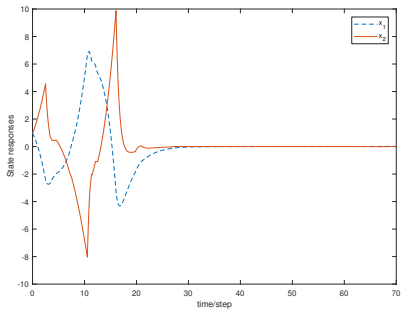
- The numerical example shows that for a two-mode system with observation delay rate $g=3$, the LMI conditions return gains $K_1=[-0.7423\,\,-0.4074]$ and $K_2=[-0.4397\,\,-0.2309]$ that stabilize the system.
Reading between the lines
- The exponential assumption is not merely technical; if the observation delay is uniform or deterministic, the pair $(r,\tilde r)$ is not Markov and the stated LMIs have no formal justification. Replacing the exponential by a phase-type distribution would preserve Markov structure with extra phases and is a natural test of how much the result depends on the assumption.
- Because the controller uses the full state $x$ and the observed mode, the same reduction would open the door to output-feedback and observer-based designs, for which the measured output $y$ is already part of the problem statement.
- The bound $\tau+\Lambda\le\min\{f_2,f_\infty\}$ lumps the initial-state and initial-delay energies; optimizing over the Lyapunov matrices instead of fixing $Q_k$ could produce less conservative bounds than the example's $\tau=7.14$, $\Lambda=4$.
- A direct falsification of the paper's scope would be to simulate the same two-mode example with non-exponential observation delays and check whether the claimed $\mathrm{H}_2$ and $\mathrm{H}_\infty$ bounds still hold; if they fail, the exponential assumption is doing the load-bearing work.
Signed reviews
Editorial analysis
A structured set of objections, weighed in public.
Referee Report
Summary. The paper studies state-feedback control for continuous-time Markov jump linear systems subject to an unknown time-varying state delay and a random delay in the observation of the mode. Under Assumption 1, which makes the mode-observation delay exponentially distributed, the pair (r(t), r̃(t)) is claimed to be a time-homogeneous Markov process, reducing the closed-loop system to a standard delayed Markov jump linear system. The main result, Theorem 1, presents LMI conditions for computing state-feedback gains that guarantee weak delay-dependent stochastic stability and prescribed mixed H2/H∞ performance levels; a numerical example is given to illustrate the design.
Significance. The remodeling idea in Section 3 is genuinely interesting: the exponential assumption is the natural memoryless condition that lets the mode-observation delay be absorbed into an enlarged Markov chain, and Proposition 1 is credible. If Theorem 1 were correct, the LMI design would be a useful tool for asynchronous switching with delayed mode information. However, the paper provides no code and only a simulation, and the central LMI system is infeasible as written; the proof contains a gap in the claimed equivalence. The paper's contribution is therefore not currently supported.
major comments (3)
- [Theorem 1, Eq. (3)] Both matrix LMIs in (3) have I_n in the (4,4) diagonal block. Since a negative-definite symmetric matrix must have all principal submatrices negative definite, and I_n is positive definite, no choice of Y_j, Z_j, ε, and Λ can satisfy either LMI. The numerical example in Section 5 therefore cannot be valid. If the intended block was -I_n or -hat Q_{kij}, the displayed statement still does not follow from the proof, because the proof replaces the (4,4) entry -hat Q_{kij} with I_n by adding a block containing -Y_j^T hat Q_{kij} Y_j - I_n; this is not a congruence or Schur-complement operation and does not preserve equivalence. In addition, the (4,1) block changes from Y_j^{-T} Z_j^T B_i^T in the intermediate LMI to Z_j^T B_i^T in (3) without a stated transformation.
- [Proposition 2, inequality (9)] The statement 'Since ||x(t)||^2 ≥ ||x(t+ϑ)||^2 for some ϑ ∈ R_+ and all -τ ≤ ϑ ≤ 0' is false for a general trajectory; for example, a trajectory with increasing norm on the interval can have ||x(t+ϑ)|| > ||x(t)||. The bound V(x(t),t,k) ≤ x^T(t)P_k x(t) + σ||x(t)||^2 with σ = τ λ_max(Q_k), and the subsequent derivation of exponential decay in (10), rely on this false inequality. Thus the proof of weak delay-dependent stochastic stability and the H2 bound in Proposition 2 is not established.
- [Section 4.1, proof of Theorem 1] The step 'from which we obtain' replaces a Schur-complement LMI whose (4,4) block is -hat Q_{kij} with the LMI displayed in (3), whose (4,4) block is I_n, by adding a block containing -Y_j^T hat Q_{kij} Y_j - I_n. This operation is not a congruence transformation or a Schur complement, and the displayed 3x3 block with a zero entry is not negative definite as claimed. Moreover, the (4,1) block changes from Y_j^{-T} Z_j^T B_i^T to Z_j^T B_i^T with no stated transformation. Therefore the sufficiency argument connecting Propositions 2 and 3 to the LMIs in (3) is not established.
minor comments (5)
- [Title] The word 'Control' appears duplicated in the arXiv title; the running header uses 'Mixed H2/H∞ Control of Delayed Markov Jump Linear Systems'.
- [Section 4, proof of Theorem 1] The sentence 'Therefore, if the second LMIs of (3) are satisfied' should refer to the first matrix LMI, and similarly 'the third LMIs' should refer to the second matrix LMI; the numbering is confusing.
- [Theorem 1, Eq. (3)] The third displayed inequality in (3) is not a valid block matrix: the lower row contains X - 1/λ_max(L_k^{-1}) with no (2,2) entry. It should be written as a scalar inequality -Λ + X^2 λ_max(L_k^{-1}) ≤ 0 or as a proper 2x2 Schur complement.
- [Section 5] The numerical example sets X = 2 but does not specify the full initial function φ on [-τ,0]; since the stability and performance bounds depend on φ(0) and on the integral defining X, the simulation is not fully reproducible.
- [Assumption 1 and Proposition 2] The paper assumes δ_+ ∈ (0,1], but if δ_+ = 1 then hat Q_{kij} = (1-δ_+)Q_{kij} = 0, and the (2,2) block in the LMI (4) is zero, so the LMI cannot be negative definite. The boundary case δ_+ = 1 should be excluded or treated separately.
Circularity Check
No significant circularity: the derivation is a standard Lyapunov–Krasovskii LMI argument with external references, and the remodeling follows from the exponential-delay assumption rather than assuming its own conclusion.
full rationale
The paper's central derivation is not circular. The remodeling in Proposition 1 is claimed to follow directly from the definition of the observation process r̃ and Assumption 1, namely that mode-observation delays are exponential; the memoryless property is an input assumption, not an output of the theorem, so reducing the closed loop to a standard delayed MJLS is a derivation from stated hypotheses rather than a definitional tautology. The H2 and H∞ bounds in Theorem 1 are obtained from Lyapunov–Krasovskii inequalities in Propositions 2 and 3, whose infinitesimal-operator and weak-stability steps are imported from external references [27,28,29]; these are not self-citations and do not assume the theorem's conclusion. The performance bound τ+Λ ≤ min{f2,f∞} is a genuine sufficient condition: τ and Λ are scalar upper bounds chosen after the fact, not fitted parameters whose values force the H2/H∞ measures by construction. No load-bearing claim rests on a self-citation chain, and no prediction is an algebraic rename of its inputs. The manuscript does have mathematical concerns—the proof of Proposition 1 is omitted, and the congruence/Schur-complement manipulation leading to the displayed LMIs is not justified and appears incorrect—but those are correctness and derivation-gap issues, not circularity, and cannot be scored under the circularity rubric.
Assumptions & free parameters
free parameters (5)
- L_k (weighting matrices in the Lyapunov-Krasovskii functional) =
L_1=L_2=L_3=L_4=I_2 in the example
- Performance targets f_2, f_∞, γ =
f_2=15, f_∞=17, γ=1 in the example
- Delay derivative bound δ_+ =
0.5 in the example
- Exponential rates g_{ij} =
g_{12}=g_{21}=3 in the example
- X (initial condition energy) =
2 in the example
assumptions (4)
- domain assumption The mode observation delay h_{i,j} follows an exponential distribution with rate g_{ij} > 0 for each i,j (Assumption 1).
- domain assumption The state delay τ(t) satisfies τ(t)∈[0,τ0] and \dot τ(t)∈[0,δ_+] with δ_+∈(0,1] (Section 2.1).
- domain assumption Proposition 1: s(t) is a time-homogeneous Markov process with transition rates q_{(i1,j1),(i2,j2)} = 1(j1=j2)λ_{i1 i2} + 1(i1=i2=j2)g_{j1 j2}.
- standard math Standard stochastic Lyapunov theory and Dynkin's formula apply to the weak infinitesimal operator of the delayed system (propositions 2 and 3).
Cite this review
Pith. "Pith review of Mixed $H_2/H_{\infty}$ Control Control of Delayed Markov Jump Linear Systems." pith.science (2026). https://pith.science/paper/BVQTC42G
@misc{pith2026190804001,
  author       = {Pith},
  title        = {Pith review of: Mixed $H_2/H_\infty$ Control Control of Delayed Markov Jump Linear Systems},
  year         = {2026},
  howpublished = {\url{https://pith.science/paper/BVQTC42G}},
  note         = {Machine review of arXiv:1908.04001}
}
abstract
This paper investigates state feedback control laws for Markov jump linear systems with state and mode-observation delays. An assumption in this study is that the delay of mode observation obeys an exponential distribution. Also, we raise an unknown time-varying state delay applied in the composition of the state feedback controller. A method of remodeling the closed-loop system as a standard Markov jump linear system with state delay is shown. Furthermore, on the basis of this remodeling, several Linear Matrix Inequalities (LMI) for designing feedback gains for stabilization and mixed $H_2/H_{\infty}$ control are proposed. Finally, we apply a numerical simulation for examining the effectiveness of the proposed mixed $H_2/H_{\infty}$ controller designing method.
Figures


Figures from the paper (3 more)


Reference graph
Works this paper leans on
-
[1]
Farias,D.,Geromel,J.,DoVal,J.,Costa,O.:’OutputfeedbackcontrolofMarkov jump linear systems in continuous-time’, IEEE Transactions on Automatic Con- trol, 2000, 45, (2), pp. 944–949
work page 2000
-
[2]
Mahmoud, S., Shi, P.:’Robust stability, stabilization andH∞ control of time- delaysystemswithMarkovianjumpparameters’,InternationalJournalofRobust and Nonlinear Control, 2003, 784, (8), pp. 755–784
work page 2003
- [3]
-
[4]
Zhao, X., Zeng, Q.:’New robust delay-dependent stability andH∞ analysis for uncertainMarkovianjumpsystemswithtime-varyingdelays’,JournaloftheFranklin Institute, 2010, 347, (5), pp. 863–874 21
work page 2010
-
[5]
Mhaskar,P.,El-Farra,N.,Christofides,P.:’Robustpredictivecontrolofswitched systems: Satisfying uncertain schedules subject to state and control constraints’, International Journal of Adaptive Control and Signal Processing, 2008, 22, (2), pp. 161–179
work page 2008
-
[6]
Shi, P., Boukas, E., Liu, Z.:’Delay-dependent stability and output feedback sta- bilisation of Markov jump system with time-delay’, IEE Proceedings - Control Theory and Applications, 2002, 149, (5), pp. 379–386
work page 2002
- [7]
-
[8]
Cao,Y.,Lam,J.:’RobustH∞ controlofuncertainMarkovianjumpsystemswith time-delay’, IEEE Transactions on Automatic Control, 2000, 45, (1), pp. 77–83
work page 2000
Show all 29 references
-
[9]
Chen, W., Guan, Z., Yu, P.:’Delay-dependent stability andH∞ control of uncer- tain discrete-time Markovian jump systems with mode-dependent time delays’, Systems & Control Letters, 2004, 52, (5), pp. 361–376
2004
-
[10]
Xiong, J., Lam, J.:’Stabilization of discrete-timeMarkovian jump linear systems via time-delayed controllers’, Automatica, 2006, 42, (5), pp. 747–753
2006
-
[11]
Cetinkaya, A., Hayakawa, T.:’Discrete-time switched stochastic control systems with randomly observed operation mode’, 52nd IEEE Conference on Decision and Control, Florence, Italy, Dec 2013, pp. 85–90
2013
-
[12]
3266–3271
Cetinkaya,A.,Hayakawa,T.:’Stabilizingdiscrete-timeswitchedlinearstochastic systems using periodically available imprecise mode information’, 2013 Ameri- can Control Conference, Washington, USA, Jun 2013, pp. 3266–3271
2013
-
[13]
3966–3971
Cetinkaya,A.,Hayakawa,T.:’Sampled-mode-dependenttime-varyingcontrolstrat- egy for stabilizing discrete-time switched stochastic systems’, 2014 American 22 Control Conference, Portland, USA, Jun 2014, pp. 3966–3971
2014
-
[14]
Lou,X.,Cui,B.:’Delay-dependentstochasticstabilityofdelayedHopfieldneural networks with Markovian jump parameters’, Journal of Mathematical Analysis and Applications, 2007, 328, (1), pp. 316–326
2007
-
[15]
1660–1667
Chen, W., Zheng, W., Shen, Y.:’Delay-dependent stochastic stability andH∞- control of uncertain neutral stochastic systems With time delay’, IEEE Transac- tions on Automatic Control, 2009, 54, (7), pp. 1660–1667
2009
-
[16]
66861–66869
Sakthivel,R.,Harshavarthini,S.,Kavikumar,R.,Ma,Y.:’Robusttrackingcontrol for fuzzy Markovian jump systems with time-varying delay and disturbances’, IEEE Access, 2018, 6, pp. 66861–66869
2018
-
[17]
Boukas, E., Liu, Z., Shi, P.:’Delay-dependent stability and output feedback sta- bilisation of Markov jump system with time-delay’, IEE Proceedings - Control Theory and Applications, 2002, 149, (5), pp. 379–386
2002
-
[18]
1603–1610
Hien,L.,Trinh,H.:’Delay-dependentstabilityandstabilisationoftwo-dimensional positive Markov jump systems with delays’, IET Control Theory and Applica- tions, 2017, 11, (10), pp. 1603–1610
2017
-
[19]
6353–6370
Sakthivela, R., Sakthivel, R., Nithyaa, V., Selvaraj, P., Kwon, M.:’Fuzzy slid- ing mode control design of Markovian jump systems with time-varying delay’, Journal of the Franklin Institute, 2018, 335, (14), pp. 6353–6370
2018
-
[20]
4354–4365
Park, B., Kwon, N., Park, P.:’Stabilization of Markovian jump systems with in- complete knowledge of transition probabilities and input quantization’, Journal of the Franklin Institute, 2015, 352, (10), pp. 4354–4365
2015
-
[21]
Xie, X., Lam, J., Fan, C.:’Robust time-weighted guaranteed cost control of un- certain periodic piecewise linear systems’, Information Sciences, 2018, 460, pp. 238–253. 23
2018
-
[22]
Chen, B., Liu, P.:’Delay-dependentH2∕H∞ control for a class of switched TS fuzzysystemswithtime-delay’,IEEETransactionsonFuzzySystems,2005,13, (4), 544–556
2005
-
[23]
4929–4934
Aliyu, M., Boukas, E.:’MixedH2∕H∞ stochastic control problem’, IFAC Pro- ceedings Volumes, 1999, 32, (2), pp. 4929–4934
1999
-
[24]
Boukas, E.:’H∞ control of discrete-time Markov jump systems with bounded transition probabilities’, Optimal Control Applications and Methods, 2009, 30, (5), pp. 477–494
2009
-
[25]
1566–1572
Luan, X., Zhao, S., Liu, F.:’H∞ control for discrete-time Markov jump systems withuncertaintransitionprobabilities’,IEEETransactionsonAutomaticControl, 2012, 58, (6), pp. 1566–1572
2012
-
[26]
1011–1029
Ma, S., Zhang, C.:’H∞ control for discrete-time singular Markov jump systems subject to actuator saturation’, Journal of the Franklin Institute, 2012, 349, (3), pp. 1011–1029
2012
-
[27]
Feng, X., Loparo, K., Ji, Y., Chizeck, H.:’Stochastic stability properties of jump linearsystems’,IEEETransactionsonAutomaticControl,1992,37,(1),pp. 38– 53
1992
-
[28]
Mahmoud, M., Al-Muthairi, N.:’Design of robust controllers for time-delay sys- tems’, IEEE Transactions on Automatic Control, 1994, 39, (5), pp. 995–999
1994
-
[29]
536–552 24
Mahmoud, M., AL-Sunni, F., Shi, Y.:’Mixed control of uncertain jumping time- delay systems’, Journal of the Franklin Institute, 2008, 345, (5), pp. 536–552 24
2008
Reviewed August 14, 2026 · model on record in the stance chip above.
Discussion (0). Continue with ORCID to comment.