REVIEW 3 major objections 6 minor 122 references
Volatile-bearing mineral atmospheres of hot rocky exoplanets as probes of interior state and composition
T0 review · 3 major / 6 minor · reviewed 2026-08-04 · deepseek-v4-flash
Pith's one-line read A magma ocean's oxygen fugacity, not its volatile budget, is the major control on the spectra of hot rocky exoplanets, with the SO2 8–9 µm feature as the most robust tracer of redox state.
desk verdict A genuinely self-consistent coupled magma-ocean/atmosphere model that makes a strong qualitative case for fO2 as the main spectral knob, but the quantitative 55 Cnc e exclusion of oxidized VIBSE rests on an unvalidated ~1200 K extrapolation of the S2 solubility law. read the letter →
The pith
A machine-rendered reading of the paper's core claim, the machinery that carries it, and where it could break.
The reading
What carries the argument
The key machinery is a coupled atmosphere-interior equilibrium model that imposes chemical equilibrium between a fully molten magma ocean and the gas at their interface. The oxygen fugacity of the melt, expressed relative to the iron-wüstite buffer (ΔIW), is treated as an independent variable that sets the fugacities of mineral gases (SiO, Mg, Fe) and, together with solubility laws, controls the partitioning of volatiles (H, C, N, S) between melt and atmosphere. The resulting gas composition feeds a 1D radiative-transfer model that computes the pressure–temperature structure and synthetic emission and transmission spectra, including wavelength-dependent planetary radius.
What would settle it
Measure the 8–9 µm emission spectrum of a hot rocky exoplanet whose bulk density and irradiation independently require an oxidised magma ocean near ΔIW+3; if the SO2 absorption feature is absent, the claimed fO2 tracer is not robust.
Extended reading notes
Core claim
The central claim is that the oxygen fugacity of the magma ocean, not the volatile mass fraction or metallicity, is the dominant variable controlling the shape of emission and transmission spectra of hot rocky exoplanets. In particular, the SO2 absorption feature at 8–9 µm appears most prominently near ΔIW+3 and weakens at both higher and lower fO2, making it a robust but non-monotonic tracer of redox state. The model also shows that high-fO2, carbon- and sulfur-rich atmospheres produce strong CO2 and SO2 absorption, while low-fO2, mineral-rich atmospheres generate SiO-driven thermal inversions and emission features. For 55 Cancri e, the MIRI spectrum disfavours oxidised Earth-like and reduc
Load-bearing premise
The atmosphere's gas composition is set by chemical equilibrium with the magma ocean at their interface; if escape, photochemistry, or a solid crust prevents this equilibrium, the spectrum no longer reflects the interior's redox state.
Editorial extensions
If this is right
- Observers can use the SO2 8–9 µm feature to infer the redox state of a magma ocean, with the strongest signal near ΔIW+3.
- The relative intensities of H2O and CO2 features can distinguish atmospheres outgassed from the interior from those accreted from a nebula.
- Mass–radius measurements alone are degenerate in fO2, volatile mass, and metallicity; spectra are required to break this degeneracy.
- Existing MIRI data for 55 Cancri e rule out both an oxidised Earth-like atmosphere and a reduced primordial (solar-composition) atmosphere.
- Future MIRI medium-resolution observations at wavelengths beyond 8 µm can distinguish the remaining candidate scenarios for 55 Cancri e.
Reading between the lines
- If fO2 is the master variable, then spectral classification of hot rocky exoplanets should be organized by redox state rather than by presumed bulk composition; planets with similar spectra could have very different volatile histories.
- Because the SO2 feature is non-monotonic in fO2, a single-band detection may be ambiguous; combining it with SO and OH features in the UVIS could break the degeneracy.
- The model's equilibrium assumption implies that the proposed tracer fails if a solid crust, photochemical escape, or atmospheric dynamics decouples the gas from the magma ocean—time-variable spectral observations could test this directly.
Editorial analysis
A structured set of objections, weighed in public.
Referee Report
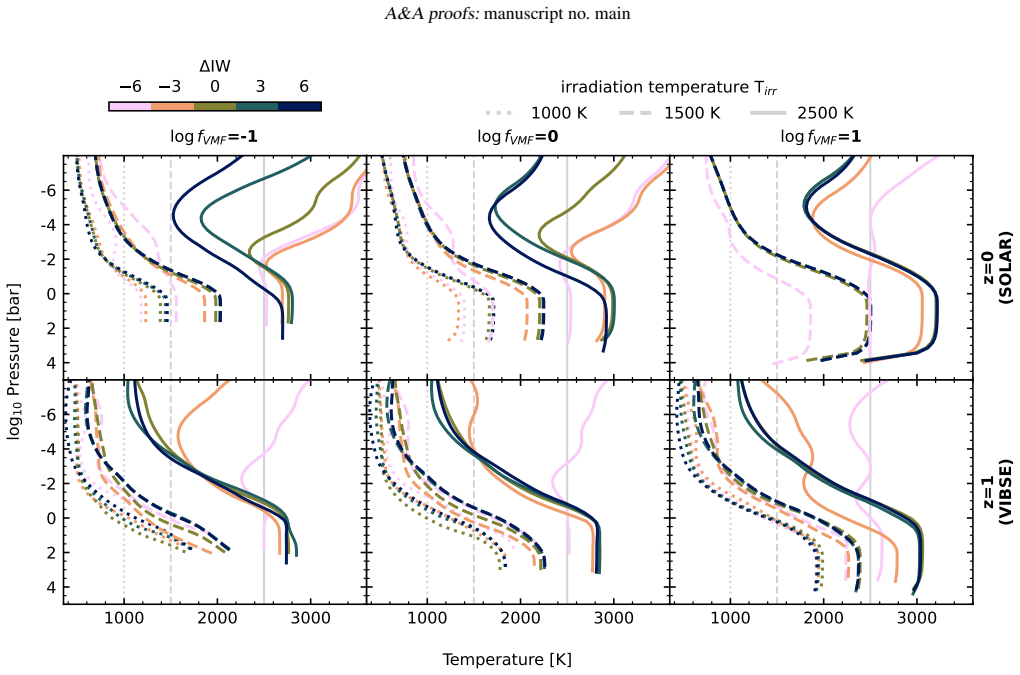
Summary. The manuscript presents a coupled magma-ocean/atmosphere model for hot rocky exoplanets (HREs) with fully molten mantles. The atmosphere-interior equilibrium code Atmodeller computes gas speciation at the magma-ocean-atmosphere interface from the system Si-Mg-Fe-O-C-H-S-N-He, combining mineral vapor fugacities with volatile solubility laws; the radiative transfer pipeline phaethon (HELIOS + FastChem COND + petitRADTRANS) then computes self-consistent P-T structures and emission/transmission spectra. The model is applied to a fiducial 8 Earth-mass, 55 Cnc e-like planet across a grid spanning oxygen fugacity (ΔIW from -6 to +6), volatile mass fraction (log fVMF from -1 to 1 relative to Earth), and metallicity mixing between solar and VIBSE compositions (z=0 to 1). The central result is that oxygen fugacity is the dominant control on spectral shape, with the SO2 8–9 μm absorption feature identified as the most robust tracer of fO2, peaking near ΔIW+3; CO2 and H2O are ubiquitous and less diagnostic. Applying the grid to JWST MIRI observations of 55 Cnc e, the authors argue that oxidized VIBSE-like and reduced primordial (SOLAR) atmospheres are disfavored, while intermediate or low-z/reduced scenarios remain viable. NIRCam data are found to be internally inconsistent and inconclusive. The paper also uses mass-radius relations to argue that most HREs require modest atmospheres of mixed heritage, with TOI-1408 c as a rare inflated case.
Significance. If the central claim holds, the paper provides a practical roadmap for using mid-infrared spectra to infer the redox state of magma oceans on hot rocky exoplanets, thereby linking an observable (emission/transmission spectra) to an inaccessible interior property (fO2). This would be a valuable contribution to the interpretation of current and upcoming JWST observations. The model's strengths include its self-consistent treatment of mineral-vapor fugacities and volatile partitioning (avoiding the a posteriori closure criticized in earlier work), the use of external thermodynamic and opacity data rather than circular retrieval inputs, explicit listing of caveats (ideal-gas breakdown, incomplete line lists, solubility-law extrapolation, no clouds), and concrete, falsifiable predictions for MIRI MRS observations. The code and data products are promised on GitHub/Zenodo upon acceptance, which will aid reproducibility. The main risk to the quantitative conclusions is the large extrapolation of the S2 solubility law to 3000 K, which directly affects the predicted strength and location of the SO2 fO2-tracer feature and hence the 55 Cnc e interpretation.
major comments (3)
- [Sec 3.3.1 / Sec 4.3(2) / Table A.1] The central diagnostic claim—that the 8–9 μm SO2 feature is the most robust fO2 tracer and that its maximum near ΔIW+3 constrains the 55 Cnc e MIRI data—rests on the S2 solubility law of Boulliung & Wood (2022, 2023), calibrated over 1473–1773 K for basaltic/andesitic melts. The model grid is evaluated at T_MAI = 3000 K (Fig. 2) and the fiducial 55 Cnc e model reaches T_MAI ≈ 3000 K (Sec. 3.1). This is a ~1200 K extrapolation, acknowledged in Sec. 4.3 point 2 but not quantified. If the true solubility of S2 at 3000 K differs from the Henry/Sieverts extrapolation (e.g., due to temperature-dependent sulfide capacity or FeO content), the pSO2 peak could shift in both amplitude and ΔIW, directly changing the exclusion of oxidized VIBSE scenarios in Sec. 4.2.1. I request a sensitivity test (e.g., varying the solubility parameters within plausible bounds, or comparing with an alternative sulfi
- [Sec 4.3(1) / Table C.1] The opacity tables for SO2 (ExoAmes) extend only to 1900 K, while the bottom-of-atmosphere temperatures in many models exceed this (up to ~3000 K). The authors note in Sec. 4.3 that 'SO2 ... only extends up to 1900 K' but do not state the impact on the 8–9 μm feature if part of the line-forming region lies above 1900 K. Even if the photosphere is generally cooler, high-T layers could contribute to the feature wings, and the correlated-k tables are truncated. A brief analysis of where the SO2 feature forms (contribution-function peak temperature) would clarify whether this is a quantitative or only a minor limitation.
- [Sec 4.2.1 / Fig. 10] The conclusion that the MIRI observation 'preclude[s] oxidised VIBSE-scenarios' is based on a ~2σ discrepancy between the predicted and observed flux in the SO2 band segment. Given the discrete model grid, the unknown vertical offset in the NIRCam data, and the S2 solubility extrapolation discussed above, the significance of this exclusion is uncertain. I recommend presenting the χ2 differences with a more explicit treatment of model uncertainty (e.g., including the effect of the S2 solubility uncertainty on the predicted spectra) and softening 'preclude' to 'disfavour' unless robustness is demonstrated.
minor comments (6)
- [Sec 4.3(1)] The text states that H2O opacity extends only up to 2900 K, but Table C.1 lists H2O (POKAZATEL) valid up to 8900 K. Please reconcile this inconsistency.
- [Fig. 2] The partial-pressure curves in Fig. 2 are not individually labeled in the figure; the caption refers to 'gas species' but the reader cannot distinguish e.g. SO2 from H2O without reference to the text. Adding a legend or labels would improve readability.
- [Eq. (12)] The scaled density ρs is defined using ρ'_Earth(Mp), but it is not immediately clear whether this is the uncompressed or compressed Earth density at the same mass. Please state the reference density model explicitly in the text.
- [Sec 4.1] There is an apparent typo in the age range '3.800.66-0.79 Gyr' for HD 213885 b; the formatting is broken. Please fix.
- [Code and Data availability] The statement 'Repo available upon acceptance' and 'Upload to zenodo upon acceptance' means the reproducibility artifacts are not currently accessible to the referee. Please provide a permanent DOI or at least a preprint-accessible repository link in the final version.
- [Sec 3.3.1] The statement that 'distinguishing between redox states based on the SO2 feature alone may be challenging because a ΔIW+6 atmosphere is ostensibly similar in the SO2-bands to one formed at ΔIW+1.5' is useful but seems to weaken the 'most robust tracer' claim. Consider rephrasing to clarify that the tracer is robust for distinguishing reducing from oxidizing states, not for finely resolving ΔIW within +1.5 to +6.
Circularity Check
No significant circularity: forward model from external thermodynamics; SO2 fO2 tracer is a model output, not a fitted input.
full rationale
The paper's derivation chain is a forward modeling pipeline: Atmodeller computes equilibrium gas speciation from imposed fO2, volatile mass fraction, metallicity, and external thermodynamic data (solubility laws from Boulliung & Wood 2022/2023, Sossi et al. 2023, etc.); phaethon/HELIOS/petitRADTRANS then compute P-T structure and spectra from these compositions and external opacity tables. The central claim that fO2 controls spectral shape, and that the SO2 8-um feature is a robust fO2 tracer, is a model output rather than an input: the grid varies fO2 and records spectral changes, and the SO2 feature location/strength is not used to define fO2 or to fit any parameter. The only fitted quantities are nuisance offsets in the NIRCam light curves (Sec. 4.2.2), explicitly treated as free parameters for shape fitting, not as predictions. Citations to the authors' own codes (Atmodeller, phaethon) and prior fugacity relations (Seidler et al. 2024 Eq. 8) are references to public, independently usable tools and standard thermodynamic identities; they do not smuggle in the result. The manuscript's acknowledged limitations—extrapolation of S2 solubility laws to ~3000 K and SO2 opacity to 1900 K (Sec. 4.3)—are validity/correctness concerns about external input data, not circularity, because the model does not redefine those inputs in terms of the spectral features it predicts. No fitted parameter is renamed as a prediction, and no self-citation chain forces the conclusion.
Assumptions & free parameters
free parameters (5)
- Delta IW (oxygen fugacity relative to iron-wustite buffer) =
-6 (best fit for 55 Cnc e MIRI; grid -6 to +6)
- z (metallicity mixing fraction between SOLAR and VIBSE) =
0.5 (best fit for 55 Cnc e MIRI; grid 0 to 1)
- log fVMF (log10 volatile mass fraction relative to Earth) =
0 (best fit for 55 Cnc e MIRI; grid -1 to 1)
- T_irr (irradiation temperature) =
2500 K for 55 Cnc e; grid 1000-2500 K
- NIRCam vertical offset Phi (average eclipse depth) =
Fitted per visit (e.g., 116 ppm, 31 ppm)
assumptions (8)
- domain assumption Melt and gas are in chemical equilibrium at the magma ocean-atmosphere interface
- domain assumption Mantle is fully molten (x_melt=1) and of bulk silicate Earth composition
- domain assumption Ideal gas equation of state for all gas species
- domain assumption Solubility laws calibrated at lower temperatures and basaltic compositions apply at magma ocean conditions
- domain assumption Elemental abundances are constant with altitude (infinitely well mixed)
- domain assumption Opacity tables for key absorbers are valid at the temperatures and pressures modeled
- domain assumption Mantle acts as an infinite reservoir of oxygen, fixing fO2; O2 and mineral gas masses are not conserved
- domain assumption No internal heat sources, zero bond albedo, and heat redistribution factor f=2/3
Cite this review
Pith. "Pith review of Volatile-bearing mineral atmospheres of hot rocky exoplanets as probes of interior state and composition." pith.science (2026). https://pith.science/paper/BWA4AYSF
@misc{pith2026250913610,
  author       = {Pith},
  title        = {Pith review of: Volatile-bearing mineral atmospheres of hot rocky exoplanets as probes of interior state and composition},
  year         = {2026},
  howpublished = {\url{https://pith.science/paper/BWA4AYSF}},
  note         = {Machine review of arXiv:2509.13610}
}
abstract
The atmospheres of hot rocky exoplanets (HREs), should they persist, are products of interactions with underlying magma oceans. Spectra collected by the James Webb Space Telescope (JWST) hint at a CO/CO$_2$-rich atmosphere on the HRE 55 Cancri e, indicative of such a process. Here, we aim to identify diagnostic features that can be used to infer the composition and geochemical state of HREs. We construct a coupled atmosphere-interior model that computes the equilibrium gas speciation in the atmosphere in the system Si-Mg-Fe-O-C-H-S-N-He. The model accounts for both the equilibrium vaporisation of mineral gases and the partitioning of volatile species between the magma ocean and atmosphere. Using a fiducial planet with the properties of 55 Cancri e, we explore a parameter space that spans volatile mass fractions from 0.1 to 10 times that of the Earth, solar- to Earth-like metallicities, and 12 orders of magnitude in oxygen fugacity fO$_2$. We find fO$_2$ to be the major control of the shape of emission and transmission features. The presence of species such as SO$_2$ and the relative intensities of H$_2$O and CO$_2$ features allow to distinguish the origin of the gas, accreted or outgassed, while the atmospheric mass is more challenging to constrain. Inflated HREs, whose densities are compatible with a nebular atmosphere are rare, but a viable explanation for the planet TOI-1408 c. The majority of HREs, including 55 Cancri e, are too dense to be dominated by H$_2$-rich nebular gas yet too puffy for an Earth-like volatile budget, implying modest atmospheres of mixed heritage that are degenerate in fO$_2$, volatile mass and composition. The MIRI observation of 55 Cancri e disfavours oxidised Earth-like and reduced primoridal atmospheres alike, while the NIRCam data remain inconclusive. Future observations at wavelengths beyond 8 $\mu$m are key to discerning between potential scenarios.
Figures


Figures from the paper (9 more)


Reference graph
Works this paper leans on
-
[1]
, " * write output.state after.block = add.period write newline
ENTRY address archiveprefix author booktitle chapter edition editor howpublished institution eprint journal key month note number organization pages publisher school series title type volume year label extra.label sort.label short.list INTEGERS output.state before.all mid.sentence after.sentence after.block FUNCTION init.state.consts #0 'before.all := #1 ...
-
[2]
write newline
" write newline "" before.all 'output.state := FUNCTION n.dashify 't := "" t empty not t #1 #1 substring "-" = t #1 #2 substring "--" = not "--" * t #2 global.max substring 't := t #1 #1 substring "-" = "-" * t #2 global.max substring 't := while if t #1 #1 substring * t #2 global.max substring 't := if while FUNCTION word.in bbl.in " " * FUNCTION format....
-
[3]
Abel, M., Frommhold, L., Li, X., & Hunt, K. L. 2011, The Journal of Physical Chemistry A, 115, 6805
2011
-
[4]
Abel, M., Frommhold, L., Li, X., & Hunt, K. L. 2012, The Journal of chemical physics, 136
2012
-
[5]
G., et al
Adibekyan, V., Dorn, C., Sousa, S. G., et al. 2021, Science, 374, 330
2021
-
[6]
S., Tremblin, P., Manners, J., Baraffe, I., & Mayne, N
Amundsen, D. S., Tremblin, P., Manners, J., Baraffe, I., & Mayne, N. J. 2017, Astronomy & Astrophysics, 598, A97
2017
-
[7]
Angelo, I. & Hu, R. 2017, The Astronomical Journal, 154, 232
2017
-
[8]
2013, Geochimica et Cosmochimica Acta, 114, 52
Ardia, P., Hirschmann, M., Withers, A., & Stanley, B. 2013, Geochimica et Cosmochimica Acta, 114, 52
2013
Show all 122 references
-
[9]
1889, Zeitschrift f \"u r physikalische Chemie, 4, 96
Arrhenius, S. 1889, Zeitschrift f \"u r physikalische Chemie, 4, 96
-
[10]
M., Lim , P
Astropy Collaboration , Price-Whelan , A. M., Lim , P. L., et al. 2022, , 935, 167
2022
-
[11]
M., Sip o cz , B
Astropy Collaboration , Price-Whelan , A. M., Sip o cz , B. M., et al. 2018, , 156, 123
2018
-
[12]
P., Tollerud , E
Astropy Collaboration , Robitaille , T. P., Tollerud , E. J., et al. 2013, , 558, A33
2013
-
[13]
A., Tennyson, J., Yurchenko, S
Azzam, A. A., Tennyson, J., Yurchenko, S. N., & Naumenko, O. V. 2016, Monthly Notices of the Royal Astronomical Society, 460, 4063
2016
-
[14]
A., et al
Bello-Arufe, A., Damiano, M., Bennett, K. A., et al. 2025, The Astrophysical Journal Letters, 980, L26
2025
-
[15]
1999, Journal of Geophysical Research: Planets, 104, 16591
Bougher, S., Engel, S., Roble, R., & Foster, B. 1999, Journal of Geophysical Research: Planets, 104, 16591
1999
-
[16]
& Wood, B
Boulliung, J. & Wood, B. J. 2022, Geochimica et Cosmochimica Acta, 336, 150
2022
-
[17]
& Wood, B
Boulliung, J. & Wood, B. J. 2023, Contributions to Mineralogy and Petrology, 178, 15
2023
-
[18]
2018, Astronomy & Astrophysics, 619, A1
Bourrier, V., Dumusque, X., Dorn, C., et al. 2018, Astronomy & Astrophysics, 619, A1
2018
-
[19]
J., Hakim, K., Sossi, P
Bower, D. J., Hakim, K., Sossi, P. A., & Sanan, P. 2022, The planetary science journal, 3, 93
2022
-
[20]
J., Kitzmann, D., Wolf, A
Bower, D. J., Kitzmann, D., Wolf, A. S., et al. 2019, Astronomy & Astrophysics, 631, A103
2019
-
[21]
J., Thompson, M
Bower, D. J., Thompson, M. A., Hakim, K., Tian, M., & Sossi, P. A. 2025, The Astrophysical Journal [ [arXiv] 2507.00499 ], submitted
2025
-
[22]
P., Yurchenko, S
Brady, R. P., Yurchenko, S. N., Tennyson, J., & Kim, G.-S. 2024, Monthly Notices of the Royal Astronomical Society, 527, 6675
2024
-
[23]
Carroll, M. R. & Draper, D. S. 1994, Chemical Geology, 117, 37
1994
-
[24]
2023, Astronomy & Astrophysics, 674, A224
Charnoz, S., Falco, A., Tremblin, P., et al. 2023, Astronomy & Astrophysics, 674, A224
2023
-
[25]
J., et al
Cherubim, C., Wordsworth, R., Bower, D. J., et al. 2025, The Astrophysical Journal, 983, 97
2025
-
[26]
L., Tennyson, J., & Yurchenko, S
Chubb, K. L., Tennyson, J., & Yurchenko, S. N. 2020, Monthly Notices of the Royal Astronomical Society, 493, 1531
2020
-
[27]
2022, Geochimica et Cosmochimica Acta, 336, 291
Dasgupta, R., Falksen, E., Pal, A., & Sun, C. 2022, Geochimica et Cosmochimica Acta, 336, 291
2022
-
[28]
2016 a , Nature, 532, 207
Demory, B.-O., Gillon, M., De Wit, J., et al. 2016 a , Nature, 532, 207
2016
-
[29]
2016 b , Monthly Notices of the Royal Astronomical Society, 455, 2018
Demory, B.-O., Gillon, M., Madhusudhan, N., & Queloz, D. 2016 b , Monthly Notices of the Royal Astronomical Society, 455, 2018
2016
-
[30]
E., Stolper, E
Dixon, J. E., Stolper, E. M., & Holloway, J. R. 1995, Journal of Petrology, 36, 1607
1995
-
[31]
Elkins-Tanton, L. T. & Seager, S. 2008, The Astrophysical Journal, 688, 628
2008
-
[32]
2020, Monthly Notices of the Royal Astronomical Society, 491, 2982
Espinoza, N., Brahm, R., Henning, T., et al. 2020, Monthly Notices of the Royal Astronomical Society, 491, 2982
2020
-
[33]
2020, The Astrophysical Journal, 898, 160
Essack, Z., Seager, S., & Pajusalu, M. 2020, The Astrophysical Journal, 898, 160
2020
-
[34]
& Cameron, A
Fegley Jr, B. & Cameron, A. 1987, Earth and Planetary Science Letters, 82, 207
1987
-
[35]
Foustoukos, D. I. 2025, Geochimica et Cosmochimica Acta, 389, 125
2025
-
[36]
2022, Earth and Planetary Science Letters, 577, 117255
Gaillard, F., Bernadou, F., Roskosz, M., et al. 2022, Earth and Planetary Science Letters, 577, 117255
2022
-
[37]
P., & Sossi, P
Gillmann, C., Hakim, K., Louren c o, D., Quanz, S. P., & Sossi, P. A. 2024, Space: Science & Technology, 4, 0075
2024
-
[38]
E., Rothman, L
Gordon, I. E., Rothman, L. S., Hill, C., et al. 2017, Journal of quantitative spectroscopy and radiative transfer, 203, 3
2017
-
[39]
N., Yurchenko, S
Gorman, M. N., Yurchenko, S. N., & Tennyson, J. 2019, Monthly Notices of the Royal Astronomical Society, 490, 1652
2019
-
[40]
Grimm, S. L. & Heng, K. 2015, The Astrophysical Journal, 808, 182
2015
-
[41]
L., Malik, M., Kitzmann, D., et al
Grimm, S. L., Malik, M., Kitzmann, D., et al. 2021, The Astrophysical Journal Supplement Series, 253, 30
2021
-
[42]
Gueymard, C. A. 2004, Solar Energy, 76, 423
2004
-
[43]
& Frommhold, L
Gustafsson, M. & Frommhold, L. 2001, The Astrophysical Journal, 546, 1168
2001
-
[44]
& Frommhold, L
Gustafsson, M. & Frommhold, L. 2003, Astronomy & Astrophysics, 400, 1161
2003
-
[45]
2025, Monthly Notices of the Royal Astronomical Society
Hakim, K., Bower, D., Seidler, F., & Sossi, P. 2025, Monthly Notices of the Royal Astronomical Society
2025
-
[46]
& Pierrehumbert, R
Hammond, M. & Pierrehumbert, R. T. 2017, The Astrophysical Journal, 849, 152
2017
-
[47]
Hansen, B. M. 2008, The Astrophysical Journal Supplement Series, 179, 484
2008
-
[48]
R., Millman, K
Harris, C. R., Millman, K. J., van der Walt, S. J., et al. 2020, Nature, 585, 357
2020
-
[49]
2021, Geochimica et Cosmochimica Acta, 313, 74
Hirschmann, M. 2021, Geochimica et Cosmochimica Acta, 313, 74
2021
-
[50]
M., Withers, A., Ardia, P., & Foley, N
Hirschmann, M. M., Withers, A., Ardia, P., & Foley, N. 2012, Earth and Planetary Science Letters, 345, 38
2012
-
[51]
& Powell, R
Holland, T. & Powell, R. 1991, Contributions to Mineralogy and Petrology, 109, 265
1991
-
[52]
2024, Nature, 1
Hu, R., Bello-Arufe, A., Zhang, M., et al. 2024, Nature, 1
2024
-
[53]
C., Saper, L
Hughes, E. C., Saper, L. M., Liggins, P., O'Neill, H. S. C., & Stolper, E. M. 2023, Journal of the Geological Society, 180, jgs2021
2023
-
[54]
Hunter, J. D. 2007, Computing in Science & Engineering, 9, 90
2007
-
[55]
1986, Geochimica et Cosmochimica Acta, 50, 401
Jambon, A., Weber, H., & Braun, O. 1986, Geochimica et Cosmochimica Acta, 50, 401
1986
-
[56]
F., Spiegelman, M., & Langmuir, C
Katz, R. F., Spiegelman, M., & Langmuir, C. H. 2003, Geochemistry, Geophysics, Geosystems, 4
2003
-
[57]
S., Fegley Jr, B., Schaefer, L., & Ford, E
Kite, E. S., Fegley Jr, B., Schaefer, L., & Ford, E. B. 2020, The Astrophysical Journal, 891, 111
2020
-
[58]
W., & Patzer, A
Kitzmann, D., Stock, J. W., & Patzer, A. B. C. 2024, Monthly Notices of the Royal Astronomical Society, 527, 7263
2024
-
[59]
2024, The Astrophysical Journal Letters, 971, L28
Korth, J., Chaturvedi, P., Parviainen, H., et al. 2024, The Astrophysical Journal Letters, 971, L28
2024
-
[60]
Kurucz, R. L. 2017, Canadian Journal of Physics, 95, 825
2017
-
[61]
S., Sundquist, E
Ledley, T. S., Sundquist, E. T., Schwartz, S. E., et al. 1999, Eos, Transactions American Geophysical Union, 80, 453
1999
-
[62]
2011, Icarus, 213, 1
L \'e ger, A., Grasset, O., Fegley, B., et al. 2011, Icarus, 213, 1
2011
-
[63]
E., Rothman, L
Li, G., Gordon, I. E., Rothman, L. S., et al. 2015, The Astrophysical Journal Supplement Series, 216, 15
2015
-
[64]
Y., Tennyson, J., & Yurchenko, S
Li, H. Y., Tennyson, J., & Yurchenko, S. N. 2019, Monthly Notices of the Royal Astronomical Society, 486, 2351
2019
-
[65]
2003, Geochimica et Cosmochimica Acta, 67, 4123
Libourel, G., Marty, B., & Humbert, F. 2003, Geochimica et Cosmochimica Acta, 67, 4123
2003
-
[66]
B., & Shorttle, O
Liggins, P., Jordan, S., Rimmer, P. B., & Shorttle, O. 2022, Journal of Geophysical Research: Planets, 127, e2021JE007123
2022
-
[67]
2021, Space Science Reviews, 217, 44
Lodders, K. 2021, Space Science Reviews, 217, 44
2021
-
[68]
& Pall \'e , E
Luque, R. & Pall \'e , E. 2022, Science, 377, 1211
2022
-
[69]
M., et al
Malik, M., Grosheintz, L., Mendonça, J. M., et al. 2017, The Astronomical Journal, 153, 56
2017
-
[70]
M., et al
Malik, M., Kitzmann, D., Mendonça, J. M., et al. 2019, The Astronomical Journal, 157, 170
2019
-
[71]
2024, Astronomy & Astrophysics, 688, A47
Maurice, M., Dasgupta, R., & Hassanzadeh, P. 2024, Astronomy & Astrophysics, 688, A47
2024
-
[72]
E., & Young, E
Misener, W., Schlichting, H. E., & Young, E. D. 2023, Monthly Notices of the Royal Astronomical Society, 524, 981
2023
-
[73]
B., Bowesman, C
Mitev, G. B., Bowesman, C. A., Zhang, J., Yurchenko, S. N., & Tennyson, J. 2025, Monthly Notices of the Royal Astronomical Society, 536, 3401
2025
-
[74]
2019, Astronomy & Astrophysics, 627, A67
Molli \`e re, P., Wardenier, J., Van Boekel, R., et al. 2019, Astronomy & Astrophysics, 627, A67
2019
-
[75]
2025, The Astronomical Journal, 169, 239
Monaghan, C., Roy, P.-A., Benneke, B., et al. 2025, The Astronomical Journal, 169, 239
2025
-
[76]
2023, Astronomy & Astrophysics, 673, A42
Nascimbeni, V., Borsato, L., Zingales, T., et al. 2023, Astronomy & Astrophysics, 673, A42
2023
-
[77]
G., Cowan, N
Nguyen, T. G., Cowan, N. B., & Dang, L. 2024, The Astronomical Journal, 168, 287
2024
-
[78]
J., & Pierrehumbert, R
Nicholls, H., Lichtenberg, T., Bower, D. J., & Pierrehumbert, R. 2024, Journal of Geophysical Research: Planets, 129, e2024JE008576
2024
-
[79]
T., Lichtenberg, T., Soucasse, L., & Smeets, S
Nicholls, H., Pierrehumbert, R. T., Lichtenberg, T., Soucasse, L., & Smeets, S. 2025, Monthly Notices of the Royal Astronomical Society, 536, 2957
2025
-
[80]
2014--, Bayesian Optimization : Open source constrained global optimization tool for Python
Nogueira, F. 2014--, Bayesian Optimization : Open source constrained global optimization tool for Python
2014
-
[81]
Owen, J. E. & Wu, Y. 2016, The Astrophysical Journal, 817, 107
2016
-
[82]
Owen, J. E. & Wu, Y. 2017, The Astrophysical Journal, 847, 29
2017
-
[83]
O’Neill, H. S. & Mavrogenes, J. A. 2002, Journal of Petrology, 43, 1049
2002
-
[84]
& O'Neill, H
Palme, H. & O'Neill, H. 2013, in The mantle and core (Elsevier), 1--39
2013
-
[85]
2024, Astronomy & Astrophysics, 690, A159
Patel, J., Brandeker, A., Kitzmann, D., et al. 2024, Astronomy & Astrophysics, 690, A159
2024
-
[86]
& Valencia, D
Peng, B. & Valencia, D. 2024, The Astrophysical Journal, 976, 202
2024
-
[87]
A., Gao, P., Brugman, K., et al
Piette, A. A., Gao, P., Brugman, K., et al. 2023, The Astrophysical Journal, 954, 29
2023
-
[88]
L., Kyuberis, A
Polyansky, O. L., Kyuberis, A. A., Zobov, N. F., et al. 2018, Monthly Notices of the Royal Astronomical Society, 480, 2597
2018
-
[89]
M., Pickering, T
Pontoppidan, K. M., Pickering, T. E., Laidler, V. G., et al. 2016, in Observatory Operations: Strategies, Processes, and Systems VI, ed. A. B. Peck, R. L. Seaman, & C. R. Benn, Vol. 9910, International Society for Optics and Photonics (SPIE), 991016
2016
-
[90]
N., & Tennyson, J
Qu, Q., Yurchenko, S. N., & Tennyson, J. 2021, Monthly Notices of the Royal Astronomical Society, 504, 5768
2021
-
[91]
2019, Astronomy & Astrophysics, 630, A58
Roueff, E., Abgrall, H., Czachorowski, P., et al. 2019, Astronomy & Astrophysics, 630, A58
2019
-
[92]
2016, Astronomy & Astrophysics, 585, L2
Salz, M., Schneider, P., Czesla, S., & Schmitt, J. 2016, Astronomy & Astrophysics, 585, L2
2016
-
[93]
& Fegley Jr, B
Schaefer, L. & Fegley Jr, B. 2004, Icarus, 169, 216
2004
-
[94]
Schlichting, H. E. & Young, E. D. 2022, The Planetary Science Journal, 3, 127
2022
-
[95]
L., Sossi, P
Seidler, F. L., Sossi, P. A., & Grimm, S. L. 2024, Astronomy & Astrophysics, 691, A159
2024
-
[96]
2024, arXiv preprint arXiv:2408.17056
Seo, C., Ito, Y., & Fujii, Y. 2024, arXiv preprint arXiv:2408.17056
2024 arXiv
-
[97]
& Saxena, S
Shi, P. & Saxena, S. 1992, American Mineralogist, 77, 1038
1992
-
[98]
Shorttle, O., Jordan, S., Nicholls, H., Lichtenberg, T., & Bower, D. J. 2024, The Astrophysical Journal Letters, 962, L8
2024
-
[99]
A., Burnham, A
Sossi, P. A., Burnham, A. D., Badro, J., et al. 2020, Science advances, 6, eabd1387
2020
-
[100]
A., Tollan, P
Sossi, P. A., Tollan, P. M., Badro, J., & Bower, D. J. 2023, Earth and Planetary Science Letters, 601, 117894
2023
-
[101]
J., Wang, H
Spaargaren, R. J., Wang, H. S., Mojzsis, S. J., Ballmer, M. D., & Tackley, P. J. 2023, The Astrophysical Journal, 948, 53
2023
-
[102]
STScI , S. T. S. I. 2024, pandeia reference data v4.0
2024
-
[103]
S., Tennyson, J., Yurchenko, S
Underwood, D. S., Tennyson, J., Yurchenko, S. N., et al. 2016, Monthly Notices of the Royal Astronomical Society, 459, 3890
2016
-
[104]
2025, Astronomy & Astrophysics, 695, A154
Van Buchem, C., Zilinskas, M., Miguel, Y., & van Westrenen, W. 2025, Astronomy & Astrophysics, 695, A154
2025
-
[105]
E., et al
Virtanen, P., Gommers, R., Oliphant, T. E., et al. 2020, Nature Methods, 17, 261
2020
-
[106]
S., Liu, F., Ireland, T
Wang, H. S., Liu, F., Ireland, T. R., et al. 2019, Monthly Notices of the Royal Astronomical Society, 482, 2222
2019
-
[107]
S., Quanz, S
Wang, H. S., Quanz, S. P., Yong, D., et al. 2022, Monthly Notices of the Royal Astronomical Society, 513, 5829
2022
-
[108]
Waskom, M. L. 2021, Journal of Open Source Software, 6, 3021
2021
-
[109]
2010, in P roceedings of the 9th P ython in S cience C onference, ed
W es M c K inney. 2010, in P roceedings of the 9th P ython in S cience C onference, ed. S t\'efan van der W alt & J arrod M illman, 56 -- 61
2010
-
[110]
M., Carter-Blatchford, L., Crozet, P., et al
Western, C. M., Carter-Blatchford, L., Crozet, P., et al. 2018, Journal of Quantitative Spectroscopy and Radiative Transfer, 219, 127
2018
-
[111]
S., J \"a ggi, N., Sossi, P
Wolf, A. S., J \"a ggi, N., Sossi, P. A., & Bower, D. J. 2023, The Astrophysical Journal, 947, 64
2023
-
[112]
2019, Geochimica et Cosmochimica Acta, 259, 129
Yoshioka, T., Nakashima, D., Nakamura, T., Shcheka, S., & Keppler, H. 2019, Geochimica et Cosmochimica Acta, 259, 129
2019
-
[113]
M., Freedman, R
Yurchenko, S., Mellor, T. M., Freedman, R. S., & Tennyson, J. 2020, Monthly Notices of the Royal Astronomical Society, 496, 5282
2020
-
[114]
Yurchenko, S. N. & Tennyson, J. 2014, Monthly Notices of the Royal Astronomical Society, 440, 1649
2014
-
[115]
N., Tennyson, J., Syme, A.-M., et al
Yurchenko, S. N., Tennyson, J., Syme, A.-M., et al. 2022, Monthly Notices of the Royal Astronomical Society, 510, 903
2022
-
[116]
D., & Jacobsen, S
Zeng, L., Sasselov, D. D., & Jacobsen, S. B. 2016, The Astrophysical Journal, 819, 127
2016
-
[117]
B., Steinrueck, M
Zhang, M., Savel, A. B., Steinrueck, M. E., et al. 2025, JWST Proposal. Cycle 4, 7875
2025
-
[118]
& Showman, A
Zhang, X. & Showman, A. P. 2017, The Astrophysical Journal, 836, 73
2017
-
[119]
L., Kunovac, V., Brewer, J
Zhao, L. L., Kunovac, V., Brewer, J. M., et al. 2023, Nature Astronomy, 7, 198
2023
-
[120]
Zilinskas, M., Miguel, Y., van Buchem, C., & Snellen, I. A. 2023, Astronomy & Astrophysics, 671, A138
2023
-
[121]
2022, Astronomy & Astrophysics, 661, A126
Zilinskas, M., Van Buchem, C., Miguel, Y., et al. 2022, Astronomy & Astrophysics, 661, A126
2022
-
[122]
2025, Astronomy & Astrophysics, 697, A34
Zilinskas, M., van Buchem, C., Zieba, S., et al. 2025, Astronomy & Astrophysics, 697, A34
2025
Reviewed August 4, 2026 · model on record in the stance chip above.
Discussion (0). Sign in to comment.