REVIEW 2 major objections 5 minor 43 references
A Nash-Type Fictitious Game Framework to Time-Inconsistent Stochastic Control Problems
T0 review · 2 major / 5 minor · reviewed 2026-08-14 · deepseek-v4-flash
Pith's one-line read This paper proves that a fictitious two-player game yields an explicit open-loop equilibrium for time-inconsistent linear-quadratic control.
desk verdict A real extension of the planner-doer idea with a solid GLQ core, but the advertised full characterization of the LQ self-coordination control is not actually stated in the manuscript. read the letter →
The pith
A machine-rendered reading of the paper's core claim, the machinery that carries it, and where it could break.
The reading
What carries the argument
The central object is a fictitious Nash-type game between a real player and an auxiliary fictitious player, formalized as Problem (LQ)$^g$ and generalized to a nonzero-sum game Problem (GLQ). The work-horse is the set of Riccati-like equations (2.9)--(2.10), (2.14)--(2.15) whose solutions organize the stationary and convexity conditions, together with Moore-Penrose inverse range conditions that turn solvability of the equilibrium equations into checkable linear-algebra conditions on the state mean and fluctuation.
What would settle it
Take a scalar one-step LQ instance with a punishment direction $\Psi$ and intensity $\mu$ for which (2.17) fails, for example by choosing $R_k$ and $B_k$ so that $\tilde H_{t,k}(\mathbb{E}_t X_k,\mathbb{E}_t X_k)^\top + h_{t,k}$ is not in $\mathrm{Ran}(\tilde W_{t,k})$, and verify numerically that no pair $(u^*,v^*)$ satisfies the stationary conditions (2.1); this would show the range condition is genuinely necessary, or conversely identify the true boundary of existence.
Extended reading notes
Core claim
The central claim is that a time-inconsistent stochastic LQ problem admits an open-loop self-coordination control exactly when a set of algebraic conditions holds: the range conditions (2.17)--(2.18) on the Moore-Penrose inverses of the assembled coefficient matrices, the semidefiniteness $O_{t,k}$, $\bar O_{t,k}$, $O_{k,k} \succeq 0$, and the invariance conditions (2.21)--(2.22). Under these conditions the equilibrium is selected by the explicit feedback formula (2.25), driven by the state trajectory (2.19). For the mean-variance portfolio selection case, existence is guaranteed for generically chosen punishment intensities, and when the punishment is zero the scheme recovers the open-loop time-consistent equilibrium control.
Load-bearing premise
The existence result stands on the requirement that, for the modeler-chosen punishment parameters, the range conditions (2.17)--(2.18) and the semidefiniteness of $O_{t,k}$, $\bar O_{t,k}$, $O_{k,k}$ hold; if a chosen punishment fails these, no open-loop self-coordination control is guaranteed.
Editorial extensions
If this is right
- For any LQ problem whose parameters satisfy the range and semidefiniteness conditions, the paper gives an explicit open-loop equilibrium control rather than a merely existential statement.
- Adjusting the punishment direction and intensity yields a family of self-coordination controls interpolating between precommitted and time-consistent behavior; at zero punishment the scheme reduces to the time-consistent equilibrium.
- The necessary-and-sufficient characterization provides a finite check for existence before computing the control.
- In multi-period mean-variance portfolio selection, existence and uniqueness hold for generically chosen punishment intensities, with an explicit Riccati recursion for the equilibrium.
- The nonzero-sum formulation makes the method applicable when one agent commits and the other behaves time-consistently.
Reading between the lines
- Beyond the paper, the same fictitious-game construction could be applied to closed-loop or feedback time-consistent policies, where the equilibrium would likely be characterized by coupled Riccati equations with a similar range-condition structure.
- Beyond the paper, the dependence on the user-chosen punishment parameters suggests a design procedure: search over punishment matrices to optimize a secondary criterion at intermediate times, since the numerical example shows late-time objectives can beat both precommitted and time-consistent policies.
- Beyond the paper, if the invariance conditions (2.21)--(2.22) fail, the equilibrium may still exist but the paper's feedback selection formula would not be valid; testing that failure on simple scalar counterexamples could delineate the true boundary of the framework.
Signed reviews
Editorial analysis
A structured set of objections, weighed in public.
Referee Report
Summary. The paper proposes a 'fictitious game' framework for time-inconsistent discrete-time stochastic linear-quadratic (LQ) control. A real player seeks a time-consistent policy while an auxiliary fictitious player seeks a precommitted optimal policy; the two play a Nash-type game with quadratic punishment terms, and the real player's equilibrium policy is called an open-loop self-coordination control. The paper embeds this problem in a general nonzero-sum stochastic LQ game (Problem (GLQ)) and derives necessary and sufficient conditions for an open-loop equilibrium via stationary conditions, convexity conditions, a set of Riccati-like equations, and linear equations (Theorems 2.1, 2.2, 2.4, 2.5). It then specializes these results to multi-period mean-variance portfolio selection (Theorems 3.1–3.3) and presents numerical examples comparing self-coordination controls with precommitted and time-consistent policies and with the planner-doer framework of [11].
Significance. Should the advertised claims be fully established, the paper would contribute a useful auxiliary-variable mechanism for interpolating between precommitted and time-consistent policies in a class of genuinely time-inconsistent stochastic LQ problems. The strength of the paper is its detailed derivation of the GLQ equilibrium characterization by discrete-time convex variation, including explicit formulas for the equilibrium controls and a clear separation of stationary and convexity conditions. The mean-variance application is nontrivial and the numerical section gives a concrete comparison with the earlier planner-doer framework of [11], including the observation that self-coordination controls can outperform both extreme policies at late instants. However, as discussed in Major Comment 1, the paper's central advertised contribution—the full characterization of the open-loop self-coordination control of the original Problem (LQ)—is not actually stated or proved in the manuscript, so the significance of the paper in its current form is substantially reduced.
major comments (2)
- [Section 2 (after equations (1.16)–(1.17))] The abstract and Section 1.3 promise that the open-loop self-coordination control of Problem (LQ) is fully characterized. However, after embedding Problem (LQ) into Problem (GLQ), the manuscript only says: 'Combining (1.16) and (1.17), we can get results that are parallel to Theorem 2.2, Theorem 2.4 and Theorem 2.5 ... Due to space limitations, the results are not presented here.' No theorem in the manuscript states necessary and sufficient conditions for existence of the open-loop self-coordination control in terms of the original data (A0, B0, Q0, R0, G0 and the punishment parameters). In particular, condition c) of Theorem 2.2 is a condition over all controls u, and it is not demonstrated that the LQ specialization reduces to finite-dimensional matrix range/rank conditions. This is load-bearing because a reader cannot check the paper's central claimed result. The manuscript must either include the specialized theorems (with proofs or at least precise statements) or narrow the advertised claim to the GLQ theory plus the mean-variance example.
- [Section 3, Theorem 3.1 and its proof] Theorem 3.1 states conditions only on Wk and ~Wk (equation (3.12)), yet an open-loop equilibrium also requires the semidefiniteness conditions and the invariance conditions of Theorem 2.2. The proof of Theorem 3.1 delegates the entire convexity half to 'Theorem 4.3 of [33]' after introducing an auxiliary static mean-field problem (5.29)–(5.30). As written, the reduction is too terse: it is not shown explicitly which matrices in (5.29)–(5.30) correspond to Ok, Ok, Ok and Mt,k, Mt,k, nor why all hypotheses of Theorem 4.3 of [33] are exactly satisfied at every step. This is a gap in the proof of a key application. Please expand the argument or state the correspondence explicitly.
minor comments (5)
- [Section 5.2, proof of Proposition 5.2] The line 'Let Ot,kuk = ...' appears to be a typo for a decomposition of Ft,kuk, and the displayed construction of c1 and c2 in the contradiction argument has several apparent typographical errors (e.g., indicator functions with overlapping or missing cases). This part of the proof is very hard to follow and should be rewritten.
- [Theorem 2.4] The phrase 'for any initial pair (t,y)×R~n' is nonstandard; it should presumably read 'for any (t,y)∈T×R~n'.
- [Section 3, proof of Theorem 3.2(iii)] In the proof, 'For ζ0∈Ξk' should be 'For ζ0∈Ξc_k', since Ξk was defined as a set of matrices while Ξc_k was defined as the set of vectors satisfying Cov(Θk)ζ = EΘk.
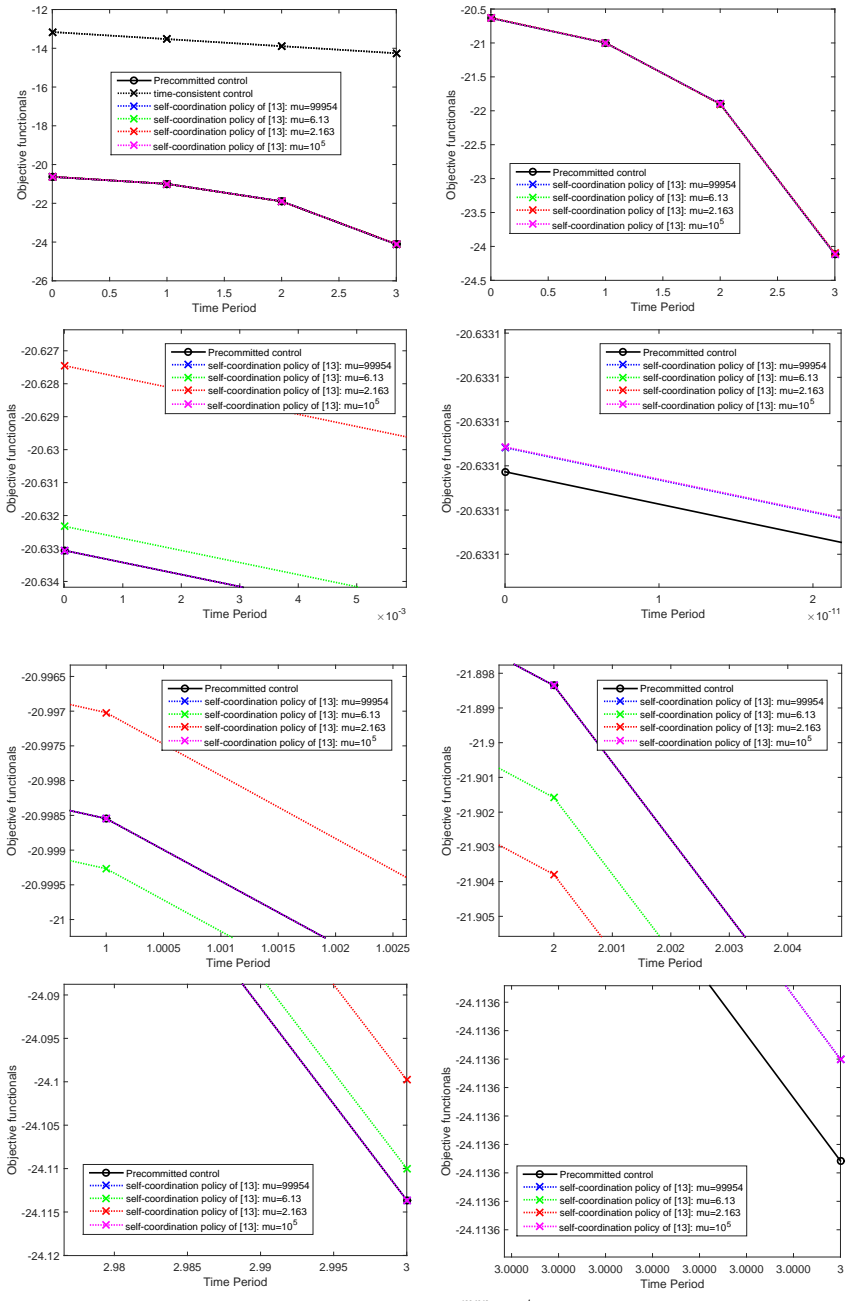
- [Section 4, Figures and Tables] The caption of Figure 1 says 'k = 3' although the figure contains four subfigures for k = 0, 1, 2, 3; also Table 3 reports the minimizer for k = 0 as 99953 while the text and Figure 3 refer to μ = 99954. These values should be reconciled.
- [References] Reference [31] is a previous arXiv version of this same manuscript (arXiv:1908.03728v3). The authors should indicate how the present version differs or should cite the published version if one exists; self-citation to an earlier arXiv version is confusing.
Circularity Check
No significant circularity: the GLQ characterization is proven from the model equations, and the MV application relies on an independent published theorem.
full rationale
The derivation chain is self-contained. Theorem 2.1 is proven by discrete-time convex variation: an equilibrium exists iff the stationary and convex conditions hold, and the proof is carried out directly from the cost functionals and state dynamics in Section 5.1. Proposition 5.1 then shows the stationary conditions are equivalent to the range conditions (2.17)-(2.18), and Proposition 5.2 shows the convex conditions are equivalent to the semidefiniteness and range conditions b)-c) of Theorem 2.2. These equivalences are mathematical arguments about the same Riccati-like equations; no fitted parameter, empirical datum, or renamed input enters. The punishment matrices and intensities are introduced by the authors as user-chosen design variables, not calibrated from data, so the equilibrium is derived rather than predicted from a fit. The MV application also solves an auxiliary mean-field LQ problem; the paper explicitly invokes Theorem 4.3 of [33] (Ni-Zhang-Li, 2015) to conclude O_k O_k^† M_k = M_k and semidefiniteness. Although one author overlaps with this paper, the cited result is an earlier published theorem for a different problem, not a restatement of the present conclusion, so the self-citation is external support rather than a load-bearing circular input. Finally, the statement 'Combining (1.16) and (1.17), we can get results that are parallel to Theorem 2.2, Theorem 2.4 and Theorem 2.5 to obtain the open-loop self-coordination control of Problem (LQ). Due to space limitations, the results are not presented here' is a genuine completeness gap for the advertised LQ characterization, but it is not circularity: the missing specialization is not used as an input to itself. Overall, no step reduces by construction to its own output, so the circularity score is 0.
Assumptions & free parameters
free parameters (2)
- punishment intensity mu_k =
user-chosen, e.g., grid values in examples
- punishment direction Psi_k =
user-chosen, e.g., matrix of ones or identity
assumptions (5)
- domain assumption The noise process {w_k} is a martingale difference sequence with deterministic conditional covariance Delta_k (eq. (1.2)).
- domain assumption The weighting matrices in the cost functionals are deterministic and symmetric (Problem (LQ), (1.5)).
- ad hoc to paper The punishment term mu_k (u_k - v_k)^T Psi_k (u_k - v_k) is added to both players' cost functionals in Step 2 (eqs. (1.10)-(1.11)).
- domain assumption The fictitious player seeks a precommitted optimal policy while the real player seeks a time-consistent policy (Definition of Problem (LQ)^g).
- standard math Moore-Penrose inverse properties, e.g., Lemma 3.1 of [2], for solvability of linear equations with range conditions.
invented entities (1)
-
Fictitious player (auxiliary control variable u)
Cite this review
Pith. "Pith review of A Nash-Type Fictitious Game Framework to Time-Inconsistent Stochastic Control Problems." pith.science (2026). https://pith.science/paper/BWGF7CSX
@misc{pith2026190803728,
  author       = {Pith},
  title        = {Pith review of: A Nash-Type Fictitious Game Framework to Time-Inconsistent Stochastic Control Problems},
  year         = {2026},
  howpublished = {\url{https://pith.science/paper/BWGF7CSX}},
  note         = {Machine review of arXiv:1908.03728}
}
read the original abstract
In this paper, a Nash-type fictitious game framework is introduced to handle a time-inconsistent linear-quadratic optimal control. The Nash-type game in this framework is called fictitious as it is between the decision maker (called real player) and an auxiliary control variable (called fictitious player) with the real player and fictitious player looking for time-consistent policy and precomitted optimal policy, respectively. Namely, the fictitious-game framework is actually an auxiliary-variable-based mechanism where the fictitious player is our particular design. Noting that the real player's cost functional is revised in accordance with that of fictitious player, the equilibrium policy of real player is called an open-loop self-coordination control of original linear-quadratic problem. As a generalization, a time-inconsistent nonzero-sum stochastic linear-quadratic dynamic game is investigated, where one player is to look for precommitted optimal policy and the other player is to search time-consistent policy. Necessary and sufficient conditions are presented to ensure the existence of open-loop equilibrium of the nonzero-sum game, which resort to a set of Riccati-like equations and linear equations. By applying the developed theory of nonzero-sum game, open-loop self-coordination control of the linear-quadratic optimal control is fully characterized, and multi-period mean-variance portfolio selection is also investigated. Finally, numerical simulations are presented, which show the efficiency of the proposed fictitious-game framework.
Figures


Figures from the paper (1 more)

Reference graph
Works this paper leans on
-
[11]
X.Y. Cui, D. Li, and Y. Shi, Self-cordination in time inconsistent stochastic decision problems: a planner-doer game framework, Journal of Economic Dynamic & Control , 2017, vol.75, pp.91-113
work page 2017
-
[33]
Y.H. Ni, J.F. Zhang, and X. Li, Indefinite mean-field stochastic linear-quadratic optimal control, IEEE Transactions on Automatic Control , 2015, vol.60, no.7, pp.1786-1800
work page 2015
-
[30]
Y.H. Ni, X. Li, J.F. Zhang, and M. Krstic, Equilibrium solutions of multi-period mean-variance portfolio selection, IEEE Transactions on Automatic Control , 2020, vol.65, no.4, 1716-1723
work page 2020
-
[1]
Richard H. Thaler: integrating Economics with Psychology, The Committee for the Prize in Eco- nomic Sciences in Memory of Alfred Nobel , https://www.nobelprize.org/uploads/2018/ 06/advanced-economicsciences2017.pdf
work page 2018
-
[2]
M. Ait Rami, X. Chen, and X.Y. Zhou, Discrete-time indefinite LQ control with state and control dependent noises, Journal of Global Optimization , 2002, vol.23, pp.245-265
work page 2002
-
[3]
L.V. Auer, Dynamic preferences, choice mechanisms, and welfare , Lecture Notes in Economics and Mathematical Systems, vol.462, Springer, 1998
work page 1998
-
[4]
Bellman, Dynamic programming, Princeton Univ
R. Bellman, Dynamic programming, Princeton Univ. Press, Princeton, New Jersey, 1957
work page 1957
-
[5]
T. Bjork and A. Murgoci, A theory of Markovian time-inconsistent stochastic control in discrete time, Finance and Stochastics, 2014, vol.18, pp.545-592
work page 2014
Show all 43 references
-
[6]
Bjork, M
T. Bjork, M. Khapko, and A. Murgoci, On time-inconsistent stochastic control in continuous time, Finance and Stochastics, 2017, vol.21, pp.331-360
2017
-
[7]
Caliendo and T.S
R.M. Caliendo and T.S. Findley, Commitment and welfare, Journal of Economic Behavior and Organization, 2019, vol.159, pp.210-234. 36
2019
-
[8]
Casari, Pre-commitment and flexibility in a time decision experiment, Journal of Risk and Uncertainty, 2009, vol.38, pp.117-141
M. Casari, Pre-commitment and flexibility in a time decision experiment, Journal of Risk and Uncertainty, 2009, vol.38, pp.117-141
2009
-
[9]
X.Y. Cui, D. Li, and X. Li, Mean-variance policy, time consistency in efficiency and minimum- variance signed supermartingale measure for discrete-time cone constrained markets,Mathematical Finance, 2017, vol.27, no.2, pp.471-504
2017
-
[10]
X.Y. Cui, D. Li, S. Wang, and S.S. Zhu, Better than dynamic meanvariance: time inconsistency and free cash flow stream, Mathematical Finance, 2012, vol.22, pp.346-378
2012
-
[12]
X.Y. Cui, D. Li, and Y. Shi, Resolving time inconsistency in financial decision problems with non-expectation operator: from internal conflict to internal harmony by strategy of self- coordination, working paper, 2017, available at SSRN: https://ssrn.com/abstract=3136877 or http...
2017 doi
-
[13]
S.L. Du, X.M. Sun, and W. Wang, Guaranteed cost control for uncertain networked control systems with predictive scheme, IEEE Transactions on Automatic Control , 2014, vol.11, no.3, pp.740-748
2014
-
[14]
Ekeland and T.A
I. Ekeland and T.A. Privu, Investment and consumption without commitment, Mathematics and Financial Economics, 2008, vol.2, no.1, pp.57-86
2008
-
[15]
Frederick, G
S. Frederick, G. Loewenstein, and T. O’Donoghue, Time discounting and time preference: a critical review, Journal of Economic Literature , 2002, XL, pp.351-401
2002
-
[16]
Fudenberg and D.K
D. Fudenberg and D.K. Levine, A dual-self model of impulse control, American Economic Review, 2006, vol.96, pp.1449-1476
2006
-
[17]
Fudenberg and D.K
D. Fudenberg and D.K. Levine, Timing and self-control, Econometrica, 2012, vol.80, pp.1-42
2012
-
[18]
Goodfellow, Y
I. Goodfellow, Y. Bengio, and A. Courville., Deep Learning. Cambridge, UK: MIT Press, 2016
2016
-
[19]
Gul and W
F. Gul and W. Pesendorfer, Dynamic inconsistency and self-control, Econometrica, 2001, vol.69, pp.1403-1436
2001
-
[20]
Y. Hu, H. Jin, and X.Y. Zhou, Time-inconsistent stochastic linear-quadratic control, SIAM Journal on Control and Optimization , 2012, vol.50, pp.1548-1572
2012
-
[21]
Y. Hu, H. Jin, and X.Y. Zhou, Time-inconsistent stochastic linear-quadratic control: characteri- zation and uniqueness of equilibrium, SIAM Journal on Control and Optimization , 2017, vol.50, no.3, pp.1548-1572
2017
-
[22]
Karnewar and O
A. Karnewar and O. Wang, MSG-GAN: multi-scale gradients for generative adversarial networks, Proceedings of the IEEE/CVF Conference on Computer Vision and Pattern Recognition (CVPR) , 2020, pp.7799-7808
2020
-
[23]
Kivetz and I
R. Kivetz and I. Simonson, Self-control for the righteous: toward a theory of precommitment to indulgence, Journal of Consumer Research , 2002, vol.29, pp.199-217
2002
-
[24]
Krusell and A.A
P. Krusell and A.A. Smith, Consumption and savings decisions with quasi-geometric discounting, Econometrica, 2003, vol.71, no.1, pp.365-375
2003
-
[25]
Kurth-Nelson1 and A.D
Z. Kurth-Nelson1 and A.D. Redish, Don’t let me do that!- the model of precommitment, Frontiers in Neuroscience, 2012, vol.6, pp.1-9
2012
-
[26]
Laibson, Golden eggs and hyperbolic discounting, The Quarterly Journal of Economics , 1997, vol.112, pp.443-477
D. Laibson, Golden eggs and hyperbolic discounting, The Quarterly Journal of Economics , 1997, vol.112, pp.443-477
1997
-
[27]
Lee and H.S
B.H. Lee and H.S. Ahn, Distributed formation control via global orientation estimation, Automat- ica, 2014, vol.73, pp.125-129
2014
-
[28]
Li and W.L
D. Li and W.L. Ng, Optimal dynamic portfolio selection: multi-period mean-variance formulation, Mathematical Finance, 2000, vol.10, pp.387-406. 37
2000
-
[29]
Y.H. Ni, X. Li, J.F. Zhang, and M. Krstic, Mixed equilibrium solution of time-inconsistent stochas- tic linear-quadratic problem, SIAM Journal on Control and Optimization , 2019, vol.57, no.1, pp.533-569
2019
-
[31]
Y.H. Ni, B.B. Si, and X.Z. Zhang, Handle time-inconsistent optimal control via fictitious game, arXiv: 1908.03728v3, https://arxiv.org/abs/1908.03728v3
1908 arXiv
-
[32]
Y.H. Ni, J.F. Zhang, and M. Krstic, Time-inconsistent mean-field stochastic LQ problem: open- loop time-consistent control, IEEE Transactions on Automatic Control, 2018, vol.63, no.9, pp.2771- 2786
2018
-
[34]
Palacios-Huerta, Time-inconsistent preferences in Adam Smith and Davis Hume, History of Political Economy, 2003, vol.35, pp.391-401
I. Palacios-Huerta, Time-inconsistent preferences in Adam Smith and Davis Hume, History of Political Economy, 2003, vol.35, pp.391-401
2003
-
[35]
Samuelson, A note on measurement of utility, The Review of Economic Studies , 1937, vol.4 pp.155-61
P. Samuelson, A note on measurement of utility, The Review of Economic Studies , 1937, vol.4 pp.155-61
1937
-
[36]
Silver, A
D. Silver, A. Huang, C.J. Maddison, A. Guez, L. Sifre, G. van Den Driessche, J. Schrittwieser, I. Antonoglou, V. Panneershelvam, M. Lanctot, S. Dieleman, D. Grewe, J. Nham, N. Kalchbrenner, I. Sutskever, T. Lillicrap, M. Leach M, K. Kavukcuoglu, T. Graepel, and D. Hassabis, Ma...
2016
-
[37]
Strotz, Myopia and inconsistency in dynamic utility maximization, The Review of Economic Studies, 1955-1956, vol.23, pp.165-180
R.H. Strotz, Myopia and inconsistency in dynamic utility maximization, The Review of Economic Studies, 1955-1956, vol.23, pp.165-180
1955
-
[38]
Thaler and H.M
R.H. Thaler and H.M. Shefrin, An economic theory of self-control, Journal of Political Economy , 1981, vol.89, no. 2, pp.392-406
1981
-
[39]
Wang, Characterizations of equilibrium controls in time inconsistent mean-field stochastic linear quadratic problems
T.X. Wang, Characterizations of equilibrium controls in time inconsistent mean-field stochastic linear quadratic problems. I, Mathematical Control and Related Rields , 2019, vol.9, no.2, 385-409
2019
-
[40]
Wang, Equilibrium controls in time inconsistent stochastic linear quadratic problems, Applied Mathematics & Optimization , https://doi.org/10.1007/s00245-018-9513-x
T.X. Wang, Equilibrium controls in time inconsistent stochastic linear quadratic problems, Applied Mathematics & Optimization , https://doi.org/10.1007/s00245-018-9513-x
-
[41]
Jin, and J
T.X Wang, Z. Jin, and J. Wei, Mean-variance portfolio selection under a non-Markovian regime- switching model: time-consistent solutions, SIAM Journal on Control Optimization , 2019, vol.57, no.5, 3249-3271
2019
-
[42]
Wei, Z.Y
Q.M. Wei, Z.Y. Yu, and J.M. Yong, Time-inconsistent recursive stochastic optimal control prob- lems, SIAM Journal on Control Optimization , 2017, vol.55. no.6, pp.4156-4201
2017
-
[43]
J.M. Yong, Linear-quadratic optimal control problems for mean-field stochastic differential equations—time-consistent solutions, Transactions of the American Mathematical Society , 2017, vol.369, pp.5467-5523. 38
2017
Reviewed August 14, 2026 · model on record in the stance chip above.
Discussion (0). Continue with ORCID to comment.