REVIEW 3 major objections 5 minor 37 references
Conditional Front-door Adjustment for Heterogeneous Treatment Assignment Effect Estimation Under Non-adherence
T0 review · 3 major / 5 minor · reviewed 2026-08-15 · deepseek-v4-flash
Pith's one-line read The paper argues that conditional front-door adjustment estimates heterogeneous treatment assignment effects with lower variance than standard backdoor adjustment when the true assignment effect is small, and introduces a…
desk verdict Real contribution and a real overclaim: the 'small CATEA' variance advantage is only a sufficient condition, and a counterexample in the paper's own setting shows CFD can lose even when ΔY=0. read the letter →
The pith
A machine-rendered reading of the paper's core claim, the machinery that carries it, and where it could break.
The reading
What carries the argument
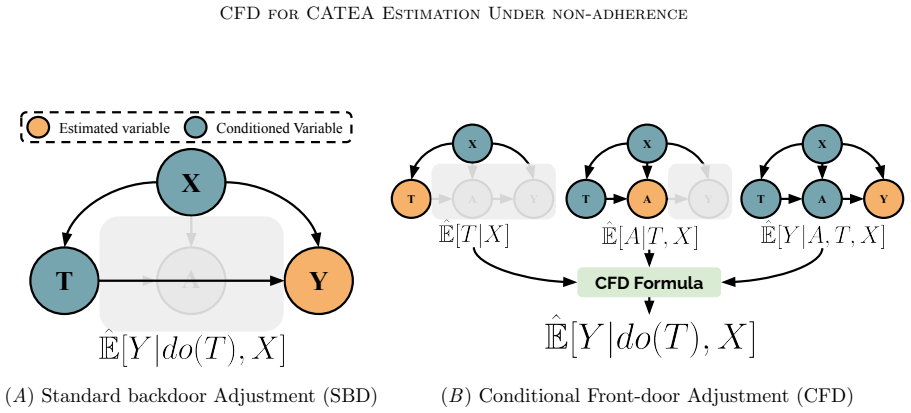
The central object is the conditional front-door adjustment formula, implemented for two-sided non-adherence as $\hat\Phi^{\mathrm{CFD}}_{ts}(x_i) = \left[(\hat Y(1,0,x_i)-\hat Y(0,0,x_i))(1-\hat\pi(x_i)) + (\hat Y(1,1,x_i)-\hat Y(0,1,x_i))\hat\pi(x_i)\right] \cdot [\hat A(1,x_i)-\hat A(0,x_i)]$, with a one-sided analog that replaces the intake-difference factor by $\hat A(1,x_i)$. The variance analysis uses the minimum cell probability $\rho = \min_{t',a'} P(a',t'|x_0)$, which controls the upper bound on CFD's variance, and the decomposition $\Phi=\Delta_A\Delta_Y$. LobsterNet is a two-stage multi-task network with a shared backbone, assignment-specific intake heads, and a router that feeds the correct intake representation to the outcome heads; the paper's hypothesis is that sharing 'virtually increases' $\rho$ because all samples contribute to every nuisance estimate.
What would settle it
Generate single-stratum data at a fixed $x_0$ with known small $\Delta_A$ and $\Delta_Y$ and a moderately large $\rho$, then compute the empirical variances of the SBD and CFD estimators over many replicates; if $n\mathrm{Var}(\hat\Phi^{\mathrm{SBD}}) - n\mathrm{Var}(\hat\Phi^{\mathrm{CFD}})$ is negative in that regime, the central variance claim would be refuted.
Extended reading notes
Core claim
The paper's central claim is that, under consistency, positivity, ignorability, and full mediation, both SBD and CFD give unbiased CATEA estimates, but CFD has lower asymptotic variance than SBD when the true CATEA is small. The CATEA factorizes as $\Phi(x_0)=\Delta_A\Delta_Y$, with $\Delta_A$ the effect of assignment on intake and $\Delta_Y$ the effect of intake on outcome; the variance-reduction bound $\lim_{n\to\infty} n(\mathrm{Var}(\hat\Phi^{\mathrm{SBD}})-\mathrm{Var}(\hat\Phi^{\mathrm{CFD}})) > O\left(V_Y - V_Y\Delta_A^2/\rho - (1-\rho)V_A\Delta_Y^2/\rho\right)$ is positive when either $\Delta_A$ or $\Delta_Y$ is small. The paper also claims that LobsterNet, by sharing representations across the three nuisance estimation tasks, improves CFD's finite-sample accuracy and lets CFD match or beat SBD even when the CATEA is large.
Load-bearing premise
The variance guarantee is proven only for the idealized setting where all n samples share one covariate value and nuisance parameters are estimated by maximum likelihood; if that behavior does not carry over to neural networks fitted on continuous covariates, the empirical advantage is not covered by the theorem.
Editorial extensions
If this is right
- When the true assignment effect is small, practitioners should prefer CFD over SBD for CATEA estimation because CFD has lower asymptotic variance.
- CFD's advantage grows as either $\Delta_A$ or $\Delta_Y$ decreases, so the method is most valuable in settings where assignment changes behavior or outcomes only modestly.
- CFD's variance advantage is easier to guarantee when every assignment/intake combination is reasonably common (larger $\rho$); when $\rho$ is tiny, the theoretical guarantee weakens.
- LobsterNet's shared representations improve CFD's finite-sample accuracy and allow CFD to match or beat SBD even when the assignment effect is large.
- Under non-adherence, using intake information through CFD can improve individual-level treatment assignment decisions compared to ignoring intake as SBD does.
Reading between the lines
- If the shared-representation mechanism is real, CFD gains should grow with the amount of structure shared between potential outcome functions; this is testable by varying the similarity of the two outcome-generating functions in a synthetic experiment.
- The dependence on $\rho$ implies that in datasets where one assignment/intake combination is very rare, a variance-aware decision rule could switch between SBD and CFD based on an estimated $\rho$; the paper does not propose such a rule.
- The paper's binary-treatment analysis suggests that extending the same variance comparison to categorical or continuous treatments would likely change the form of the $\rho$ cells and the bound's constants.
- A practical test would be to measure the gap between CFD and SBD PEHE across datasets with different true $\rho$ values but similar effect sizes, checking whether the predicted advantage trend appears.
Signed reviews
Editorial analysis
A structured set of objections, weighed in public.
Referee Report
Summary. The paper studies estimation of the conditional average treatment effect of treatment assignment (CATEA) under non-adherence, comparing the standard backdoor adjustment (SBD) with the conditional front-door adjustment (CFD). The authors prove identifiability of CFD for CATEA, derive asymptotic variance bounds in a single-stratum MLE setting, and claim that CFD has lower asymptotic variance than SBD when the true CATEA is small, i.e., when either the assignment-to-intake effect ΔA or the intake-to-outcome effect ΔY is small (Proposition 3). They then introduce LobsterNet, a multi-task neural network that jointly estimates CFD nuisance parameters via shared representations, and report experiments on synthetic data, IHDP, and AMR-UTI showing that CFD, especially with LobsterNet, reduces PEHE relative to SBD baselines.
Significance. If the central variance comparison were correct, this would be a valuable contribution to an underexplored problem: CATEA estimation under non-adherence, with a formal identifiability proof, an asymptotic variance analysis, and a practical neural implementation with released code. The identifiability proofs, the variance derivations, and the multi-task architecture are useful building blocks, and the empirical evaluation is reasonably extensive including semi-synthetic and real-world counterfactual data. However, the main theoretical claim is currently overstated: Proposition 3 provides only a sufficient condition, and there are counterexamples within the paper's own setting where CATEA is zero yet CFD has strictly higher variance. The equal-variance assumption used in the theorem is also incompatible with one-sided non-adherence whenever non-adherence is present. These issues undermine the paper's headline claim and require substantive revision.
major comments (3)
- [Abstract, §4.3, §4.4, Appendix D.4] The claim that CFD yields lower-variance estimates than SBD when the true CATEA is small (or, per Section 4.4 and Figure 2 caption, when 'either ΔA or ΔY is small') is not implied by the proved sufficient condition. Proposition 3 gives a lower bound on the variance reduction that is positive only if VY > VY ΔA²/ρ + (1−ρ)VA ΔY²/ρ. This is a sufficient condition, not a characterization. A concrete counterexample within the paper's own single-stratum MLE framework: one-sided non-adherence with π=0.5, P(A=1|T=1)=0.9 (so ΔA=0.9 and ρ=0.05), and binary Y with P(Y=1|A=0)=P(Y=1|A=1)=0.5 (so ΔY=0 and CATEA=0). Using the paper's exact asymptotic variance formulas in Appendix D.2, nVar(SBD_os) = V(Yt=1)/π + V(Yt=0)/(1−π) = 1.0, while nVar(CFD_os) = V(Ya=0)[ΔA²(1−π)²/ω00 + ΔA²π²/ω01] + V(Ya=1)ΔA²/ω11 = 0.25[0.405 + 4.05 + 1.8] ≈ 1.56. Thus CFD has higher variance than SBD even though the treatment assignment effect on the outcome is exactly zero. The paper's own bound is negative in this case, so Proposition 3 does not cover it, but the abstract and Section 4.4 assert the 'small CATEA' regime without this caveat. The headline claim must be weakened to a sufficient condition with explicit bounds, and the counterexample should be acknowledged.
- [§4.3, Appendix D.4] The simplification V(At=0)=V(At=1)=VA is incompatible with the one-sided non-adherence setting analyzed throughout the paper. Under one-sided non-adherence, A=0 always when T=0, so V(At=0)=0, while V(At=1)>0 whenever there is any non-adherence. Therefore the equal-variance assumption cannot hold in the one-sided setting except in the degenerate case of perfect adherence. Proposition 3 is then stated as applying to both one-sided and two-sided non-adherence ('This variance reduction bound applies to both one-sided and two-sided non-adherence'), but it has no force for one-sided non-adherence with realistic non-adherence rates. The authors need to either derive a separate bound for the one-sided case without this assumption, or explicitly restrict the theoretical guarantee to the two-sided setting (or to settings where the assumption is plausible). This is a load-bearing inconsistency because the synthetic and semi-synthetic experiments include one-sided non-adherence and are presented as validating the theory.
- [§4.5, §6] The theoretical analysis is carried out in a single-stratum setting with n i.i.d. samples at one covariate value x0 and maximum-likelihood nuisance estimators, while the empirical claims use neural networks on continuous covariates with finite samples. The only link provided is the hypothesis in Section 4.5 that shared representations 'virtually increase' ρ, which is not formalized or directly tested. As a result, the PEHE improvements in Section 6 do not follow from Proposition 3; they are separate empirical observations. The paper should either provide a finite-sample or representation-based argument connecting shared modeling to the variance bounds, or explicitly decouple the theoretical variance comparison from the LobsterNet empirical evaluation so that the strength of each claim is clear.
minor comments (5)
- [§3.2] The phrase 'Individuals not assigned the treatment (ti=0) always adherer' contains a typo: 'adherer' should be 'adhere'.
- [§4.1] In the definition of the CATEA decomposition, the text writes 'Φ(xo)' but should be 'Φ(x0)' (the evaluation point).
- [Appendix F.3] There is a typo: 'Among all tthe raining data' should be 'Among all the training data'.
- [§6.3] The two-sided synthetic dataset A result is reported as 'CFD: 0.394, 95%CI: 0.336-0.345', where the point estimate 0.394 lies outside the stated confidence interval; this appears to be a typo and should be corrected.
- [Appendix H.2] The heading 'CATAE estimation PEHE' contains a transposition; it should be 'CATEA'.
Circularity Check
No circularity: the variance comparison is derived analytically from MLE variance formulas and benchmarked on external data.
full rationale
The paper's derivation chain is self-contained. Proposition 3 follows from explicit asymptotic variance formulas in Appendix D.2 for the MLE-based SBD and CFD estimators, combined with law-of-total-variance calculations and the positivity bound ρ; no parameter is fitted to a subset of the data and then renamed as a prediction. The synthetic experiments are generated under the same data-generating process as the theory, which is a standard validation loop rather than circular reasoning, and the IHDP and AMR-UTI results provide external, independently sourced benchmarks with public code. The main caveat is that the abstract's 'small CATEA' phrasing over-generalizes the sufficient condition in Proposition 3: the proven variance-reduction bound is positive only when ΔA and ΔY are jointly small relative to ρ and the variances, and a one-sided non-adherence example with ΔY=0 and ΔA=0.9 can reverse the variance ranking even though the treatment assignment effect on the outcome is zero. However, this is a correctness/scope issue, not circularity: the theorem does not assume its conclusion, and the paper itself acknowledges regions where CFD does not guarantee reduced variance (Section 4.5). The bridge from the MLE single-stratum theory to neural-network implementations is explicitly stated as a hypothesis ('ρ is virtually increased'), which limits the strength of the empirical extrapolation but does not make the derivation circular. There are no load-bearing self-citations or uniqueness arguments imported from the authors' prior work.
Assumptions & free parameters
free parameters (1)
- alpha, beta (LobsterNet loss weights) =
alpha=beta=RMS(y) for regression; alpha=beta=1 for classification
assumptions (8)
- domain assumption Consistency: observed intake and outcome equal potential intake and outcome under the observed assignment.
- domain assumption Positivity: 0 < P(T=1|x) < 1 for all x.
- domain assumption Full mediation: effect of assignment on outcome is fully mediated by intake.
- domain assumption Assignment-Outcome ignorability: potential outcomes independent of assignment given X.
- domain assumption Assignment-Intake ignorability: potential intakes independent of assignment given X.
- domain assumption Intake-Outcome ignorability: potential outcomes independent of intake given X.
- ad hoc to paper Equal variances of potential outcomes and intakes: V(Ya=0)=V(Ya=1), V(At=0)=V(At=1).
- ad hoc to paper Single-stratum setting with n samples at a single x0 and MLE estimators.
Cite this review
Pith. "Pith review of Conditional Front-door Adjustment for Heterogeneous Treatment Assignment Effect Estimation Under Non-adherence." pith.science (2026). https://pith.science/paper/BWTLFHXI
@misc{pith2026250505677,
  author       = {Pith},
  title        = {Pith review of: Conditional Front-door Adjustment for Heterogeneous Treatment Assignment Effect Estimation Under Non-adherence},
  year         = {2026},
  howpublished = {\url{https://pith.science/paper/BWTLFHXI}},
  note         = {Machine review of arXiv:2505.05677}
}
read the original abstract
Estimates of heterogeneous treatment assignment effects can inform treatment decisions. Under the presence of non-adherence (e.g., patients do not adhere to their assigned treatment), both the standard backdoor adjustment (SBD) and the conditional front-door adjustment (CFD) can recover unbiased estimates of the treatment assignment effects. However, the estimation variance of these approaches may vary widely across settings, which remains underexplored in the literature. In this work, we demonstrate theoretically and empirically that CFD yields lower-variance estimates than SBD when the true effect of treatment assignment is small (i.e., assigning an intervention leads to small changes in patients' future outcome). Additionally, since CFD requires estimating multiple nuisance parameters, we introduce LobsterNet, a multi-task neural network that implements CFD with joint modeling of the nuisance parameters. Empirically, LobsterNet reduces estimation error across several semi-synthetic and real-world datasets compared to baselines. Our findings suggest CFD with shared nuisance parameter modeling can improve treatment assignment effect estimation under non-adherence.
Figures


Figures from the paper (8 more)


Reference graph
Works this paper leans on
-
[1]
End-to-end balancing for causal continuous treatment-effect estimation
Taha Bahadori, Eric Tchetgen Tchetgen, and David Heckerman. End-to-end balancing for causal continuous treatment-effect estimation. In International Conference on Machine Learning, pages 1313--1326. PMLR, 2022
work page 2022
-
[2]
Heterogeneous causal effects with imperfect compliance: A bayesian machine learning approach
Falco J Bargagli-Stoffi, Kristof De Witte, and Giorgio Gnecco. Heterogeneous causal effects with imperfect compliance: A bayesian machine learning approach. The Annals of Applied Statistics, 16 0 (3): 0 1986--2009, 2022
work page 1986
-
[3]
The paper of how: Estimating treatment effects using the front-door criterion
Marc F Bellemare, Jeffrey R Bloem, and Noah Wexler. The paper of how: Estimating treatment effects using the front-door criterion. Oxford Bulletin of Economics and Statistics, 2020
work page 2020
-
[4]
Double/debiased machine learning for treatment and causal parameters
Victor Chernozhukov, Denis Chetverikov, Mert Demirer, Esther Duflo, Christian Hansen, Whitney Newey, and James Robins. Double/debiased machine learning for treatment and causal parameters. Technical report, 2017
work page 2017
-
[5]
Regression analysis when there is prior information about supplementary variables
Daniel R Cox. Regression analysis when there is prior information about supplementary variables. Journal of the Royal Statistical Society: Series B (Methodological), 22 0 (1): 0 172--176, 1960
work page 1960
-
[6]
On inductive biases for heterogeneous treatment effect estimation
Alicia Curth and Mihaela Van der Schaar. On inductive biases for heterogeneous treatment effect estimation. Advances in Neural Information Processing Systems, 34: 0 15883--15894, 2021
work page 2021
-
[7]
A unified bias-variance decomposition
Pedro Domingos. A unified bias-variance decomposition. In Proceedings of 17th international conference on machine learning, pages 231--238. Morgan Kaufmann Stanford, 2000
work page 2000
-
[8]
The problem of non-compliance with drug therapy
Larry Evans and Michael Spelman. The problem of non-compliance with drug therapy. Drugs, 25: 0 63--76, 1983
work page 1983
Show all 37 references
-
[9]
Statistical methods for research workers
Ronald Aylmer Fisher. Statistical methods for research workers. Number 5. Oliver and Boyd, 1928
1928
-
[10]
Front-door versus back-door adjustment with unmeasured confounding: Bias formulas for front-door and hybrid adjustments with application to a job training program
Adam N Glynn and Konstantin Kashin. Front-door versus back-door adjustment with unmeasured confounding: Bias formulas for front-door and hybrid adjustments with application to a job training program. Journal of the American Statistical Association, 113 0 (523): 0 1040--1049, 2018
2018
-
[11]
A comparison of approaches to advertising measurement: Evidence from big field experiments at facebook
Brett R Gordon, Florian Zettelmeyer, Neha Bhargava, and Dan Chapsky. A comparison of approaches to advertising measurement: Evidence from big field experiments at facebook. Marketing Science, 38 0 (2): 0 193--225, 2019
2019
-
[12]
Review on prevention of falls in hospital settings
Yuan-Yuan Gu, Koen Balcaen, Yicheng Ni, Jan Ampe, and Jan Goffin. Review on prevention of falls in hospital settings. Chinese Nursing Research, 3 0 (1): 0 7--10, 2016
2016
-
[13]
Intention-to-treat concept: a review
Sandeep K Gupta. Intention-to-treat concept: a review. Perspectives in clinical research, 2 0 (3): 0 109--112, 2011
2011
-
[14]
Estimating treatment effects with observed confounders and mediators
Shantanu Gupta, Zachary C Lipton, and David Childers. Estimating treatment effects with observed confounders and mediators. In Uncertainty in Artificial Intelligence, pages 982--991. PMLR, 2021
2021
-
[15]
Measuring causal impact of online actions via natural experiments: Application to display advertising
Daniel N Hill, Robert Moakler, Alan E Hubbard, Vadim Tsemekhman, Foster Provost, and Kiril Tsemekhman. Measuring causal impact of online actions via natural experiments: Application to display advertising. In Proceedings of the 21th ACM SIGKDD International Conference on Knowl...
2015
-
[16]
Bayesian nonparametric modeling for causal inference
Jennifer L Hill. Bayesian nonparametric modeling for causal inference. Journal of Computational and Graphical Statistics, 20 0 (1): 0 217--240, 2011
2011
-
[17]
Assessing the effect of an influenza vaccine in an encouragement design
Keisuke Hirano, Guido W Imbens, Donald B Rubin, and Xiao-Hua Zhou. Assessing the effect of an influenza vaccine in an encouragement design. Biostatistics, 1 0 (1): 0 69--88, 2000
2000
-
[18]
Why most published research findings are false
John PA Ioannidis. Why most published research findings are false. PLoS medicine, 2 0 (8): 0 e124, 2005
2005
-
[19]
Causal effect inference for structured treatments
Jean Kaddour, Yuchen Zhu, Qi Liu, Matt J Kusner, and Ricardo Silva. Causal effect inference for structured treatments. Advances in Neural Information Processing Systems, 34: 0 24841--24854, 2021
2021
-
[20]
Towards optimal doubly robust estimation of heterogeneous causal effects
Edward H Kennedy. Towards optimal doubly robust estimation of heterogeneous causal effects. Electronic Journal of Statistics, 17 0 (2): 0 3008--3049, 2023
2023
-
[21]
Treatment non-adherence patterns among patients with mental illness: A study from the district mental health care center in india
Jahangir Khan, Jwaad A Khan, Subhra Kumari, and Deepak Charan. Treatment non-adherence patterns among patients with mental illness: A study from the district mental health care center in india. Cureus, 16 0 (2), 2024
2024
-
[22]
Adam: A method for stochastic optimization
Diederik P Kingma and Jimmy Ba. Adam: A method for stochastic optimization. International Conference for Learning Representations, 2015
2015
-
[23]
o ren R K \
S \"o ren R K \"u nzel, Jasjeet S Sekhon, Peter J Bickel, and Bin Yu. Metalearners for estimating heterogeneous treatment effects using machine learning. Proceedings of the national academy of sciences, 116 0 (10): 0 4156--4165, 2019
2019
-
[24]
Estimation of causal effects with multiple treatments: a review and new ideas
Michael J Lopez and Roee Gutman. Estimation of causal effects with multiple treatments: a review and new ideas. Statistical Science, pages 432--454, 2017
2017
-
[25]
Estimating the efficacy of receiving treatment in randomized clinical trials with noncompliance
Sue M Marcus and Robert D Gibbons. Estimating the efficacy of receiving treatment in randomized clinical trials with noncompliance. Health Services and Outcomes Research Methodology, 2: 0 247--258, 2001
2001
-
[26]
Instrumental variable meta-analysis of individual patient data: application to adjust for treatment non-compliance
Branko Miladinovic, Ambuj Kumar, Iztok Hozo, and Benjamin Djulbegovic. Instrumental variable meta-analysis of individual patient data: application to adjust for treatment non-compliance. BMC medical research methodology, 11: 0 1--7, 2011
2011
-
[27]
Intention-to-treat principle
Victor M Montori and Gordon H Guyatt. Intention-to-treat principle. Cmaj, 165 0 (10): 0 1339--1341, 2001
2001
-
[28]
Estimating treatment effects in randomized clinical trials in the presence of non-compliance
Nico Nagelkerke, Vaclav Fidler, Roos Bernsen, and Martien Borgdorff. Estimating treatment effects in randomized clinical trials in the presence of non-compliance. Statistics in medicine, 19 0 (14): 0 1849--1864, 2000
2000
-
[29]
Amr-uti: antimicrobial resistance in urinary tract infections (version 1.0
M Oberst, S Boominathan, H Zhou, S Kanjilal, and D Sontag. Amr-uti: antimicrobial resistance in urinary tract infections (version 1.0. 0), 2020
2020
-
[30]
Causality
Judea Pearl. Causality. Cambridge university press, 2009
2009
-
[31]
Individual treatment prescription effect estimation in a low compliance setting
Thibaud Rahier, Am \'e lie H \'e liou, Matthieu Martin, Christophe Renaudin, and Eustache Diemert. Individual treatment prescription effect estimation in a low compliance setting. In Proceedings of the 27th ACM SIGKDD Conference on Knowledge Discovery & Data Mining, pages 1399...
2021
-
[32]
Supplementary variables for causal estimation
Roland R Ramsahai. Supplementary variables for causal estimation. Causality: Statistical perspectives and applications, pages 218--233, 2012
2012
-
[33]
Adapting neural networks for the estimation of treatment effects
Claudia Shi, David Blei, and Victor Veitch. Adapting neural networks for the estimation of treatment effects. Advances in neural information processing systems, 32, 2019
2019
-
[34]
Interventions to increase completion of hepatitis b vaccination in people who inject drugs: a systematic review and meta-analysis
Stacy Tressler and Ruchi Bhandari. Interventions to increase completion of hepatitis b vaccination in people who inject drugs: a systematic review and meta-analysis. In Open forum infectious diseases, volume 6, page ofz521. Oxford University Press US, 2019
2019
-
[35]
Targeted maximum likelihood learning
Mark J Van Der Laan and Daniel Rubin. Targeted maximum likelihood learning. The international journal of biostatistics, 2 0 (1), 2006
2006
-
[36]
How much can we generalize from impact evaluations? Journal of the European Economic Association, 18 0 (6): 0 3045--3089, 2020
Eva Vivalt. How much can we generalize from impact evaluations? Journal of the European Economic Association, 18 0 (6): 0 3045--3089, 2020
2020
-
[37]
Causal inference with conditional front-door adjustment and identifiable variational autoencoder
Ziqi Xu, Debo Cheng, Jiuyong Li, Jixue Liu, Lin Liu, and Kui Yu. Causal inference with conditional front-door adjustment and identifiable variational autoencoder. International Conference on Learning Representations, 2024
2024
Reviewed August 15, 2026 · model on record in the stance chip above.
Discussion (0). Continue with ORCID to comment.