REVIEW 2 major objections 5 minor 82 references
Fault-tolerant bosonic quantum error correction with the surface-GKP code
T0 review · 2 major / 5 minor · reviewed 2026-08-14 · deepseek-v4-flash
Pith's one-line read Fault-tolerant quantum error correction is possible with the surface-GKP code if GKP squeezing exceeds 11.2 dB.
desk verdict First full circuit-level simulation of surface-GKP code with concrete thresholds; the thresholds are solid within the stated twirled Gaussian noise model, but the 'conservative' mapping to that model is asserted, not proven. read the letter →
The pith
A machine-rendered reading of the paper's core claim, the machinery that carries it, and where it could break.
The reading
What carries the argument
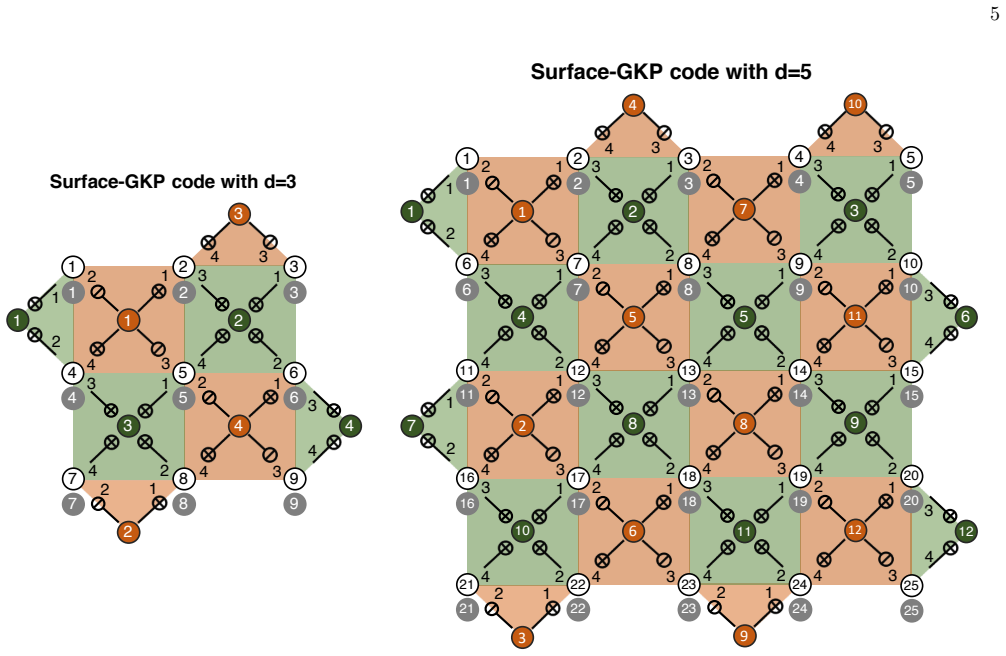
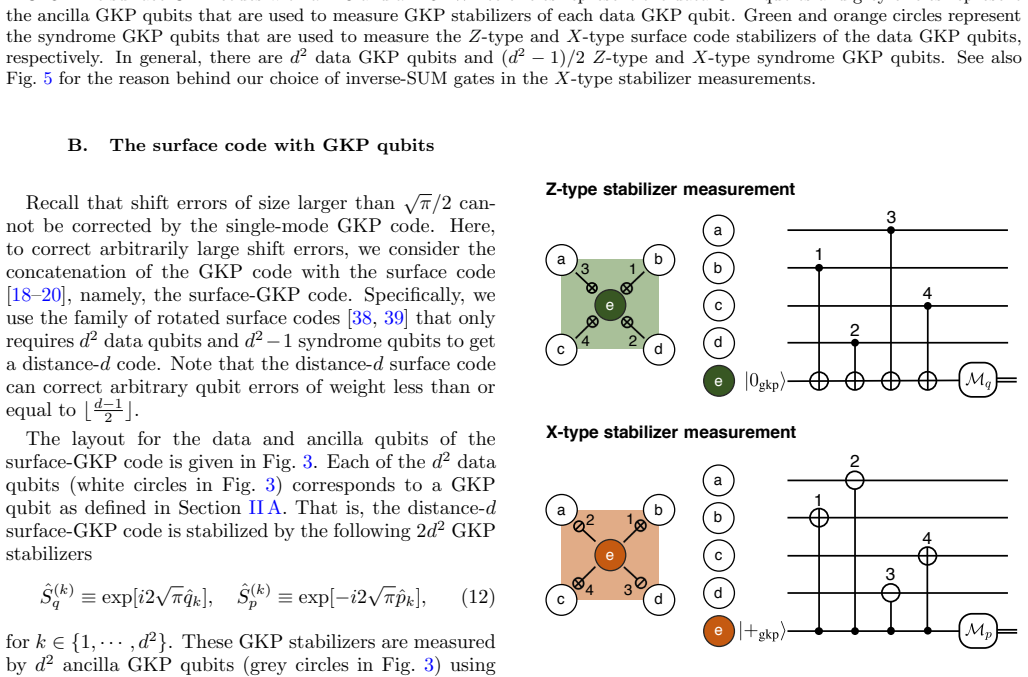
The central object is the concatenated code: each data mode, ancilla mode, and syndrome mode of a rotated surface code is itself a GKP-encoded qubit, with GKP stabilizers measured by SUM and inverse-SUM gates followed by homodyne detection. The load-bearing simplification is the noise model: finite-squeezing GKP states and lossy gates are represented as incoherent Gaussian random displacement channels with variances $\sigma_{\mathrm{gkp}}^2$ and $\sigma^2$, with covariance matrices derived from a Lindblad evolution that adds heating to convert photon loss into displacement noise. The decoding machinery is a 3D space-time graph whose horizontal and vertical edge weights are renormalized using the analog position and momentum outcomes of the GKP-stabilizer measurements, so that a minimum-weight perfect matching decoder can exploit soft information about how close a measured shift was to the decision boundary where a Pauli error becomes likely.
What would settle it
Run the distance-3 and distance-5 surface-GKP error-correction circuits under the paper's own noise model at $\sigma_{\mathrm{gkp}} = 0.19$ with $\sigma = 0$, and check whether the logical X-error rate drops as the code distance increases; the paper predicts a clear drop, so observing a flat or rising rate would falsify the Case I threshold claim. An experiment with GKP squeezing near 12 dB and otherwise ideal components that shows no error suppression with code distance would contradict the claim directly.
Extended reading notes
Core claim
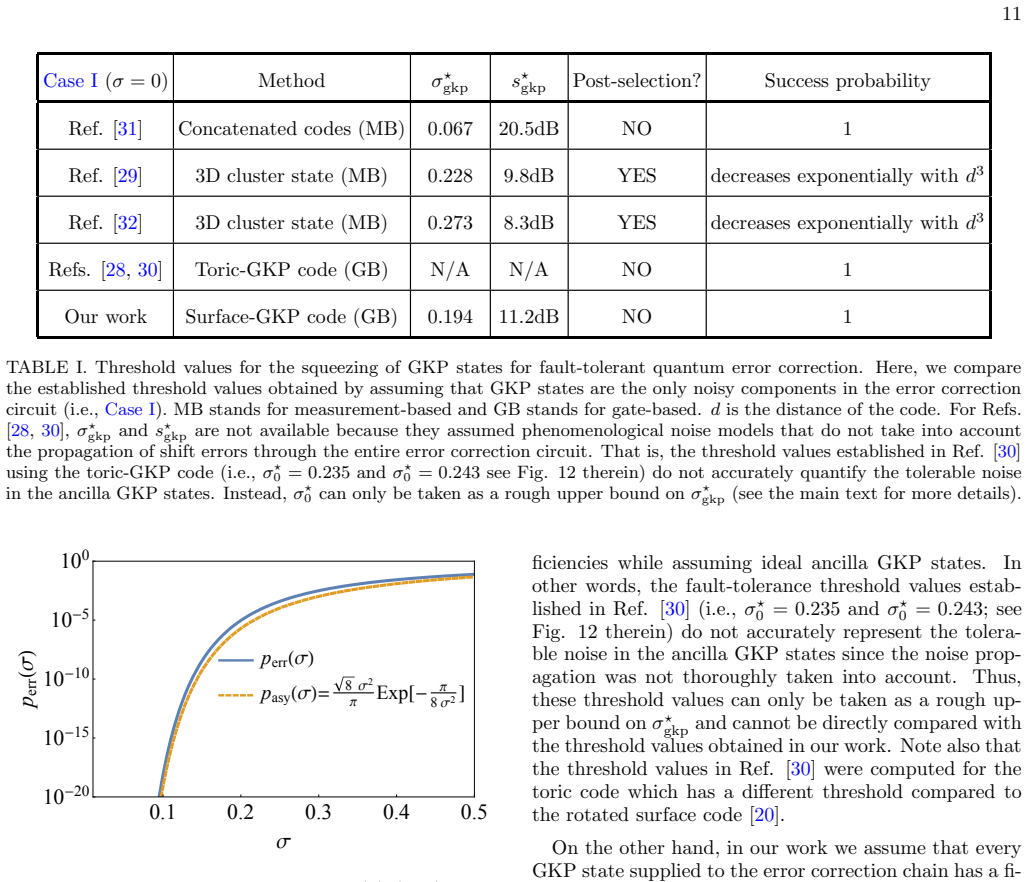
The central claim is that the concatenated surface-GKP code is fault tolerant below the reported thresholds: GKP squeezing above 11.2 dB when only the GKP states are noisy, component failure probability below 0.81% when GKP states are noiseless, and 18.6 dB squeezing with 0.69% component failure when both are comparably noisy. The paper further claims that, below threshold, the logical X or Z error rate decreases as the code distance increases, and that the decoder's use of continuous GKP-stabilizer information is essential, since ignoring it lowers the thresholds and raises logical error rates by one to several orders of magnitude. The paper also derives simple effective noise variances, such as $\sqrt{5\sigma_{\mathrm{gkp}}^2 + (59/3)\sigma^2}$ for the probability of a Pauli error after a GKP-stabilizer measurement, showing that these probabilities decay exponentially as the noise parameters approach zero.
Load-bearing premise
Everything rests on modelling realistic finite-squeezing GKP states, photon loss, and gate noise as incoherent Gaussian random displacement channels with known variances; if actual devices produce non-Gaussian or correlated noise, the numerical thresholds may not transfer.
Editorial extensions
If this is right
- Below the thresholds, larger surface-GKP codes suppress logical error rates with increasing code distance, so the architecture is scalable without post-selection.
- The decoder works without 3D space-time correlated edges, simplifying the matching-graph construction relative to optimized bare-qubit surface-code decoders.
- Circuit-element failure thresholds around 0.7 to 0.8 percent are comparable to the roughly one-percent threshold of the rotated surface code with depolarizing noise, suggesting that bosonic encoding does not inherently require an order-of-magnitude worse noise tolerance.
- Because the GKP inner code converts small shift errors into exponentially suppressed Pauli-error probabilities, a small-distance surface code may reach a target logical error rate with fewer total modes than a bare surface code in the low-noise regime.
Reading between the lines
- The twirling step that justifies replacing coherent finite-squeezing noise with an incoherent displacement channel is acknowledged to be impractical because it raises the average photon number; a natural follow-up is to repeat the threshold simulation with coherent, non-twirled GKP states and check how much the 11.2 dB and 18.6 dB values move.
- If SUM-gate implementations introduce Kerr nonlinearities, the assumed Gaussian displacement noise model breaks down, so the thresholds should be re-evaluated for any specific gate hardware that is not well approximated by the loss-plus-heating Lindblad model.
- The renormalized-edge-weight technique is not obviously limited to GKP codes and could plausibly transfer to other analog bosonic codes, such as cat or binomial codes, when concatenated with a topological code, provided their stabilizer measurements supply similar soft error information.
- The comparison with measurement-based GKP schemes suggests a systems-level trade-off: deterministic operation costs higher squeezing thresholds than post-selection-based approaches, which is relevant when choosing between gate-based and measurement-based architectures.
Signed reviews
Editorial analysis
A structured set of objections, weighed in public.
Referee Report
Summary. The manuscript studies fault-tolerant quantum error correction with a concatenated surface-GKP code under a circuit-level noise model. Finite-squeezing GKP states are modeled as ideal GKP states subject to the Gaussian random displacement channel N[σ_gkp] (Eq. (16)), and noisy SUM/inverse-SUM gates are modeled, via a Lindblad equation with loss and added heating (Eqs. (17)-(18)), as ideal gates followed by correlated Gaussian displacements with variance σ² = κ/g (Eq. (19)). The full syndrome extraction circuit, alternating GKP stabilizer measurements with four-step surface-code stabilizer measurements, is simulated for increasing code distances and decoded by minimum-weight perfect matching on 3D space-time graphs whose edge weights are renormalized using the conditional error probabilities p[σ](z) derived from GKP stabilizer measurements (Appendix B). The paper reports three thresholds: σ*_gkp = 0.194, corresponding to 11.2 dB squeezing, when GKP states are the only noisy components; σ* = 0.09, corresponding to κ/g = 0.81%, when GKP states are ideal; and σ* = σ*_gkp = 0.083, corresponding to 18.6 dB and κ/g = 0.69%, when both are comparably noisy. Below these thresholds the logical X/Z error rate is suppressed with increasing code distance d. The results are compared with earlier toric-GKP and measurement-based GKP computations, and the authors argue that their scheme is deterministic (no post-selection) and scalable.
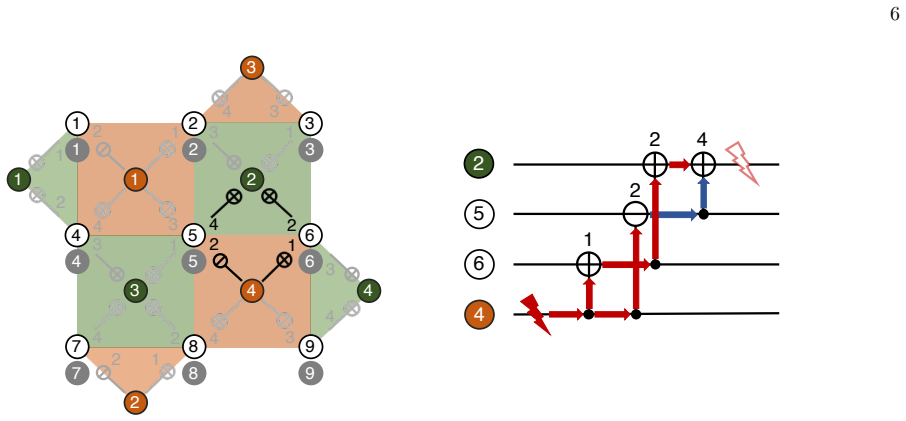
Significance. If the thresholds are taken at face value, the paper is a significant advance in the practical assessment of bosonic quantum error correction: it provides, for this concatenated setting, a full circuit-level simulation in which noise propagation through every gate is tracked, a decoder that exploits the analog syndrome information from GKP stabilizer measurements, and concrete falsifiable predictions (the three threshold values and the exponential scaling of perr(σ) in Eqs. (20)-(21)) that connect state-preparation squeezing to a fault-tolerance threshold. Strengths of the manuscript are the exceptionally detailed simulation protocol (Appendix B gives explicit stochastic update equations for every noise step and the complete MWPM decoding procedure), the careful scheduling of SUM and inverse-SUM gates to avoid correlated-noise amplification (Fig. 5), and the transparent comparison with prior toric-GKP and measurement-based results. The central claims are conditional on the noise model, and the 'conservative' reduction of physical finite-squeezing and loss noise to Gaussian displacement channels is asserted rather than proven; this is the main risk.
major comments (2)
- [II C and Appendix A] The thresholds reported in Section III are computed for the model of Eq. (16), in which every finite-squeezing GKP state is replaced by an ideal state subject to the incoherent Gaussian displacement channel N[σ_gkp], and Section II C asserts that this replacement is 'conservative' compared to the coherent superposition of displacements in Eq. (15). The twirling derivation in Eqs. (A2)-(A4) shows that the incoherent model is obtained from the coherent state by averaging over GKP stabilizer shifts and dropping the (k1,k2)≠(0,0) terms, but it does not establish that the decoded logical error rate is larger for the incoherent model: the logical error probability after repeated rounds of measurement and feedback is not a convex function of the input state, and coherences between distinct displacement components within a peak, which are destroyed by the twirl, could in principle affect subsequent rounds. Because the abstract's headline claim ('fault-tolerant quantum error correction is possible ... if the squeezing ... is higher than 11.2 dB') is phrased in terms of physical squeezing, the identification of the physical state with N[σ_gkp] is load-bearing. Please either prove the monotonicity, provide numerical evidence by simulating the coherent states of Eq. (15) directly for small d and comparing with the N[σ_gkp] model, or explicitly qualify the abstract and Section III as applying to the twirled noise model.
- [II C, Eqs. (17)-(19)] The gate error model in Eq. (18) replaces the loss-only Lindbladian L± of Eq. (17) by L'± = L± + κ(D[a1†] + D[a2†]), which doubles the added displacement variance relative to pure photon loss and removes the attenuation; the resulting correlated Gaussian displacement model (Eq. (19)) is directionally pessimistic, but the paper gives no monotonicity argument for the final logical error rate under this substitution. Since the MWPM edge weights in Eqs. (B22)-(B33) are themselves computed from the same noise parameters σ and σ_gkp, changing the noise model also changes the decoder, so a monotone relation between the physical loss rate and the simulated logical error rate cannot simply be assumed. The authors should either provide such an argument, or state explicitly that the thresholds (κ/g)* = 0.81% and 0.69% are for the diffusion-type gate model and may not match a pure-loss implementation.
minor comments (5)
- [III, Fig. 6] The caption does not state which symbol shape corresponds to which code distance d, nor the set of distances used in each panel; listing the distances (apparently d = 3, 5, 7, and possibly 9) would make the threshold crossings checkable.
- [III] The threshold values (σ*_gkp = 0.194, σ* = 0.09, and σ* = 0.083) are quoted to three significant figures, but Fig. 6 shows no error bars or confidence intervals; Appendix B only reports that 10,000-100,000 samples were used, so please quantify the statistical precision of the extracted thresholds.
- [Appendix B, MWPM decoding step 3] The decoding procedure says to 'find the path with the minimum total weight' for all pairs of highlighted vertices but does not state which shortest-path algorithm is used; a one-sentence statement (e.g., Dijkstra on the spatio-temporal graph) would aid reproducibility.
- [II A, after Eq. (10)] There is a typo in the sentence 'for some intergern' which should read 'for some integer n.'
- [II C] The paper defines separate noise parameters σ_p, σ_c, σ_m for preparation, gates, and measurement but simulates only the case σ_p = σ_c = σ_m ≡ σ; a sentence on how unequal parameters would be handled, or why equal-time noise is the relevant regime, would clarify the sense in which the noise model is general.
Circularity Check
No significant circularity: the fault-tolerance thresholds are outputs of a Monte Carlo simulation over a stated circuit-level noise model, with no fitted parameter renamed as a prediction and no load-bearing self-citation.
full rationale
The derivation chain is self-contained. The approximate GKP state is expanded in Eq. (15), then converted to the incoherent displacement channel N[sigma_gkp] in Eq. (16) via the twirling calculation in Appendix A; the gate noise model in Eqs. (17)-(19) is derived from the Lindbladian with added heating. These are model assumptions, not circular definitions. The thresholds in Section III are obtained by simulating the full noisy syndrome-extraction circuit and applying MWPM to 3D space-time graphs; the edge weights in Appendix B use the same noise variances that generate the data, which is standard matched decoding and does not fit any parameter to the logical error rates being predicted. The analytical error probabilities in Eqs. (20)-(21) are derived from noise propagation and are used as decoder weights, not as the logical error rates that determine the threshold. The only self-citations (Refs. [5, 50, 67]) are background or technique citations; the loss-to-displacement conversion is re-derived in Appendix A, so the central claim does not reduce to a self-citation. The paper itself flags the twirling operation as impractical and notes possible Kerr limitations (Section IV), but those are caveats about model realism, not circularity.
Assumptions & free parameters
assumptions (5)
- domain assumption Finite-squeezing GKP states can be modeled by an incoherent Gaussian displacement channel N[σ_gkp] with σ_gkp^2 = (1 - e^-Δ)/(1 + e^-Δ).
- domain assumption Photon loss and heating during SUM/inverse-SUM gates can be converted into a correlated Gaussian displacement error after an ideal gate, via the Lindblad model in Eqs. (17)-(19).
- domain assumption The displacement operations used for error correction are noiseless and can be tracked in a Pauli frame.
- domain assumption The decoder has perfect knowledge of the noise parameters σ_gkp and σ and uses them in the renormalized edge weight formulas.
- standard math Standard quantum mechanics and Gaussian quantum information tools (CPTP maps, Trotter's formula, Poisson summation) are used.
Cite this review
Pith. "Pith review of Fault-tolerant bosonic quantum error correction with the surface-GKP code." pith.science (2026). https://pith.science/paper/BWYTSOCY
@misc{pith2026190803579,
  author       = {Pith},
  title        = {Pith review of: Fault-tolerant bosonic quantum error correction with the surface-GKP code},
  year         = {2026},
  howpublished = {\url{https://pith.science/paper/BWYTSOCY}},
  note         = {Machine review of arXiv:1908.03579}
}
read the original abstract
Bosonic quantum error correction is a viable option for realizing error-corrected quantum information processing in continuous-variable bosonic systems. Various single-mode bosonic quantum error-correcting codes such as cat, binomial, and GKP codes have been implemented experimentally in circuit QED and trapped ion systems. Moreover, there have been many theoretical proposals to scale up such single-mode bosonic codes to realize large-scale fault-tolerant quantum computation. Here, we consider the concatenation of the single-mode GKP code with the surface code, namely, the surface-GKP code. In particular, we thoroughly investigate the performance of the surface-GKP code by assuming realistic GKP states with a finite squeezing and noisy circuit elements due to photon losses. By using a minimum-weight perfect matching decoding algorithm on a 3D space-time graph, we show that fault-tolerant quantum error correction is possible with the surface-GKP code if the squeezing of the GKP states is higher than 11.2dB in the case where the GKP states are the only noisy elements. We also show that the squeezing threshold changes to 18:6dB when both the GKP states and circuit elements are comparably noisy. At this threshold, each circuit component fails with probability 0.69%. Finally, if the GKP states are noiseless, fault-tolerant quantum error correction with the surface-GKP code is possible if each circuit element fails with probability less than 0.81%. We stress that our decoding scheme uses the additional information from GKP-stabilizer measurements and we provide a simple method to compute renormalized edge weights of the matching graphs. Furthermore, our noise model is general as it includes full circuit-level noise.
Figures


Figures from the paper (7 more)



Reference graph
Works this paper leans on
-
[1]
Simulate d rounds of noisy stabilizer measurements followed by one round of ideal stabilizer measure- ments and construct the Z-type and X-type 3D space-time graphs as described above
-
[2]
If the number of highlighted vertices is odd, highlight a boundary vertex
Highlight all vertices whose assigned stabilizer value is changed from the previous round. If the number of highlighted vertices is odd, highlight a boundary vertex. Thus, the number of highlighted vertices is always even
-
[3]
Then, save the minimum total weight and all edges in the path
For all pairs of highlighted Z-type (X-type) ver- tices, find the path with the minimum total weight. Then, save the minimum total weight and all edges in the path. Then, we are left with a Z-type (X- type) complete graph of highlighted vertices, where the weight of the edge ( v,w ) is given by the mini- mum total weight of the path that connects v and w. 21
-
[4]
Apply the minimum-weight perfect matching algo- rithm [34, 35] on the Z-type (X-type) complete graph of highlighted vertices. For all matched pairs of Z-type (X-type) vertices, highlight all the Z- type (X-type) edges contained in the path that connects the matched vertices
-
[5]
For each Z-type (X-type) horizontal edge, count how many times it was highlighted
Suppress all vertical edges and project the Z-type (X-type) 3D space-time graph onto the 2D plane. For each Z-type (X-type) horizontal edge, count how many times it was highlighted. If it is high- lighted even times, do nothing. Otherwise, apply the Pauli correction operator ˆXgkp ( ˆZgkp) to the corresponding data GKP qubit. Equivalently, up- date the qu...
-
[6]
Macroscopically distinct quantum-superposition states as a bosonic code for amplitude damping,
P. T. Cochrane, G. J. Milburn, and W. J. Munro, “Macroscopically distinct quantum-superposition states as a bosonic code for amplitude damping,” Phys. Rev. A 59, 2631–2634 (1999)
work page 1999
-
[7]
Quantum computation over continuous variables,
S. Lloyd and S. L. Braunstein, “Quantum computation over continuous variables,” Phys. Rev. Lett. 82, 1784– 1787 (1999)
work page 1999
-
[8]
Efficient quantum computa- tion using coherent states,
H. Jeong and M. S. Kim, “Efficient quantum computa- tion using coherent states,” Phys. Rev. A 65, 042305 (2002)
work page 2002
Show all 82 references
-
[9]
Quantum computation with optical co- herent states,
T. C. Ralph, A. Gilchrist, G. J. Milburn, W. J. Munro, and S. Glancy, “Quantum computation with optical co- herent states,” Phys. Rev. A 68, 042319 (2003)
2003
-
[10]
Fault- tolerant linear optical quantum computing with small- amplitude coherent states,
A. P. Lund, T. C. Ralph, and H. L. Haselgrove, “Fault- tolerant linear optical quantum computing with small- amplitude coherent states,” Phys. Rev. Lett.100, 030503 (2008)
2008
-
[11]
Performance and structure of single-mode bosonic codes,
V. V. Albert, K. Noh, K. Duivenvoorden, D. J. Young, R. T. Brierley, P. Reinhold, C. Vuillot, L. Li, C. Shen, S. M. Girvin, B. M. Terhal, and L. Jiang, “Performance and structure of single-mode bosonic codes,” Phys. Rev. A 97, 032346 (2018)
2018
-
[12]
Quantum error correction and uni- versal gate set operation on a binomial bosonic logical qubit,
L. Hu, Y. Ma, W. Cai, X. Mu, Y. Xu, W. Wang, Y. Wu, H. Wang, Y. P. Song, C. L. Zou, S. M. Girvin, L-M. Duan, and L. Sun, “Quantum error correction and uni- versal gate set operation on a binomial bosonic logical qubit,” Nature Physics 15, 503–508 (2019)
2019
-
[13]
New class of quantum error-correcting codes for a bosonic mode,
M. H. Michael, M. Silveri, R. T. Brierley, V. V. Albert, J. Salmilehto, L. Jiang, and S. M. Girvin, “New class of quantum error-correcting codes for a bosonic mode,” Phys. Rev. X 6, 031006 (2016)
2016
-
[14]
Encoding a qubit in an oscillator,
D. Gottesman, A. Kitaev, and J. Preskill, “Encoding a qubit in an oscillator,” Phys. Rev. A 64, 012310 (2001)
2001
-
[15]
Confining the state of light to a quantum manifold by engineered two-photon loss,
Z. Leghtas, S. Touzard, I. M. Pop, A. Kou, B. Vlas- takis, A. Petrenko, K. M. Sliwa, A. Narla, S. Shankar, M. J. Hatridge, M. Reagor, L. Frunzio, R. J. Schoelkopf, M. Mirrahimi, and M. H. Devoret, “Confining the state of light to a quantum manifold by engineered two-photon loss...
2015
-
[16]
Ex- tending the lifetime of a quantum bit with error correc- tion in superconducting circuits,
N. Ofek, A. Petrenko, R. Heeres, P. Reinhold, Z. Leghtas, B. Vlastakis, Y. Liu, L. Frunzio, S. M. Girvin, L. Jiang, M. Mirrahimi, M. H. Devoret, and R. J. Schoelkopf, “Ex- tending the lifetime of a quantum bit with error correc- tion in superconducting circuits,” Nature 536, 4...
2016
-
[17]
Coherent oscilla- tions inside a quantum manifold stabilized by dissipa- tion,
S. Touzard, A. Grimm, Z. Leghtas, S. O. Mundhada, P. Reinhold, C. Axline, M. Reagor, K. Chou, J. Blumoff, K. M. Sliwa, S. Shankar, L. Frunzio, R. J. Schoelkopf, M. Mirrahimi, and M. H. Devoret, “Coherent oscilla- tions inside a quantum manifold stabilized by dissipa- tion,” Phy...
2018
-
[18]
Quantum codes on a lat- 22 tice with boundary,
S. B. Bravyi and A. Yu. Kitaev, “Quantum codes on a lat- 22 tice with boundary,” arXiv e-prints , quant-ph/9811052 (1998), arXiv:quant-ph/9811052 [quant-ph]
1998 arXiv
-
[19]
A stabilized logical quan- tum bit encoded in grid states of a superconduct- ing cavity,
P. Campagne-Ibarcq, A. Eickbusch, S. Touzard, E. Zalys- Geller, N. E. Frattini, V. V. Sivak, P. Reinhold, S. Puri, S. Shankar, R. J. Schoelkopf, L. Frunzio, M. Mir- rahimi, and M. H. Devoret, “A stabilized logical quan- tum bit encoded in grid states of a superconduct- ing cav...
2019 arXiv
-
[20]
The Kerr-Cat Qubit: Stabilization, Readout, and Gates,
A. Grimm, N. E. Frattini, S. Puri, S. O. Mundhada, S. Touzard, M. Mirrahimi, S. M. Girvin, S. Shankar, and M. H. Devoret, “The Kerr-Cat Qubit: Stabilization, Readout, and Gates,” arXiv e-prints , arXiv:1907.12131 (2019), arXiv:1907.12131 [quant-ph]
2019 arXiv
-
[21]
Sequential modular position and momentum measurements of a trapped ion mechanical oscillator,
C. Fl¨ uhmann, V. Negnevitsky, M. Marinelli, and J. P. Home, “Sequential modular position and momentum measurements of a trapped ion mechanical oscillator,” Phys. Rev. X 8, 021001 (2018)
2018
-
[22]
Encoding a qubit in a trapped-ion mechanical oscillator,
C. Fl¨ uhmann, T. L. Nguyen, M. Marinelli, V. Negnevit- sky, K. Mehta, and J. P. Home, “Encoding a qubit in a trapped-ion mechanical oscillator,” Nature 566, 513–517 (2019)
2019
-
[23]
Direct characteristic- function tomography of quantum states of the trapped-ion motional oscillator,
C. Fl¨ uhmann and J. P. Home, “Direct characteristic- function tomography of quantum states of the trapped-ion motional oscillator,” arXiv e-prints , arXiv:1907.06478 (2019), arXiv:1907.06478 [quant-ph]
2019 arXiv
-
[24]
Tailoring surface codes for highly biased noise,
D. K. Tuckett, C. T. Chubb, S. Bravyi, S. D. Bartlett, and S. T. Flammia, “Tailoring surface codes for highly biased noise,” arXiv e-prints , arXiv:1812.08186 (2018), arXiv:1812.08186 [quant-ph]
2018 arXiv
-
[25]
Topological quantum memory,
E. Dennis, A. Kitaev, A. Landahl, and J. Preskill, “Topological quantum memory,” Journal of Mathematical Physics 43, 4452–4505 (2002), https://doi.org/10.1063/1.1499754
2002 doi
-
[26]
Surface codes: Towards practical large-scale quantum computation,
A. G. Fowler, M. Mariantoni, J. M. Martinis, and A. N. Cleland, “Surface codes: Towards practical large-scale quantum computation,” Phys. Rev. A 86, 032324 (2012)
2012
-
[27]
Repetition cat-qubits: fault-tolerant quantum computation with highly reduced overhead,
J. Guillaud and M. Mirrahimi, “Repetition cat-qubits: fault-tolerant quantum computation with highly reduced overhead,” arXiv e-prints , arXiv:1904.09474 (2019), arXiv:1904.09474 [quant-ph]
2019 arXiv
-
[28]
Bias-preserving gates with stabilized cat qubits,
S. Puri, L. St-Jean, J. A. Gross, A. Grimm, N. E. Frat- tini, P. S. Iyer, A. Krishna, S. Touzard, L. Jiang, A. Blais, S. T. Flammia, and S. M. Girvin, “Bias-preserving gates with stabilized cat qubits,” arXiv e-prints , arXiv:1905.00450 (2019), arXiv:1905.00450 [quant-ph]
2019 arXiv
-
[29]
Ultra- high error threshold for surface codes with biased noise,
D. K. Tuckett, S. D. Bartlett, and S. T. Flammia, “Ultra- high error threshold for surface codes with biased noise,” Phys. Rev. Lett. 120, 050505 (2018)
2018
-
[30]
Quantum error correction with the toric Gottesman-Kitaev-Preskill code,
C. Vuillot, H. Asasi, Y. Wang, L. P. Pryadko, and B. M. Terhal, “Quantum error correction with the toric Gottesman-Kitaev-Preskill code,” Phys. Rev. A 99, 032344 (2019)
2019
-
[31]
Fault-tolerant thresholds for the surface code in excess of 5% under biased noise,
D. K. Tuckett, S. D. Bartlett, S. T. Flammia, and B. J. Brown, “Fault-tolerant thresholds for the surface code in excess of 5% under biased noise,” arXiv e-prints , arXiv:1907.02554 (2019), arXiv:1907.02554 [quant-ph]
2019 arXiv
-
[32]
Analog quan- tum error correction with encoding a qubit into an oscil- lator,
K. Fukui, A. Tomita, and A. Okamoto, “Analog quan- tum error correction with encoding a qubit into an oscil- lator,” Phys. Rev. Lett. 119, 180507 (2017)
2017
-
[33]
Tracking quan- tum error correction,
K. Fukui, A. Tomita, and A. Okamoto, “Tracking quan- tum error correction,” Phys. Rev. A 98, 022326 (2018)
2018
-
[34]
Wang, Quantum error correction with the GKP code and concatenation with stabilizer codes , Ph.D
Y. Wang, Quantum error correction with the GKP code and concatenation with stabilizer codes , Ph.D. thesis, Masters thesis, RWTH Aachen University (2017)
2017
-
[35]
High- threshold fault-tolerant quantum computation with ana- log quantum error correction,
K. Fukui, A. Tomita, A. Okamoto, and K. Fujii, “High- threshold fault-tolerant quantum computation with ana- log quantum error correction,” Phys. Rev. X 8, 021054 (2018)
2018
-
[36]
Surface code quantum computing with error rates over 1%,
D. S. Wang, A. G. Fowler, and L. C. L. Hollenberg, “Surface code quantum computing with error rates over 1%,” Phys. Rev. A 83, 020302 (2011)
2011
-
[37]
Fault-tolerant measurement-based quantum computing with continuous-variable cluster states,
N. C. Menicucci, “Fault-tolerant measurement-based quantum computing with continuous-variable cluster states,” Phys. Rev. Lett. 112, 120504 (2014)
2014
-
[38]
High-threshold fault-tolerant quantum com- putation with the GKP qubit and realistically noisy devices,
K. Fukui, “High-threshold fault-tolerant quantum com- putation with the GKP qubit and realistically noisy devices,” arXiv e-prints , arXiv:1906.09767 (2019), arXiv:1906.09767 [quant-ph]
2019 arXiv
-
[39]
Measurement-based quantum computation on cluster states,
R. Raussendorf, D. E. Browne, and H. J. Briegel, “Measurement-based quantum computation on cluster states,” Phys. Rev. A 68, 022312 (2003)
2003
-
[40]
Paths, trees, and flowers,
J. Edmonds, “Paths, trees, and flowers,” Canadian Jour- nal of Mathematics 17, 449467 (1965)
1965
-
[41]
Maximum matching and a polyhedron with 0, 1 vertices,
J. Edmonds, “Maximum matching and a polyhedron with 0, 1 vertices,” J. of Res. the Nat. Bureau of Standards 69 B , 125–130 (1965)
1965
-
[42]
Generating continuous variable quantum codewords in the near-field atomic lithography,
S. Pirandola, S. Mancini, D. Vitali, and P. Tombesi, “Generating continuous variable quantum codewords in the near-field atomic lithography,” Journal of Physics B: Atomic, Molecular and Optical Physics 39, 997 (2006)
2006
-
[43]
Topological and subsystem codes on low-degree graphs with flag qubits,
C. Chamberland, G. Zhu, T. J. Yoder, J. B. Hertzberg, and A. W. Cross, “Topological and subsystem codes on low-degree graphs with flag qubits,” arXiv e-prints , arXiv:1907.09528 (2019), arXiv:1907.09528 [quant-ph]
2019 arXiv
-
[44]
Optimal re- sources for topological two-dimensional stabilizer codes: Comparative study,
H. Bombin and M. A. Martin-Delgado, “Optimal re- sources for topological two-dimensional stabilizer codes: Comparative study,” Phys. Rev. A 76, 012305 (2007)
2007
-
[45]
Low-distance surface codes under realistic quantum noise,
Y. Tomita and K. M. Svore, “Low-distance surface codes under realistic quantum noise,” Phys. Rev. A 90, 062320 (2014)
2014
-
[46]
Preparing encoded states in an oscillator,
B. C. Travaglione and G. J. Milburn, “Preparing encoded states in an oscillator,” Phys. Rev. A 66, 052322 (2002)
2002
-
[47]
Constructing finite-dimensional codes with optical con- tinuous variables,
S. Pirandola, S. Mancini, D. Vitali, and P. Tombesi, “Constructing finite-dimensional codes with optical con- tinuous variables,” EPL (Europhysics Letters) 68, 323 (2004)
2004
-
[48]
Con- version of Gaussian states to non-Gaussian states us- ing photon number-resolving detectors,
D. Su, C. R.. Myers, and K. K. Sabapathy, “Con- version of Gaussian states to non-Gaussian states us- ing photon number-resolving detectors,” arXiv e-prints , arXiv:1902.02323 (2019), arXiv:1902.02323 [quant-ph]
2019 arXiv
-
[49]
All-optical generation of states for “encoding a qubit in an oscilla- tor
H. M. Vasconcelos, L. Sanz, and S. Glancy, “All-optical generation of states for “encoding a qubit in an oscilla- tor”,” Opt. Lett. 35, 3261–3263 (2010)
2010
-
[50]
Encoding a qubit into a cavity mode in circuit QED using phase estimation,
B. M. Terhal and D. Weigand, “Encoding a qubit into a cavity mode in circuit QED using phase estimation,” Phys. Rev. A 93, 012315 (2016)
2016
-
[51]
Encoding qubits into oscillators with atomic ensembles and squeezed light,
K. R. Motes, B. Q. Baragiola, A. Gilchrist, and N. C. Menicucci, “Encoding qubits into oscillators with atomic ensembles and squeezed light,” Phys. Rev. A 95, 053819 (2017)
2017
-
[52]
Generating grid states from Schr¨ odinger-cat states without postselec- tion,
D. J. Weigand and B. M. Terhal, “Generating grid states from Schr¨ odinger-cat states without postselec- tion,” Phys. Rev. A 97, 022341 (2018)
2018
-
[53]
Machine learning method for state preparation and gate synthesis on pho- tonic quantum computers,
J. M. Arrazola, T. R. Bromley, J. Izaac, C. R. My- ers, K. Br´ adler, and N. Killoran, “Machine learning method for state preparation and gate synthesis on pho- tonic quantum computers,” Quantum Science and Tech- nology 4, 024004 (2019)
2019
-
[54]
All-gaussian uni- versality and fault tolerance with the gottesman-kitaev- preskill code,
B. Q. Baragiola, G. Pantaleoni, R. N. Alexander, A. Karanjai, and N. C. Menicucci, “All-gaussian uni- versality and fault tolerance with the gottesman-kitaev- preskill code,” Phys. Rev. Lett. 123, 200502 (2019)
2019
-
[55]
Non-gaussian and gottesman–kitaev–preskill state preparation by photon catalysis,
M. Eaton, R. Nehra, and O. Pfister, “Non-gaussian and gottesman–kitaev–preskill state preparation by photon catalysis,” New Journal of Physics 21, 113034 (2019)
2019
-
[56]
Fault-tolerant preparation of approximate GKP states,
Y. Shi, C. Chamberland, and A. Cross, “Fault-tolerant preparation of approximate GKP states,” New Journal of Physics 21, 093007 (2019)
2019
-
[57]
Realizing mod- ular quadrature measurements via a tunable photon- pressure coupling in circuit-QED,
D. J. Weigand and B. M. Terhal, “Realizing mod- ular quadrature measurements via a tunable photon- pressure coupling in circuit-QED,” arXiv e-prints , arXiv:1909.10075 (2019), arXiv:1909.10075 [quant-ph]
2019 arXiv
-
[58]
Demonstrating the via- bility of universal quantum computation using teleporta- tion and single-qubit operations,
D. Gottesman and I. L. Chuang, “Demonstrating the via- bility of universal quantum computation using teleporta- tion and single-qubit operations,” Nature 402, 390–393 (1999)
1999
-
[59]
Universal quantum computa- tion with ideal clifford gates and noisy ancillas,
S. Bravyi and A. Kitaev, “Universal quantum computa- tion with ideal clifford gates and noisy ancillas,” Phys. Rev. A 71, 022316 (2005)
2005
-
[60]
Fault-tolerant quantum computing in the Pauli or Clifford frame with slow error diagnostics,
C. Chamberland, P. Iyer, and D. Poulin, “Fault-tolerant quantum computing in the Pauli or Clifford frame with slow error diagnostics,” Quantum 2, 43 (2018)
2018
-
[61]
Charge-insensitive qubit design derived from the cooper pair box,
J. Koch, T. M. Yu, J. Gambetta, A. A. Houck, D. I. Schuster, J. Majer, A. Blais, M. H. Devoret, S. M. Girvin, 23 and R. J. Schoelkopf, “Charge-insensitive qubit design derived from the cooper pair box,” Phys. Rev. A 76, 042319 (2007)
2007
-
[62]
Suppressing charge noise decoherence in su- perconducting charge qubits,
J. A. Schreier, A. A. Houck, J. Koch, D. I. Schuster, B. R. Johnson, J. M. Chow, J. M. Gambetta, J. Ma- jer, L. Frunzio, M. H. Devoret, S. M. Girvin, and R. J. Schoelkopf, “Suppressing charge noise decoherence in su- perconducting charge qubits,” Phys. Rev. B 77, 180502 (2008)
2008
-
[63]
Quantum computing with realistically noisy devices,
E. Knill, “Quantum computing with realistically noisy devices,” Nature 434, 39–44 (2005)
2005
-
[64]
Effective fault-tolerant quantum computation with slow measurements,
D. P. DiVincenzo and P. Aliferis, “Effective fault-tolerant quantum computation with slow measurements,” Phys. Rev. Lett. 98, 020501 (2007)
2007
-
[65]
Quantum error correction for quantum memories,
B. M. Terhal, “Quantum error correction for quantum memories,” Rev. Mod. Phys. 87, 307–346 (2015)
2015
-
[66]
Completely positive linear maps on com- plex matrices,
M.-D. Choi, “Completely positive linear maps on com- plex matrices,” Linear Algebra and its Applications 10, 285 – 290 (1975)
1975
-
[67]
Ordered expansions in boson amplitude operators,
K. E. Cahill and R. J. Glauber, “Ordered expansions in boson amplitude operators,” Phys. Rev. 177, 1857–1881 (1969)
1969
-
[68]
Modular Bosonic Subsystem Codes,
G. Pantaleoni, B. Q. Baragiola, and N. C. Menicucci, “Modular Bosonic Subsystem Codes,” arXiv e-prints , arXiv:1907.08210 (2019), arXiv:1907.08210 [quant-ph]
2019 arXiv
-
[69]
Towards practical qubit computation using approximate error-correcting grid states,
I. Tzitrin, J. E. Bourassa, N. C. Menicucci, and K. K. Sabapathy, “Towards practical qubit computation using approximate error-correcting grid states,” arXiv e-prints , arXiv:1910.03673 (2019), arXiv:1910.03673 [quant-ph]
2019 arXiv
-
[70]
On the equivalence of approximate Gottesman-Kitaev- Preskill codes,
T. Matsuura, H. Yamasaki, and M. Koashi, “On the equivalence of approximate Gottesman-Kitaev- Preskill codes,” arXiv e-prints , arXiv:1910.08301 (2019), arXiv:1910.08301 [quant-ph]
2019 arXiv
-
[71]
Symmetrized characterization of noisy quan- tum processes,
J. Emerson, M. Silva, O. Moussa, C. Ryan, M. Lafor- est, J. Baugh, D. G. Cory, and R. Laflamme, “Symmetrized characterization of noisy quan- tum processes,” Science 317, 1893–1896 (2007), https://science.sciencemag.org/content/317/5846/1893.full.pdf
2007
-
[72]
Coping with qubit leakage in topological codes,
A. G. Fowler, “Coping with qubit leakage in topological codes,” Phys. Rev. A 88, 042308 (2013)
2013
-
[73]
Quantum ca- pacity bounds of Gaussian thermal loss channels and achievable rates with Gottesman-Kitaev-Preskill codes,
K. Noh, V. V. Albert, and L. Jiang, “Quantum ca- pacity bounds of Gaussian thermal loss channels and achievable rates with Gottesman-Kitaev-Preskill codes,” IEEE Transactions on Information Theory65, 2563–2582 (2019)
2019
-
[74]
Programmable interference between two mi- crowave quantum memories,
Y. Y. Gao, B. J. Lester, Y. Zhang, C. Wang, S. Rosen- blum, L. Frunzio, L. Jiang, S. M. Girvin, and R. J. Schoelkopf, “Programmable interference between two mi- crowave quantum memories,” Phys. Rev. X 8, 021073 (2018)
2018
-
[75]
yields exp[L′ ±∆t] = lim N→∞ [ exp [ V± ∆t N ] exp [ Lerr ∆t N ]]N . (A7) Note that both exp[ V±∆t/N] and exp[ Lerr∆t/N] are 14 Gaussian channels with the characterization matrices T± = 1 0 0 0 0 1 0 ∓1/N ±1/N 0 1 0 0 0 0 1 , N± = 0, Terr = 1 0 0 0 0 1 0 0 0 0 1 ...
-
[76]
Engineering bilinear mode coupling in circuit qed: Theory and experiment,
Y. Zhang, B. J. Lester, Y. Y. Gao, L. Jiang, R. J. Schoelkopf, and S. M. Girvin, “Engineering bilinear mode coupling in circuit qed: Theory and experiment,” Phys. Rev. A 99, 012314 (2019)
2019
-
[77]
3-wave mixing josephson dipole element,
N. E. Frattini, U. Vool, S. Shankar, A. Narla, K. M. Sliwa, and M. H. Devoret, “3-wave mixing josephson dipole element,” Applied Physics Letters 110, 222603 (2017), https://doi.org/10.1063/1.4984142
2017 doi
-
[78]
Fault-tolerant quantum computation for local leakage faults,
P. Aliferis and B. M. Terhal, “Fault-tolerant quantum computation for local leakage faults,” Quantum Info. Comput. 7, 139–156 (2007)
2007
-
[79]
Leak- age suppression in the toric code,
M. Suchara, A. W. Cross, and J. M. Gambetta, “Leak- age suppression in the toric code,” in 2015 IEEE Interna- tional Symposium on Information Theory (ISIT) (2015) pp. 1119–1123
2015
-
[80]
Handling leakage with subsystem codes,
N. C. Brown, M. Newman, and K. R. Brown, “Handling leakage with subsystem codes,” New Journal of Physics 21, 073055 (2019)
2019
-
[81]
On the product of semi-groups of opera- tors,
H. F. Trotter, “On the product of semi-groups of opera- tors,” Proceedings of the American Mathematical Society 10, 545–551 (1959)
1959
-
[82]
Gaus- sian quantum information,
C. Weedbrook, S. Pirandola, R. Garc´ ıa-Patr´ on, N. J. Cerf, T. C. Ralph, J. H. Shapiro, and S. Lloyd, “Gaus- sian quantum information,” Rev. Mod. Phys. 84, 621– 669 (2012)
2012
Reviewed August 14, 2026 · model on record in the stance chip above.
Discussion (0). Continue with ORCID to comment.