REVIEW 3 major objections 6 minor 54 references
Signal Lasso with Non-Convex Penalties for Efficient Network Reconstruction and Topology Inference
T0 review · 3 major / 6 minor · reviewed 2026-08-05 · deepseek-v4-flash
Pith's one-line read Two non-convex penalty versions of signal lasso are claimed to shrink regression coefficients exactly to 0 or 1 with a single large tuning parameter, removing the need for cross-validation in network reconstruction.
desk verdict The central no-tuning claim rests on an incorrect coordinate descent update for the product penalty; the paper has useful pieces but needs major rework before I'd trust it. read the letter →
The pith
A machine-rendered reading of the paper's core claim, the machinery that carries it, and where it could break.
The reading
What carries the argument
The machinery is the coordinate-descent update for two non-convex penalties. The product penalty lambda|beta(beta-1)| is zero at beta=0 and beta=1 and positive in between; the minimum penalty lambda min(|beta|,|beta-1|) has the same two zeros through a cusp at 0.5. Both penalties therefore favor the two signal states. The paper's lemma uses the coordinate-descent formulas (11) and (13) to show that as lambda tends to infinity, each updated coefficient tends to 0 or 1, so the estimator converges to exact 0/1 classification without tuning.
What would settle it
Take a one-coordinate problem with x'x=1 and residual r=0.2; the true univariate minimizer of 0.5(beta-0.2)^2 + 0.2|beta(beta-1)| is beta=0, while formula (11) gives 0.125. Reproducing this discrepancy would show that the coordinate update is not the minimizer of the stated objective, and the large-lambda lemma would not establish the proposed estimator's behavior.
Extended reading notes
Core claim
The paper's central claim is that replacing the additive penalty of signal lasso or adaptive signal lasso with one of two non-convex penalties—lambda|beta(beta-1)| or lambda min(|beta|,|beta-1|)—lets a coordinate-descent estimator push every coefficient to exactly 0 or 1 as lambda grows. Because this happens for any sufficiently large lambda, the authors argue that the tuning parameter can be fixed without cross-validation, removing the main computational bottleneck of earlier methods. Simulations across linear regressions, evolutionary-game dynamics, Kuramoto synchronization, and a human behavioral experiment are offered as evidence that the method is effective and fast, especially for spar
Load-bearing premise
The load-bearing premise is that the coordinate-descent update in Eq. (11) solves the one-coordinate minimization of the product-penalty objective; if that update is not the true minimizer, the algorithm is not optimizing the stated objective and the large-lambda lemma does not describe the proposed estimator.
Editorial extensions
If this is right
- Both proposed methods return coefficients exactly at 0 or 1 for large lambda, so the unclassified middle zone that plagues plain signal lasso disappears, with unclassified rates near zero in the reported simulations.
- Because a single large lambda replaces cross-validation, the methods are orders of magnitude faster than signal lasso and adaptive signal lasso in the reported CPU comparisons.
- In sparse and non-sparse linear regression with low noise, the non-convex penalty methods match or beat adaptive signal lasso; for dense signals they are the recommended option.
- When the design matrix contains zero columns, which happens in sparse network data, the product penalty method is more robust than the minimum penalty method, giving concrete guidance for method choice.
- The approach extends beyond linear regression to network dynamics models such as evolutionary games and Kuramoto oscillators, and to real behavioral experimental data.
Reading between the lines
- An extension the paper leaves implicit: the asymptotic lemma justifies lambda going to infinity, but no concrete rule is given for how large lambda must be in finite samples; a practical follow-up would derive a lower bound on lambda as a function of n, p, and noise level.
- The same non-convex penalty trick could be reused for other estimation problems whose coefficients are constrained to a small discrete set, such as group memberships or quantized coefficients, not just 0/1 network links.
- The observed zero-column advantage of the product penalty suggests a testable conjecture: the product penalty's behavior at zero makes it more forgiving than the minimum penalty when a predictor has no sample variation.
Editorial analysis
A structured set of objections, weighed in public.
Referee Report
Summary. The paper proposes two non-convex penalties for signal-lasso estimation of 0/1 regression coefficients: the product penalty λ|β(β−1)| (SL_prod) and the minimum penalty λ min{|β|,|β−1|} (SL_min). The authors claim that, with these penalties, one can set the tuning parameter λ to a sufficiently large value and the coordinate-descent estimates will shrink exactly to 0 or 1, eliminating the need for tuning and cross-validation. They give coordinate-descent update formulas, prove a lemma about the λ→∞ limit, and support the proposal with extensive simulations on linear models, evolutionary-game-based dynamics, the Kuramoto model, and a human behavioral experiment. The central message is that signal lasso with non-convex penalties is effective, fast, and requires no tuning parameter.
Significance. If valid, the proposal would be an appealing alternative to signal lasso and adaptive signal lasso: a single penalty parameter that can be made large, with estimators automatically classifying coefficients as 0 or 1, plus simpler computation. The paper has strengths: it addresses a practically relevant problem, provides code on GitHub, and reports broad numerical comparisons including real data. However, the theoretical foundation is not sound as presented. The key coordinate-descent update for SL_prod is not the univariate minimizer of the stated objective, so the algorithm does not minimize the proposed penalized least-squares problem. The no-tuning lemma only describes the trivial pointwise limit of the update formula and does not establish convergence of an iterative algorithm. These are load-bearing issues for the main claim.
major comments (3)
- [Section III.B, Eq. (11)] The coordinate update for SL_prod is not the argmin of Eq. (10). With c=x_k'x_k and r=x_k'ε_k/c, the univariate objective on [0,1] is h(β)=(c/2)(β−r)^2+λβ(1−β). For c>2λ, h is convex with vertex β*=(cr−λ)/(c−2λ), not (cr−λ/2)/(c−λ) as in Eq. (11), and the correctness threshold is c>2λ, not c>λ. Concrete counterexample: c=1, r=0.2, λ=0.2. Eq. (11) returns 0.125, but h(0.125)=0.0247>h(0)=0.02, so the true minimizer is 0. Thus SL_prod as implemented does not minimize the stated objective (8), and the lemma in Section III.D is not a property of the penalized estimator defined by Eq. (10).
- [Section III.D, Lemma and 'no tuning' claim] The proof evaluates only the pointwise limit of the update formulas as λ→∞ for fixed data. It does not show that coordinate descent converges for a finite λ, nor does it prove that there exists a finite 'large enough' λ with the claimed property. For SL_prod, the indicator I(x_k'x_k>λ) forces λ>max_k x_k'x_k to eliminate the fractional branches; this bound depends on the data and is not given or estimated. The phrase 'can converge to either 0 or 1' is therefore not justified as an iterative-convergence statement. No convergence theory for coordinate descent on the nonconvex objectives (8)–(9) is provided.
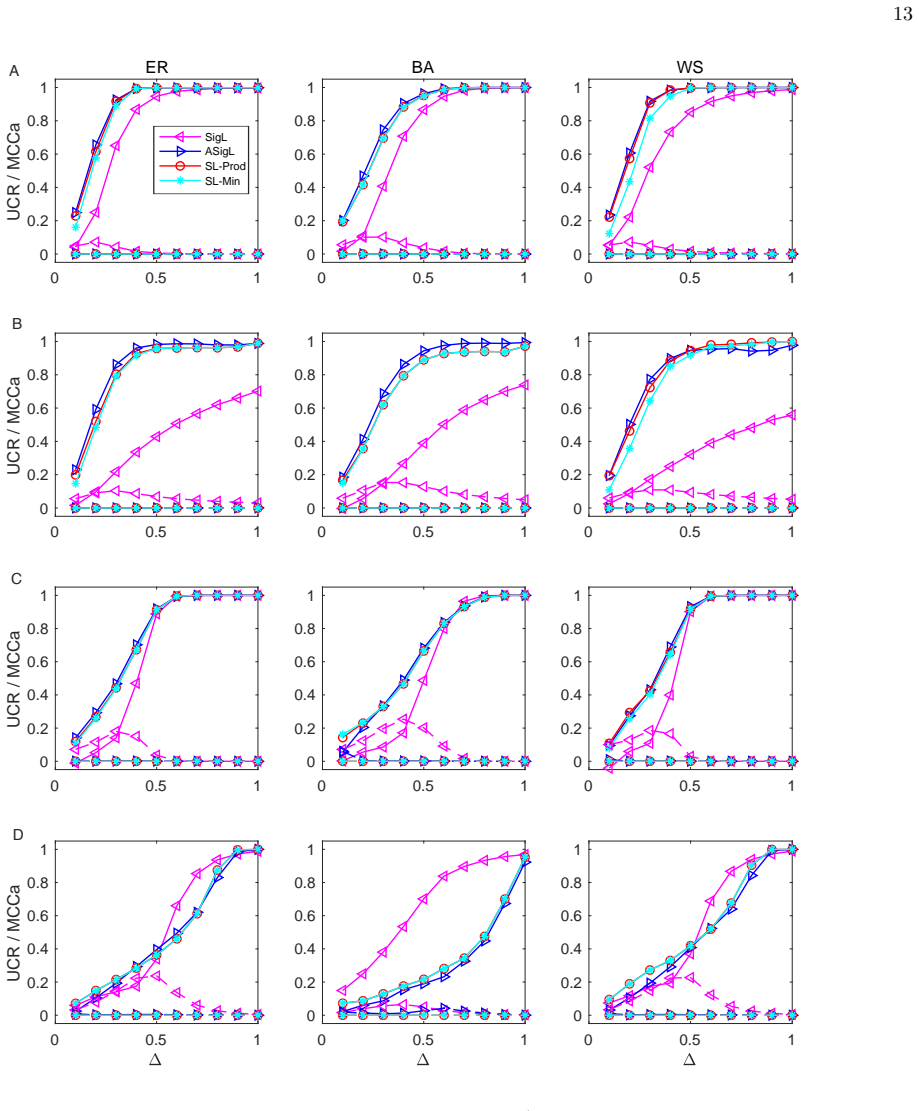
- [Sections V and VI (simulations and real data)] Neither the main text nor the tables report the λ values actually used for SL_prod and SL_min in the simulations (except for illustrative values λ=0.9 and λ=1.2 in Figure 1). Since the central selling point is that λ can be set large without tuning, the absence of these values and of any sensitivity analysis makes the numerical results unreproducible and leaves open the possibility that λ was tuned per scenario. Moreover, because the SL_prod update is not the minimizer of Eq. (8), the simulation results for SL_prod concern a different algorithm than the one defined by the paper, undermining the empirical support for the main claim.
minor comments (6)
- [Abstract and Introduction] 'easily to complementation in computation' should be 'easy to implement'; there are numerous English and typographical errors throughout that should be corrected.
- [Section II, Eq. (6) and surrounding text] The notation α1 and α2 appears without definition before Eq. (6). Please define α1, α2 and their relation to α.
- [Table II, second panel] The column header (150,150,6,2) is inconsistent with the stated setting (50,150,6,2) for n<p; this appears to be a typographical error.
- [Figures 2–5] Figure 3 caption says 'Gamma distribution' while the text describes the exponential σ=2 case; the captions and labels for Figures 2–5 should be checked for consistency.
- [Appendix B, Table V] SL_prod and SL_min CPU times are reported as 0.000000 seconds for all linear-regression settings, which is implausible. The timing methodology and the number of coordinate-descent iterations should be described.
- [Section IV, Eq. (15)] The displayed formula for MCCa appears to be missing a square root in the denominator; it should match the standard MCC formula applied to augmented counts.
Circularity Check
No significant circularity; the main weakness is an unverified (and apparently incorrect) coordinate update, which is a correctness issue rather than a circular reduction.
full rationale
No circular step is identifiable in the paper's derivation chain. The penalties (8) and (9) are explicitly attributed to external papers [41,45], and the algorithm is derived by coordinate descent. The Lemma in Section III.D is proved by taking limits in the stated update formulas; this is a direct theorem about the algorithm, not a fitted-input-called-prediction or a self-citation. The earlier self-citations ([39],[40]) provide the SigL/ASigL baselines, data set, and MCCa metric, but the new no-tuning result does not rest on those citations. There is a serious correctness gap: Eq. (11) is asserted 'through some simple calculations' but is not in fact the univariate minimizer of Eq. (10) (e.g., c=1, r=0.2, lambda=0.2 gives 0.125 instead of the true minimizer 0), so the simulations may be solving a different update than the stated objective. That is a bug/omitted-proof concern, not circularity: the lambda-to-infinity property is not a restatement of a fitted parameter or a self-citation, and the conclusion would be a valid (if different) property of the correct update as well.
Assumptions & free parameters
free parameters (2)
- lambda =
not specified ('large enough' in Section III.D)
- lambda_lasso_init =
not specified
assumptions (5)
- standard math Noise has mean zero and finite variance; data are centered
- domain assumption True regression coefficients are exactly 0 or 1
- ad hoc to paper Coordinate descent converges to a useful solution of the non-convex objective
- ad hoc to paper The λ→∞ limit of the update rules is a valid finite-sample estimator with a fixed 'large enough' λ
- domain assumption The game and synchronization models are exactly linear with known regressor functions
Cite this review
Pith. "Pith review of Signal Lasso with Non-Convex Penalties for Efficient Network Reconstruction and Topology Inference." pith.science (2026). https://pith.science/paper/BX3FDARE
@misc{pith2026250900342,
  author       = {Pith},
  title        = {Pith review of: Signal Lasso with Non-Convex Penalties for Efficient Network Reconstruction and Topology Inference},
  year         = {2026},
  howpublished = {\url{https://pith.science/paper/BX3FDARE}},
  note         = {Machine review of arXiv:2509.00342}
}
read the original abstract
Inferring network structures remains an interesting question for its importance on the understanding and controlling collective dynamics of complex systems. The existing shrinking methods such as Lasso-type estimation can not suitably reveal such property. A new method recently suggested, called by {\it signal lasso} (or its updating version: adaptive signal lasso) was proposed to solve the network reconstruction problem, where the signal parameter can be shrunk to either 0 or 1 in two different directions. The signal lasso or adaptive signal lasso employed the additive penalty of signal and non-signal terms which is a convex function and easily to complementation in computation. However their methods need tuning the one or two parameters to find an optimal solution, which is time cost for large size network. In this paper we propose new signal lasso method based on two penalty functions to estimate the signal parameter and uncovering network topology in complex network with a small amount of observations. The penalty functions we introduced are non-convex function, thus coordinate descent algorithms are suggested. We find in this method the tuning parameter can be set to a large enough values such that the signal parameter can be completely shrunk either 0 or 1. The extensive simulations are conducted in linear regression models with different assumptions, the evolutionary-game-based dynamic model and Kuramoto model of synchronization problem. The advantage and disadvantage of each method are fully discussed in various conditions. Finally a real example comes from behavioral experiment is used for illustration. Our results show that signal lasso with non-convex penalties is effective and fast in estimating signal parameters in linear regression model.
Figures


Figures from the paper (5 more)




Reference graph
Works this paper leans on
-
[1]
School of Statistics and Mathematics, Yunnan University of Finance and Economics, Kunming, 650221, China
-
[2]
Interdisciplinary Research Institute of Data Science, Shanghai Lixin University of Accounting and Finance, Shanghai 201209, China
-
[3]
Management School, Science and Technology University of China,Hefei, China
-
[4]
Department of Statistics and Data Science, School of Economics, Xiamen University, Xiamen, 361005, China
-
[5]
Faculty of Engineering Sciences, Kyushu University, Kasuga-koen, Kasuga-shi, Fukuoka 816-8580, Japan (Dated: September 14, 2025) Inferring network structures remains an interesting question for its importance on the under- standing and controlling collective dynamics of complex systems. The most of real networks exhibit sparsely connected properties, and ...
work page 2025
-
[6]
Signal Lasso with Non-Convex Penalties for Efficient Network Reconstruction and Topology Inference
The extensive simulations are conducted in linear regression models with different assumptions, the evolutionary-game-based dynamic model and Kuramoto model of synchronization problem. The advantage and disadvantage of each method are fully discussed in various conditions. Finally a real example comes from behavioral experiment is used for illustration. O...
work page Pith review arXiv 2025
-
[7]
Donoho, D. and Johnstone, I. and Kerkyacharian, G. and Picard, D. (1995). Wavelet shrinkage: asymptopia? (with discussion) . Journal of the Royal Statistical Society, B . 57 301–337
work page 1995
-
[8]
Antoniadis, A. and F an, J. (1999). Regularization of Wavelets Approximations . Journal of the American Statistical Association. 96 939–967
work page 1999
Show all 54 references
-
[9]
Barab´asi,A.-L. (2012). The Network Takeover. Nat. Phys. 8 14–16
2012
-
[10]
and Latora, V
Boccaletti, S. and Latora, V. and Moreno, Y. and Chavez, M. and Hwang, D. U. (2006). Complex networks: Structure and dynamics . Physics Reports. 424 175–308
2006
-
[11]
and Donoho, D
Chen, S. and Donoho, D. and Saunders, M. (2001). Atomic Decomposition by Basis Pursuit. SIAM Review. 43 129–159
2001
-
[12]
Donoho, D. (2006). Compressed Sensing. IEEE Trans. Inf. Theory. 52 1289
2006
-
[13]
and Johnstone, I
Donoho, D. and Johnstone, I. (1994). Ideal Spatial Adaptation by Wavelet Shrinkage . Biometrika. 81 425–455
1994
-
[14]
and Shen, Z
Han, X. and Shen, Z. and W ang, W.X.and Di, Z. (2015). Robut reconstraction of complex networks from sparse data . Phys. Rev. Lett. 114 028701
2015
-
[15]
and Hastie, T
Efron, B. and Hastie, T. and Johnstone, I. and Tibshirani, R. (2004). Least Angle Regression . The Annals of Statistics. 32 407–499
2004
-
[16]
F an, J.and Li, R. (2001). Variable Selection via Nonconcave Penalized Likelihood and Its Oracle Properties . Journal of the American Statistical Association . 96 1348–1360
2001
-
[17]
and Wu, Y
F an, J.and Feng, Y. and Wu, Y. (2009). Network exploration via the adaptive LASSO and SCAD penalties . The annals of applied statistics . 3(2) 521
2009
-
[18]
and Fischbacher, U
Fehr, E. and Fischbacher, U. (2003). The nature of human altruism . Nature. 425(6960) 785
2003
-
[19]
and di Bernardo, D
Gardner, T.S. and di Bernardo, D. and Lorenz, D. and Collins, J. (2003). Inferring Genetic Networks and Identi- fying Compound Mode of Action via Expression Profiling . Science. 301 102
2003
-
[20]
and Timmer, J
Geier, F. and Timmer, J. and Fleck, C. (2007). Reconstructing Gene-Regulatory Networks from Time Series, Knock-Out Data, and Prior Knowledge . BMC Syst. Biol. 1 11
2007
-
[21]
and Corso, A
Malizia, F. and Corso, A. and Gambuzza, L.V. and Russo, G. and Latora, V. and Frasca, M. (2024). Reconstructing higher-order interactions in coupled dynamical systems . Nature Communications. 2024
2024
-
[22]
and Tibshirani, R
Hastie, T. and Tibshirani, R. and Friedman, J. (2003). The Elements of Statistical Learning: Data Mining, Inference, and Prediction. Springer, New York
2003
-
[23]
and Tibshirani, R
Hastie, T. and Tibshirani, R. and W ainwright, M.(2015). Statistical Learning with Sparsity . Springer, New York
2015
-
[24]
and Doebeli, M
Hauert, C. and Doebeli, M. (2004). Spatial structure often inhibits the evolution of cooperation in the snowdrift game . Nature. 428 643
2004
-
[25]
Hoerl, A. E. and Kennard, R. W. (1970). Ridge regression: applications to nonorthogonal problems . Technometrics. 12(1) 69–82
1970
-
[26]
and Jusup, M
Li X.L. and Jusup, M. and W ang, Z.and Li, H.J. and Shi, L. and Podobnik, B. and Stanley, H. E. and Havlin, S. and Boccaletti, S. (2018). Punishment diminishes the benefits of network reciprocity in social dilemma experiments . Proceedings of the National Academy of Sciences o...
2018
-
[27]
and Costello, J
Marbach, D. and Costello, J. C. and K¨¹ffner, R. and Vega, N. M. and Prill, R. J. and Camacho, D. M. and Allison, K. R. and Consortium, D. and Kellis, M., et al., Collins, J.J., Stolovitzky, G. (2012). Wisdom of crowds for robust gene network inference . Nat. Methods. 9 796–804
2012
-
[28]
and Lin, Y
Yuan, M. and Lin, Y. (2006). Model selection and estimation in regression with grouped variables . Journal of the Royal Statistics Society Series B . 68 49–67
2006
-
[29]
Newman, M.E. (2018). Network structure from rich but noisy data . Nature Physics. 14(6) 542–545
2018
-
[30]
and May, M
Nowak, A. and May, M. (1992). Evolutionary games and spatial chaos . Nature. 359 826
1992
-
[31]
Peixoto, T. P. (2018). Reconstructing Networks with Unknown and Heterogeneous Errors . Phys. Rev. X. 8 041011
2018
-
[32]
Tibshirani, R. (1996). Regression shrinkage and selection via the lasso . Journal of the Royal Statistical Society: Series B (Methodological). 58(1) 267–288
1996
-
[33]
and Grebogi, C
W ang, W.X.and Lai, Y.-C. and Grebogi, C. and Ye, J. (2011). Network reconstruction based on evolutionary-game data via compressive sensing . Phys. Rev. X. 1 021021
2011
-
[34]
and Grebogi, C
W ang, W.X.and Lai, Y.-C. and Grebogi, C. (2016). Data based identification and prediction of nonlinear and complex dynamical systems Author links open overlay panel . Physics Reports. 644 1–76
2016
-
[35]
and De Domenico, M
Raimondo, S. and De Domenico, M. (2021). Measuring topological descriptors of complex networks under uncertainty . Physical Review E . 103(2) 022311
2021
-
[36]
Zou, H. (2006). The Adaptive Lasso and Its Oracle Properties . Journal of the American Statistical Association . 101(476) 1418-1429
2006
-
[37]
and Hastie, T
Zou, H. and Hastie, T. (2005). Regularization and variable selection via the elastic net . Journal of the royal statistical society: series B (statistical methodology) . 67(2) 301–320. 20
2005
-
[38]
and Diesmann, M
Gr¨un, S. and Diesmann, M. and Aertsen, A. (2002). Unitary Events in Multiple Single-Neuron Activity: I. Detection and Significance. Neural Comput. 14 43
2002
-
[39]
and Aertsen, A
G´utig, R. and Aertsen, A. and Rotter, S. (2002). Statistical Significance of Coincident Spikes: Count-Based versus Rate-Based Statistics. Neural Comput. 14 121
2002
-
[40]
are calculated but here we only list the results of MSE, UCR, MCC and MCCa as we see these four measures can reveal the overall accuracy of network reconstruction (refer to [40]). In Table II, we calculate the results based on nine methods in which the firs five methods are we...
1919
-
[41]
and Shi, L
W ang, Z.and Jusup, M. and Shi, L. and Lee, J.H. and Iwasa, Y. and Boccaletti, S. (2018). Exploiting a cognitive bias promotes cooperation in social dilemma experiments . Nature Communications. 9(1) 2954
2018
-
[42]
and Jusup, M
W ang, Z. and Jusup, M. and W ang, R.W. and Shi, L. and Iwasa, Y. and Moreno, Y. and Kurths, J. (2017). Onymity promotes cooperation in social dilemma experiments . Science Advances. 3 e1601444
2017
-
[43]
Santos, F. C. and Pacheco, J. M. (2005). Scale-free networks provide a unifying framework for the emergence of cooperation. Phys. Rev. Lett. 95(9) 098104
2005
-
[44]
and Romi´c, I
Shi, L. and Romi´c, I. and Ma, Y. and W an, Z.and Podobnik, B. and Stanley, H.E. and Holme, P. and Jusup, M. (2020). Freedom of choice adds value to public goods . Proceedings of the National Academy of Sciences of USA . 117(30) 17516–175211
2020
-
[45]
and Shen C
Shi, L. and Shen C. and Shi, Q. and W ang, Z. (2020). Recovering Network Structures Based on Evolutionary Game Dynamics Via Secure Dimensional Reduction . IEEE transaction on Network Science and Engineering . 7 2027–2036
2020
-
[46]
and Shen C
Shi, L. and Shen C. and Jin, L.B. and Shi, Q. and W ang, Z.and Boccaletti, S. (2021). Inferring network structures via signal lasso . Physical Review Research. 3(4) 043210
2021
-
[47]
and Hu, J
Shi, L. and Hu, J. and Jin, L.B. and Tan, H.Y. and Shen, C. and Yu, D.L. (2023). Robust and efficient network construction via adaptive signal lasso . Physical Review Research. 5 043200
2023
-
[48]
and Shi, Z.T
Su, L.J. and Shi, Z.T. and Phillips, C.B. (2016). Identifying Latent Structures In Panel Data . Econometrica. 84(6) 2215–2264
2016
-
[49]
and F ath, G.(2007)
Szab´o, G. and F ath, G.(2007). Evolutionary games on graphs . Physics Reports. 446(4-6) 97–216
2007
-
[50]
and Perc, M
Szolnoki, A. and Perc, M. and Szab´o, G. (2012). Defense mechanisms of empathetic players in the spatial ultimatum game. Phys. Rev. Lett. 109(7) 078701
2012
-
[51]
and Menon, V
Supekar, K. and Menon, V. and Rubin, D. and Musen, M. and Greicius, M. D. (2008). Network Analysis of Intrinsic Functional Brain Connectivity in Alzheimer¡ ¯s Disease. PLoS Comput. Biol. 4 e1000100
2008
-
[52]
and Xue, F
Tang, X. and Xue, F. and Qu, A. (2021). Individualized multidirectional variable selection . Journal of the American Statistical Association 116(535) 1280–1296
2021
-
[53]
and F agiolo, G.and Garlaschelli, D
Squartini, T. and F agiolo, G.and Garlaschelli, D. (2011). Randomizing world trade. ii. a weighted network analysis . Physical Review E 84
2011
-
[54]
R.and Huang, H
W ang, Y. R.and Huang, H. (2014). Review on statistical methods for gene network reconstruction using expression data . Journal of theoretical biology 362 53–61
2014
Reviewed August 5, 2026 · model on record in the stance chip above.
Discussion (0). Sign in to comment.