REVIEW 3 major objections 5 minor 13 references
ExRole: From Team Trajectories to Executable Roles in Multi-Agent Language Models
T0 review · 3 major / 5 minor · reviewed 2026-08-16 · deepseek-v4-flash
Pith's one-line read Roles induced from past team trajectories outperform hand-written and role-free role prompts in multi-agent LLM search, with 11.5–16.1 point EM/F1 gains over the strongest controls.
desk verdict A serious role-induction framework with honest reporting, but the headline 2Wiki gain is within sampling noise and the routed-capacity variant doesn't justify its billing. read the letter →
The pith
A machine-rendered reading of the paper's core claim, the machinery that carries it, and where it could break.
The reading
What carries the argument
The load-bearing mechanism is the trajectory-to-role pipeline. Each logged agent turn is encoded into a 30-coordinate prefix-local feature vector covering action rates, timing, team context, evidence use, and answer behavior, and a small encoder is trained to predict the same agent's next action, future evidence hit, and final trajectory return; Euclidean K-means over these future-aware embeddings yields role prototypes. A deterministic resolver scores each prototype against a fixed functional vocabulary and binds it to a readable instruction and a token-aligned role marker, making the induced role an executable identity. That identity drives two complementary paths: it conditions the active agent's observation and prompt, and it computes a balanced sparse-delta gate over shared LoRA rank slots in the routed variant, while turn-aligned GRPO adds discounted local turn returns to the role-turn segment's tokens and trains the router to predict that credit. ExRole-Shared keeps the same roles and credit but uses a uniform LoRA path, isolating the effect of role-conditioned routing.
What would settle it
Run ExRole-Shared from scratch on the same 200-example MuSiQue split with the reward coefficients in the turn-level formula perturbed (for example, doubling $\lambda_{\text{ans}}$ and $\lambda_{\text{ver}}$, or zeroing all penalty terms) and measure EM/F1 against the single-agent and no-role controls; if the induced-role advantage shrinks to within noise, the reward's manual weighting, not trajectory-derived roles, is carrying the result.
Extended reading notes
Core claim
The central discovery is that roles recovered from the statistics of past team trajectories, rather than from hand-authored descriptions, can function as executable control variables: the same induced identity conditions the active agent's instruction, stays aligned with generated role-turn tokens, selects a balanced subset of shared LoRA rank slots, and receives discounted turn-level credit in optimization. In the controlled comparison, ExRole-Shared reaches 31.5 EM and 43.2 F1 on MuSiQue, 15.0/14.4 points above single-agent search and 11.5/11.6 points above the strongest non-ExRole control; ExRole-Routed reaches 50.0 EM and 59.7 F1 on 2WikiMultiHopQA, 13.5/16.1 points above single-agent search and 7.7/9.7 points above the strongest control. The paper also reports that adding role identity to an action model that already observes agent identity and turn phase reduces held-out action log loss by roughly 19%, indicating that induced roles encode behavioral specialization beyond fixed agent indices or turn positions.
Load-bearing premise
Everything rests on the hand-set scoring formula that grades each turn and serves as the shared target for role induction, credit assignment, and policy optimization; if those weights reward the wrong behavior, the induced roles and measured gains are artifacts of the scoring formula.
Editorial extensions
If this is right
- If ExRole's results hold, role definition for LLM agent teams can shift from hand-written prompts to a learned, auditable artifact: a library of prototypes with deterministic instructions and markers, refreshable when the task distribution changes.
- The same role identity can be used at three levels at once—prompt text, token alignment, and parameter routing—so role conditioning becomes a single control variable rather than three disconnected mechanisms.
- Turn-aligned credit means a useful role turn reinforces both its own response tokens and, in the routed variant, the LoRA capacity that produced them, directly addressing the team credit-assignment problem in language-agent settings.
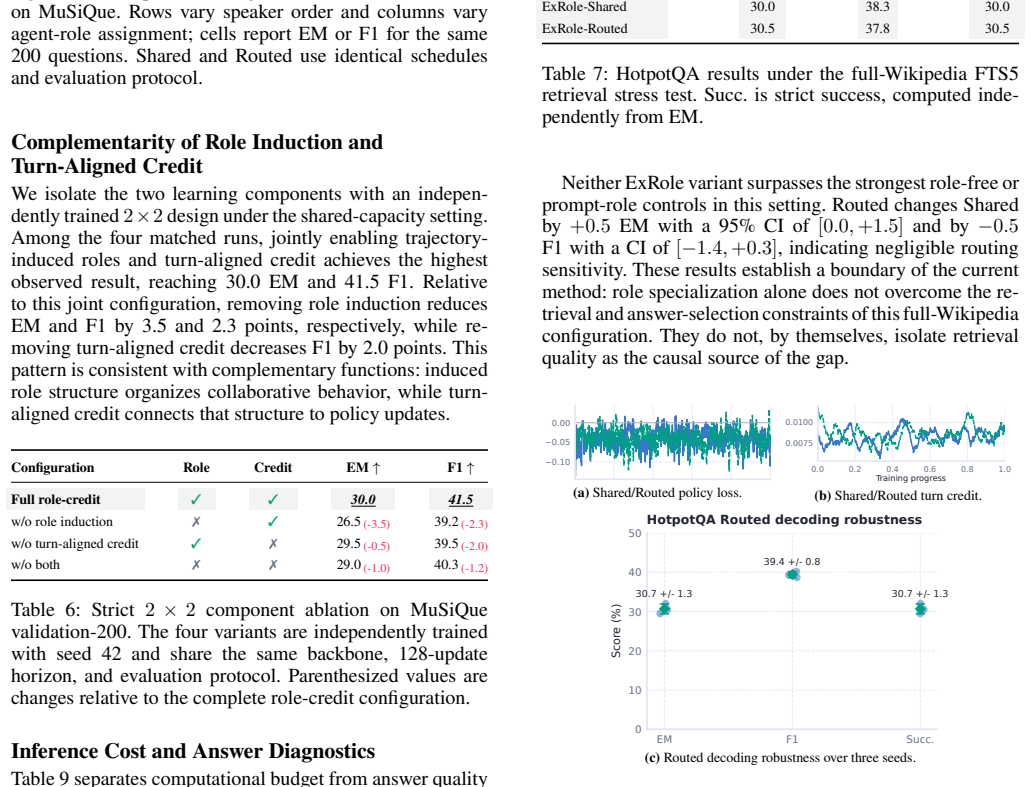
- The reported HotpotQA full-Wikipedia stress test shows the benefit is not universal: when retrieval comes from an unbounded lexical index, induced roles do not beat role-free or prompt-role controls, so the method's gains are tied to the bounded supporting-document setting.
- Because ExRole-Shared and ExRole-Routed differ only in the routing path, the matched comparison isolates the contribution of role-conditioned sparse LoRA routing; the paired differences on the 200-example splits are small and not statistically reliable across all metrics.
Reading between the lines
- Editorial inference: a role library induced on one multi-hop QA benchmark should provide a useful warm start on a second benchmark with the same team interface, since the fixed agent-role assignment is an implementation choice rather than a requirement of the learned roles.
- Editorial inference: the deterministic template resolver restricts roles to a fixed vocabulary (researcher, coordinator, verifier, analyst), but the induction step itself does not require that vocabulary; an open-vocabulary or learned resolver could discover roles the templates cannot name.
- Editorial inference: the cleanest stress test of the whole framework is a reward-sensitivity sweep, because the turn-level reward coefficients are manually weighted and never varied; one would expect the induced-role advantage to survive plausible coefficient perturbations if the roles reflect real behavioral specialization rather than reward-shaped artifacts.
- Editorial inference: if the mechanism generalizes, router gate deltas and role-turn markers give a token-level record of which capacity a role used, turning black-box team behavior into inspectable specialization that could be used for auditing and debugging agent teams.
Signed reviews
Editorial analysis
A structured set of objections, weighed in public.
Referee Report
Summary. The paper introduces ExRole, a framework that learns "executable roles" from prior multi-agent LLM trajectories and uses them to condition team behavior and, in the Routed variant, to allocate shared LoRA capacity via role-conditioned sparse routing. Role induction is performed by training a prefix-local encoder with next-action, future-evidence, and final-return targets, clustering the embeddings, and deterministically resolving clusters into readable instructions and token-aligned markers. The policy is trained with turn-aligned GRPO, and a Shared variant is presented as a matched control for the Routed variant. The method is evaluated on MuSiQue and 2WikiMultiHopQA, comparing against single-agent search, no-role and manual-role MAS, random role prompts, and shuffled induced roles, with additional ablations and a HotpotQA stress test.
Significance. The core idea of making roles executable control variables that bridge behavioral abstraction, prompt conditioning, and parameter routing is a useful and timely contribution to multi-agent LLM systems. The paper ships a deterministic template resolver that avoids an extra role-labeling model, provides a split-isolation audit for the role library (Appendix B.8), and reports a matched Shared/Routed comparison with paired bootstrap CIs (Table 10). The MuSiQue result is reasonably robust (11.5 EM over the no-role control is roughly 2.5 standard errors), and the HotpotQA stress test in Appendix D.6 honestly reports a boundary where induced roles do not beat the strongest controls. However, the statistical support for the 2Wiki headline claim and the absence of reward-weight sensitivity analysis are significant caveats that presently limit confidence in the strength of the central claims.
major comments (3)
- [Table 1 and Abstract] The headline 2WikiMultiHopQA EM gain of 7.7 points over the strongest non-ExRole control is not statistically supported. With 200 binary examples, the difference between 50.0 EM (ExRole-Routed) and 42.3 EM (shuffled induced role) has an approximate standard error of 4–5 percentage points, so the 95% confidence interval includes zero; the F1 margin of 9.7 points is more likely to survive. Table 10 reports paired bootstrap CIs only for Routed minus Shared, not for ExRole versus the controls that define the central claim, and the identity of the strongest control shifts from no-role on MuSiQue to shuffled on 2Wiki, with the shuffled control behaving oppositely on the two benchmarks (8.5 EM on MuSiQue versus 42.3 on 2Wiki). Please provide paired or clustered bootstrap confidence intervals for ExRole versus each control on both benchmarks, or report the comparison as exploratory where the interval includes zero.
- [Appendix B.1 (Eq. 21) and Limitations C.1] The turn-level reward in Eq. (21) is manually weighted with several positive and penalty terms, and the paper acknowledges in Limitations C.1 that "The turn-level reward components are manually weighted." Because the same reward defines the role-induction targets (Eq. 5), the turn-aligned credit (Eqs. 16–18), and the GRPO objective, the induced roles and the measured gains are all contingent on this specific reward design. No sensitivity analysis for any reward coefficient is provided. Please include at least one alternative weighting scheme (or a one-at-a-time perturbation of the major coefficients) to show that the qualitative ranking in Table 1 is robust to reward misspecification.
- [Table 1 and Table 6] The training status of the Table 1 controls is unclear. The paper states that all controlled systems share the same policy backbone, action interface, and evaluation protocol, and the manual-role control description mentions a "training configuration," but it is not stated whether the single-agent, no-role, manual-role, random-role, and shuffled-role controls are optimized with the same turn-aligned GRPO objective as ExRole. This matters because the "w/o role induction" ablation in Table 6 (26.5 EM) differs substantially from the no-role MAS in Table 1 (20.0 EM) under the same shared-capacity setting, suggesting different training conditions. Please state explicitly, for each row of Table 1, whether the model was trained with the same GRPO objective, the same reward, and the same number of updates as ExRole, and if not, report the trained controls or restrict the claim accordingly.
minor comments (5)
- [Table 1 and Appendix C.2] The Succ. column exactly equals the EM column for all primary-benchmark rows, and Appendix C.2 reports D_Succ,EM = 0. Consider stating that this agreement is a property of the current predictions rather than a definitional identity, since the two metrics are defined differently.
- [Appendix D.2] The cross-seed agreement for K = 3 shows ARI ranging from 0.61 to 0.85 and NMI from 0.62 to 0.82, indicating moderate stability. The paper should mention this degree of variability in the main text rather than only in the appendix.
- [Abstract] The abstract claims that "the controlled results consistently favor trajectory-induced role conditioning over role-free, manual, random, and shuffled alternatives." This is accurate for the two primary benchmarks, but the HotpotQA stress test in Appendix D.6 shows the opposite. Consider adding a qualifier such as "on the primary supporting-document benchmarks" to avoid overgeneralization.
- [Figure 1] The three-bar groups in Figure 1 have no per-bar color legend. Adding a legend or directly labeling the Manual, Random, and Shuffled bars would improve readability.
- [Section "Role-Conditioned Sparse Routing" (Eq. 13)] The symbol Ld (the total number of adapted module–rank slots) is used in Eq. (13) and later but is not defined at first use in the main text; a brief definition would help the reader.
Circularity Check
No significant circularity: role induction is frozen on a bootstrap split with a split-isolation audit, evaluation is held-out, and the shared turn reward is objective alignment rather than a by-construction reduction.
full rationale
ExRole's derivation chain is self-contained. The role library is induced offline from 64 train bootstrap trajectories (Appendix B.8), with future-evidence and return targets computed solely from those source trajectories, and the paper reports a split-isolation audit against the validation set at the task, answer, gold-evidence, and role-induction levels. Evaluation metrics are not used to fit role-count, template, or routing constants: K is selected by silhouette/stability or fixed to the execution budget, and the stated sensitivity analysis is post-hoc. The manually weighted turn reward of Eq. (21) is shared among role-induction targets, turn-aligned credit, and the GRPO objective, but this is normal objective alignment rather than a circular reduction: the induced roles are frozen before policy optimization, and the headline comparisons are measured downstream on held-out EM/F1 rather than on the role-induction loss. The HotpotQA stress test is an explicit negative control in which ExRole does not outperform the strongest controls (Table 7), which makes it unlikely that the primary results are forced by construction. The only self-citations in the reference list are related-work mentions (e.g., MARFT by Liao et al. 2025, which shares an author) and are not load-bearing evidence for any claim. The abstract's 2Wiki gain over the shuffled control lacks reported confidence intervals, but that is a statistical-robustness concern, not a circularity claim. Overall, no specific reduction from output back to input was found.
Assumptions & free parameters
free parameters (5)
- Turn reward weights (lambda_ans, lambda_sup, lambda_nov, lambda_ver, lambda_rep, lambda_early, lambda_bridge… =
not stated numerically in text
- Role feature and target mixing weights (lambda_evd, lambda_ret) =
1, 0.5
- Role-count selection (K, lambda_stab, n0) =
K=3 for MuSiQue; K=4 selected for 2Wiki/HotpotQA; lambda_stab=0.2; n0 not specified
- Routing hyperparameters (tau_b, lambda_u, lambda_c, lambda_g, gate range, router loss weights) =
0.8, 0.35, 0.5, 0.5, [0.5,1.5], lambda_future=0.05, lambda_credit=0.10, lambda_load=0.10, lambda_div=0.05…
- GRPO and optimization hyperparameters (beta_KL, lambda_disc, alpha_c, LR, group size, updates, LoRA rank, slot budget) =
1e-3, 0.9, 0.35, 1e-6, 8, 128 updates, rank 8, 392/1568 slots
assumptions (5)
- domain assumption The turn-level reward r_t is a faithful proxy for final answer quality (EM/F1).
- domain assumption The 30-coordinate prefix-local feature vector captures the behavior relevant to future utility.
- standard math Euclidean K-means on the learned embedding with the silhouette/stability criterion yields meaningful, stable role clusters.
- ad hoc to paper The deterministic template resolver converts cluster statistics into readable instructions that preserve the behavioral meaning.
- domain assumption The round-robin speaker schedule with fixed role-to-agent binding is a representative coordination protocol.
invented entities (2)
-
Executable role (z_i, psi_i, chi_i)
-
Token-aligned role marker (chi_k)
Cite this review
Pith. "Pith review of ExRole: From Team Trajectories to Executable Roles in Multi-Agent Language Models." pith.science (2026). https://pith.science/paper/BXHS25XY
@misc{pith2026260811949,
  author       = {Pith},
  title        = {Pith review of: ExRole: From Team Trajectories to Executable Roles in Multi-Agent Language Models},
  year         = {2026},
  howpublished = {\url{https://pith.science/paper/BXHS25XY}},
  note         = {Machine review of arXiv:2608.11949}
}
read the original abstract
Roles provide an interpretable interface for organizing language-model agents, yet most multi-agent systems treat them as hand-written prompt labels disconnected from learned behavior and parameter updates. We argue that a useful role should instead be an executable control variable: it should summarize behavior predictive of future utility, guide subsequent interaction, and identify the trainable capacity responsible for that behavior. We introduce ExRole, a trajectory-to-role framework that learns future-aware role prototypes from prefix-local team traces, resolves them into readable instructions and token-aligned role markers, and optionally routes shared LoRA rank slots with turn-aligned credit. Across MuSiQue and 2WikiMultiHopQA, ExRole improves over single-agent search by 15.0/14.4 and 13.5/16.1 EM/F1 points, respectively. Against the strongest non-ExRole controls, the corresponding gains remain 11.5/11.6 and 7.7/9.7 points. Across both benchmarks, the controlled results consistently favor trajectory-induced role conditioning over role-free, manual, random, and shuffled alternatives. Role-Agent-Turn interventions further show that the induced roles capture transferable behavioral specialization beyond fixed agent identities or turn positions.
Figures


Figures from the paper (9 more)




Reference graph
Works this paper leans on
-
[1]
modN). The turn reward used by all ExRole variants is rt =r base t +r + t −Pent, r+ t =λ ansrans t +λ suprsup t +λ novrnov t +λ verrver t , Pent =λ repPenrep t +λ earlyPenearly t +λ bridgePenbridge t +λ insufPeninsuf t +λ gwrongPengwrong t +λ unsupPenunsup t +λ noansPennoans t . (21) The shared base term covers action format, communica- tion,answertype,an...
-
[2]
Select and normalize the executable setPexec, resolve agent-level runtime rolesz1,...,z N, and insert marker χzi into each agent observation
-
[3]
Atturnt,choosetheactivespeakerbytheteamschedule, usuallyit = 1 + ((t−1) modN)
-
[4]
Build the observationot from the task, active role, latest evidence, shared board, recent search queries, and recent team history
-
[5]
Load source prototypesP={p k}K−1 k=0 from the induced role library
-
[6]
Pool the semantic prefix for the active segment and com- puteslotscoresω q,ℓs,softbudget ˜bq,ℓs,top-SmaskM q,ℓs, and balanced sparse-delta multiplierγq,ℓs
-
[7]
Generatetheassistantresponsewiththerole-conditioned LoRA path
-
[8]
Projecttheresponsetoastructuredaction:search,answer, or invalid
Show all 13 references
-
[9]
During prefill, coalesce every role marker in the multi- turn sequence and align each token to its role-turn seg- ment; during cached decoding, retain the latest segment ID
-
[13]
If the action is answer, terminate and score the answer
If the action is search, update evidence and continue. If the action is answer, terminate and score the answer. Gradient Flow through Balanced Sparse-Delta Routing Theforwardpasstreatsthetop-Smaskasfixedwhileretain- ing a differentiable soft budget on the selected slots. Defin...
-
[2022]
Yu, Y.; Yin, Q.; Zhang, J.; Xu, P.; and Huang, K
LDSA:LearningDynamicSubtaskAssignmentinCo- operativeMulti-AgentReinforcementLearning.InAdvances inNeuralInformationProcessingSystems,volume35,1698– 1710. Yu, Y.; Yin, Q.; Zhang, J.; Xu, P.; and Huang, K. 2024. ADMN: Agent-Driven Modular Network for Dynamic Pa- rameter Sharing ...
2024
-
[2024]
InInternational Conference on Learning Representations
Attention-Guided Contrastive Role Representations for Multi-Agent Reinforcement Learning. InInternational Conference on Learning Representations. Huang, C.; Liu, Q.; Lin, B. Y.; Pang, T.; Du, C.; and Lin, M. 2024. LoraHub: Efficient Cross-Task Generalization via Dynamic LoRA C...
2024
-
[2025]
In Proceedings of the 63rd Annual Meeting of the Associa- tionforComputationalLinguistics(Volume1:LongPapers), 22655–22666
Advancing Collaborative Debates with Role Differ- entiation through Multi-Agent Reinforcement Learning. In Proceedings of the 63rd Annual Meeting of the Associa- tionforComputationalLinguistics(Volume1:LongPapers), 22655–22666. Li, X.; Pan, L.; and Zhang, J. 2024. Kaleidoscope...
2024 arXiv
Reviewed August 16, 2026 · model on record in the stance chip above.
Discussion (0). Continue with ORCID to comment.