REVIEW 3 major objections 4 minor 27 references
Magnetoelectric Effect Dependent on Electric Field Direction in a Pyroelectric Ferrimagnet CaBaCo$_4$O$_7$
T0 review · 3 major / 4 minor · reviewed 2026-08-04 · deepseek-v4-flash
Pith's one-line read The static magnetoelectric effect in the pyroelectric ferrimagnet CaBaCo4O7 depends on whether the applied electric field points with or against the assumed polarization shift, stabilizing or destabilizing the ferrimagnetic phase.
desk verdict Plausible new direction-dependent static ME effect in CaBaCo4O7, but missing leakage-current control and an assumed ΔP sign keep it from being conclusive. read the letter →
The pith
A machine-rendered reading of the paper's core claim, the machinery that carries it, and where it could break.
The reading
What carries the argument
The central mechanism is a free-energy argument: ΔF = −ΔP·Ec − ΔM·Bab − Eα32 Ec Bab, where ΔP is the change in spontaneous polarization between the antiferromagnetic and ferrimagnetic phases, Bab is the applied magnetic field, and Eα32 is the linear magnetoelectric tensor component. Because the magnetoelectric coupling term is negligible, the sign of ΔP·Ec dominates, so when Ec is parallel to ΔP the ferrimagnetic phase is stabilized and when antiparallel it is destabilized. The paper assumes a fixed direction for ΔP to explain the four experimental arrangements consistently.
What would settle it
A direct measurement of the sign of ΔP across the AFM–FiM transition, for instance by pyroelectric current or polarization hysteresis under a magnetic field, that contradicts the arrow direction assumed in Fig. 1(b) would invalidate the free-energy interpretation, though the observed electric-field-direction dependence of Tc would still be a measured fact.
Extended reading notes
Core claim
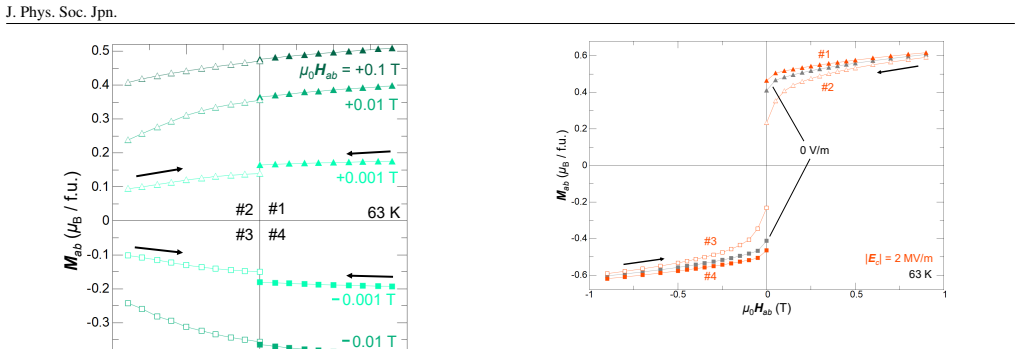
In CaBaCo4O7, which crystallizes in the polar space group Pbn21 and orders ferrimagnetically at TC = 63 K, the authors show that applying an electric field of ±2 MV/m along the c axis shifts TC by about 1 K upward when the field is parallel to the assumed change in spontaneous polarization ΔP between the antiferromagnetic and ferrimagnetic phases, and downward when antiparallel. Comparisons of the four measurement arrangements reveal that reversing the sign of P×M (the product of polarization and magnetization) has no effect on the transition shift, thus isolating the electric-field-direction dependence of the static magnetoelectric response. The paper concludes that this behavior clearly de
Load-bearing premise
The direction of the change in spontaneous polarization ΔP between the antiferromagnetic and ferrimagnetic phases is assumed to explain the observed results, not directly measured; if the true ΔP pointed the opposite way, the labels 'parallel' and 'antiparallel' would flip even though the raw transition shifts remain.
Editorial extensions
If this is right
- Reversing the electric field alone shifts the magnetic transition temperature by approximately 1 K, providing a simple knob for magnetic phase control.
- The sign of P×M does not contribute to the transition shift, ruling out a nonreciprocal directional-dichroism-type mechanism for the static response.
- The magnetization changes observed in M–T, M–E, and M–H measurements are mutually consistent, confirming that the effect is intrinsic and not due to Joule heating.
- The direction-dependent stabilization suggests pyroelectric-magnetic materials could encode information through the sign of the applied electric field in spintronics devices.
Reading between the lines
- A direct measurement of ΔP's sign—for example, tracking the electric polarization change along c across the 63 K transition under magnetic field—would test the assumed direction and solidify the interpretation.
- The same free-energy argument implies that other pyroelectric magnets with strong magnetostriction may exhibit similar electric-field-direction-dependent phase control, a searchable design criterion.
- Detwinning the ab plane to distinguish a and b axes could reveal additional anisotropy in the linear magnetoelectric tensor beyond the averaged response reported here.
Signed reviews
Editorial analysis
A structured set of objections, weighed in public.
Referee Report
Summary. This manuscript reports a static magnetoelectric effect in single-crystal CaBaCo4O7 that depends on whether the applied electric field is parallel or antiparallel to the spontaneous polarization/spontaneous polarization change. Four electrode/field arrangements (#1-#4) are used with |Ec|=2 MV/m and |H_ab|=0.1 T. The authors find in M-T, M-E, and M-H measurements that the ferrimagnetic phase is stabilized (Tc shifts up by ~1 K; |M| increases) when the assumed ΔP and Ec are parallel (#1/#4) and destabilized when antiparallel (#2/#3), while reversal of P×M alone does not change the shift. The data are interpreted within a free-energy model containing -ΔP Ec and a small linear magnetoelectric term. The authors conclude that the static ME effect in this pyroelectric ferrimagnet is controlled by electric-field direction.
Significance. If the result survives scrutiny, it provides a clean demonstration of static directional ME control in a pyroelectric magnetic material, in contrast to the more commonly studied dynamical nonreciprocal phenomena. A notable strength is the consistency among three measurement protocols (M-T in H and E, M-E in H, M-H in E) and the comparison of the extracted linear magnetoelectric coefficient with the previously reported Hα32 ≈ 300 ps/m. However, the central quantitative claim rests on a ~1 K Tc shift and small magnetization changes that are not accompanied by error bars or by leakage-current/temperature data; the interpretation also assumes, rather than measures, the sign of ΔP. These issues prevent the manuscript from being accepted in its present form.
major comments (3)
- [Fig. 2 inset and text near 'T_C corresponding to arrangements'] The central claim is that Tc shifts by approximately 1 K between #1/#4 and #2/#3. No error bars, repeated runs, or definition of Tc (e.g., inflection point of M(T)) are given. Since the M-E and M-H asymmetries in Figs. 3 and 5 are interpreted as consequences of the same small shift, run-to-run or thermal instability at the level of 1 K is a load-bearing uncertainty. Please present at least three repeated determinations of Tc for each arrangement, with the extraction method and scatter.
- [M-H in E paragraph, sentence 'At 63 K... negligible'] The authors dismiss Joule heating by asserting that at 63 K CaBaCo4O7 is a sufficiently good insulator. However, no leakage current, contact resistance, sample temperature, or heat-load calibration is reported. Because the crystal is described as semiconductor-like and the electric field is applied from 85 K, asymmetric electrode contacts can make the dissipated power depend on the sign of E; a polarity-dependent temperature offset of ~1 K would shift Tc in Fig. 2 and produce the same signs in Figs. 3 and 5. Please report I-V data at ±2 MV/m at 63 K, estimate the corresponding ΔT, or provide a control experiment that distinguishes thermally induced shifts from the intrinsic magnetoelectric response.
- [Fig. 1(b) caption and Eq. (2)] The interpretation 'parallel to the polarization' depends on the sign of ΔP = P_FiM - P_AFM, which is assumed rather than measured. The caption states that the ΔP arrows 'represent the directions assumed to explain our experimental results consistently', and Eq. (2) uses -ΔP E_c to decide which arrangements stabilize the ferrimagnetic phase. If the true ΔP were opposite, the labels #1/#4 vs #2/#3 for parallel/antiparallel would be reversed, changing the abstract's statement. The raw polarization-direction-independent observation (E reversal matters) is not circular, but the physical attribution is. Please measure ΔP across TC independently (e.g., pyroelectric current or field-cooled polarization) or cite a direct determination of its sign, and adjust the wording if necessary.
minor comments (4)
- [Eqs. (1)-(2) and Fig. 4] The notation Eα32 is confusing because E is also the external electric field E_c. Please distinguish the tensor component (e.g., ^Eα32 or α32^E) from the field, and specify whether the linear fit in Fig. 4 is over the full E range or only the low-field region.
- [Fig. 2] The inset 'expanded graph near TC' would be more informative with error bars and with the method used to determine TC from each curve.
- [Sample twinning, text after Eq. (2)] The ab-plane twinning means M_ab and the extracted Eα32 are domain averages over a- and b-oriented twins. This does not affect the scalar ΔP E_c argument, but the tensor value should be described as a twin-averaged quantity.
- [Comparison with Hα32] The comparison between Eα32 and the previously reported Hα32 ≈ 300 ps/m would benefit from an uncertainty estimate and a statement of the exact field/temperature conditions under which the previous value was obtained.
Circularity Check
The measured direction-dependent Tc shift is real, but the paper's 'parallel ΔP stabilizes' explanation is circular: the sign of ΔP is assumed to match the observed stabilized arrangements.
-
self definitional
[Fig. 1(b) caption; final phenomenological section, Eq. (2)]
""The arrows for change in spontaneous electric polarization ∆P represent the directions assumed to explain our experimental results consistently." ... "Consequently, the ferrimagnetic phase is stabilized when the ∆P and E_c are parallel, resulting in ∆PE_c >0.""
The direction of ΔP is not measured; it is assigned so that arrangements #1/#4 (the ones observed to have higher TC) are labeled 'parallel' and #2/#3 (lower TC) are labeled 'antiparallel.' Eq. (2) then uses the ΔPEc term to 'explain' that parallel ΔP and Ec stabilize the ferrimagnetic phase. But this is a restatement of the labeling choice, not an independent result. If the ΔP arrows were reversed, the same data would be described as antiparallel stabilization. Thus the interpretive claim 'parallel stabilizes' is true by construction; only the raw sign-dependent TC shift and magnetization asymmetries are independent measured facts.
full rationale
The central raw observations are not circular: the paper measures a ~1 K TC shift whose sign depends on the electric-field direction (Fig. 2, inset), and consistent magnetization changes in M-E and M-H measurements (Figs. 3, 5). Those are independent experimental facts. The circularity is confined to the explanatory assignment: the sign of ΔP is chosen in Fig. 1(b) to make arrangements #1/#4 the parallel ones, and then Eq. (2) is used to conclude that parallel ΔP and Ec stabilize the ferrimagnetic phase. This is a self-definitional step because the 'predicted' direction dependence is exactly the assumption used to orient ΔP. I also flag the manuscript's Joule-heating assertion ('At 63 K, CaBaCo4O7 is a sufficiently good insulator, and the Joule heating caused by leakage current under an applied electric field of 2 MV/m is negligible') as an unsupported experimental claim, not a circularity: it does not reduce a derived result to an input, but it is a missing calibration that bears on whether the observed ~1 K shifts are intrinsic ME effects or thermal asymmetry. No load-bearing self-citation or imported uniqueness theorem was found; the linear magnetoelectric tensor fit from Fig. 3 is a fit, not a prediction passed off as independent. Overall score 4: the central claim retains substantial independent experimental content, but the polarization-direction interpretation is circular.
Assumptions & free parameters
free parameters (1)
- Sign of delta-P (polarization change at AFM to FiM transition) =
not quantified; chosen so that delta-P is parallel to E_c for arrangements #1 and #4
assumptions (5)
- domain assumption CaBaCo4O7 is pyroelectric; spontaneous polarization does not switch when the external electric field is reversed.
- domain assumption The ferrimagnetic phase has magnetic point group m'm2' with nonzero alpha32 = alpha23 components of the linear ME tensor.
- domain assumption Phenomenological free energy F = -P dot E - M dot B - alpha dot E dot B with the ME tensor zero in the AFM phase.
- domain assumption The ME coupling term E alpha32 E_c B_ab is negligible compared with delta-P E_c and delta-M B_ab.
- domain assumption Joule heating from leakage current under 2 MV/m at 63 K is negligible, so the magnetization changes are intrinsic.
Cite this review
Pith. "Pith review of Magnetoelectric Effect Dependent on Electric Field Direction in a Pyroelectric Ferrimagnet CaBaCo$_4$O$_7$." pith.science (2026). https://pith.science/paper/BYDAZ3R3
@misc{pith2026250909326,
  author       = {Pith},
  title        = {Pith review of: Magnetoelectric Effect Dependent on Electric Field Direction in a Pyroelectric Ferrimagnet CaBaCo$_4$O$_7$},
  year         = {2026},
  howpublished = {\url{https://pith.science/paper/BYDAZ3R3}},
  note         = {Machine review of arXiv:2509.09326}
}
abstract
This study investigates the dependence of the static magnetoelectric (ME) effect on the external field direction in the pyroelectric-ferrimagnet CaBaCo$_4$O$_7$, a topic that remains largely unexplored compared to dynamical nonreciprocal ME effects. We measured the magnetization with respect to the inherent polarization and found that an external electric field stabilizes the ferrimagnetic phase when applied parallel to the polarization, and destabilizes it when antiparallel. These results clearly demonstrate the electric-field-direction dependent control of the static ME effect, suggesting a new route to enhancing ME effects in pyroelectric-magnetic materials.
Figures


Figures from the paper (3 more)


Reference graph
Works this paper leans on
-
[1]
Kimura, T
T. Kimura, T. Goto, H. Shintani, K. Ishizaka, T. Arima, and Y . Tokura, Nature (London)426, 55 (2003)
2003
-
[2]
Fiebig, J
M. Fiebig, J. Phys. D: Appl. Phys.38, R123 (2005)
2005
-
[3]
Tokura, S
Y . Tokura, S. Seki, and N. Nagaosa, Rep. Prog. Phys.77, 076501 (2014)
2014
-
[4]
R. M. Hornreich and S. Shtrikman, Phys. Rev.171, 1065 (1968)
1968
-
[5]
Kimura and T
K. Kimura and T. Kimura, APL Mater.11, 100902 (2023)
2023
-
[6]
Kubota, T
M. Kubota, T. Arima, Y . Kaneko, J. P. He, X. Z. Yu, and Y . Tokura, Phys. Rev. Lett.92, 137401 (2004)
2004
-
[7]
Saito, K
M. Saito, K. Taniguchi, and T. Arima, J. Phys. Soc. Jpn.77, 013705 (2008)
2008
-
[8]
K ´ezsm´arki, D
I. K ´ezsm´arki, D. Szaller, S. Bord´acs, V . Kocsis, Y . Tokunaga, Y . Taguchi, H. Murakawa, Y . Tokura, H. Engelkamp, T. R˜o˜om, and U. Nagel, Nat. Commun.5, 3203 (2014)
2014
Show all 27 references
-
[9]
Akaki, M
M. Akaki, M. Matsumoto, Y . Narumi, S. Okubo, H. Ohta, and M. Hagi- wara, Sci. Adv.11, eado6783 (2025)
2025
-
[10]
Momma and F
K. Momma and F. Izumi, J. Appl. Crystallogr.44, 1272 (2011)
2011
-
[11]
Iwamoto, M
H. Iwamoto, M. Ehara, M. Akaki, and H. Kuwahara, J. Phys: Conf. Ser. 400, 032021 (2012)
2012
-
[12]
Caignaert, V
V . Caignaert, V . Pralong, V . Hardy, C. Ritter, and B. Raveau, Phys. Rev. B81, 094417 (2010)
2010
-
[13]
Caignaert, A
V . Caignaert, A. Maignan, K. Singh, Ch. Simon, V . Pralong, B. Raveau, J. F. Mitchell, H. Zheng, A. Huq, and L. C. Chapon, Phys. Rev. B88, 174403 (2013)
2013
-
[14]
T. Omi, Y . Watanabe, N. Abe, H. Sagayama, A. Nakano, K. Munakata, Y . Tokunaga, and T. Arima, Phys. Rev. B103, 184412 (2021)
2021
-
[15]
Sarkar, Md
T. Sarkar, Md. Motin Seikh, V . Pralong, V . Caignaert, and B. Raveau, J. Mater. Chem.22, 18043 (2012)
2012
-
[16]
Motin Seikh, T
Md. Motin Seikh, T. Sarkar, V . Pralong, V . Caignaert, and B. Raveau, Phys. Rev. B86, 184403 (2012)
2012
-
[17]
R. Oda, R. Kajihara, K. Nishina, M. Akaki, H. Kuroe, and H. Kuwahara, Phys. Proc.75, 303 (2015)
2015
-
[18]
Dhanasekhar, A
C. Dhanasekhar, A. K. Das, R. Singh, A. Das, G. Giovannetti, D. Khom- skii, and A. Venimadhav, Phys. Rev. B96, 134413 (2017)
2017
-
[19]
M. Gen, A. Miyake, H. Yagiuchi, Y . Watanabe, A. Ikeda, Y . H. Matsuda, M. Tokunaga, T. Arima, and Y . Tokunaga, Phys. Rev. B105, 214412 (2022)
2022
-
[20]
Bord ´acs, V
S. Bord ´acs, V . Kocsis, Y . Tokunaga, U. Nagel, T. R˜o˜om, Y . Takahashi, Y . Taguchi, and Y . Tokura, Phys. Rev. B92, 214441 (2015)
2015
-
[21]
R. D. Johnson, K. Cao, F. Giustino, and P. G. Radaelli, Phys. Rev. B90, 045129 (2014)
2014
-
[22]
A. A. Coelho, J. Appl. Crystallogr.51, 210 (2018). 4 J. Phys. Soc. Jpn
2018
-
[23]
Izumi and T
F. Izumi and T. Ikeda, Mater. Sci. Forum321, 198 (2000)
2000
-
[24]
H. Arai, T. Shirasaki, M. Akaki, H. Kuroe, and H. Kuwahara, JPS Conf. Proc.38, 011126 (2022)
2022
-
[25]
J. -P. Rivera, Eur. Phys. J. B71, 299 (2009)
2009
-
[26]
Okamura, F
Y . Okamura, F. Kagawa, S. Seki, and Y . Tokura, Nat. Commun.7, 12669 (2016)
2016
-
[27]
Shimamura, D
K. Shimamura, D. Chiba, S. Ono, S. Fukami, N. Ishiwata, M. Kawaguchi, K. Kobayashi, and T. Ono, Appl. Phys. Lett.100, 122402 (2012). 5
2012
Reviewed August 4, 2026 · model on record in the stance chip above.
Discussion (0). Continue with ORCID to comment.