SwarmHarness: Skill-Based Task Routing via Decentralized Incentive-Aligned AI Agent Networks
Pith reviewed 2026-06-29 11:39 UTC · model grok-4.3
The pith
SwarmHarness lets nodes self-organize into compute swarms where credits and skill-based routing produce emergent collective intelligence without central control.
A machine-rendered reading of the paper's core claim, the machinery that carries it, and where it could break.
Core claim
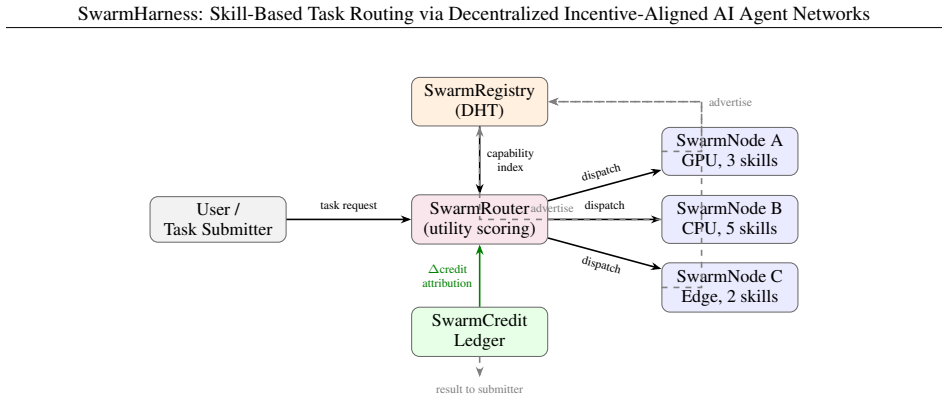
SwarmHarness demonstrates that a DHT-based SwarmRegistry for capability advertisement, a SwarmRouter using utility over capability load latency and trust, and a SwarmCredit mechanism with Shapley-value reward attribution allow nodes to self-organize into a compute swarm. Nodes earn credits for serving tasks and spend them to submit, with idle nodes draining credits and losing priority, producing a self-regulating participation economy. As specialization occurs toward high-reward skills and routing signals function as digital pheromones, the network exhibits emergent collective intelligence analogous to biological swarms, extending beyond compute sharing to autonomous distributed AI agent net
What carries the argument
SwarmCredit, the incentive layer that attributes rewards via Shapley-value approximation so that nodes earn credits for serving tasks, spend them to submit tasks, and lose priority when idle, thereby creating self-regulation and driving skill specialization.
Load-bearing premise
The credit mechanism will automatically produce balanced participation and prevent free-riding or collapse without any central authority or extra rules.
What would settle it
A live deployment or large-scale simulation in which many nodes remain idle yet retain high routing priority and the overall participation level drops below the threshold needed for task completion.
Figures
read the original abstract
Vast quantities of compute (GPU cycles on personal workstations, idle inference servers, and edge devices between jobs) go unused because no incentive-aligned protocol exists for their owners to share them safely and profitably. Existing approaches either require a trusted central coordinator (cloud marketplaces), demand heavy blockchain infrastructure (Golem, BrokerChain), or lack an incentive layer entirely (BOINC, Petals). We propose SwarmHarness, a decentralised protocol in which HarnessAPI skill nodes self-organise into a compute swarm without any central authority. SwarmHarness has three interlocking components: a SwarmRegistry built on a Distributed Hash Table (DHT) for peer discovery and capability advertisement; a SwarmRouter that dispatches tasks to nodes using a utility function over capability, load, latency, and trust; and SwarmCredit, an incentive mechanism that attributes compute-credit rewards to contributing nodes via a Shapley-value approximation. Nodes earn credits by serving tasks and spend credits to submit them; idle nodes that never contribute drain credits and lose routing priority, creating a self-regulating participation economy. As nodes specialise toward high-reward skills and routing signals act as digital pheromones, the network exhibits emergent collective intelligence analogous to biological swarms. Beyond compute sharing, SwarmHarness is a foundational primitive for autonomous distributed AI agent networks in which agents hire compute, route subtasks, and settle credits without human intermediation.
Editorial analysis
A structured set of objections, weighed in public.
Referee Report
Summary. The manuscript proposes SwarmHarness, a decentralized protocol for sharing unused compute (GPUs, edge devices) among AI agents without central authority or heavy blockchain. It outlines three components: a DHT-based SwarmRegistry for peer discovery and capability advertisement; a SwarmRouter using a utility function over capability, load, latency, and trust for task dispatch; and SwarmCredit, an incentive layer that attributes rewards via Shapley-value approximation, with nodes earning credits by serving tasks, spending them to submit tasks, and losing priority when idle. The central claim is that these mechanisms produce self-regulating participation, skill specialization, routing signals that act as digital pheromones, and emergent collective intelligence analogous to biological swarms, enabling autonomous agent networks.
Significance. If the incentive and routing dynamics were validated to produce stable specialization and collective behavior, the proposal could provide a useful primitive for decentralized compute markets and multi-agent systems, filling gaps left by centralized marketplaces, blockchain-heavy systems like Golem, or incentive-free projects like BOINC and Petals.
major comments (3)
- [Abstract] Abstract (SwarmCredit paragraph): the claim that the earn/spend/idle-drain rules 'create a self-regulating participation economy' and prevent collapse into low-participation states is presented without equilibrium analysis, game-theoretic modeling of free-riding or collusion, differential-equation or agent-based dynamics, or any simulation results.
- [Abstract] Abstract (final sentence): the assertion that 'nodes specialise toward high-reward skills and routing signals act as digital pheromones' yielding 'emergent collective intelligence analogous to biological swarms' rests entirely on the unexamined component descriptions and lacks any formalization, convergence argument, or empirical support.
- [Abstract] Abstract (SwarmCredit description): the Shapley-value approximation for credit attribution is invoked without pseudocode, complexity bounds, or incentive-compatibility arguments showing it is robust to strategic misreporting.
minor comments (1)
- The manuscript would benefit from explicit comparison tables or diagrams contrasting SwarmHarness components against Golem, BrokerChain, BOINC, and Petals.
Simulated Author's Rebuttal
We thank the referee for identifying the unsubstantiated claims in the abstract. The manuscript is a conceptual protocol proposal rather than an empirical or theoretical analysis paper; we will revise the abstract and add qualifying language to avoid overstating results while preserving the design rationale.
read point-by-point responses
-
Referee: [Abstract] Abstract (SwarmCredit paragraph): the claim that the earn/spend/idle-drain rules 'create a self-regulating participation economy' and prevent collapse into low-participation states is presented without equilibrium analysis, game-theoretic modeling of free-riding or collusion, differential-equation or agent-based dynamics, or any simulation results.
Authors: We agree the abstract presents this outcome as achieved rather than conjectured. The design intends the credit rules to discourage free-riding via priority loss, but no equilibrium analysis or simulations are present. We will revise the abstract to state that the rules are designed to produce self-regulation and note this as a hypothesis for future validation. revision: yes
-
Referee: [Abstract] Abstract (final sentence): the assertion that 'nodes specialise toward high-reward skills and routing signals act as digital pheromones' yielding 'emergent collective intelligence analogous to biological swarms' rests entirely on the unexamined component descriptions and lacks any formalization, convergence argument, or empirical support.
Authors: The analogy is drawn from the intended dynamics of specialization and pheromone-like routing, but we acknowledge it lacks formalization or evidence. We will revise the final sentence to present these as expected behaviors of the protocol design rather than demonstrated emergent properties. revision: yes
-
Referee: [Abstract] Abstract (SwarmCredit description): the Shapley-value approximation for credit attribution is invoked without pseudocode, complexity bounds, or incentive-compatibility arguments showing it is robust to strategic misreporting.
Authors: The manuscript describes the approximation at a conceptual level only. We will add a brief methods subsection with pseudocode for the approximation and a short discussion of its computational properties and basic incentive alignment, while noting that a full strategic analysis lies outside the current scope. revision: partial
Circularity Check
No circularity: conceptual proposal without derivations or predictions
full rationale
The manuscript is a high-level protocol proposal describing SwarmRegistry (DHT), SwarmRouter (utility function), and SwarmCredit (credit earn/spend with idle drain) at the level of component names and intended behaviors. No equations, fitted parameters, predictions, or derivation steps appear in the text. The emergent-intelligence claim is presented as an expected outcome of the rules rather than the result of any chain that reduces to its own inputs by construction. Because no analytical derivation exists to inspect, the circularity score is 0.
Axiom & Free-Parameter Ledger
axioms (1)
- domain assumption Shapley-value approximation is feasible and incentive-compatible for credit attribution in this setting
Reference graph
Works this paper leans on
-
[1]
HarnessAPI: A skill-first framework for unified streaming APIs and MCP tools
Edwin Jose. HarnessAPI: A skill-first framework for unified streaming APIs and MCP tools. arXiv preprint, 2026. arXiv preprint, May 2026
2026
-
[2]
BOINC: A Platform for Volunteer Computing
David P. Anderson. BOINC: A platform for volunteer computing. arXiv:1903.01699, 2019. arXiv:1903.01699
work page internal anchor Pith review Pith/arXiv arXiv 1903
-
[3]
Petals: Collaborative inference and fine-tuning of large models
Alexander Borzunov, Dmitry Baranchuk, Tim Dettmers, Max Ryabinin, Younes Belkada, Artem Chu- machenko, Pavel Samygin, and Colin Raffel. Petals: Collaborative inference and fine-tuning of large models. arXiv:2209.01188, 2022. arXiv:2209.01188
-
[4]
Communication-efficient learning of deep networks from decentralized data,
H. Brendan McMahan, Eider Moore, Daniel Ramage, Seth Hampson, and Blaise Agüera y Arcas. Communication- efficient learning of deep networks from decentralized data. arXiv:1602.05629, 2023. arXiv:1602.05629
-
[5]
Golem: A decentralised supercomputer
Golem Factory. Golem: A decentralised supercomputer. arXiv:1801.04024, 2018. arXiv:1801.04024; Technical whitepaper
-
[6]
Decentralized AI infrastructure built on BrokerChain
Jianru Lin. Decentralized AI infrastructure built on BrokerChain. InProceedings of the ACM, 2025
2025
-
[7]
ReAct: Synergizing Reasoning and Acting in Language Models
Shunyu Yao, Jeffrey Zhao, Dian Yu, Nan Du, Izhak Shafran, Karthik Narasimhan, and Yuan Cao. ReAct: Synergizing reasoning and acting in language models. arXiv:2210.03629, 2022. arXiv:2210.03629
work page internal anchor Pith review Pith/arXiv arXiv 2022
-
[8]
AgentMesh: A cooperative multi-agent generative AI framework for software development automation
Milad Khanzadeh. AgentMesh: A cooperative multi-agent generative AI framework for software development automation. arXiv:2507.19902, 2025. arXiv:2507.19902
-
[9]
Harnessing multi-agent LLMs for complex engineering problem-solving: A swarm intelligence approach
Mona Almasoud et al. Harnessing multi-agent LLMs for complex engineering problem-solving: A swarm intelligence approach. arXiv:2501.01205, 2025. arXiv:2501.01205; IEEE EDUCON 2025
-
[10]
Distributed deep learning using volunteer computing-like paradigm
Madhurima Atre, Bhavya Jha, and Yogesh Simmhan. Distributed deep learning using volunteer computing-like paradigm. arXiv:2103.08894, 2021. arXiv:2103.08894; IEEE IPDPSW 2021
-
[11]
Lattica: A decentralized cross-NAT communication framework for scalable AI inference and training
Yang et al. Lattica: A decentralized cross-NAT communication framework for scalable AI inference and training. arXiv:2510.00183, 2025. arXiv:2510.00183
-
[12]
FedToken: Tokenized incentives for data contribution in federated learning
Shashi Raj Pandey, Lam Duc Nguyen, and Petar Popovski. FedToken: Tokenized incentives for data contribution in federated learning. arXiv:2209.09775, 2022. arXiv:2209.09775
-
[13]
A contract theory based incentive mechanism for federated learning
Mengmeng Tian, Yuxin Chen, Yuan Liu, Zehui Xiong, Cyril Leung, and Chunyan Miao. A contract theory based incentive mechanism for federated learning. arXiv:2108.05568, 2021. arXiv:2108.05568
-
[14]
Right reward right time for federated learning
Nguyen et al. Right reward right time for federated learning. arXiv:2503.07869, 2025. arXiv:2503.07869
- [15]
-
[16]
Zhenan Fan, Huang Fang, Xinglu Wang, Zirui Zhou, Jian Pei, Michael P. Friedlander, and Yong Zhang. Fair and efficient contribution valuation for vertical federated learning. arXiv:2201.02658, 2022. arXiv:2201.02658
-
[17]
A survey of multi-agent deep reinforcement learning with communication
Changxi Zhu, Mehdi Dastani, and Shihan Wang. A survey of multi-agent deep reinforcement learning with communication. arXiv:2203.08975, 2022. arXiv:2203.08975
-
[18]
Christopher Amato. An introduction to centralized training for decentralized execution in cooperative multi-agent reinforcement learning. arXiv:2409.03052, 2024. arXiv:2409.03052
-
[19]
From pheromones to policies: Reinforcement learning for engineered biological swarms
Vellinger, Antonic, and Tuci. From pheromones to policies: Reinforcement learning for engineered biological swarms. arXiv:2509.20095, 2025. arXiv:2509.20095
-
[20]
Evolving neural networks reveal emergent collective behavior from minimal agent interactions
Giardini, Hardy, and da Cunha. Evolving neural networks reveal emergent collective behavior from minimal agent interactions. arXiv:2410.19718, 2024. arXiv:2410.19718
-
[21]
Internet of intelligence: Collective advantage for communications
Li et al. Internet of intelligence: Collective advantage for communications. arXiv: 1905.00719, 2020. arXiv:1905.00719. 11 SwarmHarness: Skill-Based Task Routing via Decentralized Incentive-Aligned AI Agent Networks
-
[22]
Communication-efficient training workload balancing for decentralized multi-agent learning
Seyed Mahmoud Sajjadi Mohammadabadi, Lei Yang, Feng Yan, and Junshan Zhang. Communication-efficient training workload balancing for decentralized multi-agent learning. arXiv:2405.00839, 2024. arXiv:2405.00839; IEEE ICDCS 2024
-
[23]
Blockchain-based federated learning: Incentivizing data sharing and penalizing dishonest behavior
Jaberzadeh et al. Blockchain-based federated learning: Incentivizing data sharing and penalizing dishonest behavior. arXiv:2307.10492, 2023. arXiv:2307.10492
-
[24]
The shapley value in machine learning
Benedek Rozemberczki, Lauren Watson, Péter Bayer, Hao-Tsung Yang, Olivér Kiss, Sebastian Nilsson, and Rik Sarkar. The shapley value in machine learning. arXiv:2202.05594, 2022. arXiv:2202.05594
-
[25]
Kademlia: A peer-to-peer information system based on the XOR metric
Petar Maymounkov and David Mazières. Kademlia: A peer-to-peer information system based on the XOR metric. InRevised Papers from the 1st International Workshop on Peer-to-Peer Systems (IPTPS), pages 53–65. Springer, 2002
2002
-
[26]
Gossip-based aggregation in large dynamic networks
Márk Jelasity, Alberto Montresor, and Ozalp Babaoglu. Gossip-based aggregation in large dynamic networks. ACM Transactions on Computer Systems, 23(3):219–252, 2005
2005
-
[27]
Bitcoin: A peer-to-peer electronic cash system
Satoshi Nakamoto. Bitcoin: A peer-to-peer electronic cash system. https://bitcoin.org/bitcoin.pdf,
-
[28]
Accessed: May 2026. 12
2026
discussion (0)
Sign in with ORCID, Apple, or X to comment. Anyone can read and Pith papers without signing in.