Gradient-Based Inverse Design of Free-Energy Landscapes with Diffusion Models
Reviewed by Pith T0 review T1 audit T2 compute T3 formal T4 kernel 2026-07-08 06:10 UTCglm-5.2pith:BYY7BU7Rrecord.jsonopen to challenge →
The pith
Frozen diffusion model backprops gradients to design target free-energy landscapes
A machine-rendered reading of the paper's core claim, the machinery that carries it, and where it could break.
Core claim
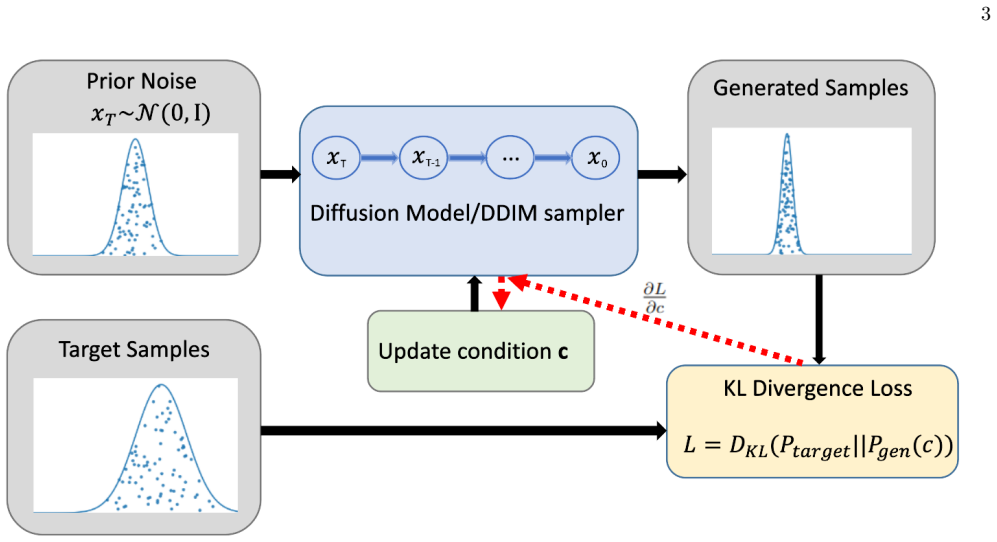
The central discovery is that a frozen conditional diffusion model, originally trained to generate conformational ensembles given system parameters, can be inverted: by backpropagating a distribution-level KL-divergence loss through the deterministic sampling path back to the conditioning inputs, one can optimize those inputs so that the generated ensemble matches a target free-energy surface. The model thus functions as a differentiable map from design parameters to ensemble distributions, and gradient descent on that map recovers parameters reproducing desired thermodynamic landscapes. The paper shows this works on a physically motivated system — a Lennard-Jones four-bead peptide — and not
What carries the argument
Conditional diffusion model (DDPM) with deterministic DDIM sampling; KDE-based KL-divergence loss; FiLM-conditioned MLP backbone; two-stage optimization (high learning rate with stochastic perturbations, then low learning rate); HLDA collective-variable reduction
If this is right
- If the method scales, molecular engineers could specify desired thermodynamic behavior (metastable state populations, barrier heights) and automatically recover interaction parameters or chemical compositions that produce it, rather than relying on trial-and-error simulation.
- The approach extends diffusion-model-based molecular design beyond single-structure generation to ensemble-level design, where the target is a distribution rather than a conformation.
- Reduced-representation optimization via collective variables (demonstrated with HLDA) suggests a path to applying the method to higher-dimensional systems where full-coordinate optimization would be intractable.
- The ability to find parameters outside the training domain hints that the diffusion model learns a smooth enough mapping from conditions to distributions to support limited extrapolation, which could reduce the breadth of training data needed.
Load-bearing premise
The method assumes that the KDE-based KL-divergence loss landscape is navigable by gradient descent (with stochastic perturbations) and that the frozen diffusion model generalizes well enough to interpolate to optimized conditioning values. The paper acknowledges the loss landscape is rough and that optimization success depends substantially on initialization — runs starting from high-interaction-strength parameters fail roughly 25% of the time versus 2.5% for low-strength初始化
What would settle it
Apply GB-FESO to a molecular system with more than a handful of degrees of freedom and multiple metastable states. If the KDE-based KL loss landscape becomes so rough that gradient descent fails to converge regardless of initialization, or if the frozen diffusion model cannot generalize to the optimized conditioning values and produces physically meaningless ensembles, the method's utility would be confined to toy systems.
Figures


read the original abstract
Free-energy surfaces govern the populations of metastable states and the barriers that control transitions between them, making their direct optimization a central challenge in molecular and materials design. In this work, we introduce Gradient-Based Free Energy Surface Optimization (GB-FESO), an inverse design framework that uses a trained conditional diffusion model as a differentiable surrogate for the ensemble distribution. After training, the diffusion model is frozen, and the conditioning variables defining the system are optimized so that the generated ensemble reproduces a prescribed target free-energy surface. The optimization is carried out by backpropagating a distribution-level loss, based on kernel density estimates of the Kullback-Leibler divergence, through a deterministic diffusion sampling trajectory. We first validate GB-FESO on one-dimensional Gaussian ensembles, demonstrating that both continuous and relaxed discrete conditioning variables can be optimized to recover target distributions, including those outside the training domain. We then apply the method to a four-particle Lennard-Jones toy peptide exhibiting multiple metastable conformational states. In this more physically motivated setting, GB-FESO successfully optimizes the interaction parameters to reproduce target free-energy landscapes in the majority of test cases, with optimization performed either in the full internal-coordinate space or in a reduced collective-variable representation. These results establish GB-FESO as a promising first step toward an ensemble-level inverse design framework for molecular systems with prescribed thermodynamic and kinetic behavior.
Editorial analysis
A structured set of objections, weighed in public.
Referee Report
Summary. The manuscript introduces Gradient-Based Free Energy Surface Optimization (GB-FESO), a framework in which a trained, frozen conditional diffusion model serves as a differentiable surrogate for an ensemble distribution. The conditioning variables (e.g., Lennard-Jones interaction parameters) are optimized via backpropagation of a KDE-based KL-divergence loss through a deterministic DDIM sampling trajectory so that the generated ensemble matches a prescribed target free-energy surface. The method is validated on a 1D Gaussian proof-of-concept (both continuous and Gumbel-relaxed discrete conditions) and on a 4-particle Lennard-Jones toy peptide with three metastable states, including optimization in both full internal-coordinate (5D) and reduced HLDA collective-variable (2D) representations. Code and data are publicly available.
Significance. The idea of treating a frozen conditional diffusion model as a differentiable surrogate for an ensemble distribution—and optimizing physical design variables through it—is novel and conceptually appealing. The Gaussian proof-of-concept is clean and well-controlled, and the demonstration that discrete conditioning variables can be handled via Gumbel relaxation is a useful contribution. The release of reproducible code and LAMMPS simulation scripts is a strength. The framework, if validated, would be a meaningful step toward ensemble-level inverse design.
major comments (3)
- §V.C and Conclusion: The central claim—that GB-FESO optimizes interaction parameters to 'reproduce target free-energy landscapes'—is evaluated entirely within the diffusion surrogate. Success is defined as 'agreement between the generated and target distributions' (§V.C), i.e., the KL divergence between the diffusion-generated ensemble and the target ensemble. No ground-truth MD simulation is run at the optimized ε values to verify that the true FES at those parameters actually matches the target. Since the authors have LAMMPS available and used it to generate all training data, this validation would be straightforward to perform. Without it, the paper cannot distinguish between cases where the optimizer found ε values that genuinely reproduce the target FES and cases where the surrogate p_θ(x|ε) is simply inaccurate at the optimized ε, yielding a low in-surrogate KL but a poor true FES.
- Conclusion: The paper claims that GB-FESO succeeds 'including targets whose conditioning parameters lie outside the training region of the diffusion model.' Figure 3b provides a spot-check of model fidelity at two unseen ε pairs, but this is not a systematic validation of surrogate accuracy at the optimized (potentially extrapolated) ε values. The extrapolation claim is especially vulnerable because surrogate errors are expected to be largest out-of-distribution, and no ground-truth check exists to detect them. This claim should either be supported by MD validation at extrapolated optimized conditions or substantially softened.
- Table I: The initialization dependence is significant—runs starting from the high–high ε region fail to populate all target-active basins in 10/40 runs (25%), compared to 0/40 (2.5%) for low–low starts. The median ΔF error for high–high starts (0.89 k_BT in 5D) is roughly 4.5× larger than for low–low starts (0.20 k_BT). The paper attributes this to 'highly localized distributions associated with strong Lennard-Jones interactions' but does not analyze whether the failures reflect surrogate inaccuracy at large ε (where distributions are sharply peaked and harder to learn) or genuine multimodality of the KL loss landscape. This distinction is load-bearing: if the former, the method's reliability is bounded by surrogate quality; if the latter, it is a fundamental optimization challenge. A brief analysis (e.g., comparing surrogate-generated vs. ground-truth distributions at the failed ε)would
minor comments (8)
- §V.C: The two-stage optimization threshold (the KL value below which stage 2 is triggered) is not specified. Please state it explicitly.
- §V.C: The stochastic perturbation scheme used in stage 1 is not described. What distribution, amplitude, and schedule are used?
- §V.C: The KDE bandwidth h=0.5 for the toy peptide is large relative to the scale of the internal coordinates (bond distances ~1, angles in radians). No sensitivity analysis is provided. A brief study of how results depend on h would strengthen the paper.
- Eq. (9): The reverse KL term weight λ is set to 0 for the toy peptide. The paper states 'exclusion of the symmetric term does not significantly affect performance,' but no quantitative comparison is given. A table or figure comparing λ=0 vs. λ>0 would help.
- Figure 4: The axis labels and colorbar are difficult to read. Please increase font sizes and ensure all panels are clearly labeled.
- §III.A: The claim that the Gaussian DDPM 'demonstrates the ability to extrapolate beyond the training domain' would be strengthened by reporting the optimized condition values and their distance from the nearest training condition.
- Table I: The 'Avg. KL successful' column mixes 5D and 2D values in a way that is initially confusing. Consider separating into two tables or using clearer formatting.
- §II.B, last paragraph: The sentence beginning 'One possible approach is binary logit relaxation[36]...' is missing a period.
Simulated Author's Rebuttal
We thank the referee for a careful and constructive report. The core methodological contribution—using a frozen conditional diffusion model as a differentiable surrogate for ensemble-level inverse design—is correctly identified, and the referee's concerns about surrogate validation are well-taken. We address each major comment below.
read point-by-point responses
-
Referee: No ground-truth MD simulation is run at the optimized ε values to verify that the true FES at those parameters actually matches the target. The paper cannot distinguish between genuine reproduction of the target FES and surrogate inaccuracy yielding low in-surrogate KL but poor true FES.
Authors: The referee is correct. This is the most important gap in the current manuscript. Success is currently defined entirely within the surrogate, and without ground-truth MD validation at the optimized ε values, we cannot rule out the scenario where the surrogate p_θ(x|ε) is inaccurate at the optimized conditions, producing a low KL divergence against the target while the true FES at those parameters is poor. We will address this by running LAMMPS simulations at the optimized ε values for a representative set of successful and failed optimization runs across all initialization regions (low–low, low–high, high–low, high–high), and comparing the ground-truth FES to both the surrogate-generated FES and the target FES. This will include both 5D and 2D (HLDA) optimization cases. We will report the ground-truth ΔF errors alongside the in-surrogate metrics in a revised Table I and add a new figure showing target vs. surrogate vs. ground-truth FES comparisons. This validation is straightforward given our existing LAMMPS infrastructure and will be incorporated into the revised manuscript. revision: yes
-
Referee: The extrapolation claim ('including targets whose conditioning parameters lie outside the training region') is not systematically validated. Figure 3b is only a spot-check at two unseen ε pairs. Surrogate errors are expected to be largest out-of-distribution, and no ground-truth check exists.
Authors: The referee's concern is valid. The extrapolation claim in the Conclusion is currently supported only by the two-point spot-check in Figure 3b and by the Gaussian proof-of-concept, neither of which constitutes systematic validation of surrogate fidelity at extrapolated optimized conditions. We will take two corrective actions. First, as part of the MD validation described in our response to the first comment, we will explicitly identify which optimized ε values fall outside the training domain and report ground-truth FES comparisons for those cases specifically. This will allow us to either support or qualify the extrapolation claim with direct evidence. Second, if the ground-truth validation reveals that surrogate accuracy degrades at extrapolated conditions, we will soften the claim accordingly and discuss the limitation explicitly. We agree that the current wording is stronger than the evidence supports. revision: yes
-
Referee: The initialization dependence (25% failure from high–high starts vs. 2.5% from low–low) is attributed to 'highly localized distributions associated with strong Lennard-Jones interactions' but not analyzed. The distinction between surrogate inaccuracy at large ε and genuine multimodality of the KL loss landscape is load-bearing and should be analyzed.
Authors: This is a fair point. The current manuscript offers a plausible but untested explanation for the initialization dependence. We will perform the analysis the referee suggests: for the failed runs (primarily from high–high starts), we will compare the surrogate-generated distribution at the optimized ε against the ground-truth MD distribution at the same ε. If the surrogate and ground truth agree at the failed ε values but both differ from the target, this indicates genuine multimodality or local minima in the KL loss landscape—an optimization challenge. If the surrogate and ground truth disagree at the failed ε values, this indicates surrogate inaccuracy at large ε, where distributions are sharply peaked and harder to learn—a model quality limitation. We expect both effects may contribute, and the analysis will allow us to disentangle them. We will add this analysis as a dedicated subsection or paragraph in the revised manuscript and update the discussion in §V.C and the Conclusion accordingly. revision: yes
Circularity Check
No significant circularity: the diffusion model is trained on external MD data, frozen, and optimized against independent targets; success is evaluated by surrogate KL loss without ground-truth MD validation, which is a correctness risk, not a circularity.
full rationale
The paper's central derivation chain is self-contained against external benchmarks. The conditional diffusion model is trained on LAMMPS MD simulation data (§V.B), which serves as independent ground truth. The model is then frozen and the conditioning variables (ε₁, ε₂) are optimized to minimize a KDE-based KL divergence between the generated ensemble and a target ensemble (Eq. 9). The target ensembles themselves originate from MD simulations at specific ε values, not from the authors' own prior results. The self-citations (refs 24, 25, 27, 28, 43–45) are to related work on collective variables and FES tailoring by the same group, but these citations provide methodological context (e.g., HLDA for dimensionality reduction) rather than serving as load-bearing premises for the central claim. The HLDA method (ref 43) is used as a tool for constructing collective variables and is not invoked to prove the validity of GB-FESO itself. The skeptic's concern—that success is evaluated entirely within the diffusion surrogate without ground-truth MD validation at optimized ε values—is a legitimate correctness risk (the surrogate may diverge from the true p(x|ε) at extrapolated conditions), but it is not circularity: the optimization objective and the target are independently specified, and the method's inputs (MD training data, target FES) are not defined in terms of the method's outputs. No step in the derivation chain reduces to its own inputs by construction.
Axiom & Free-Parameter Ledger
free parameters (6)
- KDE bandwidth h (Gaussian) =
0.06
- KDE bandwidth h (toy peptide) =
0.5
- Learning rate (stage 1) =
0.12 (Gaussian); unspecified (peptide)
- Gumbel relaxation temperature τ =
0.7
- KL reverse term weight λ =
0
- Two-stage optimization threshold =
unspecified
axioms (4)
- domain assumption The deterministic DDIM sampling trajectory is sufficiently differentiable for gradient backpropagation across all 40-1000 timesteps
- domain assumption The KDE-based approximation of KL divergence is an accurate surrogate for the true distributional distance
- domain assumption The frozen diffusion model generalizes to condition values outside its training domain
- domain assumption HLDA collective variables adequately separate metastable states for the reduced 2D optimization
Reference graph
Works this paper leans on
-
[1]
Butler, K. T., Davies, D. W., Cartwright, H., Isayev, O., and Walsh, A. Machine learning for molecular and materials science.Nature, 559, 547–555, 2018. https: //doi.org/10.1038/s41586-018-0337-2
-
[2]
Sanchez-Lengeling, B. and Aspuru-Guzik, A. Inverse molecular design using machine learning: Generative mod- els for matter engineering.Science, 361, 360–365, 2018. https://doi.org/10.1126/science.aat2663
-
[3]
Rives, A. et al. Biological structure and function emerge from scaling unsupervised learning to 250 million pro- tein sequences.Proceedings of the National Academy of Sciences, 118, e2016239118, 2021.https://doi.org/10. 1073/pnas.2016239118
work page 2021
-
[4]
Salman, S. N., Shteingolts, S. A., Levie, R., and Mendels, D. Evaluating the use of a machine learning simulator for structure–property prediction: A case study on disordered 10 elastic networks.The Journal of Chemical Physics, 163, 124115, 2025.https://doi.org/10.1063/5.0282871
-
[5]
Shteingolts, S. A., Salman, S. N., and Mendels, D. En- abling structure-only initialization and out-of-distribution generalization in GNN-based molecular dynamics simu- lators.arXiv preprint arXiv:2605.09495, 2026. https: //arxiv.org/abs/2605.09495
work page internal anchor Pith review Pith/arXiv arXiv 2026
-
[6]
Learning to simulate complex physics with graph networks
Sanchez-Gonzalez, A., Godwin, J., Pfaff, T., Ying, R., Leskovec, J., and Battaglia, P. Learning to simulate complex physics with graph networks. InProceedings of the 37th International Conference on Machine Learning, PMLR 119, 8459–8468, 2020.https://proceedings.mlr. press/v119/sanchez-gonzalez20a.html
work page 2020
-
[7]
Ho, J., Jain, A., and Abbeel, P. Denoising diffusion probabilistic models.Advances in Neu- ral Information Processing Systems, 33:6840–6851,
-
[8]
https://proceedings.neurips.cc/paper/2020/ file/4c5bcfec8584af0d967f1ab10179ca4b-Paper.pdf
work page 2020
-
[9]
Jumper, J., Evans, R., Pritzel, A., Green, T., Figurnov, M., Ronneberger, O., Tunyasuvunakool, K., Bates, R., Žídek, A., Potapenko, A., Bridgland, A., Meyer, C., Kohl, S. A. A., Ballard, A. J., Cowie, A., Romera-Paredes, B., Nikolov, S., Jain, R., Adler, J., Back, T., Petersen, S., Reiman, D., Clancy, E., Zielinski, M., Steinegger, M., Pacholska, M., Berg...
-
[10]
Lewis, S., Hempel, T., Jimenez-Luna, J., Gastegger, M., Xie, Y., Foong, A. Y. K., Satorras, V. G., Abdin, O., Veeling, B. S., Zaporozhets, I., et al. Scalable emulation of protein equilibrium ensembles with generative deep learning.Science, 389(6761):eadv9817, 2025. https:// doi.org/10.1126/science.adv9817
-
[11]
Watson, J. L., Juergens, D., Bennett, N. R., Trippe, B. L., Yim, J., Eisenach, H. E., Ahern, W., Borst, A. J., Ragotte, R. J., Milles, L. F., et al. De novo design of protein structure and function with RFdiffusion.Na- ture, 620:1089–1100, 2023.https://doi.org/10.1038/ s41586-023-06415-8
work page 2023
-
[12]
B., Baranov, M., Costello, Z., Barber, K
Ingraham, J. B., Baranov, M., Costello, Z., Barber, K. W., Wang, W., Ismail, A., Frappier, V., Lord, D. M., Ng-Thow-Hing, C., Van Vlack, E. R., et al. Illuminating protein space with a programmable generative model.Na- ture, 623:1070–1078, 2023.https://doi.org/10.1038/ s41586-023-06728-8
work page 2023
-
[13]
Wu, K. E., Yang, K. K., van den Berg, R., Alamdari, S., Zou, J. Y., Lu, A. X., and Amini, A. P. Protein structure generation via folding diffusion.Nature Com- munications, 15:1059, 2024.https://doi.org/10.1038/ s41467-024-45051-2
work page 2024
-
[14]
L., De Bortoli, V., Mathieu, E., Doucet, A., Barzilay, R., and Jaakkola, T
Yim, J., Trippe, B. L., De Bortoli, V., Mathieu, E., Doucet, A., Barzilay, R., and Jaakkola, T. SE(3) dif- fusion model with application to protein backbone gen- eration. InProceedings of the 40th International Con- ference on Machine Learning, volume 202 ofProceedings of Machine Learning Research, pages 40001–40039, 2023. https://proceedings.mlr.press/v2...
work page 2023
-
[15]
J., Lin, G., Chen, M., Sa- hoo, A., and Hanson, S
Liu, Y., Yu, Z., Lindsay, R. J., Lin, G., Chen, M., Sa- hoo, A., and Hanson, S. M. ExEnDiff: An experiment- guided diffusion model for protein conformational en- semble generation.PRX Life, 3:023013, 2025. https: //doi.org/10.1103/PRXLife.3.023013
-
[17]
Novak, B., Lotthammer, J. M., Emenecker, R. J., and Holehouse, A. S. Accurate predictions of disordered pro- tein ensembles with STARLING.Nature, 652:240–250, 2026.https://doi.org/10.1038/s41586-026-10141-2
-
[18]
Stenstrom, O., Diehl, C., Modig, K., andAkke, M. Ligand- induced protein transition state stabilization switches the binding pathway from conformational selection to induced fit.Proceedings of the National Academy of Sciences, 121(14):e2317747121, 2024. https://doi.org/10.1073/ pnas.2317747121
work page 2024
-
[19]
Spoendlin, F. C., Fernandez-Quintero, M. L., Raghavan, S. S. R., Turner, H. L., Gharpure, A., Loeffler, J. R., Wong, W. K., Bujotzek, A., Georges, G., Ward, A. B., et al. PredictingtheconformationalflexibilityofantibodyandT cellreceptorcomplementarity-determiningregions.Nature Machine Intelligence, 7(10):1755–1767, 2025.https:// doi.org/10.1038/s42256-025-01131-6
-
[20]
Leveraging conformational ensembles in allosteric drug discovery
Nussinov, R., Regev, C., and Jang, H. Leveraging conformational ensembles in allosteric drug discovery. Trends in Pharmacological Sciences, 47(3):276–289, 2026. https://doi.org/10.1016/j.tips.2026.01.006
-
[21]
Frauenfelder, H., Sligar, S. G., and Wolynes, P. G. The energy landscapes and motions of proteins.Science, 254(5038):1598–1603, 1991.https://doi.org/10.1126/ science.1749933
work page 1991
-
[22]
Torrie, G. M. and Valleau, J. P. Nonphysical sam- pling distributions in Monte Carlo free-energy estima- tion: Umbrella sampling.Journal of Computational Physics, 23(2):187–199, 1977. https://doi.org/10. 1016/0021-9991(77)90121-8
work page 1977
-
[23]
Laio, A. and Parrinello, M. Escaping free-energy min- ima.Proceedings of the National Academy of Sciences, 99(20):12562–12566, 2002. https://doi.org/10.1073/ pnas.202427399
work page 2002
-
[24]
R., Valsson, O., and Delemotte, L
Henin, J., Lelievre, T., Shirts, M. R., Valsson, O., and Delemotte, L. Enhanced sampling methods for molecular dynamics simulations.Living Journal of Computational Molecular Science, 4(1):1583, 2022.https://doi.org/10. 33011/livecoms.4.1.1583
work page 2022
-
[25]
Medaparambath, M., Zhilkin, A., and Mendels, D. Collec- tive variable-guided engineering of the free-energy surface of a small peptide.arXiv preprint arXiv:2602.19906, 2026. https://doi.org/10.48550/arXiv.2602.19906
-
[26]
Zhilkin, A., Medaparambath, M., and Mendels, D. Guid- ing Peptide Kinetics via Collective-Variable Tuning of Free-Energy Barriers.Journal of Chemical Theory and Computation, 22(9):4573–4580, 2026.https://doi.org/ 10.1021/acs.jctc.6c00418
-
[27]
Abrams, C. and Bussi, G. Enhanced sampling in molecu- lar dynamics using metadynamics, replica-exchange, and temperature-acceleration.Entropy, 16(1):163–199, 2014. https://doi.org/10.3390/e16010163
-
[28]
Mendels, D.anddePablo, J.J. Collectivevariablesforfree energy surface tailoring: Understanding and modifying functionality in systems dominated by rare events.The Journal of Physical Chemistry Letters, 13(12):2830–2837,
-
[29]
https://doi.org/10.1021/acs.jpclett.2c00317 11
-
[30]
Mendels, D., Byléhn, F., Sirk, T. W., and de Pablo, J. J. Systematic modification of functionality in disordered elastic networks through free energy surface tailoring. Science Advances, 9(23):eadf7541, 2023. https://doi. org/10.1126/sciadv.adf7541
-
[31]
Rombach, Robin and Blattmann, Andreas and Lorenz, Dominik and Esser, Patrick and Ommer High-Resolution Image Synthesis with Latent Diffusion Models InProceed- ings of the IEEE/CVF Conference on Computer Vision and Pattern Recognition (CVPR), 2022
work page 2022
-
[32]
A Stochastic Approximation Method
Kullback, S. and Leibler, R. A. On information and suffi- ciency.The Annals of Mathematical Statistics, 22(1):79– 86, 1951.https://doi.org/10.1214/aoms/1177729694
-
[33]
Parzen, E. On estimation of a probability density func- tion and mode.The Annals of Mathematical Statistics, 33(3):1065–1076, 1962
work page 1962
-
[34]
End-to-End Diffusion Latent Optimization Improves Classifier Guidance
Wallace, B., Gokul, A., Ermon, S., and Naik, N. End- to-end diffusion latent optimization improves classifier guidance. InProceedings of the IEEE/CVF International Conference on Computer Vision, pages 7280–7290, 2023. https://arxiv.org/abs/2303.13703
work page internal anchor Pith review Pith/arXiv arXiv 2023
-
[35]
Towards Accurate Guided Diffusion Sampling through Symplectic Adjoint Method
Pan, J., Yan, H., Liew, J. H., Feng, J., and Tan, V. Y. F. Towards accurate guided diffusion sampling through sym- plectic adjoint method.arXiv preprint arXiv:2312.12030, 2023.https://doi.org/10.48550/arXiv.2312.12030
work page internal anchor Pith review Pith/arXiv arXiv doi:10.48550/arxiv.2312.12030 2023
-
[36]
Learn- ing fast samplers for diffusion models by differentiating through sample quality
Watson, D., Chan, W., Ho, J., and Norouzi, M. Learn- ing fast samplers for diffusion models by differentiating through sample quality. InInternational Conference on Learning Representations, 2022. https://openreview. net/forum?id=VFBjuF8HEp
work page 2022
-
[37]
Denoising Diffusion Implicit Models
Song, J., Meng, C., and Ermon, S. Denoising diffusion im- plicit models.International Conference on Learning Rep- resentations, 2021. https://arxiv.org/abs/2010.02502
work page internal anchor Pith review Pith/arXiv arXiv 2021
-
[38]
Louizos, C., Welling, M., and Kingma, D. P. Learning sparse neural networks through L0 regularization. In International Conference on Learning Representations, 2018.https://arxiv.org/abs/1712.01312
work page internal anchor Pith review Pith/arXiv arXiv 2018
-
[39]
Estimating or Propagating Gradients Through Stochastic Neurons for Conditional Computation
Bengio, Y., Leonard, N., and Courville, A. Estimating or propagating gradients through stochastic neurons for conditional computation.arXiv preprint arXiv:1308.3432, 2013.https://arxiv.org/abs/1308.3432
work page internal anchor Pith review Pith/arXiv arXiv 2013
-
[40]
Categorical Reparameterization with Gumbel-Softmax
Jang, E., Gu, S., and Poole, B. Categorical repa- rameterization with Gumbel-Softmax. InInternational Conference on Learning Representations, 2017.https: //arxiv.org/abs/1611.01144
work page internal anchor Pith review Pith/arXiv arXiv 2017
-
[41]
The Concrete Distribution: A Continuous Relaxation of Discrete Random Variables
Maddison, C. J., Mnih, A., and Teh, Y. W. The Concrete distribution: A continuous relaxation of discrete random variables. InInternational Conference on Learning Rep- resentations, 2017. https://arxiv.org/abs/1611.00712
work page internal anchor Pith review Pith/arXiv arXiv 2017
-
[42]
Jones, J. E. On the determination of molecular fields. I. From the variation of the viscosity of a gas with tempera- ture.Proceedings of the Royal Society of London. Series A, 106(738):441–462, 1924
work page 1924
-
[43]
Plimpton, S. Fast parallel algorithms for short-range molecular dynamics.Journal of Computational Physics, 117(1):1–19, 1995
work page 1995
-
[44]
Perez, E., Strub, F., de Vries, H., Dumoulin, V., and Courville, A. FiLM: Visual reasoning with a general conditioning layer.AAAI Conference on Artificial Intelli- gence, 2018
work page 2018
-
[45]
Mendels, D., Piccini, G., and Parrinello, M. Collective variables from local fluctuations.The Journal of Physical Chemistry Letters, 9(11):2776–2781, 2018.https://doi. org/10.1021/acs.jpclett.8b00733
-
[46]
M., Mendels, D., and Parrinello, M
Piccini, G. M., Mendels, D., and Parrinello, M. Meta- dynamics with discriminants: A tool for understanding chemistry.Journal of Chemical Theory and Computation, 14(10):5040–5044, 2018.https://doi.org/10.1021/acs. jctc.8b00634
work page doi:10.1021/acs 2018
-
[47]
Mendels, D., Piccini, G. M., Brotzakis, Z. F., Yang, Y. I., and Parrinello, M. Folding a small protein us- ing harmonic linear discriminant analysis.The Jour- nal of Chemical Physics, 149(19):194113, 2018.https: //doi.org/10.1063/1.5053566
-
[48]
Cuturi, M. Sinkhorn distances: Lightspeed computation of optimal transport.Advances in Neural Information Processing Systems, 2013.https://arxiv.org/abs/1306. 0895
work page 2013
-
[49]
Kingma, D. P. and Ba, J. Adam: A method for stochastic optimization. InInternational Conference on Learning Representations, 2015. https://arxiv.org/abs/1412. 6980
work page 2015
-
[50]
EigenFold: Generative Protein Structure Prediction with Diffusion Models
Jing, B., Erives, E., Pao-Huang, P., Corso, G., Berger, B., and Jaakkola, T. EigenFold: Generative protein structure prediction with diffusion models. InICLR Workshop on Machine Learning for Drug Discovery, 2023.https: //arxiv.org/abs/2304.02198
work page internal anchor Pith review Pith/arXiv arXiv 2023
-
[51]
Explaining and Harnessing Adversarial Examples
Goodfellow, I. J., Shlens, J., and Szegedy, C. Explaining and harnessing adversarial examples. InInternational Conference on Learning Representations, 2015.https: //arxiv.org/abs/1412.6572
work page internal anchor Pith review Pith/arXiv arXiv 2015
-
[52]
C., Parres-Gold, J., Pieri, E., Cruzeiro, V
Du, S., Kretsch, R. C., Parres-Gold, J., Pieri, E., Cruzeiro, V. W. D., Zhu, M., Pinney, M. M., Yabukarski, F., Schwans, J. P., Martinez, T. J., and Herschlag, D. Conformational ensembles reveal the origins of serine protease catalysis.Science, 387(6735):eado5068, 2025. https://doi.org/10.1126/science.ado5068
discussion (0)
Sign in with ORCID, Apple, or X to comment. Anyone can read and Pith papers without signing in.