REVIEW 62 references
Critical Microwave Mach-Zehnder-Type Interferometry with Dual-LO Rydberg Atoms
T0 review · reviewed 2026-08-14 · deepseek-v4-flash
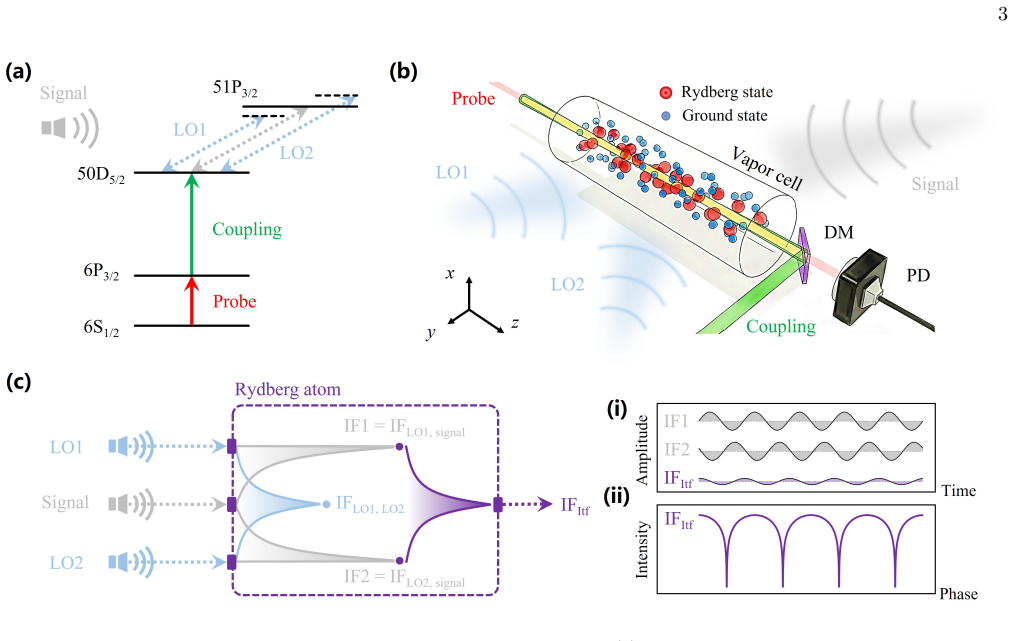
Pith's one-line read A dual-local-oscillator Rydberg-atom scheme realizes a Mach-Zehnder-type microwave interferometer with phase resolution below 0.1 degrees, full 360 degree coverage, and a claimed sensitivity gain of about 25 dB.
The pith
A machine-rendered reading of the paper's core claim, the machinery that carries it, and where it could break.
The reading
The authors add a weak auxiliary field at the signal frequency to hold the system at this dark point, and then show that a weak test signal changes the output enough to be detected. They report a detection sensitivity of about minus 152 dBm per hertz, about 25 dB better than their comparison receiver. They also use the same phase-to-intensity mapping to measure the distance a microwave travels (about 20 micron precision) and the angle of its polarization (below 0.1 degrees). The main caveat is that the 25 dB sensitivity gain relies on a metric that mixes a phase with a decibel power, and the comparison receiver is evaluated with a different observable, so the gain is not yet independently established.
Extended reading notes
Core claim
The load-bearing claim is that the dual-LO Rydberg configuration realizes a Mach-Zehnder-type interferometer whose IF intensity is governed by I_Itf = 10 log[1 + cos(phi_LO1 + phi_LO2 - 2 phi_sig)] (Eqs. 3 and 7), enabling direct phase retrieval with resolution exceeding 0.1 degrees over the full 360 degree range and, when biased by an auxiliary field at the critical point, a power-sensitivity enhancement exceeding 25 dB relative to a conventional single-LO receiver. If true, this gives a simple, reconfigurable Rydberg platform for phase, distance, and polarization metrology.
Load-bearing premise
The entire interferometric transfer characteristic rests on the assumption that the two IF components from LO1 and LO2 are generated with exactly equal amplitudes in the atomic medium and recombine as coherent classical fields, so that their sum can reach a perfect null (Eqs. 1-3 and 7). Any imbalance, saturation, or uncontrolled higher-order mixing product would leave a residual background at the critical point and would remove the diverging slope on which the 25 dB sensitivity claim depends.
Signed reviews
Editorial analysis
A structured set of objections, weighed in public.
Assumptions & free parameters
free parameters (2)
- Minimum detectable intensity variation delta_I_IF =
1 (normalized)
- Detection threshold for conventional receiver =
not specified
assumptions (5)
- domain assumption The two IF components IF1 and IF2 are generated with equal amplitudes and recombine coherently in the atomic medium as classical fields (Eqs. 1-3).
- domain assumption The detected IF intensity is the squared modulus of the summed IF fields and can be represented in dB as 10 log[1 + cos(phi_Itf)] (Eq. 7).
- domain assumption The auxiliary field exactly biases the interferometer to the critical destructive-interference point and is coherent with the signal (Methods, Eqs. 11-13).
- domain assumption The Rydberg transition responds linearly to the microwave field amplitude so the polarization response enters only as cos(theta_sig) (Methods, Eq. 16).
- standard math Standard trigonometric identities and small-angle expansions are used to derive the interference and phase-perturbation formulas.
Cite this review
Pith. "Pith review of Critical Microwave Mach-Zehnder-Type Interferometry with Dual-LO Rydberg Atoms." pith.science (2026). https://pith.science/paper/BYZJ4TIN
@misc{pith2026260813222,
  author       = {Pith},
  title        = {Pith review of: Critical Microwave Mach-Zehnder-Type Interferometry with Dual-LO Rydberg Atoms},
  year         = {2026},
  howpublished = {\url{https://pith.science/paper/BYZJ4TIN}},
  note         = {Machine review of arXiv:2608.13222}
}
abstract
High-precision phase measurement of microwave fields underpins a wide range of applications, including wireless communications, distributed radar, plasma diagnostics, and antenna metrology. Existing Rydberg-atom-based approaches, however, often face trade-offs among phase resolution, measurement range, and system complexity. Here we demonstrate a Rydberg-atom-based microwave Mach-Zehnder-type interferometer using a dual-local-oscillator configuration. The two local oscillators establish two coherent interferometric pathways in the Rydberg medium. Their coherent mixing with the signal field produces an interferometric intermediate-frequency output governed by a phase-to-intensity transfer characteristic that enables critical-point enhancement. This scheme supports direct phase retrieval with a resolution exceeding $0.1^\circ$ and unambiguous full $360^\circ$ phase coverage with the reconfigurable dual-LO architecture. Moreover, near the critical interference point, the system exhibits a sharply enhanced phase-to-amplitude transduction, where weak amplitude variations are converted into pronounced phase responses, yielding a sensitivity enhancement exceeding 25 dB. Besides, the same interferometric transfer mechanism enables microwave propagation-distance and polarization metrology, achieving a propagation-distance precision below 20 $\mu$m at 5.7 GHz together with a polarization-angle resolution exceeding $0.1^\circ$. This approach eliminates the need for complex optical configurations and lock-in detection, providing a simple, scalable, and reconfigurable Mach-Zehnder-type quantum microwave interferometry framework for multifunctional high-precision microwave metrology.
Figures


Figures from the paper (2 more)


Reference graph
Works this paper leans on
-
[1]
T. Gong, P. Gavriilidis, R. Ji, C. Huang, G. C. Alexan- dropoulos, L. Wei, Z. Zhang, M. Debbah, H. V. Poor, and C. Yuen, Holographic mimo communications: Theo- retical foundations, enabling technologies, and future di- rections, IEEE Communications Surveys & Tutorials26, 196 (2023)
work page 2023
-
[2]
Y. Zhao, Reconfigurable intelligent surfaces for 6g: ap- plications, challenges, and solutions, Frontiers of Infor- mation Technology & Electronic Engineering24, 1669 (2023)
work page 2023
- [3]
-
[4]
V. Janoudi, P. Schoeder, T. Grebner, N. Appenrodt, J. Dickmann, and C. Waldschmidt, On distributed radar networks: Signal model, analysis, and signal processing, IEEE Journal of Microwaves4, 329 (2024)
work page 2024
-
[5]
C. Lin, C. Huang, and Y. Su, A coherent signal processing method for distributed radar system, in2016 Progress in Electromagnetic Research Symposium (PIERS)(IEEE,
-
[6]
A. K¨ ohn-Seemann and R. B. Morales, From electron cy- clotron emission and reflectometry to microwave imaging diagnostics in fusion plasmas: Progress and perspectives, 12 Physics of Plasmas32(2025)
work page 2025
-
[7]
G. Cunningham, Use of the absolute phase in frequency modulated continuous wave plasma reflectometry, Re- view of Scientific Instruments79(2008)
work page 2008
- [8]
Show all 62 references
-
[9]
Kim, H.-J
S. Kim, H.-J. Dong, J.-W. Yu, and H. L. Lee, Phased ar- ray calibration system with high accuracy and low com- plexity, Alexandria Engineering Journal69, 759 (2023)
2023
-
[10]
Sebastian, P
J. Sebastian, P. Dayal, K.-B. Song, and W. AliAh- mad, Explicit calibration of mmwave phased arrays with phase dependent errors, arXiv preprint arXiv:2107.09561 (2021)
2021 arXiv
-
[11]
Jokinen, O
M. Jokinen, O. Kursu, N. Tervo, A. P¨ arssinen, and M. E. Leinonen, Over-the-air phase calibration methods for 5g mmw antenna array transceivers, IEEE Access12, 28057 (2024)
2024
-
[12]
D. A. Abd El-Aziz, A. M. Attiya, H. M. Elhennawy, and R. S. Ali, Comparative study of microwave relative phase measurement methods, MAPAN40, 253 (2025)
2025
-
[13]
Balestrieri, L
E. Balestrieri, L. De Vito, F. Picariello, S. Rapuano, I. Tudosa,et al., A review of accurate phase measure- ment methods and instruments for sinewave signals, Acta Imeko9, 52 (2020)
2020
-
[14]
Schlossberger, N
N. Schlossberger, N. Prajapati, S. Berweger, A. P. Ro- tunno, A. B. Artusio-Glimpse, M. T. Simons, A. A. Sheikh, E. B. Norrgard, S. P. Eckel, and C. L. Holloway, Rydberg states of alkali atoms in atomic vapour as si- traceable field probes and communications receivers, Na- tur...
2024
-
[15]
Allinson, M
G. Allinson, M. Bason, A. Bonnin, S. Bor´ owka, P. Martin-Iglesias, M. M. Neira, M. Mazelanik, R. Murchie, M. Parniak, S. Pataraia,et al., Ryd- berg receivers for space applications, arXiv preprint arXiv:2601.20631 (2026)
2026
-
[16]
J. Yuan, W. Yang, M. Jing, H. Zhang, Y. Jiao, W. Li, L. Zhang, L. Xiao, and S. Jia, Quantum sensing of mi- crowave electric fields based on Rydberg atoms, Reports on Progress in Physics86, 106001 (2023)
2023
-
[17]
B. Liu, L. Zhang, Z. Liu, Z. Deng, D. Ding, B. Shi, and G. Guo, Electric field measurement and application based on Rydberg atoms, Electromagnetic Science1, 1 (2023)
2023
-
[18]
C. L. Holloway, M. T. Simons, A. B. Artusio-Glimpse, and J. A. Gordon, Overview of Rydberg atom-based sensors/receivers for the measurement of electric fields, power, voltage, and modulated signals, Antenna and Ar- ray Technologies for Future Wireless Ecosystems , 393 (2022)
2022
-
[19]
D. H. Meyer, Z. A. Castillo, K. C. Cox, and P. D. Kunz, Assessment of Rydberg atoms for wideband electric field sensing, Journal of Physics B: Atomic, Molecular and Optical Physics53, 034001 (2020)
2020
-
[20]
M. T. Simons, A. H. Haddab, J. A. Gordon, and C. L. Holloway, A Rydberg atom-based mixer: Measuring the phase of a radio frequency wave, Applied Physics Letters 114(2019)
2019
-
[21]
M. Jing, Y. Hu, J. Ma, H. Zhang, L. Zhang, L. Xiao, and S. Jia, Atomic superheterodyne receiver based on microwave-dressed Rydberg spectroscopy, Nature Physics16, 911 (2020)
2020
-
[22]
M. Cai, Z. Xu, S. You, and H. Liu, Sensitivity im- provement and determination of Rydberg atom-based microwave sensor, inPhotonics, Vol. 9 (MDPI, 2022) p. 250
2022
-
[23]
Ding, Z.-K
D.-S. Ding, Z.-K. Liu, B.-S. Shi, G.-C. Guo, K. Mølmer, and C. S. Adams, Enhanced metrology at the critical point of a many-body Rydberg atomic system, Nature Physics18, 1447 (2022)
2022
-
[24]
Liu, J.-R
B. Liu, J.-R. Chen, Y. Ma, Q.-F. Wang, T.-Y. Han, H. Tian, Y.-H. Qian, G.-C. Guo, L.-H. Zhang, B.- B. Wei,et al., Enhanced multi-parameter metrology in dissipative Rydberg atom time crystals, arXiv preprint arXiv:2601.10347 (2026)
2026
-
[25]
D. Xiao, Z. Shi, L. Chen, S. Yan, L. Xu, and H. Zhang, Low-frequency weak electric field measurement based on Rydberg atoms using cavity-enhanced three photon sys- tem, Frontiers in Physics12, 1405149 (2024)
2024
-
[26]
Liang, Q
Y. Liang, Q. Wang, Z. Wang, S. Guan, P. Yang, Y. Zhang, J. He, P. Zhang, G. Li, and T. Zhang, Cavity- enhanced Rydberg atomic superheterodyne receiver, Op- tics Express33, 13034 (2025)
2025
-
[27]
Liu, L.-H
B. Liu, L.-H. Zhang, Q.-F. Wang, Y. Ma, T.-Y. Han, Z.- K. Liu, Z.-Y. Zhang, S.-Y. Shao, J. Zhang, Q. Li,et al., Cavity-enhanced Rydberg atom microwave receiver, Chi- nese Physics Letters42, 053201 (2025)
2025
-
[28]
V. Venu, S. M. Bohaichuk, F. Christaller, M. Schmidt, H. K¨ ubler, and J. P. Shaffer, Three-photon Rydberg atom electrometry with enhanced sensitivity, inQuan- tum Sensing, Imaging, and Precision Metrology III, Vol. 13392 (SPIE, 2025) pp. 255–260
2025
-
[29]
Schlossberger, N
N. Schlossberger, N. Prajapati, A. B. Artusio- Glimpse, S. Berweger, and C. L. Holloway, Fundamen- tal linewidth limit of electromagnetically induced trans- parency in a thermal Rydberg ladder, arXiv preprint arXiv:2603.04596 (2026)
2026
-
[30]
Prajapati, N
N. Prajapati, N. Bhusal, A. P. Rotunno, S. Berweger, M. T. Simons, A. B. Artusio-Glimpse, Y. Ju Wang, E. Bottomley, H. Fan, and C. L. Holloway, Sensitivity comparison of two-photon vs three-photon Rydberg elec- trometry, Journal of Applied Physics134(2023)
2023
-
[31]
Santamaria-Botello, S
G. Santamaria-Botello, S. Verploegh, E. Bottomley, and Z. Popovic, Comparison of noise temperature of Rydberg-atom and electronic microwave receivers, arXiv preprint arXiv:2209.00908 (2022)
2022 arXiv
-
[32]
Qiu, H.-L
S.-Y. Qiu, H.-L. Wang, X.-H. Liu, Z.-Q. Du, Y.-Q. Guo, H.-T. Tu, Y. Xu, T.-F. Miao, H. Yan, and K.-Y. Liao, Shortwave frequency-hopping reception via a Rydberg atom-based electrically small antenna, Applied Physics Letters128, 034003 (2026)
2026
-
[33]
Schlossberger, C
N. Schlossberger, C. L. Holloway, E. McKee, M. A. Highman, and N. Prajapati, Electromagnetically induced transparency and population repump readout of Ryd- berg states of cs atoms in a J-scheme, arXiv preprint arXiv:2603.08678 (2026)
2026
-
[34]
Liu, K.-Y
X.-H. Liu, K.-Y. Liao, Z.-X. Zhang, H.-T. Tu, W. Bian, Z.-Q. Li, S.-Y. Zheng, H.-H. Li, W. Huang, H. Yan,et al., Continuous-frequency microwave heterodyne detection in an atomic vapor cell, Physical Review Applied18, 054003 (2022)
2022
-
[35]
Prajapati, S
N. Prajapati, S. Berweger, A. P. Rotunno, A. B. Artusio- Glimpse, N. Schlossberger, D. Shylla, W. J. Watterson, M. T. Simons, D. LaMantia, E. B. Norrgard, S. P. Eckel, and C. L. Holloway, Investigation of fluorescence ver- sus transmission readout for three-photon Rydberg ex- ...
2024
-
[36]
Zhang, Y
J. Zhang, Y. Liu, Y. Liu, Z. Xu, F. Jia, J. Wang, F. Meng, Q. Wang, J. Zhang, and Z. Zhong, Advanc- 13 ing Three-Photon-Excited Rydberg RF Sensing: Fluo- rescence Readout for Wide-Dynamic-Range Characteri- zation and Spatial Resolution Beyond Transmission, Sen- sors25, 7185 (2025)
2025
-
[37]
J. Yao, Z. Sun, Y. Lin, D. Sang, S. Zhang, K. Yang, J. Zhang, Q. An, and Y. Fu, Ultra-wideband continuous spectrum Rydberg atomic superheterodyne receiver with high sensitivity, Communications Physics (2026)
2026
-
[38]
Zhang, Z
L. Zhang, Z. Liu, B. Liu, Q. Wang, Y. Ma, T. Han, Z. Zhang, H. Chen, S. Shao, Q. Li,et al., Tun- able off-resonant Rydberg microwave frequency comb spectroscopy based on metawaveguide coupled Rydberg atoms, Chinese Optics Letters22, 080201 (2024)
2024
-
[39]
J. Hu, H. Li, R. Song, J. Bai, Y. Jiao, J. Zhao, and S. Jia, Continuously tunable radio frequency electrometry with Rydberg atoms, Applied Physics Letters121(2022)
2022
-
[40]
Liu, L.-H
B. Liu, L.-H. Zhang, Z.-K. Liu, Z.-Y. Zhang, Z.-H. Zhu, W. Gao, G.-C. Guo, D.-S. Ding, and B.-S. Shi, Highly sensitive measurement of a megahertz rf electric field with a Rydberg-atom sensor, Physical Review Applied 18, 014045 (2022)
2022
-
[41]
Zhang, Z.-K
L.-H. Zhang, Z.-K. Liu, B. Liu, Q.-F. Wang, Y. Ma, T.-Y. Han, Z.-Y. Zhang, H.-C. Chen, S.-Y. Shao, Q. Lim,et al., Floquet engineering Rydberg sub-THz frequency comb spectroscopy, arXiv preprint arXiv:2404.07433 (2024)
2024 arXiv
-
[42]
S. Yuan, M. Jing, H. Zhang, L. Zhang, L. Xiao, and S. Jia, Isotropic antenna based on Rydberg atoms, Optics Express32, 8379 (2024)
2024
-
[43]
M. T. Simons, A. H. Haddab, J. A. Gordon, D. Novotny, and C. L. Holloway, Embedding a Rydberg atom-based sensor into an antenna for phase and amplitude detection of radio-frequency fields and modulated signals, IEEE access7, 164975 (2019)
2019
-
[44]
J. A. Gordon, M. T. Simons, A. H. Haddab, and C. L. Holloway, Weak electric-field detection with sub-1 hz res- olution at radio frequencies using a Rydberg atom-based mixer, Aip Advances9(2019)
2019
-
[45]
A. K. Robinson, N. Prajapati, D. Senic, M. T. Simons, J. A. Gordon, and C. L. Holloway, Angle-of-arrival of a radio-frequency field from sub-wavelength Rydberg atom-based phase measurements, inCLEO: Science and Innovations(Optica Publishing Group, 2021) pp. SW2I– 3
2021
-
[46]
P. K. Elgee, K. C. Cox, J. C. Hill, P. D. Kunz, and D. H. Meyer, Electrically small Rydberg sensor for three- dimensional determination of radio-frequency k-vectors, Physical Review Applied23, 064022 (2025)
2025
-
[47]
M. Cui, Q. Zeng, and K. Huang, Rydberg atomic re- ceiver: Next frontier of wireless communications, IEEE Communications Magazine (2025)
2025
-
[48]
Y. Tong, Z. Liu, Q. Ren, H. Wang, W. Yang, J. Xie, M. Jing, H. Zhang, L. Xiao, S. Jia,et al., Broadband fre- quency hopping by Rydberg atoms with high orbital an- gular momentum states, Optics Express34, 5447 (2026)
2026
-
[49]
Prajapati, A
N. Prajapati, A. P. Rotunno, S. Berweger, M. T. Simons, A. B. Artusio-Glimpse, S. D. Voran, and C. L. Holloway, TV and video game streaming with a quantum receiver: A study on a Rydberg atom-based receiver’s bandwidth and reception clarity, A VS Quantum Science4(2022)
2022
-
[50]
D. H. Meyer, J. C. Hill, P. D. Kunz, and K. C. Cox, Simultaneous multiband demodulation using a Rydberg atomic sensor, Physical Review Applied19, 014025 (2023)
2023
-
[51]
Nan, J.-R
J.-D. Nan, J.-R. Chen, B. Liu, Q.-F. Wang, Y. Ma, Y.-M. Yin, T.-Y. Han, G.-C. Guo, H. Tian, L.-H. Zhang,et al., Ultra-broadband anti-jamming communication via a Ry- dberg atomic receiver, arXiv preprint arXiv:2606.14497 (2026)
2026
-
[52]
S. M. Bohaichuk, D. Booth, K. Nickerson, H. Tai, and J. P. Shaffer, Origins of Rydberg-atom electrometer tran- sient response and its impact on radio-frequency pulse sensing, Physical Review Applied18, 034030 (2022)
2022
-
[53]
M. Chen, T. Mao, Z. Zhu, H. Feng, G. Gao, Z. Wu, W. Xiao, Z. Li, and D. Zheng, High-resolution quan- tum sensing with Rydberg atomic receiver: Princi- ples, experiments and future prospects, arXiv preprint arXiv:2506.11833 (2025)
2025 arXiv
-
[54]
Arumugam, J.-H
D. Arumugam, J.-H. Park, B. Feyissa, J. Bush, and S. P. Mysore Nagaraja, Remote sensing of soil moisture using Rydberg atoms and satellite signals of opportunity, Sci- entific Reports14, 18025 (2024)
2024
-
[55]
W. J. Watterson, N. Prajapati, R. Castillo-Garza, S. Berweger, N. Schlossberger, A. Artusio-Glimpse, C. L. Holloway, and M. T. Simons, An imaging radar using a Rydberg atom receiver, Applied Physics Letters127 (2025)
2025
-
[56]
S. M. Bohaichuk, V. Venu, F. Christaller, and J. P. Shaffer, Transient phase sensing in a three-photon Ryd- berg ladder scheme, Physical Review Letters136, 153201 (2026)
2026
-
[57]
Jia, H.-Y
F.-D. Jia, H.-Y. Zhang, X.-B. Liu, J. Mei, Y.-H. Yu, Z.- Q. Lin, H.-Y. Dong, Y. Liu, J. Zhang, F. Xie,et al., Transfer phase of microwave to beat amplitude in a Ry- dberg atom-based mixer by zeeman modulation, Journal of Physics B: Atomic, Molecular and Optical Physics54, 1655...
2021
-
[58]
S. B. Oliver, S. Berweger, E. E. Mikhailov, D. Manchaiah, N. Prajapati, C. L. Holloway, and M. T. Simons, Simul- taneous detection, demodulation, and angle-of-arrival de- termination of communication signals using a dual lad- der Rydberg receiver, arXiv preprint arXiv:2603.002...
2026
-
[59]
Liu, F.-D
X.-B. Liu, F.-D. Jia, H.-Y. Zhang, J. Mei, W.-C. Liang, F. Zhou, Y.-H. Yu, Y. Liu, J. Zhang, F. Xie,et al., An all- optical phase detector by amplitude modulation of the lo- cal field in a Rydberg atom-based mixer, Chinese Physics B31, 090703 (2022)
2022
-
[60]
Anderson, R
D. Anderson, R. Sapiro, L. Gon¸ calves, R. Cardman, and G. Raithel, Optical radio-frequency phase measure- ment with an internal-state Rydberg atom interferome- ter, Physical Review Applied17, 044020 (2022)
2022
-
[61]
Y. Han, C. He, P. Xu, Y. Zhao, T. Wang, and W. Li, Phase-sensitive Rydberg-atom interferometry with flo- quet electromagnetically induced transparency, Physical Review Applied24, 024063 (2025)
2025
-
[62]
Berweger, A
S. Berweger, A. B. Artusio-Glimpse, A. P. Rotunno, N. Prajapati, J. D. Christesen, K. R. Moore, M. T. Si- mons, and C. L. Holloway, Closed-loop quantum inter- ferometry for phase-resolved Rydberg-atom field sensing, Physical Review Applied20, 054009 (2023)
2023
Reviewed August 14, 2026 · model on record in the stance chip above.
Discussion (0). Continue with ORCID to comment.