REVIEW 5 major objections 4 minor 79 references
Unsupervised Techniques to Detect Quantum Chaos
T0 review · 5 major / 4 minor · reviewed 2026-08-06 · deepseek-v4-flash
Pith's one-line read A Self-Organizing Map can detect the integrable-to-chaotic crossover in quantum Hamiltonians directly from the raw matrix entries, without diagonalization.
desk verdict The spectral half is solid, but the SOM half is confounded by graph geometry and the authors half-admit it; send to review with major revisions and required controls. read the letter →
The pith
A machine-rendered reading of the paper's core claim, the machinery that carries it, and where it could break.
The reading
What carries the argument
The load-bearing object is the Self-Organizing Map itself, used as an unsupervised clustering engine. Each Hamiltonian matrix of size N×N is flattened into an input vector of length N², normalized by its Euclidean norm (Eq. 3), and presented to a lattice of neurons whose weight vectors are trained by competitive learning: the neuron with the smallest normalized Euclidean distance (Eq. 4) wins, and weights are updated by a Gaussian-neighborhood rule (Eq. 5) followed by renormalization (Eq. 6). The map's output—the distribution of winning neurons over an ensemble of Hamiltonians—is the detector: the paper observes that certain neurons only begin to fire as the rewiring probability crosses into the chaotic regime, and the sharpening of this response with N is taken as evidence that the network tracks the same transition that the r-ratio sees.
What would settle it
Take fixed Watts-Strogatz graphs at several rewiring probabilities and randomize the Gaussian coupling weights independently of the graph structure (or permute the off-diagonal entries while keeping the graph skeleton fixed). If the SOM's neuron-response curves then lose their dependence on p, the detector is reading the graph geometry, not the spectral statistics; if the curves survive, the matrix-element content carries the signal. Likewise, feeding the SOM the unweighted adjacency matrix alone would show whether the rewiring probability alone suffices to reproduce the transition.
Extended reading notes
Core claim
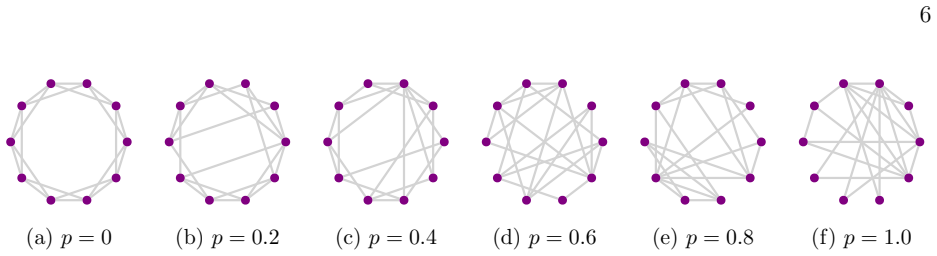
On the paper's own terms, the central claim is that a Self-Organizing Map fed with the flattened Hamiltonian matrix—complex entries and all, without any diagonalization—can separate the integrable regime from the chaotic regime of the model. The authors validate this by computing the average r-ratio of level spacings on the same ensembles: for small rewiring probability p the statistics are Poissonian (⟨r⟩ ≈ 0.386), for large p they approach the GUE value (⟨r⟩ ≈ 0.5996), with a crossover that steepens as N grows and a fixed point near p ≈ 0.02. The trained SOM, given 500 matrices per p value, shows neuron hit counts that are flat at small p, then rise sharply, with slope changes at p ≈ 5×10⁻³ and p ≈ 0.2 that the authors interpret as the finite-size edges of the same transition. They explicitly entertain two readings: the network may be learning something intrinsic about spectral statistics from the matrix, or it may be detecting the changing geometry of the underlying graph; both, they argue, are worth pursuing.
Load-bearing premise
The network's grouping is attributed to the chaos/integrability transition, but the paper provides no control experiment showing the SOM is not simply detecting the change in graph rewiring probability or geometry, a possibility it explicitly acknowledges in the discussion.
Editorial extensions
If this is right
- If a SOM can read chaos directly from matrix entries, spectral probes of quantum chaos no longer require diagonalization, which is the main computational bottleneck for large or dense Hamiltonians.
- The method is unsupervised, so it needs no reference Hamiltonians known to be chaotic or integrable; it could be pointed at a new model family with no prior labels.
- The neuron-response crossover locations (p ≈ 5×10⁻³ and p ≈ 0.2) bracket the r-ratio transition at p ≈ 0.02, suggesting the network is tracking the same physical crossover, just with finite-size blurring.
- The steepening of the SOM response with system size supports the paper's conjecture that the crossover becomes a genuine transition in the large-N limit.
- The agreement extends the known connection between single-particle Dyson models and many-body quantum chaos, since a many-body model on the same graphs shows a transition at similar p.
Reading between the lines
- The paper leaves open whether the SOM is reading spectral statistics or graph geometry; a control that shuffles the random weights while preserving the graph skeleton (or vice versa) would settle which information the network actually uses.
- Because the input is normalized by its Euclidean norm and contains complex off-diagonal entries, the SOM may be sensitive to the magnitude distribution of matrix elements rather than their phase structure; testing real-symmetric versus complex-Hermitian versions of the same graph could isolate which feature carries the signal.
- The technique, if confirmed, suggests a generic pipeline: train a SOM on any family of parametric Hamiltonians and use neuron-hit curves as a cheap surrogate for spectral statistics, potentially useful for scanning phase diagrams of disordered or many-body systems where diagonalization is prohibitive.
Editorial analysis
A structured set of objections, weighed in public.
Referee Report
Summary. The paper studies a single-particle Hamiltonian defined on Watts-Strogatz random graphs with random hopping weights, H_ab = i r_ab A_ab, and asks whether an unsupervised Self-Organizing Map (SOM), fed only the raw Hamiltonian matrix, can detect the same chaos/integrability crossover that is revealed by the spectral r-ratio. The authors first show via the r-ratio that increasing the graph rewiring probability p drives the spectrum from Poissonian to GUE statistics, with a crossover near p ≈ 0.02 that they conjecture becomes a genuine transition in the large-N limit. They then train a SOM on flattened Hamiltonian matrices and report that certain output neurons respond to changes in p, with breakpoints claimed to agree with the spectral analysis. The abstract states that the same transition can be detected by the SOM without any diagonalization procedure.
Significance. The spectral r-ratio part is standard and the crossover is clearly visible, and the authors are transparent in acknowledging that their SOM result might be explained by graph geometry rather than by quantum chaos. If the SOM claim were established, it would be an interesting proof of principle that unsupervised learning can extract spectral-phase information directly from Hamiltonian entries. However, the central claim is not yet established: the SOM response is not decoupled from the trivial rewiring-probability signal, the reported transition values are internally inconsistent, and the 'genuine transition' claim lacks finite-size scaling evidence. The paper does not provide code or data, so the ambiguous parts of the algorithm description are not readily checkable.
major comments (5)
- [Section V, Eq. (4), Figs. 3-4] The headline claim that the SOM detects the chaos/integrability transition from the Hamiltonian matrix is not established, because no control experiments separate the spectral-statistics signal from the trivial graph-rewiring signal p. After normalization in Eq. (3), the flattened input vector is dominated by the support pattern A_ab: the weights r_ab are iid Gaussian and exchangeable, so the Euclidean distance in Eq. (4) can cluster matrices almost entirely by the number and arrangement of nonzero entries, i.e., by p. I am not claiming the network is necessarily doing this, but the paper needs to exclude it. Concretely, please add controls: (i) a support-only input (e.g., set r_ab=1 or feed A_ab), (ii) a null model with the same support but shuffled or randomized weight magnitudes, and (iii) a fixed-geometry ensemble in which the spectral statistics are varied without changing p. Without these, the alternative scenario acknowledged in Section VI, that the SOM detects graph geometry rather than quantum chaos, is just as consistent with the data, and the abstract overstates the result.
- [Section V, post-processing paragraph, Figs. 3-4] The selection of 'responsive' neurons is post hoc and undefined. The text states that 'we noticed that only some neurons respond to changes in rewiring probability' and that the serial numbers 'do not obey a particular pattern,' but no selection rule, number of responsive neurons, or reproducibility across SOM initializations and training runs is given. The plotted quantity, the normalized number of hits, has no error bars. To support the claimed detection, please specify the exact criterion used to designate neurons as responsive, report the fraction of neurons used, and show that the response curves and breakpoints are stable across independent training runs and across random realizations of the input matrices.
- [Section V, Fig. 4, Discussion] The extracted transition value is internally inconsistent. The text near Fig. 4 identifies breakpoints at p = 5×10^{-3} and p = 0.2 and then says the three regions should merge into a single crossover in the region p ∈ (5×10^{-3}, 0.2); a few lines later it claims these values are in 'very good agreement' with Fig. 2, whose crossover is near p ≈ 0.02; and the Discussion states that the neuron response increases sharply when the rewiring probability approaches p ≈ 0.01. The manuscript needs to state one quantitative transition value, with uncertainty, and justify the claimed agreement. The vertical shift used to make the N=56 and N=84 curves 'almost coincide' in Fig. 4 also needs to be described precisely, since an arbitrary additive constant can make unrelated curves look similar.
- [Section IV, Fig. 2] The statement that the crossover 'turns out to be a genuine transition (i.e. a step function in the large N limit) located at p ≈ 0.02' is not supported by the data as presented. The curves steepen with N, but no finite-size scaling collapse, no crossing analysis with uncertainties, and no scaling exponent is provided. Given that the Discussion uses this value as the reference to which the SOM is compared, please add a quantitative finite-size scaling analysis or soften the claim to a crossover consistent with a possible transition until such an analysis is performed.
- [Section V, Eqs. (3)-(4)] The input vector has complex entries (H_ab = i r_ab A_ab), but Eq. (3) uses x_k^2 and Eq. (4) uses an ordinary Euclidean distance without specifying how complex numbers are treated. Please specify whether the vector is split into real and imaginary parts, or whether a complex modulus is used in the norms, and provide the code or implementation details necessary to reproduce the SOM results.
minor comments (4)
- [Section V, training data paragraph] The text 'We generated 10 5 samples' should read '10^5 samples' (the superscript is missing).
- [Section V, paragraph after Fig. 4] The sentence 'It is interesting to emphasize that these probability values are in very good agreement with the values probability values presented in Fig. 2' contains a duplicated phrase 'probability values'.
- [Section V, paragraph after Fig. 4] The statement 'We could expect these three sections to merge in the large N limit into a single transition/crossover' should be explicitly labeled as a speculation, consistent with the caveats in the Discussion.
- [Section V, training and classification data] The description of generating 10^5 samples with a log-uniform p-distribution and then generating 500 matrices per p for classification is ambiguous: please clarify how the training set and the evaluation set are separated and whether any training sample is reused in the classification step.
Circularity Check
No significant circularity: the SOM result is tested against an independent spectral benchmark, and the acknowledged geometry confound is an attribution gap, not a derivation-equals-input reduction.
full rationale
The paper's central claim is that a Self-Organizing Map fed the raw Hamiltonian matrix identifies the same chaos/integrability crossover as the spectral r-ratio. This is not a case where a fitted parameter is renamed as a prediction: the SOM is unsupervised, the input is the full N^2 vector of H_ab = i r_ab A_ab (Eq. 1), and the transition location is read from neuron hit counts and then compared with the separately computed r-ratio (Eq. 2, Fig. 2). The r-ratio benchmark is external to the SOM training and is not used to construct the network, so the agreement is a genuine validation rather than a tautology. The authors themselves flag the possible confound that the SOM may be detecting the change in graph geometry rather than spectral chaos (Section VI, 'second scenario'), and the paper explicitly leaves this open. That is a real limitation of the attribution, but it is not circularity: the SOM output is not defined in terms of the r-ratio, nor is the spectral transition inserted into the network as a label or fit parameter. The only self-citations ([38] on white-noise SOM classification and [43] on many-body WS graphs) are supporting context, not load-bearing premises of the derivation, and [43] concerns a different model family with overlapping authors, so it does not make the present claim definitional. No equation in the paper reduces to its own input, and no 'prediction' is statistically forced by a fit.
Assumptions & free parameters
free parameters (6)
- SOM output map dimensions =
not stated
- SOM training hyperparameters (alpha, sigma, iterations) =
not stated
- Training sample count and p-distribution =
10^5 samples, log-uniform in [10^-4, 1]
- Middle 25% spectral window for r-ratio =
25% of eigenvalues
- Realizations per p =
50 weight realizations; 10-19 graph repeats
- Selection rule for 'responsive' neurons =
post hoc, unspecified
assumptions (5)
- domain assumption BGS conjecture: chaotic quantum systems have RMT spectral statistics
- domain assumption Berry-Tabor conjecture: integrable systems have Poissonian statistics
- domain assumption Watts-Strogatz rewiring is performed conditioned on graph connectedness
- ad hoc to paper Input normalization in Eq. (3) and Euclidean distance in Eq. (4) are appropriate similarity measures for complex Hamiltonian matrices
- domain assumption The r-ratio crossover at p~0.02 is a genuine phase transition
Cite this review
Pith. "Pith review of Unsupervised Techniques to Detect Quantum Chaos." pith.science (2026). https://pith.science/paper/BZ3GT6AP
@misc{pith2026250712887,
  author       = {Pith},
  title        = {Pith review of: Unsupervised Techniques to Detect Quantum Chaos},
  year         = {2026},
  howpublished = {\url{https://pith.science/paper/BZ3GT6AP}},
  note         = {Machine review of arXiv:2507.12887}
}
read the original abstract
Conventional spectral probes of quantum chaos require eigenvalues, and sometimes, eigenvectors of the quantum Hamiltonian. This involves computationally expensive diagonalization procedures. We test whether an unsupervised neural network can detect quantum chaos directly from the Hamiltonian matrix. We use a single-body Hamiltonian with an underlying random graph structure and random coupling constants, with a parameter that determines the randomness of the graph. The spectral analysis shows that increasing the amount of randomness in the underlying graph results in a transition from integrable spectral statistics to chaotic ones. We show that the same transition can be detected via unsupervised neural networks, or more specifically, Self-Organizing Maps by feeding the Hamiltonian matrix directly into the neural network, without any diagonalization procedure.
Figures


Figures from the paper (2 more)


Reference graph
Works this paper leans on
-
[1]
Input normalization: Before inputting data into the network, each element of the input vector is normalized using the formula: xk → xkqPi l=1 x2 l (3) where xk represents the k-th element of the input vector with a total length of i
-
[2]
Each of the j weight vectors containi elements corresponding to the number of input layer neurons
Training: The weight vectors ⃗ wm with 1 ≤ m ≤ j of output neurons are initialized randomly. Each of the j weight vectors containi elements corresponding to the number of input layer neurons. Subsequently, the c-th neuron with the smallest Euclidean distance to the input vector, ∥⃗ x(N ) − ⃗ wc(N )∥ = iX l=1 (wcl(N ) − xl(N ))2, (4) is selected as the win...
-
[3]
Low Temperature Physics/Fizika 13 Nizkikh Temperatur
Post-processing: After completing the training process and obtaining the final map, the input data undergoes clustering or other necessary analytical procedures [54]. For the case at hand, we need to decide what kind of data we want to use as input for 9 FIG. 3: Normalized number of hits in neurons (a.u. stands for arbitrary units), responding to changes ...
work page 2021
-
[4]
M. L. Mehta, Random matrices (Elsevier, 2004)
2004
-
[5]
M. V. Berry and M. Tabor, Level clustering in the regular spectrum, Proceedings of the Royal Society of London. A. Mathematical and Physical Sciences 356, 375 (1977)
work page 1977
-
[6]
A. Lichtenberg and M. Lieberman, Regular and Chaotic Dynamics , Applied Mathematical Sciences (Springer New York, 2013)
work page 2013
-
[7]
Ott, Chaos in Dynamical Systems (Cambridge University Press, 1993)
E. Ott, Chaos in Dynamical Systems (Cambridge University Press, 1993)
work page 1993
-
[8]
O. Bohigas, M.-J. Giannoni, and C. Schmit, Characterization of chaotic quantum spectra and universality of level fluctuation laws, Physical review letters 52, 1 (1984)
work page 1984
Show all 79 references
-
[9]
P. W. Anderson, Absence of diffusion in certain random lattices, Phys. Rev. 109, 1492 (1958)
1958
-
[10]
Izrailev, A
F. Izrailev, A. Krokhin, and N. Makarov, Anomalous localization in low-dimensional systems with correlated disorder, Physics Reports 512, 125 (2012), anomalous localization in low- dimensional systems with correlated disorder
2012
-
[11]
Haake, Quantum Signatures of Chaos (Springer-Verlag, Berlin, Heidelberg, 2006)
F. Haake, Quantum Signatures of Chaos (Springer-Verlag, Berlin, Heidelberg, 2006)
2006
-
[12]
St¨ ockmann,Quantum Chaos: An Introduction , Cambridge nonlinear science series (Cam- bridge University Press, 1999)
H. St¨ ockmann,Quantum Chaos: An Introduction , Cambridge nonlinear science series (Cam- bridge University Press, 1999)
1999
-
[13]
A. P. Luca D’Alessio, Yariv Kafri and M. Rigol, From quantum chaos and eigenstate ther- malization to statistical mechanics and thermodynamics, Advances in Physics 65, 239 (2016), https://doi.org/10.1080/00018732.2016.1198134
2016
-
[14]
Kagalovsky, B
V. Kagalovsky, B. Horovitz, and Y. Avishai, Phase diagram and level statistics in d class disordered superconductors, physica status solidi (b) 230, 117 (2002)
2002
-
[15]
Kagalovsky, B
V. Kagalovsky, B. Horovitz, and Y. Avishai, Random matrix theory and metal–insulator transition in disordered superconductors, Physica E: Low-dimensional Systems and Nanos- tructures 12, 627 (2002), proceedings of the Fourteenth International Conference on the Ele ctronic Prop...
2002
-
[16]
Evers and A
F. Evers and A. D. Mirlin, Anderson transitions, Rev. Mod. Phys. 80, 1355 (2008). 14
2008
-
[17]
Theodorou and M
G. Theodorou and M. H. Cohen, Extended states in a one-demensional system with off- diagonal disorder, Phys. Rev. B 13, 4597 (1976)
1976
-
[18]
Fleishman and D
L. Fleishman and D. C. Licciardello, Fluctuations and localization in one dimension, Journal of Physics C: Solid State Physics 10, L125 (1977)
1977
-
[19]
Bauer and O
M. Bauer and O. Golinelli, Random Incidence Matrices: Moments of the Spectral Density, Journal of Statistical Physics 103, 301 (2001), arXiv:cond-mat/0007127 [cond-mat.stat-mech]
2001 arXiv
-
[20]
M. Sade, T. Kalisky, S. Havlin, and R. Berkovits, Localization transition on complex networks via spectral statistics, Phys. Rev. E 72, 066123 (2005)
2005
-
[21]
Kagalovsky, B
V. Kagalovsky, B. Horovitz, and Y. Avishai, Level statistics of quasiparticles in disordered two-dimensional superconductors, Journal of Superconductivity 16, 319 (2003)
2003
-
[22]
KAGALOVSKY, B
V. KAGALOVSKY, B. HOROVITZ, and Y. A VISHAI, Various facets of chalker–coddington network model, Modern Physics Letters B 18, 385 (2004)
2004
-
[23]
A. D. Mirlin and Y. V. Fyodorov, Universality of level correlation function of sparse random matrices, Journal of Physics A: Mathematical and General 24, 2273 (1991)
1991
-
[24]
L. F. Cugliandolo, G. Schehr, M. Tarzia, and D. Venturelli, Multifractal phase in the weighted adjacency matrices of random erd¨ os-r´ enyi graphs, arXiv preprint arXiv:2404.06931 (2024)
2024 arXiv
-
[25]
Grabarits, K
A. Grabarits, K. R. Swain, M. S. Heydari, P. Chandarana, F. J. G´ omez-Ruiz, and A. del Campo, Quantum chaos in random ising networks, arXiv preprint arXiv:2405.14376 (2024)
2024 arXiv
-
[26]
Jalan and J
S. Jalan and J. N. Bandyopadhyay, Random matrix analysis of complex networks, Phys. Rev. E 76, 046107 (2007), arXiv:cond-mat/0701043 [cond-mat.stat-mech]
2007 arXiv
-
[27]
Hartmann, J
J.-G. Hartmann, J. Murugan, and J. P. Shock, Chaos and scrambling in quantum small worlds, arXiv preprint arXiv:1901.04561 (2019)
2019 arXiv
-
[28]
J. Alt, R. Ducatez, and A. Knowles, Delocalization transition for critical erd˝ os–r´ enyi graphs, Communications in Mathematical Physics 388, 507 (2021)
2021
-
[29]
E. V. H. Doggen, F. Schindler, K. S. Tikhonov, A. D. Mirlin, T. Neupert, D. G. Polyakov, and I. V. Gornyi, Many-body localization and delocalization in large quantum chains, Phys. Rev. B 98, 174202 (2018)
2018
-
[30]
Y. A. Kharkov, V. Sotskov, A. Karazeev, E. O. Kiktenko, and A. K. Fedorov, Revealing quantum chaos with machine learning, Physical Review B 101, 064406 (2020)
2020
-
[31]
Mehta, M
P. Mehta, M. Bukov, C.-H. Wang, A. G. Day, C. Richardson, C. K. Fisher, and D. J. Schwab, A high-bias, low-variance introduction to machine learning for physicists, Physics Reports 810, 1 (2019), a high-bias, low-variance introduction to Machine Learning for physicists
2019
-
[32]
ˇCadeˇ z, B
T. ˇCadeˇ z, B. Dietz, D. Rosa, A. Andreanov, K. Slevin, and T. Ohtsuki, Machine learning wave functions to identify fractal phases, Phys. Rev. B 108, 184202 (2023)
2023
-
[33]
Fujita, Y
H. Fujita, Y. O. Nakagawa, S. Sugiura, and M. Oshikawa, Construction of hamiltonians by supervised learning of energy and entanglement spectra, Phys. Rev. B 97, 075114 (2018). 15
2018
-
[34]
Beetar, J
C. Beetar, J. Murugan, and D. Rosa, Neural networks as universal probes of many-body localization in quantum graphs (2021), arXiv:2108.05737 [cond-mat.dis-nn]
2021 arXiv
-
[35]
Th´ eveniaut and F
H. Th´ eveniaut and F. Alet, Neural network setups for a precise detection of the many-body localization transition: Finite-size scaling and limitations, Phys. Rev. B 100, 224202 (2019)
2019
-
[36]
Berezutskii, M
A. Berezutskii, M. Beketov, D. Yudin, Z. Zimbor´ as, and J. D. Biamonte, Probing criticality in quantum spin chains with neural networks, Journal of Physics: Complexity 1, 03LT01 (2020)
2020
-
[37]
to detect a chaos/integrability transition in a set of single-particle Hamiltonians, with- out assuming any prior knowledge of the properties of the Hamiltonians considered: In the process of unsupervised learning, the SOM, following an algorithm that we will describe, disting...
2000
-
[38]
Harashima, T
Y. Harashima, T. Mano, K. Slevin, and T. Ohtsuki, Analysis of kohn–sham eigenfunc- tions using a convolutional neural network in simulations of the metal–insulator transi- tion in doped semiconductors, Journal of the Physical Society of Japan 90, 094001 (2021), https://doi.org...
2021 doi
-
[39]
Ohtsuki and T
T. Ohtsuki and T. Ohtsuki, Deep learning the quantum phase transitions in random electron systems: Applications to three dimensions, Journal of the Physical Society of Japan86, 044708 (2017), https://doi.org/10.7566/JPSJ.86.044708
2017 doi
-
[40]
A. M. Garc ´ ıa-Garc ´ ıa, Y. Jia, D. Rosa, and J. J. Verbaarschot, Sparse sachdev-ye-kitaev model, quantum chaos, and gravity duals, Physical Review D 103, 106002 (2021)
2021
-
[41]
In passing, we note that very recently unsupervised methods have been successfully applied to detect deviations from ergodicity in quantum many-body systems [73, 74]
-
[42]
Kohonen, Self-organized formation of topologically correct feature maps, Biological Cyber- netics 43, 59 (1982)
T. Kohonen, Self-organized formation of topologically correct feature maps, Biological Cyber- netics 43, 59 (1982)
1982
-
[43]
Kagalovsky, D
V. Kagalovsky, D. Nemirovsky, and S. V. Kravchenko, Noise signal as input data in self-organized neural networks, Low Temperature Physics 48, 452 (2022), https://pubs.aip.org/aip/ltp/article-pdf/48/6/452/16384476/452 1 online.pdf
2022
-
[44]
S. Xu, L. Susskind, Y. Su, and B. Swingle, A sparse model of quantum holography, arXiv preprint arXiv:2008.02303 (2020)
2020 arXiv
-
[45]
Orman, H
P. Orman, H. Gharibyan, and J. Preskill, Quantum chaos in the sparse syk model (2024), arXiv:2403.13884 [hep-th]
2024 arXiv
-
[46]
C´ aceres, A
E. C´ aceres, A. Misobuchi, and R. Pimentel, Sparse syk and traversable wormholes, Journal of High Energy Physics 2021, 15 (2021)
2021
-
[47]
J. Kim, J. Murugan, J. Olle, and D. Rosa, Operator delocalization in quantum networks, Phys. Rev. A 105, L010201 (2022)
2022
-
[48]
Andreanov, M
A. Andreanov, M. Carrega, J. Murugan, J. Olle, D. Rosa, and R. Shir, From dyson models to many-body quantum chaos, arXiv preprint arXiv:2302.00917 (2023)
2023 arXiv
-
[49]
C´ aceres, T
E. C´ aceres, T. Guglielmo, B. Kent, and A. Misobuchi, Out-of-time-order correlators and lyapunov exponents in sparse syk, Journal of High Energy Physics 2023, 88 (2023). 16
2023
-
[50]
Y. Y. Atas, E. Bogomolny, O. Giraud, and G. Roux, Distribution of the ratio of consecutive level spacings in random matrix ensembles, Physical review letters 110, 084101 (2013)
2013
-
[51]
Nokkala, J
J. Nokkala, J. Piilo, and G. Bianconi, Complex quantum networks: a topical review, Journal of Physics A: Mathematical and Theoretical (2024)
2024
-
[52]
D. J. Watts and S. H. Strogatz, Collective dynamics of ‘small-world’ networks, Nature 393, 440 (1998)
1998
-
[53]
T. Guhr, A. Muller-Groeling, and H. A. Weidenmuller, Random matrix theories in quantum physics: Common concepts, Phys. Rept. 299, 189 (1998), arXiv:cond-mat/9707301
1998 arXiv
-
[54]
Oganesyan and D
V. Oganesyan and D. A. Huse, Localization of interacting fermions at high temperature, Phys. Rev. B 75, 155111 (2007)
2007
-
[55]
Altland, T
A. Altland, T. Micklitz, and J. T. de Miranda, Tensor product random matrix theory (2024), arXiv:2404.10919 [cond-mat.mes-hall]
2024 arXiv
-
[56]
S. O. Haykin, Neural Networks: A Comprehensive Foundation, 2nd Edition (Pearson, 1999)
1999
-
[57]
Zupan and J
J. Zupan and J. Gasteiger, Neural Networks for Chemists: An Introduction 1st Edition (VCH Publishers, 1999)
1999
-
[58]
Kohonen, Self-Organizing Maps (Springer, Berlin, Heidelberg, 2001)
T. Kohonen, Self-Organizing Maps (Springer, Berlin, Heidelberg, 2001)
2001
-
[59]
Vesanto, SOM-based data visualization methods, Intelligent Data Analysis 3, 111 (1999)
J. Vesanto, SOM-based data visualization methods, Intelligent Data Analysis 3, 111 (1999)
1999
-
[60]
De Luca, B
A. De Luca, B. L. Altshuler, V. E. Kravtsov, and A. Scardicchio, Anderson localization on the bethe lattice: Nonergodicity of extended states, Phys. Rev. Lett. 113, 046806 (2014)
2014
-
[61]
Monteiro, T
F. Monteiro, T. Micklitz, M. Tezuka, and A. Altland, Minimal model of many-body localiza- tion, Phys. Rev. Res. 3, 013023 (2021)
2021
-
[62]
Winer, S.-K
M. Winer, S.-K. Jian, and B. Swingle, Exponential ramp in the quadratic sachdev-ye-kitaev model, Phys. Rev. Lett. 125, 250602 (2020)
2020
-
[63]
Y. Liao, A. Vikram, and V. Galitski, Many-body level statistics of single-particle quantum chaos, Phys. Rev. Lett. 125, 250601 (2020)
2020
-
[64]
Liao and V
Y. Liao and V. Galitski, Universal dephasing mechanism of many-body quantum chaos, Phys. Rev. Res. 4, L012037 (2022)
2022
-
[65]
Pino, Scaling up the anderson transition in random-regular graphs, Phys
M. Pino, Scaling up the anderson transition in random-regular graphs, Phys. Rev. Res. 2, 042031 (2020)
2020
-
[66]
K. S. Tikhonov, A. D. Mirlin, and M. A. Skvortsov, Anderson localization and ergodicity on random regular graphs, Phys. Rev. B 94, 220203 (2016)
2016
-
[67]
B. L. Altshuler, E. Cuevas, L. B. Ioffe, and V. E. Kravtsov, Nonergodic phases in strongly disordered random regular graphs, Phys. Rev. Lett. 117, 156601 (2016)
2016
-
[68]
K. S. Tikhonov and A. D. Mirlin, Fractality of wave functions on a cayley tree: Difference between tree and locally treelike graph without boundary, Phys. Rev. B 94, 184203 (2016)
2016
-
[69]
Biroli and M
G. Biroli and M. Tarzia, Delocalization and ergodicity of the anderson model on bethe lattices (2018), arXiv:1810.07545 [cond-mat.dis-nn]. 17
2018 arXiv
-
[70]
Vanoni, B
C. Vanoni, B. L. Altshuler, V. E. Kravtsov, and A. Scardicchio, Renormalization group analysis of the anderson model on random regular graphs, Proceedings of the National Academy of Sciences 121, e2401955121 (2024), https://www.pnas.org/doi/pdf/10.1073/pnas.2401955121
2024 doi
-
[71]
Tikhonov and A
K. Tikhonov and A. Mirlin, From anderson localization on random regular graphs to many- body localization, Annals of Physics 435, 168525 (2021), special Issue on Localisation 2020
2021
-
[72]
Baroni, G
M. Baroni, G. G. Lorenzana, T. Rizzo, and M. Tarzia, Corrections to the bethe lattice solution of anderson localization, Phys. Rev. B 109, 174216 (2024)
2024
-
[73]
Pino and J
M. Pino and J. E. Roman, Correlated volumes for extended wave functions on a random- regular graph, Phys. Rev. B 109, 184204 (2024)
2024
-
[74]
B. L. Altshuler, V. E. Kravtsov, A. Scardicchio, P. Sierant, and C. Vanoni, Renormalization group for anderson localization on high-dimensional lattices (2024), arXiv:2403.01974 [cond- mat.dis-nn]
2024 arXiv
-
[76]
Pietracaprina, N
F. Pietracaprina, N. Mac´ e, D. J. Luitz, and F. Alet, Shift-invert diagonalization of large many-body localizing spin chains, SciPost Phys. 5, 045 (2018)
2018
-
[77]
Sierant, M
P. Sierant, M. Lewenstein, and J. Zakrzewski, Polynomially filtered exact diagonalization approach to many-body localization, Phys. Rev. Lett. 125, 156601 (2020)
2020
-
[78]
H. Cao, D. G. Angelakis, and D. Leykam, Unsupervised learning of quantum many-body scars using intrinsic dimension, Machine Learning: Science and Technology 5, 025049 (2024)
2024
-
[79]
Vanoni and V
C. Vanoni and V. Vitale, Analysis of localization transitions using nonparametric unsupervised learning, Phys. Rev. B 110, 024204 (2024)
2024
-
[1991]
B. I. Verkin and Low Temperature Physics in Kharkiv,
Sergey devoted his research activities to the most advanced problems of modern physics and the history of physics in his native Kharkiv, especially in his favorite FTINT. He coauthored books and articles about the exciting adventures of Kharkiv physics. He was also a brilliant...
2021
Reviewed August 6, 2026 · model on record in the stance chip above.
Discussion (0). Sign in to comment.