REVIEW 4 major objections 8 minor 1 cited by
Text-Guided Coarse-to-Fine Fusion Network for Robust Remote Sensing Visual Question Answering
T0 review · 4 major / 8 minor · reviewed 2026-08-12 · deepseek-v4-flash
Pith's one-line read Question-guided fusion of optical and radar satellite images keeps remote-sensing visual question answering accurate in cloud-covered and low-light scenes, with the best results on a new benchmark.
desk verdict Useful new optical-SAR RSVQA benchmark and a reasonable fusion net, but the evaluation hides the categories that would actually test the robustness claim. read the letter →
The pith
A machine-rendered reading of the paper's core claim, the machinery that carries it, and where it could break.
The reading
What carries the argument
The load-bearing machinery is a question-conditioned routing and fusion pipeline built on fine-tuned CLIP encoders. CFAR splits each image into regions, scores every region against the embedded question, selects the top-k regions, applies multi-head cross-attention between question tokens and those regions, and then enhances the full image features by similarity-weighted attention; this implements the 'coarse-to-fine' idea of first choosing broad areas and then refining detail. AMEF then combines three experts: an optical expert, a SAR expert, and a fusion expert whose input is produced by Regional Quality-Aware Fusion (RQAF), which for each spatial location selects the top patches from both modalities and uses question-guided softmax weights to blend them. A small adaptive-fusion network learns per-expert weights from their predictions, and the final answer is the softmax of that weighted sum. Each expert uses a two-layer transformer decoder plus a classification MLP, and all experts are trained jointly with cross-entropy losses while only the adaptively fused output is used at inference.
What would settle it
Train a text-only model that sees the question but no images on OSVQA; if it reaches a large share of TGFNet's reported accuracy, then the fusion advantage is substantially explained by answer priors in the template questions rather than by optical-SAR reasoning.
Extended reading notes
Core claim
On its own terms, the paper's central claim is that text-guided, coarse-to-fine, adaptive fusion of optical and SAR imagery substantially improves remote sensing visual question answering under adverse conditions. The TGFNet architecture is built around two mechanisms: the Text-guided Coarse-to-Fine Attention Refinement (CFAR) module, which scores image regions against the question, keeps the top-k regions, and refines them with cross-attention and similarity enhancement; and the Adaptive Multi-Expert Fusion (AMEF) module, which learns patch-level quality-aware fusion plus an adaptive weighted combination of an optical expert, a SAR expert, and a fusion expert. Compared with the strongest baseline, TGFNet raises overall accuracy from 69.97% to 71.89% and average accuracy from 64.15% to 65.12% on OSVQA. The paper also reports that each added module contributes: AMEF alone adds 0.34 overall accuracy and 2.15 average accuracy, CFAR adds 0.63 and 0.03, and RQAF adds 0.54 and 0.49. Because the evaluation excludes the three question types that explicitly ask about modality quality ('quality', 'fog-dark', 'match'), the reported gains describe fusion benefit apart from questions that literally name the data sources.
Load-bearing premise
The load-bearing premise is that the OSVQA dataset, with its template-generated questions, artificially degraded optical images, and author-provided annotations, captures genuine optical-SAR visual question answering ability rather than letting models exploit linguistic shortcuts or annotation biases.
Editorial extensions
If this is right
- If TGFNet's results hold, question-guided optical-SAR fusion is a viable route to robust remote sensing VQA: it beats the best compared method on OSVQA and beats every single-modality input.
- The ablations imply that each of the three design pieces pays off: adaptive multi-expert fusion, text-guided coarse-to-fine attention, and region-level quality-aware fusion each improve accuracy when added.
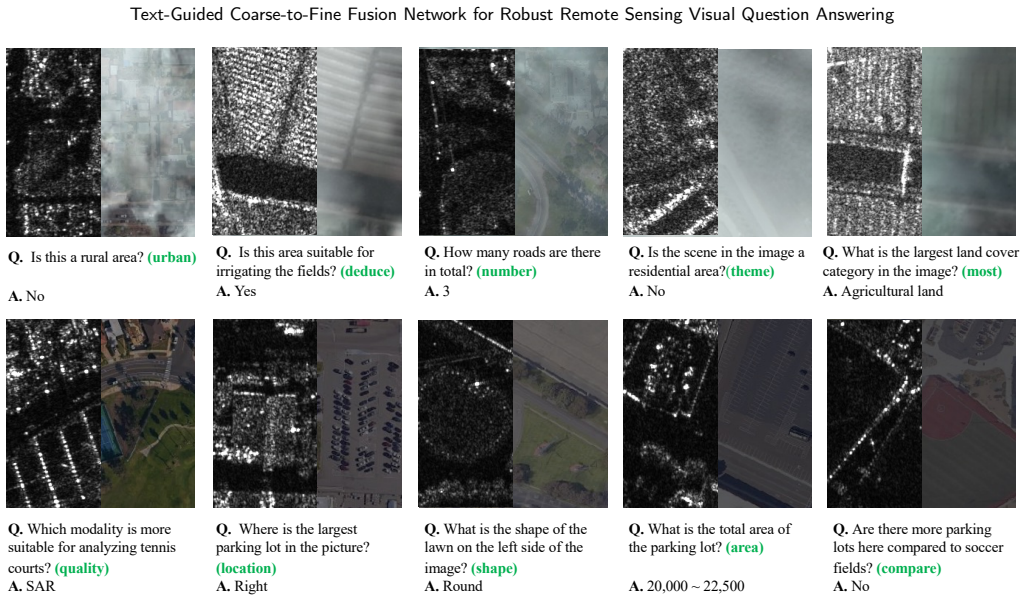
- The OSVQA dataset gives the field a shared benchmark with 16 question types, over a million question-answer pairs, and aligned optical-SAR pairs, including modality-quality and relational-reasoning questions that previous RSVQA datasets lack.
- Fusion generally helps, but the paper's comparisons show that naive addition of features is a weak fusion: on OSVQA, addition and concatenation lag transformer-based fusion, and TGFNet's adaptively weighted experts outperform all of them.
Reading between the lines
- Editorial inference: because the benchmark's questions are template-generated and the optical degradations are partly artificial, the absolute accuracies may reflect the dataset's linguistic regularities; a text-only model trained on the same questions would reveal how much of the reported accuracy comes from language priors rather than image fusion.
- Editorial inference: the excluded 'quality' question type is arguably the most direct test of whether the model has learned to trust the right sensor; including it in the headline metric, or using the model's quality answers to predict its fusion weights, would expose whether the adaptive fusion is genuinely semantic or just a learned re-weighting.
- Editorial inference: the coarse-to-fine routing idea transfers naturally to other sensor-fusion tasks where one modality degrades, such as cloud-inpainting, change detection, or disaster mapping; the same question-conditioned routing could be applied there.
Editorial analysis
A structured set of objections, weighed in public.
Referee Report
Summary. The paper proposes TGFNet, a text-guided coarse-to-fine fusion network for remote sensing visual question answering (RSVQA) that combines optical and synthetic aperture radar (SAR) imagery. The method consists of a Text-guided Coarse-to-Fine Attention Refinement (CFAR) module, which routes question-relevant image regions and enhances them through cross-attention, and an Adaptive Multi-Expert Fusion (AMEF) module, which combines predictions from optical, SAR, and fused-image experts via learned weights. The authors also introduce OSVQA, a new dataset of 6,008 optical-SAR image pairs and 1,036,694 question-answer pairs across 16 question types, including a "quality" category intended to assess which modality is more informative. Experiments on OSVQA compare TGFNet with six existing RSVQA methods and include ablations of the proposed modules and fusion strategies. The reported headline results are an average accuracy (AA) of 71.89% and overall accuracy (OA) of 65.12%, which the authors state outperform all baselines. The central claims are that text-guided optical-SAR fusion improves RSVQA under cloud-covered and low-light conditions, and that OSVQA is the first large-scale benchmark for this task.
Significance. If the claims are substantiated, the paper would make a useful contribution: OSVQA is, to my knowledge, the first large-scale optical-SAR RSVQA benchmark, and the proposed architecture is a reasonable instantiation of text-guided, multi-expert fusion. The authors have made the dataset publicly announced (though the URL in the paper is incomplete), and the method description is sufficiently detailed to be reimplemented. The CFAR module's coarse-to-fine routing and the AMEF module's adaptive expert weighting are sensible design choices, and the ablation structure in Table 4 gives some credit to each component. However, the experimental evidence as presented is under-powered: all numbers come from single runs without error bars or significance tests, the gains over the strongest baseline are modest (1.92% AA and 0.97% OA), and the reported metrics exclude three of the sixteen question types, including the categories most directly tied to the paper's stated novelty and robustness claims. The benchmark's validity also depends on the semi-automatic annotation pipeline and the artificial fog/darkness simulation, which are not yet described with enough detail or external validation.
major comments (4)
- [Section 5.1, Table 3] The headline OA and AA are computed after excluding the 'quality', 'fog-dark', and 'match' question categories, with the stated rationale that these categories involve both optical and SAR images. This rationale does not apply to 'fog-dark', which asks about the presence of clouds or darkness in the optical image and can be answered by an optical-only model. More importantly, the excluded 'quality' category is the dataset's self-described unique modality-assessment category (Section 4.2), and 'fog-dark' directly probes the adverse conditions that motivate the paper. Since no per-category accuracy for any of the three excluded types is reported anywhere in Table 3 or the text, the claimed improvement in robustness under cloud-covered and low-light conditions is not actually measured by the reported numbers. Please report per-category accuracies for all 16 question types, and for 'match' either define a protocol that is fair to single-modality models or report that category separately for multi-modal models only.
- [Section 5.2, Tables 3-5] All quantitative results appear to come from a single training run; no standard deviations, confidence intervals, or significance tests are reported. The headline gains over the strongest baseline are 1.92% AA and 0.97% OA, and the ablation margins in Table 4 range from 0.34% to 0.63% OA and 0.03% to 2.15% AA, which are small relative to typical seed variance in VQA training. Please rerun all models with at least three (preferably five) random seeds, report mean and standard deviation, and include a paired significance test (e.g., bootstrap or Wilcoxon signed-rank) for the main comparisons between TGFNet and the best baseline and between the ablation variants.
- [Section 4.2] OSVQA is constructed entirely by the authors, partly from their own earlier OGSOD-1.0 dataset, using manual attribute annotation followed by template-based question generation, with artificial fog and darkness added post-hoc. No inter-annotator agreement, external human evaluation, or quantitative description of the fog/dark simulation (e.g., degradation type, parameters, and whether answers were re-verified after modification) is provided. These details are needed to establish that the benchmark measures multi-modal reasoning rather than annotation artifacts or linguistic shortcuts in the templates. Please report the simulation protocol, the annotation quality controls, and at least a small-scale human evaluation or internal consistency check on a sample of questions.
- [Section 5.1, Table 3] For the MUL setting, all single-modality baselines are adapted by adding a second identical image encoder and fusing optical and SAR features with a simple addition operation, while TGFNet uses the full AMEF machinery with three experts, a question-guided fusion module (RQAF), and adaptive weighting. This comparison conflates architectural capacity with the proposed fusion mechanism. Table 5 partially addresses this by comparing fusion strategies within a fixed backbone, but the main benchmark should also include a stronger fusion baseline (e.g., cross-attention or transformer-based fusion of optical/SAR features) so that the reported improvements can be attributed to the adaptive multi-expert design rather than to the absence of any learned fusion in the baseline.
minor comments (8)
- [Equation (10)] Equation (10) contains a typographical error: the term before lambda_4 reads '+ +' instead of a single '+'. Please correct it.
- [Table 3] The column header 'Precence' is misspelled and should be 'Presence'; the abbreviations 'Locat.' and 'Num.' should be defined in the table caption.
- [Section 3.3.2, Equation (7)] The number of answer classes C in Equation (7) is not specified. Please state the value used for OSVQA (the paper reports 140 distinct answers in Section 4.3) and explain how the classification head handles the full answer vocabulary.
- [Section 3.2.1, Equation (1)] The notation in Equation (1) is ambiguous: the Mean is said to be taken along dimension 1, but the dimensions of W_T, W_I, and the resulting score tensor S are not made explicit. Please clarify the exact shapes and the role of the mean over the sequence dimension.
- [Abstract and Section 4.2] The dataset URL in the abstract is just 'https://github.com/mmic-lcl/' with no repository path. Also, the abstract describes the image pairs as 'well-aligned', while Section 4.2 says the selected pairs are 'approximately aligned'. Please provide the full URL and specify the alignment procedure.
- [Section 5.1] The sentence 'the input questions are embedded into 71×512 vectors' is unclear: please specify how the maximum length of 71 is determined, how padding/truncation is handled, and which tokenizer is used for the CLIP text encoder.
- [Figure 4] The caption of Figure 4 contains untranslated Chinese text ('MCA 和IE的⽹络结构。...'). This should be translated or removed for publication.
- [Section 3.4] The loss weights lambda_1 through lambda_4 are described as 'regularization parameters', which is imprecise; they are weighting coefficients for the four cross-entropy losses. In addition, no sensitivity analysis is given for the chosen value of 0.5.
Circularity Check
No significant circularity: TGFNet's reported gains come from a held-out test split of the authors' own OSVQA dataset, and the self-citation to OGSOD-1.0 is data provenance rather than a load-bearing theoretical premise. The exclusion of 'quality', 'fog-dark', and 'match' questions is an evaluation-coverage limitation, not a derivation-level circularity.
full rationale
The paper's central predictive claim is that TGFNet outperforms existing RSVQA methods on the OSVQA dataset. This is an empirical claim evaluated on a held-out partition: Section 4.2 describes a 3:1:1 split into training, testing, and validation sets, yielding 208,578 test question-answer pairs, and Section 5.1 reports OA and AA on that test set. The model is trained with standard cross-entropy loss on the training partition, and the test answers are not used to fit the model, so the headline numbers are not forced by construction. The main self-citation is to OGSOD-1.0 [17], which shares authors with the present paper and supplies 3,000 of the 6,008 optical-SAR image pairs. This is a data-source citation, not a theoretical premise: OSVQA adds new question-answer annotations, a new split, and new evaluation protocols, so the benchmark comparison is not an identity or a renaming of the cited dataset. No uniqueness theorem or ansatz is imported from the authors' prior work; the network components (CFAR, AMEF, RQAF, AF) are new and their equations do not reduce to the evaluation metric. The potentially concerning passage is Section 5.1: 'To ensure a fair comparison between models with single-modality image input and those with optical and SAR multi-modal image input, we exclude the question categories "quality", "fog-dark", and "match", which involve both optical and SAR images.' This exclusion removes the question types most directly tied to the paper's robustness and modality-quality narrative, so the claimed improvements in 'challenging scenarios' are not directly measured on those categories. However, this is a validity/scope concern about what the headline OA/AA actually demonstrate, not a circular derivation: the reported accuracies are still genuine held-out predictions, and no equation or fitted parameter is being relabeled as a prediction. The lack of error bars and single-run results further weaken the strength of the empirical claim but do not make it circular. Overall, the derivation chain is self-contained with respect to circularity: the model is trained on one partition and evaluated on another, and the benchmark construction, while author-created, does not make the test outcome equivalent to the training input by definition.
Assumptions & free parameters
free parameters (3)
- Loss weights lambda_1 to lambda_4 =
0.5 each
- Top-k regions and patches per region in CFAR =
Not reported
- Top-R similar patches in RQAF =
Not reported
assumptions (4)
- domain assumption CLIP's vision-language embedding space, with only a lightweight adapter fine-tuned on OSVQA, provides semantically meaningful alignments between remote sensing optical and SAR imagery and question text.
- domain assumption The manually annotated image attributes are accurate and complete enough that template-generated questions have unique correct answers.
- ad hoc to paper Artificially modified fog and dark images are representative of real cloud-covered and low-light remote sensing conditions.
- ad hoc to paper Excluding the 'quality', 'fog-dark', and 'match' question categories preserves a fair and meaningful evaluation.
Cite this review
Pith. "Pith review of Text-Guided Coarse-to-Fine Fusion Network for Robust Remote Sensing Visual Question Answering." pith.science (2026). https://pith.science/paper/BZLEGWWB
@misc{pith2026241115770,
  author       = {Pith},
  title        = {Pith review of: Text-Guided Coarse-to-Fine Fusion Network for Robust Remote Sensing Visual Question Answering},
  year         = {2026},
  howpublished = {\url{https://pith.science/paper/BZLEGWWB}},
  note         = {Machine review of arXiv:2411.15770}
}
read the original abstract
Remote Sensing Visual Question Answering (RSVQA) has gained significant research interest. However, current RSVQA methods are limited by the imaging mechanisms of optical sensors, particularly under challenging conditions such as cloud-covered and low-light scenarios. Given the all-time and all-weather imaging capabilities of Synthetic Aperture Radar (SAR), it is crucial to investigate the integration of optical-SAR images to improve RSVQA performance. In this work, we propose a Text-guided Coarse-to-Fine Fusion Network (TGFNet), which leverages the semantic relationships between question text and multi-source images to guide the network toward complementary fusion at the feature level. Specifically, we develop a Text-guided Coarse-to-Fine Attention Refinement (CFAR) module to focus on key areas related to the question in complex remote sensing images. This module progressively directs attention from broad areas to finer details through key region routing, enhancing the model's ability to focus on relevant regions. Furthermore, we propose an Adaptive Multi-Expert Fusion (AMEF) module that dynamically integrates different experts, enabling the adaptive fusion of optical and SAR features. In addition, we create the first large-scale benchmark dataset for evaluating optical-SAR RSVQA methods, comprising 6,008 well-aligned optical-SAR image pairs and 1,036,694 well-labeled question-answer pairs across 16 diverse question types, including complex relational reasoning questions. Extensive experiments on the proposed dataset demonstrate that our TGFNet effectively integrates complementary information between optical and SAR images, significantly improving the model's performance in challenging scenarios. The dataset is available at: https://github.com/mmic-lcl/. Index Terms: Remote Sensing Visual Question Answering, Multi-source Data Fusion, Multimodal, Remote Sensing, OPT-SAR.
Figures


Figures from the paper (6 more)




Forward citations
Cited by 1 Pith paper
-
SAR Strikes Back: A New Hope for RSVQA
A two-stage 'prompt' pipeline that turns SAR image classifications into text outperforms an end-to-end model for remote sensing visual question answering, and late fusion with optical data gives the best overall accuracy.
Reference graph
Works this paper leans on
-
[1]
Lawrence Zitnick, and Devi Parikh
Stanislaw Antol, Aishwarya Agrawal, Jiasen Lu, Margaret Mitchell, Dhruv Batra, C. Lawrence Zitnick, and Devi Parikh. Vqa: Visual ques- tion answering. In Proceedings of the IEEE International Conference on Computer Vision (ICCV), pages 2425–2433, 2015
work page 2015
-
[2]
Eurosat: A novel dataset and deep learning benchmark for land use and land cover classification
PatrickHelber,BenjaminBischke,AndreasDengel,andDamianBorth. Eurosat: A novel dataset and deep learning benchmark for land use and land cover classification. IEEE Journal of Selected Topics in Applied Earth Observations and Remote Sensing, 12:2217–2226, 2019
work page 2019
-
[3]
Xing Liu. Three-dimensional visualized urban landscape planning and design based on virtual reality technology.IEEE Access, 8:149510– 149521, 2020. Zhicheng Zhao et al.: Page 13 of 15 Text-Guided Coarse-to-Fine Fusion Network for Robust Remote Sensing Visual Question Answering
work page 2020
-
[4]
A review of remote sensing for environmental monitoring in china
JunLi,YanqiuPei,ShaohuaZhao,RulinXiao,XiaoSang,andChengye Zhang. A review of remote sensing for environmental monitoring in china. Remote Sensing, 12:1130, 2020
work page 2020
-
[5]
Mostapha Mohammad Harb and Fabio Dell’Acqua. Remote sensing in multirisk assessment: Improving disaster preparedness.IEEE Geo- science and Remote Sensing Magazine, 5:53–65, 2017
work page 2017
-
[6]
Sylvain Lobry, Diego Marcos, Jesse Murray, and Devis Tuia. Rsvqa: Visual question answering for remote sensing data.IEEE Transactions on Geoscience and Remote Sensing, 58:8555–8566, 2020
work page 2020
-
[7]
Mu- tual attention inception network for remote sensing visual question an- swering
XiangtaoZheng,BinqiangWang,XingqianDu,andXiaoqiangLu. Mu- tual attention inception network for remote sensing visual question an- swering. IEEE Transactions on Geoscience and Remote Sensing, 60:1– 14, 2022
work page 2022
-
[8]
Hrvqa: A visual questionansweringbenchmarkforhigh-resolutionaerialimages
Kun Li, George Vosselman, and Michael Ying Yang. Hrvqa: A visual questionansweringbenchmarkforhigh-resolutionaerialimages. ISPRS Journal of Photogrammetry and Remote Sensing, 214:65–81, 2024
work page 2024
Show all 44 references
-
[9]
Prompt-rsvqa: Prompting visual context to a language model for remote sensing visual question answering
ChristelChappuis,ValérieZermatten,SylvainLobry,BertrandLeSaux, and Devis Tuia. Prompt-rsvqa: Prompting visual context to a language model for remote sensing visual question answering. InProceedings of theIEEE/CVFConferenceonComputerVisionandPatternRecognition , pages 1372–1381, 2022
2022
-
[10]
Multistep question-driven vi- sualquestionansweringforremotesensing
Meimei Zhang, Fang Chen, and Bin Li. Multistep question-driven vi- sualquestionansweringforremotesensing. IEEETransactionsonGeo- science and Remote Sensing, 61:1–12, 2023
2023
-
[11]
Bi-modal transformer-based approach for visual question answering in remote sensing imagery
Yakoub Bazi, Mohamad Mahmoud Al Rahhal, Mohamed Lamine Mekhalfi, Mansour Abdulaziz Al Zuair, and Farid Melgani. Bi-modal transformer-based approach for visual question answering in remote sensing imagery. IEEE Transactions on Geoscience and Remote Sens- ing, 60:1–11, 2022
2022
-
[12]
From easy to hard: Learning language-guided curriculum for visual question answering on remote sensing data.IEEE Transactions on Geoscience and Remote Sensing, 60:1–11, 2022
Zhenghang Yuan, Lichao Mou, Qi Wang, and Xiao Xiang Zhu. From easy to hard: Learning language-guided curriculum for visual question answering on remote sensing data.IEEE Transactions on Geoscience and Remote Sensing, 60:1–11, 2022
2022
-
[13]
Aspatialhierarchicalreasoningnetwork for remote sensing visual question answering.IEEE Transactions on Geoscience and Remote Sensing, 61:1–15, 2023
ZixiaoZhang,LichengJiao,LinglingLi,XuLiu,PuhuaChen,FangLiu, YuxuanLi,andZhichengGuo. Aspatialhierarchicalreasoningnetwork for remote sensing visual question answering.IEEE Transactions on Geoscience and Remote Sensing, 61:1–15, 2023
2023
-
[14]
Argho Sarkar, Tashnim Chowdhury, Robin Roberson Murphy, Aryya Gangopadhyay, and Maryam Rahnemoonfar. Sam-vqa: Supervised attention-based visual question answering model for post-disaster dam- age assessment on remote sensing imagery.IEEE Transactions on Geo- science and Remote...
2023
-
[15]
Change detection meets visual question answering.IEEE Transactions on Geoscience and Remote Sensing, 60:1–13, 2022
Zhenghang Yuan, Lichao Mou, Zhitong Xiong, and Xiao Xiang Zhu. Change detection meets visual question answering.IEEE Transactions on Geoscience and Remote Sensing, 60:1–13, 2022
2022
-
[16]
Floodnet: A high resolution aerial imagery dataset for post flood scene understand- ing
Maryam Rahnemoonfar, Tashnim Chowdhury, Argho Sarkar, Debvrat Varshney, Masoud Yari, and Robin Roberson Murphy. Floodnet: A high resolution aerial imagery dataset for post flood scene understand- ing. IEEE Access, 9:89644–89654, 2021
2021
-
[17]
Category-oriented localization distillation for sar object detection and a unified benchmark
Chao Wang, Rui Ruan, Zhicheng Zhao, Chenglong Li, and Jin Tang. Category-oriented localization distillation for sar object detection and a unified benchmark. IEEE Transactions on Geoscience and Remote Sensing, 61:1–14, 2023
2023
-
[18]
Jia Liu, Maoguo Gong, Kai Qin, and Puzhao Zhang. A deep convo- lutional coupling network for change detection based on heterogeneous optical and radar images.IEEE Transactions on Neural Networks and Learning Systems, 29:545–559, 2016
2016
-
[19]
Multimodal classification of remote sensing images: A review and future directions.Proceedings of the IEEE, 103:1560–1584, 2015
Luis Gómez-Chova, Devis Tuia, Gabriele Moser, and Gustau Camps- Valls. Multimodal classification of remote sensing images: A review and future directions.Proceedings of the IEEE, 103:1560–1584, 2015
2015
-
[20]
Data fusion and remote sensing: An ever-growing relationship
Michael Schmitt and Xiao Xiang Zhu. Data fusion and remote sensing: An ever-growing relationship. IEEE Geoscience and Remote Sensing Magazine, 4:6–23, 2016
2016
-
[21]
Multitemporal very high resolution from space: Outcome ofthe2016ieeegrssdatafusioncontest
Lichao Mou, Xiaoxiang Zhu, Maria Vakalopoulou, Konstantinos Karantzalos, Nikos Paragios, Bertrand Le Saux, Gabriele Moser, and Devis Tuia. Multitemporal very high resolution from space: Outcome ofthe2016ieeegrssdatafusioncontest. IEEEJournalofSelectedTop- ics in Applied Earth ...
2017
-
[22]
XueLi,GuoZhang,HaoCui,ShashaHou,ShunyaoWang,XinLi,Yujia Chen, Zhijiang Li, and Li Zhang. Mcanet: A joint semantic segmenta- tion framework of optical and sar images for land use classification.In- ternational Journal of Applied Earth Observation and Geoinformation, 106:102638, 2022
2022
-
[23]
InternationalJournalofAppliedEarthObservationand Geoinformation, 109:102769, 2022
Chenxiao Zhang, Yukang Feng, Lei Hu, Deodato Tapete, Li Pan, Zhe- hengLiang,FrancescaCigna,andPengYue.Adomainadaptationneural networkfor changedetectionwith heterogeneousoptical andsarremote sensingimages. InternationalJournalofAppliedEarthObservationand Geoinformation, 109:10...
2022
-
[24]
Unsupervised domain adaptationbasedonprogressivetransferforshipdetection: Fromoptical to sar images.IEEE Transactions on Geoscience and Remote Sensing, 60:1–17, 2022
Yu Shi, Lan Du, Yuchen Guo, and Yuang Du. Unsupervised domain adaptationbasedonprogressivetransferforshipdetection: Fromoptical to sar images.IEEE Transactions on Geoscience and Remote Sensing, 60:1–17, 2022
2022
-
[25]
Askyourneu- rons: A neural-based approach to answering questions about images
MateuszMalinowski,MarcusRohrbach,andMarioFritz. Askyourneu- rons: A neural-based approach to answering questions about images. In Proceedings of the IEEE International Conference on Computer Vision (ICCV), pages 1–9, 2015
2015
-
[26]
Are you talking to a machine? dataset and methods for mul- tilingual image question
Haoyuan Gao, Junhua Mao, Jie Zhou, Zhiheng Huang, Lei Wang, and Wei Xu. Are you talking to a machine? dataset and methods for mul- tilingual image question. Advances in neural information processing systems, 28, 2015
2015
-
[27]
Attention is all you need.Advances in neural information processing systems, 30, 2017
Ashish Vaswani, Noam Shazeer, Niki Parmar, Jakob Uszkoreit, Llion Jones, Aidan N Gomez, Łukasz Kaiser, and Illia Polosukhin. Attention is all you need.Advances in neural information processing systems, 30, 2017
2017
-
[28]
Where to look: Focus regions for visual question answering
Kevin J Shih, Saurabh Singh, and Derek Hoiem. Where to look: Focus regions for visual question answering. InProceedings of the IEEE/CVF Conferenceon Computer Vision and Pattern Recognition, pages 4613– 4621, 2016
2016
-
[29]
Deepmodular co-attention networks for visual question answering
ZhouYu,JunYu,YuhaoCui,DachengTao,andQiTian. Deepmodular co-attention networks for visual question answering. InProceedings of theIEEE/CVFConferenceonComputerVisionandPatternRecognition , pages 6281–6290, 2019
2019
-
[30]
Multi-grained vision lan- guage pre-training: Aligning texts with visual concepts.arXiv preprint arXiv:2111.08276, 2021
Yan Zeng, Xinsong Zhang, and Hang Li. Multi-grained vision lan- guage pre-training: Aligning texts with visual concepts.arXiv preprint arXiv:2111.08276, 2021
2021 arXiv
-
[31]
Explicit knowledge-based reasoning for visual question answer- ing
PengWang,QiWu,ChunhuaShen,AntonvandenHengel,andAnthony Dick. Explicit knowledge-based reasoning for visual question answer- ing. arXiv preprint arXiv:1511.02570, 2015
2015 arXiv
-
[32]
Ask me anything: Free-form visual question answer- ing based on knowledge from external sources
Qi Wu, Peng Wang, Chunhua Shen, Anthony Dick, and Anton Van Den Hengel. Ask me anything: Free-form visual question answer- ing based on knowledge from external sources. InProceedings of the IEEE/CVF Conferenceon Computer Vision and Pattern Recognition, pages 4622–4630, 2016
2016
-
[33]
Clip: Learningtransferablevisualmodelsfromnatural language supervision.arXiv preprint arXiv:2103.00020, 2021
Alec Radford, Jong Wook Kim, Chris Hallacy, Aditya Ramesh, Gabriel Goh,SandhiniAgarwal,GirishSastry,AmandaAskell,PamelaMishkin, JackClark,etal. Clip: Learningtransferablevisualmodelsfromnatural language supervision.arXiv preprint arXiv:2103.00020, 2021
2021 arXiv
-
[34]
Imagenetclas- sification with deep convolutional neural networks.Advances in neural information processing systems, 25, 2012
AlexKrizhevsky,IlyaSutskever,andGeoffreyEHinton. Imagenetclas- sification with deep convolutional neural networks.Advances in neural information processing systems, 25, 2012
2012
-
[35]
Gen- erative adversarial networks.Communications of the ACM, pages 139– 144, 2020
Ian Goodfellow, Jean Pouget-Abadie, Mehdi Mirza, Bing Xu, David Warde-Farley,SherjilOzair,AaronCourville,andYoshuaBengio. Gen- erative adversarial networks.Communications of the ACM, pages 139– 144, 2020
2020
-
[36]
Xiao Li, Lin Lei, Yuli Sun, Ming Li, and Gangyao Kuang. Multimodal bilinear fusion network with second-order attention-based channel se- lection for land cover classification.IEEE Journal of Selected Topics in Applied Earth Observations and Remote Sensing, 13:1011–1026, 2020
2020
-
[37]
ISPRS Journal of Photogrammetry and Remote Sensing, 158:11–22, 2019
Dino Ienco, Roberto Interdonato, Raffaele Gaetano, and Dinh Ho Tong Minh.Combiningsentinel-1andsentinel-2satelliteimagetimeseriesfor landcovermappingviaamulti-sourcedeeplearningarchitecture. ISPRS Journal of Photogrammetry and Remote Sensing, 158:11–22, 2019
2019
-
[38]
Multi-temporal sentinel-1 and-2 data fu- sion for optical image simulation.ISPRS International Journal of Geo- Information, 7:389, 2018
Wei He and Naoto Yokoya. Multi-temporal sentinel-1 and-2 data fu- sion for optical image simulation.ISPRS International Journal of Geo- Information, 7:389, 2018
2018
-
[39]
Cloud removal with fusion of sar and optical images by deep learning
Jianhao Gao, Hai Zhang, and Qiangqiang Yuan. Cloud removal with fusion of sar and optical images by deep learning. In2019 10th In- ternational Workshop on the Analysis of Multitemporal Remote Sensing Images (MultiTemp), pages 1–3. IEEE, 2019
2019
-
[40]
Shilei Fu, Feng Xu, and Ya-Qiu Jin. Reciprocal translation between sar and optical remote sensing images with cascaded-residual adversarial Zhicheng Zhao et al.: Page 14 of 15 Text-Guided Coarse-to-Fine Fusion Network for Robust Remote Sensing Visual Question Answering network...
2021
-
[41]
A conditional generative adversarial network to fuse sar and multispectral optical data for cloud removal from sentinel-2 images
Claas Grohnfeldt, Michael Schmitt, and Xiaoxiang Zhu. A conditional generative adversarial network to fuse sar and multispectral optical data for cloud removal from sentinel-2 images. InIGARSS 2018-2018 IEEE InternationalGeoscienceandRemoteSensingSymposium ,pages1726–
2018
-
[42]
The qxs-saropt dataset for deep learning in sar-optical data fusion
Meiyu Huang, Yao Xu, Lixin Qian, Weili Shi, Yaqin Zhang, Wei Bao, Nan Wang, Xuejiao Liu, and Xueshuang Xiang. The qxs-saropt dataset for deep learning in sar-optical data fusion. arXiv preprint arXiv:2103.08259, 2021
2021 arXiv
-
[43]
Trar: Routingtheatten- tion spans in transformer for visual question answering
YiyiZhou,TianheRen,ChaoyangZhu,XiaoshuaiSun,JianzhuangLiu, XinghaoDing,MingliangXu,andRongrongJi. Trar: Routingtheatten- tion spans in transformer for visual question answering. InProceedings oftheIEEEInternationalConferenceonComputerVision(ICCV) ,pages 2074–2084, 2021
2021
-
[44]
Rsadapter: Adapting multimodal modelsforremotesensingvisualquestionanswering
Yuduo Wang and Pedram Ghamisi. Rsadapter: Adapting multimodal modelsforremotesensingvisualquestionanswering. IEEETransactions on Geoscience and Remote Sensing, 62:1–13, 2024. Zhicheng Zhao et al.: Page 15 of 15
2024
Reviewed August 12, 2026 · model on record in the stance chip above.
Discussion (0). Continue with ORCID to comment.