REVIEW 3 major objections 4 minor 1 cited by
Learning curves theory for hierarchically compositional data with power-law distributed features
T0 review · 3 major / 4 minor · reviewed 2026-08-15 · deepseek-v4-flash
Pith's one-line read In a hierarchy of production rules, making rule frequencies Zipf-distributed turns classification learning curves into power laws with exponent a/(1+a), while next-token prediction keeps its hierarchy-controlled power law.
desk verdict A clean synthesis of Zipf and hierarchy that yields a new classification exponent and a striking next-token invariance, held up by a heuristic learnability assumption that the paper doesn't fully justify. read the letter →
The pith
A machine-rendered reading of the paper's core claim, the machinery that carries it, and where it could break.
The reading
What carries the argument
The Random Hierarchy Model: a depth-$L$ context-free grammar in which each nonterminal has $m$ unambiguous production rules, one Zipf-distributed layer with probabilities $f_k \propto k^{-(1+a)}$, and all other layers uniform. Learning is tracked through correlation functions $C_j(y,\mu)$ for label-tuple correlations in classification and $C_j(\mu,\nu)$ for token-tuple correlations in next-token prediction; their variance over grammar realisations and over finite-sample noise determines when a rule's signal becomes detectable. Setting signal equal to noise yields per-rule sample complexities $P_k^*=v m^{L-1}/f_k$ for classification and $P_{\ell,k}=v m^{2\ell-3}(1-m/v^{s-1})f_k\sum_{k'}f_{k'}^2$ for next-token steps. Combining these thresholds with the probabilities of resolved rules and with the average $s^\ell$-gram cross-entropies produces the learning curves.
What would settle it
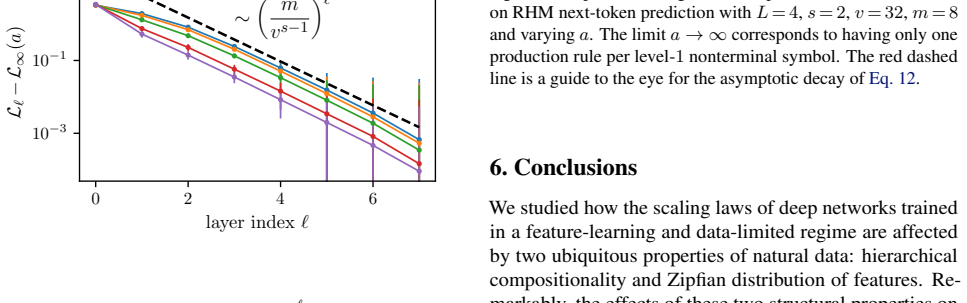
Train a deep transformer on next-token RHM data (e.g. $s=2$, $v=32$, $m=8$, $L=4$) with $a=0.2$ and $a=4$, and compare the late slopes of $L(P)-L_\infty(a)$ on a log-log plot: Eq. (12) says both approach $P^{-\log(4/32)/(2\log 8)}$, so any systematic slope separation would refute the claimed independence; similarly, classification curves should exhibit slopes $-a/(1+a)$ after the $v m^{L-1}$ rescaling.
Extended reading notes
Core claim
The central discovery is that, within the Random Hierarchy Model with one layer of power-law rule frequencies $f_k \propto k^{-(1+a)}$, the task determines which ingredient sets the scaling exponent. Classification errors obey $\varepsilon(P)=1-(\sum_{k:P_k^*<P} f_k)^{s^{L-1}}$, which for $P \gg v m^{L-1}$ becomes $s^{L-1}(P/(v m^{L-1}))^{-a/(1+a)}$; the hierarchy contributes a large constant and delayed onset, not the exponent. Next-token prediction first passes through an $s$-gram memorisation stage with the Zipf exponent, but the long-distance reconstruction of the hidden tree follows sample complexities $P_{\ell,k}=v m^{2\ell-3}(1-m/v^{s-1})f_k(\sum_{k'}f_{k'}^2)$, whose level-dependence is the same as in the uniform case, so the asymptotic excess loss decays as $P^{-\log(m/v^{s-1})/(2\log m)}$ independent of $a$. The paper thereby unifies the power-law-units view and the hierarchical-structure view by showing that both are right, each for a different task.
Load-bearing premise
The derivation relies on Assumption 3.1, that a rule is learned exactly when its correlation signal becomes detectable in finite data, and, for classification in the strict regime, on the requirement that all $s^{L-1}$ patches be resolved, which is guaranteed only when $m=v^{s-1}$; neither premise is derived from gradient-descent dynamics.
Editorial extensions
If this is right
- Classification error on Zipf-RHM data decays as $\varepsilon(P)\sim s^{L-1}(P/(v m^{L-1}))^{-a/(1+a)}$; larger $a$ yields faster decay, while $L$ and $m$ set the horizontal offset of the power law.
- The sigmoidal learning curve of the uniform RHM becomes a power law once rule frequencies are uneven, so the same hierarchy can look qualitatively different under different feature statistics.
- Next-token prediction retains its exponent $-\log(m/v^{s-1})/(2\log m)$ for all $a$, meaning that the long-range structure of language-like data, not token frequency, controls the late-time learning curve.
- The first stage of next-token prediction is $s$-gram memorisation with exponent $a/(1+a)$; this stage is visible in early data but disappears from the asymptotics.
- All classification curves collapse when $P$ is rescaled by $v m^{L-1}$, providing a direct experimental signature of the hierarchy's contribution.
Reading between the lines
- A testable extension: putting Zipf rules on two layers should make input probabilities products of Zipf factors; the classification exponent may then interpolate between $a/(1+a)$ and a combination of the layer exponents rather than the single-layer value.
- An architectural prediction follows from Assumption 3.1: different optimizers could shift the $P$ thresholds at which rules are learned, changing prefactors and crossover locations while leaving the asymptotic exponents intact.
- For real language corpora this implies a cross-corpus diagnostic: if late next-token slopes vary with token-frequency distribution at fixed branching structure, some ingredient beyond this tree hierarchy is active.
- For real classification datasets, a long pre-asymptotic plateau can coexist with a strong final power law, so measuring only short-data performance would underestimate the asymptotic learning rate.
Signed reviews
Editorial analysis
A structured set of objections, weighed in public.
Referee Report
Summary. This paper studies neural scaling laws in a Random Hierarchy Model (RHM) in which production rules follow a Zipf distribution. For classification, it derives the asymptotic learning curve ε(P) ≃ s^{L-1}(P/(v m^{L-1}))^{-a/(1+a)} (Eq. 8), implying that the Zipf exponent a sets the power-law decay while the hierarchy sets a multiplicative pre-asymptotic scale. For next-token prediction, it argues that the asymptotic exponent remains -log(m/v^{s-1})/(2 log m) (Eq. 12), independent of the rule distribution, and that Zipf statistics only modify finite-size corrections. The theory is built on Assumption 3.1, which asserts that each production rule is learned as soon as its correlation signal exceeds sampling noise; all main results follow from this sharp threshold. The predictions are tested with deep CNNs for classification and deep transformers for next-token prediction, with code available online.
Significance. If the results hold, the paper offers a concrete unification of two strands of scaling-law theory: it shows how power-law distributed features (the Hutter mechanism) and hierarchical composition interact, with the classification exponent a/(1+a) directly inherited from the rule distribution and the next-token exponent governed by the tree structure alone. The derivations are transparent, the asymptotic calculations in Appendix B are standard, and the empirical validation spans two architectures with publicly released code. The predictions are falsifiable: the data collapse under P/(v m^{L-1}) for classification and the invariance of the next-token exponent across a are crisp experimental signatures. The principal caveat is the heuristic nature of Assumption 3.1 and the restriction of the classification derivation to the m = v^{s-1} regime, which limits the generality of the abstract claims until those points are addressed.
major comments (3)
- [Section 3.2 (Assumption 3.1) and its use in Sections 4.1 and 5.1] The central results hinge on Assumption 3.1, which asserts that a production rule is learned exactly when its effect on correlations can be detected from the training data. This is a sharp threshold that is not derived from gradient-descent dynamics. Under the alternative scaling P*_k ∝ f_k^{-β} with β ≠ 1, the classification exponent in Eq. (8) would become β a/(1+β a), breaking the claimed unification with Hutter's memorization exponent. I recommend either deriving Assumption 3.1 in a tractable setting (for example, a linear network or online SGD with a single rule) or providing a direct empirical test of the per-rule sample complexity P*(f) across a range of f. The current experiments validate the aggregate learning curve, not the per-rule threshold.
- [Section 4.1, Eq. (7) and footnote 2] Equation (7) is derived under the condition that classification succeeds only when all s^{L-1} input patches are resolvable, which the authors acknowledge is exact only when m = v^{s-1}. For m < v^{s-1}, the root can sometimes be inferred without resolving every patch, so the prefactor and possibly the exponent in Eq. (8) are not established outside the tested regime; all classification experiments in Figs. 2-3 and Appendix C use m = v. Since the abstract presents the exponent a/(1+a) as a general result for hierarchical compositional data, the paper should either restrict the claim to m = v^{s-1} or extend the derivation using the optimal-decoder probability from Sclocchi et al. (2024).
- [Section 4.2] The claim that power-law distributed rules at an arbitrary layer ℓ ≠ 1 lead to the same classification exponent is only sketched in one paragraph; no derivation is given for how the variance and sample-complexity arguments of Section 4.1 generalize to higher layers. The empirical evidence in Fig. 2 (right) and Fig. 7 supports the claim, but the theory as written covers only level-1 nonuniformity. If the intended contribution is the general statement that the classification exponent depends on the rule distribution, this gap should be closed or the contribution restated.
minor comments (4)
- [Section 5, opening sentence] The phrase 'Assumption Theorem 3.1' appears to be a typo and should read 'Assumption 3.1'.
- [Section 5.1, paragraph on sampling variance] The sampling variance is written as 'f_k(µ)/(v^2P)^{-1}'; the exponent appears to be a typo and should read f_k(µ)/(v^2 P).
- [Section 1.1, third bullet] The sentence 'decays asymptotically as P^{−a/(1+a)} with the;' is incomplete and should be finished.
- [Equation (18) and Appendix E] The quantity H_{2,a,m} is used in Eq. (18) without being defined in the main text; a brief definition or a pointer to Appendix E in the main text would improve readability.
Circularity Check
No significant circularity: the paper's scaling-law predictions follow from its explicit Assumption 3.1 and from independent, parameter-free variance calculations, not from fitted parameters or self-citation chains.
full rationale
The derivation chain is self-contained in the sense required by this review. For classification, Eq. (8) is obtained from Eq. (7), which in turn follows from the correlation-variance calculation around Eq. (6): the per-rule sample complexity P*_k = v m^{L-1}/f_k is computed by balancing the signal variance f_k^2/(v^3 m^{L-1}) against the sampling noise f_k/(v^2 P), then Zipf's law f_k ∝ k^{-(1+a)} is inserted and Appendix B evaluates the resulting tail sum with Euler-Maclaurin. No parameter is fitted to the target learning curve; the dotted lines in Figs. 2-3 are direct evaluations of Eq. (7). For next-token prediction, the Zipf-independence claim follows from the derived variance formula (Eq. 13) and sample complexity (Eq. 14), which share the same level-ℓ scaling as the uniform case, combined with the computed s^ℓ-gram entropies (Eq. 18); the final exponent is then obtained algebraically. The self-citations to Cagnetta et al. (2024) and Cagnetta & Wyart (2024) provide the uniform-RHM variance and uniform scaling law as building blocks; these are independent published results, and the new Zipf dependence is added, not assumed away. Assumption 3.1 is an openly stated modeling hypothesis connecting statistical detectability to learning; it is not a re-definition of the predicted quantity, and the paper explicitly footnotes the regime (m = v^{s-1}) where the 'all patches must be resolved' condition is exact. Thus there is no concrete step where an output equals an input by construction or where a fitted constant absorbs the target exponent.
Assumptions & free parameters
assumptions (6)
- domain assumption Data are generated by an RHM/PCFG with L layers of v nonterminal symbols, branching s, m unambiguous production rules per symbol, and production-rule probabilities f_k proportional to k^{-(1+a)} in one layer and uniform elsewhere.
- ad hoc to paper Assumption 3.1: each production rule is learnt exactly when its effect on correlations can be detected from training data.
- ad hoc to paper For classification, the model classifies correctly iff all s^{L-1} input patches are resolvable; if m < v^{s-1} the root might be inferable without all patches.
- ad hoc to paper For next-token prediction, the first learning step is memorization of s-tuples (Hutter's regime) and subsequent steps reconstruct the tree using token-token correlations.
- domain assumption Uniform-RHM correlation variances, sample complexities, and the uniform next-token scaling law are taken from prior work.
- domain assumption Asymptotic limits used: large vocabulary v, 1 << m << v^{s-1}, and neglect of |Vc,ell| > 2 for cross-entropies.
Cite this review
Pith. "Pith review of Learning curves theory for hierarchically compositional data with power-law distributed features." pith.science (2026). https://pith.science/paper/BZLTA3UV
@misc{pith2026250507067,
  author       = {Pith},
  title        = {Pith review of: Learning curves theory for hierarchically compositional data with power-law distributed features},
  year         = {2026},
  howpublished = {\url{https://pith.science/paper/BZLTA3UV}},
  note         = {Machine review of arXiv:2505.07067}
}
read the original abstract
Recent theories suggest that Neural Scaling Laws arise whenever the task is linearly decomposed into power-law distributed units. Alternatively, scaling laws also emerge when data exhibit a hierarchically compositional structure, as is thought to occur in language and images. To unify these views, we consider classification and next-token prediction tasks based on probabilistic context-free grammars -- probabilistic models that generate data via a hierarchy of production rules. For classification, we show that having power-law distributed production rules results in a power-law learning curve with an exponent depending on the rules' distribution and a large multiplicative constant that depends on the hierarchical structure. By contrast, for next-token prediction, the distribution of production rules controls the local details of the learning curve, but not the exponent describing the large-scale behaviour.
Figures


Figures from the paper (5 more)




Forward citations
Cited by 1 Pith paper
-
Bigger Isn't Always Memorizing: Early Stopping Overparameterized Diffusion Models
In overparameterized diffusion models, generalization happens first and memorization starts later, with the memorization time growing linearly with dataset size.
Reference graph
Works this paper leans on
-
[1]
write newline
" write newline "" before.all 'output.state := FUNCTION n.dashify 't := "" t empty not t #1 #1 substring "-" = t #1 #2 substring "--" = not "--" * t #2 global.max substring 't := t #1 #1 substring "-" = "-" * t #2 global.max substring 't := while if t #1 #1 substring * t #2 global.max substring 't := if while FUNCTION format.date year duplicate empty "emp...
-
[2]
A., Goyal, N., and Tsvetkov, Y
Ahuja, K., Balachandran, V., Panwar, M., He, T., Smith, N. A., Goyal, N., and Tsvetkov, Y. Learning syntax without planting trees: Understanding when and why transformers generalize hierarchically. arXiv preprint arXiv:2404.16367, 2024
arXiv 2024
- [3]
-
[4]
Explaining neural scaling laws
Bahri, Y., Dyer, E., Kaplan, J., Lee, J., and Sharma, U. Explaining neural scaling laws. arXiv preprint arXiv:2102.06701, 2021
arXiv 2021
-
[5]
Spectrum dependent learning curves in kernel regression and wide neural networks
Bordelon, B., Canatar, A., and Pehlevan, C. Spectrum dependent learning curves in kernel regression and wide neural networks. In International Conference on Machine Learning, pp.\ 1024--1034. PMLR, 2020
2020
-
[6]
A dynamical model of neural scaling laws
Bordelon, B., Atanasov, A., and Pehlevan, C. A dynamical model of neural scaling laws. In Forty-first International Conference on Machine Learning, 2024. URL https://openreview.net/forum?id=nbOY1OmtRc
work page 2024
-
[7]
Borenstein, N., Svete, A., Chan, R., Valvoda, J., Nowak, F., Augenstein, I., Chodroff, E., and Cotterell, R. What languages are easy to language-model? a perspective from learning probabilistic regular languages. arXiv preprint arXiv:2406.04289, 2024
arXiv 2024
-
[8]
Cagnetta, F. and Wyart, M. Towards a theory of how the structure of language is acquired by deep neural networks. In The Thirty-eighth Annual Conference on Neural Information Processing Systems, 2024. URL https://openreview.net/forum?id=NaCXcUKihH
work page 2024
Show all 44 references
-
[9]
What can be learnt with wide convolutional neural networks? In International Conference on Machine Learning, pp.\ 3347--3379
Cagnetta, F., Favero, A., and Wyart, M. What can be learnt with wide convolutional neural networks? In International Conference on Machine Learning, pp.\ 3347--3379. PMLR, 2023
2023
-
[10]
M., Favero, A., and Wyart, M
Cagnetta, F., Petrini, L., Tomasini, U. M., Favero, A., and Wyart, M. How deep neural networks learn compositional data: The random hierarchy model. Phys. Rev. X, 14: 0 031001, Jul 2024. doi:10.1103/PhysRevX.14.031001. URL https://link.aps.org/doi/10.1103/PhysRevX.14.031001
2024 doi
-
[11]
and De Vito, E
Caponnetto, A. and De Vito, E. Optimal rates for the regularized least-squares algorithm. Foundations of Computational Mathematics, 7: 0 331--368, 2007
2007
-
[12]
Zipf’s law for word frequencies: Word forms versus lemmas in long texts
Corral, A., Boleda, G., and Ferrer-i Cancho, R. Zipf’s law for word frequencies: Word forms versus lemmas in long texts. PLOS ONE, 10 0 (7): 0 e0129031, 2015. ISSN 1932-6203. doi:10.1371/journal.pone.0129031. URL http://dx.doi.org/10.1371/journal.pone.0129031
2015 doi
-
[13]
Locality defeats the curse of dimensionality in convolutional teacher-student scenarios
Favero, A., Cagnetta, F., and Wyart, M. Locality defeats the curse of dimensionality in convolutional teacher-student scenarios. In Beygelzimer, A., Dauphin, Y., Liang, P., and Vaughan, J. W. (eds.), Advances in Neural Information Processing Systems, 2021. URL https://openrevi...
2021
-
[14]
How transformers learn structured data: insights from hierarchical filtering
Garnier-Brun, J., M \'e zard, M., Moscato, E., and Saglietti, L. How transformers learn structured data: insights from hierarchical filtering. arXiv preprint arXiv:2408.15138, 2024
2024 arXiv
-
[15]
Hestness, J., Narang, S., Ardalani, N., Diamos, G., Jun, H., Kianinejad, H., Patwary, M. M. A., Yang, Y., and Zhou, Y. Deep learning scaling is predictable, empirically. arXiv preprint arXiv:1712.00409, 2017
2017 arXiv
-
[16]
A., Welbl, J., Clark, A., Hennigan, T., Noland, E., Millican, K., van den Driessche, G., Damoc, B., Guy, A., Osindero, S., Simonyan, K., Elsen, E., Vinyals, O., Rae, J
Hoffmann, J., Borgeaud, S., Mensch, A., Buchatskaya, E., Cai, T., Rutherford, E., de las Casas, D., Hendricks, L. A., Welbl, J., Clark, A., Hennigan, T., Noland, E., Millican, K., van den Driessche, G., Damoc, B., Guy, A., Osindero, S., Simonyan, K., Elsen, E., Vinyals, O., Ra...
2022
-
[17]
Learning curve theory
Hutter, M. Learning curve theory. arXiv preprint arXiv:2102.04074, 2021
2021 arXiv
-
[18]
Joshi, A. K. Tree adjoining grammars: How much context-sensitivity is required to provide reasonable structural descriptions? In Dowty, D. R., Karttunen, L., and Zwicky, A. M. (eds.), Natural Language Parsing: Psychological, Computational, and Theoretical Perspectives, pp.\ 20...
1985
-
[19]
B., Chess, B., Child, R., Gray, S., Radford, A., Wu, J., and Amodei, D
Kaplan, J., McCandlish, S., Henighan, T., Brown, T. B., Chess, B., Child, R., Gray, S., Radford, A., Wu, J., and Amodei, D. Scaling laws for neural language models. arXiv preprint arXiv:2001.08361, 2020
2001 arXiv
-
[20]
Knuth, D. E. Semantics of context-free languages. Mathematical systems theory, 2 0 (2): 0 127--145, 1968
1968
-
[21]
M., Bartlett, P., and Lee, J
Lin, L., Wu, J., Kakade, S. M., Bartlett, P., and Lee, J. D. Scaling laws in linear regression: Compute, parameters, and data. In The Thirty-eighth Annual Conference on Neural Information Processing Systems, 2024. URL https://openreview.net/forum?id=PH7sdEanXP
2024
-
[22]
and Shalev-Shwartz, S
Malach, E. and Shalev-Shwartz, S. A provably correct algorithm for deep learning that actually works. Preprint at http://arxiv.org/abs/1803.09522, 2018. URL http://arxiv.org/abs/1803.09522
2018 arXiv
-
[23]
and Shalev-Shwartz, S
Malach, E. and Shalev-Shwartz, S. The implications of local correlation on learning some deep functions. In Advances in Neural Information Processing Systems, volume 33, pp.\ 1322--1332, 2020. URL https://proceedings.neurips.cc/paper_files/paper/2020/file/0e4ceef65add6cf21c0f3...
2020
-
[24]
A., and Sully, J
Maloney, A., Roberts, D. A., and Sully, J. A solvable model of neural scaling laws. arXiv:2210.16859, 2022
2022 arXiv
-
[25]
T., Frank, R., and Linzen, T
McCoy, R. T., Frank, R., and Linzen, T. Does syntax need to grow on trees? sources of hierarchical inductive bias in sequence-to-sequence networks. Transactions of the Association for Computational Linguistics, 8: 0 125--140, 2020. doi:10.1162/tacl_a_00304. URL https://aclanth...
2020 doi
-
[26]
U-nets as belief propagation: Efficient classification, denoising, and diffusion in generative hierarchical models
Mei, S. U-nets as belief propagation: Efficient classification, denoising, and diffusion in generative hierarchical models. arXiv preprint arXiv:2404.18444, 2024
2024 arXiv
-
[27]
J., Liu, Z., Girit, U., and Tegmark, M
Michaud, E. J., Liu, Z., Girit, U., and Tegmark, M. The quantization model of neural scaling. In Thirty-seventh Conference on Neural Information Processing Systems, 2023. URL https://openreview.net/forum?id=3tbTw2ga8K
2023
-
[28]
Understanding transformers via n-gram statistics
Nguyen, T. Understanding transformers via n-gram statistics. In The Thirty-eighth Annual Conference on Neural Information Processing Systems, 2024. URL https://openreview.net/forum?id=WCc440cUhX
2024
-
[29]
A statistical theory of contrastive pre-training and multimodal generative ai
Oko, K., Lin, L., Cai, Y., and Mei, S. A statistical theory of contrastive pre-training and multimodal generative ai. arXiv preprint arXiv:2501.04641, 2025
2025
-
[30]
Gpt-4 technical report
OpenAI. Gpt-4 technical report. 2023
2023
-
[31]
PyTorch : An Imperative Style , High - Performance Deep Learning Library
Paszke, A., Gross, S., Massa, F., Lerer, A., Bradbury, J., Chanan, G., Killeen, T., Lin, Z., Gimelshein, N., Antiga, L., Desmaison, A., Kopf, A., Yang, E., DeVito, Z., Raison, M., Tejani, A., Chilamkurthy, S., Steiner, B., Fang, L., Bai, J., and Chintala, S. PyTorch : An Imper...
2019
-
[32]
Pullum, G. K. and Gazdar, G. Natural languages and context-free languages. Linguist. Philos., 4 0 (4): 0 471--504, 1982. doi:10.1007/BF00360802
1982 doi
-
[33]
and Salomaa, A
Rozenberg, G. and Salomaa, A. Handbook of Formal Languages . Springer, 1997. doi:10.1007/978-3-642-59126-6
1997 doi
-
[34]
I., and Wyart, M
Sclocchi, A., Favero, A., Levi, N. I., and Wyart, M. Probing the latent hierarchical structure of data via diffusion models. arXiv preprint arXiv:2410.13770, 2024
2024 arXiv
-
[35]
A phase transition in diffusion models reveals the hierarchical nature of data
Sclocchi, A., Favero, A., and Wyart, M. A phase transition in diffusion models reveals the hierarchical nature of data. Proceedings of the National Academy of Sciences, 122 0 (1): 0 e2408799121, 2025. doi:10.1073/pnas.2408799121. URL https://www.pnas.org/doi/abs/10.1073/pnas.2...
2025 doi
-
[36]
S., Marzen, S
Shai, A. S., Marzen, S. E., Teixeira, L., Oldenziel, A. G., and Riechers, P. M. Transformers represent belief state geometry in their residual stream. arXiv preprint arXiv:2405.15943, 2024
2024 arXiv
-
[37]
Asymptotic learning curves of kernel methods: empirical data versus teacher–student paradigm
Spigler, S., Geiger, M., and Wyart, M. Asymptotic learning curves of kernel methods: empirical data versus teacher–student paradigm. Journal of Statistical Mechanics: Theory and Experiment, 2020 0 (12), 2020
2020
-
[38]
and Cotterell, R
Svete, A. and Cotterell, R. Transformers can represent n -gram language models. arXiv preprint arXiv:2404.14994, 2024
2024 arXiv
-
[39]
Can transformers learn n -gram language models? arXiv preprint arXiv:2410.03001, 2024
Svete, A., Borenstein, N., Zhou, M., Augenstein, I., and Cotterell, R. Can transformers learn n -gram language models? arXiv preprint arXiv:2410.03001, 2024
2024 arXiv
-
[40]
Tomasini, U. M. and Wyart, M. How deep networks learn sparse and hierarchical data: the sparse random hierarchy model. In Forty-first International Conference on Machine Learning, 2024. URL https://openreview.net/forum?id=CtEWswTjUd
2024
-
[41]
N., Kaiser, ., and Polosukhin, I
Vaswani, A., Shazeer, N., Parmar, N., Uszkoreit, J., Jones, L., Gomez, A. N., Kaiser, ., and Polosukhin, I. Attention is all you need. Advances in neural information processing systems, 30, 2017
2017
-
[42]
and Hu, E
Yang, G. and Hu, E. J. Feature learning in infinite-width neural networks. arXiv preprint arXiv:2011.14522, 2020
2011 arXiv
-
[43]
Do transformers parse while predicting the masked word? arXiv preprint arXiv:2303.08117, 2023
Zhao, H., Panigrahi, A., Ge, R., and Arora, S. Do transformers parse while predicting the masked word? arXiv preprint arXiv:2303.08117, 2023
2023 arXiv
-
[44]
and Mumford, D
Zhu, S.-C. and Mumford, D. A stochastic grammar of images. Found. Trends Comput. Graph. Vis., 2 0 (4): 0 259--362, 2006. doi:10.1561/0600000017
2006 doi
Reviewed August 15, 2026 · model on record in the stance chip above.
Discussion (0). Continue with ORCID to comment.