REVIEW 3 major objections 5 minor 34 references
Towards a deeper GCN: Alleviate over-smoothing with iterative training and fine-tuning
T0 review · 3 major / 5 minor · reviewed 2026-08-06 · deepseek-v4-flash
Pith's one-line read Trainable linear transformations in GCNs drive over-smoothing, and a gradual layer-wise training schedule with identity initialization and low-rank fine-tuning keeps plain GCNs accurate at 32 layers.
desk verdict LGT is a genuinely useful training recipe for deep GCNs, but the paper's causal story about linear transformations driving over-smoothing is not supported by the SGC comparison. read the letter →
The pith
A machine-rendered reading of the paper's core claim, the machinery that carries it, and where it could break.
The reading
What carries the argument
The central object is Layer-wise Gradual Training (LGT), a training schedule with three components: incremental layer-wise training adds one layer at a time and freezes earlier ones; low-rank adaptation writes each frozen weight as $W_0 + AB$ with a small rank $r$ so shallow layers stay lightly trainable; identity initialization starts every new layer at the identity matrix so it passes representations through unchanged at first. Together these isolate newly added parameters from the already stabilized network, so depth grows without a sudden random perturbation that collapses features.
What would settle it
Train an SGC-style network that keeps per-layer nonlinear activations but fixes all linear weights at the identity (SGC plus ReLU). If its accuracy and feature diversity collapse by 8 layers, the collapse is not caused by trainable linear transformations.
Extended reading notes
Core claim
The paper's central claim is that trainable linear transformations in GCN layers, rather than repeated Laplacian propagation alone, are a primary accelerant of over-smoothing: on Cora, standard GCN accuracy drops to about 40% at 32 layers while SGC, which removes learned weights, stays near 70%. To keep expressiveness while avoiding collapse, the paper proposes LGT and reports that GCN+LGT reaches around 81% on Cora at 32 layers and similarly strong results on Citeseer, Pubmed, and AmazonPhoto, outperforming vanilla GCN, SGC, and several anti-over-smoothing baselines. LGT also improves PairNorm and ContraNorm in most tested settings and cuts training time by avoiding full-model retraining.
Load-bearing premise
The diagnosis rests on the SGC comparison, which removes linear transformations together with nonlinearities and layer collapse, so the stability of SGC at 32 layers does not isolate the effect of the learned weights.
Editorial extensions
If this is right
- A vanilla GCN can be trained to 32 layers with accuracy comparable to specialized anti-over-smoothing architectures, so depth itself need not force an architecture change.
- Normalization-based methods such as PairNorm and ContraNorm inherit the training-efficiency and accuracy gains, so LGT can be stacked on top of existing fixes.
- Because LGT only changes the training schedule, it applies to any GCN-like model without modifying the forward pass or the graph structure.
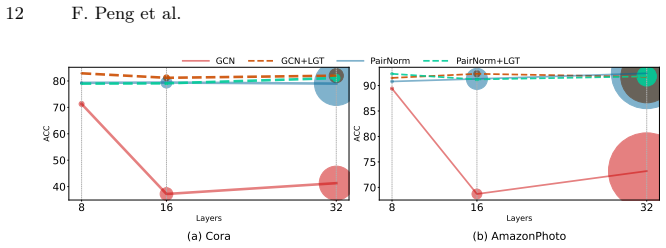
- Deep GCN training becomes cheaper: since only the newest layer is fully trained and older layers are lightly adapted, reported training time drops substantially at 8, 16, and 32 layers.
Reading between the lines
- Inference: if the diagnosis is right, the same staged schedule should transfer to attention-based or message-passing architectures with learned per-layer maps, such as GAT, without architectural changes.
- Inference: the paper's account predicts a new test: monitoring feature diversity (for example Dirichlet energy) across LGT stages would show diversity preserved during the schedule, not just at the final layer; this is not reported.
- Inference: a cheaper variant might drop LoRA and rely on identity initialization alone for some datasets; the paper's ablations show LoRA helps at depth, but the interaction is data-dependent.
- Inference: the role of the learned weight matrices could be probed by freezing all layers at identity after their initial stage, which would separate the benefit of the schedule from the benefit of continued light adaptation.
Editorial analysis
A structured set of objections, weighed in public.
Referee Report
Summary. The paper argues that over-smoothing in deep GCNs is driven not only by repeated Laplacian propagation but also by trainable linear transformations, and it proposes Layer-wise Gradual Training (LGT), which combines incremental layer-wise training, LoRA-based fine-tuning of frozen layers, and identity initialization of newly added layers. LGT is evaluated on Cora, Citeseer, Pubmed, and AmazonPhoto for depths 4, 8, 16, and 32, and is also combined with PairNorm and ContraNorm. The authors report large accuracy gains over plain GCNs, improved training efficiency, and state-of-the-art performance for deep vanilla GCNs.
Significance. If the causal claim were established, the paper would make a useful contribution by reframing over-smoothing as partly an optimization problem and by offering a training-side remedy that is compatible with normalization-based methods. The LGT recipe is simple, the code is public, and the ablation in Figure 4 gives some support for the contribution of each component. However, the central diagnostic claim rests on a confounded comparison, the state-of-the-art claim is not supported by the included baselines, and one reported training-time result contradicts the efficiency claim. The empirical improvement of deep GCNs with LGT is plausible and interesting, but the paper's scientific and comparative claims need substantial revision.
major comments (3)
- [Section 1, Figure 1, Section 4] The central diagnostic claim—that trainable linear transformations, rather than the graph Laplacian, are a primary driver of over-smoothing—is not established by the evidence presented. Figure 1 compares GCN with SGC, but SGC differs from GCN in three simultaneous ways: it removes per-layer nonlinearities, collapses the stacked propagation into a single matrix power, and reduces trainable weights to a final classifier. Any of these differences could explain SGC's stability at 32 layers, so the comparison cannot isolate the effect of trainable linear transformations. Section 4 repeats this attribution when motivating LGT, and the paper's own conclusion concedes that no theoretical analysis is provided. To support the claim, the authors should add controlled experiments that vary only the trainability of the linear weights at fixed depth and nonlinearity (e.g., a deep GCN with frozen or identity-initialized weights versus trained weights), and report a quantitative feature-collapse measure such as Dirichlet energy rather than relying on accuracy and t-SNE plots alone.
- [Section 5.1, Table 2] The claim that LGT achieves 'state-of-the-art performance on vanilla GCN' is substantially overstated. Table 2 compares LGT only against SGC, IresGCN, PSNR, PairNorm, ContraNorm, and vanilla GCN; standard deep-GCN baselines such as GCNII, JK-Net, and DropEdge—which are discussed in Section 2.1—are missing. Moreover, GCN+LGT does not consistently outperform the included baselines: on AmazonPhoto at 32 layers, IresGCN reaches 91.68% versus 91.34% for GCN+LGT, and on several settings PairNorm+LGT is worse than PairNorm itself (e.g., Citeseer at 16 layers: 65.12% versus 66.66%). The 'state-of-the-art' wording should be replaced by a more precise claim, and the missing baselines should be added or the comparison scope stated explicitly.
- [Section 5.4, Table 3] Table 3 contradicts the efficiency claim that LGT 'significantly reduces training time.' On AmazonPhoto at 16 layers, GCN+LGT requires 1452 seconds versus 228 seconds for vanilla GCN, an increase of more than sixfold, and at 8 layers GCN+LGT (41s) is only marginally faster than GCN (72s) despite the qualitative claim in Figure 5. The authors should either correct the table, explain the anomaly (e.g., different hardware or LoRA rank settings), or restrict the efficiency claim to the settings where it actually holds; as written, Section 5.4's central assertion is not supported by its own data.
minor comments (5)
- [Section 5.5] In the rank analysis paragraph, 'shadow networks' should read 'shallow networks.'
- [References] Reference [10] contains a typo: 'International onference' should be 'International Conference.'
- [Section 5.1] The experimental setup does not report key hyperparameters such as the number of stages, epochs per stage, early stopping patience, learning rate, or LoRA rank per dataset; the code link alone is insufficient for reproducibility.
- [Figure 1 and Section 5.2] The caption and text describe SGC as maintaining 'stable performance,' but SGC accuracy on Cora drops from 79.88% at 4 layers to 69.62% at 32 layers, so 'stable' should be qualified.
- [Abstract, Table 2] The abstract's statement that LGT 'further enhances' PairNorm and ContraNorm is too broad; Table 2 shows several settings where PairNorm+LGT or ContraNorm+LGT is worse than the base method, so the compatibility claim should be stated as improving performance in most but not all settings.
Circularity Check
No circularity: the method is evaluated on held-out accuracy against external baselines, and the SGC comparison, while confounded, is an experimental-validity concern rather than a circular derivation.
full rationale
The paper's central empirical claim is supported by an independent comparison against an external baseline (SGC, Wu et al. 2019), and its method (LGT) is evaluated on held-out test accuracy across four datasets against external baselines. No parameter is fitted to the target quantity and then renamed as a prediction: the only validation-based selection is the LoRA rank (Section 5.5), which is a hyperparameter choice and not presented as a test of the over-smoothing mechanism. The single self-citation, [21] in Section 3, is used only to reference evaluation methodology and is not load-bearing. The SGC-vs-GCN contrast in Figure 1 is confounded (SGC removes nonlinearities and collapses depth as well as per-layer linear transforms), but that is an experimental-validity concern, not circularity: the contrast is not defined in terms of the paper's own claims, and LGT's reported gains do not reduce to the SGC comparison by construction. No equation in the paper defines a predicted quantity in terms of its own input or imports a uniqueness theorem from the authors' prior work. Accordingly, no circular step is present.
Assumptions & free parameters
free parameters (2)
- LoRA rank r =
10 (recommended, searched over {2, 10, 20, 32})
- Stage schedule and per-stage epochs =
not reported
assumptions (3)
- domain assumption The normalized graph Laplacian propagation (Eq. 1) is the correct model for GCN message passing.
- domain assumption The over-smoothing limit (Eq. 3), convergence to a constant matrix, is the operational definition of the problem.
- ad hoc to paper The comparison of GCN vs SGC in Figure 1 isolates the effect of removing trainable linear transformations.
Cite this review
Pith. "Pith review of Towards a deeper GCN: Alleviate over-smoothing with iterative training and fine-tuning." pith.science (2026). https://pith.science/paper/BZR3IM26
@misc{pith2026250617576,
  author       = {Pith},
  title        = {Pith review of: Towards a deeper GCN: Alleviate over-smoothing with iterative training and fine-tuning},
  year         = {2026},
  howpublished = {\url{https://pith.science/paper/BZR3IM26}},
  note         = {Machine review of arXiv:2506.17576}
}
read the original abstract
Graph Convolutional Networks (GCNs) suffer from severe performance degradation in deep architectures due to over-smoothing. While existing studies primarily attribute the over-smoothing to repeated applications of graph Laplacian operators, our empirical analysis reveals a critical yet overlooked factor: trainable linear transformations in GCNs significantly exacerbate feature collapse, even at moderate depths (e.g., 8 layers). In contrast, Simplified Graph Convolution (SGC), which removes these transformations, maintains stable feature diversity up to 32 layers, highlighting linear transformations' dual role in facilitating expressive power and inducing over-smoothing. However, completely removing linear transformations weakens the model's expressive capacity. To address this trade-off, we propose Layer-wise Gradual Training (LGT), a novel training strategy that progressively builds deep GCNs while preserving their expressiveness. LGT integrates three complementary components: (1) layer-wise training to stabilize optimization from shallow to deep layers, (2) low-rank adaptation to fine-tune shallow layers and accelerate training, and (3) identity initialization to ensure smooth integration of new layers and accelerate convergence. Extensive experiments on benchmark datasets demonstrate that LGT achieves state-of-the-art performance on vanilla GCN, significantly improving accuracy even in 32-layer settings. Moreover, as a training method, LGT can be seamlessly combined with existing methods such as PairNorm and ContraNorm, further enhancing their performance in deeper networks. LGT offers a general, architecture-agnostic training framework for scalable deep GCNs. The code is available at [https://github.com/jfklasdfj/LGT_GCN].
Figures


Figures from the paper (4 more)



Reference graph
Works this paper leans on
-
[1]
In: Proceedings of the AAAI conference on artificial intelligence
Chen, D., Lin, Y., Li, W., Li, P., Zhou, J., Sun, X.: Measuring and relieving the over-smoothing problem for graph neural networks from the topological view. In: Proceedings of the AAAI conference on artificial intelligence. vol. 34, pp. 3438–3445 (2020)
2020
-
[2]
Chen,M.,Wei,Z.,Huang,Z.,Ding,B.,Li,Y.:Simpleanddeepgraphconvolutional networks. In: III, H.D., Singh, A. (eds.) Proceedings of the 37th International Conference on Machine Learning. Proceedings of Machine Learning Research, vol. 119, pp. 1725–1735. PMLR (13–18 Jul 2020)
work page 2020
-
[3]
Chen, Y., Tang, X., Qi, X., Li, C.G., Xiao, R.: Learning graph normalization for graph neural networks. Neurocomputing493, 613–625 (2022).https://doi.org/ https://doi.org/https://doi.org/10.1016/j.neucom.2022.01.003
-
[4]
Advances in neural information processing systems29(2016)
Defferrard, M., Bresson, X., Vandergheynst, P.: Convolutional neural networks on graphs with fast localized spectral filtering. Advances in neural information processing systems29(2016)
work page 2016
-
[5]
WWW ’19, Association for Computing Machinery, New York, NY, USA (2019)
Fan, W., Ma, Y., Li, Q., He, Y., Zhao, E., Tang, J., Yin, D.: Graph neural net worksforsocialrecommendation.In:TheWorldWideWebConference.p.417–426. WWW ’19, Association for Computing Machinery, New York, NY, USA (2019)
work page 2019
-
[6]
Advances in neural information processing systems33, 22092–22103 (2020)
Feng,W.,Zhang,J.,Dong,Y.,Han,Y.,Luan,H.,Xu,Q.,Yang,Q.,Kharlamov,E., Tang, J.: Graph random neural networks for semi-supervised learning on graphs. Advances in neural information processing systems33, 22092–22103 (2020)
work page 2020
-
[7]
In: Proceedings of the Third ACM Conference on Digital Libraries
Giles, C.L., Bollacker, K.D., Lawrence, S.: Citeseer: an automatic citation indexing system. In: Proceedings of the Third ACM Conference on Digital Libraries. p. 89–98. DL ’98, Association for Computing Machinery, New York, NY, USA (1998). https://doi.org/https://doi.org/10.1145/276675.276685
arXiv 1998
-
[8]
In: Proceedings of the 34th International Confer- ence on Machine Learning - Volume 70
Gilmer, J., Schoenholz, S.S., Riley, P.F., Vinyals, O., Dahl, G.E.: Neural message passing for quantum chemistry. In: Proceedings of the 34th International Confer- ence on Machine Learning - Volume 70. p. 1263–1272. ICML’17, JMLR.org (2017)
work page 2017
Show all 34 references
-
[9]
In: The Eleventh International Conference on Learning Representations (2023)
Guo, X., Wang, Y., Du, T., Wang, Y.: Contranorm: A contrastive learning per- spective on oversmoothing and beyond. In: The Eleventh International Conference on Learning Representations (2023)
2023
-
[10]
In: International onference on Learning Representations (2022)
Hu, E.J., Shen, Y., Wallis, P., Allen-Zhu, Z., Li, Y., Wang, S., Wang, L., Chen, W.: LoRA: Low-rank adaptation of large language models. In: International onference on Learning Representations (2022)
2022
-
[11]
In: International Conference on Learning Representations (2017)
Kipf, T.N., Welling, M.: Semi-supervised classification with graph convolutional networks. In: International Conference on Learning Representations (2017)
2017
-
[12]
Li, G., Muller, M., Thabet, A., Ghanem, B.: Deepgcns: Can gcns go as deep as cnns? In: Proceedings of the IEEE/CVF international conference on computer vision. pp. 9267–9276 (2019)
2019
-
[13]
arXiv preprint arXiv:2401.00713 (2024)
Li, H., Zhao, Y., Mao, Z., Qin, Y., Xiao, Z., Feng, J., Gu, Y., Ju, W., Luo, X., Zhang, M.: A survey on graph neural networks in intelligent transportation sys- tems. arXiv preprint arXiv:2401.00713 (2024)
2024 arXiv
-
[14]
Li, Q., Han, Z., Wu, X.M.: Deeper insights into graph convolutional networks for semi-supervised learning. In: Proceedings of the Thirty-Second AAAI Conference on Artificial Intelligence and Thirtieth Innovative Applications of Artificial In- telligence Conference and Eighth A...
2018
-
[15]
In: Bessiere, C
Lin, X., Quan, Z., Wang, Z.J., Ma, T., Zeng, X.: Kgnn: Knowledge graph neural network for drug-drug interaction prediction. In: Bessiere, C. (ed.) Proceedings of 16 F. Peng et al. the Twenty-Ninth International Joint Conference on Artificial Intelligence, IJCAI-
-
[16]
Journal of Machine Learning Research9(86), 2579–2605 (2008)
van der Maaten, L., Hinton, G.: Visualizing data using t-sne. Journal of Machine Learning Research9(86), 2579–2605 (2008)
2008
-
[17]
Information Retrieval3, 127–163 (2000)
McCallum,A.K., Nigam, K., Rennie, J., Seymore, K.: Automating theconstruction of internet portals with machine learning. Information Retrieval3, 127–163 (2000)
2000
-
[18]
In: 10th international workshop on mining and learning with graphs
Namata, G., London, B., Getoor, L., Huang, B., Edu, U.: Query-driven active surveying for collective classification. In: 10th international workshop on mining and learning with graphs. vol. 8, p. 1 (2012)
2012
-
[19]
In: International Conference on Learning Representations (2020)
Oono, K., Suzuki, T.: Graph neural networks exponentially lose expressive power for node classification. In: International Conference on Learning Representations (2020)
2020
-
[20]
2739–2745
pp. 2739–2745. International Joint Conferences on Artificial Intelligence Or- ganization (7 2020).https://doi.org/https://doi.org/10.24963/ijcai.2020/ 380, main track
2020 doi
-
[21]
In: Proceedings of the 41st International Conference on Machine Learning
Park, M., Heo, J., Kim, D.: Mitigating oversmoothing through reverse process of gnns for heterophilic graphs. In: Proceedings of the 41st International Conference on Machine Learning. ICML’24, JMLR.org (2024)
2024
-
[22]
In: Proceedings of the 30th ACM SIGKDD Conference on Knowledge Discovery and Data Mining
Peng, F., Liu, K., Lu, X., Qian, Y., Yan, H., Ma, C.: Tsc: A simple two-sided constraint against over-smoothing. In: Proceedings of the 30th ACM SIGKDD Conference on Knowledge Discovery and Data Mining. pp. 2376–2387 (2024)
2024
-
[23]
arXiv preprint arXiv:1907.10903 (2019)
Rong, Y., Huang, W., Xu, T., Huang, J.: Dropedge: Towards deep graph convolu- tional networks on node classification. arXiv preprint arXiv:1907.10903 (2019)
2019 arXiv
-
[24]
AI Mag.29(3), 93–106 (Sep 2008).https: //doi.org/https://doi.org/10.1609/aimag.v29i3.2157
Sen, P., Namata, G., Bilgic, M., Getoor, L., Gallagher, B., Eliassi-Rad, T.: Col- lective classification in network data. AI Mag.29(3), 93–106 (Sep 2008).https: //doi.org/https://doi.org/10.1609/aimag.v29i3.2157
2008 doi
-
[25]
arXiv preprint arXiv:1811.05868 (2018)
Shchur, O., Mumme, M., Bojchevski, A., Günnemann, S.: Pitfalls of graph neural network evaluation. arXiv preprint arXiv:1811.05868 (2018)
2018 arXiv
-
[26]
In: The Eleventh International Conference on Learning Representations (2023)
Song, Y., Zhou, C., Wang, X., Lin, Z.: Ordered GNN: Ordering message pass- ing to deal with heterophily and over-smoothing. In: The Eleventh International Conference on Learning Representations (2023)
2023
-
[27]
In: International Conference on Learning Representations (2018)
Veličković, P., Cucurull, G., Casanova, A., Romero, A., Liò, P., Bengio, Y.: Graph attention networks. In: International Conference on Learning Representations (2018)
2018
-
[28]
arXiv preprint arXiv:2308.10051 (2023)
Wang, K., Li, G., Wang, S., Zhang, G., Wang, K., You, Y., Peng, X., Liang, Y., Wang, Y.: The snowflake hypothesis: Training deep gnn with one node one receptive field. arXiv preprint arXiv:2308.10051 (2023)
2023 arXiv
-
[29]
In: Chaudhuri, K., Salakhutdinov, R
Wu, F., Souza, A., Zhang, T., Fifty, C., Yu, T., Weinberger, K.: Simplifying graph convolutional networks. In: Chaudhuri, K., Salakhutdinov, R. (eds.) Proceedings of the 36th International Conference on Machine Learning. Proceedings of Machine Learning Research, vol. 97, pp. 6...
2019
-
[30]
In: Dy, J., Krause, A
Xu, K., Li, C., Tian, Y., Sonobe, T., Kawarabayashi, K.i., Jegelka, S.: Represen- tation learning on graphs with jumping knowledge networks. In: Dy, J., Krause, A. (eds.) Proceedings of the 35th International Conference on Machine Learning. Proceedings of Machine Learning Rese...
2018
-
[31]
In: International Conference on Learning Representations (2020)
Zhao, L., Akoglu, L.: Pairnorm: Tackling oversmoothing in gnns. In: International Conference on Learning Representations (2020)
2020
-
[32]
AI Open 1, 57–81 (2020) Alleviating Over-smoothing via Iterative Training and Fine-tuning 17
Zhou, J., Cui, G., Hu, S., Zhang, Z., Yang, C., Liu, Z., Wang, L., Li, C., Sun, M.: Graph neural networks: A review of methods and applications. AI Open 1, 57–81 (2020) Alleviating Over-smoothing via Iterative Training and Fine-tuning 17
2020
-
[33]
In: Globerson, A., Mackey, L., Belgrave, D., Fan, A., Paquet, U., Tomczak, J., Zhang, C
Zhou, J., Du, Y., Zhang, R., Xia, J., Yu, Z., Zang, Z., Jin, D., Yang, C., Zhang, R., Li, S.Z.: Deep graph neural networks via posteriori-sampling-based node- adaptative residual module. In: Globerson, A., Mackey, L., Belgrave, D., Fan, A., Paquet, U., Tomczak, J., Zhang, C. (...
2024
-
[34]
In: Beygelzimer, A., Dauphin, Y., Liang, P., Vaughan, J.W
Zhou, K., Huang, X., Zha, D., Chen, R., Li, L., Choi, S.H., Hu, X.: Dirichlet energy constrained learning for deep graph neural networks. In: Beygelzimer, A., Dauphin, Y., Liang, P., Vaughan, J.W. (eds.) Advances in Neural Information Processing Systems (2021)
2021
Reviewed August 6, 2026 · model on record in the stance chip above.
Discussion (0). Continue with ORCID to comment.