REVIEW 4 major objections 5 minor 1 cited by
Constraints on minimally and conformally coupled ultralight dark matter with the EPTA
T0 review · 4 major / 5 minor · reviewed 2026-08-09 · deepseek-v4-flash
Pith's one-line read EPTA pulsar timing bounds minimally coupled ultralight dark matter to a few tenths of the local abundance in the window $10^{-24}$ to $10^{-23.7}$ eV, and tightens conformal-coupling limits orders of magnitude past Cassini and PSR…
desk verdict A transparent summary of the author's own prior EPTA results, with a real but fixable flaw: the FJBD conclusion quotes a constraint on α while the analysis actually constrains α√fDM. read the letter →
The pith
A machine-rendered reading of the paper's core claim, the machinery that carries it, and where it could break.
The reading
What carries the argument
The load-bearing object is the neutron-star angular-momentum sensitivity $s_I$, defined as the fractional shift in the star's moment of inertia (equivalently, observed spin frequency) per change in the scalar field, at fixed baryon number and angular momentum. In the conformally coupled models, the oscillating scalar wave changes the local value of the scalar field; through the universal coupling this modulates $s_I$ and thus the pulsar's spin, producing the timing residuals used in the analysis. The paper also uses the wave description of ultralight dark matter as a classical Rayleigh-distributed stochastic field and splits the signal into three regimes -- correlated, pulsar-correlated, and uncorrelated -- according to whether the coherence length of the field covers the pulsar-Earth separations. The numerical values of $s_I$ come from the code of Ref. [30], with the AP4 equation of state for FJBD and MPA1 for DEF.
What would settle it
Recompute the FJBD 95% upper limits using $s_I$ from a different neutron-star equation of state, such as SLy4, with the same EPTA data; if in any part of the EPTA mass range the bound on $\alpha$ rises to the Cassini or PSR J0337+1715 level, the paper's central claim of an orders-of-magnitude improvement collapses.
Extended reading notes
Core claim
The central discovery, on the paper's own terms, is that pulsar timing observations simultaneously restrict the abundance of a minimally coupled ultralight scalar and the strength of a conformal coupling of such a scalar to ordinary matter. In the minimal case, the 95% limits from the EPTA second data release imply $\rho_\phi \lesssim 0.15\ \mathrm{GeV/cm^3}$ in the mass window $10^{-24.0}\ \mathrm{eV} \lesssim m_\phi \lesssim 10^{-23.7}\ \mathrm{eV}$, i.e. the field can account for at most a few tenths of the fiducial local dark matter density $\rho_{\mathrm{DM}}=0.4\ \mathrm{GeV/cm^3}$. In the FJBD case, the residual formula yields upper limits on $\alpha\sqrt{f_{\mathrm{DM}}}$ that improve on the Cassini bound $\alpha^2 \lesssim 10^{-5}$ and the PSR J0337+1715 bound $\alpha^2 \lesssim 4\times 10^{-6}$ by several orders of magnitude across the entire mass range the EPTA is sensitive to. In the DEF case, working with $\beta<0$ and the prior $\beta \gtrsim -4.3$, the bounds on $|\beta|$ for the benchmark densities $\rho_\phi=\rho_{\mathrm{DM}}$ and $\rho_\phi=0.5\,\rho_{\mathrm{DM}}$ improve on earlier binary-pulsar constraints in a specific mass range.
Load-bearing premise
The bounds stand on a single model of neutron-star matter for the spin-sensitivity $s_I$ and on neglecting how that sensitivity changes with the coupling strength; if a realistic model gives a different $s_I$, the coupling limits move by exactly that factor.
Editorial extensions
If this is right
- If the minimal-coupling bounds hold, a gravitationally coupled scalar cannot be the dominant dark matter component locally in the window $10^{-24}$ to $10^{-23.7}\ \mathrm{eV}$; it can contribute at most a few tenths of $\rho_{\mathrm{DM}}$.
- In FJBD theory, scalar couplings still allowed by Cassini and by the PSR J0337+1715 triple system are excluded by the PTA data across the whole EPTA mass range, by several orders of magnitude.
- In DEF theory with negative $\beta$, the PTA data improve on previous literature constraints only in a specific mass range and only for the benchmark densities $\rho_\phi=\rho_{\mathrm{DM}}$ and $\rho_\phi=0.5\,\rho_{\mathrm{DM}}$; the bounds weaken if the field is a smaller fraction of the halo.
- The distinction between correlated, pulsar-correlated, and uncorrelated regimes means that the same dataset produces three different exclusion curves depending on the ULDM coherence length, with the most constraining regime depending on mass.
- All limits are derived at 95% credibility from the EPTA second data release, so longer timing baselines and additional pulsars should tighten them further.
Reading between the lines
- Extension: because the bounds are linear in the neutron-star sensitivity $s_I$, the single equation-of-state choice (AP4 for FJBD, MPA1 for DEF) is the main microphysics lever; recomputing $s_I$ across a range of equations of state would show how much of the claimed exclusion is robust.
- Extension: the same $s_I$-based machinery could be applied to future PTA datasets with longer baselines, pushing the excluded mass range toward lower masses and allowing a dedicated treatment of positive $\beta$ values in DEF theory.
- Extension: as pulsar distance measurements improve, some systems currently in the uncorrelated or pulsar-correlated regimes will migrate toward the correlated regime, where the excluded density fraction is lower; this could close the remaining window for minimally coupled ULDM even without new pulsars.
- Extension: the conformal-coupling signal is a clean, universal gravity-mediated effect, so a detection in one PTA dataset could be cross-checked against atomic-clock or interferometer searches for the same field, providing an independent test of the dark matter interpretation.
Editorial analysis
A structured set of objections, weighed in public.
Referee Report
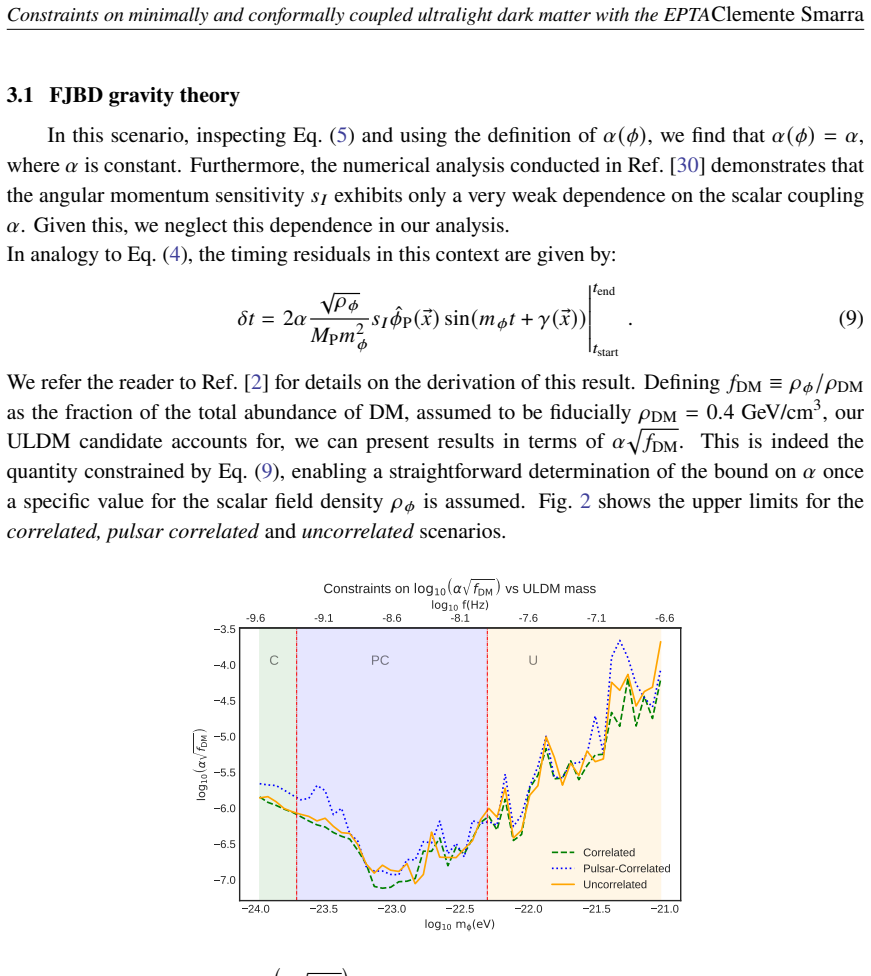
Summary. The manuscript is a conference-proceedings contribution that reviews and repackages the EPTA bounds on scalar ultralight dark matter obtained in the author's earlier papers [1,2]. It presents the timing-residual formulae for minimally coupled ULDM (Eq. 4), for FJBD scalar-tensor coupling (Eq. 9), and for DEF coupling (Eq. 10). The paper displays 95% upper limits on the ULDM density fraction (Fig. 1), on the combination alpha*sqrt(f_DM) (Fig. 2), and on |beta| for two fixed density benchmarks (Fig. 3). The central claims are that minimally coupled ULDM can contribute at most a few tenths of the local dark matter abundance in the mass range 10^-24 eV to 10^-23.7 eV, and that the FJBD coupling bounds improve on the Cassini and PSR J0337+1715 bounds by several orders of magnitude across the EPTA mass range.
Significance. The underlying numerical results are not new; the paper is transparent about this, stating in the abstract that the discussion is based on [1,2]. If the claims are properly qualified, the paper is a useful summary of an interesting application of PTA data to ultralight dark matter, and the FJBD result is potentially significant because PTAs probe a mass range complementary to Solar System and binary-pulsar tests. The main strength is the direct connection to the EPTA second data release and the explicit use of the neutron-star angular-momentum sensitivity from Ref. [30]. However, the paper as written overstates what is actually constrained: the FJBD headline refers to alpha sqrt(f_DM) rather than alpha alone, and Fig. 3 contains prior-dominated bins presented as constraints. These issues are fixable by rewriting the claims, so the scientific content does not appear to be invalid, but the presentation is not yet reliable.
major comments (4)
- [Section 3.1, Section 4, Abstract] The quantity actually constrained by Eq. (9) is alpha sqrt(f_DM), not alpha alone; the paper itself states this in Section 3.1 ('This is indeed the quantity constrained by Eq. (9)...'), but the abstract and Section 4 drop the f_DM qualifier and claim improvements on the Cassini and PSR J0337+1715 bounds on alpha by several orders of magnitude. Because the inferred limit on alpha scales as 1/sqrt(f_DM), the claimed improvement disappears if the field is not close to saturating the local DM density; for example, f_DM = 10^-4 weakens the bound by two orders of magnitude. The headline statements must either be expressed as bounds on alpha sqrt(f_DM) or accompanied by the benchmark abundance assumption used, exactly as is done in the DEF section.
- [Figure 3, Section 3.2] The caption of Fig. 3 states that in cases where the data are not constraining, the upper limits correspond to the maximum value allowed by the prior. These bins are not data-driven constraints, yet they are plotted with the same line style and contribute to the claimed coverage of the DEF parameter space. Presenting prior-boundary values as upper limits is misleading; such bins should be omitted, shaded, or visually distinguished, and the text should state which mass ranges are actually constrained by the EPTA data.
- [Section 3.1, Fig. 2 caption] The FJBD coupling bound in Eq. (9) is inversely proportional to the neutron-star angular-momentum sensitivity s_I, so any systematic error in s_I translates directly into the quoted limit on alpha sqrt(f_DM). The paper uses a single equation of state (AP4) via the code of Ref. [30] and asserts that s_I depends only weakly on the coupling alpha, but it gives no quantification of the EoS dependence or of the resulting systematic uncertainty. A robustness check with at least one additional EoS, or an explicit estimate of the EoS systematic, is needed to support the claimed order-of-magnitude improvements; the same caveat applies to the MPA1-based DEF results in Fig. 3.
- [Section 4 and Abstract] The abstract says that conformally coupled ultralight candidates improve on existing bounds by several orders of magnitude, but Section 4 states that in the DEF case the improvement is limited to 'a specific mass range' and does not quantify it. The plotted DEF limits on |beta| are of order a few, not orders of magnitude beyond the existing beta > -4.3 constraint, so the abstract's sweeping statement overstates the DEF results. The claims for FJBD and DEF should be separated and each accompanied by the appropriate quantifier.
minor comments (5)
- [Figure 2] The y-axis label and plot title read 'log10( fDM )' while the caption reads 'Upper limits on log10( alpha sqrt(fDM) )'. These are different quantities; the figure must be made consistent, since this is the central result used to compare with Cassini and PSR J0337+1715.
- [Eq. (3)] The coherence time is written as tau_c ~ 2/(m v^2); for v ~ 10^-3 and m = 10^-22 eV this gives a value near 4 x 10^5 yr rather than 2 x 10^5 yr, depending on the conventions used. Please check the factor of 2 and define v explicitly.
- [Eq. (1) and Section 3 action] The mass term in Eq. (1) appears with a minus sign, while the noncanonical action in Section 3 has a plus sign. Footnote 1 explains the normalization change, but the sign discrepancy is confusing; a brief remark reconciling the two conventions would help.
- [Section 3 heading] The heading 'Non minimally coupled ULDM' is used while the abstract and text refer to 'conformally coupled' ULDM; please use consistent terminology throughout.
- [References] Ref. [23] (Blas, Nacir, and Sibiryakov) is cited in the sentence about the Cassini bound but is not otherwise discussed or clearly connected to the text; either the connection should be made explicit or the citation should be moved to a more relevant place.
Circularity Check
No circular derivation: EPTA timing-residual fits drive all reported bounds; the FJBD improvement claim is conditional on an unstated fDM normalization, but the product structure is disclosed in Sec. 3.1 and DEF prior-saturated points are flagged in Fig. 3.
full rationale
This conference paper is a review of the author's own EPTA analyses [1,2]. The derivation chain for every reported bound is: (i) ULDM induces sinusoidal timing residuals with amplitudes set by rho_phi (Eq. 4) or by alpha*sqrt(rho_phi)*s_I and beta*s_I(beta) (Eqs. 9-10); (ii) EPTA TOA data are fit to these signals; (iii) upper limits are converted into rho_phi/rho_DM or alpha*sqrt(fDM). None of these steps presupposes the target conclusion: the residual formulas are published analytic results [8,9,14,15], and the numerical ingredient s_I is taken from the independent code of Ref. [30]. The self-citations to [1,2] are reports of the underlying peer-reviewed EPTA data analyses, not a way of assuming the answer; those analyses are externally falsifiable against the same timing data. Two caveats that might look circular are actually disclosed: Sec. 3.1 states that the quantity constrained by Eq. (9) is alpha*sqrt(fDM), not alpha alone, so the conclusion's 'several orders of magnitude' improvement over Cassini is conditional on choosing a value of rho_phi (effectively fDM=1 for the headline); and the Fig. 3 caption states that where data are unconstraining the 'upper limits' are just the prior boundary beta=-4.3. These are presentation/interpretation caveats, not self-referential reductions: no fit parameter is renamed as a prediction, and no equation is defined in terms of the quantity it is claimed to constrain. The s_I EoS and coupling dependence is a systematic caveat, not circularity. I therefore find no significant circularity.
Assumptions & free parameters
free parameters (4)
- Local ULDM density rho_phi =
Constrained; plotted as rho_phi/rho_DM
- FJBD coupling alpha*sqrt(f_DM) =
Upper limit curves in Fig. 2
- DEF coupling beta =
Upper limits in Fig. 3, for beta < 0
- Rayleigh amplitude phi_hat =
Sampled from P(phi_hat^2)=e^{-phi_hat^2}
assumptions (5)
- domain assumption ULDM is treated as a classical non-relativistic wave with Rayleigh-distributed amplitude (Eq. 2).
- domain assumption Local DM density is fiducially rho_DM=0.4 GeV/cm^3 and DM velocity v~10^-3.
- domain assumption Signal templates Eqs. (4), (9), and (10) are correct.
- domain assumption Neutron-star angular momentum sensitivity s_I is computed with the code from Ref. [30] for the AP4/MPA1 equation of state, neglecting alpha dependence.
- domain assumption The DEF prior lower bound beta >= -4.3 from binary pulsars is valid for the mass range considered.
Cite this review
Pith. "Pith review of Constraints on minimally and conformally coupled ultralight dark matter with the EPTA." pith.science (2026). https://pith.science/paper/C2DEL2DJ
@misc{pith2026250202420,
  author       = {Pith},
  title        = {Pith review of: Constraints on minimally and conformally coupled ultralight dark matter with the EPTA},
  year         = {2026},
  howpublished = {\url{https://pith.science/paper/C2DEL2DJ}},
  note         = {Machine review of arXiv:2502.02420}
}
read the original abstract
Millisecond pulsars are extremely stable natural timekeepers. Pulsar Timing Array experiments, tracking subtle changes in the pulsars' rotation periods, can shed light on the presence of ultralight particles in our Galaxy. In this conference paper, we start by reviewing the most conservative scenario, in which ultralight particles interact only gravitationally. In this setting, we show that Pulsar Timing Arrays are able to constrain the presence of ultralight fields up to a few tenths of the observed dark matter abundance. Then, we consider conformally coupled ultralight candidates, demonstrating that the constraints on the universal scalar coupling of the field to Standard Model particles improve on existing bounds by several orders of magnitude, in the relevant mass range analyzed by Pulsar Timing Arrays. The discussion presented here is based on [1,2].
Figures


Forward citations
Cited by 1 Pith paper
-
The SKAO Pulsar Timing Array
An SKAO PTA with ~174 millisecond pulsars can dominate nanohertz GW sensitivity within four years and enable continuous-wave detections plus anisotropy maps of the gravitational-wave background.
Reference graph
Works this paper leans on
-
[2]
C.Smarraetal., ConstraintsonconformalultralightdarkmattercouplingsfromtheEuropean Pulsar Timing Array, Phys. Rev. D110 (2024) 043033, [2405.01633]
arXiv 2024
-
[30]
A. Kuntz and E. Barausse,Angular momentum sensitivities in scalar-tensor theories, Phys. Rev. D109 (Jun, 2024) 124001
work page 2024
-
[1]
European Pulsar Timing Arraycollaboration, C.Smarraetal., SecondDataReleasefrom theEuropeanPulsarTimingArray: ChallengingtheUltralightDarkMatterParadigm ,Phys. Rev. Lett.131 (2023) 171001, [2306.16228]
arXiv 2023
-
[3]
R. A. Flores and J. R. Primack,Observational and Theoretical Constraints on Singular Dark Matter Halos, Astrophysical Journal, Letters(May, 1994) L1427
work page 1994
-
[4]
B. Moore,Evidence against dissipation-less dark matter from observations of galaxy haloes, Nature 370(Aug, 1994) 629–631
work page 1994
-
[5]
Karukes,E.V.,Salucci,P.andGentile,G., Thedarkmatterdistributioninthespiralngc3198 out to 0.22 rvir,A&A 578 (2015) A13
work page 2015
-
[6]
W. Hu, R. Barkana and A. Gruzinov,Cold and fuzzy dark matter, Phys. Rev. Lett.85 (2000) 1158–1161, [astro-ph/0003365]
arXiv 2000
-
[7]
L. Hui, J. P. Ostriker, S. Tremaine and E. Witten,Ultralight scalars as cosmological dark matter, Physical Review D95 (feb, 2017)
work page 2017
Show all 38 references
-
[8]
Khmelnitsky and V
A. Khmelnitsky and V. Rubakov,Pulsar timing signal from ultralight scalar dark matter, Journal of Cosmology and Astroparticle Physics2014(feb, 2014) 019–019
2014
-
[9]
N.K.Porayko,X.Zhu,Y.Levin,L.Hui,G.Hobbs,A.Grudskayaetal., Parkespulsartiming array constraints on ultralight scalar-field dark matter,Physical Review D98(Nov., 2018)
2018
-
[10]
Fierz,On the physical interpretation of P.Jordan’s extended theory of gravitation, Helv
M. Fierz,On the physical interpretation of P.Jordan’s extended theory of gravitation, Helv. Phys. Acta29 (1956) 128–134
1956
-
[11]
157(1959)112–121
P.Jordan, ThepresentstateofDirac’scosmologicalhypothesis ,Z.Phys. 157(1959)112–121
1959
-
[12]
124 (Nov, 1961) 925–935
C.BransandR.H.Dicke, Mach’sprincipleandarelativistictheoryofgravitation ,Phys.Rev. 124 (Nov, 1961) 925–935
1961
-
[13]
R. H. Dicke,Mach’s principle and invariance under transformation of units, Phys. Rev.125 (Mar, 1962) 2163–2167. 7 Constraints on minimally and conformally coupled ultralight dark matter with the EPTAClemente Smarra
1962
-
[14]
Damour and G
T. Damour and G. Esposito-Farese,Tensor multiscalar theories of gravitation, Class. Quant. Grav. 9 (1992) 2093–2176
1992
-
[15]
Damour and G
T. Damour and G. Esposito-Farèse,Nonperturbative strong-field effects in tensor-scalar the- ories of gravitation, Phys. Rev. Lett.70(Apr, 1993) 2220–2223
1993
-
[16]
Alsing, E
J. Alsing, E. Berti, C. M. Will and H. Zaglauer,Gravitational radiation from compact bi- nary systems in the massive Brans-Dicke theory of gravity, Phys. Rev. D85 (2012) 064041, [1112.4903]
2012 arXiv
-
[17]
169(May,1968) 1017–1025
K.Nordtvedt, Equivalenceprincipleformassivebodies.ii.theory ,Phys.Rev. 169(May,1968) 1017–1025
1968
-
[18]
D.M.Eardley, Observableeffectsofascalargravitationalfieldinabinarypulsar ,Astrophys- ical Journal196 (Mar., 1975) L59–L62
1975
-
[19]
C. M. Will and H. W. Zaglauer,Gravitational Radiation, Close Binary Systems, and the Brans-Dicke Theory of Gravity,Astrophysical Journal346 (Nov., 1989) 366
1989
-
[20]
C. M. Will,Gravitational radiation from binary systems in alternative metric theories of gravity: dipole radiation and the binary pulsar., Astrophysical Journal 214 (June, 1977) 826–839
1977
-
[21]
C. M. Will,Theory and experiment in gravitational physics. 1993
1993
-
[22]
B.Bertotti,L.IessandP.Tortora, Atestofgeneralrelativityusingradiolinkswiththecassini spacecraft,Nature 425(Sep, 2003) 374–376
2003
-
[23]
D. Blas, D. L. Nacir and S. Sibiryakov,Ultralight dark matter resonates with binary pulsars, Physical Review Letters118 (jun, 2017)
2017
-
[24]
S.M.Ransom,I.H.Stairs,A.M.Archibald,J.W.T.Hessels,D.L.Kaplan,M.H.vanKerkwijk et al.,A millisecond pulsar in a stellar triple system,Nature 505 (Jan, 2014) 520–524
2014
-
[25]
A.M.Archibald,N.V.Gusinskaia,J.W.T.Hessels,A.T.Deller,D.L.Kaplan,D.R.Lorimer et al.,Universality of free fall from the orbital motion of a pulsar in a stellar triple system, Nature 559 (Jul, 2018) 73–76
2018
-
[26]
Voisin, G., Cognard, I., Freire, P. C. C., Wex, N., Guillemot, L., Desvignes, G. et al.,An improved test of the strong equivalence principle with the pulsar in a triple star system,A& A 638 (2020) A24
2020
-
[27]
Castillo, J
A. Castillo, J. Martin-Camalich, J. Terol-Calvo, D. Blas, A. Caputo, R. T. G. Santos et al., Searching for dark-matter waves with PPTA and QUIJOTE pulsar polarimetry, JCAP 06 (2022) 014, [2201.03422]
2022 arXiv
-
[28]
8 Constraints on minimally and conformally coupled ultralight dark matter with the EPTAClemente Smarra
J.P.W.Verbiest,J.M.Weisberg,A.A.Chael,K.J.LeeandD.R.Lorimer, Onpulsardistance measurements and their uncertainties, The Astrophysical Journal755 (jul, 2012) 39. 8 Constraints on minimally and conformally coupled ultralight dark matter with the EPTAClemente Smarra
2012
-
[29]
F.NestiandP.Salucci, Thedarkmatterhaloofthemilkyway,ad2013 ,JournalofCosmology and Astroparticle Physics2013(jul, 2013) 016
2013
-
[31]
A.Akmal,V.R.PandharipandeandD.G.Ravenhall, Equationofstateofnucleonmatterand neutron star structure,Phys. Rev. C58(Sep, 1998) 1804–1828
1998
-
[32]
Müther, M
H. Müther, M. Prakash and T. Ainsworth, The nuclear symmetry energy in relativistic brueckner-hartree-fock calculations, Physics Letters B199 (1987) 469–474
1987
-
[33]
L. Shao, N. Sennett, A. Buonanno, M. Kramer and N. Wex, Constraining nonpertur- bative strong-field effects in scalar-tensor gravity by combining pulsar timing and laser- interferometer gravitational-wave detectors,Phys. Rev. X7(2017) 041025, [1704.07561]
2017 arXiv
-
[34]
R.F.P.Mendes, Possibilityofsettinganewconstrainttoscalar-tensortheories ,Phys.Rev.D 91 (2015) 064024, [1412.6789]
2015 arXiv
-
[35]
Anderson and N
D. Anderson and N. Yunes,Solar System constraints on massless scalar-tensor gravity with positive coupling constant upon cosmological evolution of the scalar field, Phys. Rev. D96 (2017) 064037, [1705.06351]
2017 arXiv
-
[36]
D.E.Kaplan,A.MitridateandT.Trickle, Constrainingfundamentalconstantvariationsfrom ultralight dark matter with pulsar timing arrays, Phys. Rev. D106 (Aug, 2022) 035032
2022
-
[37]
Wu and Q.-G
Y.-M. Wu and Q.-G. Huang,Constraining ultralight scalar dark matter couplings with the european pulsar timing array second data release, 2024
2024
-
[38]
EPTA collaboration, N. K. Porayko et al.,Searches for signatures of ultra-light axion dark matter in polarimetry data of the European Pulsar Timing Array, 2412.02232. 9
Reviewed August 9, 2026 · model on record in the stance chip above.
Discussion (0). Continue with ORCID to comment.