REVIEW 1 major objections 25 references
A Compact, Ultra-High Resolution VIPA Spectrograph for Solar Spectroscopic Observations: Astrocomb Characterization and First Light
T0 review · 1 major / 0 minor · reviewed 2026-06-27 · grok-4.3
Pith's one-line read A compact VIPA spectrograph reaches spectral resolutions of 290000 to 340000 and validates on-sky solar observations.
desk verdict Compact VIPA spectrograph hits the claimed resolution and delivers on-sky solar detections, but the attribution of signals needs tighter checks on other broadening sources. read the letter →
The pith
A machine-rendered reading of the paper's core claim, the machinery that carries it, and where it could break.
The reading
What carries the argument
The Virtually Imaged Phased Array (VIPA) as the dispersing element in a compact fiber-fed design, with astrocomb wavelength calibration.
What would settle it
A laboratory measurement of the instrumental profile or resolution using an independent method that yields values consistently below 290000 or above 340000, or repeated on-sky observations failing to detect the reported solar oscillations and line identifications.
Extended reading notes
Core claim
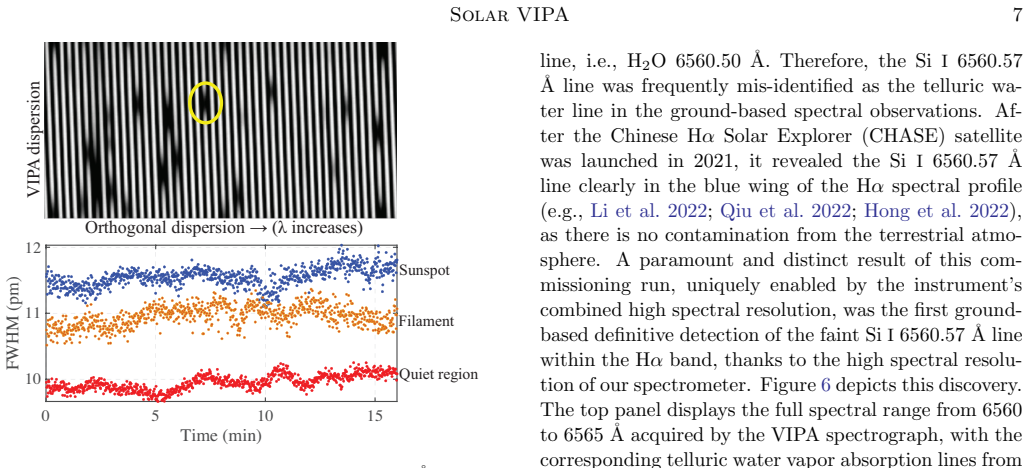
The prototype VIPA spectrograph establishes an operational bandpass of 592.76--657.07 nm with measured spectral resolution between 290000 and 340000 when calibrated using a 25 GHz astrocomb. First light observations at the NVST demonstrate detection of solar five-minute oscillations in the Fe I 6280.57 Å line, resolution of magnetic broadening using the Fe I 6173.34 Å line in sunspots, and definitive ground-based identification of the faint Si I 6560.57 Å line.
Load-bearing premise
Observed on-sky line profiles and velocity signals primarily reflect the instrument's resolution and calibration rather than unaccounted atmospheric, telescope, or data-reduction effects.
Editorial extensions
If this is right
- The instrument detects solar five-minute oscillations at velocities of ±300 m s^{-1}.
- It resolves magnetic broadening in sunspot spectra using iron lines.
- It allows the first ground-based definitive identification of the faint Si I 6560.57 Å line.
- The compact size supports future multi-object solar studies and high spectral resolution time-domain astronomy including exoplanet detection.
- Potential applications extend to space-borne instrumentation.
Reading between the lines
- The VIPA design could be scaled or adapted for observations in other spectral regions beyond the current visible band.
- Combining this spectrograph with existing solar telescopes might enable simultaneous high-resolution monitoring of multiple solar features without requiring large dedicated instruments.
- Further tests in varying atmospheric conditions could clarify the limits of the instrument's performance for velocity measurements.
Signed reviews
Editorial analysis
A structured set of objections, weighed in public.
Referee Report
Summary. The manuscript presents a compact (53×20×18 cm³) fiber-fed VIPA spectrograph for solar observations. Astrocomb (25 GHz) calibration defines the 592.76–657.07 nm bandpass and reveals an asymmetric instrumental profile better fit by a Fano-Lorentz product than a Gaussian; measured resolving power is 290 000–340 000. On-sky tests at NVST show detection of Fe I 6280.57 Å five-minute oscillations (±300 m s⁻¹), magnetic broadening in the Fe I 6173.34 Å line, and the first ground-based identification of the faint Si I 6560.57 Å line.
Significance. If the on-sky signals can be shown to arise primarily from the reported resolution and calibration rather than from unaccounted broadening or wavelength drifts, the work establishes a compact, high-resolution platform with clear potential for multi-object solar spectroscopy, time-domain astronomy, and space applications. The external astrocomb calibration and concrete on-sky detections constitute measurable strengths.
major comments (1)
- [Abstract and on-sky validation section] Abstract (on-sky validation paragraph) and corresponding results section: the central validation claim—that the observed oscillations, magnetic broadening, and Si I line identification demonstrate the VIPA’s 290k–340k resolution and astrocomb calibration—rests on the assumption that atmospheric, telescope, and reduction effects are negligible or subtracted. No quantitative checks (e.g., deconvolved line widths versus expected solar values, or wavelength-solution stability across the time series) are reported, leaving the attribution least secure.
Simulated Author's Rebuttal
We are grateful to the referee for their thorough review and encouraging recommendation for minor revision. We address the single major comment in detail below.
read point-by-point responses
-
Referee: [Abstract and on-sky validation section] Abstract (on-sky validation paragraph) and corresponding results section: the central validation claim—that the observed oscillations, magnetic broadening, and Si I line identification demonstrate the VIPA’s 290k–340k resolution and astrocomb calibration—rests on the assumption that atmospheric, telescope, and reduction effects are negligible or subtracted. No quantitative checks (e.g., deconvolved line widths versus expected solar values, or wavelength-solution stability across the time series) are reported, leaving the attribution least secure.
Authors: We agree that the manuscript would benefit from more explicit quantitative validation to strengthen the attribution of the observed signals to the instrument's performance. While the detections of solar oscillations, magnetic broadening, and the faint Si I line are consistent with the expected capabilities at the reported resolution, we did not include deconvolution analyses or stability metrics in the original submission. In the revised version, we will add quantitative checks, such as comparing the observed line profiles to solar atlas values after convolution with the measured instrumental profile, and assessing the wavelength solution stability over the observation time series using the astrocomb calibration. These additions will be incorporated into the results section. revision: yes
Circularity Check
No circularity: empirical calibration and observations are externally anchored
full rationale
The paper reports an instrument design, astrocomb-based wavelength calibration (external frequency comb with stated 25 GHz rep rate), direct measurement of the instrumental profile via Fano-Lorentz fitting to comb lines, and on-sky detections at the NVST telescope. None of these steps invoke a derivation chain, fitted parameter renamed as prediction, self-citation load-bearing premise, or ansatz smuggled from prior author work. The resolution range (290k–340k) and oscillation/magnetic-broadening detections are presented as measured outcomes, not as quantities forced by internal definitions or self-referential equations. The central claims therefore remain self-contained against external benchmarks.
Assumptions & free parameters
Cite this review
Pith. "Pith review of A Compact, Ultra-High Resolution VIPA Spectrograph for Solar Spectroscopic Observations: Astrocomb Characterization and First Light." pith.science (2026). https://pith.science/paper/C2I4RXXQ
@misc{pith2026260606793,
  author       = {Pith},
  title        = {Pith review of: A Compact, Ultra-High Resolution VIPA Spectrograph for Solar Spectroscopic Observations: Astrocomb Characterization and First Light},
  year         = {2026},
  howpublished = {\url{https://pith.science/paper/C2I4RXXQ}},
  note         = {Machine review of arXiv:2606.06793}
}
abstract
We present a compact, high spectral resolution prototype spectrograph based on a Virtually Imaged Phased Array (VIPA), which is designed for solar spectral observations. This fiber-fed instrument has a size of only 53 $\times$ 20 $\times$ 18 cm$^3$. Wavelength calibration using an astrocomb ($f_{\text{rep}}=25$ GHz) established an operational bandpass of 592.76--657.07 nm and revealed an asymmetric instrumental profile. A Fano-Lorentz product function provides a significantly better fit to this profile than a Gaussian. The measured spectral resolution ranges between 290,000 and 340,000 across the band. Initial on-sky validation at the New Vacuum Solar Telescope (NVST, Yunnan Observatories) successfully demonstrated the prototype's capabilities: clear detection of solar five-minute oscillations ($\pm 300 \, \text{m s}^{-1}$) in the \ion {Fe}{1} 6280.57 \AA~ line, resolution of magnetic broadening in sunspots using the \ion{Fe}{1} 6173.34 \AA~ line, and the first ground-based definitive identification of the faint \ion{Si}{1} 6560.57 \AA~ line within the H$\alpha$ band. These results validate the VIPA as a promising platform for high spectral resolution solar spectroscopy. Its compact design and performance directly support future applications in multi-object solar studies, high spectral resolution observations for time-domain astronomy, including exoplanet detection, and potential space-borne instrumentation.
Figures


Figures from the paper (3 more)


Reference graph
Works this paper leans on
-
[1]
2017, CEAS Space Journal, 9, 411
Bourdarot, G., Le Coarer, E., Bonfils, X., et al. 2017, CEAS Space Journal, 9, 411
2017
-
[2]
2011, Living Reviews in Solar Physics, 8, 1
Chen, P.-F. 2011, Living Reviews in Solar Physics, 8, 1
2011
-
[3]
2020, Research in Astronomy and Astrophysics, 20, 166
Chen, P.-F., Xu, A.-A., & Ding, M.-D. 2020, Research in Astronomy and Astrophysics, 20, 166
2020
-
[4]
2013, in Novel Optical Systems Design and Optimization XVI, Vol
Conconi, P., Riva, M., Pepe, F., et al. 2013, in Novel Optical Systems Design and Optimization XVI, Vol. 8842, SPIE, 178–186 De Pontieu, B., McIntosh, S., Carlsson, M., et al. 2007, science, 318, 1574
2013
-
[5]
2012, Solar Physics, 280, 663
Doerr, H.-P., Steinmetz, T., Holzwarth, R., Kentischer, T., & Schmidt, W. 2012, Solar Physics, 280, 663
2012
-
[6]
2008, Chinese Journal of Astronomy and Astrophysics, 8, 723
Du, Q.-S., & Li, H. 2008, Chinese Journal of Astronomy and Astrophysics, 8, 723
2008
-
[7]
2018, PASP, 130, 125001
Hao, Z., Ye, H., Han, J., et al. 2018, PASP, 130, 125001
2018
-
[8]
2022, Astronomy & Astrophysics, 668, A9
Hong, J., Qiu, Y., Hao, Q., et al. 2022, Astronomy & Astrophysics, 668, A9
2022
Show all 25 references
-
[9]
2012, Astronomy & Astrophysics, 542, A112, doi: 10.1051/0004-6361/201218887
Kuckein, C., Martinez Pillet, V., & Centeno, R. 2012, Astronomy & Astrophysics, 542, A112, doi: 10.1051/0004-6361/201218887
2012 doi
-
[10]
2016, Publications of the Astronomical Society of the Pacific, 128, 095002
Lemke, U., & Reiners, A. 2016, Publications of the Astronomical Society of the Pacific, 128, 095002
2016
-
[11]
2022, Science China Physics, Mechanics & Astronomy, 65, 289602 10W ang et al
Li, C., Fang, C., Li, Z., et al. 2022, Science China Physics, Mechanics & Astronomy, 65, 289602 10W ang et al
2022
-
[12]
Lites, B. W. 2005, The Astrophysical Journal, 622, 1275, doi: 10.1086/428820
2005 doi
-
[13]
2013, Solar Physics, 287, 279 L¨ ohner-B¨ ottcher, J., Schmidt, W., Stief, F., Steinmetz, T., & Holzwarth, R
Liu, Y., Zhao, J., & Schuck, P. 2013, Solar Physics, 287, 279 L¨ ohner-B¨ ottcher, J., Schmidt, W., Stief, F., Steinmetz, T., & Holzwarth, R. 2018, Astronomy & Astrophysics, 611, A4 Milakovi´ c, D., & Jethwa, P. 2024, Astronomy & Astrophysics, 684, A38
2013
-
[14]
2000, Proc
Pepe, F., Mayor, M., Delabre, B., et al. 2000, Proc. SPIE, 4008, 582
2000
-
[15]
2022, Science China Physics, Mechanics & Astronomy, 65, 289603 Radziemski Jr, L
Qiu, Y., Rao, S., Li, C., et al. 2022, Science China Physics, Mechanics & Astronomy, 65, 289603 Radziemski Jr, L. J., & Andrew, K. L. 1965, Journal of the Optical Society of America, 55, 474
2022
-
[16]
1996, OptL, 21, 366
Shirasaki, M. 1996, OptL, 21, 366
1996
-
[17]
Smitha, H., van Noort, M., Solanki, S., & Dur´ an, J. C. 2023, Astronomy & Astrophysics, 669, A144
2023
-
[18]
Solanki, S. K. 2003, The Astronomy and Astrophysics Review, 11, 153
2003
-
[19]
Stenflo, J. O. 2015, Astronomy & Astrophysics, 573, A74
2015
-
[20]
1956, Publications of the Astronomical Society of Japan, 8, 108
Unno, W. 1956, Publications of the Astronomical Society of Japan, 8, 108
1956
-
[21]
2021, The Astrophysical Journal, 913, 59
Wang, Y., Zhang, Q., & Ji, H. 2021, The Astrophysical Journal, 913, 59
2021
-
[22]
M., & Lin, C
Xiao, S., Weiner, A. M., & Lin, C. 2004, IEEE Journal of Quantum Electronics, 40, 420
2004
-
[23]
2020, The Astronomical Journal, 160, 135
Zhu, X., Lin, D., Hao, Z., Wang, L., & He, J. 2020, The Astronomical Journal, 160, 135
2020
-
[24]
2023, The Astronomical Journal, 165, 228
Zhu, X., Lin, D., Zhang, Z., Xie, X., & He, J. 2023, The Astronomical Journal, 165, 228
2023
-
[25]
Zirker, J. B. 1993, Solar physics, 148, 43
1993
Reviewed June 27, 2026 · model on record in the stance chip above.
Discussion (0). Continue with ORCID to comment.