REVIEW 5 major objections 5 minor 56 references
Automating Idealness Proofs for Binary Programs with Application to Rectangle Packing
T0 review · 5 major / 5 minor · reviewed 2026-08-03 · deepseek-v4-flash
Pith's one-line read A new optimization-based framework automatically certifies when mixed-binary programs are 'ideal,' and applies it to settle four rectangle-packing formulations.
desk verdict A useful automation framework for idealness proofs with a checkable SB-L counterexample, but the positive computational theorems—especially SB-M—are not certified as stated; worth peer review with major-revision expectations. read the letter →
The pith
A machine-rendered reading of the paper's core claim, the machinery that carries it, and where it could break.
The reading
What carries the argument
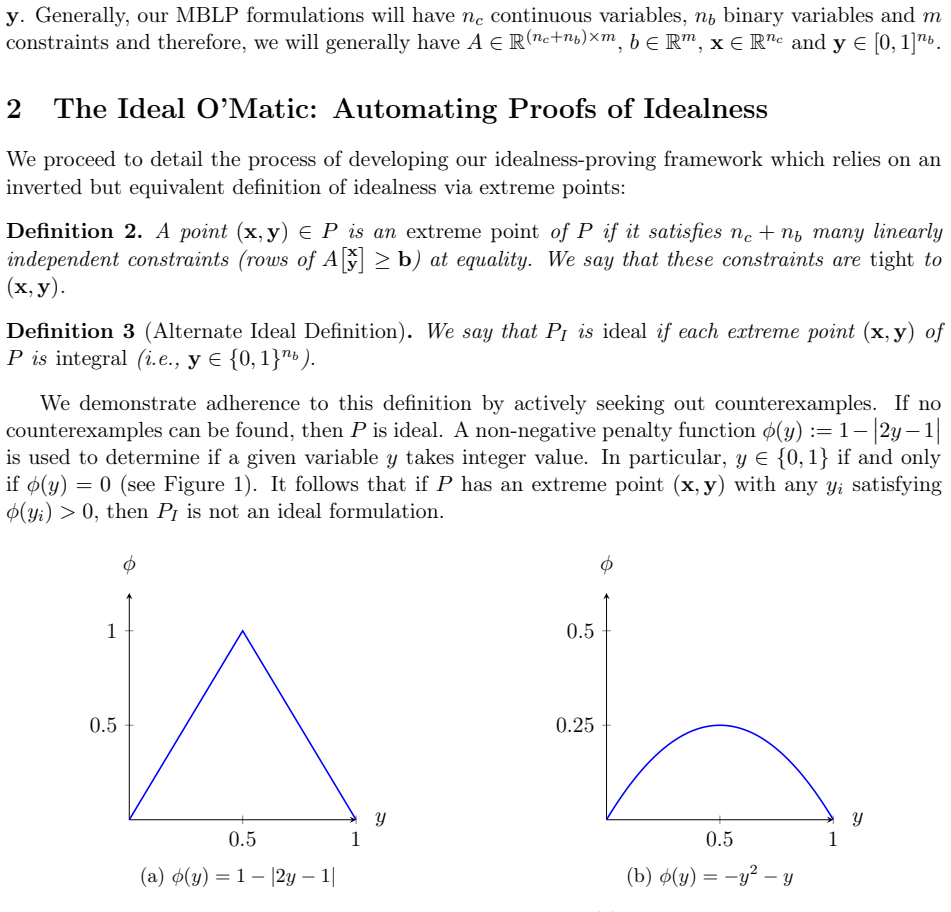
The engine is a bilevel-style optimization formulation, IOM: indicators select nc+nb constraints to be tight, a rank constraint forces linear independence, and the objective maximizes phi(y)=sum(1-|2y_i-1|), zero only when all binary variables are integral. The parametric extension PIOM lets LB, UB and precedence margins P vary as variables, turning the proof into a nonconvex quadratically constrained program, with linear-dependence covers (circuits) added by a separation subroutine. The second key object is the selector function: replacing the one-hot unary encoding with a Hamming-distance selector destroys idealness, while the multilinear selector (a product of Bernoulli factors) restores
What would settle it
Run the parametric search with exact rational arithmetic and epsilon=0 on a parameter instance where P equals UB-LB (or, for RU, where the two strict inequalities vanish). Any fractional extreme point with positive penalty would refute the corresponding theorem; equivalently, for SB-L, the paper itself supplies a concrete fractional vertex at c=(9,1,9,1), delta=(1/2,1/2) on a 10x10 region with 2x2 rectangles — the same kind of explicit witness, if found for SU, RU, or SB-M at a boundary parameter, would settle the claim.
Extended reading notes
Core claim
The central claim is that idealness of a mixed-binary linear program can be verified by maximizing a fractionality penalty over points that are feasible and tight to a full set of linearly independent constraints; an optimal value of zero means every extreme point of the relaxation is integral. The parametric version lets the constraint data vary and searches over whole families of instances, proving pairwise-idealness for the rectangle-packing formulations SU and RU (under stated parameter inequalities), disproving it for SB-L via an explicit fractional extreme point, and establishing it for the new SB-M built from the multilinear selector. The same framework is used to model a novel cleara
Load-bearing premise
The load-bearing premise is that the finite lists of linear-dependence patterns in Lemmas 1–3 are exhaustive for every parameter value in the ranges considered; they are checked by direct computation on sampled data rather than proven, and the floating-point solver tolerance plus the epsilon=W/10 boundary exclusion means the certified region is slightly smaller than the stated theorems.
Editorial extensions
If this is right
- If Theorem 1 and 2 are correct, two standard unary rectangle-packing formulations can be solved as continuous LPs for any two-rectangle instance meeting the stated inequalities, eliminating branch-and-bound at that scale.
- Theorem 3 means the logarithmic two-binary-variable formulation based on the Hamming selector cannot be relied upon; its fractional extreme point is constructible for any instance, not just a special case.
- Theorem 4 gives a pairwise-ideal formulation with only two binary variables per pair, using the multilinear selector and McCormick linearization, combining logarithmic size with idealness.
- The paper's experiments indicate pairwise-idealness alone does not guarantee faster solving in practice; sequence-pair inequalities and branching priorities matter more, especially for binary formulations.
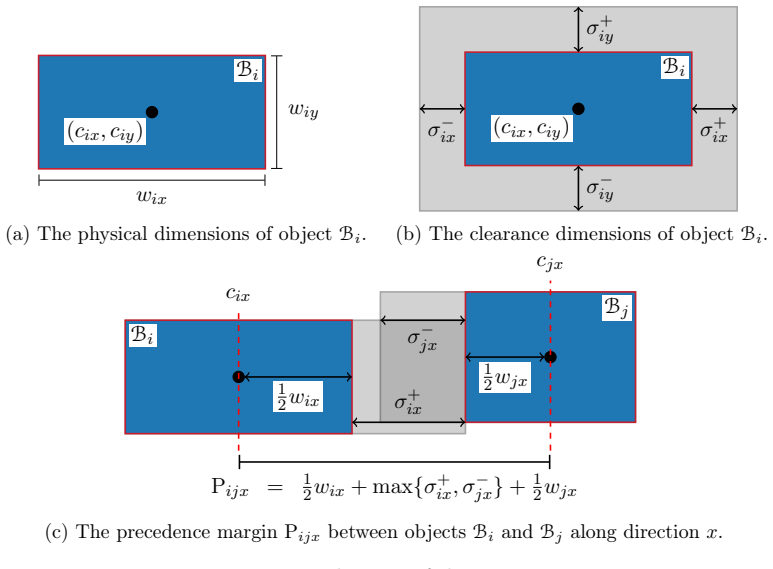
- The clearance-aware model extends the same idealness analysis to layouts requiring buffer zones, so the proof framework applies beyond plain packing.
Reading between the lines
- Because Proposition 2 shows no linear selector can map interior hypercube points into the simplex, the failure of SB-L is likely structural; the multilinear selector is the unique exact polynomial extension, suggesting any ideal logarithmic formulation must be nonlinear or use a different encoding.
- The epsilon=W/10 gap and reliance on floating-point solve means the theorems are proven on an open region; a natural next step is exact rational computation or symbolic vertex enumeration to close the boundary cases, especially for RU's 56-case parameter split.
- The dependence-cover lists in Lemmas 1-3 are asserted comprehensive but only checked computationally; a reader wanting full rigor could verify exhaustiveness algebraically, and the same separation approach could be reused for other disjunctive formulations (e.g., multi-rectangle or higher-dimensional packing).
- The negligible practical impact of pairwise-idealness hints that idealness is not the right sole predictor of solver performance; the framework could be used to benchmark other structural properties, such as sharpness or local idealness.
Editorial analysis
A structured set of objections, weighed in public.
Referee Report
Summary. The paper develops Ideal O'Matic (IOM) and its parametric variant PIOM, optimization-based frameworks for certifying idealness of mixed-binary linear programs. The verification problem is formulated as a linear program for fixed data and as a nonconvex quadratic program when the data are parametric. The framework is applied to rectangle packing formulations: the paper claims computational proofs that the Standard Unary (SU) and Refined Unary (RU) formulations are pairwise-ideal, gives a counterexample showing the linear Hamming-selector formulation SB-L is not pairwise-ideal, and introduces a new multilinear formulation SB-M that it claims is pairwise-ideal. A secondary contribution is a generalization of rectangle packing with edge clearances, plus computational experiments comparing the formulations. The main theorems are Theorems 1, 2, 3, and 4; Section 5.4 explicitly acknowledges numerical gaps in the proof framework.
Significance. The paper's core idea is attractive: replacing long analytic case analyses with optimization-based searches for fractional extreme points could be a useful tool in integer programming theory. The explicit counterexamples for SB-L and NU in Appendix C are checkable and appear correct, and the new SB-M formulation is a plausible contribution. The paper also ships code, model files, and data, and it honestly discloses the numerical limitations of its approach. However, the advertised computational proofs are not rigorous as stated: the acknowledged epsilon gap and floating-point tolerances, together with the nonzero PIOM bounds reported for SB-M, mean that Theorems 1, 2, and 4 are not established by the evidence provided. The value of the paper is real, but the proof claims need substantial revision or additional verification.
major comments (5)
- [§5.4, Theorems 1 and 2] The computational proofs use an epsilon = W/10 tolerance and a case matrix C that records only whether UB_js - P_ijs - LB_is is at least epsilon or exactly zero. Parameter values for which this difference lies in (0, epsilon) are not covered. Thus Theorems 1 and 2, stated for all non-trivial instances satisfying the given inequalities, are not proven. For Theorem 2 the same epsilon gap applies to the strict inequalities P_kls+LB_ks-LB_ls>0 and P_kls+UB_ks-UB_ls>0, and the paper itself notes that the full 56-case analysis is not performed. The authors should either close this gap with rigorous interval/rational methods or explicitly restate the results as epsilon-conditional computational evidence rather than proofs.
- [§5.3, Theorem 4] The reported PIOM results do not certify that the optimal objective value is zero. Eight cases are asterisked with dual bounds in [4.26e-7, 9.55e-7], and four cases list positive 'Optimum' values (7.99e-8, 9.13e-11, 2.52e-9, 1.12e-9). If any such positive value is feasible, it is a fractional extreme point contradicting Theorem 4; if it is numerical noise, then the solver has not proved the optimum is zero. The subsequent linear IOM checks only verify the discrete (LB,UB,P) points returned by PIOM, not the continuous parameter regions claimed by the theorem. Theorem 4 is therefore unproven as stated.
- [§5.1-§5.3, Lemmas 1-3] Each lemma asserts that the listed collections are a 'comprehensive set of dependence covers' and says that the dependencies can be verified by direct computation. For the zero-objective direction, nonexhaustiveness of the list would be conservative (omitting a valid cover relaxes IOM), so the load-bearing issue is whether every listed cover is a genuine linear dependence over the claimed parameter ranges. Please provide explicit algebraic combination certificates or machine-checkable proofs for each dependence, rather than relying solely on repository notebooks.
- [§2, Eq. (IOM.e) and §5.1] The big-M constant in constraint (IOM.e) is not specified. The text 'we set W=M=10' suggests that the container width is being used as the big-M value. If M is not sufficiently large, (IOM.e) can remove genuinely feasible points, including extreme points, and produce a spurious zero objective. The authors should state how M is chosen, prove that the chosen value is valid for the bounded variables in the model, and report the value used in each computation.
- [§8] The conclusion claims that the paper develops 'an algebraic vertex enumeration approach' that provides independent verification without floating-point optimization, but no such approach is presented in Sections 2-7. This is either a missing contribution or an erroneous claim. Please add the method and its verification, or delete the sentence.
minor comments (5)
- [§1.2] 'Padburg' should be 'Padberg'.
- [§5.1] The phrase 'we set W=M=10 w.l.o.g.' needs a scaling justification. Setting two different quantities to the same value is not automatically without loss of generality unless all parameters and constraints scale appropriately.
- [Tables 5-7] Tables 5-7 appear misaligned: several entries are not clearly matched to column headers, and some cells contain extra numbers or percentages without a clear row/column correspondence. Please reformat these tables.
- [§5.3] There is a typo: 'Additionaly' should be 'Additionally'.
- [References] References [45] and [46] are duplicate entries for Vielma's 'Mixed Integer Linear Programming Formulation Techniques'.
Circularity Check
No significant circularity: IOM/PIOM is a direct counterexample search, not a derivation that assumes its conclusion.
full rationale
The paper's derivation chain is a faithful reformulation of the idealness definition. Definition 3 equates idealness with integrality of all extreme points, and IOM (Section 2) is constructed so that a feasible solution with positive objective is exactly a fractional extreme point; the optimal value is zero if and only if no such point exists (Proposition 1). This is a direct test of the definition, not a fitted parameter renamed as a prediction. Corollary 1 correctly notes that restricting IOM.g to a subset of dependence covers can only relax the model, so a zero objective on the restricted model still certifies idealness; omitted covers cannot create a false positive. The dependence covers in Lemmas 1–3 are used to strengthen the search, and their validity is checked by rank computations, not assumed. The paper's own Section 5.4 explicitly flags the real limitations: epsilon tolerances, floating-point Gurobi solves, and the unproven exhaustiveness of cover lists. These are correctness/rigor concerns, not circularity. There are no load-bearing self-citations (the authors cite external work such as [13], [29], [48]); no result is imported from the authors' prior work as a forced uniqueness theorem; and no known empirical pattern is renamed as a new derivation. Thus the central claim is self-contained with respect to its inputs, and any objections are about numerical certification, not about circular dependence.
Assumptions & free parameters
free parameters (3)
- epsilon tolerance (epsilon = W/10) =
W/10 (1 in the W=10 experiments)
- Big-M in IOM(e) and separation model (3) =
W=M=10 in experiments; theoretical bound in Remark 1
- Gurobi tolerances (FeasibilityTol, IntFeasTol, MIPGapAbs) =
1e-9 (MIPGapAbs 1e-9)
assumptions (5)
- standard math A point of a polyhedron is a vertex iff it satisfies n_c+n_b linearly independent tight constraints (Definitions 2-3).
- ad hoc to paper The dependence cover lists in Lemmas 1, 2 and 3 are comprehensive over all parameter values considered.
- domain assumption Gurobi's nonconvex QCP solver returns correct global optima within the reported tolerances.
- domain assumption Theorem 2 may restrict to instances with Pkls+LBks-LBls >= epsilon and Pkls+UBks-UBls >= epsilon.
- ad hoc to paper Instances with boundary values (UB-LB in (0,epsilon) or P margins in (0,epsilon)) are treated as trivial or excluded by the epsilon tolerance in non-triviality.
Cite this review
Pith. "Pith review of Automating Idealness Proofs for Binary Programs with Application to Rectangle Packing." pith.science (2026). https://pith.science/paper/C3H4WEW7
@misc{pith2026260115252,
  author       = {Pith},
  title        = {Pith review of: Automating Idealness Proofs for Binary Programs with Application to Rectangle Packing},
  year         = {2026},
  howpublished = {\url{https://pith.science/paper/C3H4WEW7}},
  note         = {Machine review of arXiv:2601.15252}
}
read the original abstract
An integer program is called ideal if its continuous relaxation coincides with its convex hull allowing the problem to be solved as a continuous program and offering substantial computational advantages. Proving idealness analytically can be extraordinarily tedious -- even for small formulations -- such proofs often span many pages of intricate case analysis which motivates the development of automated verification methods. We develop a general-purpose framework for certifying idealness in Mixed Binary Linear Programs (MBLPs), formulating the verification problem as a linear program when the data is fixed and as a nonconvex quadratic program when the data is parametric. We apply this framework to study several formulations of the rectangle packing problem that are conjectured to be pairwise-ideal, obtaining computational proofs where analytic proofs were previously unknown or impractical. As our second contribution, we introduce and model a novel generalization of the rectangle packing problem that enforces edge clearances between selected rectangles. We present both existing and novel MBLP formulations which arise from different encodings of the underlying disjunctive constraints. We perform some computational experiments on these formulations under a strip-packing objective to determine the importance of pairwise-idealness in practice.
Figures

Figures from the paper (6 more)


Reference graph
Works this paper leans on
-
[1]
Symmetry-breaking constraints for packing identical rectangles within polyhedra
Ricardo Andrade and Ernesto G Birgin. “Symmetry-breaking constraints for packing identical rectangles within polyhedra”. In:Optimization Letters7.2 (2013), pp. 375–405.doi:10.1007/ s11590-011-0425-9
2013
-
[2]
Disjunctive programming: Properties of the convex hull of feasible points
Egon Balas. “Disjunctive programming: Properties of the convex hull of feasible points”. In: Discrete Applied Mathematics89.1 (1998), pp. 3–44.issn: 0166-218X.doi:10.1016/S0166- 218X(98)00136-X
doi:10.1016/s0166- 1998
-
[3]
Suresh Bolusani et al.The SCIP Optimization Suite 9.0. 2024. arXiv:2402.17702 [math.OC]. url:https://arxiv.org/abs/2402.17702. 30
arXiv 2024
-
[4]
A genetic algorithm for the two-dimensional strip packing problem with rectangular pieces
Andreas Bortfeldt. “A genetic algorithm for the two-dimensional strip packing problem with rectangular pieces”. In:European Journal of Operational Research172.3 (2006), pp. 814–837. issn: 0377-2217.doi:10.1016/j.ejor.2004.11.016
-
[5]
An epsilon-accurate model for optimal unequal-area block layout design
Ignacio Castillo and Tapio Westerlund. “An epsilon-accurate model for optimal unequal-area block layout design”. In:Computers and Operations Research32.3 (2005), pp. 429–447.issn: 0305-0548.doi:10.1016/S0305-0548(03)00246-6
-
[6]
Atomic Decomposition by BasisPursuit
Scott Shaobing Chen, David L. Donoho and Michael A. Saunders. “Atomic Decomposition by BasisPursuit”. In:SIAM Review43.1(2001),pp. 129–159.doi:10.1137/S003614450037906X
-
[7]
Verifying integer programming results
Kevin KH Cheung, Ambros Gleixner and Daniel E Steffy. “Verifying integer programming results”. In:Integer Programming and Combinatorial Optimization: 19th International Con- ference, IPCO 2017, Waterloo, ON, Canada, June 26-28, 2017, Proceedings 19.Springer.2017, pp. 148–160.isbn: 978-3-319-59250-3.doi:10.1007/978-3-319-59250-3_13
-
[8]
Michele Conforti, Gérard Cornuéjols and Giacomo Zambelli.Integer Programming. Vol. 271. Graduate Texts in Mathematics. Cham: Springer, 2014.isbn: 978-3-319-11007-3.doi:10 . 1007/978-3-319-11008-0
2014
Show all 56 references
-
[9]
A computational status update for exact rational mixed integer programming
Leon Eifler and Ambros Gleixner. “A computational status update for exact rational mixed integer programming”. In:Mathematical Programming197.2 (2023), pp. 793–812.doi:10. 1007/s10107-021-01749-5
2023
-
[10]
A Safe Computational Framework for Integer Programming Applied to Chvátal’s Conjecture
Leon Eifler, Ambros Gleixner and Jonad Pulaj. “A Safe Computational Framework for Integer Programming Applied to Chvátal’s Conjecture”. In:ACM Trans. Math. Softw.48.2 (May 2022).issn: 0098-3500.doi:10.1145/3485630
2022 doi
-
[11]
A survey on the cutting and packing problems
Loris Faina. “A survey on the cutting and packing problems”. In:Bollettino dell’Unione Matematica Italiana13.4 (Aug. 2020), pp. 567–572.issn: 2198-2759.doi:10.1007/s40574- 020-00253-6
2020 doi
-
[12]
An Exact Formulation for Multi-Workshop Facility Layout Problem with Clearance Bounds
Chao Guan, Zeqiang Zhang and Silu Liu. “An Exact Formulation for Multi-Workshop Facility Layout Problem with Clearance Bounds”. In:2019 IEEE International Conference on Indus- trial Engineering and Engineering Management (IEEM). 2019, pp. 1583–1587.doi:10.1109/ IEEM44572.2019.8978631
2019
-
[14]
A Combinatorial Approach for Small and Strong Formulations of Disjunctive Constraints
Joey Huchette and Juan Pablo Vielma. “A Combinatorial Approach for Small and Strong Formulations of Disjunctive Constraints”. In:Mathematics of Operations Research44.3 (2019), pp. 793–820.doi:10.1287/moor.2018.0946
2019
-
[15]
Fixed and flexible shape facility layout problems using biogeography-based optimisation algorithm
Supriya Ingole and Dinesh Singh. “Fixed and flexible shape facility layout problems using biogeography-based optimisation algorithm”. In:International Journal of Industrial and Sys- tems Engineering37.1 (2021), p. 84.issn: 1748-5045.doi:10.1504/ijise.2021.112469
2021
-
[16]
Unequal-area, fixed-shape facility layout problems using the firefly algorithm
Supriya Ingole and Dinesh Singh. “Unequal-area, fixed-shape facility layout problems using the firefly algorithm”. In:Engineering Optimization49.7 (2017), pp. 1097–1115.doi:10.1080/ 0305215X.2016.1235327. [17]IPOPT Documentation. Accessed: 2025-06-10.url:https://coin- or.githu...
2017
-
[18]
Modelling with integer variables
R. G. Jeroslow and J. K. Lowe. “Modelling with integer variables”. In:Mathematical Program- ming at Oberwolfach II. Ed. by Bernhard Korte and Klaus Ritter. Berlin, Heidelberg: Springer Berlin Heidelberg, 1984, pp. 167–184.isbn: 978-3-642-00915-0.doi:10.1007/BFb0121015
1984 doi
-
[19]
On verifiable sufficient conditions for sparse signal recovery via L1 minimization
Anatoli Juditsky and Arkadi Nemirovski. “On verifiable sufficient conditions for sparse signal recovery via L1 minimization”. In:Mathematical programming127 (2011), pp. 57–88.doi: 10.1007/s10107-010-0417-z
2011 doi
-
[20]
A biased random-key genetic algorithm using dotted board model for solving two-dimensional irregular strip packing problems
Bonfim Amaro Junior et al. “A biased random-key genetic algorithm using dotted board model for solving two-dimensional irregular strip packing problems”. In:2020 IEEE Congress on Evolutionary Computation (CEC). 2020.doi:10.1109/CEC48606.2020.9185794
2020
-
[21]
Construction heuristics for the single row layout problem with machine-spanning clearances
B. Keller. “Construction heuristics for the single row layout problem with machine-spanning clearances”. In:INFOR: Information Systems and Operational Research57.1 (2019), pp. 32– 55.doi:10.1080/03155986.2017.1393729
2019
-
[22]
Integer-Programming Bounds on Pebbling Numbers of Cartesian-ProductGraphs
Franklin Kenter and Daphne Skipper. “Integer-Programming Bounds on Pebbling Numbers of Cartesian-ProductGraphs”.In:Combinatorial Optimization and Applications.Ed.byDonghyun Kim, R. N. Uma and Alexander Zelikovsky. Cham: Springer International Publishing, 2018, pp. 681–695.doi:...
2018 doi
-
[23]
Using Integer Programming to Search for Counterexamples: A Case Study
Giuseppe Lancia, Eleonora Pippia and Franca Rinaldi. “Using Integer Programming to Search for Counterexamples: A Case Study”. In:Mathematical Optimization Theory and Operations Research. Ed. by Alexander Kononov et al. Cham: Springer International Publishing, 2020, pp. 69–84.i...
2020 doi
-
[24]
Visual nesting system for irregular cutting-stock problem based on rubber band packing algorithm
Xiaoping Liao et al. “Visual nesting system for irregular cutting-stock problem based on rubber band packing algorithm”. In:Advances in Mechanical Engineering8.6 (2016).doi: 10.1177/1687814016652080
2016 doi
-
[25]
Two-dimensional packing problems: A survey
Andrea Lodi, Silvano Martello and Michele Monaci. “Two-dimensional packing problems: A survey”. In:European Journal of Operational Research141.2 (2002), pp. 241–252.issn: 0377- 2217.doi:https://doi.org/10.1016/S0377-2217(02)00123-6
2002 doi
-
[26]
An Application of an Unequal-Area Facilities Layout Problem with Fixed-Shape Facilities
Alan McKendall and Artak Hakobyan. “An Application of an Unequal-Area Facilities Layout Problem with Fixed-Shape Facilities”. In:Algorithms14.11 (2021).issn: 1999-4893.doi:10. 3390/a14110306
2021
-
[27]
Applying the sequence-pair represen- tation to optimal facility layout designs
Russell D. Meller, Weiping Chen and Hanif D. Sherali. “Applying the sequence-pair represen- tation to optimal facility layout designs”. In:Operations Research Letters35.5 (2007), pp. 651– 659.issn: 0167-6377.doi:10.1016/j.orl.2006.10.007
2007 doi
-
[28]
A biased random key genetic algorithm for open dimension nesting problems using no-fit raster
Leandro R. Mundim, Marina Andretta and Thiago Alves de Queiroz. “A biased random key genetic algorithm for open dimension nesting problems using no-fit raster”. In:Expert Systems with Applications81 (2017), pp. 358–371.issn: 0957-4174.doi:10.1016/j.eswa.2017.03. 059
2017 doi
-
[29]
On the degree of Boolean functions as real polynomials
Noam Nisan and Mario Szegedy. “On the degree of Boolean functions as real polynomials”. In:Computational complexity4.4 (1994), pp. 301–313.doi:10.1007/BF01263419
1994 doi
-
[30]
Manfred Padberg.Linear Optimization and Extensions. Vol. 12. Algorithms and Combina- torics. Springer Science & Business Media, 1999.isbn: 978-3-540-65833-7.doi:10.1007/978- 3-662-12273-0. 32
1999 doi
-
[31]
Locally Ideal LP Formulations I
Manfred Padberg and Minendra P. Rijal. “Locally Ideal LP Formulations I”. In:Location, Scheduling, Design and Integer Programming. Vol. 3. International Series in Operations Re- search & Management Science. Boston, MA: Springer, 1996.isbn: 978-1-4613-1379-3.doi: 10.1007/978-1-...
1996 doi
-
[32]
SOLVING IRREGULAR STRIP PACKING PROBLEMS WITH FREE ROTATIONS USING SEPARATION LINES
Jeinny Peralta, Marina Andretta and José Fernando Oliveira. “SOLVING IRREGULAR STRIP PACKING PROBLEMS WITH FREE ROTATIONS USING SEPARATION LINES”. In:Pesquisa Operacional38.2 (2018), pp. 195–214.issn: 0101-7438.doi:10 . 1590 / 0101 - 7438.2018.038.02.0195
2018
-
[33]
Cutting planes for families implying Frankl’s conjecture
Jonad Pulaj. “Cutting planes for families implying Frankl’s conjecture”. In:Mathematics of Computation89.322 (2020), pp. 829–857.doi:10.1090/mcom/3461
2020 doi
-
[34]
A clique covering MIP model for the irregular strip packing problem
Marcos Okamura Rodrigues and Franklina M.B. Toledo. “A clique covering MIP model for the irregular strip packing problem”. In:Computers & Operations Research87 (2017), pp. 221– 234.issn: 0305-0548.doi:10.1016/j.cor.2016.11.006
2017 doi
-
[35]
Solving an extended multi-row facility layout problem with fuzzy clearances using GA
Soroush Safarzadeh and Hamidreza Koosha. “Solving an extended multi-row facility layout problem with fuzzy clearances using GA”. In:Applied Soft Computing61 (2017), pp. 819–831. issn: 1568-4946.doi:https://doi.org/10.1016/j.asoc.2017.09.003
2017 doi
-
[36]
A study in pairwise clustering for bi-dimensional irregular strip packing using the dotted board model
André Kubagawa Sato et al. “A study in pairwise clustering for bi-dimensional irregular strip packing using the dotted board model”. In:IFAC-PapersOnLine51.11 (2018), pp. 284–289. doi:10.1016/j.ifacol.2018.08.297
2018 doi
-
[37]
Alexander Schrijver.Theory of linear and integer programming. en. Wiley Series in Discrete Mathematics & Optimization. Chichester, England: John Wiley & Sons, Apr. 1998.isbn: 978-0-4708-6059-5
1998
-
[38]
Enhanced Model Formu- lations for Optimal Facility Layout
Hanif D. Sherali, Barbara M. P. Fraticelli and Russell D. Meller. “Enhanced Model Formu- lations for Optimal Facility Layout”. In:Operations Research51.4 (2003), pp. 629–644.doi: 10.1287/opre.51.4.629.16096
2003 doi
-
[39]
2DCPackGen: A problem generator for two-dimensional rectangular cutting and packing problems
Elsa Silva, José F. Oliveira and Gerhard Wäscher. “2DCPackGen: A problem generator for two-dimensional rectangular cutting and packing problems”. In:European Journal of Oper- ational Research237.3 (2014), pp. 846–856.issn: 0377-2217.doi:10.1016/j.ejor.2014. 02 . 059.url:https ...
2014 doi
-
[40]
Cutting and packing problems for irregular objects with continuous rotations: mathematical modelling and non-linear op- timization
Yuriy Stoyan, Alexander Pankratov and Tatiana Romanova. “Cutting and packing problems for irregular objects with continuous rotations: mathematical modelling and non-linear op- timization”. In:Journal of the Operational Research Society67.5 (2016), pp. 786–800.doi: 10.1057/jor...
2016 doi
-
[41]
Computing the spark: mixed-integer programming for the (vector) matroid girth problem
Andreas M. Tillmann. “Computing the spark: mixed-integer programming for the (vector) matroid girth problem”. In:Computational Optimization and Applications74.2 (June 2019), pp. 387–441.issn: 1573-2894.doi:10.1007/s10589-019-00114-9
2019 doi
-
[42]
The Computational Complexity of the Restricted Isometry Property, the Nullspace Property, and Related Concepts in Compressed Sensing
Andreas M. Tillmann and Marc E. Pfetsch. “The Computational Complexity of the Restricted Isometry Property, the Nullspace Property, and Related Concepts in Compressed Sensing”. In:IEEE Transactions on Information Theory60.2 (2014), pp. 1248–1259.doi:10.1109/ TIT.2013.2290112
2014
-
[43]
Zoning Constrained Machine Layout Problem with Mutual Clearances
Zeynep Uruk and Nevra Akbilek. “Zoning Constrained Machine Layout Problem with Mutual Clearances”. In:Scientia Iranica0.0 (2022).issn: 2345-3605.doi:10 . 24200 / sci . 2022 . 57877.5453. 33
2022
-
[44]
Embedding formulations and complexity for unions of polyhedra
Juan Pablo Vielma. “Embedding formulations and complexity for unions of polyhedra”. In: Management Science64.10 (2018), pp. 4721–4734.doi:10.1287/mnsc.2017.2856
2018
-
[46]
Mixed Integer Linear Programming Formulation Techniques
Juan Pablo Vielma. “Mixed Integer Linear Programming Formulation Techniques”. In:SIAM Review57.1 (2015), pp. 3–57.doi:10.1137/130915303
2015 doi
-
[47]
Modeling Disjunctive Constraints with a Logarithmic Number of Binary Variables and Constraints
Juan Pablo Vielma and George L. Nemhauser. “Modeling Disjunctive Constraints with a Logarithmic Number of Binary Variables and Constraints”. In:Mathematical Programming 128.1–2 (2011), pp. 49–72.doi:10.1007/s10107-009-0295-4
2011 doi
-
[48]
Wolsey.Integer Programming
Laurence A. Wolsey.Integer Programming. 2nd. Hoboken, NJ: John Wiley & Sons, 2020.isbn: 978-1-119-60647-5
2020
-
[49]
A hybrid multiobjective GRASP for a multi-row facility layout problem with extra clearances
Xiaodong Li Xing Wan Xingquan Zuo and Xinchao Zhao. “A hybrid multiobjective GRASP for a multi-row facility layout problem with extra clearances”. In:International Journal of Production Research60.3 (2022), pp. 957–976.doi:10.1080/00207543.2020.1847342
2022
-
[50]
A tabu search heuristic for the single row layoutproblemwithsharedclearances
Meng Yu, Xingquan Zuo and Chase C. Murray. “A tabu search heuristic for the single row layoutproblemwithsharedclearances”.In:2014 IEEE Congress on Evolutionary Computation (CEC). 2014, pp. 819–825.doi:10.1109/CEC.2014.6900353
2014
-
[51]
Sharing clearances to improve machine layout
X. Q. Zuo, C. C. Murray and A. E. Smith. “Sharing clearances to improve machine layout”. In:International Journal of Production Research54.14 (2016), pp. 4272–4285.doi:10.1080/ 00207543.2016.1142134. 34 Appendices A An Analytic Proof of Theorem 1 This proof is largely a copy o...
2016
-
[52]
A fractional ˆδˆsnecessitates a fractional extreme point in the projected system (16) which is a contradiction as we have already demonstrated that (16) has no fractional extreme points
-
[53]
We have already shown that this is a contradiction
If (16g) is not tight in direction ˆt, then a fractional ˆδˆt implies a fractional ˆδˆsby equality constraint (SU.d). We have already shown that this is a contradiction
-
[54]
However, (SU.d) is linearly dependent with a tight (16g) in the directionˆtand tight (16h) and (16i) in the direction ofˆs
On the other hand, if (16g) is tight in the directionˆt, then a fractionalˆδˆt implies that neither (16h) nor (16i) is tight in the directionˆtwhile both are tight in the direction ofˆs. However, (SU.d) is linearly dependent with a tight (16g) in the directionˆtand tight (16h)...
-
[55]
But the projected system (16) has only four variables and cannot support five or more linearly independent, tight constraints
Finally, if ˆthas fewer than three of the tight inequalities; thenˆsmust have at least five. But the projected system (16) has only four variables and cannot support five or more linearly independent, tight constraints. 41 B Additional Tables and Plots Table 8: Additional resu...
-
[56]
Notice that the SB constraints{(a ijx),(a ijy ),(b ijx),(b jix),(c ijx),(c ijy )}withς←ς U, are given by: 0 1 0 0 2 2 0 0 0 1−2 2 −1 0 0 0 2 2 0 0−1 0−2 2 −1 1 0 1 10 10 0 0−1 1−10 10 c1x c2x c1y c2y δ12 δ21 ≥ 3 1 −7 −9 2 −8 ...
-
[57]
Thus, SB-L is not generally pairwise-ideal
The above solution is feasible to the other constraints and so is a fractional extreme point of the relaxation. Thus, SB-L is not generally pairwise-ideal. In fact, this collection of constraintsalwaysinduces aδ 12 =δ 21 = 1 2 solution regardless of problem instance. SeeCounte...
-
[58]
Thus,N Uis not generally pairwise-ideal
The above solution is feasible to the other constraints and is therefore a fractional extreme point of the relaxation. Thus,N Uis not generally pairwise-ideal. SeeCounterexampleNU.nbin our repository (footnote 2) for more evidence and a slight generalization of this counterexa...
-
[59]
SeeCounterexampleSU.nbin our repository (footnote 2) for complete evidence
The above solution is feasible to the other constraints and is therefore a fractional extreme point of the relaxation. SeeCounterexampleSU.nbin our repository (footnote 2) for complete evidence. 45
Reviewed August 3, 2026 · model on record in the stance chip above.
Discussion (0). Sign in to comment.