REVIEW 4 major objections 5 minor 37 references
Through Van Gogh's Eyes: Global Style Transfer with Diffusion Model
T0 review · 4 major / 5 minor · reviewed 2026-08-16 · deepseek-v4-flash
Pith's one-line read A residual offset in a diffusion model's h-space, trained on an artist's corpus under the fixed prompt 'A painting', transfers that artist's global style to arbitrary content images.
desk verdict A new many-to-one artist style transfer formulation with a clean h-space mechanism, but the quantitative evidence only supports diversity gains; fidelity and content-preservation claims need rebalancing. read the letter →
The pith
A machine-rendered reading of the paper's core claim, the machinery that carries it, and where it could break.
The reading
What carries the argument
The load-bearing object is the global style offset $\Delta h_t$ in h-space: the feature activations at the U-Net bottleneck of a latent diffusion model, a semantic space that remains stable across timesteps and noise levels. GST trains a lightweight MLP, the Style Extraction Function, to output this residual from the current bottleneck features under a fixed prompt, so text conditioning contributes no variance; zero-initialization starts learning from a neutral state. The offset steers the reverse diffusion process by modifying the predicted clean-image part while leaving the denoising direction intact. The second mechanism, Content Alignment Guidance, inverts the content photo into a noisy latent and applies a CLIP perceptual gradient at each timestep, keeping semantic structure while permitting geometric deformation.
What would settle it
Use the paper's own failure case: an artist whose corpus consists mostly of mountains. Apply the trained offset to a photo of a person or vehicle. If the output consistently replaces the subject with mountain-like forms instead of preserving the subject under the artist's palette and brushwork, the learned offset encodes the corpus's subject distribution rather than a transferable global style.
Extended reading notes
Core claim
On its own terms, the paper claims that a residual feature offset $\Delta h_t = f_t(h_t;\theta)$ in the U-Net bottleneck of a latent diffusion model can represent the global style of an artist rather than any single artwork or prompt phrase. The Style Extraction Function $f_t$ is trained on the artist's artworks with the noise-reconstruction loss $\mathcal{L}_{\mathrm{SEF}} = \mathbb{E}_{z,\epsilon,t}[\|\epsilon_\theta(z_t,t,\tau_\phi(y)|\Delta h_t)-\epsilon_t\|_2^2]$, always under the fixed prompt $y=$ 'A painting'. This makes the learned offset encode style from visual statistics alone. During sampling the offset steers the denoising trajectory; separately, Content Alignment Guidance computes $\ell(z_t)=\|E^l_{\mathrm{CLIP}}(\tilde{x}_0)-E^l_{\mathrm{CLIP}}(x_t)\|_2$ from a Tweedie-approximated clean image and applies $\tilde{z}_t = z_t - s\nabla_{z_t}\ell(z_t)$ to preserve content structure. The experiments report that GST achieves competitive FID and ArtFID, the highest stylistic diversity (CLIP-Div), and the best memorization avoidance (1-Precision) among the compared personalization methods, with diversity close to that of the real artwork corpus.
Load-bearing premise
Training an offset on an artist's paintings yields a style signal that transfers to photographs the artist never painted, rather than a content signal that overfits the subjects most common in the corpus.
Editorial extensions
If this is right
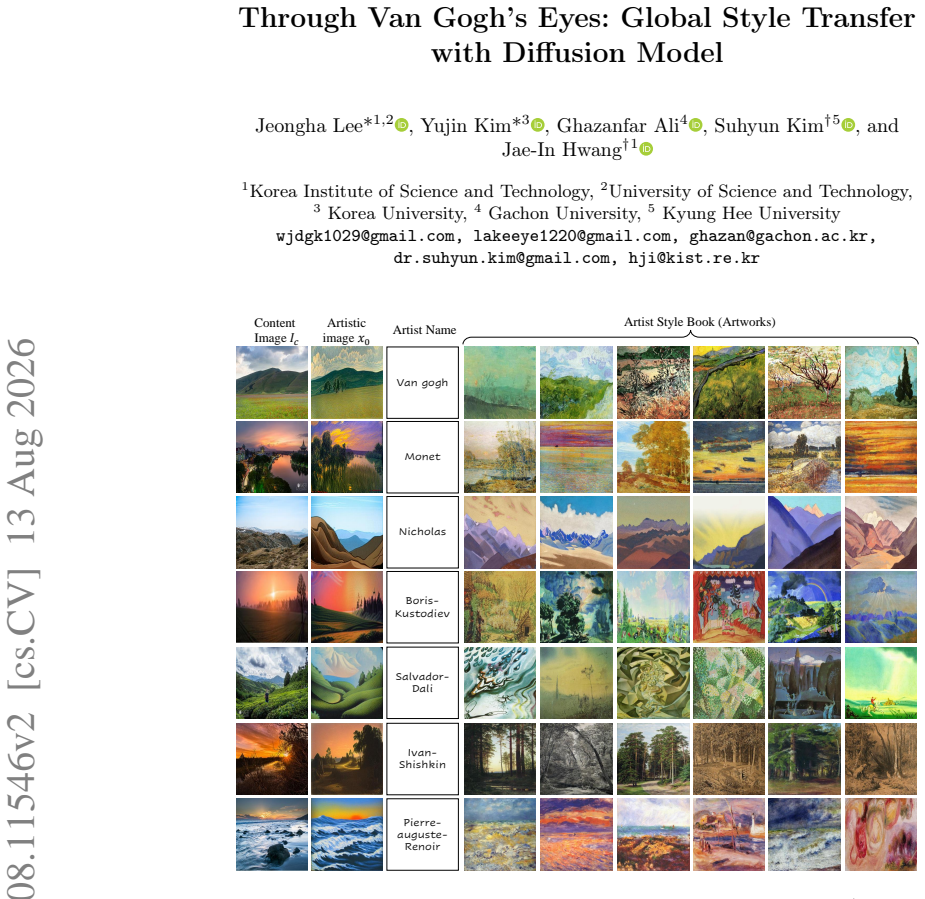
- The same content photo can be rendered in the global styles of many artists with no artist-name prompt and with one frozen base model.
- Replacing the training prompt ('A painting', 'An artwork', 'An image', '.') leaves the stylized output nearly unchanged, showing the learned style is text-independent.
- Training on the full artwork corpus gives higher output diversity and lower memorization than prompt-embedding and fine-tuning personalization baselines, tracking the diversity of the real artwork collections.
- Removing Content Alignment Guidance degrades content fidelity (higher FID and ArtFID), so content preservation is a genuine contribution of CAG rather than an incidental property.
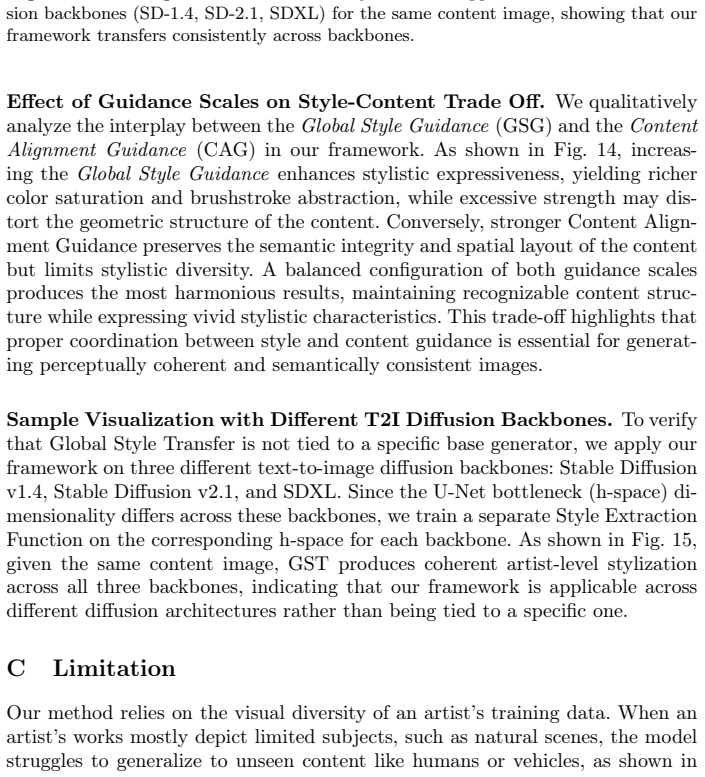
- The framework carries over to different diffusion backbones with different h-space dimensionalities by retraining the offset function for each backbone.
Reading between the lines
- Not tested in the paper: because each artist's offset lives in the same h-space, one could interpolate or add two offsets to blend global styles (for instance, one painter's brushwork with another's palette) without retraining.
- A direct measure of style-content disentanglement would be to train GSG on artists whose corpora vary in subject diversity and measure how well the offset transfers to content classes absent from the corpus; the paper's mountain-dominated failure case suggests transfer quality tracks subject diversity.
- Since CAG relies on one high-level CLIP layer, swapping in a semantic encoder with finer spatial fidelity could sharpen structure preservation under strong style modulation, offering a testable variant of the mechanism.
- The learned offset functions could double as compact artist descriptors, pointing toward style retrieval or quantitative comparisons of artists by the geometry of their offsets in h-space.
Signed reviews
Editorial analysis
A structured set of objections, weighed in public.
Referee Report
Summary. The paper introduces Global Style Transfer (GST), a many-to-one artistic image synthesis paradigm that aggregates multiple artworks of an artist to learn a global style representation. The method has two components: Global Style Guidance (GSG), which trains a lightweight Style Extraction Function f_t to produce a residual offset Δh_t in the h-space of a latent diffusion model under the fixed prompt 'A painting', and Content Alignment Guidance (CAG), a training-free CLIP-based guidance that preserves content structure during sampling. Experiments on WikiArt report FID, ArtFID, CFSD, CLIP-Div, and 1-Precision, comparing against Textual Inversion, Custom Diffusion, LoRA fine-tuning, and qualitative comparisons with style-transfer baselines. The paper claims superior stylistic fidelity, content preservation, and diversity, and includes ablations on guidance scales, training epochs, and backbones.
Significance. If the claims held, the paper would make a useful contribution: a text-independent, data-driven way to represent an artist's global style, potentially mitigating mode collapse in name-conditioned T2I generation. The h-space offset training and the training-free CAG mechanism are simple and reasonably motivated, and the paper includes extensive ablations, failure cases, and a limitation section. These are strengths. However, the significance is substantially tempered by the quantitative results, which on the paper's own reported metrics show the proposed method is worse than Textual Inversion on ArtFID and CFSD for all three tested artists, and by the clearly demonstrated content-bias failure in the Roerich case. The evaluation also conflates the training distribution with the evaluation reference for style-fidelity metrics. The core idea is defensible as a direction, but the evidence as presented does not support the headline claims of superiority.
major comments (4)
- [§4.1, Table 2] The quantitative results contradict the abstract's claim of 'superior stylistic fidelity, content preservation' and the text's characterization of 'consistently strong performance'. For Van Gogh, the proposed method has ArtFID 19.25 versus Textual Inversion's 13.68 and CFSD 0.2896 versus 0.1674; the same pattern holds for Chagall and Renoir. Since ArtFID and CFSD are the paper's own metrics for style fidelity and content preservation, the method is not superior on these axes. The claim that GST is 'competitive' with TI is not supported by the numbers. Please either present a defensible interpretation of these results, revise the claims, or add evidence that the differences are not significant (e.g., confidence intervals over seeds).
- [Appendix C, Fig. 16] The failure case with Nicholas Roerich shows that when the artist's corpus is dominated by one content type (mountains), the learned offset Δh_t converts unrelated content (trees) into mountain-like forms. This is direct evidence that f_t encodes content statistics of the training corpus rather than a pure global style operator. The limitation statement concedes that effectiveness depends on whether the artist's dataset includes the target content type, which undermines the central claim that GSG transfers global style to arbitrary content images. The training objective in Eq. (7) does not include any content-style disentanglement, and the fixed prompt only removes text variance, not visual content variance. Please address how the method can be claimed to learn 'artist-level style semantics purely from visual statistics' in light of this failure, or substantially qualify the generalization claim.
- [§4.1 and Appendix A (Evaluation Metrics)] The style-fidelity metrics FID, ArtFID, CLIP-Div, and 1-Precision are all computed against the same WikiArt artist corpus that is used to train GSG (and to train the personalization baselines). This creates a circular evaluation: methods trained to reproduce the artist's distribution are expected to score well on these measures, and the metrics cannot distinguish between learning the artist's style and memorizing the training set. CFSD, which uses separate content images, is more independent, and on CFSD the proposed method is worse than the baselines. Please provide an evaluation setting that avoids this circularity, for example by training on a subset of an artist's works and computing style metrics on a held-out subset, or by using a reference corpus that was not part of any method's training.
- [§2.2, §4.1] The paper repeatedly claims to outperform 'style transfer and diffusion-based artistic synthesis methods', but Table 2 quantitatively compares only with style personalization methods (Textual Inversion, Custom Diffusion, LoRA fine-tuning). The diffusion-based style-transfer baselines discussed in Related Works (StyleInjection, CSGO, InST, Diff-NST) appear only in the qualitative figure Fig. 5; no quantitative comparison with them is provided. This makes the broad superiority claim unsupported. Please add quantitative results for at least the main diffusion style-transfer baselines, or restrict the claim to the methods actually compared.
minor comments (5)
- [§4.2, Fig. 8] The prompt-sensitivity analysis claims that generated images are 'nearly identical across prompts', but this is based on visual inspection only. Please quantify prompt sensitivity, e.g., by reporting the average pairwise distance between outputs under different prompts.
- [§3.4, Eq. (8)-(10)] The symbol ℓ is used both for the perceptual loss and for the CLIP layer index l; this is confusing. Please use distinct notation, e.g., L for the loss and l for the layer.
- [§4, Table 2, CLIP-Div] The CLIP-Div values are reported as 'Ours/Real'. For Van Gogh, Ours is 0.297 and Real is 0.335; this is an 11% gap, yet the text says the values are 'highly consistent'. Please define a quantitative criterion for consistency and report it, or soften the wording.
- [Appendix A, Hyper Parameter Settings] The text says 'The impact of training epochs is presented in Fig. 7 of the main paper', but Figure 11 is the epoch ablation; Figure 7 in the printed version is a qualitative comparison with T2I models. Please correct the cross-reference.
- [Table 3] The ablation of CAG reports results for one artist only (Van Gogh) without error bars or multiple seeds. Since the differences are modest, please include variance estimates or additional artists to support the claim that CAG is crucial.
Circularity Check
Global-style fidelity is evaluated against the same WikiArt corpus used to fit the style offset, and the admitted Roerich failure shows the offset encodes corpus content; content transfer retains independent support.
-
fitted input called prediction
[Appendix A (Evaluation Metrics) with Eq. (7)]
"we train the Style Extraction Function (SEF) f_t on the WikiArt dataset [28], using between 500 and 1800 artworks per artist ... we measure Frechet Inception Distance (FID) [10] between the generated images and the full set of artworks for each artist."
The SEF is fitted via Eq. (7) to minimize noise reconstruction on the artist's WikiArt artworks, and the headline style-fidelity metrics (FID, ArtFID, 1-Precision) are then computed against that same artwork set. No held-out artwork split is reported, so 'superior stylistic fidelity' quantifies proximity to the training distribution rather than an independent prediction of artist-level style. The fitted residual offset is thus evaluated against the very distribution it was trained to reproduce.
-
self definitional
[Appendix C (Limitation) with Eq. (7)]
"When an artist's works mostly depict limited subjects, such as natural scenes, the model struggles to generalize to unseen content like humans or vehicles ... the effectiveness of style transfer depends on whether the artist's dataset includes the target content type."
Eq. (7) provides no mechanism to separate content from style: Delta h_t is a function of h_t, which carries both content and style information, and 'global style' is operationally defined as the visual statistics of the artist's corpus. The admitted Roerich failure, where tree content is reconstructed as mountain-like shapes, shows the learned offset encodes corpus content. The claim that GSG learns 'purely visual style semantics' therefore holds only by defining style as the corpus distribution; generalization to arbitrary content is assumed rather than derived.
full rationale
The derivation chain is not wholly self-contained. The core training objective (Eq. 7) fits the residual offset to the artist's artworks, and the paper's central style-fidelity claims are evaluated on that same WikiArt corpus, so the headline 'superior stylistic fidelity' is partially forced by the training distribution. The Roerich limitation, admitted in Appendix C, shows that the offset can encode content statistics when the artwork corpus is content-biased, undermining the claim that GSG captures only style. However, the transfer pipeline itself is run on separate content images (VanGogh2Photo), and the content-preservation metric CFSD is applied to those held-out content inputs, giving independent grounding to the content-alignment component. The paper also compares against external baselines and does not rely on self-citation for its main innovation, only on the standard Asyrp h-space construction from different authors. Therefore the circularity is partial: one or more predictions reduce by construction to the training distribution, but the central content-transfer claim is independently tested. Score 4 reflects this partial circularity without declaring the whole method circular.
Assumptions & free parameters
free parameters (3)
- Global style offset scaling factor w =
1.0, 1.25, 1.5 (selected per artist)
- CAG guidance scale s =
50.0
- CLIP layer index l for CAG =
11
assumptions (4)
- domain assumption The h-space (U-Net bottleneck) of a pretrained latent diffusion model is a stable, transferable semantic space that encodes artist-level style (Fig. 4).
- ad hoc to paper Pairing all artworks with the fixed prompt 'A painting' makes text conditioning variance negligible, so f_t learns style purely from visual statistics.
- domain assumption DDIM inversion of a content image yields a latent whose Tweedie estimate captures the content structure, so CAG can align generated images to it.
- domain assumption Noise reconstruction loss on the artist's corpus produces a style offset that generalizes to out-of-domain content (photos).
Cite this review
Pith. "Pith review of Through Van Gogh's Eyes: Global Style Transfer with Diffusion Model." pith.science (2026). https://pith.science/paper/C3JGEHA5
@misc{pith2026260811546,
  author       = {Pith},
  title        = {Pith review of: Through Van Gogh's Eyes: Global Style Transfer with Diffusion Model},
  year         = {2026},
  howpublished = {\url{https://pith.science/paper/C3JGEHA5}},
  note         = {Machine review of arXiv:2608.11546}
}
read the original abstract
Artistic image synthesis aims to recreate the expressive visual identity of a target artist, yet existing methods often fail to capture an artist's global style. Conventional style transfer methods transfer the style of one or a few reference artworks to a content image in a One-to-One manner, making them effective for artwork-level stylization but limited in representing the broader stylistic distribution of an artist. Text-to-image diffusion models conditioned on artist names, such as '~ in Van Gogh style', offer greater flexibility, but they often suffer from text-induced bias and reproduce patterns from only a few iconic works. To address these limitations, we introduce Global Style Transfer (GST), an artistic image synthesis paradigm, in a Many-to-One manner, that aggregates multiple artworks from a target artist and transfers their shared global style to a single content image. For GST, we propose Global Style Guidance (GSG), which learns a residual global style offset in the intermediate feature space, or h-space, of a diffusion model under a fixed prompt. By learning artist-level style semantics purely from visual statistics, GSG mitigates text-dependent artistic bias. We further propose Content Alignment Guidance (CAG), a training-free perceptual guidance mechanism that preserves the semantic structure of the content image while allowing artist-specific geometric deformation. Experiments on WikiArt demonstrate that GST achieves superior stylistic fidelity, content preservation, and output diversity compared to existing style transfer and diffusion-based artistic synthesis methods.
Figures


Figures from the paper (13 more)



Reference graph
Works this paper leans on
-
[1]
In: Proceedings of the IEEE/CVF International Conference on Computer Vision
Alanov, A., Titov, V., Nakhodnov, M., Vetrov, D.: Styledomain: Efficient and lightweight parameterizations of stylegan for one-shot and few-shot domain adap- tation. In: Proceedings of the IEEE/CVF International Conference on Computer Vision. pp. 2184–2194 (2023)
work page 2023
-
[2]
In: Proceedings of the IEEE/CVF conference on computer vision and pattern recognition
Chung, J., Hyun, S., Heo, J.P.: Style injection in diffusion: A training-free approach for adapting large-scale diffusion models for style transfer. In: Proceedings of the IEEE/CVF conference on computer vision and pattern recognition. pp. 8795–8805 (2024)
2024
-
[3]
In: Proceedings of the IEEE/CVF conference on computer vision and pattern recognition
Deng, Y., Tang, F., Dong, W., Ma, C., Pan, X., Wang, L., Xu, C.: Stytr2: Image style transfer with transformers. In: Proceedings of the IEEE/CVF conference on computer vision and pattern recognition. pp. 11326–11336 (2022)
2022
-
[4]
Journal of the American Statistical Association106(496), 1602–1614 (2011)
Efron, B.: Tweedie’s formula and selection bias. Journal of the American Statistical Association106(496), 1602–1614 (2011)
2011
-
[5]
arXiv preprint arXiv:2208.01618 (2022)
Gal, R., Alaluf, Y., Atzmon, Y., Patashnik, O., Bermano, A.H., Chechik, G., Cohen-Or, D.: An image is worth one word: Personalizing text-to-image gener- ation using textual inversion. arXiv preprint arXiv:2208.01618 (2022)
arXiv 2022
-
[6]
In: Proceedings of the IEEE conference on computer vision and pattern recognition
Gatys, L.A., Ecker, A.S., Bethge, M.: Image style transfer using convolutional neural networks. In: Proceedings of the IEEE conference on computer vision and pattern recognition. pp. 2414–2423 (2016)
2016
-
[7]
google/overview/image-generation/(2026), accessed: 2026-01-22
Google: Gemini image generation: Create images with gemini.https://gemini. google/overview/image-generation/(2026), accessed: 2026-01-22
work page 2026
-
[8]
In: Proceedings of the IEEE conference on computer vision and pattern recognition
Gu, S., Chen, C., Liao, J., Yuan, L.: Arbitrary style transfer with deep feature reshuffle. In: Proceedings of the IEEE conference on computer vision and pattern recognition. pp. 8222–8231 (2018)
2018
Show all 37 references
-
[9]
In: Proceedings of the IEEE/CVF Conference on Computer Vision and Pattern Recognition
Hertz, A., Voynov, A., Fruchter, S., Cohen-Or, D.: Style aligned image generation via shared attention. In: Proceedings of the IEEE/CVF Conference on Computer Vision and Pattern Recognition. pp. 4775–4785 (2024)
2024
-
[10]
Advances in neural information processing systems30(2017)
Heusel,M.,Ramsauer,H.,Unterthiner,T.,Nessler,B.,Hochreiter,S.:Ganstrained by a two time-scale update rule converge to a local nash equilibrium. Advances in neural information processing systems30(2017)
2017
-
[11]
In: Proceedings of the IEEE international conference on computer vision
Huang, X., Belongie, S.: Arbitrary style transfer in real-time with adaptive instance normalization. In: Proceedings of the IEEE international conference on computer vision. pp. 1501–1510 (2017)
2017
-
[12]
In: Proceedings of the IEEE/CVF conference on computer vision and pattern recognition
Kumari, N., Zhang, B., Zhang, R., Shechtman, E., Zhu, J.Y.: Multi-concept cus- tomization of text-to-image diffusion. In: Proceedings of the IEEE/CVF conference on computer vision and pattern recognition. pp. 1931–1941 (2023)
2023
-
[13]
arXiv preprint arXiv:2210.10960 (2022)
Kwon, M., Jeong, J., Uh, Y.: Diffusion models already have a semantic latent space. arXiv preprint arXiv:2210.10960 (2022)
2022 arXiv
-
[14]
Advances in neural information processing systems32(2019)
Kynkäänniemi, T., Karras, T., Laine, S., Lehtinen, J., Aila, T.: Improved precision and recall metric for assessing generative models. Advances in neural information processing systems32(2019)
2019
-
[15]
arXiv preprint arXiv:1701.01036 (2017)
Li, Y., Wang, N., Liu, J., Hou, X.: Demystifying neural style transfer. arXiv preprint arXiv:1701.01036 (2017)
2017 arXiv
-
[16]
Advances in neural information processing systems30(2017)
Li,Y.,Fang,C.,Yang,J.,Wang,Z.,Lu,X.,Yang,M.H.:Universalstyletransfervia feature transforms. Advances in neural information processing systems30(2017)
2017
-
[17]
In: Proceedings of the IEEE/CVF international conference on computer vision
Liu, S., Lin, T., He, D., Li, F., Wang, M., Li, X., Sun, Z., Li, Q., Ding, E.: Adaattn: Revisit attention mechanism in arbitrary neural style transfer. In: Proceedings of the IEEE/CVF international conference on computer vision. pp. 6649–6658 (2021) Global Style Transfer 17
2021
-
[18]
In: International conference on machine learning
Naeem, M.F., Oh, S.J., Uh, Y., Choi, Y., Yoo, J.: Reliable fidelity and diversity metrics for generative models. In: International conference on machine learning. pp. 7176–7185. PMLR (2020)
2020
-
[19]
find inspiration
OpenAI: Chatgpt: Get answers. find inspiration. be productive.https://openai. com/ko-KR/index/chatgpt/(2026), accessed: 2026-01-22
2026
-
[20]
In: proceedings of the IEEE/CVF conference on computer vision and pattern recog- nition
Park, D.Y., Lee, K.H.: Arbitrary style transfer with style-attentional networks. In: proceedings of the IEEE/CVF conference on computer vision and pattern recog- nition. pp. 5880–5888 (2019)
2019
-
[21]
In: International conference on machine learning
Radford, A., Kim, J.W., Hallacy, C., Ramesh, A., Goh, G., Agarwal, S., Sastry, G., Askell, A., Mishkin, P., Clark, J., et al.: Learning transferable visual models from natural language supervision. In: International conference on machine learning. pp. 8748–8763. PmLR (2021)
2021
-
[22]
In: Proceedings of the IEEE/CVF conference on computer vision and pattern recognition
Rombach, R., Blattmann, A., Lorenz, D., Esser, P., Ommer, B.: High-resolution image synthesis with latent diffusion models. In: Proceedings of the IEEE/CVF conference on computer vision and pattern recognition. pp. 10684–10695 (2022)
2022
-
[23]
Ruiz, N., Li, Y., Jampani, V., Pritch, Y., Rubinstein, M., Aberman, K.: Dream- booth:Finetuningtext-to-imagediffusionmodelsforsubject-drivengeneration.In: Proceedings of the IEEE/CVF conference on computer vision and pattern recog- nition. pp. 22500–22510 (2023)
2023
-
[24]
In: European Conference on Computer Vision
Ruta, D., Tarrés, G.C., Gilbert, A., Shechtman, E., Kolkin, N., Collomosse, J.: Diff-nst: Diffusion interleaving for deformable neural style transfer. In: European Conference on Computer Vision. pp. 50–66. Springer (2024)
2024
-
[25]
arXiv preprint arXiv:2306.00983 (2023)
Sohn, K., Ruiz, N., Lee, K., Chin, D.C., Blok, I., Chang, H., Barber, J., Jiang, L., Entis, G., Li, Y., et al.: Styledrop: Text-to-image generation in any style. arXiv preprint arXiv:2306.00983 (2023)
2023 arXiv
-
[26]
arXiv preprint arXiv:2010.02502 (2020)
Song, J., Meng, C., Ermon, S.: Denoising diffusion implicit models. arXiv preprint arXiv:2010.02502 (2020)
2020 arXiv
-
[27]
arXiv preprint arXiv:2011.13456 (2020)
Song, Y., Sohl-Dickstein, J., Kingma, D.P., Kumar, A., Ermon, S., Poole, B.: Score- based generative modeling through stochastic differential equations. arXiv preprint arXiv:2011.13456 (2020)
2020 arXiv
-
[28]
IEEE Transactions on Image Processing 28(1), 394–409 (2018)
Tan, W.R., Chan, C.S., Aguirre, H.E., Tanaka, K.: Improved artgan for conditional synthesis of natural image and artwork. IEEE Transactions on Image Processing 28(1), 394–409 (2018)
2018
-
[29]
arXiv preprint arXiv:1607.08022 (2016)
Ulyanov, D., Vedaldi, A., Lempitsky, V.: Instance normalization: The missing in- gredient for fast stylization. arXiv preprint arXiv:1607.08022 (2016)
2016 arXiv
-
[30]
In: DAGM German Conference on Pattern Recognition
Wright, M., Ommer, B.: Artfid: Quantitative evaluation of neural style transfer. In: DAGM German Conference on Pattern Recognition. pp. 560–576. Springer (2022)
2022
-
[31]
arXiv preprint arXiv:2408.16766 (2024)
Xing, P., Wang, H., Sun, Y., Wang, Q., Bai, X., Ai, H., Huang, R., Li, Z.: Csgo: Content-style composition in text-to-image generation. arXiv preprint arXiv:2408.16766 (2024)
2024 arXiv
-
[32]
In: Proceed- ings of the Computer Vision and Pattern Recognition Conference
Xu, R., Xi, W., Wang, X., Mao, Y., Cheng, Z.: Stylessp: Sampling startpoint en- hancement for training-free diffusion-based method for style transfer. In: Proceed- ings of the Computer Vision and Pattern Recognition Conference. pp. 18260–18269 (2025)
2025
-
[33]
In: Proceedings of the AAAI conference on artificial intelligence
Zhang, C., Xu, X., Wang, L., Dai, Z., Yang, J.: S2wat: Image style transfer via hierarchical vision transformer using strips window attention. In: Proceedings of the AAAI conference on artificial intelligence. vol. 38, pp. 7024–7032 (2024)
2024
-
[34]
In: Proceedings of the IEEE/CVF international conference on computer vision
Zhang, L., Rao, A., Agrawala, M.: Adding conditional control to text-to-image diffusion models. In: Proceedings of the IEEE/CVF international conference on computer vision. pp. 3836–3847 (2023) 18 J. Lee et al
2023
-
[35]
In: Proceedings of the IEEE/CVF con- ference on computer vision and pattern recognition
Zhang, Y., Huang, N., Tang, F., Huang, H., Ma, C., Dong, W., Xu, C.: Inversion- based style transfer with diffusion models. In: Proceedings of the IEEE/CVF con- ference on computer vision and pattern recognition. pp. 10146–10156 (2023)
2023
-
[36]
In: ACM SIG- GRAPH 2022 conference proceedings
Zhang, Y., Tang, F., Dong, W., Huang, H., Ma, C., Lee, T.Y., Xu, C.: Domain enhanced arbitrary image style transfer via contrastive learning. In: ACM SIG- GRAPH 2022 conference proceedings. pp. 1–8 (2022)
2022
-
[37]
A painting
Zhu, J.Y., Park, T., Isola, P., Efros, A.A.: Unpaired image-to-image translation using cycle-consistent adversarial networks. In: Proceedings of the IEEE interna- tional conference on computer vision. pp. 2223–2232 (2017) Global Style Transfer 19 A Experiment Settings Model.We...
2017
Reviewed August 16, 2026 · model on record in the stance chip above.
Discussion (0). Continue with ORCID to comment.