REVIEW 2 major objections 1 cited by
Constraining primordial black holes in dark matter with kinematics of dwarf galaxies
T0 review · 2 major / 0 minor · reviewed 2026-05-25 · grok-4.3
Pith's one-line read Dwarf galaxy velocity data rules out primordial black hole dark matter fractions above roughly twice the inverse mass squared at 99.99 percent confidence.
desk verdict Leo I data yields a new PBH fraction bound via velocity dispersion, but the mapping and error budget are not shown in the abstract. read the letter →
The pith
A machine-rendered reading of the paper's core claim, the machinery that carries it, and where it could break.
The reading
What carries the argument
The radial velocity dispersion induced in dwarf-galaxy star clusters by the gravitational influence of embedded primordial black holes.
What would settle it
A complete accounting of Leo I's velocity dispersion by ordinary stellar dynamics, binary stars, or measurement systematics without any PBH contribution would eliminate the claimed bound.
Extended reading notes
Core claim
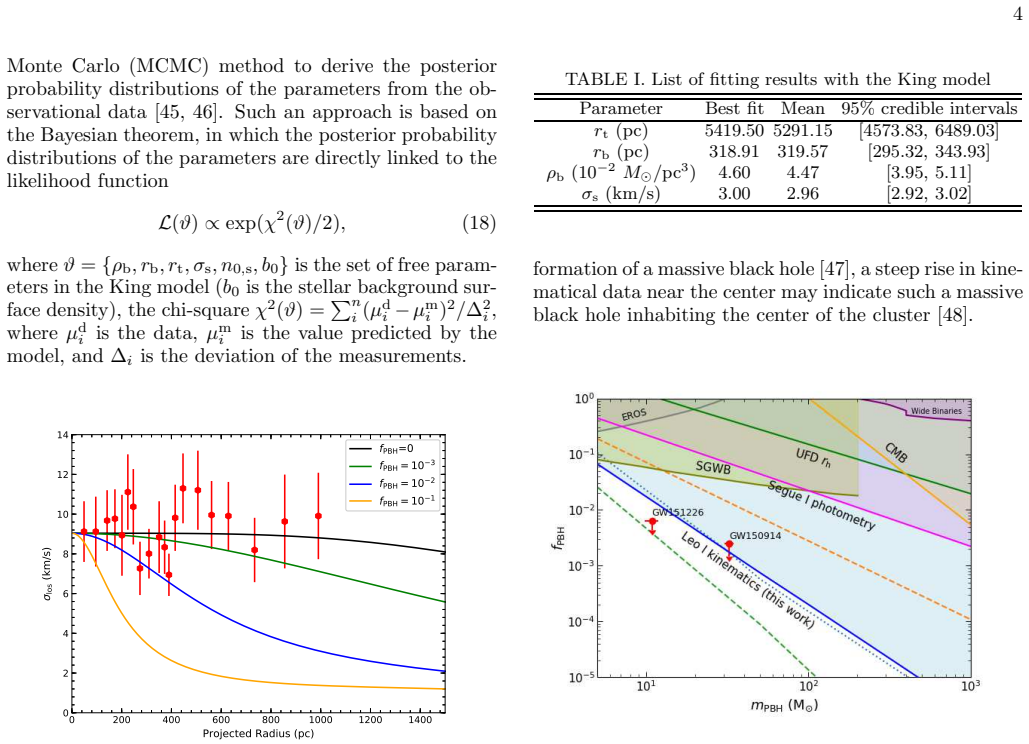
The presence of primordial black holes in star clusters will lead to the radial velocity dispersion of the system. Using the velocity dispersion observations from Leo I we show that the primordial black hole fraction f_PBH greater than or equal to 2.0 times (1 solar mass over m_PBH) squared is ruled out at a 99.99 percent confidence level. This method yields the most stringent limits on the PBH abundance at the mass scales from one to one thousand solar masses and tightly constrains the primordial origin of gravitational wave events observed by the LIGO experiments.
Load-bearing premise
The observed velocity dispersion in Leo I is produced by the dynamical effect of PBHs embedded in the stellar system rather than by other astrophysical processes or systematics.
Editorial extensions
If this is right
- The PBH fraction of dark matter cannot exceed a threshold that grows as the inverse square of PBH mass in the solar-mass range.
- PBHs between one and one thousand solar masses are excluded as the dominant dark-matter component.
- LIGO gravitational-wave events cannot be explained as mergers of a primordial black-hole population that saturates the allowed fraction.
Reading between the lines
- Applying the same kinematic analysis to other well-observed dwarf galaxies could tighten or corroborate the Leo I bound.
- If the bound holds, models in which PBHs form the entire dark matter or explain all LIGO events must invoke additional suppression mechanisms at these masses.
- Future precision proper-motion or radial-velocity surveys of dwarfs would extend the testable mass window downward or upward.
Signed reviews
Editorial analysis
A structured set of objections, weighed in public.
Referee Report
Summary. The manuscript proposes using kinematic observations of dwarf galaxies to constrain the fraction of dark matter in primordial black holes (PBHs). PBHs embedded in stellar systems are argued to induce additional radial velocity dispersion; applying this to Leo I data yields the bound f_PBH ≳ 2.0 × (1 M_⊙ / m_PBH)^2 ruled out at 99.99% confidence. The authors claim this provides the strongest limits for PBH masses in the range ~1–10^3 M_⊙ and thereby constrains a primordial origin for LIGO gravitational-wave events.
Significance. If the dynamical mapping from PBH parameters to observed dispersion is robust and the error budget is complete, the result would supply an independent and competitive constraint on stellar-mass PBHs as dark matter, with direct relevance to the interpretation of LIGO binary-black-hole mergers. The approach is novel in its use of dwarf-galaxy kinematics rather than microlensing or accretion signatures.
major comments (2)
- The central claim rests on an unspecified mapping from PBH mass and fraction to the induced velocity dispersion in Leo I. No equation, derivation, or reference to a prior calculation of this relation is supplied, so the numerical prefactor 2.0 and the quoted 99.99% confidence level cannot be reproduced or checked.
- The assumption that the entire observed velocity dispersion in Leo I is attributable to PBH dynamical heating (rather than baryonic mass, tidal effects, or measurement systematics) is adopted without quantitative comparison to alternative models or an explicit error budget; this premise directly determines the quoted exclusion.
Simulated Author's Rebuttal
We thank the referee for the careful reading and constructive comments on our manuscript. The points raised highlight areas where additional detail will improve the presentation. We address each major comment below and have revised the manuscript accordingly.
read point-by-point responses
-
Referee: The central claim rests on an unspecified mapping from PBH mass and fraction to the induced velocity dispersion in Leo I. No equation, derivation, or reference to a prior calculation of this relation is supplied, so the numerical prefactor 2.0 and the quoted 99.99% confidence level cannot be reproduced or checked.
Authors: We agree that the original manuscript did not include an explicit derivation or equation for the mapping from PBH parameters to the additional velocity dispersion. This mapping follows from the dynamical heating of stars by PBHs, where the induced dispersion scales with sqrt(f_PBH * m_PBH). The numerical bound is obtained by requiring that the PBH-induced component not exceed the observed Leo I dispersion. In the revised version we have added a dedicated subsection with the full derivation, the governing equation, and a reference to the underlying dynamical model. The prefactor 2.0 and the 99.99% confidence level are now directly traceable from the chi-squared comparison to the Leo I data. revision: yes
-
Referee: The assumption that the entire observed velocity dispersion in Leo I is attributable to PBH dynamical heating (rather than baryonic mass, tidal effects, or measurement systematics) is adopted without quantitative comparison to alternative models or an explicit error budget; this premise directly determines the quoted exclusion.
Authors: The original analysis used the full observed dispersion to set a conservative upper limit on f_PBH. We acknowledge that an explicit error budget and comparison to other contributions would strengthen the presentation. The revised manuscript now includes a quantitative discussion of baryonic mass, tidal effects, and measurement systematics for Leo I, drawing on existing literature values. These contributions are shown to be sub-dominant, so the quoted exclusion remains valid (and would only become stronger if other terms were subtracted). An explicit error budget table has been added. revision: yes
Circularity Check
No significant circularity identified
full rationale
The paper derives an observational upper bound on f_PBH by translating measured velocity dispersion in Leo I into a PBH-induced heating constraint. This uses external data (Leo I kinematics) as input and applies a dynamical model to produce the limit f_PBH ≳ 2.0×(1 M_⊙/m_PBH)^2 at 99.99% CL. No self-definitional loop, fitted parameter renamed as prediction, or load-bearing self-citation chain is exhibited in the abstract or stated claims. The central result is an external-data constraint rather than a quantity forced by the paper's own inputs or prior self-citations. The derivation is therefore self-contained against the provided text.
Assumptions & free parameters
Cite this review
Pith. "Pith review of Constraining primordial black holes in dark matter with kinematics of dwarf galaxies." pith.science (2026). https://pith.science/paper/C442OQAK
@misc{pith2026190610463,
  author       = {Pith},
  title        = {Pith review of: Constraining primordial black holes in dark matter with kinematics of dwarf galaxies},
  year         = {2026},
  howpublished = {\url{https://pith.science/paper/C442OQAK}},
  note         = {Machine review of arXiv:1906.10463}
}
abstract
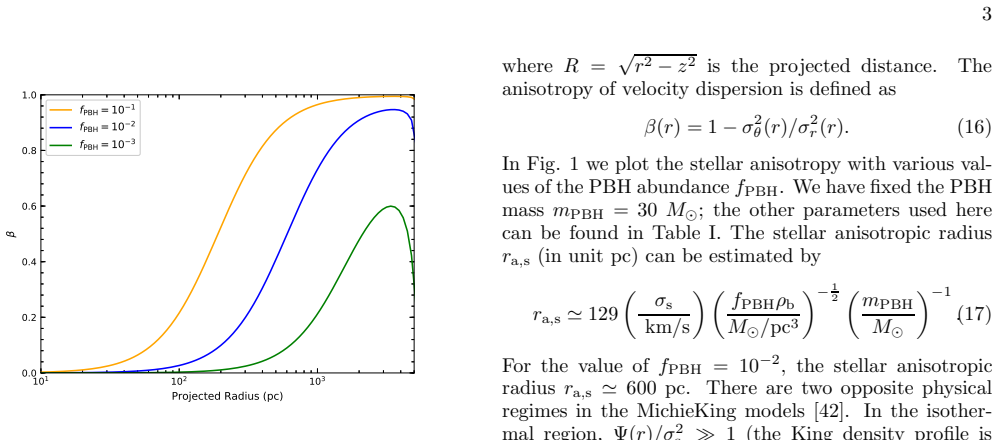
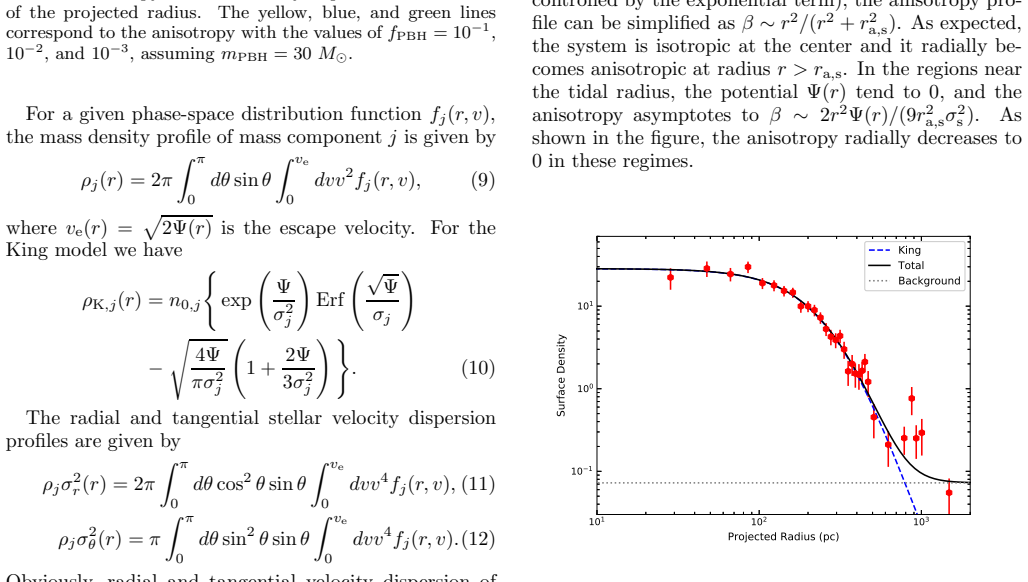
We propose that the kinematical observations of dwarf galaxies can be used to constrain the primordial black hole's (PBH) abundance in dark matter since the presence of primordial black holes in star clusters will lead to the radial velocity dispersion of the system. For instance, using the velocity dispersion observations from Leo I we show that the primordial black hole fraction $f_{\rm PBH}\gtrsim 2.0\times(1~M_{\odot}/m_{\rm PBH})^2$ is ruled out at a 99.99\% confidence level. This method yields the most stringent limits on the PBH abundance at the mass scales $\sim (1-10^3)~M_{\odot}$ and tightly constrains the primordial origin of gravitational wave events observed by the LIGO experiments.
Figures
Lean theorems connected to this paper
-
IndisputableMonolith/Cost/FunctionalEquation.leanwashburn_uniqueness_aczel unclear?
unclearRelation between the paper passage and the cited Recognition theorem.
We use the Michie-King model ... ra,j = ra μ_j^η ... ρ_DM = ρ_b / [(1+xb)(1+xb²)] ... MCMC ... f_PBH ≳ 2.0×(1 M_⊙/m_PBH)²
-
IndisputableMonolith/Foundation/RealityFromDistinction.leanreality_from_one_distinction unclear?
unclearRelation between the paper passage and the cited Recognition theorem.
The Michie-King model for the phase-space density ... King phase-space distribution function
What do these tags mean?
- matches
- The paper's claim is directly supported by a theorem in the formal canon.
- supports
- The theorem supports part of the paper's argument, but the paper may add assumptions or extra steps.
- extends
- The paper goes beyond the formal theorem; the theorem is a base layer rather than the whole result.
- uses
- The paper appears to rely on the theorem as machinery.
- contradicts
- The paper's claim conflicts with a theorem or certificate in the canon.
- unclear
- Pith found a possible connection, but the passage is too broad, indirect, or ambiguous to say the theorem truly supports the claim.
Forward citations
Cited by 1 Pith paper
-
Constraints on the primordial curvature power spectrum at small scales between $3\times 10^{18}$ and $4.5\times 10^{21}~\rm Mpc^{-1}$
Using recent bounds on light, memory-burdened primordial black holes, this paper derives new upper limits on the curvature power spectrum, roughly P_R < 10^-1.7, for wavenumbers 4.5e18 to 1.8e21 Mpc^-1.
Reference graph
Works this paper leans on
-
[1]
B. W. Lee and S. Weinberg, Phys. Rev. Lett. 39 165 (1977)
work page 1977
- [2]
- [3]
-
[4]
D. S. Akerib et al. (LUX Collaboration), Phys. Rev. Lett. 118, 021303 (2017)
work page 2017
-
[5]
M. Ackermann et al. (Fermi-LAT Collaboration), Phys. Rev. Lett. 115, 231301 (2015)
work page 2015
-
[6]
B. Q. Lu and H. S. Zong, Phys. Rev. D 93, 103517 (2016)
work page 2016
-
[7]
B. J. Carr and S. W. Hawking, Mon. Not. R. Astron. Soc. 168, 399 (1974)
work page 1974
- [8]
Show all 56 references
-
[9]
B. J. Carr, Astrophys. J. 201, 1 (1975)
1975
-
[10]
Hawking, Mon
S. Hawking, Mon. Not. R. Astron. Soc. 152, 75 (1971)
1971
-
[11]
Garriga, A
J. Garriga, A. Vilenkin, and J. Zhang, J. Cosmol. As- tropart. Phys. 02 (2016) 064
2016
-
[12]
Deng and A
H. Deng and A. Vilenkin, J. Cosmol. Astropart. Phys. 12 (2017) 044
2017
-
[13]
S. W. Hawking, Phys. Lett. B 231, 237 (1989)
1989
-
[14]
Polnarev, and R
A. Polnarev, and R. Zembowicz, Phys. Rev. D 43, 1106 (1991)
1991
-
[15]
Sasaki, T
M. Sasaki, T. Suyama, T. Tanaka and S. Yokoyama, Clas- sical Quantum Gravity 35, 063001 (2018)
2018
-
[16]
S. Bird, I. Cholis, J. B. Mu˜ noz, Y. Ali-Haimoud, M. Kamionkowski, E. D. Kovetz, A. Raccanelli, and A. G. 6 Riess, Phys. Rev. Lett. 116, 201301 (2016)
2016
-
[17]
B. P. Abbott et al. (LIGO and Virgo Collaborations), Phys. Rev. Lett. 116, 061102 (2016)
2016
-
[18]
Sasaki, T
M. Sasaki, T. Suyama, T. Tanaka and S. Yokoyama, Phys. Rev. Lett. 117, 061101 (2016)
2016
-
[19]
T. D. Brandt, Astrophys. J. Lett. 824, L31 (2016)
2016
-
[20]
Merritt, Dynamics and Evolution of Galactic Nuclei , Princeton University Press, Princeton, NJ, 2013
D. Merritt, Dynamics and Evolution of Galactic Nuclei , Princeton University Press, Princeton, NJ, 2013
2013
-
[21]
Spitzer, Jr., Astrophys
L. Spitzer, Jr., Astrophys. J. Lett. 158, L139 (1969)
1969
-
[22]
S. M. Koushiappas and A. Loeb, Phys. Rev. Lett. 119 041102 (2017)
2017
-
[23]
Giersz and D
M. Giersz and D. C. Heggie, Mon. Not. R. Astron. Soc. 268, 257 (1994)
1994
-
[24]
Peuten, A
M. Peuten, A. Zocchi, M. Gieles, V. H. Brunet, Mon. Not. R. Astron. Soc. 470, 3 (2017)
2017
-
[25]
Spurzem and K
R. Spurzem and K. Takahashi, Mon. Not. R. Astron. Soc. 272, 772 (1995)
1995
-
[26]
Takahashi, Publ
K. Takahashi, Publ. Astron. Soc. Jpn. 48, 691 (1996)
1996
-
[27]
Takahashi, Publ
K. Takahashi, Publ. Astron. Soc. Jpn. 49, 547 (1997)
1997
-
[28]
Spitzer, Jr, Dynamical Evolution of Globular Clusters
L. Spitzer, Jr, Dynamical Evolution of Globular Clusters. (Princeton University Press, Princeton, NJ 1987)
1987
-
[29]
Meylan and M
G. Meylan and M. Mayor, Astron. Astrophys. 166, 122 (1986)
1986
-
[30]
C. R. Mann, H. Richer, J. Heyl, J. Anderson, J. Kalirai, I. Caiazzo, S.D. Moohle, A. Knee, and H. Baumgardt, Astrophys. J. 875, 1 (2019)
2019
-
[31]
A. W. McConnachie, Astron. J. 144, 4 (2012)
2012
-
[32]
R. W. Michie, Mon. Not. R. Astron. Soc. 126, 331 (1963)
1963
-
[33]
Gieles and A
M. Gieles and A. Zocchi, Mon. Not. R. Astron. Soc. 454, 576 (2015)
2015
-
[34]
J. E. Gunn and R. F. Griffin, Astron. J. 84, 752 (1979)
1979
-
[35]
Meylan, Astron
G. Meylan, Astron. Astrophys. 184, 144 (1987)
1987
-
[36]
I. R. King, Astron. J. 70, 376 (1965)
1965
-
[37]
I. R. King, Astron. J. 71, 64 (1966)
1966
-
[38]
Giersz and D
M. Giersz and D. C. Heggie Mon. Not. R. Astron. Soc. 279, 1037 (1996)
1996
-
[39]
Tulin and H
S. Tulin and H. B. Yu, Phys. Rep. 730, 1 (2018)
2018
-
[40]
Burkert, Astrophys
A. Burkert, Astrophys. J. Lett. 447, L25 (1995)
1995
-
[41]
L. E. Strigari, C. S. Frenk, and S. D. M. White, Astro- phys. J. 838, 123 (2017)
2017
-
[42]
N. C. Amorisco and N. W. Evans, Mon. Not. R. Astron. Soc. 419, 184 (2012)
2012
-
[43]
Irwin and D
M. Irwin and D. Hatzidimitriou, Mon. Not. R. Astron. Soc., 277, 1354 (1995)
1995
-
[44]
M. G. Walker et al. , Astrophys. J. 667, L53 (2007)
2007
-
[45]
Lewis and S
A. Lewis and S. Bridle, Phys. Rev. D, 66, 103511 (2002)
2002
-
[46]
Putze, L
A. Putze, L. Derome, D. Maurin, L. Perotto, and R. Taillet, Astron. Astrophys. 497, 991 (2009)
2009
-
[47]
M. A. Gurkan, M. Freitag and F. A. Rasio, Astrophys. J. 604, 632 (2004)
2004
-
[48]
Binney and G
J. Binney and G. A. Mamon, Mon. Not. R. Astron. Soc. 200, 361 (1982)
1982
-
[49]
Cowan, Statistical Data Analysis, Oxford Science Publications (Clarendon Press, Oxford, 1998)
G. Cowan, Statistical Data Analysis, Oxford Science Publications (Clarendon Press, Oxford, 1998)
1998
-
[50]
J. F. Navarro, C. S. Frenk, and S. D. M. White, Astro- phys. J. 462, 563 (1996)
1996
-
[51]
Tisserand et al
P. Tisserand et al. (EROS-2 Collaboration), Astron. As - trophys. 469, 387 (2007)
2007
-
[52]
S. Wang, Y. F. Wang, Q. G. Huang, and T. G. F. Li, Phys. Rev. Lett. 120, 191102 (2018)
2018
-
[53]
M. A. Monroy-Rodriguez and C. Allen, Astrophys. J. 790, 159 (2014)
2014
-
[54]
Ali-Haimoud and M
Y. Ali-Haimoud and M. Kamionkowski, Phys Rev. D 95, 043534 (2017)
2017
-
[55]
B. P. Abbott et al. (LIGO and Virgo Collaborations), Phys. Rev. Lett. 116, 241103 (2016)
2016
-
[56]
Raidal, C
M. Raidal, C. Spethmann, V. Vaskonen, and H. Veermae, J. Cosmol. Astropart. Phys. 02 (2019) 018
2019
Reviewed May 25, 2026 · model on record in the stance chip above.
Discussion (0). Continue with ORCID to comment.