REVIEW 3 major objections 5 minor 56 references
Isolated spin ladders in Ln$_2$Ti$_9$Sb$_{11}$ (Ln:La-Nd) metals
T0 review · 3 major / 5 minor · reviewed 2026-08-05 · deepseek-v4-flash
Pith's one-line read The paper reports that Ln$_2$Ti$_9$Sb$_{11}$ (Ln = La–Nd) hosts well-isolated, nearly square two-leg rare-earth spin ladders, and that the Nd and Ce members show low-dimensional antiferromagnetism while Pr forms a weakly magnetic singlet gr
desk verdict Solid new material, unproven ladder physics — the structural supercell work is the lasting part. read the letter →
The pith
A machine-rendered reading of the paper's core claim, the machinery that carries it, and where it could break.
The reading
What carries the argument
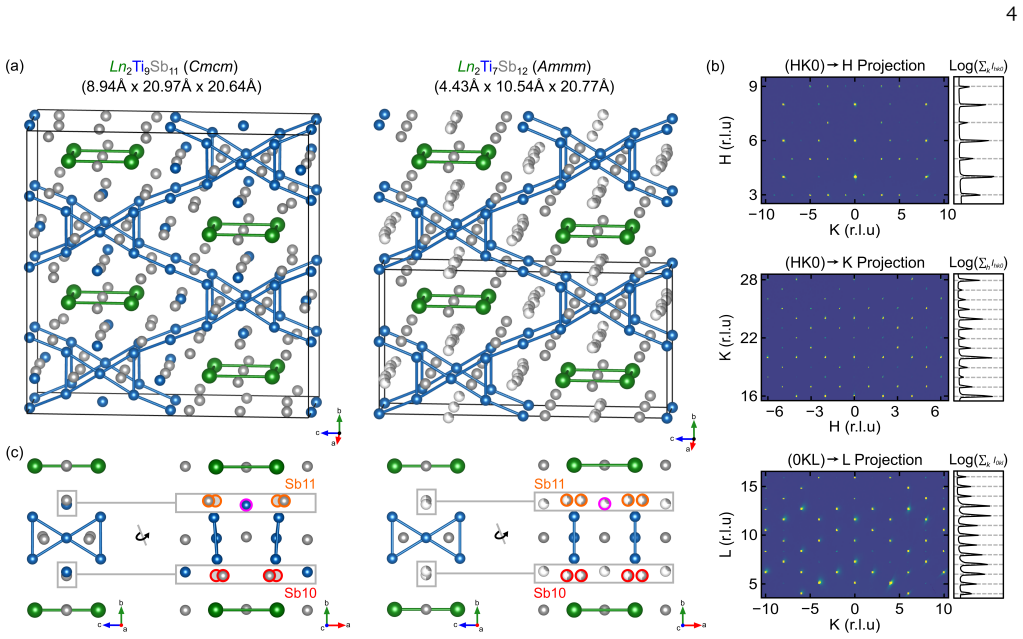
The load-bearing object is the Ln sublattice geometry: a two-leg ($n=2$) spin ladder, i.e., two parallel chains of magnetic rare-earth ions connected by rungs. The ladder is nearly square because the rung and leg spacings are both 4.4–4.6 Å, suggesting comparable exchange $J_{\rm rung}\sim J_{\rm leg}$; it is isolated because the next ladder sits about 10.5 Å away, with the closest inter-ladder Ln–Ln contact at 7.8 Å. The surrounding Ti–Ti and Ti–Sb network provides conduction electrons, so exchange among Ln moments is expected to be RKKY-mediated, while 9-fold Sb coordination structurally separates the Ln ions from the Ti network.
What would settle it
Inelastic neutron scattering on Nd$_2$Ti$_9$Sb$_{11}$ that resolves the magnetic excitation spectrum would settle the claim: a spectrum with inter-ladder dispersion comparable to the leg dispersion, or a magnetically ordered wavevector inconsistent with correlations within a single ladder, would refute the isolated-ladder picture. A cheaper proxy would be a dilution series replacing Nd with nonmagnetic La and tracking whether the low-temperature ordering scale falls as expected for isolated chains.
Extended reading notes
Core claim
The central claim is structural: in the orthorhombic Cmcm cell, the single Ln site arranges into two-leg ladders along a, with rung and leg spacings of 4.4–4.6 Å and a center-to-center distance near 10.5 Å. Thermal and magnetic data on the Nd and Ce members are consistent with antiferromagnetic correlations within the ladders: anisotropic magnetization, heat-capacity anomalies at 1.1/1.9 K and 0.9/1.7 K, and magnetic entropy approaching $R\ln 2$. Pr does not order but instead shows a weakly magnetic singlet ground state. Nd$_2$Ti$_9$Sb$_{11}$ is a poor metal with nearly temperature-independent resistivity; its field-dependent thermal conductivity is suppressed in the paramagnetic state up to
Load-bearing premise
The load-bearing premise is that the comparable 4.4–4.6 Å Ln–Ln distances within a ladder actually translate into dominant magnetic exchange within the ladder ($J_{\rm leg}\sim J_{\rm rung}$ much larger than inter-ladder couplings), even though no exchange constants are measured and the compound is a metal in which RKKY interactions could couple distant ladders through the Ti–Sb network.
Editorial extensions
If this is right
- If the ladder identification is correct, Ln$_2$Ti$_9$Sb$_{11}$ is a rare inorganic platform for testing two-leg spin-ladder physics with rare-earth moments instead of transition-metal moments.
- The Nd and Ce members provide two independent doublet realizations with slightly different temperature scales, and the Pr member supplies a singlet comparison, enabling systematic checks of how ground-state degeneracy controls ladder behavior.
- The field-induced suppression of Nd$_2$Ti$_9$Sb$_{11}$'s thermal conductivity up to 40 K implies strong spin-lattice coupling persists far above the magnetic ordering scale, a measurable signature that can be probed by neutron scattering or thermal expansion.
- Because the compounds are metals with Ti-dominated states at the Fermi level, magnetic exchange is likely mediated by itinerant carriers, making chemical doping or pressure a direct route to tune ladder couplings without changing the Ln ion.
Reading between the lines
- Editorial inference: the square-ladder claim is directly testable by inelastic neutron scattering on Nd$_2$Ti$_9$Sb$_{11}$; mapping the spin-excitation spectrum would give $J_{\rm leg}$, $J_{\rm rung}$, and inter-ladder couplings, which the present magnetization and heat-capacity data can only constrain indirectly.
- Editorial inference: because the ladder is embedded in a metal with conduction-electron-mediated exchange, the ground state is unlikely to be a clean isolated spin-ladder spin liquid; a more plausible outcome is a dimerized or weakly ordered state whose energy scales shift with Fermi-surface properties, so the platform's value may lie more in tunability than in realizing the pristine even-leg ladd
- Editorial inference: if the suggested Sb-to-As substitution stabilizes smaller rare earths, the resulting Gd/Tb analogues would have larger effective spins and possibly higher ordering temperatures, making the ladder physics easier to access; this is a synthetically falsifiable prediction the paper leaves implicit.
Signed reviews
Editorial analysis
A structured set of objections, weighed in public.
Referee Report
Summary. The paper reports the discovery and characterization of a new family of rare-earth titanium antimonides Ln2Ti9Sb11 (Ln = La–Nd), with the central claim that the Ln sublattice forms well-isolated, nearly square n=2 spin ladders. The authors present single-crystal X-ray diffraction, precession imaging, EDS, magnetization, heat capacity, electrical resistivity, and thermal conductivity measurements. They argue that Nd2Ti9Sb11 and Ce2Ti9Sb11 show low-dimensional antiferromagnetic behavior with doublet ground states, while Pr2Ti9Sb11 has a nonmagnetic singlet ground state. The magnetic exchange couplings are not measured; the ladder description is inferred from Ln–Ln distances of 4.4–4.6 Å and a ladder center-to-center distance of about 10.5 Å. The paper also reports a field-induced suppression of thermal conductivity in Nd2Ti9Sb11 at temperatures far above the 1.1 K ordering feature.
Significance. If the spin-ladder interpretation holds, this would be a rare inorganic rare-earth-based square spin-ladder platform with tunable effective spin and anisotropy, and the structural work appears careful and well supported. The crystallographic characterization, including the ordered supercell relation to Ln2Ti7Sb12, is a solid contribution. The magnetization, heat capacity, and transport data are of good quality and establish interesting low-temperature phenomenology. However, the load-bearing magnetic claim that these are well-isolated spin ladders with dominant intra-ladder exchange is not directly established by any measurement or calculation. The paper is honest about many uncertainties, but the central framing goes beyond the evidence. With appropriate reframing or additional exchange-sensitive measurements, the work could be a valuable contribution.
major comments (3)
- [§III A, §III B] The central claim that the Ln sublattice forms 'well-isolated, n=2 spin ladders' with dominant intra-ladder exchange is not established. The structural geometry is clear, but the exchange hierarchy J_leg ~ J_rung >> J_inter is inferred solely from Ln–Ln distances. No exchange constants are measured, and the DFT calculation is on nonmagnetic La2Ti9Sb11 with no 4f states, so it cannot validate the magnetic ladder picture. In a metal with RKKY interactions, inter-ladder coupling can be long-ranged and anisotropic; the 9-fold Sb coordination does not by itself isolate the moments. The text's assertion that intra-ladder interactions are 'likely much stronger (>5-10)' than inter-ladder interactions is unsupported. The paper should either provide exchange estimates from experiment (e.g., fits to magnetization, heat capacity, or inelastic neutron scattering) or substantially soften the claim to
- [§III C, Fig. 4] The observation of a sharp heat-capacity feature at 1.1 K with a corresponding magnetization cusp is evidence of long-range magnetic order. For a truly isolated even-leg S=1/2 ladder, no finite-temperature ordering transition is expected; a robust ordering transition implies non-negligible inter-ladder coupling. This directly weakens the 'well-isolated' characterization. The paper needs to quantify or at least bound the inter-ladder coupling, or discuss why the 1.1 K transition is consistent with the ladder picture despite the finite-temperature ordering.
- [§III A, §III B] The 'well-isolated' claim is also internally qualified by the structural data itself: the next-nearest-neighbor Ln–Ln interaction between adjacent ladders is given as 7.8 Å, while the ladder 'center-to-center' distance is quoted as 10.5 Å. The relevant magnetic separation is the shorter 7.8 Å distance, not the geometric center-to-center distance. The ratio of intra-ladder (4.4–4.6 Å) to inter-ladder (7.8 Å) distances is much less impressive than implied by the 10.5 Å figure and does not by itself support a factor of 5–10 in exchange strength. This should be addressed explicitly.
minor comments (5)
- [§II B] Typo: 'Apezion N-grease' should be 'Apiezon N-grease'.
- [§III C] The phrase 'we will omitted further discussion' should be 'we will omit further discussion'.
- [§III B] The notation 'J_leg ~ J_rung' is introduced without a definition of J. Please define J as the magnetic exchange constant and specify the Hamiltonian convention used.
- [§II C] The DFT calculations neglect spin-orbit coupling and 4f magnetism; this is reasonable for La but should be stated as a limitation when drawing any inference about the magnetic ladders in Ce, Pr, and Nd compounds.
- [§III A] The relation to Ln2Ti7Sb12 is interesting, but the possibility of a Ti–Sb solid solution is mentioned only briefly. A sentence or two on how the current data rule out or constrain intergrowths would strengthen the structural claim.
Circularity Check
No significant circularity: the structural characterization is self-contained, and the magnetic 'spin ladder' interpretation is an under-supported inference rather than a reduction to fitted inputs or self-citation.
full rationale
The paper's load-bearing structural claims—Ln–Ln leg and rung spacings of 4.4–4.6 Å and a ladder center-to-center distance of ~10.5 Å—are derived directly from single-crystal X-ray diffraction refinements, not from the spin-ladder label. The leap from geometry to magnetism occurs in Section III.B: 'The similar Ln–Ln leg and rung separations (4.4–4.6 Å) suggests comparable magnetic interactions (e.g. J_leg ∼ Jrung). These interactions are likely much stronger (>5-10) than the inter-ladder interactions.' This is an inductive assumption about exchange in a metal, not a circular derivation: no exchange constant is fitted, no equation defining the ladder in terms of its own magnetism is used, and the statement is explicitly hedged ('likely', 'expected to dominate'). The paper even notes that Fermi-surface anisotropy could alter J_leg vs Jrung, and the closest next-nearest-neighbor magnetic interaction (7.8 Å) is disclosed, undermining the 'well-isolated' wording but not creating a circular tautology. Curie-Weiss fits are deliberately de-emphasized ('we will omitted further discussion of the Curie-Weiss fits'), so no fitted parameter is relabeled as a prediction. The self-citations (e.g., refs. 36, 38, 44) are comparisons to prior kagome/titanium antimonide work and are not load-bearing for the ladder claim; no uniqueness theorem or ansatz is imported from the authors' prior papers. The observed 1.1 K heat-capacity feature is discussed as a possible magnetic ordering transition, which is treated as consistent with a quasi-1D ladder plus weak inter-ladder coupling, not as a prediction that reduces to the input geometry. Overall, the central weakness is the unmeasured exchange hierarchy (a scientific uncertainty about whether these are true magnetic spin ladders), not circular reasoning. Under the given rubric, no specific reduction can be quoted, so the circularity score is 0.
Assumptions & free parameters
assumptions (4)
- domain assumption The Ln-Ln bond geometry (rung and leg distances 4.4-4.6 Å, center-to-center ~10.5 Å) defines a magnetic square spin ladder with dominant intra-ladder exchange J_leg ~ J_rung.
- domain assumption La2Ti9Sb11 is a valid nonmagnetic phonon reference for the magnetic heat capacity of Nd and Ce compounds.
- domain assumption The Wiedemann-Franz law with the standard Lorenz number applies to estimate the electronic thermal conductivity of Nd2Ti9Sb11.
- domain assumption RKKY interactions mediated by the Ti/Sb conduction electrons couple the lanthanide moments.
Cite this review
Pith. "Pith review of Isolated spin ladders in Ln$_2$Ti$_9$Sb$_{11}$ (Ln:La-Nd) metals." pith.science (2026). https://pith.science/paper/C45KOPWB
@misc{pith2026250805870,
  author       = {Pith},
  title        = {Pith review of: Isolated spin ladders in Ln$_2$Ti$_9$Sb$_11$ (Ln:La-Nd) metals},
  year         = {2026},
  howpublished = {\url{https://pith.science/paper/C45KOPWB}},
  note         = {Machine review of arXiv:2508.05870}
}
abstract
Here we present the discovery and characterization of a series of antimonides Ln$_2$Ti$_9$Sb$_{11}$ (Ln: La--Nd) which exhibit well-isolated, $n=2$ rare-earth spin ladders. We discuss the structure of the new compounds, with a particular focus on the magnetic Ln spin ladders. Nd$_2$Ti$_9$Sb$_{11}$ and Ce$_2$Ti$_9$Sb$_{11}$ exhibit antiferromagnetic interactions and a well-defined doublet ground state, whereas Pr$_2$Ti$_9$Sb$_{11}$ exhibits a weakly magnetic singlet ground state. Nd$_2$Ti$_9$Sb$_{11}$ is a poor metal with an electrical resistivity of 0.1m$\Omega$-cm at 300K and weak temperature dependence. The thermal conductivity along the ladder exhibits significant field dependence even at 40K, considerably higher than the magnetic ordering temperature of 1.1K. Compared to compounds with transition metal spin ladders, the rare-earth elements impart much lower energy scales, making these compounds highly tunable with external stimuli like magnetic fields. The diverse magnetism of the rare-earth ions and RKKY interactions further contribute to the potential for a wide array of rich magnetic ground states, positioning these materials as a rare example of an inorganic square spin-ladder platform.
Figures


Figures from the paper (2 more)


Reference graph
Works this paper leans on
-
[1]
a hump that peaks in CP around 1.7 K, and 2) a sec- ondary (weak) feature that occurs around 0.9 K. These temperatures correlate well with the broad rise in H ∥a and the plateau/cusp observed in H∥b and H∥c. The magnetization and heat capacity results in Ce2Ti9Sb11 are vaguely reminiscent of the results for Nd2Ti9Sb11. Both materials present magnetization...
-
[2]
Bethe, Zur theorie der metalle: I
H. Bethe, Zur theorie der metalle: I. eigenwerte und eigenfunktionen der linearen atomkette, Zeitschrift f ¨ur Physik 71, 205 (1931)
work page 1931
-
[3]
F. D. M. Haldane, Nonlinear field theory of large-spin heisenberg antiferromagnets: semiclassically quantized solitons of the one-dimensional easy-axis n´eel state, Phys- ical review letters 50, 1153 (1983)
work page 1983
-
[4]
B. Sutherland, Two-dimensional hydrogen bonded crys- tals without the ice rule, Journal of Mathematical Physics 11, 3183 (1970)
work page 1970
-
[5]
Hulth ´en, ¨Uber das austauschproblem eines kristalles , Ph.D
L. Hulth ´en, ¨Uber das austauschproblem eines kristalles , Ph.D. thesis, Almqvist & Wiksell (1938). 1 Notice: This manuscript has been authored by UT-Battelle, LLC, under contract DE-AC05-00OR22725 with the US Department of Energy (DOE). The US government retains and the publisher, by accepting the article for publication, acknowledges that the US govern...
work page 1938
-
[6]
J. D. Johnson, S. Krinsky , and B. M. McCoy , Vertical-arrow correlation length in the eight-vertex model and the low- lying excitations of the x- y- z hamiltonian, Physical Re- view A 8, 2526 (1973)
work page 1973
-
[7]
Baxter, One-dimensional anisotropic heisenberg chain, Physical Review Letters 26, 834 (1971)
R. Baxter, One-dimensional anisotropic heisenberg chain, Physical Review Letters 26, 834 (1971)
work page 1971
-
[8]
P. W. Anderson, An approximate quantum theory of the antiferromagnetic ground state, Physical Review 86, 694 (1952)
work page 1952
Show all 56 references
-
[9]
Kl ¨umper, Thermodynamics of the anisotropic spin-1/2 heisenberg chain and related quantum chains, Zeitschrift f¨ur Physik B Condensed Matter 91, 507 (1993)
A. Kl ¨umper, Thermodynamics of the anisotropic spin-1/2 heisenberg chain and related quantum chains, Zeitschrift f¨ur Physik B Condensed Matter 91, 507 (1993)
1993
-
[10]
than the inter-ladder interactions. The nearest lad- der center-to-center distance is approximately 10.5 ˚A , though the closest next-nearest neighbor magnetic inter- action is 7.8 ˚A (interaction between right leg to left leg of nearest diagonal ladder). Regardless, the rung/...
-
[11]
Anderson, Limits on the energy of the antiferromag- netic ground state, Physical Review 83, 1260 (1951)
P. Anderson, Limits on the energy of the antiferromag- netic ground state, Physical Review 83, 1260 (1951)
1951
-
[12]
Kubo, The spin-wave theory of antiferromagnetics, Physical Review 87, 568 (1952)
R. Kubo, The spin-wave theory of antiferromagnetics, Physical Review 87, 568 (1952)
1952
-
[13]
Dagotto and T
E. Dagotto and T. Rice, Surprises on the way from one-to two-dimensional quantum magnets: The ladder materi- als, Science 271, 618 (1996). 10
1996
-
[14]
Dagotto, Experiments on ladders reveal a complex in- terplay between a spin-gapped normal state and super- conductivity , Reports on Progress in Physics 62, 1525 (1999)
E. Dagotto, Experiments on ladders reveal a complex in- terplay between a spin-gapped normal state and super- conductivity , Reports on Progress in Physics 62, 1525 (1999)
1999
-
[15]
Kageyama, T
H. Kageyama, T. Watanabe, Y. Tsujimoto, A. Kitada, Y. Sumida, K. Kanamori, K. Yoshimura, N. Hayashi, S. Muranaka, M. Takano, et al. , Spin-ladder iron oxide: Sr3fe2o5, Angewandte Chemie 120, 5824 (2008)
2008
-
[16]
Hiroi, M
Z. Hiroi, M. Azuma, M. Takano, and Y. Bando, A new ho- mologous series srn- 1cun+ 1o2n found in the sro-cuo system treated under high pressure, Journal of Solid State Chemistry 95, 230 (1991)
1991
-
[17]
Koo and M.-H
H.-J. Koo and M.-H. Whangbo, Analysis of the spin– spin interactions in layered oxides α-nav2o5, cav2o5 and mgv2o5 and the spin-peierls distortion in α-nav2o5 by molecular orbital, madelung energy and bond valence sum calculations, Solid state communications 111, 353 (1999)
1999
-
[18]
Y. E. Gorbunova and S. Linde, Structure of crystals of vanadyl pyrophosphate (vo) 2p 2o 7, in Doklady Akademii Nauk , Vol. 245 (Russian Academy of Sciences,
-
[19]
Takahashi, A
H. Takahashi, A. Sugimoto, Y. Nambu, T. Yamauchi, Y. Hi- rata, T. Kawakami, M. Avdeev, K. Matsubayashi, F. Du, C. Kawashima, et al., Pressure-induced superconductivity in the iron-based ladder material bafe2s3, Nature materi- als 14, 1008 (2015)
2015
-
[20]
Chiari, O
B. Chiari, O. Piovesana, T. Tarantelli, and P. Zanazzi, Ex- change interaction in multinuclear transition metal com- plexes. 14. exchange interactions in a novel copper (ii) linear-chain compound with ladderlike structure: Cu2 (1, 4-diazacycloheptane) 2cl4, Inorganic Chemistry...
1990
-
[21]
T. Komm, D. Biner, A. Neels, and K. W. Kr ¨amer, (c5h12n) cu2br3: A piperidinium copper (i) bromide with [cu2br3]- ladders, Crystals 2, 1434 (2012)
2012
-
[22]
Biswal, S
P. Biswal, S. Guchhait, S. Ghosh, S. Sarangi, D. Samal, D. Swain, M. Kumar, and R. Nath, Crystal structure and magnetic properties of the spin-1 2 frustrated two-leg lad- der compounds (c 4 h 14 n 2) cu 2 x 6 (x= cl and br), Physical Review B 108, 134420 (2023)
2023
-
[23]
Akutagawa, T
T. Akutagawa, T. Hasegawa, T. Nakamura, and T. Inabe, Supramolecular cation assemblies of hydrogen-bonded (nh4+/nh2nh3+)(crown ether) in [ni (dmit) 2]-based molecular conductors and magnets, Journal of the Amer- ican Chemical Society 124, 8903 (2002)
2002
-
[24]
Rovira, J
C. Rovira, J. Veciana, E. Ribera, J. Tarr ´es, E. Canadell, R. Rousseau, M. Mas, E. Molins, M. Almeida, R. T. Hen- riques, et al., An organic spin-ladder molecular material, Angewandte Chemie International Edition in English 36, 2324 (1997)
1997
-
[25]
Nomura, Y
K. Nomura, Y. H. Matsuda, A. Ikeda, Y. Kohama, H. Tsuda, N. Amaya, T. Ono, and Y. Hosokoshi, Metastable magne- tization plateaus in the s= 1 organic spin ladder bip-teno induced by a microsecond-pulsed megagauss field, Physi- cal Review B 105, 214430 (2022)
2022
-
[26]
Higashi, T
I. Higashi, T. Tanaka, K. Kobayashi, Y. Ishizawa, and M. Takami, Crystal structure of yb41si1. 2, Journal of Solid State Chemistry 133, 11 (1997)
1997
-
[27]
Mori, Crystal growth and magnetic properties of rare earth borosilicides, Zeitschrift f ¨ur Kristallographie- Crystalline Materials 221, 464 (2006)
T. Mori, Crystal growth and magnetic properties of rare earth borosilicides, Zeitschrift f ¨ur Kristallographie- Crystalline Materials 221, 464 (2006)
2006
-
[28]
J. Zhou, A. Liu, F. Song, L. Ling, J. Li, W. Tong, Z. Xia, G. Gong, Y. Wang, J. Zhao, et al., Structure and magnetic properties of a family of two-leg spin ladder compounds ba2re2ge4o13 (re= pr, nd, and gd–ho), Inorganic Chem- istry 63, 22748 (2024)
2024
-
[29]
Orlandi, M
F. Orlandi, M. Ciomaga Hatnean, D. Mayoh, J. Tidey , S. Riberolles, G. Balakrishnan, P. Manuel, D. Khalyavin, H. Walker, M. Le,et al., Magnetic properties of the zigzag ladder compound srtb 2 o 4, Physical Review B 111, 054415 (2025)
2025
-
[30]
P. C. Canfield, T. Kong, U. S. Kaluarachchi, and N. H. Jo, Use of frit-disc crucibles for routine and exploratory so- lution growth of single crystalline samples, Philosophical magazine 96, 84 (2016)
2016
-
[31]
See Supplemental Information for further details
-
[32]
Kresse and J
G. Kresse and J. Furthm ¨uller, Efficient iterative schemes for ab initio total-energy calculations using a plane-wave basis set, Phys. Rev. B 54, 11169 (1996)
1996
-
[33]
Kresse and J
G. Kresse and J. Furthm ¨uller, Efficiency of ab-initio total energy calculations for metals and semiconductors using a plane-wave basis set, Comput. Mater. Sci. 6, 15 (1996)
1996
-
[34]
Kresse and D
G. Kresse and D. Joubert, From ultrasoft pseudopotentials to the projector augmented-wave method, Phys. Rev. B 59, 1758 (1999)
1999
-
[35]
J. P. Perdew, K. Burke, and M. Ernzerhof, Generalized gradient approximation made simple, Phys. Rev. Lett. 77, 3865 (1996)
1996
-
[36]
Hinuma, G
Y. Hinuma, G. Pizzi, Y. Kumagai, F. Oba, and I. Tanaka, Band structure diagram paths based on crystallography , Computational Materials Science 128, 140 (2017)
2017
-
[37]
A. Togo, K. Shinohara, and I. Tanaka, Spglib: a software library for crystal symmetry search, Science and Technol- ogy of Advanced Materials: Methods 4, 2384822 (2024)
2024
-
[38]
B. R. Ortiz, G. Pokharel, M. Gundayao, H. Li, F. Kaboud- vand, L. Kautzsch, S. Sarker, J. P. Ruff, T. Hogan, S. J. G. Alvarado, et al. , YbV 3Sb4 and EuV 3Sb4 vanadium-based kagome metals with Yb 2+ and Eu2+ zigzag chains, Phys. Rev. Mater.7, 064201 (2023)
2023
-
[39]
B. R. Ortiz, L. C. Gomes, J. R. Morey , M. Winiarski, M. Bor- delon, J. S. Mangum, I. W. Oswald, J. A. Rodriguez- Rivera, J. R. Neilson, S. D. Wilson, et al. , New kagome prototype materials: discovery of KV 3Sb5, RbV 3Sb5, and CsV3Sb5, Phys. Rev. Materials 3, 094407 (2019)
2019
-
[40]
B. R. Ortiz, H. Miao, D. S. Parker, F. Yang, G. D. Samolyuk, E. M. Clements, A. Rajapitamahuni, T. Yilmaz, E. Vescovo, J. Yan, et al., Evolution of Highly Anisotropic Magnetism in the Titanium-Based Kagome Metals LnTi3Bi4 (Ln: La··· Gd3+, Eu 2+, Yb 2+), Chemistry of Materials ...
2023
-
[41]
Ovchinnikov and S
A. Ovchinnikov and S. Bobev, Synthesis, Crystal and Electronic Structure of the Titanium Bismuthides Sr5Ti12Bi19+x, Ba 5Ti12Bi19+x, and Sr 5−δEuδTi12Bi19+x (x=0.5–1.0; δ=2.4, 4.0), Eur. J. Inorg. Chem.2018, 1266 (2018)
2018
-
[42]
Ovchinnikov and S
A. Ovchinnikov and S. Bobev, Bismuth as a reactive sol- vent in the synthesis of multicomponent transition-metal- bearing bismuthides, Inorg. Chem. 59, 3459 (2019)
2019
-
[43]
Motoyama, M
G. Motoyama, M. Sezaki, J. Gouchi, K. Miyoshi, S. Nishig- ori, T. Mutou, K. Fujiwara, and Y. Uwatoko, Magnetic properties of new antiferromagnetic heavy-fermion com- pounds, Ce3TiBi5 and CeTi3Bi4, Physica B Condens. 536, 142 (2018)
2018
-
[44]
L. Chen, Y. Zhou, H. Zhang, X. Ji, K. Liao, Y. Ji, Y. Li, Z. Guo, X. Shen, R. Yu, et al. , Tunable magnetism in titanium-based kagome metals by rare-earth engineer- ing and high pressure, Communications Materials 5, 73 11 (2024)
2024
-
[45]
J. Guo, L. Zhou, J. Ding, G. Qu, Z. Liu, Y. Du, H. Zhang, J. Li, Y. Zhang, F. Zhou, W. Qi, F. Guo, T. Wang, F. Fei, Y. Huang, T. Qian, D. Shen, H. Weng, and F. Song, Magnetic kagome materials RETi3Bi4 family with weak interlayer interactions, 2023, arXiv:2308.14509v1 [cond-mat...
2023 arXiv
-
[46]
B. R. Ortiz, H. Zhang, K. G ´ornicka, D. S. Parker, G. D. Samolyuk, F. Yang, H. Miao, Q. Lu, R. G. Moore, A. F. May , et al. , Intricate magnetic landscape in antiferromagnetic kagome metal tbti3bi4 and interplay with ln2–x ti6+ x bi9 (ln: Tb··· lu) shurikagome metals, Chemist...
2024
-
[47]
K. Guo, Z. Ma, H. Liu, Z. Wu, J. Wang, Y. Shi, Y. Li, and S. Jia, 1/3 and other magnetiza- tion plateaus in a quasi-one-dimensional Ising magnet TbTi 3Bi4 with zigzag spin chain, 2024, arXiv:2405.09280v1 [cond-mat.str-el]. arXiv.org e-Print archive. https://arxiv.org/pdf/2405....
2024 arXiv
-
[48]
Cheng, K
E. Cheng, K. Wang, S. Nie, T. Ying, Z. Li, Y. Li, Y. Xu, H. Chen, R. Koban, H. Borrmann, et al. , Giant anomalous hall effect and band folding in a kagome metal with mixed dimensionality , 2024, arXiv:2405.16831v1 [cond-mat.str-el]. arXiv.org e-Print archive. https://arxiv.org...
2024
-
[49]
H. Bie, S. D. Moore, D. G. Piercey , A. V. Tkachuk, O. Y. Zelinska, and A. Mar, Ternary rare-earth titanium anti- monides: phase equilibria in the RE–Ti–Sb (RE= La, Er) systems and crystal structures of RE2Ti7Sb12 (RE= La, Ce, Pr, Nd) and RETi 3(SnxSb1−x)4 (RE= Nd, Sm), J. Sol...
2007
-
[50]
Q. Zeng, H. Ge, M. Wu, S. Ruan, T. Li, Z. Wang, J. Li, L. Ling, W. Tong, S. Huang,et al., K2renb5o15 (re= ce, pr, nd, sm, gd–ho): A family of quasi-one-dimensional spin- chain compounds with large interchain distance, Chem- istry of Materials 36, 2867 (2024)
2024
-
[51]
Algra, L
H. Algra, L. De Jongh, and R. Carlin, One-and two- dimensional s= 12 heisenberg antiferromagnetism in cu (c5h5no) 6 (clo4) 2 and cu (c5h5no) 6 (bf4) 2, respec- tively , Physica B+ C93, 24 (1978)
1978
-
[52]
Sologubenko, T
A. Sologubenko, T. Lorenz, H. R. Ott, and A. Freimuth, Thermal conductivity via magnetic excitations in spin- chain materials, Journal of Low Temperature Physics147, 387 (2007)
2007
-
[53]
Sologubenko, K
A. Sologubenko, K. Gianno, H. Ott, A. Vietkine, and A. Revcolevschi, Heat transport by lattice and spin exci- tations in the spin-chain compounds srcuo 2 and sr 2 cuo 3, Physical Review B 64, 054412 (2001)
2001
-
[54]
Chernyshev and A
A. Chernyshev and A. Rozhkov, Thermal transport in antiferromagnetic spin-chain materials, Physical Review B—Condensed Matter and Materials Physics 72, 104423 (2005)
2005
-
[55]
Kl ¨umper and K
A. Kl ¨umper and K. Sakai, The thermal conductivity of the spin-1/2 xxz chain at arbitrary temperature, Journal of Physics A: Mathematical and General 35, 2173 (2002)
2002
-
[56]
Sologubenko, E
A. Sologubenko, E. Felder, K. Gianno, H. Ott, A. Vietkine, and A. Revcolevschi, Thermal conductivity and specific heat of the linear chain cuprate sr 2 cuo 3: Evidence for thermal transport via spinons, Physical Review B 62, R6108 (2000)
2000
Reviewed August 5, 2026 · model on record in the stance chip above.
Discussion (0). Continue with ORCID to comment.