Euclid preparation: Testing multi-field inflation with galaxy power spectrum and bispectrum
Pith reviewed 2026-05-21 03:04 UTC · model grok-4.3
The pith
Joint power spectrum and bispectrum analysis on Euclid-like mocks recovers unbiased f_NL with 29-46 percent tighter errors.
A machine-rendered reading of the paper's core claim, the machinery that carries it, and where it could break.
Core claim
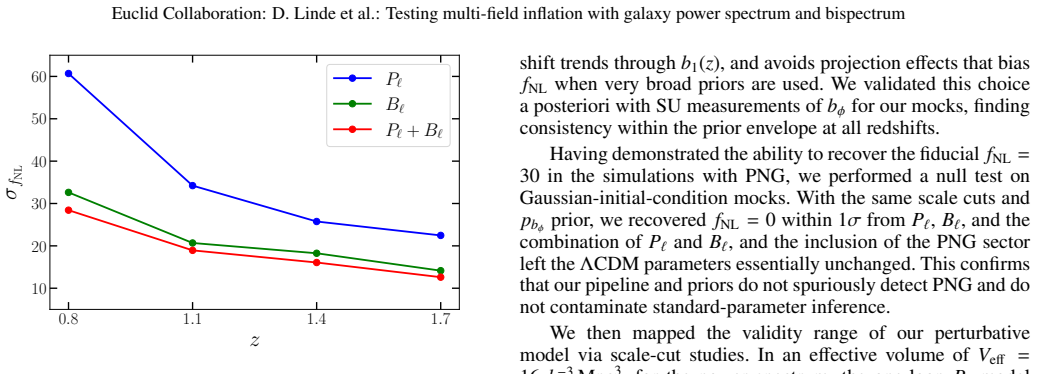
Likelihood analyses of one-loop redshift-space power spectrum multipoles and tree-level bispectrum multipoles applied to Abacus-PNG simulations recover f_NL and Lambda-CDM parameters with less than one-sigma bias when the effective volume reaches 16 h^{-3} Gpc^3 across four snapshots from z=0.8 to 1.7. The bispectrum alone reduces the uncertainty on f_NL by 29-46 percent relative to the power spectrum at fixed scale cuts; the joint analysis supplies a further 8-13 percent gain. The strongest individual-bin results appear at z=1.7, where a physically motivated prior on the PNG bias parameter b_phi yields a 2.35-sigma detection of f_NL while the prior-agnostic setup reaches 1.9 sigma on the f_
What carries the argument
Joint likelihood of one-loop power-spectrum multipoles and tree-level bispectrum multipoles that isolates the dominant local PNG term proportional to f_NL times b_phi while marginalizing over bias and cosmological parameters.
If this is right
- B_ℓ alone reduces σ(f_NL) by ∼29–46% relative to P_ℓ at fixed cuts.
- Joint power spectrum-bispectrum analysis tightens constraints a further ∼8–13%.
- Cumulative gain across the four redshift snapshots is a factor of ∼2.3 for the joint case.
- A physically motivated prior on b_φ produces unbiased f_NL while incorporating theory uncertainty.
- The bispectrum quadrupole supplies a substantial fraction of the extra constraining power.
Where Pith is reading between the lines
- Extending the same pipeline to higher-order perturbation theory or wider scale ranges could further tighten f_NL bounds once real Euclid systematics are controlled.
- Joint power-spectrum-bispectrum constraints on local PNG may be combined with CMB bispectrum measurements to break remaining degeneracies in multi-field inflation models.
- The demonstrated volume scaling suggests that full-sky Euclid data could reach several-sigma detections of f_NL if the simulation-validated precision carries over.
- Similar joint analyses could be applied to other large-scale structure surveys to cross-check PNG signals.
Load-bearing premise
The halo occupation distribution tuned to Euclid Flagship 2 accurately populates halos in the Abacus-PNG simulations and the one-loop power spectrum plus tree-level bispectrum models remain sufficient without higher-order corrections or additional PNG bias terms for the chosen scale cuts.
What would settle it
Repeating the identical likelihood pipeline on an independent set of mocks or on actual Euclid data and finding biases in f_NL larger than one sigma would falsify the claim of unbiased recovery.
Figures





read the original abstract
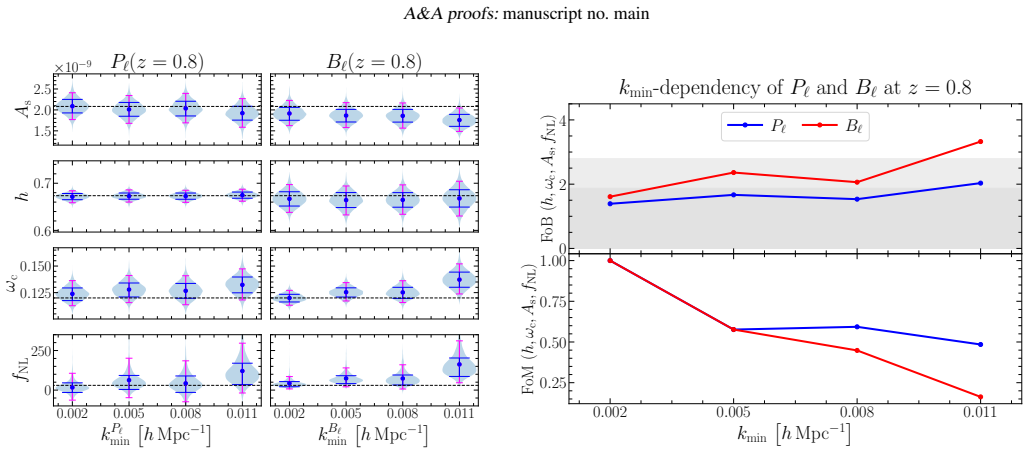
Primordial non-Gaussianity (PNG) is a powerful probe of the origin of cosmic structure. Stage-IV surveys like \Euclid will measure galaxy $2$- and $3$-point clustering at high signal-to-noise, whose exploitation requires robust joint analysis. We prepare for Euclid's spectroscopic sample by validating a redshift-space power-spectrum and bispectrum pipeline (one-loop $P_\ell$, tree-level $B_\ell$) on Euclid-like mocks from Abacus-PNG $N$-body simulations with Gaussian and local-PNG initial conditions, using a halo occupation distribution (HOD) tuned to Euclid Flagship 2. We stress-test analysis choices -- PNG-bias parametrisation, priors, and scale cuts -- and perform null tests without PNG. In a `prior-agnostic setup', detection of the dominant PNG term $\propto f_{\rm NL} \, b_\phi$ in single redshift bins is difficult; nevertheless, the bispectrum provides constraints on other PNG combinations that partially lift degeneracies. We propose a physically motivated prior on $b_\phi$ that yields unbiased $f_{\rm NL}$ while accounting for theory uncertainty, and determine scale cuts that give unbiased $\Lambda$CDM and $f_{\rm NL}$. With $V_{\rm eff}=16\,h^{-3}\,{\rm Gpc}^3$ across four snapshots ($0.8\le z\le1.7$), our likelihood analyses recover $<1\sigma$ bias in $f_{\rm NL}$ and $\Lambda$CDM. At fixed cuts, $B_\ell$ alone reduces $\sigma({f_{\rm NL}})$ by $\sim29$--$46\%$ relative to $P_\ell$, and joint power spectrum-bispectrum analysis tightens a further $\sim8$--$13\%$; the cumulative gain from $z=0.8$ to $1.7$ is $\sim2.3$ for the joint case. The bispectrum quadrupole is key. Our strongest results are at $z=1.7$: $1.9\sigma$ for $f_{\rm NL} \, b_\phi$ (prior-agnostic) and $2.35\sigma$ for $f_{\rm NL}$ (prior-based). Joint analyses thus offer strong prospects for testing multi-field inflation, pending end-to-end validation in the full Euclid geometry with observational systematics.
Editorial analysis
A structured set of objections, weighed in public.
Referee Report
Summary. The manuscript validates a joint redshift-space power spectrum and bispectrum pipeline for constraining local primordial non-Gaussianity (f_NL) using Euclid-like mocks from Abacus-PNG N-body simulations populated with an HOD tuned to Euclid Flagship 2. It employs one-loop P_ℓ and tree-level B_ℓ models, stress-tests PNG-bias parametrization, priors, and scale cuts, introduces a physically motivated prior on b_φ to account for theory uncertainty, performs null tests, and reports unbiased recovery of f_NL and ΛCDM parameters with V_eff = 16 h^{-3} Gpc^3 across four snapshots (0.8 ≤ z ≤ 1.7). The bispectrum alone reduces σ(f_NL) by 29–46% relative to the power spectrum, with joint analysis providing an additional 8–13% tightening and a cumulative gain of ~2.3; the bispectrum quadrupole is highlighted as key, yielding up to 2.35σ for f_NL at z=1.7 under the prior-based setup.
Significance. If the adopted perturbative models and scale cuts prove sufficient, the work quantifies concrete gains from including the bispectrum (particularly the quadrupole) for multi-field inflation tests with Euclid and supplies a practical framework for handling degeneracies and theory uncertainties via a motivated prior on b_φ. The simulation-based recovery of injected f_NL with <1σ bias, combined with explicit stress-tests on Abacus-PNG mocks and null tests without PNG, provides a reproducible benchmark that strengthens prospects for Stage-IV PNG constraints. The reported improvement factors and strongest signals at z=1.7 constitute useful quantitative guidance for survey planning.
major comments (2)
- [§5] §5 (scale cuts and model validation): The central claim of <1σ bias in f_NL recovery and the 29–46% improvement from B_ℓ rests on the sufficiency of tree-level bispectrum plus one-loop power spectrum up to the chosen k-cuts. At z=1.7, where the bispectrum quadrupole drives the strongest results, an explicit test or estimate of the size of neglected two-loop corrections and additional PNG-induced bias operators (beyond the dominant f_NL b_φ term) within those cuts is needed; without it, the joint multi-redshift constraints and cumulative gain of ~2.3 could be compromised.
- [§4.2, §6.1] §4.2 and §6.1 (PNG-bias parametrization and prior on b_φ): The physically motivated prior on b_φ is presented as accounting for theory uncertainty while yielding unbiased f_NL. The manuscript should specify the exact functional form of this prior (including any dependence on the HOD or simulation parameters) and demonstrate that it does not inadvertently incorporate information from the same Abacus-PNG mocks used for the likelihood analyses, to ensure the 1.9σ (prior-agnostic) and 2.35σ (prior-based) detections at z=1.7 remain robust.
minor comments (3)
- [Figure 4] Figure 4 (or equivalent results figure): Axis labels and error-bar styles for the different redshift bins and analysis combinations (P_ℓ only, B_ℓ only, joint) could be made more distinct to improve readability of the σ(f_NL) comparisons.
- [Abstract, §3] Abstract and §3: The effective volume V_eff=16 h^{-3} Gpc^3 is stated without an explicit breakdown of the contribution per snapshot or per survey geometry; adding this would clarify how the four snapshots combine.
- [§2.2] §2.2: The HOD parameters tuned to Euclid Flagship 2 are summarized but lack a table of best-fit values or a brief discussion of how PNG-induced changes in halo properties are (or are not) propagated.
Simulated Author's Rebuttal
We thank the referee for their careful reading of the manuscript and constructive comments. We address each major comment below and have incorporated revisions to strengthen the presentation of our model validation and prior specification.
read point-by-point responses
-
Referee: [§5] §5 (scale cuts and model validation): The central claim of <1σ bias in f_NL recovery and the 29–46% improvement from B_ℓ rests on the sufficiency of tree-level bispectrum plus one-loop power spectrum up to the chosen k-cuts. At z=1.7, where the bispectrum quadrupole drives the strongest results, an explicit test or estimate of the size of neglected two-loop corrections and additional PNG-induced bias operators (beyond the dominant f_NL b_φ term) within those cuts is needed; without it, the joint multi-redshift constraints and cumulative gain of ~2.3 could be compromised.
Authors: We agree that an explicit estimate of higher-order terms would further bolster the validation. The scale cuts in the manuscript were chosen precisely because they yield unbiased recovery of both f_NL and ΛCDM parameters across the mocks, providing implicit evidence that neglected contributions remain subdominant. In the revised manuscript we have added a paragraph in §5 that estimates the magnitude of two-loop corrections using standard perturbation-theory scaling relations from the literature, confirming they lie below the statistical errors for our adopted k_max at z=1.7. We also briefly discuss additional PNG bias operators, noting that they are either suppressed by extra powers of f_NL or enter at higher order in the bias expansion; their expected impact is therefore smaller than the dominant f_NL b_φ term already included. These additions clarify the robustness of the reported gains without changing the conclusions. revision: yes
-
Referee: [§4.2, §6.1] §4.2 and §6.1 (PNG-bias parametrization and prior on b_φ): The physically motivated prior on b_φ is presented as accounting for theory uncertainty while yielding unbiased f_NL. The manuscript should specify the exact functional form of this prior (including any dependence on the HOD or simulation parameters) and demonstrate that it does not inadvertently incorporate information from the same Abacus-PNG mocks used for the likelihood analyses, to ensure the 1.9σ (prior-agnostic) and 2.35σ (prior-based) detections at z=1.7 remain robust.
Authors: We thank the referee for requesting this clarification. The prior is constructed from the theoretical peak-background-split expectation for the PNG bias parameter and is assigned a finite width to marginalize over residual theoretical uncertainties in the bias expansion. Its functional form and width are determined from general considerations in the literature and do not depend on the specific HOD parameters or outputs of the Abacus-PNG mocks employed in the likelihood analyses. In the revised version we have expanded §4.2 to state the functional form explicitly and added a sentence in §6.1 confirming that the prior parameters were fixed independently of the present mock likelihoods. This ensures the quoted significances remain unaffected by any circularity. revision: yes
Circularity Check
No significant circularity; validation is externally benchmarked
full rationale
The paper validates a one-loop power spectrum plus tree-level bispectrum pipeline on independent Abacus-PNG N-body simulations that inject known f_NL values (Gaussian and local-PNG initial conditions). The HOD is tuned to the separate Euclid Flagship 2 simulation. Likelihood analyses recover the injected signals with <1σ bias, and the reported 29–46% improvement from B_ℓ (plus further 8–13% from joint analysis) are direct numerical outcomes measured on these mocks. The proposed prior on b_φ is described as physically motivated to account for theory uncertainty rather than being fitted to the analysis data. No load-bearing step reduces by construction to a fitted parameter renamed as prediction, a self-definition, or a self-citation chain. The central claims rest on external simulation benchmarks and are therefore self-contained.
Axiom & Free-Parameter Ledger
free parameters (2)
- prior on b_φ
- scale cuts
axioms (2)
- domain assumption HOD tuned to Euclid Flagship 2 accurately represents galaxy population in Abacus-PNG mocks
- domain assumption One-loop P_ℓ and tree-level B_ℓ capture the relevant clustering signal including PNG effects
Reference graph
Works this paper leans on
-
[1]
Euclid Collaboration:. Euclid preparation. Galaxy 2-point correlation function modelling in redshift space. 2026. arXiv:2601.04780
-
[2]
Euclid: Field-level inference of primordial non-Gaussianity and cosmic initial conditions
Euclid Collaboration:. Euclid: Field-level inference of primordial non-Gaussianity and cosmic initial conditions. 2024. arXiv:2412.11945
- [3]
-
[4]
Chudaykin, Anton and Ivanov, Mikhail M. and Philcox, Oliver H. E. Reanalyzing DESI DR1. III. Constraints on inflation from galaxy power spectra and bispectra. Phys. Rev. D. 2026. doi:10.1103/fhj3-6q4x. arXiv:2512.04266
-
[5]
Chudaykin, Anton and Ivanov, Mikhail M. and Philcox, Oliver H. E. Reanalyzing DESI DR1. I. CDM constraints from the power spectrum and bispectrum. Phys. Rev. D. 2026. doi:10.1103/qsnt-dppc. arXiv:2507.13433
-
[6]
Chudaykin, Anton and Ivanov, Mikhail M. and Philcox, Oliver H. E. Reanalyzing DESI DR1: 5. Cosmological Constraints with Simulation-Based Priors. 2026. arXiv:2602.18554
-
[7]
Ivanov, Mikhail M. and Sullivan, James M. and Chen, Shi-Fan and Chudaykin, Anton and Maus, Mark and Philcox, Oliver H. E. Reanalyzing DESI DR1: 4. Percent-Level Cosmological Constraints from Combined Probes and Robust Evidence for the Normal Neutrino Mass Hierarchy. 2026. arXiv:2601.16165
-
[8]
Reanalyzing DESI DR1: 2. Constraints on Dark Energy, Spatial Curvature, and Neutrino Masses
Chudaykin, Anton and Ivanov, Mikhail M. and Philcox, Oliver H. E. Reanalyzing DESI DR1: 2. Constraints on Dark Energy, Spatial Curvature, and Neutrino Masses. 2025. arXiv:2511.20757
work page internal anchor Pith review Pith/arXiv arXiv 2025
-
[9]
Lagu. Constraints on Local Primordial Non-Gaussianity with 3D Velocity Reconstruction from the Kinetic Sunyaev-Zeldovich Effect. Phys. Rev. Lett. 2025. doi:10.1103/PhysRevLett.134.151003. arXiv:2411.08240
-
[10]
Optimising primordial non-Gaussianity measurements from galaxy surveys
Mueller, Eva-Maria and Percival, Will J. and Ruggeri, Rossana. Optimizing primordial non-Gaussianity measurements from galaxy surveys. MNRAS. 2019. doi:10.1093/mnras/sty3150. arXiv:1702.05088
work page internal anchor Pith review Pith/arXiv arXiv doi:10.1093/mnras/sty3150 2019
-
[11]
Hotinli, Selim C. and Smith, Kendrick M. and Ferraro, Simone. Velocity Reconstruction from KSZ: Measuring f_ NL with ACT and DESILS. 2025. arXiv:2506.21657
-
[12]
Loop Corrections in Non-Linear Cosmological Perturbation Theory
Scoccimarro, Roman and Frieman, Joshua. Loop corrections in nonlinear cosmological perturbation theory. ApJS. 1996. doi:10.1086/192306. arXiv:astro-ph/9509047
work page internal anchor Pith review Pith/arXiv arXiv doi:10.1086/192306 1996
-
[14]
The One-Loop Matter Bispectrum in the Effective Field Theory of Large Scale Structures
Angulo, Raul E. and Foreman, Simon and Schmittfull, Marcel and Senatore, Leonardo. The One-Loop Matter Bispectrum in the Effective Field Theory of Large Scale Structures. JCAP. 2015. doi:10.1088/1475-7516/2015/10/039. arXiv:1406.4143
work page internal anchor Pith review Pith/arXiv arXiv doi:10.1088/1475-7516/2015/10/039 2015
-
[15]
The Bispectrum in the Effective Field Theory of Large Scale Structure
Baldauf, Tobias and Mercolli, Lorenzo and Mirbabayi, Mehrdad and Pajer, Enrico. The Bispectrum in the Effective Field Theory of Large Scale Structure. JCAP. 2015. doi:10.1088/1475-7516/2015/05/007. arXiv:1406.4135
work page internal anchor Pith review Pith/arXiv arXiv doi:10.1088/1475-7516/2015/05/007 2015
-
[17]
Bias Loop Corrections to the Galaxy Bispectrum
Eggemeier, Alexander and Scoccimarro, Roman and Smith, Robert E. Bias Loop Corrections to the Galaxy Bispectrum. Phys. Rev. D. 2019. doi:10.1103/PhysRevD.99.123514. arXiv:1812.03208
work page internal anchor Pith review Pith/arXiv arXiv doi:10.1103/physrevd.99.123514 2019
-
[19]
The Inflationary Universe: A Possible Solution to the Horizon and Flatness Problems
Guth, Alan H. The Inflationary Universe: A Possible Solution to the Horizon and Flatness Problems. Phys. Rev. D. 1981. doi:10.1103/PhysRevD.23.347
-
[20]
A New Type of Isotropic Cosmological Models Without Singularity
Starobinsky, Alexei A. A New Type of Isotropic Cosmological Models Without Singularity. Phys. Lett. B. 1980. doi:10.1016/0370-2693(80)90670-X
-
[21]
Linde, Andrei D. A New Inflationary Universe Scenario: A Possible Solution of the Horizon, Flatness, Homogeneity, Isotropy and Primordial Monopole Problems. Phys. Lett. B. 1982. doi:10.1016/0370-2693(82)91219-9
-
[22]
Krolewski , Alex and Percival , Will J. and Ferraro , Simone and Chaussidon , Edmond and Rezaie , Mehdi and Aguilar , Jessica Nicole and Ahlen , Steven and Brooks , David and Dawson , Kyle and de la Macorra , Axel and Doel , Peter and Fanning , Kevin and Font-Ribera , Andreu and a Gontcho , Satya Gontcho and Guy , Julien and Honscheid , Klaus and Kehoe , ...
-
[23]
Measuring primordial non-gaussianity without cosmic variance
Seljak, Uros. Extracting primordial non-gaussianity without cosmic variance. Phys. Rev. Lett. 2009. doi:10.1103/PhysRevLett.102.021302. arXiv:0807.1770
work page internal anchor Pith review Pith/arXiv arXiv doi:10.1103/physrevlett.102.021302 2009
-
[24]
Bermejo-Climent , J. R. and Demina , R. and Krolewski , A. and Chaussidon , E. and Rezaie , M. and Ahlen , S. and Bailey , S. and Bianchi , D. and Brooks , D. and Burtin , E. and Claybaugh , T. and de la Macorra , A. and Dey , A. and Doel , P. and Farren , G. and Ferraro , S. and Forero-Romero , J. E. and Gazta \ n aga , E. and Gontcho A Gontcho , S. and ...
-
[25]
Constraints on primordial non-Gaussianity from Quaia
Constraints on primordial non-Gaussianity from Quaia. JCAP , keywords =. doi:10.1088/1475-7516/2026/02/056 , archivePrefix =. 2504.20992 , primaryClass =
work page internal anchor Pith review Pith/arXiv arXiv doi:10.1088/1475-7516/2026/02/056 2026
-
[26]
doi:10.1111/j.1365-2966.2009.14548.x , eprint =
Grossi, M. and Verde, L. and Carbone, C. and Dolag, K. and Branchini, E. and Iannuzzi, F. and Matarrese, S. and Moscardini, L. Large-scale non-Gaussian mass function and halo bias: tests on N-body simulations. MNRAS. 2009. doi:10.1111/j.1365-2966.2009.15150.x. arXiv:0902.2013
-
[27]
Non-Gaussian halo bias and future galaxy surveys
Carbone, Carmelita and Verde, Licia and Matarrese, Sabino. Non-Gaussian halo bias and future galaxy surveys. ApJL. 2008. doi:10.1086/592020. arXiv:0806.1950
work page internal anchor Pith review Pith/arXiv arXiv doi:10.1086/592020 2008
-
[28]
The Halo Mass Function from Excursion Set Theory. III. Non-Gaussian Fluctuations
Maggiore, Michele and Riotto, Antonio. The Halo mass function from excursion set theory. III. Non-Gaussian fluctuations. ApJ. 2010. doi:10.1088/0004-637X/717/1/526. arXiv:0903.1251
work page internal anchor Pith review Pith/arXiv arXiv doi:10.1088/0004-637x/717/1/526 2010
-
[29]
doi:10.1111/j.1365-2966.2009.14548.x , eprint =
Pillepich, Annalisa and Porciani, Cristiano and Hahn, Oliver. Universal halo mass function and scale-dependent bias from N-body simulations with non-Gaussian initial conditions. MNRAS. 2010. doi:10.1111/j.1365-2966.2009.15914.x. arXiv:0811.4176
-
[31]
Journal of Chemical Physics 21, 1087–1092
Metropolis, Nicholas and Rosenbluth, Arianna W. and Rosenbluth, Marshall N. and Teller, Augusta H. and Teller, Edward. Equation of State Calculations by Fast Computing Machines. J. Chem. Phys. 1953. doi:10.1063/1.1699114
-
[32]
Hastings, W. K. Monte Carlo Sampling Methods Using Markov Chains and Their Applications. Biometrika. 1970. doi:10.1093/biomet/57.1.97
-
[33]
The Journal of Open Source Software , keywords =
pocoMC: A Python package for accelerated Bayesian inference in astronomy and cosmology. The Journal of Open Source Software , keywords =. doi:10.21105/joss.04634 , archivePrefix =. 2207.05660 , primaryClass =
-
[34]
Feroz, Farhan and Hobson, M. P. and Bridges, Michael. MultiNest: an efficient and robust Bayesian inference tool for cosmology and particle physics. MNRAS. 2009. doi:10.1111/j.1365-2966.2009.14548.x. arXiv:0809.3437
-
[35]
nautilus: boosting Bayesian importance nested sampling with deep learning
Lange, Johannes U. nautilus: boosting Bayesian importance nested sampling with deep learning. MNRAS. 2023. doi:10.1093/mnras/stad2431. arXiv:2306.16923
-
[36]
A Lagrangian effective field theory
Vlah, Zvonimir and White, Martin and Aviles, Alejandro. A Lagrangian effective field theory. JCAP. 2015. doi:10.1088/1475-7516/2015/09/014. arXiv:1506.05264
work page internal anchor Pith review Pith/arXiv arXiv doi:10.1088/1475-7516/2015/09/014 2015
-
[37]
Exploring redshift-space distortions in large-scale structure
Vlah, Zvonimir and White, Martin. Exploring redshift-space distortions in large-scale structure. JCAP. 2019. doi:10.1088/1475-7516/2019/03/007. arXiv:1812.02775
work page internal anchor Pith review Pith/arXiv arXiv doi:10.1088/1475-7516/2019/03/007 2019
-
[38]
On approximations of the redshift-space bispectrum and power spectrum multipoles covariance matrix
Novell-Masot, Sergi and Gil-Mar \' n, H \'e ctor and Verde, Licia. On approximations of the redshift-space bispectrum and power spectrum multipoles covariance matrix. JCAP. 2024. doi:10.1088/1475-7516/2024/06/048. arXiv:2306.03137
-
[39]
On the impact of galaxy bias uncertainties on primordial non-Gaussianity constraints
Barreira, Alexandre. On the impact of galaxy bias uncertainties on primordial non-Gaussianity constraints. JCAP. 2020. doi:10.1088/1475-7516/2020/12/031. arXiv:2009.06622
-
[40]
Galaxy power spectrum multipoles covariance in perturbation theory
Wadekar, Digvijay and Scoccimarro, Roman. Galaxy power spectrum multipoles covariance in perturbation theory. Phys. Rev. D. 2020. doi:10.1103/PhysRevD.102.123517. arXiv:1910.02914
-
[41]
Barreira, Alexandre. Predictions for local PNG bias in the galaxy power spectrum and bispectrum and the consequences for f _ NL constraints. JCAP. 2022. doi:10.1088/1475-7516/2022/01/033. arXiv:2107.06887
-
[44]
Towards optimal cosmological parameter recovery from compressed bispectrum statistics
Byun, Joyce and Eggemeier, Alexander and Regan, Donough and Seery, David and Smith, Robert E. Towards optimal cosmological parameter recovery from compressed bispectrum statistics. MNRAS. 2017. doi:10.1093/mnras/stx1681. arXiv:1705.04392
work page internal anchor Pith review Pith/arXiv arXiv doi:10.1093/mnras/stx1681 2017
-
[45]
The covariance of squeezed bispectrum configurations
Biagetti, Matteo and Castiblanco, Lina and Nore \ n a, Jorge and Sefusatti, Emiliano. The covariance of squeezed bispectrum configurations. JCAP. 2022. doi:10.1088/1475-7516/2022/09/009. arXiv:2111.05887
-
[47]
Primordial non-Gaussianity and non-Gaussian covariance
Fl. Primordial non-Gaussianity and non-Gaussian covariance. Phys. Rev. D. 2023. doi:10.1103/PhysRevD.107.023528. arXiv:2206.10458
-
[48]
Bispectrum non-Gaussian covariance in redshift space
Salvalaggio, Jacopo and Castiblanco, Lina and Nore \ n a, Jorge and Sefusatti, Emiliano and Monaco, Pierluigi. Bispectrum non-Gaussian covariance in redshift space. JCAP. 2024. doi:10.1088/1475-7516/2024/08/046. arXiv:2403.08634
-
[49]
Euclid Collaboration: Castander , F. J. and Fosalba , P. and Stadel , J. and Potter , D. and Carretero , J. and Tallada-Cresp \' , P. and Pozzetti , L. and Bolzonella , M. and Mamon , G. A. and Blot , L. and Hoffmann , K. and Huertas-Company , M. and Monaco , P. and Gonzalez , E. J. and De Lucia , G. and Scarlata , C. and Breton , M. -A. and Linke , L. an...
-
[50]
The Rockstar Phase-Space Temporal Halo Finder and the Velocity Offsets of Cluster Cores
Behroozi, Peter S. and Wechsler, Risa H. and Wu, Hao-Yi. The Rockstar Phase-Space Temporal Halo Finder and the Velocity Offsets of Cluster Cores. ApJ. 2013. doi:10.1088/0004-637X/762/2/109. arXiv:1110.4372
work page internal anchor Pith review Pith/arXiv arXiv doi:10.1088/0004-637x/762/2/109 2013
-
[51]
Hadzhiyska, Boryana and Eisenstein, Daniel and Bose, Sownak and Garrison, Lehman H. and Maksimova, Nina. compaso: A new halo finder for competitive assignment to spherical overdensities. MNRAS. 2021. doi:10.1093/mnras/stab2980. arXiv:2110.11408
-
[52]
The IllustrisTNG simulations: public data release
Nelson , Dylan and Springel , Volker and Pillepich , Annalisa and Rodriguez-Gomez , Vicente and Torrey , Paul and Genel , Shy and Vogelsberger , Mark and Pakmor , Ruediger and Marinacci , Federico and Weinberger , Rainer and Kelley , Luke and Lovell , Mark and Diemer , Benedikt and Hernquist , Lars. The IllustrisTNG simulations: public data release. Compu...
-
[53]
Estimating non-gaussian bias using counts of tracers. JCAP , keywords =. doi:10.1088/1475-7516/2026/04/037 , archivePrefix =. 2503.21024 , primaryClass =
-
[54]
Sullivan, James M. and Seljak, Uros. Local Primordial non-Gaussian Bias from Time Evolution. 2025. arXiv:2503.21736
-
[55]
Shiveshwarkar, Charuhas and Loverde, Marilena and Hirata, Christopher M. and Jamieson, Drew. Where does non-Universality in Assembly Bias come from?. 2025. arXiv:2508.11798
-
[56]
Sullivan, James M. and Chen, Shi-Fan. Local primordial non-Gaussian bias at the field level. JCAP. 2025. doi:10.1088/1475-7516/2025/03/016. arXiv:2410.18039
-
[57]
Fondi, Emanuele and Verde, Licia and Villaescusa-Navarro, Francisco and Baldi, Marco and Coulton, William R. and Jung, Gabriel and Karagiannis, Dionysios and Liguori, Michele and Ravenni, Andrea and Wandelt, Benjamin D. Taming assembly bias for primordial non-Gaussianity. JCAP. 2024. doi:10.1088/1475-7516/2024/02/048. arXiv:2311.10088
-
[58]
and Prijon, Tijan and Seljak, Uros
Sullivan, James M. and Prijon, Tijan and Seljak, Uros. Learning to concentrate: multi-tracer forecasts on local primordial non-Gaussianity with machine-learned bias. JCAP. 2023. doi:10.1088/1475-7516/2023/08/004. arXiv:2303.08901
-
[59]
Halo assembly bias from a deep learning model of halo formation
Lucie-Smith, Luisa and Barreira, Alexandre and Schmidt, Fabian. Halo assembly bias from a deep learning model of halo formation. MNRAS. 2023. doi:10.1093/mnras/stad2003. arXiv:2304.09880
-
[60]
Galacticus: A Semi-Analytic Model of Galaxy Formation
Benson, Andrew J. Galacticus: A Semi-Analytic Model of Galaxy Formation. New Astron. 2012. doi:10.1016/j.newast.2011.07.004. arXiv:1008.1786
work page internal anchor Pith review Pith/arXiv arXiv doi:10.1016/j.newast.2011.07.004 2012
-
[62]
Marinucci, M. and Desjacques, V. and Benson, A. Non-Gaussian assembly bias from a semi-analytic galaxy formation model. MNRAS. 2023. doi:10.1093/mnras/stad1884. arXiv:2303.10337
-
[63]
N-body simulations with generic non-Gaussian initial conditions II: Halo bias
Wagner, Christian and Verde, Licia. N-body simulations with generic non-Gaussian initial conditions II: Halo bias. JCAP. 2012. doi:10.1088/1475-7516/2012/03/002. arXiv:1102.3229
work page internal anchor Pith review Pith/arXiv arXiv doi:10.1088/1475-7516/2012/03/002 2012
-
[64]
Assembly bias in the local PNG halo bias and its implication for f _ NL constraints
Lazeyras, Titouan and Barreira, Alexandre and Schmidt, Fabian and Desjacques, Vincent. Assembly bias in the local PNG halo bias and its implication for f _ NL constraints. JCAP. 2023. doi:10.1088/1475-7516/2023/01/023. arXiv:2209.07251
-
[65]
Nishimichi, Takahiro. Scale Dependence of the Halo Bias in General Local-Type Non-Gaussian Models I: Analytical Predictions and Consistency Relations. JCAP. 2012. doi:10.1088/1475-7516/2012/08/037. arXiv:1204.3490
work page internal anchor Pith review Pith/arXiv arXiv doi:10.1088/1475-7516/2012/08/037 2012
-
[66]
Scale-dependent bias from an inflationary bispectrum: the effect of a stochastic moving barrier
Biagetti, Matteo and Desjacques, Vincent. Scale-dependent bias from an inflationary bispectrum: the effect of a stochastic moving barrier. MNRAS. 2015. doi:10.1093/mnras/stv1174. arXiv:1501.04982
work page internal anchor Pith review Pith/arXiv arXiv doi:10.1093/mnras/stv1174 2015
-
[67]
Planck 2018 results. IX. Constraints on primordial non-Gaussianity
Planck Collaboration: Akrami , Y. and Arroja , F. and Ashdown , M. and Aumont , J. and Baccigalupi , C. and Ballardini , M. and Banday , A. J. and Barreiro , R. B. and Bartolo , N. and Basak , S. and Benabed , K. and Bernard , J. -P. and Bersanelli , M. and Bielewicz , P. and Bond , J. R. and Borrill , J. and Bouchet , F. R. and Bucher , M. and Burigana ,...
work page internal anchor Pith review Pith/arXiv arXiv doi:10.1051/0004-6361/201935891 2018
-
[68]
Desjacques, Vincent and Jeong, Donghui and Schmidt, Fabian. Non-Gaussian Halo Bias Re-examined: Mass-dependent Amplitude from the Peak-Background Split and Thresholding. Phys. Rev. D. 2011. doi:10.1103/PhysRevD.84.063512. arXiv:1105.3628
work page internal anchor Pith review Pith/arXiv arXiv doi:10.1103/physrevd.84.063512 2011
-
[69]
Barreira, Alexandre. Can we actually constrain f _ NL using the scale-dependent bias effect? An illustration of the impact of galaxy bias uncertainties using the BOSS DR12 galaxy power spectrum. JCAP. 2022. doi:10.1088/1475-7516/2022/11/013. arXiv:2205.05673
-
[70]
Barreira, Alexandre and Cabass, Giovanni and Schmidt, Fabian and Pillepich, Annalisa and Nelson, Dylan. Galaxy bias and primordial non-Gaussianity: insights from galaxy formation simulations with IllustrisTNG. JCAP. 2020. doi:10.1088/1475-7516/2020/12/013. arXiv:2006.09368
-
[71]
Giannantonio, Tommaso and Porciani, Cristiano. Structure formation from non-Gaussian initial conditions: multivariate biasing, statistics, and comparison with N-body simulations. Phys. Rev. D. 2010. doi:10.1103/PhysRevD.81.063530. arXiv:0911.0017
work page internal anchor Pith review Pith/arXiv arXiv doi:10.1103/physrevd.81.063530 2010
-
[73]
Primordial non-gaussianity, statistics of collapsed objects, and the Integrated Sachs-Wolfe effect
Afshordi, Niayesh and Tolley, Andrew J. Primordial non-gaussianity, statistics of collapsed objects, and the Integrated Sachs-Wolfe effect. Phys. Rev. D. 2008. doi:10.1103/PhysRevD.78.123507. arXiv:0806.1046
work page internal anchor Pith review Pith/arXiv arXiv doi:10.1103/physrevd.78.123507 2008
-
[74]
What the "simple renormalization group" approach to dark matter clustering really was
McDonald, Patrick. What the ''simple renormalization group'' approach to dark matter clustering really was. 2014. arXiv:1403.7235
work page internal anchor Pith review Pith/arXiv arXiv 2014
-
[75]
Clustering of dark matter tracers: generalizing bias for the coming era of precision LSS
McDonald, Patrick and Roy, Arabindo. Clustering of dark matter tracers: generalizing bias for the coming era of precision LSS. JCAP. 2009. doi:10.1088/1475-7516/2009/08/020. arXiv:0902.0991
work page internal anchor Pith review Pith/arXiv arXiv doi:10.1088/1475-7516/2009/08/020 2009
-
[76]
Primordial non-Gaussianity: large-scale structure signature in the perturbative bias model
McDonald, Patrick. Primordial non-Gaussianity: large-scale structure signature in the perturbative bias model. Phys. Rev. D. 2008. doi:10.1103/PhysRevD.78.123519. arXiv:0806.1061
work page internal anchor Pith review Pith/arXiv arXiv doi:10.1103/physrevd.78.123519 2008
-
[77]
The renormalization group for large-scale structure: primordial non-Gaussianities
Nikolis, Charalampos and Rubira, Henrique and Schmidt, Fabian. The renormalization group for large-scale structure: primordial non-Gaussianities. JCAP. 2024. doi:10.1088/1475-7516/2024/08/017. arXiv:2405.21002
-
[78]
Constraints on local primordial non-Gaussianity from large scale structure
Slosar, Anze and Hirata, Christopher and Seljak, Uros and Ho, Shirley and Padmanabhan, Nikhil. Constraints on local primordial non-Gaussianity from large scale structure. JCAP. 2008. doi:10.1088/1475-7516/2008/08/031. arXiv:0805.3580
work page internal anchor Pith review Pith/arXiv arXiv doi:10.1088/1475-7516/2008/08/031 2008
-
[79]
The effect of primordial non-Gaussianity on halo bias
Matarrese, Sabino and Verde, Licia. The effect of primordial non-Gaussianity on halo bias. ApJL. 2008. doi:10.1086/587840. arXiv:0801.4826
work page internal anchor Pith review Pith/arXiv arXiv doi:10.1086/587840 2008
-
[80]
Dalal, Neal and Dore, Olivier and Huterer, Dragan and Shirokov, Alexander. The imprints of primordial non-gaussianities on large-scale structure: scale dependent bias and abundance of virialized objects. Phys. Rev. D. 2008. doi:10.1103/PhysRevD.77.123514. arXiv:0710.4560
work page internal anchor Pith review Pith/arXiv arXiv doi:10.1103/physrevd.77.123514 2008
-
[81]
Biagetti, Matteo and Lazeyras, Titouan and Baldauf, Tobias and Desjacques, Vincent and Schmidt, Fabian. Verifying the consistency relation for the scale-dependent bias from local primordial non-Gaussianity. MNRAS. 2017. doi:10.1093/mnras/stx714. arXiv:1611.04901
work page internal anchor Pith review Pith/arXiv arXiv doi:10.1093/mnras/stx714 2017
-
[82]
Bridle, S. L. and Crittenden, R. and Melchiorri, A. and Hobson, M. P. and Kneissl, R. and Lasenby, A. N. Analytic marginalization over CMB calibration and beam uncertainty. MNRAS. 2002. doi:10.1046/j.1365-8711.2002.05709.x. arXiv:astro-ph/0112114
-
[83]
Taylor, A. N. and Kitching, T. D. Analytic Methods for Cosmological Likelihoods. MNRAS. 2010. doi:10.1111/j.1365-2966.2010.17201.x. arXiv:1003.1136
-
[84]
Philcox, Oliver H. E. and Ivanov, Mikhail M. and Zaldarriaga, Matias and Simonovic, Marko and Schmittfull, Marcel. Fewer Mocks and Less Noise: Reducing the Dimensionality of Cosmological Observables with Subspace Projections. Phys. Rev. D. 2021. doi:10.1103/PhysRevD.103.043508. arXiv:2009.03311
-
[86]
Peloso, Marco and Pietroni, Massimo. Galilean invariance and the consistency relation for the nonlinear squeezed bispectrum of large scale structure. JCAP. 2013. doi:10.1088/1475-7516/2013/05/031. arXiv:1302.0223
work page internal anchor Pith review Pith/arXiv arXiv doi:10.1088/1475-7516/2013/05/031 2013
-
[87]
Symmetries and Consistency Relations in the Large Scale Structure of the Universe
Kehagias, A. and Riotto, A. Symmetries and Consistency Relations in the Large Scale Structure of the Universe. Nucl. Phys. B. 2013. doi:10.1016/j.nuclphysb.2013.05.009. arXiv:1302.0130
work page internal anchor Pith review Pith/arXiv arXiv doi:10.1016/j.nuclphysb.2013.05.009 2013
-
[88]
Single-Field Consistency Relations of Large Scale Structure
Creminelli, Paolo and Nore\ na, Jorge and Simonovi\'c, Marko and Vernizzi, Filippo. Single-Field Consistency Relations of Large Scale Structure. JCAP. 2013. doi:10.1088/1475-7516/2013/12/025. arXiv:1309.3557
work page internal anchor Pith review Pith/arXiv arXiv doi:10.1088/1475-7516/2013/12/025 2013
-
[89]
On the Robustness of the Acoustic Scale in the Low-Redshift Clustering of Matter
Eisenstein, Daniel J. and Seo, Hee-jong and White, Martin J. On the Robustness of the Acoustic Scale in the Low-Redshift Clustering of Matter. ApJ. 2007. doi:10.1086/518755. arXiv:astro-ph/0604361
work page internal anchor Pith review Pith/arXiv arXiv doi:10.1086/518755 2007
-
[90]
Nonlinear Evolution of Baryon Acoustic Oscillations
Crocce, Martin and Scoccimarro, Roman. Nonlinear Evolution of Baryon Acoustic Oscillations. Phys. Rev. D. 2008. doi:10.1103/PhysRevD.77.023533. arXiv:0704.2783
work page internal anchor Pith review Pith/arXiv arXiv doi:10.1103/physrevd.77.023533 2008
discussion (0)
Sign in with ORCID, Apple, or X to comment. Anyone can read and Pith papers without signing in.