REVIEW 3 major objections 3 minor 1 cited by
Reconstructing chemical enrichment pathways in disc galaxies: A phylogenetic approach
T0 review · 3 major / 3 minor · reviewed 2026-07-12 · grok-4.5
Pith's one-line read Phylogenetic trees of stellar chemistry recover distinct enrichment pathways that track how different regions of a disc galaxy assembled.
desk verdict Promising methods paper on chemical phylogenetics for disc assembly, but we only have the abstract and the load-bearing claim (tree topology = assembly pathway) is still unaudited. read the letter →
The pith
A machine-rendered reading of the paper's core claim, the machinery that carries it, and where it could break.
The reading
What carries the argument
Galactic phylogenetic trees built from multi-element chemical abundance vectors of selected stellar populations, quantified by the Corrected Colless index of tree balance, which turns abundance relationships into a readable map of enrichment order and mixing.
What would settle it
Apply the same tree construction and Corrected Colless comparison to stars drawn from inner and outer rings of an independent simulation (or real survey fields) with known but different bar versus spiral assembly histories; if the index no longer separates the regions or the SNII-then-SNIa hierarchy disappears, the claim fails.
Extended reading notes
Core claim
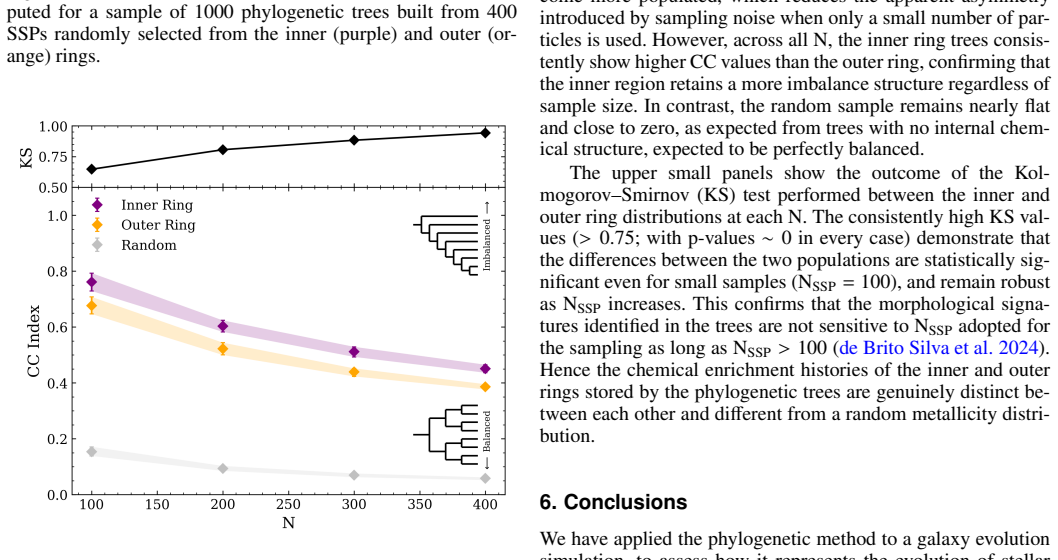
In a simulated disc galaxy, phylogenetic trees constructed from stellar chemical abundances recover region-dependent enrichment pathways: the inner ring forms a compact old SNII-dominated clade followed by hierarchical SNIa/AGB enrichment, while the outer ring yields more symmetric trees consistent with prolonged star formation and local mixing, and these structural differences are captured by the Corrected Colless index even for modest samples.
Load-bearing premise
Tree shape built from chemical abundance vectors of selected stars truly records assembly history rather than simulation mixing, particle selection, or the particular enrichment model.
Editorial extensions
If this is right
- Inner-disc versus outer-disc stellar samples should produce measurably different phylogenetic balance even when only ~100 stars are available.
- Chemical phylogenetics can complement kinematic archaeology by ordering enrichment events without requiring full orbital histories.
- Rapid early SNII clades followed by hierarchical SNIa/AGB branches become an expected chemical signature of bar-driven central assembly.
- Smoother, more symmetric trees become an expected signature of spiral-arm-dominated outer discs with efficient local mixing.
Reading between the lines
- If the method is robust, multi-element abundance catalogues from large spectroscopic surveys could be turned into assembly chronologies for real Milky Way-like discs without new simulations for every field.
- Tree-balance metrics may offer a compact scalar diagnostic for comparing chemical evolution across different galaxy simulations and enrichment codes.
- The same residual-structure idea could be stress-tested on galaxies that experienced major mergers to see whether the balance signal survives violent mixing.
Signed reviews
Editorial analysis
A structured set of objections, weighed in public.
Referee Report
Summary. The manuscript (as represented by its abstract and metadata for arXiv:2604.11974) proposes applying phylogenetic tree reconstruction to chemical abundance vectors of stellar populations in a high-resolution isolated disc-galaxy simulation, in order to recover assembly-linked chemical enrichment pathways. Two radial regions are contrasted: an inner ring associated with early bar-driven inflows and an outer ring shaped by spiral arms. Trees are quantified with the Corrected Colless balance index; the abstract reports a compact old SNII-dominated clade plus hierarchical SNIa/AGB enrichment in the inner ring, versus more symmetric caterpillar-like trees and smoother gradients in the outer ring, with enrichment-rate trends offered as corroboration and index differences said to converge for modest samples (NSSP = 100). The central claim is that galactic phylogenetics is a novel, complementary tool for decoding the chemical fossil record of disc assembly.
Significance. If the method robustly recovers assembly-driven enrichment structure beyond what is already visible in abundance gradients and enrichment-rate histories, it would be a genuine methodological contribution to galactic archaeology, importing a mature biological toolkit (tree balance metrics, clade structure) into chemical evolution. The abstract’s emphasis on multi-channel enrichment (SNII, SNIa, AGB), particle inheritance of parent-gas composition, and sample-size convergence (NSSP = 100) is in principle falsifiable and of practical interest for both simulations and future multi-element surveys. That significance, however, is entirely conditional on controls that cannot be audited from the materials provided for this review.
major comments (3)
- The full manuscript text supplied under paper_id 2604.11974 is not this paper: it is an unrelated DeepONet / coherent nonlinear wave dynamics manuscript (arXiv:2604.11972). No methods, distance metric, tree-building algorithm, figures, tables, or statistical tests for the galactic phylogenetics work are available. A load-bearing technical review of the central claim is therefore impossible; the report below is constrained to the abstract and cannot verify any result.
- Abstract (central claim): Differences in phylogenetic topology and Corrected Colless index between the inner (bar-influenced) and outer (spiral-influenced) rings are interpreted as recovering assembly-linked enrichment pathways. That inference requires that abundance-vector trees primarily encode assembly history rather than continuous mixing, radial enrichment-rate gradients, particle selection, chemical-distance definition, or the isolated-disc enrichment model. The abstract supplies no distance metric, linkage/algorithm, null models (e.g. shuffled abundances, mixed-region controls, or trees built from enrichment rates alone), or comparison showing that phylogeny adds information beyond the enrichment-rate corroboration already cited. Until those controls are present and auditable, the assembly-history reading of tree structure remains an assumption.
- Abstract (experimental design): Results rest on a single isolated disc simulation and two hand-chosen rings. Without a suite of simulations (varying bar strength, spiral structure, feedback, or cosmological accretion) or explicit tests against known assembly histories, it is unclear whether tree-balance differences generalise or are simulation- and selection-specific. The free parameter NSSP and the claim of robust convergence at NSSP = 100 also cannot be assessed without the sampling protocol and uncertainty quantification.
minor comments (3)
- Abstract: ‘Target particles are selected to store the chemical history of each chemical element’ is ambiguous (which elements, how many, abundance ratios vs absolute abundances, normalisation). Clarify in any resubmission.
- Abstract: ‘caterpillar-like trees’ and ‘compact clade’ are qualitative; define operationally (e.g. Colless, Sackin, or clade-size statistics) when the correct full text is provided.
- Title/abstract framing as ‘unveil assembly histories’ is stronger than what an isolated disc (no mergers/accretion) can demonstrate; consider ‘enrichment pathways linked to internal secular structure’ unless cosmological assembly is actually modelled.
Circularity Check
No circularity: empirical phylogenetic comparison of simulated chemical abundances, not a closed-loop derivation.
full rationale
Based on the available abstract (the cached full manuscript is the unrelated DeepONet paper 2604.11972, so methods/equations cannot be audited), the work is an empirical simulation experiment: stellar particles inherit parent-gas chemical compositions; phylogenetic trees are built for inner-ring vs outer-ring populations; tree balance is quantified with the Corrected Colless index; and chemical enrichment rates are used as independent corroboration. Nothing in the abstract defines the claimed pathway difference (compact SNII clade vs caterpillar-like outer trees; significant Colless contrast) as equal to a fitted parameter or as a tautology of the inputs. There is no self-definitional loop, no fitted quantity re-labeled as a prediction, no load-bearing uniqueness theorem imported from the authors, and no ansatz smuggled via self-citation. Residual methodological risks (region selection, chemical distance, enrichment model) are assumptions about interpretation, not circular reductions of the derivation chain. Score 0 is therefore the honest finding from the text that can be quoted.
Assumptions & free parameters
free parameters (1)
- NSSP (number of stellar sample particles) =
100
assumptions (4)
- domain assumption Stellar chemical abundance vectors inherit parent-gas composition and preserve enough evolutionary signal to reconstruct enrichment pathways via phylogenetic trees.
- domain assumption The Corrected Colless index of tree balance is a meaningful discriminator of chemical assembly modes between galactic regions.
- ad hoc to paper An isolated high-resolution disc simulation with multi-channel enrichment (SNII, SNIa, AGB) is a sufficient laboratory for testing whether phylogenetics can unveil assembly histories.
- domain assumption Inner-ring chemistry is dominated by early bar-driven inflows and outer-ring chemistry by spiral-arm-driven prolonged star formation and local mixing.
invented entities (1)
-
Galactic phylogenetic trees of stellar populations (chemical clades)
Cite this review
Pith. "Pith review of Reconstructing chemical enrichment pathways in disc galaxies: A phylogenetic approach." pith.science (2026). https://pith.science/paper/C4CFWCY5
@misc{pith2026260411974,
  author       = {Pith},
  title        = {Pith review of: Reconstructing chemical enrichment pathways in disc galaxies: A phylogenetic approach},
  year         = {2026},
  howpublished = {\url{https://pith.science/paper/C4CFWCY5}},
  note         = {Machine review of arXiv:2604.11974}
}
read the original abstract
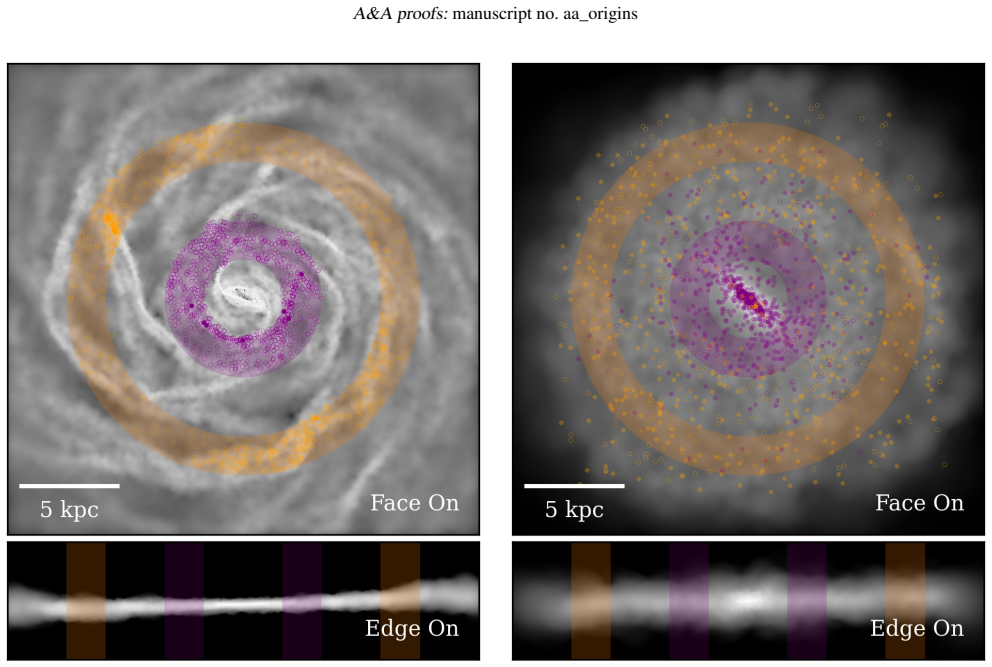
Phylogenetic methods, traditionally used in biology to trace the evolutionary relationships among species, are emerging as a powerful framework to reconstruct evolutionary processes in galaxies from chemical information. We apply galactic phylogenetics to study the chemical evolution of stellar populations in distinct regions of a simulated disc galaxy, assessing its capability to unveil assembly histories. We used a high-resolution simulation that follows the chemical enrichment of an isolated disc galaxy, by different stellar progenitors. We track gas particles as they turn into stars and inherit their parent gas chemical composition. Target particles are selected to store the chemical history of each chemical element considered in the simulation. Two regions were analysed: an inner ring, influenced by early bar-driven inflows, and an outer ring, shaped by spiral arms. We built phylogenetic trees for stellar populations in each region and quantified their structure using the Corrected Colless index, a standard metric of tree balance used in biology. The inner ring tree reveals a compact clade of old stars enriched by rapid SNII feedback, followed by a hierarchical sequence with increasing SNIa and AGB contributions. In contrast, the outer ring exhibits more symmetric, caterpillar-like trees with smoother abundance gradients, consistent with more prolonged star formation and efficient local mixing. Chemical enrichment rates corroborate these trends, showing fast early enrichment in the inner ring and gradual, spatially extended enrichment in the outer disc. The structural indices differ significantly between the two regions and converge robustly even for modest stellar samples (NSSP = 100). Galactic phylogenetics provides a novel and complementary tool to decode the fossil record of galaxies.
Figures


Figures from the paper (8 more)


Forward citations
Cited by 1 Pith paper
-
Disentangling chemical evolution histories with phylogenetic trees
Phylogenetic trees built from flexCE model abundances separate primarily by the outflow mass-loading parameter η, with branches connecting at the most metal-rich tips.
Reference graph
Works this paper leans on
-
[1]
, " * write output.state after.block = add.period write newline
ENTRY address archiveprefix author booktitle chapter edition editor howpublished institution eprint journal key month note number organization pages publisher school series title type volume year label extra.label sort.label short.list INTEGERS output.state before.all mid.sentence after.sentence after.block FUNCTION init.state.consts #0 'before.all := #1 ...
-
[2]
write newline
" write newline "" before.all 'output.state := FUNCTION n.dashify 't := "" t empty not t #1 #1 substring "-" = t #1 #2 substring "--" = not "--" * t #2 global.max substring 't := t #1 #1 substring "-" = "-" * t #2 global.max substring 't := while if t #1 #1 substring * t #2 global.max substring 't := if while FUNCTION word.in bbl.in " " * FUNCTION format....
-
[3]
C., Somerville , R
Arrigoni , M., Trager , S. C., Somerville , R. S., & Gibson , B. K. 2010, , 402, 173
2010
-
[4]
A., Wetzel , A., Loebman , S
Bellardini , M. A., Wetzel , A., Loebman , S. R., et al. 2021, , 505, 4586
2021
-
[5]
& Freeman , K
Bland-Hawthorn , J. & Freeman , K. C. 2003, in Astronomical Society of the Pacific Conference Series, Vol. 297, Star Formation Through Time, ed. E. Perez, R. M. Gonzalez Delgado, & G. Tenorio-Tagle , 457--+
2003
-
[6]
& Menci , N
Calura , F. & Menci , N. 2009, , 400, 1347
2009
-
[7]
B., Padilla , N., et al
Casanueva-Villarreal , C., Tissera , P. B., Padilla , N., et al. 2024, , 688, A183
2024
-
[8]
E., Tissera , P
Cataldi , P., Pedrosa , S. E., Tissera , P. B., et al. 2023, , 523, 1919
2023
Show all 73 references
-
[9]
1997, ApJ, 477, 765
Chiappini , C., Matteucci , F., & Gratton , R. 1997, ApJ, 477, 765
1997
-
[10]
1859, On the Origin of Species by Means of Natural Selection (London: John Murray)
Darwin, C. 1859, On the Origin of Species by Means of Natural Selection (London: John Murray)
-
[11]
B., et al
de Brito Silva , D., Jofr \'e , P., Tissera , P. B., et al. 2024, , 962, 154
2024
-
[12]
E., Bower , R
De Rossi , M. E., Bower , R. G., Font , A. S., Schaye , J., & Theuns , T. 2017, , 472, 3354
2017
-
[13]
Deason , A. J. & Belokurov , V. 2024, , 99, 101706
2024
-
[14]
L., & Wicke, K
Fischer, M., Herbst, L., Kersting, S., K \"u hn, A. L., & Wicke, K. 2023
2023
-
[15]
Fragkoudi , F., Grand , R. J. J., Pakmor , R., et al. 2020, , 494, 5936
2020
-
[16]
M., Torrey , P., Hemler , Z
Garcia , A. M., Torrey , P., Hemler , Z. S., et al. 2023, , 519, 4716
2023
-
[17]
2006, Molecular Biology and Evolution, 23, 1997
Gascuel , O. 2006, Molecular Biology and Evolution, 23, 1997
2006
-
[18]
B., Monachesi , A., et al
Gonzalez-Jara , J., Tissera , P. B., Monachesi , A., et al. 2025, , 693, A282
2025
-
[19]
& Madau , P
Haardt , F. & Madau , P. 2001, in Clusters of Galaxies and the High Redshift Universe Observed in X-rays, ed. D. M. Neumann & J. T. V. Tran
2001
-
[20]
Heard, S. B. 1992, Evolution, 46, 1818
1992
-
[21]
2020, , 58, 205
Helmi , A. 2020, , 58, 205
2020
-
[22]
S., Torrey , P., Qi , J., et al
Hemler , Z. S., Torrey , P., Qi , J., et al. 2021, , 506, 3024
2021
-
[23]
1990, , 356, 359
Hernquist , L. 1990, , 356, 359
1990
-
[24]
1999, ApJS, 125, 439
Iwamoto , K., Brachwitz , F., Nomoto , K., et al. 1999, ApJS, 125, 439
1999
-
[25]
2021, , 502, 32
Jackson , H., Jofr \'e , P., Yaxley , K., et al. 2021, , 502, 32
2021
-
[26]
B., Sillero , E., et al
Jara-Ferreira , F., Tissera , P. B., Sillero , E., et al. 2024, , 530, 1369
2024
-
[27]
B., & Matteucci , F
Jim \'e nez , N., Tissera , P. B., & Matteucci , F. 2015, , 810, 137
2015
-
[28]
2025, , 699, A291
Jofr \'e , P., Aguilera-G \'o mez , C., Villarreal , P., et al. 2025, , 699, A291
2025
-
[29]
2017, , 467, 1140
Jofr \'e , P., Das , P., Bertranpetit , J., & Foley , R. 2017, , 467, 1140
2017
-
[30]
W., Weinberg , D
Johnson , J. W., Weinberg , D. H., Vincenzo , F., et al. 2021, , 508, 4484
2021
-
[31]
Karakas , A. I. 2010, , 403, 1413
2010
-
[32]
J., Rupke , D., Zahid , H
Kewley , L. J., Rupke , D., Zahid , H. J., Geller , M. J., & Barton , E. J. 2010, ApJL, 721, L48
2010
-
[33]
& Slatkin, M
Kirxpatrick, M. & Slatkin, M. 1993, Evolution, 47, 1171
1993
-
[34]
A., & Mendel , J
Leaman , R., VandenBerg , D. A., & Mendel , J. T. 2013, , 436, 122
2013
-
[35]
2002, MNRAS, 330, 821
Lia , C., Portinari , L., & Carraro , G. 2002, MNRAS, 330, 821
2002
-
[36]
F., Wetzel , A
Ma , X., Hopkins , P. F., Wetzel , A. R., et al. 2017, , 467, 2430
2017
-
[37]
2021, , 29, 5
Matteucci , F. 2021, , 29, 5
2021
-
[38]
& Greggio , L
Matteucci , F. & Greggio , L. 1986, A & A, 154, 279
1986
-
[39]
& Ferrini , F
Moll\'a , M. & Ferrini , F. 1995, ApJ, 454, 726
1995
-
[40]
B., Tissera , P
Mosconi , M. B., Tissera , P. B., Lambas , D. G., & Cora , S. A. 2001, , 325, 34
2001
-
[41]
G., Okamoto , T., et al
Nagashima , M., Lacey , C. G., Okamoto , T., et al. 2005, , 363, L31
2005
-
[42]
F., Frenk , C
Navarro , J. F., Frenk , C. S., & White , S. D. M. 1996, , 462, 563
1996
-
[43]
F., Frenk , C
Navarro , J. F., Frenk , C. S., & White , S. D. M. 1997, , 490, 493
1997
-
[44]
E., Christensen-Dalsgaard , J., Mosumgaard , J
Nissen , P. E., Christensen-Dalsgaard , J., Mosumgaard , J. R., et al. 2020, , 640, A81
2020
-
[45]
2013, , 51, 457
Nomoto , K., Kobayashi , C., & Tominaga , N. 2013, , 51, 457
2013
-
[46]
A., Spitoni , E., Recio-Blanco , A., et al
Palicio , P. A., Spitoni , E., Recio-Blanco , A., et al. 2023, , 678, A61
2023
-
[47]
Pedrosa , S. E. & Tissera , P. B. 2015, , 584, A43
2015
-
[48]
Perez , J., Michel-Dansac , L., & Tissera , P. B. 2011, MNRAS, 417, 580
2011
-
[49]
& Matteucci , F
Pipino , A. & Matteucci , F. 2011, , 530, A98
2011
-
[50]
Queiroz , A. B. A., Anders , F., Chiappini , C., et al. 2023, , 673, A155
2023
-
[51]
M., Villata , M., & Navarro , J
Raiteri , C. M., Villata , M., & Navarro , J. F. 1996, A & A, 315, 105
1996
-
[52]
A., et al
Recio-Blanco , A., de Laverny , P., Palicio , P. A., et al. 2023, , 674, A29
2023
-
[53]
D., et al
Rodr \' guez , S., Garcia Lambas , D., Padilla , N. D., et al. 2022, , 514, 6157
2022
-
[54]
Rupke , D. S. N., Kewley , L. J., & Chien , L.-H. 2010, , 723, 1255
2010
-
[55]
Salpeter , E. E. 1955, , 121, 161
1955
-
[56]
B., White , S
Scannapieco , C., Tissera , P. B., White , S. D. M., & Springel , V. 2005, MNRAS, 364, 552
2005
-
[57]
B., White , S
Scannapieco , C., Tissera , P. B., White , S. D. M., & Springel , V. 2006, MNRAS, 371, 1125
2006
-
[58]
B., Lambas , D
Sillero , E., Tissera , P. B., Lambas , D. G., & Michel-Dansac , L. 2017, , 472, 4404
2017
-
[59]
2021, , 647, A73
Spitoni , E., Verma , K., Silva Aguirre , V., et al. 2021, , 647, A73
2021
-
[60]
B., Sillero , E., et al
Tapia-Contreras , B., Tissera , P. B., Sillero , E., et al. 2025, , 700, A69
2025
-
[61]
A., Monachesi , A., Gomez , F
Tau , E. A., Monachesi , A., Gomez , F. A., et al. 2025, , 699, A93
2025
-
[62]
1998, , 296, 119
Thomas , D., Greggio , L., & Bender , R. 1998, , 296, 119
1998
-
[63]
Tinsley , B. M. 1980, , 5, 287
1980
-
[64]
B., Bignone , L., Gonzalez-Jara , J., et al
Tissera , P. B., Bignone , L., Gonzalez-Jara , J., et al. 2025, , 697, A134
2025
-
[65]
B., Pedrosa , S
Tissera , P. B., Pedrosa , S. E., Sillero , E., & Vilchez , J. M. 2016, , 456, 2982
2016
-
[66]
B., Scannapieco , C., Beers , T
Tissera , P. B., Scannapieco , C., Beers , T. C., & Carollo , D. 2013, MNRAS, 432, 3391
2013
-
[67]
B., White , S
Tissera , P. B., White , S. D. M., & Scannapieco , C. 2012, MNRAS, 420, 255
2012
-
[68]
2024, , 529, 2946
Walsen , K., Jofr \'e , P., Buder , S., et al. 2024, , 529, 2946
2024
-
[69]
White , S. D. M. & Frenk , C. S. 1991, , 379, 52
1991
-
[70]
Wiersma , R. P. C., Schaye , J., & Smith , B. D. 2009, , 393, 99
2009
-
[71]
M., Henriques , B., Thomas , P
Yates , R. M., Henriques , B., Thomas , P. A., et al. 2013, , 435, 3500
2013
-
[72]
M., Henriques , B
Yates , R. M., Henriques , B. M. B., Fu , J., et al. 2021, , 503, 4474
2021
-
[73]
Zhang , C., Li , Z., Hu , Z., & Krumholz , M. R. 2025, , 540, 3906
2025
Reviewed July 12, 2026 · model on record in the stance chip above.
Discussion (0). Continue with ORCID to comment.