REVIEW 4 major objections 5 minor 51 references
Noisy Braiding of Majorana Modes: A Comparison of Nanowire Trijunction and Quantum-Dot-Assisted Architectures
T0 review · 4 major / 5 minor · reviewed 2026-08-15 · deepseek-v4-flash
Pith's one-line read Quantum-dot-assisted Majorana braiding achieves lower error in shorter time than a nanowire trijunction, even under telegraph and 1/f noise.
desk verdict A credible noiseless/global-noise comparison of two Majorana braiding architectures, but the headline spatially-resolved conclusion is not established because the local-noise comparison never specifies per-site versus total-power normalization. read the letter →
The pith
A machine-rendered reading of the paper's core claim, the machinery that carries it, and where it could break.
The reading
What carries the argument
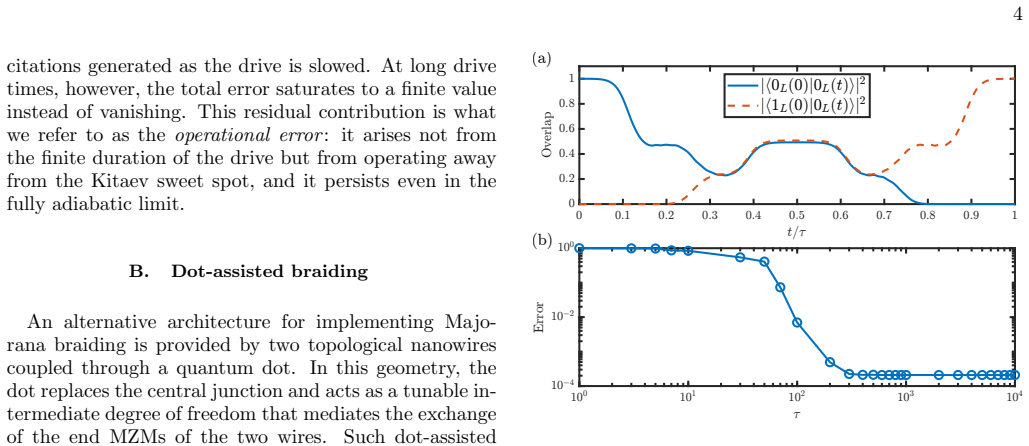
The load-bearing object is the time-dependent Bogoliubov-de Gennes evolution of a one-dimensional p-wave superconducting chain, with many-body overlaps computed through the Bloch-Messiah decomposition, a canonical factorization of the Bogoliubov transformation into empty, paired, and occupied modes. The exchange is implemented by the operator $R^\dagger_{23}=(1+\gamma_2\gamma_3)/\sqrt{2}$ applied twice to realize a Pauli $X$, and the error is $1-|\langle 1_L|\psi(\tau)\rangle|^2$. Noise enters as telegraph two-level fluctuators and as 1/f noise built from a distribution of such fluctuators, coupled to the chemical potential. The explanatory distinction is localized exchange: in the dot-assisted protocol the Majorana moves through a tunable dot level with a larger effective gap, whereas the trijunction transports it along extended wire segments by slow chemical-potential ramps, so its diabatic error falls more slowly with $\tau$.
What would settle it
Re-run the same $X$-gate protocol with matched dimensionless quantities: equal numbers of tunable control parameters, identical smoothstep ramps, and gaps normalized by the same energy scale. If the trijunction then attains equal or lower error at the same or shorter time, the claimed architectural advantage is disproven. A simpler probe: in a dot-assisted device, measure the error as a function of quasi-static dot-level detuning; the claim predicts a monotonic rise in operational error, while fast short-correlation dot noise should leave the error nearly unchanged.
Extended reading notes
Core claim
The central discovery is that the braiding mechanism itself, extended adiabatic transport versus local hybridization, sets the error budget of a finite-time Majorana $X$-gate in a microscopic p-wave chain simulation. Defining the error as $1-|\langle 1_L|\psi(\tau)\rangle|^2$ after two exchanges of the inner Majoranas, the paper finds that the dot-assisted geometry reaches a comparably low error at a much shorter total braiding time $\tau$, both with noiseless dynamics and under global telegraph and 1/f noise. In both geometries the error saturates at long times to a finite operational error from operating away from the sweet spot of the chain. Spatially resolved noise simulations then show a crossover specific to the dot-assisted geometry: for fast fluctuations the dot contributes less error than the wires, while for slow fluctuations the dot becomes the dominant error source because a quasi-static shift moves it off its optimal operating point; the trijunction, by contrast, always suffers most from noise applied at the junction. The advantage is attributed to a larger effective gap from localized exchange, which suppresses nonadiabatic excitations as the drive slows.
Load-bearing premise
The two simulated designs use particular sizes, phase conventions, and timing schedules that the authors treat as a fair comparison; if one geometry is given an easier ramp, a larger gap, or better-optimized parameters, the claimed architectural advantage would not be established.
Editorial extensions
If this is right
- A dot-assisted Majorana $X$-gate can reach a given fidelity in a shorter total braiding time than a trijunction, reducing exposure to the slow fluctuations that dominate realistic noise environments.
- Both telegraph and 1/f noise create an optimal drive time, so braiding protocols should operate at the time that balances diabatic errors against accumulated noise errors.
- In the trijunction, noise mitigation should focus on the actively driven junction, since noise there dominates the error at all correlation times.
- In the dot-assisted device, fast noise on the dot is effectively averaged out and causes less error than equivalent noise on the wires, while slow quasi-static noise on the dot is the dominant error channel.
- A concrete design principle follows: minimize low-frequency noise on control elements and prefer geometries with localized exchange to enable faster operations.
Reading between the lines
- The paper leaves implicit a general heuristic: a braiding geometry whose active exchange region is small and strongly coupled acts as a high-pass filter, averaging out fast control fluctuations while remaining sensitive to slow shifts of that region.
- Because the slow-noise error on the dot is identified as a quasi-static displacement from the sweet spot, a natural extension is to test feed-forward compensation of the dot level, which should recover most of the lost fidelity.
- Varying dot-wire coupling strength and dot size in the same simulation would test whether the architectural advantage scales with the local effective gap, as the paper's explanation predicts.
Signed reviews
Editorial analysis
A structured set of objections, weighed in public.
Referee Report
Summary. The paper simulates time-dependent Bogoliubov--de Gennes dynamics of two Majorana braiding architectures—a nanowire trijunction and a quantum-dot-assisted two-wire setup—implementing a Pauli X gate by exchanging the two inner Majoranas. It defines the gate error as one minus the many-body overlap with the target logical state, separates diabatic and operational error contributions, and then adds telegraph and 1/f noise to the chemical potential, both globally and in selected spatial regions. The main claims are that the dot-assisted architecture reaches comparably low error at shorter protocol times, that this advantage persists under global noise, and that in the dot-assisted geometry fast noise localized on the dot is less harmful than fast noise on the wires, while slow noise on the dot becomes the dominant limitation.
Significance. The paper's strengths are its direct time-dependent simulation approach, a clear and well-defined error metric based on many-body overlaps, the use of a Bloch--Messiah/Pfaffian formalism that is appropriate for systems with Majorana zero modes, and a comparison that is not fitted to any target. If the architectural comparison is fair, the paper offers a concrete design principle: operate fast and minimize low-frequency noise on the actively controlled dot. The spatially resolved noise analysis is potentially the most valuable part, since it connects error contributions to device geometry. However, the local-noise comparison is currently under-specified, and the statistical basis of the noise-averaged curves is not reported, so the paper's strongest conclusions are not yet established.
major comments (4)
- [Section IV.C and Fig. 7(a,b)] The local-noise comparison does not control the number of noisy degrees of freedom. In the dot-assisted geometry, 'noise on the dot' perturbs the single dot level, while 'noise on the outer wire segments' perturbs twenty sites (two ten-site wires). If each selected site receives an independent telegraph or 1/f fluctuation of amplitude δ, the wire region carries roughly twenty times the total noise variance of the dot region. The manuscript does not state whether the comparison fixes per-site amplitude, per-region power, or total power. Under the natural per-site reading, the finding that fast wire noise is more damaging than fast dot noise is a counting artifact rather than evidence for the claimed motional-averaging/hybridization mechanism. The trijunction panels have the same ambiguity. Please normalize the noise power per region or per degree of freedom and restate the spatially resolved conclusions accordingly.
- [Fig. 7(c)] The asymmetric [0,2δ] telegraph test does not isolate the quasi-static detuning mechanism. Compared with the symmetric ±δ noise, the asymmetric process changes the mean from zero to δ and includes one state with exactly zero fluctuation, so the suppression of the slow-noise enhancement is expected even if the quasi-static interpretation is correct. A clean control would use a zero-mean slow telegraph process or a deterministic static detuning of the dot level, and should also control the noise variance across the two settings.
- [Figs. 4-6] The noise-averaged results are presented without error bars or the number of realizations. The central quantitative conclusions—the existence of an optimal drive time and the relative advantage of the dot-assisted architecture—rest on these averages. Please report the number of independent noise realizations and include statistical error estimates, or otherwise show the dispersion of the results across realizations.
- [Section III.A-B] The two architectures are not matched in size or protocol details: the trijunction has legs of L=20 sites with ten-site topological segments, while the dot-assisted wires have L=10 sites, and the two protocols use different phase conventions and ramping schedules. The claimed advantage of the dot-assisted architecture could in part reflect these asymmetries rather than the intrinsic exchange mechanism. Please demonstrate robustness to equivalent system sizes, bulk gaps, and protocol durations, or explicitly quantify how the size and parameter choices affect the comparison.
minor comments (5)
- [Section II] The paragraph after Eq. (1) contains a redundant and ungrammatical sentence starting 'For the remaining part of the paper we are going to chose this parameter.' Remove it and keep the parameter specification in the main text.
- [Eq. (6)] The index ranges in the trijunction Hamiltonian are unclear; in particular, the first sum runs over x=0,...,3L while the leg terms begin at nL+1. Please specify the total number of sites and the labeling of the three legs explicitly.
- [Section II.A] The qubit encoding uses four Majoranas γ1,...,γ4, but the text does not explain how these four modes are realized in the specific three-leg trijunction geometry or in the two-wire dot-assisted geometry. Clarifying this would make the encoding and the braiding protocol easier to follow.
- [Appendix B] Equation (B12) contains the typo '⟨1 d(0)||1 d(t)⟩' and should be written as ⟨1_¯d(0)|1_¯d(t)⟩. Please correct the notation.
- [Fig. 7 caption] The caption describes the symmetric telegraph noise as switching between −δ and +δ, while panel (c) uses [0,2δ]; please add a sentence clarifying the difference between the panels.
Circularity Check
No significant circularity: the error curves are generated by direct time-dependent BdG simulation, and the central architectural comparison is not equivalent to any fitted parameter or self-citation.
full rationale
The paper's central claims (dot-assisted braiding reaches lower error at shorter times, and spatially resolved noise has different effects) are outputs of time-dependent Bogoliubov–de Gennes simulations. The error in Eq. (5) is an overlap with the target logical state, computed from the evolved many-body state; no parameter is fitted to the target error, and no low-energy effective model is imposed that would build the conclusion into the input. The noiseless comparison follows from the simulated dynamics rather than from a definition. The only self-citation, Ref. [33], is used for the numerical generation of discrete telegraph-noise trajectories (Section IV.A); this is a methodological implementation detail and not a theorem, and the noise statistics themselves (telegraph autocorrelation and 1/f spectrum from a distribution of switching rates) are standard and independently stated in Eqs. (11)–(14). The residual 'operational error' at long times is diagnosed from the saturation of the simulated error, not assumed by construction. The local-noise comparison in Section IV.C is potentially under-specified regarding whether noise amplitude is normalized per site or per region, which is a fairness/correctness concern about the comparison, not a circularity: the different error values are still computed from simulation rather than being equivalent to the input by construction. Overall, the derivation chain is self-contained relative to the paper's stated models; no prediction reduces to an input by definition or to a self-citation chain.
Assumptions & free parameters
assumptions (4)
- standard math Bloch-Messiah decomposition and Pfaffian overlap formulas correctly compute many-body ground and excited state overlaps for Bogoliubov-de Gennes systems with singular V.
- domain assumption The one-dimensional spinless p-wave Kitaev chain faithfully represents the low-energy physics of Majorana nanowire devices.
- domain assumption Telegraph and 1/f noise injected into the chemical potential capture the dominant environmental noise in Majorana devices.
- domain assumption The phase conventions (0, pi, pi/2 in the trijunction and 0, pi in the dot-assisted setup) and the chosen ramping schedules realize the desired braid without closing the bulk gap.
Cite this review
Pith. "Pith review of Noisy Braiding of Majorana Modes: A Comparison of Nanowire Trijunction and Quantum-Dot-Assisted Architectures." pith.science (2026). https://pith.science/paper/C5FSPXTZ
@misc{pith2026260809416,
  author       = {Pith},
  title        = {Pith review of: Noisy Braiding of Majorana Modes: A Comparison of Nanowire Trijunction and Quantum-Dot-Assisted Architectures},
  year         = {2026},
  howpublished = {\url{https://pith.science/paper/C5FSPXTZ}},
  note         = {Machine review of arXiv:2608.09416}
}
read the original abstract
Majorana zero modes have emerged as one of the most promising platforms for topological quantum computation, since their non-Abelian braiding statistics allow quantum information to be encoded nonlocally and manipulated through braiding operations that are, in principle, protected against local perturbations. In practice, however, a braid is only as robust as its physical implementation: finite-time operation, residual couplings, and environmental noise can all convert local excitations into logical errors during the exchange process. Here, we address this question through a microscopic comparison of two representative braiding architectures, a nanowire trijunction and a quantum-dot-assisted setup, simulating the full time-dependent Bogoliubov--de Gennes dynamics under both noiseless and noisy conditions. We show that the dot-assisted architecture consistently achieves a lower error over a shorter timescale than the trijunction, owing to its more localized exchange mechanism. This advantage persists in the presence of noise, and a spatially resolved analysis further reveals that, in the dot-assisted geometry, fast noise localized on the dot produces a smaller error than equivalent noise on the wires, whereas slow, quasi-static noise on the dot becomes the dominant limitation. Taken together, these findings link the different error contributions directly to device geometry, pointing to concrete design principles for noise-resilient Majorana-based quantum gates.
Figures


Figures from the paper (3 more)


Reference graph
Works this paper leans on
-
[1]
A. Y. Kitaev, Unpaired Majorana fermions in quantum wires, Physics-uspekhi44, 131 (2001)
work page 2001
-
[2]
Nayak, S
C. Nayak, S. H. Simon, A. Stern, M. Freedman, and S. Das Sarma, Non-Abelian anyons and topological quan- tum computation, Rev. Mod. Phys.80, 1083 (2008)
2008
- [3]
-
[4]
S. D. Sarma, M. Freedman, and C. Nayak, Majorana zero modes and topological quantum computation, npj Quantum Information1, 1 (2015)
2015
-
[5]
R. M. Lutchyn, E. P. a. M. Bakkers, L. P. Kouwen- hoven, P. Krogstrup, C. M. Marcus, and Y. Oreg, Majo- rana zero modes in superconductor–semiconductor het- erostructures, Nature Reviews Materials3, 52 (2018)
2018
- [6]
-
[7]
D. Aasen, M. Aghaee, Z. Alam, M. Andrzejczuk, A. An- tipov, M. Astafev, L. Avilovas, A. Barzegar, B. Bauer, J. Becker, J. M. Bello-Rivas, U. Bhaskar, A. Bocharov, S. Boddapati, D. Bohn, J. Bommer, P. Bonderson, J. Borovsky, L. Bourdet, S. Boutin, T. Brown, G. Camp- bell, L. Casparis, S. Chakravarthi, R. Chao, B. J. Chap- man, S. Chatoor, A. W. Christensen...
arXiv 2025
- [8]
Show all 51 references
-
[9]
Karzig, F
T. Karzig, F. Pientka, G. Refael, and F. von Oppen, Shortcuts to non-Abelian braiding, Physical Review B 91, 201102 (2015)
2015
-
[10]
F. L. Pedrocchi, N. E. Bonesteel, and D. P. DiVincenzo, Monte Carlo studies of the self-correcting properties of the Majorana quantum error correction code under braid- ing, Physical Review B92, 115441 (2015)
2015
-
[11]
Rahmani, B
A. Rahmani, B. Seradjeh, and M. Franz, Optimal dia- batic dynamics of Majorana-based quantum gates, Phys- ical Review B96, 075158 (2017)
2017
-
[12]
Sekania, S
M. Sekania, S. Plugge, M. Greiter, R. Thomale, and P. Schmitteckert, Braiding errors in interacting Majorana quantum wires, Physical Review B96, 094307 (2017)
2017
-
[13]
Nag and J
A. Nag and J. D. Sau, Diabatic errors in Majorana braid- ing with bosonic bath, Physical Review B100, 014511 (2019)
2019
-
[14]
Knapp, M
C. Knapp, M. Zaletel, D. E. Liu, M. Cheng, P. Bonder- son, and C. Nayak, The Nature and Correction of Dia- batic Errors in Anyon Braiding, Physical Review X6, 041003 (2016)
2016
-
[15]
Beenakker, Search for non-Abelian Majorana braid- ing statistics in superconductors, SciPost Physics Lecture Notes , 015 (2020)
C. Beenakker, Search for non-Abelian Majorana braid- ing statistics in superconductors, SciPost Physics Lecture Notes , 015 (2020)
2020
-
[16]
W. Chen, J. Wang, Y. Wu, J. Qi, J. Liu, and X. C. Xie, Non-Abelian statistics of Majorana zero modes in the presence of an Andreev bound state, Physical Review B 105, 054507 (2022)
2022
-
[17]
C.-X. Liu, H. Pan, F. Setiawan, M. Wimmer, and J. D. Sau, Fusion protocol for Majorana modes in coupled quantum dots, Physical Review B108, 085437 (2023)
2023
-
[18]
L. Xu, J. Bai, W. Feng, and X.-Q. Li, Dynamics simula- tion of braiding two Majorana zero modes via a quantum dot, Physical Review B108, 115411 (2023), publisher: American Physical Society
2023
-
[19]
H. Pan, Z. Li, J. Jia, and Z. Qiao, Braiding induced by the finite-size effect in one-dimensional topological super- conductors, Physical Review B110, L161110 (2024)
2024
-
[20]
Miles, F
S. Miles, F. Zatelli, A. M. Bozkurt, M. Wimmer, and C.-X. Liu, Braiding Majoranas in a linear quan- tum dot-superconductor array: Mitigating the errors from Coulomb repulsion and residual tunneling (2025), arXiv:2501.16056 [cond-mat] version: 1
2025
-
[21]
F. Yu, P. Z. Zhao, and J. Gong, Nonadiabatic braiding of Majorana modes (2025), arXiv:2503.00953 [quant-ph]
2025
-
[22]
Quade and M
R. Quade and M. Potthoff, Exchangeless braiding of Majorana zero modes in weakly coupled Kitaev chains (2025), arXiv:2503.17720 [cond-mat]
2025 arXiv
-
[23]
Hodge, E
T. Hodge, E. Mascot, and S. Rachel, Altermagnet- Superconductor Heterostructure: a Scalable Platform for Braiding of Majorana Modes (2025), arXiv:2506.08095 [cond-mat]
2025 arXiv
-
[24]
Nitsch, V
M. Nitsch, V. Svensson, W. Samuelson, K. Nestmann, 11 J. Danon, K. Flensberg, R. S. Souto, and M. Leijnse, Adiabatic nonabelian braiding of imperfect Majoranas (2025), arXiv:2507.11039 [cond-mat]
2025 arXiv
-
[25]
P. Frey, T. Hodge, E. Mascot, and S. Rachel, Majo- rana braiding simulations with projective measurements (2025), arXiv:2508.10106 [quant-ph]
2025 arXiv
-
[26]
Hodge, T
T. Hodge, T. Kieu, J. Bedow, E. Mascot, D. K. Morr, and S. Rachel, Fusion dynamics of Majorana zero modes, Physical Review B113, 035429 (2026)
2026
-
[27]
D. A. Ivanov, Non-Abelian Statistics of Half-Quantum Vortices in$\mathit{p}$-Wave Superconductors, Physi- cal Review Letters86, 268 (2001)
2001
-
[28]
J. D. Sau, D. J. Clarke, and S. Tewari, Controlling non- Abelian statistics of Majorana fermions in semiconductor nanowires, Physical Review B84, 094505 (2011)
2011
-
[29]
Bauer, T
B. Bauer, T. Pereg-Barnea, T. Karzig, M.-T. Rieder, G. Refael, E. Berg, and Y. Oreg, Topologically protected braiding in a single wire using Floquet Majorana modes, Physical Review B100, 041102 (2019)
2019
-
[30]
Plugge, A
S. Plugge, A. Rasmussen, R. Egger, and K. Flensberg, Majorana box qubits, New Journal of Physics19, 012001 (2017)
2017
-
[31]
Zhang, F
Z.-T. Zhang, F. Mei, X.-G. Meng, B.-L. Liang, and Z.-S. Yang, Effects of decoherence on diabatic errors in Majo- rana braiding, Physical Review A100, 012324 (2019)
2019
-
[32]
F. L. Pedrocchi and D. P. DiVincenzo, Majorana Braid- ing with Thermal Noise, Physical Review Letters115, 120402 (2015)
2015
-
[33]
Sahu and S
D. Sahu and S. Gangadharaiah, Transport of Majorana bound states in the presence of telegraph noise, Physical Review B111, 235306 (2025)
2025
-
[34]
B. I. Halperin, Y. Oreg, A. Stern, G. Refael, J. Alicea, and F. von Oppen, Adiabatic manipulations of Majo- rana fermions in a three-dimensional network of quantum wires, Physical Review B85, 144501 (2012)
2012
-
[35]
J. D. Torres Luna, S. R. Kuppuswamy, and A. R. Akhmerov, Design of a Majorana trijunction, SciPost Physics16, 044 (2024)
2024
-
[36]
Boross and A
P. Boross and A. P´ alyi, Braiding-based quantum control of a Majorana qubit built from quantum dots, Physical Review B109, 125410 (2024)
2024
-
[37]
B. v. Heck, A. R. Akhmerov, F. Hassler, M. Burrello, and C. W. J. Beenakker, Coulomb-assisted braiding of Majorana fermions in a Josephson junction array, New Journal of Physics14, 035019 (2012)
2012
-
[38]
Malciu, L
C. Malciu, L. Mazza, and C. Mora, Braiding Majorana zero modes using quantum dots, Physical Review B98, 165426 (2018)
2018
-
[39]
J. Liu, W. Chen, M. Gong, Y. Wu, and X. Xie, Min- imal setup for non-Abelian braiding of Majorana zero modes, Science China Physics, Mechanics & Astronomy 64, 117811 (2021)
2021
-
[40]
Tsintzis, R
A. Tsintzis, R. S. Souto, K. Flensberg, J. Danon, and M. Leijnse, Majorana Qubits and Non-Abelian Physics in Quantum Dot–Based Minimal Kitaev Chains, PRX Quantum5, 010323 (2024)
2024
-
[41]
Mascot, T
E. Mascot, T. Hodge, D. Crawford, J. Bedow, D. K. Morr, and S. Rachel, Many-Body Majorana Braiding without an Exponential Hilbert Space, Physical Review Letters131, 176601 (2023)
2023
-
[42]
Alase, M
A. Alase, M. C. Goffage, M. C. Cassidy, and S. N. Cop- persmith, Decoherence of Majorana qubits by 1/f noise (2025), arXiv:2506.22394 [cond-mat]
2025 arXiv
-
[43]
Karzig, A
T. Karzig, A. Rahmani, F. von Oppen, and G. Refael, Optimal control of Majorana zero modes, Physical Re- view B91, 201404 (2015)
2015
-
[44]
Hodge, E
T. Hodge, E. Mascot, D. Crawford, and S. Rachel, Characterizing Dynamic Hybridization of Majorana Zero Modes for Universal Quantum Computing, Physical Re- view Letters134, 096601 (2025)
2025
-
[45]
Pandey, N
B. Pandey, N. Kaushal, G. Alvarez, and E. Dagotto, Ma- jorana zero modes in Y-shape interacting Kitaev wires, npj Quantum Materials8, 1 (2023)
2023
-
[46]
Zhang, Y
Y. Zhang, Y. Wu, J. Liu, and X. C. Xie, Quantifying the non-Abelian property of Andreev bound states in inho- mogeneous Majorana nanowires, Physical Review B111, 205411 (2025)
2025
-
[47]
Abel and F
B. Abel and F. Marquardt, Decoherence by quantum telegraph noise: A numerical evaluation, Physical Re- view B78, 201302 (2008)
2008
-
[48]
Daniotti, C
S. Daniotti, C. Benedetti, and M. G. A. Paris, Qubit systems subject to unbalanced random telegraph noise: quantum correlations, non-Markovianity and teleporta- tion, The European Physical Journal D72, 208 (2018)
2018
-
[49]
H. J. Wold, H. Brox, Y. M. Galperin, and J. Bergli, Deco- herence of a qubit due to either a quantum fluctuator, or classical telegraph noise, Physical Review B86, 205404 (2012)
2012
-
[50]
J. A. Krzywda and L. Cywi´ nski, Adiabatic electron charge transfer between two quantum dots in presence of 1/fnoise, Phys. Rev. B101, 035303 (2020)
2020
-
[51]
M. Wimmer, Algorithm 923: Efficient Numerical Com- putation of the Pfaffian for Dense and Banded Skew- Symmetric Matrices, ACM Transactions on Mathemati- cal Software (TOMS)38, 30:1 (2012)
2012
Reviewed August 15, 2026 · model on record in the stance chip above.
Discussion (0). Continue with ORCID to comment.