REVIEW 4 major objections 5 minor 45 references
A Spectral Quantum Algorithm for Numerical Differentiation and Integration
T0 review · 4 major / 5 minor · reviewed 2026-08-15 · deepseek-v4-flash
Pith's one-line read Two quantum algorithms, QFTD and QFTI, compute derivatives and indefinite integrals directly from amplitude-encoded data samples, returning results at every domain point simultaneously.
desk verdict The derivative half is a real, publishable quantum-circuit contribution; the integration half has a structural mathematical error and should not be published as claimed. read the letter →
The pith
A machine-rendered reading of the paper's core claim, the machinery that carries it, and where it could break.
The reading
What carries the argument
The two objects that carry the argument are the modified-wavenumber identities of spectral calculus and the cumulative-sum matrix $\Sigma$. The derivative identity replaces the continuous Fourier factor $i\omega$ by $i\sin(2\pi k/N)/\Delta x$, which corresponds to a central-difference stencil; the integration identity uses $\Delta x\cos(2\pi k/N)$ to represent the differential area of overlapping two-step trapezoids. The quantum Fourier transform moves the amplitude-encoded samples into frequency space, where a sequence of controlled $R_x$ rotations on an ancilla applies the sine or cosine factor to every frequency component in parallel; an inverse QFT returns to the spatial domain with the result encoded in the amplitudes. The QFTI then needs one more operation, a block-encoded unitary for the unit lower-triangular matrix $\Sigma$, constructed by embedding $H = \begin{pmatrix}0 & \Sigma^\dagger \\ \Sigma & 0\end{pmatrix}$ in a larger unitary and using QR decomposition. What makes the mechanism work, if it works, is that these classical spectral identities can be executed as circuits whose gate count is logarithmic in the number of samples rather than linear, because the QFT and the rotation ladder act on superpositions of all frequencies at once.
What would settle it
On a four-point grid with $f_j = j$, compute $\Delta A_j = \Delta x(f_{j+1} + f_{j-1})$ for all $j$, take the DFT of both sides of the cosine identity, and compare the spectrum with $\Delta x\cos(2\pi k/N)F_k$; the vectors differ by a factor of two. Then sum the $\Delta A_j$ and compare with the trapezoidal integrals $\int_{x_0}^{x_j} f\,dx$; the running total does not match, and a statevector simulation of the QFTI circuit on the same input would show the output amplitudes deviating from the claimed integral by the same offset.
Extended reading notes
Core claim
On its own terms, the paper's central discovery is that discrete spectral calculus identities can be turned into gate-level quantum circuits whose output state is directly proportional to the derivative or integral of a sampled function. For derivatives, the identity is $\mathrm{DFT}^{-1}[i\sin(2\pi k/N)/\Delta x \,\mathrm{DFT}[f]]_j$, a discrete analogue of the Fourier derivative rule that uses a modified wavenumber to match a central-difference stencil; the QFTD realizes it as a QFT, a ladder of controlled $R_x$ rotations that multiplies each frequency amplitude by $i\sin(2\pi k/N)$ inside an ancilla, and an ancilla-controlled inverse QFT. For integration, the paper writes the trapezoidal differential areas as $\Delta x\,\mathrm{DFT}^{-1}[\cos(2\pi k/N)\,\mathrm{DFT}[f]]_j$ and then applies a unit lower-triangular matrix $\Sigma$, block-encoded into a unitary by Hermitian embedding and QR decomposition, to accumulate the areas into partially bound integrals from $x_0$ to each $x_j$ with the integration constant fixed. The claimed payoffs are that all $N$ spatial results appear simultaneously in the quantum state, sign information can be recovered by a parallel comparison circuit, and the complexity is $O(\log^2 N)$ for QFTD, with the QFTI exponentially faster than the $O(\sqrt{N})$ QMCI baseline; error is bounded by $\max\{O(N^{-2}), O(M^{-1/2})\}$ for QFTD and $\max\{O(N^{-1}), O(M^{-1/2})\}$ for QFTI.
Load-bearing premise
The integration algorithm assumes that a cosine scaling of the function's Fourier components followed by a running total of the resulting pieces equals the trapezoidal integral from the starting point to each sample point; that equivalence is where the derivation drops a factor of two and sums overlapping intervals rather than adjacent ones, so the QFTI's claimed output rests on a premise the paper does not actually establish.
Editorial extensions
If this is right
- A quantum machine-learning or image-processing pipeline that already has data in amplitudes can obtain derivative or integral features with roughly the circuit depth of one or two QFTs, instead of a classical pass over all $N$ samples.
- Domain-wide derivative estimates at all $N$ points become available from one circuit execution, whereas Jordan's algorithm and variational approaches return point estimates and require the function's algebraic form.
- For indefinite integration on samples, the QFTI would make the full running integral available as a quantum state, something the quantum Riemann-sum method would need $O(N\log N)$ gates to reproduce point by point.
- The two-dimensional QFTD returns all partial derivatives, including mixed partials, tagged by ancilla states, so gradient information for variational loops can be produced without repeated circuit executions.
- Error scales as $\max\{O(N^{-2}), O(M^{-1/2})\}$ for derivatives and $\max\{O(N^{-1}), O(M^{-1/2})\}$ for integrals, so accuracy is controlled by sample density and shot count rather than by an oracle construction.
Reading between the lines
- Correcting the missing factor of two in the cosine scaling would change the QFTI's kernel: the algorithm as written likely computes a cosine-windowed weighted average of neighboring samples rather than a trapezoidal integral, so a repaired version would need to halve the kernel or redefine the sum so the intervals tile the domain.
- Because the paper implements $\Sigma$ with a generic arbitrary-unitary gate whose isometry decomposition costs between $4^n/4$ and $23\cdot 4^n/48$ gates, the $O(\log^2 N)$ integration claim depends on an efficient structured circuit for $\Sigma$; finding such a circuit, or a quantum carry-save accumulation of the partial sums, is the direct test of whether the exponential speedup survives at the
- The sign-recovery procedure compares two measured probabilities that can be very close when the derivative or integral is small, so the shot budget may need to grow in low-amplitude regions; the resolution formulas give a concrete threshold for when this dominates.
- If a corrected QFTI is found, the same rotation-ladder trick should generalize to other quadrature rules by replacing the cosine wavenumber and the summation matrix; the paper explicitly leaves higher-order quadrature unexplored.
Signed reviews
Editorial analysis
A structured set of objections, weighed in public.
Referee Report
Summary. The paper proposes two quantum algorithms operating on amplitude-encoded function samples: QFTD, a spectral method for numerical differentiation, and QFTI, a spectral method for partially bound (indefinite) integration with a prescribed integration constant. Both are built on DFT shift-theorem identities with trigonometric modified wavenumbers, implemented via QFT, controlled ancilla rotations, and, for QFTI, a block-encoded cumulative-summation matrix. The paper also presents a higher-dimensional QFTD extension, sign-recovery post-processing, Qiskit simulation results, and error/complexity analyses. The work claims that QFTD and QFTI return domain-wide derivative and integral results simultaneously, with QFTD complexity O(log^2 N) and QFTI exponentially more efficient than the latest QMCI technique.
Significance. If the QFTI result were correct, the paper would provide a genuinely useful quantum subroutine: sample-based, domain-wide numerical integration with logarithmic query complexity, plus a derivative algorithm that is largely sound. The QFTD portion is developed carefully: the modified-wavenumber derivation follows the classical FFT-differentiation literature, the circuit construction with controlled Rx rotations is plausible, and the numerical examples (including the 1/x test and the 2D gradient example) support the derivative claim. The sign-recovery circuits are a thoughtful addition. However, the central integration identity is mathematically incorrect: Eq. (9) drops a factor of 2 from the shift theorem, and Eq. (12) sums overlapping centered intervals rather than adjacent trapezoids, so the quantity produced by QFTI is not the trapezoidal partial integral claimed. Because the integration algorithm is a headline contribution of the paper, this failure is load-bearing for the manuscript as a whole.
major comments (4)
- [§2.2, Eq. (9)] Under the DFT convention in Eq. (4), the Fourier shift theorem gives DFT[Δx(f_{j+1}+f_{j-1})] = 2Δx cos(2πk/N) F_k, not Δx cos(2πk/N) F_k as written in Eq. (9). The missing factor of 2 is propagated into Eq. (10), so the quantity actually produced by the wavenumber rotation is (Δx/2)(f_{j+1}+f_{j-1}) rather than the interval area defined in Eq. (8).
- [§2.2, Eqs. (10)–(14)] The core identity underlying QFTI is incorrect. Each ΔA_j in Eq. (10) is the half-area of the centered interval [x_{j-1}, x_{j+1}]; these intervals overlap, so the cumulative sum in Eq. (12) gives I_j = T_j + (Δx/2)(f_{j+1}+f_{-1}) for j ≥ 1 (with periodic indexing f_{-1}=f_{N-1}), where T_j is the trapezoidal partial sum. The extra term is not a constant offset, varies with j, and does not vanish as N grows unless the relevant end values vanish. Therefore Eq. (14) does not approximate ∫_{x0}^{x_j} f dx, and the claim that QFTI implements trapezoidal integration is unsupported.
- [§3.2 and §4.1] The numerical validation in §3.2 and Fig. 21 does not test the claimed integral identity: the R² values compare squared outputs, and the mean-absolute-error scaling in Fig. 21(c) is insensitive to a fixed O(Δx) perturbation of the integrand. Moreover, the 'systematic error caused by the initial point' discussed in §3.2 is an incomplete diagnosis; the construction in Eqs. (10)–(14) contributes both a constant f_{-1} term and a j-dependent f_{j+1} look-ahead term. The signed results in Fig. 20 show a systematic offset of exactly the type these extra terms would produce, so they provide confirmatory evidence against, rather than for, the claimed algorithm.
- [§4.2 and Tables 3–4] The complexity analysis contains internal inconsistencies. A gate-level implementation of the QFT on n qubits requires Θ(n^2)=Θ(log^2 N) gates, so the sentence claiming 'two applications of the QFT circuit with gate complexity O(log N)' is incorrect; the abstract and Table 3 correctly state O(log^2 N) for QFTD. For QFTI, the block-encoded partial-summation operator U_H is implemented as an arbitrary isometry whose decomposition cost is exponential in the number of qubits (the text cites costs ranging from (1/4)4^n to (23/48)4^n), which contradicts the claimed O(log^2 N) gate complexity in Table 4 and undermines the exponential speedup claim relative to QMCI.
minor comments (5)
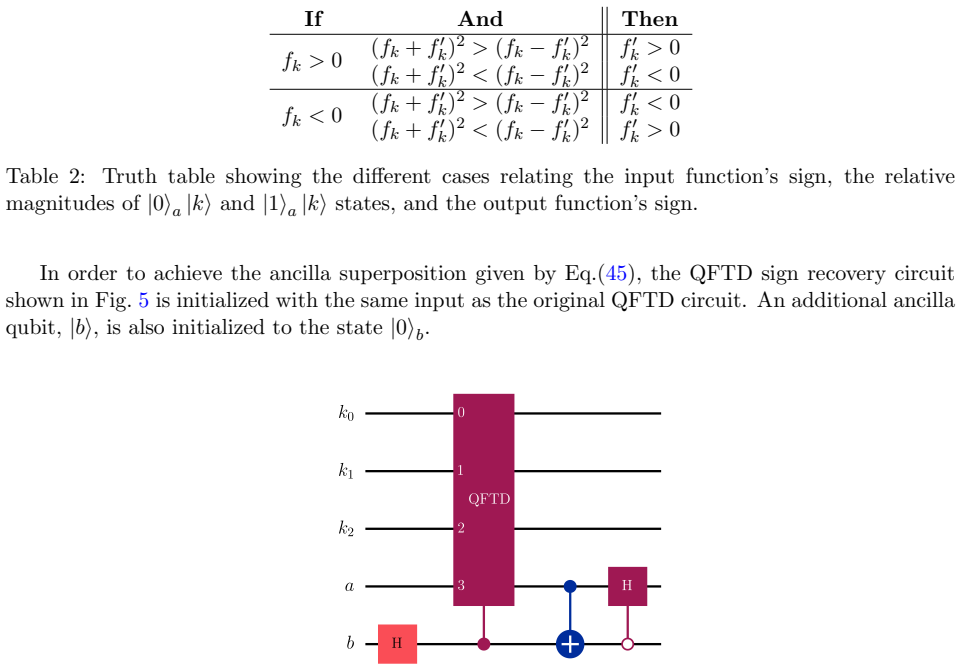
- [§2.4, paragraph after Eq. (31)] The sentence 'observations in the |0⟩a should be discarded' contradicts the preceding sentence, which says observations with the ancilla in |0⟩a have received the proper phase; one of these statements is a typo.
- [§3.2] 'Systemic error' should be 'systematic error'.
- [§4.1, Fig. 21 discussion] The phrases '108-qubit QFTD simulation' and '106-qubit QFTI simulation' appear to be errors for '10^8-shot' and '10^6-shot' simulations.
- [§2.2, last paragraph] The sentence 'the integral procedure an additional step' is missing a verb; it should read 'the integral procedure requires an additional step'.
- [Eq. (34)] The notation '||f|| 2 l2' is ambiguous; it should be written as ||f||_{l2}^2.
Circularity Check
No significant circularity: QFTD and QFTI are self-contained derivations benchmarked against analytical solutions.
full rationale
The paper's derivation chain is self-contained and does not reduce to its own inputs. The QFTD algorithm is derived from standard DFT differentiation identities, with the modified wavenumber obtained from the central-difference formula and the Fourier shift theorem in Eqs. (5)-(7); this derivation is carried out in the text and is not imported as an unexamined self-citation. The QFTI algorithm is constructed from an analogous trapezoidal-area expression and a cumulative partial-sum matrix, with the final state-vector coefficients proportional to the claimed integral through Eq. (14) and the post-processing relation Eq. (42). No parameters are fitted to the numerical results; all scaling factors (norm of the input, Δx, spectral norm of the summation matrix) are known constants of the encoding and linear-algebra construction. The numerical examples compare circuit outputs with analytically known derivatives and integrals, which are external benchmarks rather than fitted or algorithm-generated targets. The cited references to prior classical DFT-differentiation work and to Riemann-sum quantum integration are external and non-load-bearing for the central construction. There is no self-citation chain, no imported uniqueness theorem, and no ansatz smuggled in solely by reference to the authors' own prior work. Correctness concerns about the QFTI identity, such as the factor-of-two issue and the overlapping-interval structure in Eqs. (8)-(14), are mathematical validity issues, not circular reductions, and therefore do not affect the circularity score.
Assumptions & free parameters
assumptions (5)
- standard math Fourier shift theorem and the identity F[f'] = i omega F[f]
- ad hoc to paper DFT[Delta x (f_{j+1}+f_{j-1})] = Delta x cos(2 pi k/N) F_k
- ad hoc to paper The cumulative sum in Eq. (12) of centered area estimates equals the partial integral from x0 to x_j
- domain assumption Block encoding of the partial-sum matrix Sigma via H = [[0, Sigma^dag],[Sigma,0]] and QR decomposition yields a unitary with controllable overhead
- domain assumption Input f can be efficiently amplitude-encoded
Cite this review
Pith. "Pith review of A Spectral Quantum Algorithm for Numerical Differentiation and Integration." pith.science (2026). https://pith.science/paper/C5HQAFEH
@misc{pith2026250619959,
  author       = {Pith},
  title        = {Pith review of: A Spectral Quantum Algorithm for Numerical Differentiation and Integration},
  year         = {2026},
  howpublished = {\url{https://pith.science/paper/C5HQAFEH}},
  note         = {Machine review of arXiv:2506.19959}
}
read the original abstract
Numerical calculus algorithms which estimate derivatives and integrals from data series acquired either via measurements or by sampling functions are essential in scientific computing. To date, a few quantum algorithms have been developed to perform calculus operations based on closed form functional inputs; yet, in many practical applications, field variables are numerically described via series of samples rather than closed form expressions. This paper presents the theoretical development and the gate-level circuit implementation of novel quantum algorithms for numerical differentiation and indefinite integration with a prescribed integration constant. The methodology relies on a spectral approach that leverages the computational efficiency of the quantum Fourier transform and the parallel computing capability afforded by quantum superposition to evaluate outputs at all domain points simultaneously. The differentiation approach is also extended to enable gradient estimation, and post-processing procedures are presented to recover sign information. The primary output of the proposed algorithms are quantum state vectors directly proportional to the numerical derivative or integral of the given data; therefore, the correctly signed results are made available to proceeding quantum computations. This result lays the foundation for the proposed algorithms to serve as core subroutines in applied quantum computing operations such as image processing, data analysis, and machine learning.
Figures


Figures from the paper (18 more)



Reference graph
Works this paper leans on
-
[1]
E. G. Hohenstein, “Hybrid Quantum/Classical Derivative Theory: Analytical Gradients and Excited-State Dynamics for the Multistate Contracted Variational Quantum Eigensolver,” tech. rep., SLAC National Accelerator Lab., Menlo Park, CA (United States), Jan. 2019
work page 2019
-
[2]
Calculating energy derivatives for quantum chemistry on a quan- tum computer,
Thomas E. O’Brien, B. Senjean, R. Sagastizabal, X. Bonet-Monroig, A. Dutkiewicz, F. Buda, L. DiCarlo, and L. Visscher, “Calculating energy derivatives for quantum chemistry on a quan- tum computer,” npj Quantum Information, vol. 5, p. 113, Dec. 2019
work page 2019
-
[3]
Theory of analytical energy derivatives for the variational quantum eigensolver,
K. Mitarai, Y. O. Nakagawa, and W. Mizukami, “Theory of analytical energy derivatives for the variational quantum eigensolver,” Physical Review Research, vol. 2, p. 013129, Feb. 2020
work page 2020
-
[4]
T. M. Chan, ed., Proceedings of the Thirtieth Annual ACM-SIAM Symposium on Discrete Algorithms. Philadelphia, PA: Society for Industrial and Applied Mathematics, Jan. 2019
work page 2019
-
[5]
Pure quantum gradient descent algorithm and full quantum variational eigensolver,
R. Chen, Z. Guang, C. Guo, G. Feng, and S.-Y. Hou, “Pure quantum gradient descent algorithm and full quantum variational eigensolver,” Frontiers of Physics, vol. 19, p. 21202, Dec. 2023
work page 2023
-
[6]
Quantum algorithmic differentiation,
G. Colucci and F. Giacosa, “Quantum algorithmic differentiation,” Quantum Information and Computation, vol. 21, pp. 0080–0094, Feb. 2021
work page 2021
-
[7]
Quantum Monte Carlo Integration: The Full Advantage in Minimal Circuit Depth,
S. Herbert, “Quantum Monte Carlo Integration: The Full Advantage in Minimal Circuit Depth,” Quantum, vol. 6, p. 823, Sept. 2022. arXiv:2105.09100 [quant-ph]
arXiv 2022
-
[8]
E. R. Johnston, “Quantum supersampling,” in ACM SIGGRAPH 2016 Talks, (Anaheim Cali- fornia), pp. 1–1, ACM, July 2016
work page 2016
Show all 45 references
-
[9]
Quantum Coin Method for Numerical Integration,
N. H. Shimada and T. Hachisuka, “Quantum Coin Method for Numerical Integration,” Computer Graphics Forum, vol. 39, pp. 243–257, Sept. 2020
2020
-
[10]
Fast Quantum Algorithm for Numerical Gradient Estimation,
S. P. Jordan, “Fast Quantum Algorithm for Numerical Gradient Estimation,” Physical Review Letters, vol. 95, p. 050501, July 2005
2005
-
[11]
Efficient quantum algorithm for weighted partial sums and numerical integration,
A. Shukla and P. Vedula, “Efficient quantum algorithm for weighted partial sums and numerical integration,” Nov. 2024. arXiv:2411.10986 [quant-ph]
2024 arXiv
-
[12]
Quantum algorithms and circuits for scientific computing,
M. K. Bhaskar, S. Hadfield, A. Papageorgiou, and I. Petras, “Quantum algorithms and circuits for scientific computing,” Quantum Info. Comput., vol. 16, pp. 197–236, Mar. 2016
2016
-
[13]
Introduction to Automatic Differentiation and MATLAB Object-Oriented Programming,
R. D. Neidinger, “Introduction to Automatic Differentiation and MATLAB Object-Oriented Programming,” SIAM Review, vol. 52, pp. 545–563, Jan. 2010
2010
-
[14]
Henrard, Algorithmic Differentiation in Finance Explained
M. Henrard, Algorithmic Differentiation in Finance Explained. Cham: Springer International Publishing, 2017
2017
-
[15]
Quantum algorithm and circuit design solving the Poisson equation,
Y. Cao, A. Papageorgiou, I. Petras, J. Traub, and S. Kais, “Quantum algorithm and circuit design solving the Poisson equation,” New Journal of Physics, vol. 15, p. 013021, Jan. 2013
2013
-
[16]
Quantum Algorithms for Scientific Computing and Approximate Optimization,
S. Hadfield, “Quantum Algorithms for Scientific Computing and Approximate Optimization,” May 2018. arXiv:1805.03265 [quant-ph]
2018 arXiv
-
[17]
Geometry optimization,
H. B. Schlegel, “Geometry optimization,” WIREs Computational Molecular Science, vol. 1, pp. 790–809, Sept. 2011. 32
2011
-
[18]
Molecular Vibrations,
E. B. Wilson, J. G. Decius, P. G. Cross, and R. T. Lagemann, “Molecular Vibrations,”American Journal of Physics, vol. 23, pp. 550–550, Nov. 1955
1955
-
[19]
Analytical Derivative Methods in Quantum Chemistry,
P. Pulay, “Analytical Derivative Methods in Quantum Chemistry,” in Advances in Chemical Physics, pp. 241–286, John Wiley & Sons, Ltd, 1987. eprint: https://onlinelibrary.wiley.com/doi/pdf/10.1002/9780470142943.ch4
1987 doi
-
[20]
T. G. Wong, Introduction to classical and quantum computing. Omaha, Nebraska: Rooted Grove, 2022
2022
-
[21]
The theory of variational hybrid quantum-classical algorithms,
J. R. McClean, J. Romero, R. Babbush, and A. Aspuru-Guzik, “The theory of variational hybrid quantum-classical algorithms,” New Journal of Physics, vol. 18, p. 023023, Feb. 2016
2016
-
[22]
Progress towards practical quantum variational algorithms,
D. Wecker, M. B. Hastings, and M. Troyer, “Progress towards practical quantum variational algorithms,” Physical Review A, vol. 92, p. 042303, Oct. 2015
2015
-
[23]
Quantum singular value transformation and beyond: exponential improvements for quantum matrix arithmetics,
A. Gily´ en, Y. Su, G. H. Low, and N. Wiebe, “Quantum singular value transformation and beyond: exponential improvements for quantum matrix arithmetics,” in Proceedings of the 51st Annual ACM SIGACT Symposium on Theory of Computing, (Phoenix AZ USA), pp. 193–204, ACM, June 2019
2019
-
[24]
Numerical Approximation of Predictive Distribution,
M. Sugiyama, “Numerical Approximation of Predictive Distribution,” in Introduction to Statistical Machine Learning, pp. 205–220, Elsevier, 2016
2016
-
[25]
Fast quantum algorithms for numerical integrals and stochastic processes,
Abrams, Daniel S. and Williams, Colin P., “Fast quantum algorithms for numerical integrals and stochastic processes,” 1999
1999
-
[26]
Review of quantum Monte Carlo methods and their applications,
P. H. Acioli, “Review of quantum Monte Carlo methods and their applications,” Journal of Molecular Structure: THEOCHEM, vol. 394, pp. 75–85, May 1997
1997
-
[27]
Quantum integration in Sobolev classes,
S. Heinrich, “Quantum integration in Sobolev classes,” Journal of Complexity, vol. 19, pp. 19– 42, Feb. 2003
2003
-
[28]
A general quantum algorithm for numerical integration,
G. Shu, Z. Shan, J. Xu, J. Zhao, and S. Wang, “A general quantum algorithm for numerical integration,” Scientific Reports, vol. 14, p. 10432, May 2024
2024
-
[29]
Quantum search algorithm on weighted databases,
Y. Sun and L.-A. Wu, “Quantum search algorithm on weighted databases,” Scientific Reports, vol. 14, p. 30169, Dec. 2024
2024
-
[30]
Path integration in non-relativistic quan- tum mechanics,
C. DeWitt-Morette, A. Maheshwari, and B. Nelson, “Path integration in non-relativistic quan- tum mechanics,” Physics Reports, vol. 50, pp. 255–372, Mar. 1979
1979
-
[31]
Notes on FFT-based differentiation,
S. G. Johnson, “Notes on FFT-based differentiation,”
-
[32]
Calculating numerical derivatives using Fourier transform: some pitfalls and how to avoid them,
Sunaina, M. Butola, and K. Khare, “Calculating numerical derivatives using Fourier transform: some pitfalls and how to avoid them,” European Journal of Physics, vol. 39, p. 065806, Nov. 2018
2018
-
[33]
Kreyszig, H
E. Kreyszig, H. Kreyszig, and E. J. Norminton, Advanced engineering mathematics. Hoboken, NJ: John Wiley, 10th ed. ed., 2011. Publication Title: Advanced engineering mathematics
2011
-
[34]
M. A. Nielsen and I. L. Chuang, Quantum computation and quantum information. Cambridge ; New York: Cambridge University Press, 10th anniversary ed ed., 2010. 33
2010
-
[35]
Block encoding of matrix product operators,
M. Nibbi and C. B. Mendl, “Block encoding of matrix product operators,” Physical Review A, vol. 110, p. 042427, Oct. 2024
2024
-
[36]
Quantum circuits for isometries,
R. Iten, R. Colbeck, I. Kukuljan, J. Home, and M. Christandl, “Quantum circuits for isometries,” Physical Review A, vol. 93, p. 032318, Mar. 2016
2016
-
[37]
Explicit Quantum Circuits for Block Encod- ings of Certain Sparse Matrices,
D. Camps, L. Lin, R. Van Beeumen, and C. Yang, “Explicit Quantum Circuits for Block Encod- ings of Certain Sparse Matrices,” SIAM Journal on Matrix Analysis and Applications, vol. 45, pp. 801–827, Mar. 2024
2024
-
[38]
Simulating Sparse Hamiltonians with Star Decompositions,
A. M. Childs and R. Kothari, “Simulating Sparse Hamiltonians with Star Decompositions,” in Theory of Quantum Computation, Communication, and Cryptography (W. Van Dam, V. M. Kendon, and S. Severini, eds.), vol. 6519, pp. 94–103, Berlin, Heidelberg: Springer Berlin Hei- delberg,...
2011
-
[39]
Hamiltonian Simulation by Qubitization,
G. H. Low and I. L. Chuang, “Hamiltonian Simulation by Qubitization,” Quantum, vol. 3, p. 163, July 2019. arXiv:1610.06546 [quant-ph]
2019 arXiv
-
[40]
On Encoding Matrices using Quantum Circuits,
L. M. Yosef and H. Avron, “On Encoding Matrices using Quantum Circuits,” Nov. 2025. arXiv:2510.20030 [quant-ph]
2025
-
[41]
Multidimensional Quantum Fourier Transformation,
P. Pfeffer, “Multidimensional Quantum Fourier Transformation,” Jan. 2023. arXiv:2301.13835 [quant-ph]
2023 arXiv
-
[42]
Quantum computing with Qiskit,
A. Javadi-Abhari, M. Treinish, K. Krsulich, C. J. Wood, J. Lishman, J. Gacon, S. Martiel, P. D. Nation, L. S. Bishop, A. W. Cross, B. R. Johnson, and J. M. Gambetta, “Quantum computing with Qiskit,” 2024. eprint: 2405.08810
2024 arXiv
-
[43]
S. C. Chapra and R. Canale, Numerical Methods for Engineers. USA: McGraw-Hill, Inc., 5 ed., 2005
2005
-
[44]
3.6 Numerical Integration - Calculus Volume 2|OpenStax,
G. Strang and E. Herman, “3.6 Numerical Integration - Calculus Volume 2|OpenStax,” Mar
-
[2016]
Book Title: Calculus Volume 2. 34
Reviewed August 15, 2026 · model on record in the stance chip above.
Discussion (0). Continue with ORCID to comment.