REVIEW 4 major objections 6 minor 39 references
Geometric Feature Prompting of Image Segmentation Models
T0 review · 4 major / 6 minor · reviewed 2026-08-07 · deepseek-v4-flash
Pith's one-line read Prompting the Segment Anything Model with points placed on multiscale ridge features produces more sensitive and more specific root segmentations than uniform grid prompting at low prompt counts, without fine-tuning the model.
desk verdict A solid, niche engineering paper: ridge-salience point prompting of SAM beats grid prompting for root segmentation, with honest limitations and released code; the missing statistics and imperfect ground truth warrant a careful revision before acceptance. read the letter →
The pith
A machine-rendered reading of the paper's core claim, the machinery that carries it, and where it could break.
The reading
What carries the argument
The central object is the multiscale ridge detector with gamma-normalized principal curvature difference as the ridge strength measure, combined with a ridge-salience-weighted prompt allocation scheme. Ridge curves are detected in scale-space as connected components whose ridge test value is integrated along the curve into a salience score; a budget of K prompts is then distributed across curves in proportion to their salience. This object carries the argument because it converts the geometric prior 'roots are bright and elongated' into a small set of point locations that SAM can use directly as prompts, and the proportional allocation avoids both the clustering of prompts at high-intensity blobs and their wasteful dispersal across random soil features.
What would settle it
Compute geomprompt and grid-prompted SAM TPR/FPR on a rhizotron test set whose root masks are verified by multiple independent annotators (or generated synthetically from known root geometry). If the true-positive gap at 64 prompts shrinks to near zero or the false-positive rates invert once unmasked roots are counted, then the reported advantage is an artifact of incomplete ground truth.
Extended reading notes
Core claim
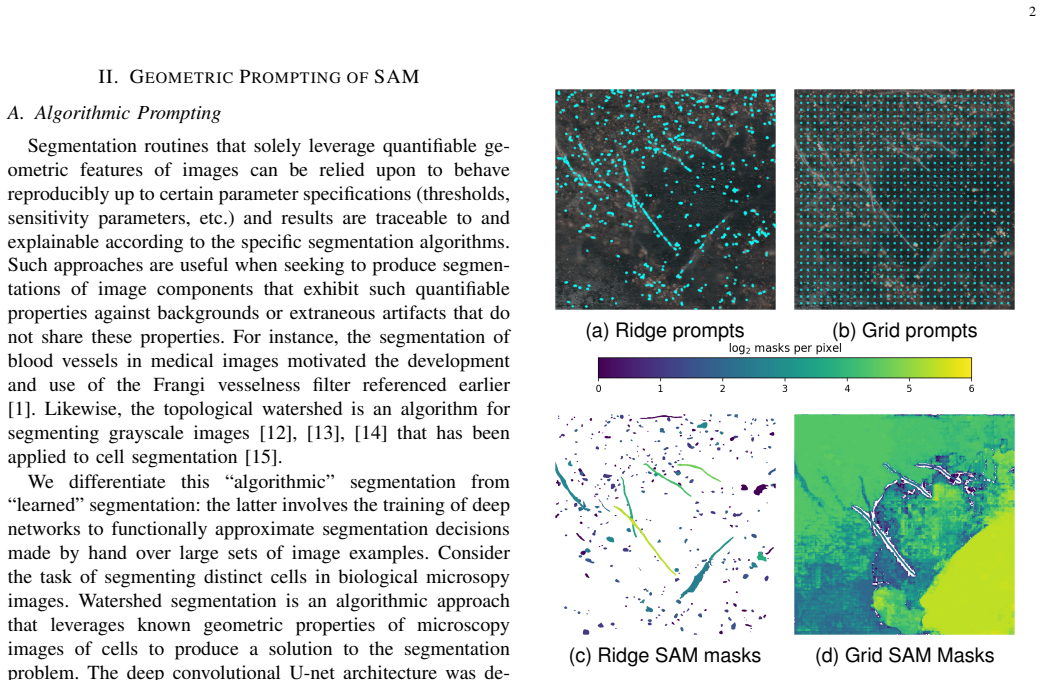
The central discovery is that the relationship between prompts and segment quality in SAM is not fixed: prompting the model at locations that carry a geometric prior about the target feature concentrates the model's attention on that feature class. Using Lindeberg's multiscale ridge detector, the authors generate prompt points on ridge-like image structures, which in rhizotron images correspond to roots. At low prompt densities this focused prompting outperforms grid prompting substantially on pixel-level recall and false positives, and the advantage only disappears at roughly 1024 prompts per image, where grid prompting matches geomprompt's true positive rate. The paper further reports that segmented root structures are instance-level, which matters for non-destructive studies of root growth and turnover, and that the approach generalizes in principle to SAM 2 and to other ridge-like or valley-like structures.
Load-bearing premise
The evaluation relies on the PRMI switchgrass pixel masks as ground truth even though the paper observes that many root-like features are not annotated and some annotations are inaccurate, so the reported true-positive and false-positive rates could be biased if those masks are systematically incomplete.
Editorial extensions
If this is right
- SAM, prompted by geomprompt, can produce usable root segmentations without fine-tuning, potentially replacing hand tracing as the first pass in rhizotron experiments.
- Instance-level root segments become available automatically, enabling non-destructive studies of individual root growth and turnover.
- Fewer prompts mean less post-processing for overlapping-mask disambiguation in SAM's segment-everything mode, offsetting some of the ridge-detection overhead.
- The method transfers to other segmentation targets with ridged or tubular morphology, such as blood vessels, and to valley-like dark structures by inverting the ridge test.
- Fine-tuning a check-pointed SAM on geomprompt outputs, with light filtering, is a plausible route to further accuracy gains beyond the out-of-the-box results reported here.
Reading between the lines
- Because the paper itself notes the benchmark masks miss many root-like features, geomprompt's reported false positive rate is likely inflated relative to a more complete ground truth; a fairer benchmark could widen rather than shrink the demonstrated advantage.
- The recipe generalizes beyond roots: any point-prompted foundation model can be steered by classical geometric priors (edges, blobs, ridges, valleys) at negligible cost, offering an alternative to learned prompters trained for a single domain.
- A direct testable extension would run the same comparison on SAM 2 over minirhizotron video frames: if ridge prompts add temporal consistency, the approach could support automated root dynamics tracking without further training.
- The method's sensitivity to ridge-detection parameters (scale range, gamma, and salience thresholds) across heterogeneous soil types and root species is untested; that sensitivity is the likeliest source of failure in new experiments.
Editorial analysis
A structured set of objections, weighed in public.
Referee Report
Summary. The paper proposes GeomPrompt, a non-learned prompt generator that places SAM point prompts on multiscale ridge features, targeting root segmentation in minirhizotron images. It compares geomprompt against uniform grid prompting at 16, 64, 256, and 1024 points on 2,419 switchgrass images from the PRMI dataset, reporting higher TPR and lower FPR at low prompt densities (e.g., 77.6% vs 51.9% TPR at 64 points). The authors also release the geomprompt Python package and emphasize that SAM is used out of the box with no fine-tuning.
Significance. If validated, the result is practically significant: it would enable zero-shot SAM-based root segmentation with only a few dozen prompts, substantially reducing the annotation burden in rhizotron studies. The release of open-source software and the use of a stock SAM checkpoint are notable strengths, as is the general idea of using non-learned geometric prompts to focus a foundation model's attention. However, the empirical evidence as presented is not yet sufficient to support the central claim of superiority at low prompt counts, because the evaluation relies on imperfect reference masks and lacks uncertainty quantification.
major comments (4)
- [Section III-B and III-D2, Table II] The reference masks are acknowledged in Section III-B as 'frequently inaccurate' with unannotated root-like features, and Section III-D2 concedes an 'objective mismatch' between segmenting ridge-like features and segmenting roots of interest. The headline TPR/FPR numbers in Table II are computed pixel-wise against these same masks. Since geomprompt is designed to detect ridge-like features that may include unannotated roots, its FPR could be inflated relative to a method that avoids those regions, and its TPR ceiling is determined by annotation completeness. The authors should either evaluate on a subset of images with carefully corrected reference masks, or conduct a sensitivity analysis that treats obvious unannotated roots as true positives and shows how the reported advantage changes. As written, the central empirical claim rests on an unvalidated ground truth.
- [Table II] The aggregated TPR/FPR values across 2,419 images are reported without confidence intervals, standard errors, or significance tests. The 25.7-point TPR gap at 64 prompts could be driven by a small number of influential images. The authors should report per-image distributions or bootstrap confidence intervals and a paired statistical test (e.g., Wilcoxon signed-rank) for each prompt density to demonstrate that the observed differences are stable and not due to outliers.
- [Section III-A and III-C] The ridge detector's scale range and step (the 'series of K scales' in Section II-C), the thresholds used to extract connected ridge curves, and the random sampling of points within each curve are not reported, and no random seed is stated. The authors say in Section III-C that they 'tuned the ridge detection algorithm to obtain an approximately correct number of geomprompt points at each scale,' but the tuning parameters are absent. Without these details, the comparison is not reproducible, and it is unclear whether the prompt counts are truly comparable (e.g., 64 geomprompt vs 64 grid points) in terms of algorithmic effort.
- [Section I and II-B] The abstract and introduction promise a comparison with 'a custom algorithmic segmentation routine,' but Section III and Tables I-II only report geomprompt versus grid prompting. Additionally, Section II-B asserts that geomprompt 'outputs segmentations that tend to be more accurate than benchmark hand annotations,' a claim not supported by the reported metrics, which show low IoU and relatively high FPR. Please either remove these statements or supply the corresponding experiments and supporting evidence.
minor comments (6)
- [Abstract] There is a typo: 'withinin situimages' should be 'within in situ images'; also 'segmention' in the introduction should be 'segmentation.'
- [Figure 2 caption] The caption reads 'an the accompanying annotation' and should be 'and the accompanying annotation.'
- [Table II caption] The caption contains a typo: 'GEOMPPROMPT' should be 'GEOMPROMPT.'
- [Section III-D1] The text says '74% of geomprompt points' and '47% of grid prompt points' at 16 prompts, while Table I lists 73.9% and 46.8%; please reconcile the rounding.
- [Section IV] The claim that focused prompting will yield 'much more important efficiency gains in the application of human and expert attention' is plausible but presented without a user study; consider softening or citing evidence from active learning literature.
- [Section III-D1] The sentence 'we posit that random sampling of prompt points from a 2-D uniform distribution over the image space would result in comparable segmentation performance' is an unsupported conjecture; it can be removed or tested by including a random-prompt baseline.
Circularity Check
No significant circularity: GeomPrompt's ridge-prompt placement is evaluated against an external benchmark, and no fitted parameter is renamed as a prediction.
full rationale
The paper's derivation chain is empirical rather than definitional. Lindeberg's external ridge detector [10] produces point prompts from local geometry; SAM is used with its default checkpoint; prompts are filtered by fixed thresholds (pred_iou_thresh=0.6, stability_score_thresh=0.8, area<25%); and final TPR/FPR are computed against PRMI benchmark masks [35]. No parameter is fitted to the benchmark and then reported as a predicted outcome, and no equation reduces a reported result to its input by construction. The authors' own caveats (Section III-B: 'pixel level annotations of root features are frequently inaccurate'; Section III-D2: 'the geomprompt + SAM objective (segment ridge-like features) differs from the benchmark analysis objective') are benchmark-validity concerns, not circularity: an incomplete reference mask can bias absolute TPR/FPR levels, but it does not make the geomprompt-vs-grid comparison a tautology. The paper also does not lean on self-citation: references [9], [10], and [35] are independent prior works, and no uniqueness theorem or fitted ansatz is imported from the authors' own previous papers. Therefore no circular step meets the required quote-and-reduction standard.
Assumptions & free parameters
free parameters (4)
- ridge_scale_range_and_step =
not reported
- pred_iou_thresh =
0.6
- stability_score_thresh =
0.8
- max_segment_area_fraction =
0.25
assumptions (4)
- domain assumption Roots in rhizotron images are bright and elongated relative to soil backgrounds.
- domain assumption PRMI switchgrass benchmark masks are a valid ground truth for TPR/FPR.
- standard math Lindeberg's Hessian-based ridge detection correctly identifies root-like structures over the chosen scales.
- domain assumption SAM produces better quality masks when prompted with focused geometric points than with grid points.
Cite this review
Pith. "Pith review of Geometric Feature Prompting of Image Segmentation Models." pith.science (2026). https://pith.science/paper/C5KX3K43
@misc{pith2026250521644,
  author       = {Pith},
  title        = {Pith review of: Geometric Feature Prompting of Image Segmentation Models},
  year         = {2026},
  howpublished = {\url{https://pith.science/paper/C5KX3K43}},
  note         = {Machine review of arXiv:2505.21644}
}
read the original abstract
Advances in machine learning, especially the introduction of transformer architectures and vision transformers, have led to the development of highly capable computer vision foundation models. The segment anything model (known colloquially as SAM and more recently SAM 2), is a highly capable foundation model for segmentation of natural images and has been further applied to medical and scientific image segmentation tasks. SAM relies on prompts -- points or regions of interest in an image -- to generate associated segmentations. In this manuscript we propose the use of a geometrically motivated prompt generator to produce prompt points that are colocated with particular features of interest. Focused prompting enables the automatic generation of sensitive and specific segmentations in a scientific image analysis task using SAM with relatively few point prompts. The image analysis task examined is the segmentation of plant roots in rhizotron or minirhizotron images, which has historically been a difficult task to automate. Hand annotation of rhizotron images is laborious and often subjective; SAM, initialized with GeomPrompt local ridge prompts has the potential to dramatically improve rhizotron image processing. The authors have concurrently released an open source software suite called geomprompt https://pypi.org/project/geomprompt/ that can produce point prompts in a format that enables direct integration with the segment-anything package.
Figures


Reference graph
Works this paper leans on
-
[1]
Multiscale vessel enhancement filtering,
A. F. Frangi, W. J. Niessen, K. L. Vincken, and M. A. Viergever, “Multiscale vessel enhancement filtering,” inMedical Image Computing and Computer-Assisted Intervention–MICCAI’98: First International Conference Cambridge, MA, USA, October 11–13, 1998 Proceedings
work page 1998
-
[2]
Springer, 1998, pp. 130–137
work page 1998
-
[3]
Watersheds in digital spaces: an efficient algorithm based on immersion simulations,
L. Vincent and P. Soille, “Watersheds in digital spaces: an efficient algorithm based on immersion simulations,”IEEE Transactions on Pattern Analysis & Machine Intelligence, vol. 13, no. 06, pp. 583–598, 1991
work page 1991
-
[4]
The persistent morse complex segmenta- tion of a 3-manifold,
H. Edelsbrunner and J. Harer, “The persistent morse complex segmenta- tion of a 3-manifold,” in3D physiological human workshop. Springer, 2009, pp. 36–50
work page 2009
-
[5]
Semantic segmentation using regions and parts,
P. Arbel ´aez, B. Hariharan, C. Gu, S. Gupta, L. Bourdev, and J. Malik, “Semantic segmentation using regions and parts,” in2012 IEEE con- ference on computer vision and pattern recognition. IEEE, 2012, pp. 3378–3385
work page 2012
-
[6]
U-net: Convolutional networks for biomedical image segmentation,
O. Ronneberger, P. Fischer, and T. Brox, “U-net: Convolutional networks for biomedical image segmentation,” inMedical Image Computing and Computer-Assisted Intervention–MICCAI 2015: 18th International Conference, Munich, Germany, October 5-9, 2015, Proceedings, Part III
2015
-
[7]
Attention is all you need,
A. Vaswani, N. Shazeer, N. Parmar, J. Uszkoreit, L. Jones, A. N. Gomez, Ł. Kaiser, and I. Polosukhin, “Attention is all you need,”Advances in neural information processing systems, vol. 30, 2017
2017
-
[8]
A review on deep learning techniques applied to semantic segmentation,
A. Garcia-Garcia, S. Orts-Escolano, S. Oprea, V . Villena-Martinez, and J. Garcia-Rodriguez, “A review on deep learning techniques applied to semantic segmentation,”arXiv preprint arXiv:1704.06857, 2017
arXiv 2017
Show all 39 references
-
[9]
Segment anything,
A. Kirillov, E. Mintun, N. Ravi, H. Mao, C. Rolland, L. Gustafson, T. Xiao, S. Whitehead, A. C. Berg, W.-Y . Loet al., “Segment anything,” arXiv preprint arXiv:2304.02643, 2023
2023 arXiv
-
[10]
On the opportunities and risks of foundation models,
R. Bommasani, D. A. Hudson, E. Adeli, R. Altman, S. Arora, S. von Arx, M. S. Bernstein, J. Bohg, A. Bosselut, E. Brunskillet al., “On the opportunities and risks of foundation models,”arXiv preprint arXiv:2108.07258, 2021
2021 arXiv
-
[11]
Sam 2: Segment anything in images and videos,
N. Ravi, V . Gabeur, Y .-T. Hu, R. Hu, C. Ryali, T. Ma, H. Khedr, R. R¨adle, C. Rolland, L. Gustafsonet al., “Sam 2: Segment anything in images and videos,”arXiv preprint arXiv:2408.00714, 2024
2024 arXiv
-
[12]
Edge detection and ridge detection with automatic scale selection,
T. Lindeberg, “Edge detection and ridge detection with automatic scale selection,”International journal of computer vision, vol. 30, no. 2, pp. 117–156, 1998
1998
-
[13]
Algorithms for the topo- logical watershed,
M. Couprie, L. Najman, and G. Bertrand, “Algorithms for the topo- logical watershed,” inDiscrete Geometry for Computer Imagery: 12th International Conference, DGCI 2005, Poitiers, France, April 13-15,
2005
-
[14]
Topological gray-scale watershed trans- formation,
M. Couprie and G. Bertrand, “Topological gray-scale watershed trans- formation,” inVision Geometry VI, vol. 3168. SPIE, 1997, pp. 136–146
1997
-
[15]
Topology- aware segmentation using discrete morse theory,
X. Hu, Y . Wang, L. Fuxin, D. Samaras, and C. Chen, “Topology- aware segmentation using discrete morse theory,”arXiv preprint arXiv:2103.09992, 2021
2021 arXiv
-
[16]
Comprehensive multimodal segmentation in medical imaging: Combining yolov8 with sam and hq- sam models,
S. Pandey, K.-F. Chen, and E. B. Dam, “Comprehensive multimodal segmentation in medical imaging: Combining yolov8 with sam and hq- sam models,” inProceedings of the IEEE/CVF International Conference on Computer Vision, 2023, pp. 2592–2598
2023
-
[17]
Edelsbrunner and J
H. Edelsbrunner and J. Harer,Computational topology: an introduction. American Mathematical Soc., 2010. 7
2010
-
[18]
Springer, 2015, pp. 234–241
2015
-
[19]
Applications and limitations of rhizotrons and minirhizotrons,
B. McMichael and H. Taylor, “Applications and limitations of rhizotrons and minirhizotrons,”Minirhizotron observation tubes: Methods and applications for measuring rhizosphere dynamics, vol. 50, pp. 1–13, 1987
1987
-
[20]
Topological data analysis guided segment anything model prompt optimization for zero-shot segmentation in biological imaging,
R. Glatt and S. Liu, “Topological data analysis guided segment anything model prompt optimization for zero-shot segmentation in biological imaging,”arXiv preprint arXiv:2306.17400, 2023
2023 arXiv
-
[21]
The rhizotron as a tool for root research,
M. G. Huck and H. M. Taylor, “The rhizotron as a tool for root research,” Advances in agronomy, vol. 35, pp. 1–35, 1982
1982
-
[22]
Spruce manual minirhizotron images from experimental plots beginning in 2013,
J. Childs, C. Iversen, J. Latimer, A. Burnham, and R. Norby, “Spruce manual minirhizotron images from experimental plots beginning in 2013,” Oak Ridge National Laboratory, TES SFA, U.S. Department of Energy, Oak Ridge, Tennessee U.S.A., Tech. Rep., 2019
2013
-
[23]
Advancing the use of minirhizotrons in wetlands,
C. M. Iversen, M. T. Murphy, M. F. Allen, J. Childs, D. M. Eissenstat, E. A. Lilleskov, T. M. Sarjala, V . L. Sloan, and P. F. Sullivan, “Advancing the use of minirhizotrons in wetlands,”Plant and Soil, vol. 352, no. 1-2, pp. 23–39, 2012
2012
-
[24]
Minirhizotrons in modern root studies,
T. Vamerali, M. Bandiera, and G. Mosca, “Minirhizotrons in modern root studies,” inMeasuring roots. Springer, 2012, pp. 341–361
2012
-
[25]
Measuring root turnover using the minirhizotron technique,
W. Cheng, D. C. Coleman, and J. E. Box Jr, “Measuring root turnover using the minirhizotron technique,”Agriculture, Ecosystems & Environ- ment, vol. 34, no. 1-4, pp. 261–267, 1991
1991
-
[26]
A device for the observation of root growth in the soil,
G. Bates, “A device for the observation of root growth in the soil,” Nature, vol. 139, no. 3527, pp. 966–967, 1937
1937
-
[27]
Observation of plant roots in situ,
J. Waddington, “Observation of plant roots in situ,”Canadian Journal of Botany, vol. 49, no. 10, pp. 1850–1852, 1971
1971
-
[28]
Segroot: A high throughput segmentation method for root image analysis,
T. Wang, M. Rostamza, Z. Song, L. Wang, G. McNickle, A. S. Iyer- Pascuzzi, Z. Qiu, and J. Jin, “Segroot: A high throughput segmentation method for root image analysis,”Computers and Electronics in Agricul- ture, vol. 162, pp. 845–854, 2019
2019
-
[29]
Automatic discrimination of fine roots in minirhizotron images,
G. Zeng, S. T. Birchfield, and C. E. Wells, “Automatic discrimination of fine roots in minirhizotron images,”New Phytologist, vol. 177, no. 2, pp. 549–557, 2008
2008
-
[30]
High- throughput in situ root image segmentation based on the improved deeplabv3+ method,
C. Shen, L. Liu, L. Zhu, J. Kang, N. Wang, and L. Shao, “High- throughput in situ root image segmentation based on the improved deeplabv3+ method,”Frontiers in Plant Science, vol. 11, p. 576791, 2020
2020
-
[31]
As good as human experts in detecting plant roots in minirhizotron images but efficient and reproducible: the convolutional neural network “rootdetector
B. Peters, G. Blume-Werry, A. Gillert, S. Schwieger, U. F. von Lukas, and J. Kreyling, “As good as human experts in detecting plant roots in minirhizotron images but efficient and reproducible: the convolutional neural network “rootdetector”,”Scientific Reports, vol. 13, no. 1...
2023
-
[32]
Segmenta- tion of roots in soil with u-net,
A. G. Smith, J. Petersen, R. Selvan, and C. R. Rasmussen, “Segmenta- tion of roots in soil with u-net,”Plant Methods, vol. 16, no. 1, pp. 1–15, 2020
2020
-
[33]
Fully-automated root image analysis (faria),
N. Narisetti, M. Henke, C. Seiler, A. Junker, J. Ostermann, T. Altmann, and E. Gladilin, “Fully-automated root image analysis (faria),”Scientific Reports, vol. 11, no. 1, p. 16047, 2021
2021
-
[34]
AutoSAM: Adapting SAM to Medical Images by Overloading the Prompt Encoder,
T. Shaharabany, A. Dahan, R. Giryes, and L. Wolf, “AutoSAM: Adapting SAM to Medical Images by Overloading the Prompt Encoder,” arXiv preprint arXiv:2306.06370, Jun. 2023, arXiv:2306.06370 [cs]. [Online]. Available: http://arxiv.org/abs/2306.06370
2023 arXiv
-
[35]
Semantic segmentation of plant roots from rgb (mini-) rhizotron images—generalisation potential and false positives of established methods and advanced deep-learning models,
P. Baykalov, B. Bussmann, R. Nair, A. G. Smith, G. Bodner, O. Hadar, N. Lazarovitch, and B. Rewald, “Semantic segmentation of plant roots from rgb (mini-) rhizotron images—generalisation potential and false positives of established methods and advanced deep-learning models,” P...
2023
-
[36]
Overcoming small minirhizotron datasets using transfer learning,
W. Xu, G. Yu, A. Zare, B. Zurweller, D. L. Rowland, J. Reyes- Cabrera, F. B. Fritschi, R. Matamala, and T. E. Juenger, “Overcoming small minirhizotron datasets using transfer learning,”Computers and Electronics in Agriculture, vol. 175, p. 105466, 2020
2020
-
[38]
Prmi: A dataset of minirhizotron images for diverse plant root study,
W. Xu, G. Yu, Y . Cui, R. Gloaguen, A. Zare, J. Bonnette, J. Reyes- Cabrera, A. Rajurkar, D. Rowland, R. Matamalaet al., “Prmi: A dataset of minirhizotron images for diverse plant root study,”arXiv preprint arXiv:2201.08002, 2022
2022 arXiv
-
[39]
Active learning literature survey,
B. Settles, “Active learning literature survey,” University of Wisconsin– Madison, Computer Sciences Technical Report 1648, 2009
2009
-
[2005]
Springer, 2005, pp
Proceedings 12. Springer, 2005, pp. 172–182
2005
Reviewed August 7, 2026 · model on record in the stance chip above.
Discussion (0). Sign in to comment.