New Gauge Forces, Neutron Stars and Schwinger Neutrino Production
Pith reviewed 2026-06-26 16:32 UTC · model grok-4.3
The pith
For the Lμ-Lτ force with g ≳ 10^{-18}, Schwinger neutrino production in neutron stars alters their composition, suppresses charge, and invalidates merger constraints while producing a potentially detectable flux.
A machine-rendered reading of the paper's core claim, the machinery that carries it, and where it could break.
Core claim
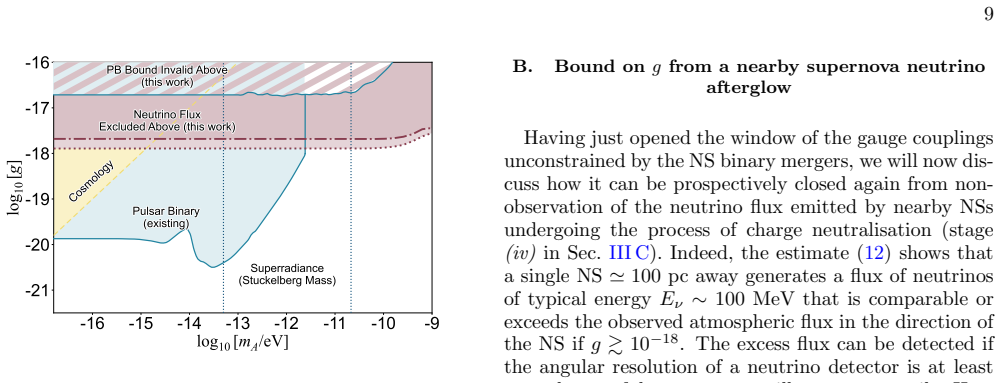
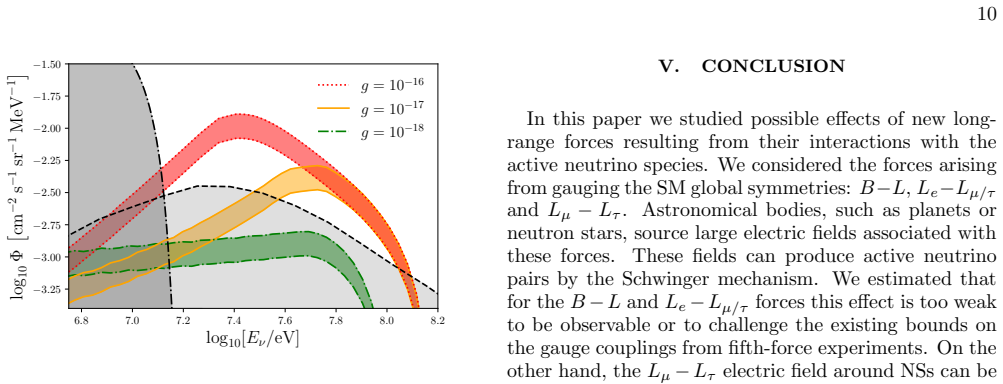
For the Lμ-Lτ force these effects are significant in neutron stars if the gauge coupling is g≳10^{-18}. The muonic force changes the element abundances of a neutron star in equilibrium and suppresses its Lμ-Lτ charge. This invalidates the constraint on g from neutron star mergers, at g≳10^{-17}. Furthermore, for such values of g, the neutrino flux produced by the Schwinger effect could potentially be detected from a single young neutron star at a distance of ≃100 pc, with the typical neutrino energy Eν∼100 MeV. A dedicated search for such a signal will reassert the bound g≲10^{-18}.
What carries the argument
Schwinger pair production of neutrinos charged under the new gauge symmetry inside the leptonic potential well of a neutron star.
If this is right
- The muonic force changes the element abundances of a neutron star in equilibrium.
- It suppresses its Lμ-Lτ charge.
- This invalidates the constraint on g from neutron star mergers at g≳10^{-17}.
- The neutrino flux produced by the Schwinger effect could potentially be detected from a single young neutron star at a distance of ≃100 pc with typical energy Eν∼100 MeV.
- A dedicated search for such a signal will reassert the bound g≲10^{-18}.
Where Pith is reading between the lines
- Detection of the flux would open a new observational channel for ultra-weak gauge forces that bypasses laboratory limits.
- The altered composition could modify other neutron-star observables such as cooling curves or maximum masses in ways left uncalculated here.
- The same potential-driven production mechanism might operate in other dense objects once their internal potentials exceed the pair-creation threshold.
Load-bearing premise
Neutron-star equilibrium under the new force is reached solely through Schwinger pair production and element-abundance adjustment, without competing processes dominating the net Lμ-Lτ charge or composition.
What would settle it
Non-observation of the predicted 100 MeV neutrino flux from any young neutron star within about 100 pc, or direct evidence that neutron-star merger constraints remain valid at g > 10^{-17}, would show the Schwinger-driven suppression does not occur.
Figures
read the original abstract
We investigate neutrino effects of new long-range forces arising from gauging $B-L$, $L_e-L_{\mu/\tau}$ or $L_{\mu}-L_{\tau}$ symmetries of the Standard Model. The leptonic potential generated by astronomical bodies, such as the Earth, the Sun or a neutron star, results in the Schwinger pair production of neutrinos charged under the new gauge symmetry. The oppositely charged particles accumulate in the potential well forming a degenerate Fermi gas, while equally charged particles fly away forming a steady flux of neutrinos. We find that, for the $B-L$ and $L_e-L_{\mu/\tau}$ forces, these effects are too weak to be observable. For the $L_{\mu}-L_{\tau}$ force these effects are significant in neutron stars if the gauge coupling is $g\gtrsim 10^{-18}$. The muonic force changes the element abundances of a neutron star in equilibrium and suppresses its $L_{\mu}-L_{\tau}$ charge. This invalidates the constraint on $g$ from neutron star mergers, at $g\gtrsim 10^{-17}$. Furthermore, for such values of $g$, the neutrino flux produced by the Schwinger effect could potentially be detected from a single young neutron star at a distance of $\simeq 100$ pc, with the typical neutrino energy $E_\nu\sim 100$ MeV. A dedicated search for such a signal will reassert the bound $g\lesssim 10^{-18}$.
Editorial analysis
A structured set of objections, weighed in public.
Referee Report
Summary. The paper examines neutrino production via the Schwinger effect induced by long-range potentials from new gauge forces associated with B-L, Le-Lμ/τ, and Lμ-Lτ symmetries. For B-L and Le-Lμ/τ the effects are stated to be unobservably weak. For Lμ-Lτ the manuscript claims that in neutron stars, gauge couplings g≳10^{-18} alter equilibrium element abundances, suppress the net Lμ-Lτ charge (thereby invalidating existing neutron-star-merger bounds at g≳10^{-17}), and generate a neutrino flux potentially detectable from a young neutron star at ~100 pc with typical energy ~100 MeV, allowing a dedicated search to restore the bound g≲10^{-18}.
Significance. If the central modeling assumptions are validated, the work would tighten phenomenological constraints on light Lμ-Lτ gauge bosons and identify a possible new astrophysical neutrino signal. The explicit linkage between charge suppression and invalidation of prior bounds, together with a concrete flux prediction, constitutes a falsifiable claim that could be tested with existing or near-future neutrino telescopes.
major comments (2)
- [neutron-star equilibrium section] The central claim that Schwinger pair production plus abundance adjustment suppresses the net Lμ-Lτ charge (thereby invalidating merger constraints for g≳10^{-17}) rests on the untested assertion that these channels dominate charge redistribution. No quantitative comparison of the Schwinger rate or abundance-adjustment timescale against competing processes (weak interactions in the core, magnetic-field effects, or accretion) is provided; without such a comparison the suppression and the consequent invalidation of prior bounds do not follow. (See the neutron-star equilibrium discussion and the paragraph containing the g≳10^{-17} statement.)
- [abstract and conclusions] The numerical thresholds quoted in the abstract (g≳10^{-18}, 100 pc, Eν∼100 MeV) and repeated in the conclusions are presented without an accompanying error budget, parameter scan, or explicit derivation from the Schwinger-rate formula. It is therefore impossible to determine whether these values are robust predictions or sensitive to the modeling choices for the neutron-star density profile and potential depth. (Abstract and final summary paragraph.)
minor comments (2)
- [throughout] Notation for the new gauge coupling is introduced as g but occasionally appears without a subscript; a consistent symbol (e.g., g_{Lμ-Lτ}) would improve readability.
- [introductory comparison paragraph] The statement that the effects are “too weak to be observable” for B-L and Le-Lμ/τ would benefit from a brief order-of-magnitude estimate or reference to the corresponding rate formula to allow the reader to reproduce the conclusion.
Simulated Author's Rebuttal
We thank the referee for their careful reading of our manuscript and for providing constructive comments that will help improve the clarity and robustness of our results. We address each of the major comments below.
read point-by-point responses
-
Referee: [neutron-star equilibrium section] The central claim that Schwinger pair production plus abundance adjustment suppresses the net Lμ-Lτ charge (thereby invalidating merger constraints for g≳10^{-17}) rests on the untested assertion that these channels dominate charge redistribution. No quantitative comparison of the Schwinger rate or abundance-adjustment timescale against competing processes (weak interactions in the core, magnetic-field effects, or accretion) is provided; without such a comparison the suppression and the consequent invalidation of prior bounds do not follow. (See the neutron-star equilibrium discussion and the paragraph containing the g≳10^{-17} statement.)
Authors: We agree that a quantitative comparison between the Schwinger pair production rate, the abundance adjustment timescale, and competing processes is necessary to firmly establish that the Schwinger mechanism dominates the charge redistribution in neutron stars. The original manuscript emphasizes the novel effect but does not include explicit timescale comparisons. In the revised version, we will add estimates showing that for g ≳ 10^{-18}, the Schwinger-induced processes operate on timescales much shorter than those of weak interactions or accretion in the relevant regions, thereby justifying the suppression of the net Lμ-Lτ charge and the invalidation of the merger bounds at g ≳ 10^{-17}. revision: yes
-
Referee: [abstract and conclusions] The numerical thresholds quoted in the abstract (g≳10^{-18}, 100 pc, Eν∼100 MeV) and repeated in the conclusions are presented without an accompanying error budget, parameter scan, or explicit derivation from the Schwinger-rate formula. It is therefore impossible to determine whether these values are robust predictions or sensitive to the modeling choices for the neutron-star density profile and potential depth. (Abstract and final summary paragraph.)
Authors: The quoted values are order-of-magnitude estimates obtained by applying the Schwinger pair production rate to standard neutron star models with typical central densities and potential depths. While the manuscript derives them from the rate formula, we acknowledge the lack of a detailed error analysis or sensitivity study. In the revision, we will include a short discussion of the dependence on the density profile and provide a basic error budget to demonstrate the robustness of the thresholds g ≳ 10^{-18}, distance ∼100 pc, and Eν ∼100 MeV. revision: partial
Circularity Check
No significant circularity in derivation chain
full rationale
The paper calculates Schwinger pair production rates under new gauge forces in neutron stars, determines thresholds for observable effects on composition and neutrino flux, and discusses implications for existing merger constraints. These steps rely on physical modeling of potentials, pair production, and accumulation rather than reducing to self-definitional inputs, fitted parameters renamed as predictions, or load-bearing self-citations. The suppression of Lμ-Lτ charge and the proposed reassertion of bounds follow from the model's rate equations applied to neutron-star conditions; no equations or sections exhibit the specific reductions required for circularity flags. The derivation remains self-contained against external benchmarks.
Axiom & Free-Parameter Ledger
free parameters (1)
- gauge coupling g
axioms (2)
- domain assumption The new U(1) symmetries remain exact and unbroken at stellar densities, producing truly long-range forces.
- ad hoc to paper Schwinger pair production dominates over all other neutrino production and charge-redistribution channels inside the star.
invented entities (1)
-
new gauge boson mediating Lμ-Lτ force
no independent evidence
Reference graph
Works this paper leans on
-
[1]
In beta-equilibrium, the chemical potentials of the species satisfy µn −µ p =µ e =µ µ +µ ¯νµ .(23) In the second equality in Eq
Chemical equilibrium The main reactions establishing the chemical equilib- rium of a NS are the weak reactions: n→p+e+ ¯ν e , p+e→n+ν e ,(21) n→p+µ+ ¯ν µ , p+µ→n+ν µ .(22) They determine the equilibrium number densities ofn, p,eandµ. In beta-equilibrium, the chemical potentials of the species satisfy µn −µ p =µ e =µ µ +µ ¯νµ .(23) In the second equality i...
-
[2]
Hydrostatic equilibrium The starting point is the expression for a static, spherically-symmetric spacetime, ds2 = e2Φdt2 −e 2λdr2 −r 2dΩ2 2 ,(29) where Φ,λare functions ofrand dΩ 2 2 is the line element of a unit 2-sphere. The gravitational massm(r) confined inside a sphere with radiusris found from the relation e−λ = p 1−2Gm/r .(30) Substituting the ansa...
-
[3]
Fermi-balls
Effect of theL µ −L τ force To find the effect of the new force on chemical equilib- rium, one needs to calculate theL µ−Lτ electric potential ϕgenerated by muons, muon antineutrinos and tau neu- trinos produced by the Schwinger mechanism. Assume a static spherically-symmetric distribution of charges. In the metric (29) the equation of motion for the 0-th...
-
[4]
Electric potential of a homogeneously-charged body Consider a spherically symmetric uniformly charged body with radiusRand charge densitygn. In flat space, the electric potentialϕ≡A 0 satisfies the equation ϕ′′ + 2 r ϕ′ −m 2 Aϕ=−gn .(A1) The solution vanishing at infinity reads as follows ϕ(r) =gnφ(r), φ(r) = mAr−(mAR+1) sinh(mAr)e−mA R m3 Ar , r < ...
-
[5]
The Lagrangian of the vector field reads as LA = √−g −1 4 FµνF µν + 1 2 m2 AAµAµ ,(A6) where the indices are raised and lowered with the metric gµν
Electric potential of a neutron star We start from the covariant generalization of the La- grangians (1), (2). The Lagrangian of the vector field reads as LA = √−g −1 4 FµνF µν + 1 2 m2 AAµAµ ,(A6) where the indices are raised and lowered with the metric gµν. The interaction term is written as Lint =− √−g gµνeaνgAµ ¯ψγ aψ ,(A7) wheree aν is the tetrad fie...
-
[6]
electric
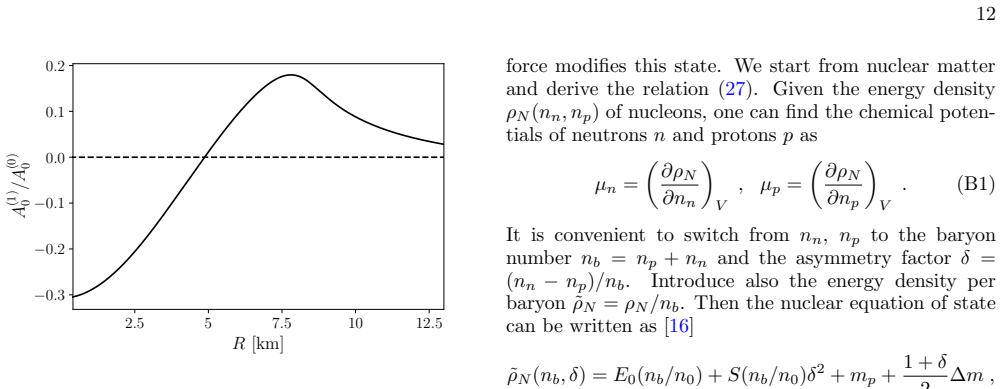
Equation of state of a neutron star Here we provide more discussion of the equilibrium state of a NS and how the presence of theL µ −L τ force modifies this state. We start from nuclear matter and derive the relation (27). Given the energy density ρN(nn, np) of nucleons, one can find the chemical poten- tials of neutronsnand protonspas µn = ∂ρN ∂nn V , µ ...
-
[7]
As discussed above, the local parameters characterising the structure of the star,n b, δ, ne, nµ, are determined by pressureP and theL µ −L τ potentialϕ
Numerical method Here we describe the numerical procedure used to solve for the equation of state (E.o.S.) of the NS. As discussed above, the local parameters characterising the structure of the star,n b, δ, ne, nµ, are determined by pressureP and theL µ −L τ potentialϕ. In the numerical analy- sis it is more convenient to calculaten b, ne, nµ, ρ, Pas fun...
-
[8]
R. L. Workmanet al.(Particle Data Group), Review of Particle Physics, PTEP2022, 083C01 (2022)
2022
-
[9]
D. Antypaset al., New Horizons: Scalar and Vector Ul- tralight Dark Matter, (2022), arXiv:2203.14915 [hep-ex]
arXiv 2022
-
[10]
E. Ma, D. P. Roy, and S. Roy, Gauged L(mu) - L(tau) with large muon anomalous magnetic moment and the bimaximal mixing of neutrinos, Phys. Lett. B525, 101 (2002), arXiv:hep-ph/0110146
Pith/arXiv arXiv 2002
-
[11]
S. Choubey and W. Rodejohann, A Flavor symmetry for quasi-degenerate neutrinos: L(mu) - L(tau), Eur. Phys. J. C40, 259 (2005), arXiv:hep-ph/0411190
Pith/arXiv arXiv 2005
-
[12]
J. Heeck and W. Rodejohann, GaugedL µ −L τ Symme- try at the Electroweak Scale, Phys. Rev. D84, 075007 (2011), arXiv:1107.5238 [hep-ph]
Pith/arXiv arXiv 2011
-
[13]
K. Asai, K. Hamaguchi, N. Nagata, S.-Y. Tseng, and K. Tsumura, Minimal Gauged U(1) Lα−Lβ Models Driven into a Corner, Phys. Rev. D99, 055029 (2019), arXiv:1811.07571 [hep-ph]
Pith/arXiv arXiv 2019
-
[14]
J. A. Dror, Discovering leptonic forces using noncon- served currents, Phys. Rev. D101, 095013 (2020), arXiv:2004.04750 [hep-ph]
arXiv 2020
-
[15]
E. G. Adelberger, B. R. Heckel, and A. E. Nelson, Tests of the gravitational inverse square law, Ann. Rev. Nucl. Part. Sci.53, 77 (2003), arXiv:hep-ph/0307284
Pith/arXiv arXiv 2003
-
[16]
E. G. Adelberger, B. R. Heckel, S. A. Hoedl, C. D. Hoyle, D. J. Kapner, and A. Upadhye, Particle Physics Implications of a Recent Test of the Gravitational In- verse Sqaure Law, Phys. Rev. Lett.98, 131104 (2007), arXiv:hep-ph/0611223
Pith/arXiv arXiv 2007
-
[17]
S. Schlamminger, K. Y. Choi, T. A. Wagner, J. H. Gund- lach, and E. G. Adelberger, Test of the equivalence prin- ciple using a rotating torsion balance, Phys. Rev. Lett. 100, 041101 (2008), arXiv:0712.0607 [gr-qc]
Pith/arXiv arXiv 2008
-
[18]
S. Gardner and M. Zakeri, Probing Dark Sectors with Neutron Stars, Universe10, 67 (2024), arXiv:2311.13649 [hep-ph]
arXiv 2024
-
[19]
D. Blas, D. L. Nacir, and S. Sibiryakov, Ultralight Dark Matter Resonates with Binary Pulsars, Phys. Rev. Lett. 118, 261102 (2017), arXiv:1612.06789 [hep-ph]
Pith/arXiv arXiv 2017
-
[20]
J. M. Armaleo, D. L´ opez Nacir, and F. R. Urban, Binary pulsars as probes for spin-2 ultralight dark matter, JCAP 01, 053, arXiv:1909.13814 [astro-ph.HE]
arXiv 1909
-
[21]
T. Kumar Poddar, S. Mohanty, and S. Jana, Vector gauge boson radiation from compact binary systems in a gauged Lµ −L τ scenario, Phys. Rev. D100, 123023 (2019), arXiv:1908.09732 [hep-ph]
arXiv 2019
-
[22]
J. A. Dror, R. Laha, and T. Opferkuch, Probing muonic forces with neutron star binaries, Phys. Rev. D102, 023005 (2020), arXiv:1909.12845 [hep-ph]
arXiv 2020
-
[23]
Haensel, A
P. Haensel, A. Potekhin, and D. Yakovlev,Neutron Stars 1: Equation of State and Structure, Astrophysics and Space Science Library (Springer New York, 2007)
2007
-
[24]
R. Garani, Y. Genolini, and T. Hambye, New Analysis of Neutron Star Constraints on Asymmetric Dark Matter, JCAP05, 035, arXiv:1812.08773 [hep-ph]
-
[25]
N. F. Bell, G. Busoni, and S. Robles, Capture of Lep- tophilic Dark Matter in Neutron Stars, JCAP06, 054, arXiv:1904.09803 [hep-ph]
Pith/arXiv arXiv 1904
-
[26]
R. Garani and J. Heeck, Dark matter interactions with muons in neutron stars, Phys. Rev. D100, 035039 (2019), arXiv:1906.10145 [hep-ph]
arXiv 2019
-
[27]
Sauter, ¨Uber das verhalten eines elektrons im homo- genen elektrischen feld nach der relativistischen theorie diracs, Zeitschrift f¨ ur Physik69, 742 (1931)
F. Sauter, ¨Uber das verhalten eines elektrons im homo- genen elektrischen feld nach der relativistischen theorie diracs, Zeitschrift f¨ ur Physik69, 742 (1931)
1931
-
[28]
W. Heisenberg and H. Euler, Consequences of dirac theory of the positron, arXiv preprint physics/0605038 (2006)
Pith/arXiv arXiv 2006
-
[29]
J. S. Schwinger, On gauge invariance and vacuum polar- ization, Phys. Rev.82, 664 (1951)
1951
-
[30]
M. D. Schwartz,Quantum Field Theory and the Standard Model(Cambridge University Press, 2014)
2014
-
[31]
T. D. Cohen and D. A. McGady, The Schwinger mechanism revisited, Phys. Rev. D78, 036008 (2008), arXiv:0807.1117 [hep-ph]
Pith/arXiv arXiv 2008
-
[32]
Navaset al.(Particle Data Group), Review of particle physics, Phys
S. Navaset al.(Particle Data Group), Review of particle physics, Phys. Rev. D110, 030001 (2024)
2024
-
[33]
S. Reddy, M. Prakash, and J. M. Lattimer, Neutrino in- teractions in hot and dense matter, Phys. Rev. D58, 013009 (1998), arXiv:astro-ph/9710115
Pith/arXiv arXiv 1998
-
[34]
G. L. Smith, C. D. Hoyle, J. H. Gundlach, E. G. Adel- berger, B. R. Heckel, and H. E. Swanson, Short range tests of the equivalence principle, Phys. Rev. D61, 022001 (2000), arXiv:2405.10982 [gr-qc]
arXiv 2000
-
[35]
F. ¨Ozel and P. Freire, Masses, Radii, and the Equation of State of Neutron Stars, Ann. Rev. Astron. Astrophys. 54, 401 (2016), arXiv:1603.02698 [astro-ph.HE]
Pith/arXiv arXiv 2016
-
[36]
T. K. Gaisser and M. Honda, Flux of atmospheric neutri- nos, Ann. Rev. Nucl. Part. Sci.52, 153 (2002), arXiv:hep- ph/0203272
arXiv 2002
-
[37]
Aghanimet al.(Planck), Planck 2018 results
N. Aghanimet al.(Planck), Planck 2018 results. VI. Cosmological parameters, Astron. Astrophys.641, A6 (2020), [Erratum: Astron.Astrophys. 652, C4 (2021)], arXiv:1807.06209 [astro-ph.CO]
Pith/arXiv arXiv 2018
-
[38]
D. Page and S. Reddy, Dense Matter in Compact Stars: Theoretical Developments and Observational Con- straints, Ann. Rev. Nucl. Part. Sci.56, 327 (2006), arXiv:astro-ph/0608360
Pith/arXiv arXiv 2006
-
[39]
J. M. Lattimer, Neutron Stars and the Nuclear Matter Equation of State, Ann. Rev. Nucl. Part. Sci.71, 433 (2021)
2021
- [40]
-
[41]
H. Heiselberg and M. Hjorth-Jensen, Phases of dense matter in neutron stars, Phys. Rept.328, 237 (2000), arXiv:nucl-th/9902033
Pith/arXiv arXiv 2000
-
[42]
S. W. Li, J. F. Beacom, L. F. Roberts, and F. Capozzi, Old data, new forensics: The first second of SN 1987A neutrino emission, Phys. Rev. D109, 083025 (2024), arXiv:2306.08024 [astro-ph.HE]
arXiv 2024
-
[43]
Haensel, A
P. Haensel, A. Y. Potekhin, and D. G. Yakovlev,Neu- tron stars 1: Equation of state and structure, Vol. 326 (Springer, New York, USA, 2007)
2007
-
[44]
M. Baryakhtar, R. Lasenby, and M. Teo, Black Hole Su- perradiance Signatures of Ultralight Vectors, Phys. Rev. D96, 035019 (2017), arXiv:1704.05081 [hep-ph]
Pith/arXiv arXiv 2017
-
[45]
T. Fischer, G. Guo, G. Mart´ ınez-Pinedo, M. Liebend¨ orfer, and A. Mezzacappa, Muonization of supernova matter, Phys. Rev. D102, 123001 (2020), arXiv:2008.13628 [astro-ph.HE]
arXiv 2020
-
[46]
W. E. East and J. Huang, Dark photon vortex formation 15 and dynamics, JHEP12, 089, arXiv:2206.12432 [hep-ph]
-
[47]
Walter, T
F. Walter, T. Eisenbeiß, J. Lattimer, B. Kim, V. Ham- baryan, and R. Neuh¨ auser, Revisiting the parallax of the isolated neutron star RX J185635-3754 using HST/ACS imaging, The Astrophysical Journal724, 669 (2010)
2010
-
[48]
Mignani, D
R. Mignani, D. V. Putte, M. Cropper, R. Turolla, S. Zane, L. Pellizza, L. Bignone, N. Sartore, and A. Treves, The birthplace and age of the isolated neu- tron star RX J1856.5-3754, Monthly Notices of the Royal Astronomical Society429, 3517 (2013)
2013
-
[49]
H. Alhazmi, K. Kong, G. Mohlabeng, and J.-C. Park, Boosted Dark Matter at the Deep Underground Neutrino Experiment, JHEP04, 158, arXiv:1611.09866 [hep-ph]
-
[50]
Suzuki, The Super-Kamiokande experiment, Eur
Y. Suzuki, The Super-Kamiokande experiment, Eur. Phys. J. C79, 298 (2019)
2019
-
[51]
Bodur and K
B. Bodur and K. Scholberg (Super-Kamiokande Collab- oration),ν e–16O Interactions with Low Energy Atmo- spheric Neutrinos in Super-Kamiokande, Talk presented at the 2nd Workshop for Atmospheric Neutrino Produc- tion in the MeV to PeV range (2021), slides, January 13, 2021
2021
-
[52]
E. Vitagliano, I. Tamborra, and G. Raffelt, Grand Uni- fied Neutrino Spectrum at Earth: Sources and Spec- tral Components, Rev. Mod. Phys.92, 45006 (2020), arXiv:1910.11878 [astro-ph.HE]
arXiv 2020
-
[53]
S. W. Li, L. F. Roberts, and J. F. Beacom, Exciting Prospects for Detecting Late-Time Neutrinos from Core- Collapse Supernovae, Phys. Rev. D103, 023016 (2021), arXiv:2008.04340 [astro-ph.HE]
arXiv 2021
-
[54]
K. Sugiura, S. Furusawa, K. Sumiyoshi, and S. Ya- mada, Leptonic and semi-leptonic neutrino interactions with muons in proto-neutron star cooling, PTEP2022, 113E01 (2022), arXiv:2211.06944 [astro-ph.HE]
arXiv 2022
-
[55]
C. A. Manzari, J. Martin Camalich, J. Spinner, and R. Ziegler, Supernova limits on muonic dark forces, Phys. Rev. D108, 103020 (2023), arXiv:2307.03143 [hep-ph]
arXiv 2023
-
[56]
D. F. G. Fiorillo, A. Lella, G. G. Raffelt, N. Selimovic, and E. Vitagliano, Neutron Star Bounds on Muonic Fifth Forces from Picometer to Kilometer Scales, (2026), arXiv:2605.24094 [hep-ph]
Pith/arXiv arXiv 2026
-
[57]
D. F. G. Fiorillo, A. Lella, G. G. Raffelt, N. Se- limovic, and E. Vitagliano, Production of Leptophilic Bosons in Ultradegenerate Relativistic Matter, (2026), arXiv:2605.24081 [hep-ph]
Pith/arXiv arXiv 2026
-
[58]
P. Haensel and J. L. Zdunik, Models of crustal heating in accreting neutron stars, Astron. Astrophys.480, 459 (2008), arXiv:0708.3996 [astro-ph]
Pith/arXiv arXiv 2008
-
[59]
E. H. Tanin and Y. Wang, Gradient-Produced Neutrinos, (2026), arXiv:2604.21968 [hep-ph]
Pith/arXiv arXiv 2026
discussion (0)
Sign in with ORCID, Apple, or X to comment. Anyone can read and Pith papers without signing in.