REVIEW 4 major objections 5 minor 1 cited by
Human-in-Context: Unified Cross-Domain 3D Human Motion Modeling via In-Context Learning
T0 review · 4 major / 5 minor · reviewed 2026-08-15 · deepseek-v4-flash
Pith's one-line read Single model, trained once, handles ten 3D human-motion tasks across pose and mesh, beating prior domain-specific and cross-domain models by 21.8% on average.
desk verdict A coherent extension of PiC with real architectural ideas, but the headline improvement rests on under-specified re-implementations of baselines, including at least one broken one. read the letter →
The pith
A machine-rendered reading of the paper's core claim, the machinery that carries it, and where it could break.
The reading
What carries the argument
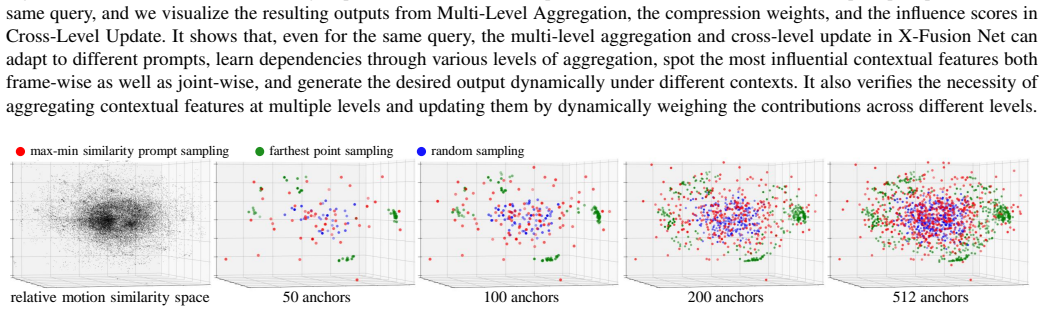
Three mechanisms carry the argument. (1) A unified cross-modal representation: pose and mesh sequences are padded with virtual joints and zero shape parameters so every task input and output lives in $\mathbb{R}^{F\times J\times C}$, making all ten tasks share one interface. (2) Max-min similarity prompt sampling (SPS): each training sequence is embedded in a relative motion similarity space anchored at the canonical T-pose; anchors are chosen iteratively by grouping unsampled sequences by maximum similarity to existing anchors and then sampling the sequence with minimum similarity to its group representative, giving $K=800$ anchors that cover dense and sparse regions; at inference the query retrieves its closest hard anchor plus a learnable soft anchor. (3) X-Fusion Net: a dual query/prompt branch network whose blocks perform multi-level context aggregation—self-attention for global embedding-space dependencies, graph convolution for local graph-space dependencies, and a state-space model for local state-space dependencies—followed by a cross-level context update that compresses the levels into influence scores and combines them with a learned frame-wise and joint-wise weighted sum, with prompt context added into the query branch each layer.
What would settle it
Train each baseline twice: once under the paper's unified single-process protocol and once with its native domain-specific heads and multi-stage training, then compare on the same ten tasks and on 3DPW. If the unified-protocol baselines lose substantially to their native versions, or if HiC's margin shrinks when baselines are given their own optimizers and loss schedules, the claim that the architecture and prompting strategy cause the improvement is falsified.
Extended reading notes
Core claim
The central claim is that cross-domain 3D human motion modeling can be formulated as in-context learning: the task is communicated entirely by a prompt pair $[\text{input}, \text{target}]$ drawn from the same domain as the query, and the model performs the corresponding task on the query without any task-specific head or fine-tuning. To make this work across modalities, the paper unifies pose and mesh sequences into one tensor format: pose joints are position coordinates, SMPL mesh joints are axis-angle rotation vectors, and gaps are filled with virtual joints and zero shape parameters. The paper then claims that two additions make the unified model succeed: max-min similarity prompt sampling, which spreads a small set of hard anchors across the data distribution and retrieves the closest one for each query, and X-Fusion Net, whose dual-branch architecture aggregates context with self-attention, graph convolution, and state-space models and updates features with learned cross-level weights. The reported evidence is a consistent win on all ten tasks on AMASS, Human3.6M, and FreeMan, and on the out-of-domain 3DPW dataset, with an average improvement of 21.8% over domain-specific and cross-domain baselines and 9.9% over PiC.
Load-bearing premise
The central comparison rests on the assumption that baseline models can be fairly re-implemented under the authors' unified setting—one training run, no domain-specific heads, one shared task formulation—so the reported 21.8% gap reflects model quality rather than the authors' choices of training recipes, hyperparameters, or losses for the baselines.
Editorial extensions
If this is right
- A single trained model can serve ten tasks across pose and mesh modalities, replacing per-task heads and multi-stage pipelines.
- Out-of-domain generalization improves: training on AMASS, Human3.6M, and FreeMan transfers to unseen 3DPW better than every compared baseline on all ten tasks.
- Distribution-aware prompt retrieval helps more than random prompts: SPS beats random, farthest-point, and cluster-based sampling on both in-domain and out-of-domain benchmarks.
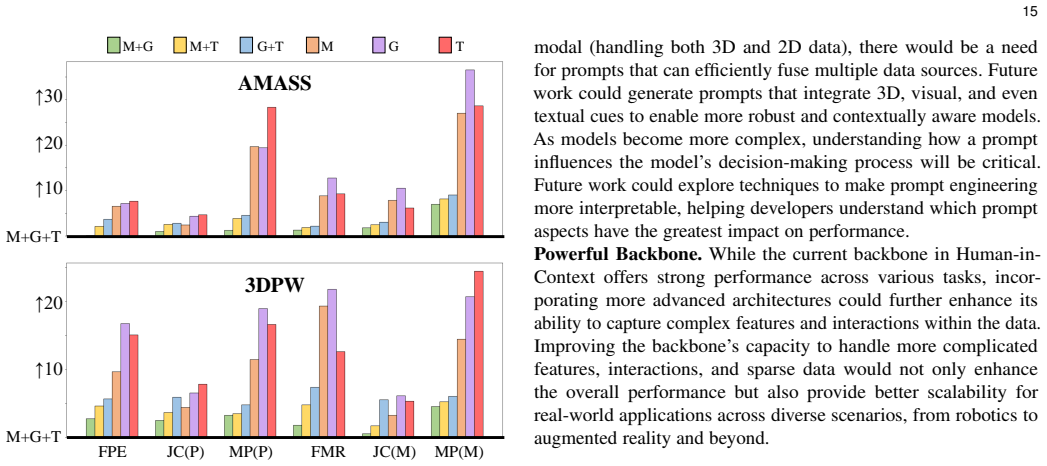
- Dynamic cross-level weighting in X-Fusion Net outperforms static averaging of aggregation levels, and all three aggregators—self-attention, graph convolution, and the state-space model—contribute to the gain.
- Scaling data roughly 21x while adding mesh tasks and a fourth dataset improves rather than degrades the model's generality.
Reading between the lines
- An untested extension follows directly: the same unified tensor format could absorb additional modalities, such as RGB video or point clouds, by adding a modality-specific encoder in front of the shared in-context model, potentially yielding a single human-motion foundation model.
- The anchor set is a non-parametric memory; replacing exhaustive similarity search with approximate nearest-neighbor retrieval could let the anchor count and training scale grow far beyond the 800 used here, which the ablations suggest would help up to a point.
- The max-min sampling objective is task-agnostic and could be transferred to other sequential domains, such as robotic manipulation trajectories, animal motion, or hand motion, wherever a prompt pair can define the task.
- A decisive experiment the paper does not run: test on a fifth dataset with a different body model or joint topology (for example, SMPL-X) to see whether virtual-joint padding generalizes across body definitions or degrades silently.
Signed reviews
Editorial analysis
A structured set of objections, weighed in public.
Referee Report
Summary. The paper proposes Human-in-Context (HiC), a single model trained once to handle ten 3D human motion tasks across pose and mesh modalities and four datasets (AMASS, Human3.6M, FreeMan, and the out-of-domain 3DPW). The method extends the authors' previous Pose-in-Context (PiC) with a max-min similarity prompt sampling strategy that retrieves hard anchors and paired soft anchors, and with X-Fusion Net, a dual-branch network using self-attention, graph convolution, and state-space aggregation followed by cross-level context update. The paper claims consistent improvements over re-implemented baselines, reporting a 9.9% gain over PiC and a 21.8% average gain over prior domain-specific and cross-domain models on MPJPE/MPVE metrics. The main evidence is in Tables 3 and 4, supported by ablations on anchors, soft anchors, sampling, fusion, dimensions, and layers. Code and models are promised at a public repository.
Significance. If the empirical claims hold, HiC would be a useful step toward a single fully unified 3D human motion model, and its design choices (prompt sampling with hard/soft anchors, multi-level context fusion) are reasonable and well motivated. The paper also contributes a larger in-context formulation than PiC, covering two modalities and ten tasks, and it releases code and models. The significance, however, is contingent on the credibility of the baseline comparison. The current evaluation is weakened by the fact that all baselines are re-implemented by the authors under a protocol described in one sentence, that the main comparison is against the authors' own prior work (PiC), and that some re-implemented baseline entries (PoseRetNet on mesh tasks) are two orders of magnitude worse than other methods, which suggests a non-functional adaptation rather than a fair comparison. The central quantitative claims therefore need substantial verification before the paper can be accepted.
major comments (4)
- [Section 5, Tables 3 and 4] The claimed 21.8% average improvement is not credible as reported because several baseline entries appear non-functional. PoseRetNet is listed with MPVE values of 478.51 and 481.95 on AMASS mesh recovery and future mesh recovery, 328.24 and 343.60 on Human3.6M, and 314.26 and 311.91 on 3DPW, while every other method on those same entries is in the 43-145 mm range. Including these entries in an average comparison inflates the headline margin. The paper never defines the formula for the 21.8% average (which tasks/datasets are averaged, whether the average is over all 50 baseline-task entries, and whether non-functional entries are included). The authors should report per-baseline averages, exclude or separately analyze non-functional task adaptations, and give the exact formula.
- [Section 5, Experimental Setting] The baseline re-implementation protocol is described only as 'all models are re-implemented to align with the setting of unified cross-domain 3D human motion modeling, i.e., one-time training for all tasks and datasets without any domain-specific model heads.' This is insufficient to establish that the comparison reflects model quality rather than the authors' implementation choices. No per-baseline architecture adaptation, loss weighting, training schedule, data augmentation, or compute budget is given. The suspicion is reinforced by MotionBERT obtaining 98.36 mm on H3.6M pose estimation, far above the published native-task performance of that method. The authors should provide per-baseline implementation details and, where possible, validate that each re-implementation reproduces its published native-task result before it is used in the unified setting.
- [Section 4.2, Eq. (4)] The similarity measure used for anchor sampling and prompt retrieval computes a Euclidean distance between raw sequence values, but those values are semantically heterogeneous: pose entries are 3D position coordinates in millimeters, while mesh entries are axis-angle rotation vectors in radians. Directly comparing these quantities in a single distance is not meaningfully justified, especially for the claimed cross-modal prompt retrieval where a pose query may be compared with mesh anchors. The paper should either define a common normalized or semantically aligned representation before applying Eq. (4), or demonstrate empirically that the retrieval behavior is robust to this unit mismatch.
- [Tables 3-9] No error bars or multiple-seed results are reported for any experiment, despite the fact that prompt retrieval, mask generation, and training involve stochastic choices. Since the paper's central claim is a set of consistent margins (9.9% over PiC, 21.8% over the field), the absence of variance estimates makes it impossible to tell whether the reported gaps are statistically significant. Reporting at least mean and standard deviation over three seeds for the main tables and the key ablations (Tables 5-8) is necessary to support the strength of these claims.
minor comments (5)
- [Section 5] There are typos in the experimental section: 'perfromance evalaution' should be 'performance evaluation', and the Figure 6 caption contains 'Recvoery' instead of 'Recovery'.
- [Figure 9 and Figure 10 captions] The captions describe ablations of 'multi-level context update', but the component being ablated is the multi-level context aggregation in X-Fusion blocks; the wording should be aligned with Section 4.3.2.
- [Eq. (2)] The notation [E(QD_j), U] for the query feature says concatenation is along the temporal axis, but the dimensions of E(QD_j) and the TUP U are not specified; please clarify how the temporal lengths match.
- [Section 4.2] The description of the relative motion similarity space is intuitive but not fully specified; to make the anchor sampling reproducible, the paper should state how the canonical T-body is represented in both pose and mesh forms and how sequences of different lengths are handled.
- [Table 2] The row for Future Mesh Recovery lists the output as {X_mesh_{F+1:2F}, beta} while the input is 2D pose from frames 1:F, but the text describing future mesh recovery in Section 3.1 does not explicitly say that the output is future frames; please make the formulation consistent.
Circularity Check
No significant circularity: HiC's reported gains are empirical measurements against tabulated baselines; the baseline re-implementation protocol is an evaluation-fairness concern, not a circular derivation.
full rationale
The paper's central claims are empirical rather than derived: HiC is trained once and directly evaluated on AMASS, Human3.6M, FreeMan, and 3DPW with MPJPE/MPVE metrics. The comparison against MotionBERT, PoseRetNet, TCPFormer, and HoT uses external methods, and the comparison against PiC is a tabulated re-implementation of the authors' own prior work, not an imported theorem or a fitted value renamed as a prediction. The proposed components are defined in a self-contained way: Eq. (4) defines the similarity function, Algorithm 1 specifies the anchor sampling, Eqs. (12)-(18) define the X-Fusion block, and the ablations (Tables 5-9) directly test each design choice against alternatives. I do not find any step in which a predicted quantity is identical by construction to an input or fitted parameter. The strongest concern in the paper is experimental: the re-implementation protocol is described in one sentence in Section 5, and Table 3 shows PoseRetNet reporting mesh MPVEs of 478.51 and 481.95 on AMASS, 328.24 and 343.60 on Human3.6M, and 314.26 and 311.91 on 3DPW, far outside the 43-145 mm range of all other methods, while the 21.8% average formula is never defined. This could inflate the headline margin, but it is a correctness and fairness issue rather than a circularity one: the HiC numbers are direct measurements, the model is not defined in terms of the baselines, and no load-bearing argument reduces to a self-citation. Accordingly, the appropriate finding is no significant circularity.
Assumptions & free parameters
free parameters (6)
- Number of anchors K =
800
- Number of layers K =
8
- Hidden feature dimension H =
128
- Mask ratio =
40%
- Sequence length F =
16 frames
- Number of joints J =
24 joints
assumptions (5)
- domain assumption The unified formulation treats 3D joint positions and SMPL axis-angle rotations as directly comparable and interchangeable representations.
- domain assumption The relative motion similarity space, built on Euclidean distances between raw sequences, is a meaningful space for identifying representative anchors.
- domain assumption In-context learning transfers from randomly selected prompt examples to novel queries in the same domain.
- ad hoc to paper The baselines are fairly re-implemented under the unified setting.
- domain assumption SMPL mesh ground truth generated by MoSh for Human3.6M is accurate enough for evaluation.
Cite this review
Pith. "Pith review of Human-in-Context: Unified Cross-Domain 3D Human Motion Modeling via In-Context Learning." pith.science (2026). https://pith.science/paper/C6SDXUPQ
@misc{pith2026250810897,
  author       = {Pith},
  title        = {Pith review of: Human-in-Context: Unified Cross-Domain 3D Human Motion Modeling via In-Context Learning},
  year         = {2026},
  howpublished = {\url{https://pith.science/paper/C6SDXUPQ}},
  note         = {Machine review of arXiv:2508.10897}
}
read the original abstract
This paper aims to model 3D human motion across domains, where a single model is expected to handle multiple modalities, tasks, and datasets. Existing cross-domain models often rely on domain-specific components and multi-stage training, which limits their practicality and scalability. To overcome these challenges, we propose a new setting to train a unified cross-domain model through a single process, eliminating the need for domain-specific components and multi-stage training. We first introduce Pose-in-Context (PiC), which leverages in-context learning to create a pose-centric cross-domain model. While PiC generalizes across multiple pose-based tasks and datasets, it encounters difficulties with modality diversity, prompting strategy, and contextual dependency handling. We thus propose Human-in-Context (HiC), an extension of PiC that broadens generalization across modalities, tasks, and datasets. HiC combines pose and mesh representations within a unified framework, expands task coverage, and incorporates larger-scale datasets. Additionally, HiC introduces a max-min similarity prompt sampling strategy to enhance generalization across diverse domains and a network architecture with dual-branch context injection for improved handling of contextual dependencies. Extensive experimental results show that HiC performs better than PiC in terms of generalization, data scale, and performance across a wide range of domains. These results demonstrate the potential of HiC for building a unified cross-domain 3D human motion model with improved flexibility and scalability. The source codes and models are available at https://github.com/BradleyWang0416/Human-in-Context.
Figures


Figures from the paper (7 more)



Forward citations
Cited by 1 Pith paper
-
Superman: Unifying Skeleton and Vision for Human Motion Perception and Generation
A single MLLM trained with a vision-guided hybrid VQ-VAE tokenizer reports state-of-the-art or competitive results for 3D pose estimation, motion prediction, and motion in-betweening on Human3.6M and 3DPW.
Reference graph
Works this paper leans on
-
[1]
Enhanced skeleton visualization for view invariant human action recognition,
M. Liu, H. Liu, and C. Chen, “Enhanced skeleton visualization for view invariant human action recognition,” PR, 2017. 1, 3
2017
-
[2]
3d human pose estimation= 2d pose estimation+ matching,
C.-H. Chen and D. Ramanan, “3d human pose estimation= 2d pose estimation+ matching,” in CVPR, 2017. 1, 3
2017
-
[3]
Pose2mesh: graph convolutional network for 3d human pose and mesh recovery from a 2d human pose,
H. Choi, G. Moon, and K. M. Lee, “Pose2mesh: graph convolutional network for 3d human pose and mesh recovery from a 2d human pose,” in ECCV, 2020. 1, 2, 3
2020
-
[4]
Recognizing human actions as the evolution of pose estimation maps,
M. Liu and J. Yuan, “Recognizing human actions as the evolution of pose estimation maps,” in CVPR, 2018. 1
2018
-
[5]
Milnet: multiplex interactive learning network for rgb-t semantic segmentation,
J. Liu, H. Liu, X. Li, J. Ren, and X. Xu, “Milnet: multiplex interactive learning network for rgb-t semantic segmentation,” IEEE T-IP, 2025. 1
2025
-
[6]
Dynamic dense graph convolutional network for skeleton-based human motion prediction,
X. Wang, W. Zhang, C. Wang, Y . Gao, and M. Liu, “Dynamic dense graph convolutional network for skeleton-based human motion prediction,” IEEE T-IP, 2024. 1, 3
2024
-
[7]
Symbiotic graph neural networks for 3d skeleton-based human action recognition and motion prediction,
M. Li, S. Chen, X. Chen, Y . Zhang, Y . Wang, and Q. Tian, “Symbiotic graph neural networks for 3d skeleton-based human action recognition and motion prediction,” IEEE T-PAMI, 2021. 1, 3
2021
-
[8]
Tcpformer: learning temporal correlation with implicit pose proxy for 3d human pose estimation,
J. Liu, M. Liu, H. Liu, and W. Li, “Tcpformer: learning temporal correlation with implicit pose proxy for 3d human pose estimation,” in AAAI, 2025. 1, 10, 11
2025
Show all 92 references
-
[9]
Hourglass tokenizer for efficient transformer-based 3d human pose estimation,
W. Li, M. Liu, H. Liu, P. Wang, J. Cai, and N. Sebe, “Hourglass tokenizer for efficient transformer-based 3d human pose estimation,” inCVPR, 2024. 1, 3, 10, 11
2024
-
[10]
Feature boosting network for 3d pose estimation,
J. Liu, H. Ding, A. Shahroudy, L.-Y . Duan, X. Jiang, G. Wang, and A. C. Kot, “Feature boosting network for 3d pose estimation,” IEEE T-PAMI,
-
[11]
Arts: semi-analytical regressor using disentangled skeletal representations for human mesh recovery from videos,
T. Tang, H. Liu, Y . You, T. Wang, and W. Li, “Arts: semi-analytical regressor using disentangled skeletal representations for human mesh recovery from videos,” in ACM MM, 2024. 1, 2, 3, 4
2024
-
[12]
Attention is all you need,
A. Vaswani, N. Shazeer, N. Parmar, J. Uszkoreit, L. Jones, A. N. Gomez, Ł. Kaiser, and I. Polosukhin, “Attention is all you need,” NeurIPS, 2017. 1 16
2017
-
[13]
An image is worth 16x16 words: transformers for image recognition at scale,
A. Dosovitskiy, “An image is worth 16x16 words: transformers for image recognition at scale,” arXiv preprint arXiv:2010.11929, 2020. 1, 3
2010 arXiv
-
[14]
Vision mamba: efficient visual representation learning with bidirectional state space model,
L. Zhu, B. Liao, Q. Zhang, X. Wang, W. Liu, and X. Wang, “Vision mamba: efficient visual representation learning with bidirectional state space model,” arXiv preprint arXiv:2401.09417, 2024. 1, 3
2024 arXiv
-
[15]
Bert: pre-training of deep bidirectional transformers for language understanding,
J. Devlin, M.-W. Chang, K. Lee, and K. Toutanova, “Bert: pre-training of deep bidirectional transformers for language understanding,” arXiv preprint arXiv:1810.04805, 2018. 1, 3
2018 arXiv
-
[16]
Language models are few-shot learners,
T. Brown, B. Mann, N. Ryder, M. Subbiah, J. D. Kaplan, P. Dhariwal, A. Neelakantan, P. Shyam, G. Sastry, A. Askell et al., “Language models are few-shot learners,” NeurIPS, 2020. 1, 3
2020
-
[17]
Spatial temporal graph convolutional networks for skeleton-based action recognition,
S. Yan, Y . Xiong, and D. Lin, “Spatial temporal graph convolutional networks for skeleton-based action recognition,” in AAAI, 2018. 1
2018
-
[18]
Motionbert: a unified perspective on learning human motion representations,
W. Zhu, X. Ma, Z. Liu, L. Liu, W. Wu, and Y . Wang, “Motionbert: a unified perspective on learning human motion representations,” in ICCV,
-
[19]
Unified pose sequence modeling,
L. G. Foo, T. Li, H. Rahmani, Q. Ke, and J. Liu, “Unified pose sequence modeling,” in CVPR, 2023. 1, 3
2023
-
[20]
Large motion model for unified multi-modal motion generation,
M. Zhang, D. Jin, C. Gu, F. Hong, Z. Cai, J. Huang, C. Zhang, X. Guo, L. Yang, Y . Heet al., “Large motion model for unified multi-modal motion generation,” in ECCV, 2025. 1, 3
2025
-
[21]
Unihcp: a unified model for human-centric perceptions,
Y . Ci, Y . Wang, M. Chen, S. Tang, L. Bai, F. Zhu, R. Zhao, F. Yu, D. Qi, and W. Ouyang, “Unihcp: a unified model for human-centric perceptions,” in CVPR, 2023. 1, 3
2023
-
[22]
Macdiff: unified skeleton modeling with masked conditional diffusion,
L. Wu, L. Lin, J. Zhang, Y . Ma, and J. Liu, “Macdiff: unified skeleton modeling with masked conditional diffusion,” in ECCV, 2024. 1
2024
-
[23]
History repeats itself: Human motion prediction via motion attention,
W. Mao, M. Liu, and M. Salzmann, “History repeats itself: Human motion prediction via motion attention,” in ECCV, 2020. 1, 3
2020
-
[24]
Gcnext: towards the unity of graph convolutions for human motion prediction,
X. Wang, Q. Cui, C. Chen, and M. Liu, “Gcnext: towards the unity of graph convolutions for human motion prediction,” in AAAI, 2024. 1
2024
-
[25]
Towards accurate 3d human motion prediction from incomplete observations,
Q. Cui and H. Sun, “Towards accurate 3d human motion prediction from incomplete observations,” in CVPR, 2021. 1, 3
2021
-
[26]
What makes good in-context examples for gpt-3?
J. Liu, D. Shen, Y . Zhang, B. Dolan, L. Carin, and W. Chen, “What makes good in-context examples for gpt-3?” arXiv preprint arXiv:2101.06804,
-
[27]
What makes good examples for visual in-context learning?
Y . Zhang, K. Zhou, and Z. Liu, “What makes good examples for visual in-context learning?” NeurIPS, 2024. 1, 3
2024
-
[28]
Images speak in images: a generalist painter for in-context visual learning,
X. Wang, W. Wang, Y . Cao, C. Shen, and T. Huang, “Images speak in images: a generalist painter for in-context visual learning,” in CVPR, 2023. 1, 3
2023
-
[29]
Explore in-context learning for 3d point cloud understanding,
Z. Fang, X. Li, X. Li, J. M. Buhmann, C. C. Loy, and M. Liu, “Explore in-context learning for 3d point cloud understanding,” NeurIPS, 2023. 1, 3
2023
-
[30]
Skeleton-in-context: unified skeleton sequence modeling with in-context learning,
X. Wang, Z. Fang, X. Li, X. Li, C. Chen, and M. Liu, “Skeleton-in-context: unified skeleton sequence modeling with in-context learning,” in CVPR,
-
[31]
On human motion prediction using recurrent neural networks,
J. Martinez, M. J. Black, and J. Romero, “On human motion prediction using recurrent neural networks,” in CVPR, 2017. 2, 3
2017
-
[32]
Convolutional sequence to sequence model for human dynamics,
C. Li, Z. Zhang, W. S. Lee, and G. H. Lee, “Convolutional sequence to sequence model for human dynamics,” in CVPR, 2018. 2, 3
2018
-
[33]
Multiscale spatio-temporal graph neural networks for 3d skeleton-based motion prediction,
M. Li, S. Chen, Y . Zhao, Y . Zhang, Y . Wang, and Q. Tian, “Multiscale spatio-temporal graph neural networks for 3d skeleton-based motion prediction,” IEEE T-IP, 2021. 2, 3
2021
-
[34]
Learning trajectory dependen- cies for human motion prediction,
W. Mao, M. Liu, M. Salzmann, and H. Li, “Learning trajectory dependen- cies for human motion prediction,” in ICCV, 2019. 2, 3
2019
-
[35]
Spatiotemporal co- attention recurrent neural networks for human-skeleton motion prediction,
X. Shu, L. Zhang, G.-J. Qi, W. Liu, and J. Tang, “Spatiotemporal co- attention recurrent neural networks for human-skeleton motion prediction,” IEEE T-PAMI, 2021. 2
2021
-
[36]
A simple yet effective baseline for 3d human pose estimation,
J. Martinez, R. Hossain, J. Romero, and J. J. Little, “A simple yet effective baseline for 3d human pose estimation,” in ICCV, 2017. 2
2017
-
[37]
Mixste: seq2seq mixed spatio-temporal encoder for 3d human pose estimation in video,
J. Zhang, Z. Tu, J. Yang, Y . Chen, and J. Yuan, “Mixste: seq2seq mixed spatio-temporal encoder for 3d human pose estimation in video,” in CVPR,
-
[38]
Mhformer: multi- hypothesis transformer for 3d human pose estimation,
W. Li, H. Liu, H. Tang, P. Wang, and L. Van Gool, “Mhformer: multi- hypothesis transformer for 3d human pose estimation,” in CVPR, 2022. 2, 3
2022
-
[39]
Diffpose: toward more reliable 3d pose estimation,
J. Gong, L. G. Foo, Z. Fan, Q. Ke, H. Rahmani, and J. Liu, “Diffpose: toward more reliable 3d pose estimation,” in CVPR, 2023. 2
2023
-
[40]
App: adaptive pose pooling for 3d human pose estimation from videos,
J. Zhang, M. Liu, H. Liu, G. Wang, and W. Li, “App: adaptive pose pooling for 3d human pose estimation from videos,” in ACM MM, 2024. 2
2024
-
[41]
Finepose: fine-grained prompt-driven 3d human pose estimation via diffusion models,
J. Xu, Y . Guo, and Y . Peng, “Finepose: fine-grained prompt-driven 3d human pose estimation via diffusion models,” in CVPR, 2024. 2, 3
2024
-
[42]
Hybrik: a hybrid analytical-neural inverse kinematics solution for 3d human pose and shape estimation,
J. Li, C. Xu, Z. Chen, S. Bian, L. Yang, and C. Lu, “Hybrik: a hybrid analytical-neural inverse kinematics solution for 3d human pose and shape estimation,” in CVPR, 2021. 2, 3, 4
2021
-
[43]
Skeleton2mesh: kinematics prior injected unsupervised human mesh recovery,
Z. Yu, J. Wang, J. Xu, B. Ni, C. Zhao, M. Wang, and W. Zhang, “Skeleton2mesh: kinematics prior injected unsupervised human mesh recovery,” in ICCV, 2021. 2
2021
-
[44]
Convolutional sequence generation for skeleton-based action synthesis,
S. Yan, Z. Li, Y . Xiong, H. Yan, and D. Lin, “Convolutional sequence generation for skeleton-based action synthesis,” in ICCV, 2019. 2, 3
2019
-
[45]
Generative tweening: long-term inbetweening of 3d human motions,
Y . Zhou, J. Lu, C. Barnes, J. Yang, S. Xiang et al. , “Generative tweening: long-term inbetweening of 3d human motions,” arXiv preprint arXiv:2005.08891, 2020. 2
2005 arXiv
-
[46]
Convolutional autoencoders for human motion infilling,
M. Kaufmann, E. Aksan, J. Song, F. Pece, R. Ziegler, and O. Hilliges, “Convolutional autoencoders for human motion infilling,” in 3DV, 2020. 2, 3
2020
-
[47]
Human motion prediction via spatio-temporal inpainting,
A. Hernandez, J. Gall, and F. Moreno-Noguer, “Human motion prediction via spatio-temporal inpainting,” in ICCV, 2019. 2
2019
-
[48]
Coupled action recognition and pose estimation from multiple views,
A. Yao, J. Gall, and L. Van Gool, “Coupled action recognition and pose estimation from multiple views,” IJCV, 2012. 2, 3
2012
-
[49]
SMPL: a skinned multi-person linear model,
M. Loper, N. Mahmood, J. Romero, G. Pons-Moll, and M. J. Black, “SMPL: a skinned multi-person linear model,” ACM TOG, 2015. 2, 3, 6
2015
-
[50]
Keep it smpl: automatic estimation of 3d human pose and shape from a single image,
F. Bogo, A. Kanazawa, C. Lassner, P. Gehler, J. Romero, and M. J. Black, “Keep it smpl: automatic estimation of 3d human pose and shape from a single image,” in ECCV, 2016. 2, 3, 4
2016
-
[51]
Unsupervised learning of view-invariant action representations,
J. Li, Y . Wong, Q. Zhao, and M. S. Kankanhalli, “Unsupervised learning of view-invariant action representations,” in NeurIPS, 2018. 2
2018
-
[52]
Motion guided 3d pose estimation from videos,
J. Wang, S. Yan, Y . Xiong, and D. Lin, “Motion guided 3d pose estimation from videos,” in ECCV, 2020. 2
2020
-
[53]
Human3. 6m: large scale datasets and predictive methods for 3d human sensing in natural environments,
C. Ionescu, D. Papava, V . Olaru, and C. Sminchisescu, “Human3. 6m: large scale datasets and predictive methods for 3d human sensing in natural environments,” IEEE T-PAMI, 2013. 2, 4, 10, 11
2013
-
[54]
Recovering accurate 3d human pose in the wild using imus and a moving camera,
T. V on Marcard, R. Henschel, M. J. Black, B. Rosenhahn, and G. Pons- Moll, “Recovering accurate 3d human pose in the wild using imus and a moving camera,” in ECCV, 2018. 2, 4, 10, 11, 13
2018
-
[55]
Amass: archive of motion capture as surface shapes,
N. Mahmood, N. Ghorbani, N. F. Troje, G. Pons-Moll, and M. J. Black, “Amass: archive of motion capture as surface shapes,” in ICCV, 2019. 2, 4, 10, 11
2019
-
[56]
Freeman: towards benchmarking 3d human pose estimation under real-world conditions,
J. Wang, F. Yang, B. Li, W. Gou, D. Yan, A. Zeng, Y . Gao, J. Wang, Y . Jing, and R. Zhang, “Freeman: towards benchmarking 3d human pose estimation under real-world conditions,” in CVPR, 2024. 2, 4, 10, 11
2024
-
[57]
Ntu rgb+ d: a large scale dataset for 3d human activity analysis,
A. Shahroudy, J. Liu, T.-T. Ng, and G. Wang, “Ntu rgb+ d: a large scale dataset for 3d human activity analysis,” in CVPR, 2016. 3
2016
-
[58]
Ntu rgb+ d 120: a large-scale benchmark for 3d human activity understanding,
J. Liu, A. Shahroudy, M. Perez, G. Wang, L.-Y . Duan, and A. C. Kot, “Ntu rgb+ d 120: a large-scale benchmark for 3d human activity understanding,” IEEE T-PAMI, 2019. 3
2019
-
[59]
Disentangling and unifying graph convolutions for skeleton-based action recognition,
Z. Liu, H. Zhang, Z. Chen, Z. Wang, and W. Ouyang, “Disentangling and unifying graph convolutions for skeleton-based action recognition,” in CVPR, 2020. 3
2020
-
[60]
Vg4d: vision- language model goes 4d video recognition,
Z. Deng, X. Li, X. Li, Y . Tong, S. Zhao, and M. Liu, “Vg4d: vision- language model goes 4d video recognition,” in ICRA, 2024. 3
2024
-
[61]
A comprehensive study of weight sharing in graph networks for 3d human pose estimation,
K. Liu, R. Ding, Z. Zou, L. Wang, and W. Tang, “A comprehensive study of weight sharing in graph networks for 3d human pose estimation,” in ECCV, 2020. 3
2020
-
[62]
Progressively generating better initial guesses towards next stages for high-quality human motion prediction,
T. Ma, Y . Nie, C. Long, Q. Zhang, and G. Li, “Progressively generating better initial guesses towards next stages for high-quality human motion prediction,” in CVPR, 2022. 3
2022
-
[63]
Graph stacked hourglass networks for 3d human pose estimation,
T. Xu and W. Takano, “Graph stacked hourglass networks for 3d human pose estimation,” in CVPR, 2021. 3
2021
-
[64]
Back to mlp: a simple baseline for human motion prediction,
W. Guo, Y . Du, X. Shen, V . Lepetit, X. Alameda-Pineda, and F. Moreno- Noguer, “Back to mlp: a simple baseline for human motion prediction,” in WACV, 2023. 3
2023
-
[65]
3d human pose estimation in video with temporal convolutions and semi-supervised training,
D. Pavllo, C. Feichtenhofer, D. Grangier, and M. Auli, “3d human pose estimation in video with temporal convolutions and semi-supervised training,” in CVPR, 2019. 3
2019
-
[66]
Co- occurrence feature learning for skeleton based action recognition using regularized deep lstm networks,
W. Zhu, C. Lan, J. Xing, W. Zeng, Y . Li, L. Shen, and X. Xie, “Co- occurrence feature learning for skeleton based action recognition using regularized deep lstm networks,” in AAAI, 2016. 3
2016
-
[67]
Spatio-temporal lstm with trust gates for 3d human action recognition,
J. Liu, A. Shahroudy, D. Xu, and G. Wang, “Spatio-temporal lstm with trust gates for 3d human action recognition,” in ECCV, 2016. 3
2016
-
[68]
Exploiting spatial-temporal relationships for 3d pose estimation via graph convolutional networks,
Y . Cai, L. Ge, J. Liu, J. Cai, T.-J. Cham, J. Yuan, and N. M. Thalmann, “Exploiting spatial-temporal relationships for 3d pose estimation via graph convolutional networks,” in ICCV, 2019. 3
2019
-
[69]
Learning dynamic relationships for 3d human motion prediction,
Q. Cui, H. Sun, and F. Yang, “Learning dynamic relationships for 3d human motion prediction,” in CVPR, 2020. 3
2020
-
[70]
3d human pose estimation with spatial and temporal transformers,
C. Zheng, S. Zhu, M. Mendieta, T. Yang, C. Chen, and Z. Ding, “3d human pose estimation with spatial and temporal transformers,” in ICCV,
-
[71]
Graformer: graph-oriented transformer for 3d pose estimation,
W. Zhao, W. Wang, and Y . Tian, “Graformer: graph-oriented transformer for 3d pose estimation,” in CVPR, 2022. 3 17
2022
-
[72]
Motionagformer: enhancing 3d human pose estimation with a transformer-gcnformer network,
S. Mehraban, V . Adeli, and B. Taati, “Motionagformer: enhancing 3d human pose estimation with a transformer-gcnformer network,” in WACV,
-
[73]
Mamba: linear-time sequence modeling with selective state spaces,
A. Gu and T. Dao, “Mamba: linear-time sequence modeling with selective state spaces,” arXiv preprint arXiv:2312.00752, 2023. 3
2023 arXiv
-
[74]
Pose magic: efficient and temporally consistent human pose estimation with a hybrid mamba- gcn network,
X. Zhang, Q. Bao, Q. Cui, W. Yang, and Q. Liao, “Pose magic: efficient and temporally consistent human pose estimation with a hybrid mamba- gcn network,” arXiv preprint arXiv:2408.02922, 2024. 3
2024 arXiv
-
[75]
Simba: mamba augmented u-shiftgcn for skeletal action recognition in videos,
S. Chaudhuri and S. Bhattacharya, “Simba: mamba augmented u-shiftgcn for skeletal action recognition in videos,”arXiv preprint arXiv:2404.07645,
-
[76]
Omg-seg: is one model good enough for all segmentation?
X. Li, H. Yuan, W. Li, H. Ding, S. Wu, W. Zhang, Y . Li, K. Chen, and C. C. Loy, “Omg-seg: is one model good enough for all segmentation?” in CVPR, 2024. 3
2024
-
[77]
Seggpt: towards segmenting everything in context,
X. Wang, X. Zhang, Y . Cao, W. Wang, C. Shen, and T. Huang, “Seggpt: towards segmenting everything in context,” in ICCV, 2023. 3
2023
-
[78]
Learning to reconstruct 3d human pose and shape via model-fitting in the loop,
N. Kolotouros, G. Pavlakos, M. J. Black, and K. Daniilidis, “Learning to reconstruct 3d human pose and shape via model-fitting in the loop,” in ICCV, 2019. 3, 4
2019
-
[79]
2d/3d pose estimation and action recognition using multitask deep learning,
D. C. Luvizon, D. Picard, and H. Tabia, “2d/3d pose estimation and action recognition using multitask deep learning,” in CVPR, 2018. 3
2018
-
[80]
A unified 3d human motion synthesis model via conditional variational auto-encoder,
Y . Cai, Y . Wang, Y . Zhu, T.-J. Cham, J. Cai, J. Yuan, J. Liu, C. Zheng, S. Yan, H. Ding et al., “A unified 3d human motion synthesis model via conditional variational auto-encoder,” in ICCV, 2021. 3
2021
-
[81]
Learning to retrieve prompts for in-context learning,
O. Rubin, J. Herzig, and J. Berant, “Learning to retrieve prompts for in-context learning,” arXiv preprint arXiv:2112.08633, 2021. 3
2021 arXiv
-
[82]
Learning transferable visual models from natural language supervision,
A. Radford, J. W. Kim, C. Hallacy, A. Ramesh, G. Goh, S. Agarwal, G. Sastry, A. Askell, P. Mishkin, J. Clark et al., “Learning transferable visual models from natural language supervision,” in ICML, 2021. 3
2021
-
[83]
In-context learning unlocked for diffusion models,
Z. Wang, Y . Jiang, Y . Lu, Y . Shen, P. He, W. Chen, Z. Wang, and M. Zhou, “In-context learning unlocked for diffusion models,” arXiv preprint arXiv:2305.01115, 2023. 3
2023 arXiv
-
[84]
Visual prompting via image inpainting,
A. Bar, Y . Gandelsman, T. Darrell, A. Globerson, and A. Efros, “Visual prompting via image inpainting,” NeurIPS, 2022. 3
2022
-
[85]
Explore in-context segmentation via latent diffusion models,
C. Wang, X. Li, H. Ding, L. Qi, J. Zhang, Y . Tong, C. C. Loy, and S. Yan, “Explore in-context segmentation via latent diffusion models,”AAAI, 2025. 3
2025
-
[86]
Towards large-scale 3d representation learning with multi-dataset point prompt training,
X. Wu, Z. Tian, X. Wen, B. Peng, X. Liu, K. Yu, and H. Zhao, “Towards large-scale 3d representation learning with multi-dataset point prompt training,” CVPR, 2024. 3
2024
-
[87]
Exploring effec- tive factors for improving visual in-context learning,
Y . Sun, Q. Chen, J. Wang, J. Wang, and Z. Li, “Exploring effec- tive factors for improving visual in-context learning,” arXiv preprint arXiv:2304.04748, 2023. 3
2023
-
[88]
Mosh: motion and shape capture from sparse markers
M. Loper, N. Mahmood, and M. J. Black, “Mosh: motion and shape capture from sparse markers.” ACM TOG, 2014. 4
2014
-
[89]
End-to-end recovery of human shape and pose,
A. Kanazawa, M. J. Black, D. W. Jacobs, and J. Malik, “End-to-end recovery of human shape and pose,” in CVPR, 2018. 4
2018
-
[90]
Pymaf: 3d human pose and shape regression with pyramidal mesh alignment feedback loop,
H. Zhang, Y . Tian, X. Zhou, W. Ouyang, Y . Liu, L. Wang, and Z. Sun, “Pymaf: 3d human pose and shape regression with pyramidal mesh alignment feedback loop,” in CVPR, 2021. 4
2021
-
[91]
3d human pose estimation via non-causal retentive networks,
K. Zheng, F. Lu, Y . Lv, L. Zhang, C. Guo, and J. Wu, “3d human pose estimation via non-causal retentive networks,” in ECCV, 2025. 10, 11 Mengyuan Liu received his Ph.D. degree from the School of Electrical Engineering and Com- puter Science, Peking University, China. He was a...
2025
-
[2023]
1, 3, 4, 6, 8, 10, 11
Reviewed August 15, 2026 · model on record in the stance chip above.
Discussion (0). Continue with ORCID to comment.