REVIEW 4 major objections 4 minor 1 cited by
SwiftSketch: A Diffusion Model for Image-to-Vector Sketch Generation
T0 review · 4 major / 4 minor · reviewed 2026-08-07 · deepseek-v4-flash
Pith's one-line read SwiftSketch turns an input image into a vector sketch in under a second by denoising stroke control points with a transformer-decoder diffusion model, cutting generation time from roughly 10 minutes to about 0.5 seconds while approaching…
desk verdict Real speed win and a novel formulation, but the quality claim is only half-supported by a self-referential evaluation. read the letter →
The pith
A machine-rendered reading of the paper's core claim, the machinery that carries it, and where it could break.
The reading
What carries the argument
The load-bearing object is the diffusion process over stroke-coordinate space: a sketch is a tensor $S_0 \in \mathbb{R}^{2\times 4 \times n}$ of Bezier control points, noised by a cosine-derived noise scheduler and denoised by a transformer decoder with eight self- and cross-attention layers. The input image enters through a frozen CLIP ResNet embedding extracted from the fourth layer, refined by a lightweight CNN, and injected via cross-attention alongside the timestep. Two other named mechanisms carry the method: ControlSketch, an SDS-based optimizer that enhances the score-distillation loss with a depth-aware ControlNet so strokes follow the object's geometry, and the stroke-sorting heuristic that orders strokes by contour intersection count and attention score, enabling variable levels of abstraction.
What would settle it
Run SwiftSketch on a few hundred photographed objects whose classes are absent from the 100 synthetic categories and report CLIP Top-1 recognition and human recognizability judgments: if accuracy sits near the 0.56 external-data value rather than the 0.95 seen-category value, the claim that the model generalizes across diverse concepts is settled in the negative, and the paper's own carrot and Eiffel Tower failure cases are the first data points of that test.
Extended reading notes
Core claim
The authors' framing is that professional-looking vector sketches can be distilled from a slow optimization process into a fast generative model. SwiftSketch trains a diffusion model to map Gaussian noise in the space of stroke control points, where each stroke is a cubic Bezier curve and each sketch consists of 32 ordered strokes, to the sketch distribution, conditioned on a CLIP image embedding injected through cross-attention; a learned refinement network applies a final cleaning pass. Training uses dual objectives, an L1 loss on control points plus an LPIPS loss on the rasterized sketch, and a learned stroke ordering that foregrounds contour and salient strokes, which supports progressive levels of abstraction. The authors report that SwiftSketch approaches ControlSketch's quality on training categories, with CLIP Top-1 recognition of 0.95 for seen classes versus 0.97 for ControlSketch, while cutting per-sketch cost from about 10 minutes to about 0.5 seconds, at the cost of degraded recognition on unseen categories (0.70) and on external SketchyCOCO data (0.56).
Load-bearing premise
The load-bearing premise is that ControlSketch's synthetic outputs, SDXL-generated images sketched by a depth-conditioned SDS optimizer and then manually filtered, form a distribution that genuinely represents professional-quality sketching; if that distribution is stylistically narrow or hides artifacts, SwiftSketch inherits those flaws, and the paper's own external-evaluation drop, CLIP Top-1 of 0.56 on SketchyCOCO, already indicates the learned style does not fully transfer to real photographs.
Editorial extensions
If this is right
- Vector sketching becomes a real-time operation, so interactive tools can re-sketch on every edit without a minutes-long optimization wait.
- Because the output is vector SVG with ordered strokes, users can control abstraction simply by truncating the stroke sequence, with early strokes already conveying the concept.
- The synthetic-pair pipeline is a general recipe: any SDS-based sketch optimizer could be swapped into ControlSketch's place to produce training data for a fast student model.
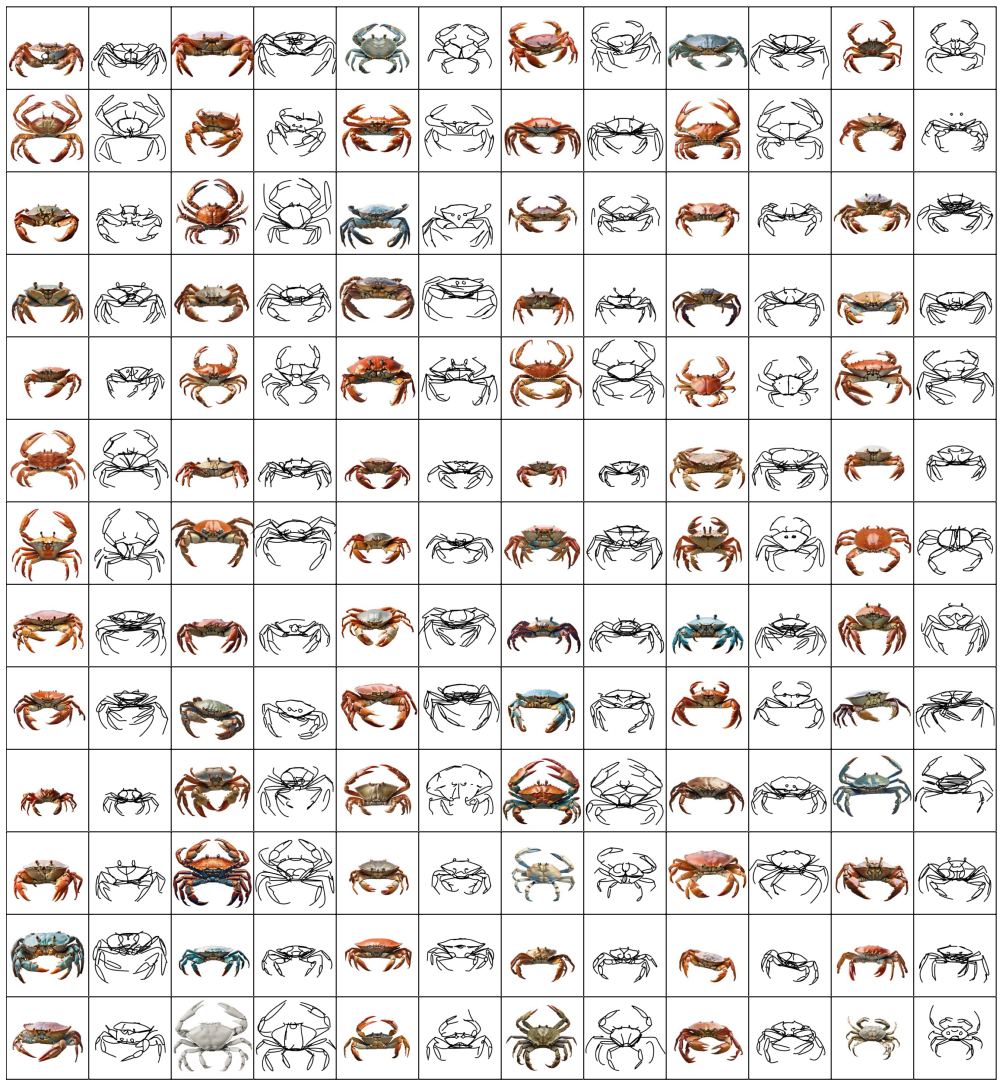
- The 35,000-pair ControlSketch dataset, covering 100 classes, is released and built by a fully automated pipeline, addressing the scarcity of professional-quality paired sketch data.
- The student's fidelity on seen categories tracks the teacher's, so the quality ceiling of the whole system is set by ControlSketch's optimization, not by the diffusion model.
Reading between the lines
- The paper's real contribution may be the distillation loop itself: the slow optimization teacher and fast diffusion student form a bootstrapping scheme that could be iterated by re-feeding student outputs into the teacher's data pool without human labor.
- The generalization gap, CLIP Top-1 of 0.70 on unseen synthetic categories versus 0.56 on real SketchyCOCO images, suggests the student has partly memorized the synthetic teacher's style; fine-tuning on a small set of real human sketches would test whether external recognition and style diversity recover.
- Because the model is trained only on masked single-object images at a fixed 32 strokes, extending training to variable stroke counts and scene-level inputs is a natural test of whether the denoising-in-coordinate-space formulation scales to other vector-generation tasks.
- Since the depth ControlNet is the main carrier of geometric fidelity in ControlSketch, improving the teacher, for example by swapping in different ControlNet condition types, should directly improve the student's output quality.
Editorial analysis
A structured set of objections, weighed in public.
Referee Report
Summary. The paper introduces SwiftSketch, a diffusion model that generates vector sketches by denoising stroke control points sampled from a Gaussian, conditioned on a frozen CLIP image embedding through a transformer decoder. To obtain training data, the authors introduce ControlSketch, an SDS-based optimization method augmented with a depth-aware ControlNet, and use it to synthesize over 35,000 image-sketch pairs across 100 classes. SwiftSketch is trained on 15 classes with a fixed stroke count of 32, produces sketches in about 0.5 seconds, and is compared against CLIPasso, Photo-Sketching, Chan et al., InstantStyle, and ControlSketch using CLIP recognition accuracy, MS-SSIM, and DreamSim. The paper claims high-quality, generalizable vector sketch generation in under a second.
Significance. The speed claim is credible and practically valuable: replacing a 5-10 minute optimization with a 0.5 second feed-forward pass, while retaining vector output, would make real-time interactive sketching feasible. The synthetic dataset pipeline is also a useful contribution, and the paper states that data and code will be released. However, the quality and generalization claims are not yet established to the standard required by the central contribution. The evaluation is largely self-referential, the perceptual study does not include SwiftSketch, and the external SketchyCOCO results show a substantial drop in recognition accuracy. These issues are fixable with additional experiments, but they currently limit the strength of the paper's main claim.
major comments (4)
- [Section 5.1, Table 1] The quality evaluation is self-referential. SwiftSketch is trained exclusively on ControlSketch-generated pairs (Sec. 4.2), and ControlSketch is described as 'the ground truth in our case' in Sec. 5.1. On the synthetic test sets, the main reference is therefore the output distribution SwiftSketch was trained to imitate. This establishes fidelity to the teacher but not independent sketch quality. The external SketchyCOCO numbers in Table 1 expose the fragility of the claim: SwiftSketch CLIP Top-1 drops from 0.95 on seen categories and 0.70 on unseen categories to 0.56 on SketchyCOCO, whereas ControlSketch drops only to 0.91. In addition, the recognition metric uses CLIP, which is also the conditioning encoder for SwiftSketch (Sec. 4.3), creating a common-mode bias. The paper should report a direct human evaluation of SwiftSketch outputs and validate ControlSketch quality independently, for example against human sketches or with a non-CLIP recognizer, before claiming that SwiftSketch approaches optimization-based quality in general.
- [Supplementary Sec. E] The only perceptual study compares ControlSketch with CLIPasso; SwiftSketch is not included. Since the central claim is that SwiftSketch produces high-quality sketches in real time, this study does not support that claim. A 2AFC or rating study that includes SwiftSketch, ideally on both synthetic and external real images, is needed to establish perceptual quality of the proposed method itself.
- [Abstract, Sec. 4.4, Sec. 5, Table 1] The claim that SwiftSketch 'generalizes across diverse concepts' is only partially supported. The model was trained on 15 classes, and Table 1 shows CLIP Top-1 of 0.70 on unseen categories of the same synthetic distribution and 0.56 on external SketchyCOCO images. Section 7 and Figure 10 acknowledge failure cases that are noisy or unrecognizable. The generalization claim should be scoped to the regime in which it is actually demonstrated, or the paper should provide additional evidence that the drop does not undermine the stated practical-usefulness claim.
- [Sec. 4.2, Supplementary Sec. A] The quality premise of the dataset is load-bearing but not rigorously validated. The supplementary states that 'all the sketches in our data were manually verified', but no protocol is given: no number of annotators, no criteria, no inter-annotator agreement, and no comparison with professional human sketch distributions. Because SwiftSketch inherits its entire output distribution from ControlSketch, the representativeness of ControlSketch as 'professional-quality' must be justified more concretely, for example by a user study comparing ControlSketch outputs with human sketches or by a quantitative style-distribution analysis.
minor comments (4)
- [Title and throughout] The title contains an erroneous space in 'V ector', and typos such as 'supplamentary' (Sec. 5.1), 'differnet' (Sec. 3), and 'sapmels' (Fig. 22 caption) should be corrected.
- [Figure 8] The caption says the stroke count is shown on top, but the visible labels '12s', '17s' read as times; please relabel the sequence to avoid confusion.
- [Sec. 4.4] The inference timing of approximately 0.5 seconds is reported without specifying the GPU and measurement protocol; please state the hardware and the number of runs averaged.
- [Sec. 5.1, Table 1] The sentence stating that Chan et al. and InstantStyle 'achieve the highest scores across most metrics' should be reconciled with Table 1, where no single method is best in every column; the claim is approximately true but should be phrased precisely.
Circularity Check
Quality evaluation is self-referential: SwiftSketch is trained on ControlSketch outputs and then measured against ControlSketch as 'ground truth,' with CLIP serving as both conditioner and metric; no human study rates SwiftSketch itself.
-
self definitional
[Section 5.1, paragraph after Table 1]
"The results show that SwiftSketch generalizes well to test set images from seen categories, as evidenced by its similar scores to ControlSketch (which serves as the ground truth in our case)."
The test set is drawn from the synthetic dataset constructed in Section 4.2 by running ControlSketch on SDXL-generated images, and SwiftSketch's training losses in Equation (5) directly minimize L1 distance and LPIPS distance to those same ControlSketch-generated sketches. Therefore 'similar scores to ControlSketch' is a restatement of the training objective, not an independent measurement of sketch quality. No human study evaluates SwiftSketch outputs; the only perceptual study in the paper (Section E) compares ControlSketch with CLIPasso, so the 'ground truth' designation makes the central quality claim reduce to the fit between a student and its own teacher.
-
other
[Section 5.1, Quantitative Evaluation; Section 4.3, SwiftSketch]
"Following common practice in the field, we use the CLIP zero-shot classifier [36] to assess class-level recognition, MS-SSIM [51] for image-sketch fidelity following the settings proposed in CLIPascene [46], and DreamSim [13]."
The main recognition metric is a CLIP zero-shot classifier, but the generator itself is conditioned on features extracted from a pretrained CLIP ResNet model ('The image I is processed using a pretrained CLIP ResNet model [36]... yielding the image embedding Ie', Section 4.3). High CLIP Top-1 scores on the synthetic test set can therefore reflect successful transfer of the conditioning feature vector into the rendered sketch rather than human recognizability of the drawing. The external SketchyCOCO results are consistent with this worry: SwiftSketch's CLIP Top-1 drops to 0.56 while ControlSketch retains 0.91 (Table 1), indicating that the score partly depends on the synthetic image distribution that the CLIP conditioning was trained on.
1 more flagged steps
-
other
[Section 5.1, user study; Section 8, Conclusions]
"To further highlight the advantages of ControlSketch over CLIPasso, we conduct a two-alternative forced-choice (2AFC) perceptual study with 40 participants... Participants rated sketches generated by ControlSketch as higher quality in 89% of cases."
The only human preference data in the paper rates ControlSketch, the method used to create SwiftSketch's training targets, and does not rate SwiftSketch at all. The paper then transfers this validation to SwiftSketch by claiming it 'produce[s] sketches that approach the quality of optimization-based techniques' (Section 5.1) and 'achiev[es] high-quality sketch generation' (Section 8). Because SwiftSketch's training objective is to reconstruct ControlSketch's output distribution, this quality inheritance is an assumption built into the training setup rather than a measured property of SwiftSketch's own outputs. A direct human evaluation of SwiftSketch, or an external benchmark that does not depend on the teacher-generated ground truth, would be needed to break this loop.
full rationale
The formal derivation chain is not mathematically circular: ControlSketch is an SDS-based optimizer, the synthetic dataset is generated from it, and SwiftSketch is trained with a standard conditional denoising objective (Eqs. 4-5). No equation is defined in terms of its own output, and the self-citations to CLIPasso and CLIPascene are ordinary prior-work references, not load-bearing uniqueness claims. The circularity is concentrated in the evaluation chain that supports the central 'high-quality' claim: (1) the benchmark is called 'the ground truth in our case' but is the same generator that produced the training data, making 'approaches ControlSketch quality' close to a restatement of Eq. (5)'s training loss; (2) the main recognition metric uses CLIP, the same feature family that conditions the generator, so high recognition scores can partly reflect conditioning-information leakage rather than independent human perception; and (3) the only human study validates the teacher (ControlSketch) rather than the student (SwiftSketch), so the student's quality is inherited by proxy. The speed claim (about 0.5 seconds) is well-supported and independent, and the SketchyCOCO external test provides a partial independent check, but that check shows a large drop (CLIP Top-1 0.56 for SwiftSketch vs 0.91 for ControlSketch), consistent with the self-referential training/evaluation loop. Overall, the central quality claim is only partially grounded independently, meriting a score of 6 rather than a full 8-10, because the fast-inference contribution and the external-data comparison still carry real content.
Assumptions & free parameters
free parameters (7)
- guidance scale s =
2.5
- LPIPS loss weight lambda =
0.2
- noise scheduler exponent =
0.4
- coordinate scaling factor =
2
- stroke count n =
32
- ControlNet conditioning scale =
1.5
- training classes count =
15 classes, 1000 samples each
assumptions (7)
- standard math Denoising diffusion probabilistic models (DDPM) can be applied to stroke coordinate spaces as well as pixels.
- domain assumption The SDS loss gradient, Eq. 3, provides a valid training signal to optimize Bezier stroke parameters toward a desired concept.
- domain assumption A depth-conditioned ControlNet, combined with SDS, provides sufficient spatial control for sketch generation.
- domain assumption CLIP image features from the fourth ResNet layer capture both geometric and semantic information needed for image-conditioned generation.
- domain assumption Perceptual and recognition metrics (CLIP zero-shot accuracy, MS-SSIM, DreamSim) are adequate proxies for sketch quality.
- domain assumption Existing human-drawn sketch datasets are amateur and professional datasets are too small, justifying a synthetic training set.
- standard math The differentiable rasterizer provides gradients suitable for both the SDS optimization in ControlSketch and the Lpoints/Lraster training losses.
Cite this review
Pith. "Pith review of SwiftSketch: A Diffusion Model for Image-to-Vector Sketch Generation." pith.science (2026). https://pith.science/paper/C6XNDRR7
@misc{pith2026250208642,
  author       = {Pith},
  title        = {Pith review of: SwiftSketch: A Diffusion Model for Image-to-Vector Sketch Generation},
  year         = {2026},
  howpublished = {\url{https://pith.science/paper/C6XNDRR7}},
  note         = {Machine review of arXiv:2502.08642}
}
read the original abstract
Recent advancements in large vision-language models have enabled highly expressive and diverse vector sketch generation. However, state-of-the-art methods rely on a time-consuming optimization process involving repeated feedback from a pretrained model to determine stroke placement. Consequently, despite producing impressive sketches, these methods are limited in practical applications. In this work, we introduce SwiftSketch, a diffusion model for image-conditioned vector sketch generation that can produce high-quality sketches in less than a second. SwiftSketch operates by progressively denoising stroke control points sampled from a Gaussian distribution. Its transformer-decoder architecture is designed to effectively handle the discrete nature of vector representation and capture the inherent global dependencies between strokes. To train SwiftSketch, we construct a synthetic dataset of image-sketch pairs, addressing the limitations of existing sketch datasets, which are often created by non-artists and lack professional quality. For generating these synthetic sketches, we introduce ControlSketch, a method that enhances SDS-based techniques by incorporating precise spatial control through a depth-aware ControlNet. We demonstrate that SwiftSketch generalizes across diverse concepts, efficiently producing sketches that combine high fidelity with a natural and visually appealing style.
Figures


Figures from the paper (39 more)




Forward citations
Cited by 1 Pith paper
-
Jodi: Unification of Visual Generation and Understanding via Joint Modeling
A single diffusion transformer with role-switch training performs joint generation, controllable generation, and multi-label perception across image and seven label domains.
Reference graph
Works this paper leans on
-
[1]
Contour detection and hierarchical image segmentation
Pablo Arbelaez, Michael Maire, Charless Fowlkes, and Ji- tendra Malik. Contour detection and hierarchical image segmentation. IEEE Trans. Pattern Anal. Mach. Intell. , 33(5):898–916, May 2011. 2
work page 2011
-
[2]
Modelling complex vector drawings with stroke-clouds
Alexander Ashcroft, Ayan Das, Yulia Gryaditskaya, Zhiyu Qu, and Yi-Zhe Song. Modelling complex vector drawings with stroke-clouds. In The Twelfth International Conference on Learning Representations, 2024. 3
work page 2024
-
[3]
Itamar Berger, Ariel Shamir, Moshe Mahler, Eliza- beth Jeanne Carter, and Jessica K. Hodgins. Style and ab- straction in portrait sketching. ACM Transactions on Graph- ics (TOG), 32:1 – 12, 2013. 2
work page 2013
-
[4]
Hospedales, Tao Xiang, Yulia Gryadit- skaya, and Yi-Zhe Song
Kumar Bhunia, Umar Ayan Das, Riaz Muhammad, Yongxin Yang, Timothy M. Hospedales, Tao Xiang, Yulia Gryadit- skaya, and Yi-Zhe Song. Edinburgh research explorer pix- elor: A competitive sketching ai agent. so you think you can sketch? 2020. 2
work page 2020
-
[5]
Midas v3.1 – a model zoo for robust monocular relative depth estimation,
Reiner Birkl, Diana Wofk, and Matthias M ¨uller. Midas v3.1 – a model zoo for robust monocular relative depth estimation,
-
[6]
Learning to generate line drawings that convey geometry and seman- tics
Caroline Chan, Fr ´edo Durand, and Phillip Isola. Learning to generate line drawings that convey geometry and seman- tics. 2022 IEEE/CVF Conference on Computer Vision and Pattern Recognition (CVPR), pages 7905–7915, 2022. 1, 2, 6, 7, 8, 4
work page 2022
-
[7]
Dif- fusiondet: Diffusion model for object detection
Shoufa Chen, Pei Sun, Yibing Song, and Ping Luo. Dif- fusiondet: Diffusion model for object detection. 2023 IEEE/CVF International Conference on Computer Vision (ICCV), pages 19773–19786, 2022. 3
work page 2023
-
[8]
Sketch- pix2seq: a model to generate sketches of multiple categories
Yajing Chen, Shikui Tu, Yuqi Yi, and Lei Xu. Sketch- pix2seq: a model to generate sketches of multiple categories. ArXiv, abs/1709.04121, 2017. 2
arXiv 2017
Show all 62 references
-
[9]
BRIA Background Removal v1.4 Model, 2025
Chenxwh. BRIA Background Removal v1.4 Model, 2025. 1
2025
-
[10]
How do humans sketch objects? ACM Transactions on Graphics (TOG), 31:1 – 10, 2012
Mathias Eitz, James Hays, and Marc Alexa. How do humans sketch objects? ACM Transactions on Graphics (TOG), 31:1 – 10, 2012. 2, 1
2012
-
[11]
Soros, and Olaf Witkowski
Kevin Frans, Lisa B. Soros, and Olaf Witkowski. Clipdraw: Exploring text-to-drawing synthesis through language-image encoders. ArXiv, abs/2106.14843, 2021. 2
2021 arXiv
-
[12]
Implicit style-content separation using b-lora,
Yarden Frenkel, Yael Vinker, Ariel Shamir, and Daniel Cohen-Or. Implicit style-content separation using b-lora,
-
[13]
Dream- sim: Learning new dimensions of human visual similarity using synthetic data
Stephanie Fu, Netanel Tamir, Shobhita Sundaram, Lucy Chai, Richard Zhang, Tali Dekel, and Phillip Isola. Dream- sim: Learning new dimensions of human visual similarity using synthetic data. InAdvances in Neural Information Pro- cessing Systems, volume 36, pages 50742–50768, 2023. 7
2023
-
[14]
Sketchycoco: Image generation from freehand scene sketches
Chengying Gao, Qi Liu, Qi Xu, Limin Wang, Jianzhuang Liu, and Changqing Zou. Sketchycoco: Image generation from freehand scene sketches. In 2020 IEEE/CVF Confer- ence on Computer Vision and Pattern Recognition (CVPR) , pages 5173–5182, 2020. 2, 7, 8, 1
2020
-
[15]
Pont, Fr´edo Durand, and Adrien Bousseau
Yulia Gryaditskaya, Mark Sypesteyn, Jan Willem Hoftijzer, Sylvia C. Pont, Fr´edo Durand, and Adrien Bousseau. Opens- ketch. ACM Transactions on Graphics (TOG) , 38:1 – 16,
-
[16]
A neural representation of sketch drawings
David Ha and Douglas Eck. A neural representation of sketch drawings. CoRR, abs/1704.03477, 2017. 2, 1
2017 arXiv
-
[17]
A generalist facex via learning unified facial 9 Figure 11
Yue Han, Jiangning Zhang, Junwei Zhu, Xiangtai Li, Yan- hao Ge, Wei Li, Chengjie Wang, Yong Liu, Xiaoming Liu, and Ying Tai. A generalist facex via learning unified facial 9 Figure 11. Sketches generated by SwiftSketch for seen categories, using input images not included in th...
2023 arXiv
-
[18]
Style aligned image generation via shared atten- tion
Amir Hertz, Andrey V oynov, Shlomi Fruchter, and Daniel Cohen-Or. Style aligned image generation via shared atten- tion. In 2024 IEEE/CVF Conference on Computer Vision and Pattern Recognition (CVPR), pages 4775–4785, 2024. 2
2024
-
[19]
Classifier-free diffusion guidance
Jonathan Ho. Classifier-free diffusion guidance. ArXiv, abs/2207.12598, 2022. 5
2022 arXiv
-
[20]
Denoising diffu- sion probabilistic models
Jonathan Ho, Ajay Jain, and Pieter Abbeel. Denoising diffu- sion probabilistic models. In Proceedings of the 34th Inter- national Conference on Neural Information Processing Sys- tems, NIPS ’20, Red Hook, NY , USA, 2020. Curran Asso- ciates Inc. 3
2020
-
[21]
Rehg, and Varun Jampani
Zixuan Huang, Mark Boss, Aaryaman Vasishta, James M. Rehg, and Varun Jampani. Spar3d: Stable point-aware re- construction of 3d objects from single images. 2025. 3
2025
-
[22]
Vectorfusion: Text-to-svg by abstracting pixel-based diffusion models
Ajay Jain, Amber Xie, and Pieter Abbeel. Vectorfusion: Text-to-svg by abstracting pixel-based diffusion models. arXiv, 2022. 3
2022
-
[23]
Synthesizing human- like sketches from natural images using a conditional convo- lutional decoder
Moritz Kampelm ¨uhler and Axel Pinz. Synthesizing human- like sketches from natural images using a conditional convo- lutional decoder. 2020 IEEE Winter Conference on Applica- tions of Computer Vision (WACV), pages 3192–3200, 2020. 2
2020
-
[24]
Blip-2: Bootstrapping language-image pre-training with frozen image encoders and large language models, 2023
Junnan Li, Dongxu Li, Silvio Savarese, and Steven Hoi. Blip-2: Bootstrapping language-image pre-training with frozen image encoders and large language models, 2023. 3, 1
2023
-
[25]
Lin, Radom ´ır Mˇech, Ersin Yumer, and Deva Ramanan
Mengtian Li, Zhe L. Lin, Radom ´ır Mˇech, Ersin Yumer, and Deva Ramanan. Photo-sketching: Inferring contour draw- ings from images. 2019 IEEE Winter Conference on Ap- plications of Computer Vision (WACV) , pages 1403–1412,
2019
-
[26]
Differentiable vector graphics rasterization for editing and learning
Tzu-Mao Li, Michal Luk ´ac, Micha ¨el Gharbi, and Jonathan Ragan-Kelley. Differentiable vector graphics rasterization for editing and learning. ACM Transactions on Graphics (TOG), 39:1 – 15, 2020. 3, 4
2020
-
[27]
Hangyu Lin, Yanwei Fu, Yu-Gang Jiang, and X. Xue. Sketch-bert: Learning sketch bidirectional encoder repre- sentation from transformers by self-supervised learning of sketch gestalt. 2020 IEEE/CVF Conference on Computer Vision and Pattern Recognition (CVPR) , pages 6757–6766,
2020
-
[28]
Neural strokes: Stylized line drawing of 3d shapes
Difan Liu, Matthew Fisher, Aaron Hertzmann, and Evange- los Kalogerakis. Neural strokes: Stylized line drawing of 3d shapes. In Proceedings of the IEEE/CVF International Conference on Computer Vision, 2021. 2
2021
-
[29]
Diffusion probabilistic models for 3d point cloud generation
Shitong Luo and Wei Hu. Diffusion probabilistic models for 3d point cloud generation. 2021 IEEE/CVF Conference on Computer Vision and Pattern Recognition (CVPR), pages 2836–2844, 2021. 2, 3
2021
-
[30]
Hospedales
Umar Riaz Muhammad, Yongxin Yang, Yi-Zhe Song, Tao Xiang, and Timothy M. Hospedales. Learning deep sketch abstraction. 2018 IEEE/CVF Conference on Computer Vi- sion and Pattern Recognition, pages 8014–8023, 2018. 2
2018
-
[31]
Kushin Mukherjee, Holly Huey, Xuanchen Lu, Yael Vinker, Rio Aguina-Kang, Ariel Shamir, and Judith E. Fan. Seva: Leveraging sketches to evaluate alignment between human and machine visual abstraction. ArXiv, abs/2312.03035,
-
[32]
Improved denoising dif- fusion probabilistic models
Alex Nichol and Prafulla Dhariwal. Improved denoising dif- fusion probabilistic models. ArXiv, abs/2102.09672, 2021. 6, 4
2021 arXiv
-
[33]
Sdxl: Improving latent diffusion models for high-resolution image synthesis, 2023
Dustin Podell, Zion English, Kyle Lacey, Andreas Blattmann, Tim Dockhorn, Jonas M ¨uller, Joe Penna, and Robin Rombach. Sdxl: Improving latent diffusion models for high-resolution image synthesis, 2023. 2, 4, 6, 1
2023
-
[34]
Barron, and Ben Milden- hall
Ben Poole, Ajay Jain, Jonathan T. Barron, and Ben Milden- hall. Dreamfusion: Text-to-3d using 2d diffusion. ArXiv, abs/2209.14988, 2022. 2, 3
2022 arXiv
-
[35]
Sketchlattice: Latticed rep- resentation for sketch manipulation
Yonggang Qi, Guoyao Su, Pinaki Nath Chowdhury, Mingkang Li, and Yi-Zhe Song. Sketchlattice: Latticed rep- resentation for sketch manipulation. 2021 IEEE/CVF In- ternational Conference on Computer Vision (ICCV) , pages 933–941, 2021. 2
2021
-
[36]
Learning transferable vi- sual models from natural language supervision
Alec Radford, Jong Wook Kim, Chris Hallacy, Aditya Ramesh, Gabriel Goh, Sandhini Agarwal, Girish Sastry, Amanda Askell, Pamela Mishkin, Jack Clark, Gretchen Krueger, and Ilya Sutskever. Learning transferable vi- sual models from natural language supervision. CoRR, abs/2103.000...
2021 arXiv
-
[37]
Collomosse, and Moacir Antonelli Ponti
Leo Sampaio Ferraz Ribeiro, Tu Bui, John P. Collomosse, and Moacir Antonelli Ponti. Sketchformer: Transformer- based representation for sketched structure. 2020 IEEE/CVF Conference on Computer Vision and Pattern Recognition (CVPR), pages 14141–14150, 2020. 2
2020
-
[38]
High-resolution image syn- thesis with latent diffusion models, 2022
Robin Rombach, Andreas Blattmann, Dominik Lorenz, Patrick Esser, and Bj¨orn Ommer. High-resolution image syn- thesis with latent diffusion models, 2022. 3
2022
-
[39]
Photorealistic text-to-image diffusion models with deep language understanding
Chitwan Saharia, William Chan, Saurabh Saxena, Lala Li, Jay Whang, Emily L Denton, Kamyar Ghasemipour, Raphael Gontijo Lopes, Burcu Karagol Ayan, Tim Salimans, et al. Photorealistic text-to-image diffusion models with deep language understanding. Advances in Neural Information...
2022
-
[40]
The sketchy database: learning to retrieve badly drawn bunnies
Patsorn Sangkloy, Nathan Burnell, Cusuh Ham, and James Hays. The sketchy database: learning to retrieve badly drawn bunnies. ACM Trans. Graph., 35(4), July 2016. 2
2016
-
[41]
Denois- ing diffusion implicit models
Jiaming Song, Chenlin Meng, and Stefano Ermon. Denois- ing diffusion implicit models. In International Conference on Learning Representations, 2021. 3
2021
-
[42]
Hospedales
Jifei Song, Kaiyue Pang, Yi-Zhe Song, Tao Xiang, and Tim- othy M. Hospedales. Learning to sketch with shortcut cycle consistency. 2018 IEEE/CVF Conference on Computer Vi- sion and Pattern Recognition, pages 801–810, 2018. 2
2018
-
[43]
Human motion diffu- sion model
Guy Tevet, Sigal Raab, Brian Gordon, Yoni Shafir, Daniel Cohen-or, and Amit Haim Bermano. Human motion diffu- sion model. In The Eleventh International Conference on Learning Representations, 2023. 2, 3
2023
-
[44]
Vecfusion: Vector font generation with diffusion
Vikas Thamizharasan, Difan Liu, Shantanu Agarwal, Matthew Fisher, Michael Gharbi, Oliver Wang, Alec Jacob- son, and Evangelos Kalogerakis. Vecfusion: Vector font generation with diffusion. In Proceedings of the IEEE/CVF Conference on Computer Vision and Pattern Recognition (CV...
2024
-
[45]
Balasub- ramanian
Varshaneya V , Balasubramanian S, and Vineeth N. Balasub- ramanian. Teaching gans to sketch in vector format. Pro- ceedings of the Twelfth Indian Conference on Computer Vi- sion, Graphics and Image Processing, 2019. 2
2019
-
[46]
Clipascene: Scene sketching with different types and levels of abstraction
Yael Vinker, Yuval Alaluf, Daniel Cohen-Or, and Ariel Shamir. Clipascene: Scene sketching with different types and levels of abstraction. 2023 IEEE/CVF International Conference on Computer Vision (ICCV), pages 4123–4133,
2023
-
[47]
Bo, Ro- man Christian Bachmann, Amit Haim Bermano, Daniel Cohen-Or, Amir Zamir, and Ariel Shamir
Yael Vinker, Ehsan Pajouheshgar, Jessica Y . Bo, Ro- man Christian Bachmann, Amit Haim Bermano, Daniel Cohen-Or, Amir Zamir, and Ariel Shamir. Clipasso: Semantically-aware object sketching. ACM Trans. Graph., 41(4), jul 2022. 1, 2, 3, 4, 6, 7, 8, 11
2022
-
[48]
Instantstyle: Free lunch to- wards style-preserving in text-to-image generation
Haofan Wang, Matteo Spinelli, Qixun Wang, Xu Bai, Zekui Qin, and Anthony Chen. Instantstyle: Free lunch to- wards style-preserving in text-to-image generation. ArXiv, abs/2404.02733, 2024. 2, 6, 7, 8, 4
2024 arXiv
-
[49]
Sketchknitter: Vectorized sketch generation with dif- fusion models
Qiang Wang, Haoge Deng, Yonggang Qi, Da Li, and Yi-Zhe Song. Sketchknitter: Vectorized sketch generation with dif- fusion models. In The Eleventh International Conference on Learning Representations, 2023. 2, 3
2023
-
[50]
Tracing versus free- hand for evaluating computer-generated drawings
Zeyu Wang, Sherry Qiu, Nicole Feng, Holly Rushmeier, Leonard McMillan, and Julie Dorsey. Tracing versus free- hand for evaluating computer-generated drawings. ACM Trans. Graph., 40(4), Aug. 2021. 2
2021
-
[51]
Multi- scale structural similarity for image quality assessment
Zhou Wang, Eero P Simoncelli, and Alan C Bovik. Multi- scale structural similarity for image quality assessment. In The Thrity-Seventh Asilomar Conference on Signals, Sys- tems & Computers, 2003, volume 2, pages 1398–1402. Ieee,
2003
-
[52]
Xdog: advanced image stylization with extended difference-of-gaussians
Holger Winnem ¨oller. Xdog: advanced image stylization with extended difference-of-gaussians. In International Sympo- sium on Non-Photorealistic Animation and Rendering, 2011. 7
2011
-
[53]
Differsketching: How differently do people sketch 3d objects?ACM Transactions on Graphics (Proceedings of ACM SIGGRAPH Asia 2022) , 41(4):1–16,
Chufeng Xiao, Wanchao Su, Jing Liao, Zhouhui Lian, Yi- 12 Zhe Song, and Hongbo Fu. Differsketching: How differently do people sketch 3d objects?ACM Transactions on Graphics (Proceedings of ACM SIGGRAPH Asia 2022) , 41(4):1–16,
2022
-
[54]
Diffsketcher: Text guided vec- tor sketch synthesis through latent diffusion models
Ximing Xing, Chuan Wang, Haitao Zhou, Jing Zhang, Qian Yu, and Dong Xu. Diffsketcher: Text guided vec- tor sketch synthesis through latent diffusion models. ArXiv, abs/2306.14685, 2023. 2, 3
2023 arXiv
-
[55]
Svgdreamer: Text guided svg gener- ation with diffusion model
Ximing Xing, Haitao Zhou, Chuang Wang, Jing Zhang, Dong Xu, and Qian Yu. Svgdreamer: Text guided svg gener- ation with diffusion model. In Proceedings of the IEEE/CVF Conference on Computer Vision and Pattern Recognition (CVPR), pages 4546–4555, June 2024. 1, 3
2024
-
[56]
Hospedales, Qiyue Yin, Yi-Zhe Song, Tao Xiang, and Liang Wang
Peng Xu, Timothy M. Hospedales, Qiyue Yin, Yi-Zhe Song, Tao Xiang, and Liang Wang. Deep learning for free-hand sketch: A survey and a toolbox, 2020. 1, 2
2020
-
[57]
Vision-language models for vision tasks: A survey, 2024
Jingyi Zhang, Jiaxing Huang, Sheng Jin, and Shijian Lu. Vision-language models for vision tasks: A survey, 2024. 1
2024
-
[58]
Adding conditional control to text-to-image diffusion models
Lvmin Zhang, Anyi Rao, and Maneesh Agrawala. Adding conditional control to text-to-image diffusion models. 2023 IEEE/CVF International Conference on Computer Vision (ICCV), pages 3813–3824, 2023. 2, 4, 1
2023
-
[59]
The unreasonable effectiveness of deep features as a perceptual metric
Richard Zhang, Phillip Isola, Alexei A Efros, Eli Shechtman, and Oliver Wang. The unreasonable effectiveness of deep features as a perceptual metric. In CVPR, 2018. 5
2018
-
[60]
Learning to doodle with stroke demonstrations and deep q-networks
Tao Zhou, Chen Fang, Zhaowen Wang, Jimei Yang, Byung- moon Kim, Zhili Chen, Jonathan Brandt, and Demetri Ter- zopoulos. Learning to doodle with stroke demonstrations and deep q-networks. In British Machine Vision Conference,
-
[62]
A highly detailed wide- shot image of one < c >, set against a plain mesmerizing background. Center
with the following prompt: “A highly detailed wide- shot image of one < c >, set against a plain mesmerizing background. Center. ”, where c is the class label. Addition- ally, a negative prompt,“close up, few, multiple, ”is applied to ensure images depict a single object in a ...
2000
-
[2018]
An example from the ControlSketch dataset, which includes the input image, object mask, attention map, and the cor- responding sketch generated using ControlSketch
2 13 SwiftSketch: A Diffusion Model for Image-to-V ector Sketch Generation Supplementary Material Image Mask Attention Sketch Figure 15. An example from the ControlSketch dataset, which includes the input image, object mask, attention map, and the cor- responding sketch genera...
Reviewed August 7, 2026 · model on record in the stance chip above.
Discussion (0). Continue with ORCID to comment.