REVIEW 3 major objections 2 minor 47 references
Revising price coordination in the classical and neoclassical economics based on elementary cellular automata
T0 review · 3 major / 2 minor · reviewed 2026-07-02 · grok-4.3
Pith's one-line read Elementary cellular automata simulations indicate that classical economics supports stable price coordination through logical interactions while neoclassical economics does not.
desk verdict The ECA rule-to-theory mapping is arbitrary and unvalidated, so the simulations do not establish any real distinction between classical and neoclassical price coordination. read the letter →
The pith
A machine-rendered reading of the paper's core claim, the machinery that carries it, and where it could break.
The reading
What carries the argument
Elementary cellular automata rules representing price interactions, where classical rules incorporate logical choices based on objective data and neoclassical rules do not.
What would settle it
A simulation where neoclassical rules generate stable, statistically significant price coordination patterns similar to classical ones would challenge the paper's distinction between the two approaches.
Extended reading notes
Core claim
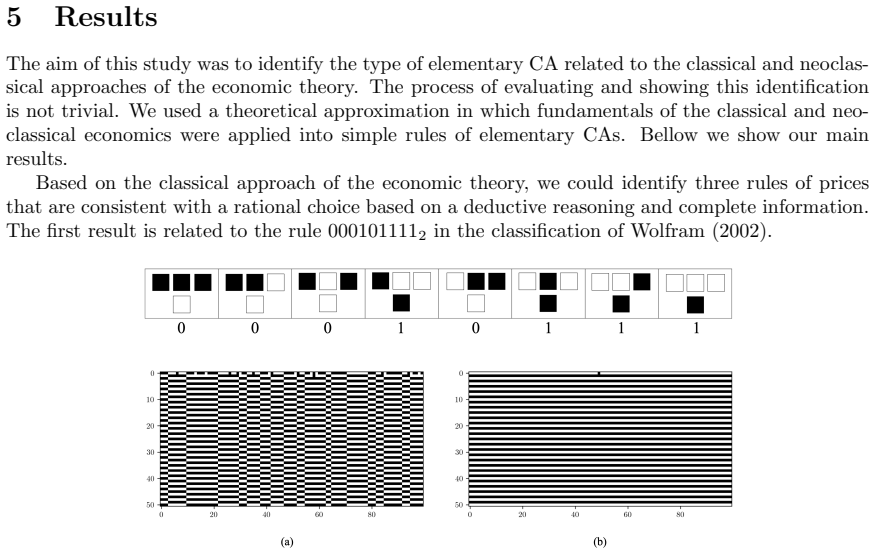
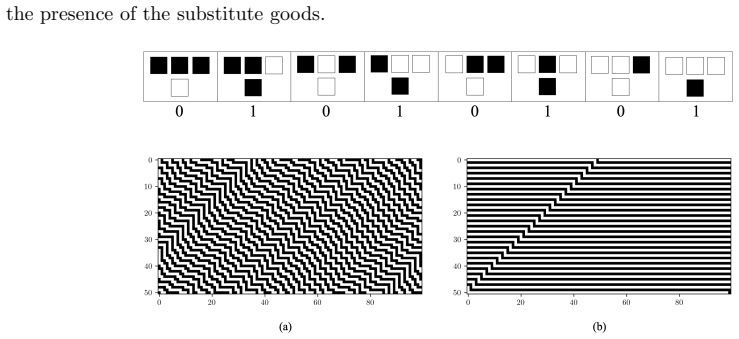
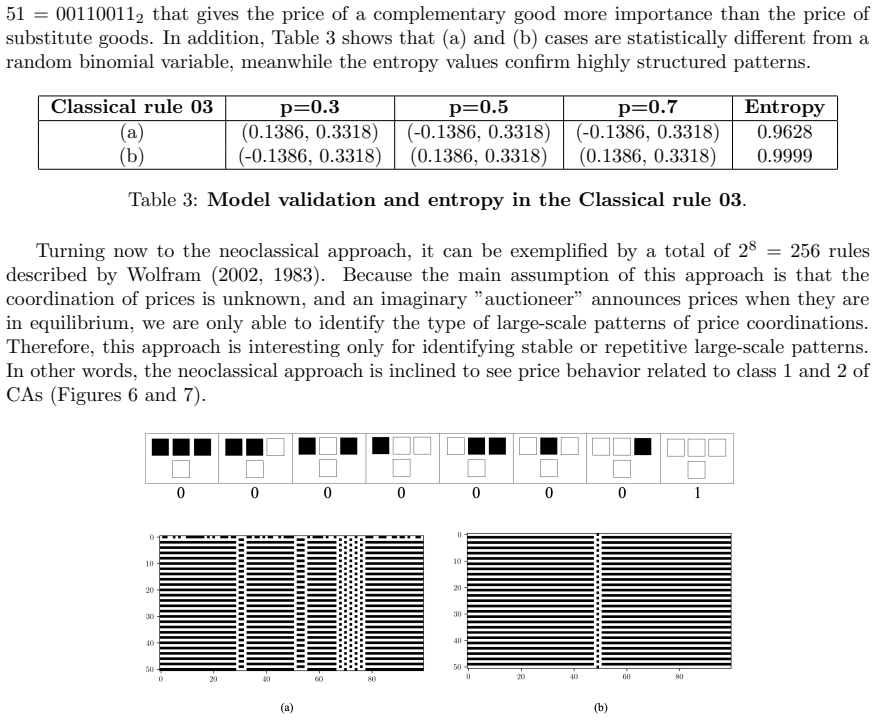
By modeling economic theory with elementary cellular automata, simple rules of price interactions generate stable patterns under classical economics and unstable or absent coordination under neoclassical economics, revealing that classical theory emphasizes logical human interactions while neoclassical treats price coordination as an unpredictable event without mechanism.
Load-bearing premise
The specific elementary cellular automata rules chosen are assumed to accurately capture the essential differences between classical and neoclassical approaches to price coordination.
Editorial extensions
If this is right
- Classical economics can be modeled to produce consistent market-clearing price patterns via agent interactions.
- Neoclassical economics lacks a proposed mechanism for price coordination in this framework.
- Shannon entropy can quantify the uncertainty and stability of generated price coordination patterns.
- Monte Carlo simulations with Spearman correlation can evaluate the statistical significance of price coordination in these models.
Reading between the lines
- The approach could be applied to test other economic theories for their coordination mechanisms.
- If the rule mappings are accurate, neoclassical models might require additional components to explain price formation.
- Simple local interaction rules in automata can lead to global economic coordination behaviors.
Signed reviews
Editorial analysis
A structured set of objections, weighed in public.
Referee Report
Summary. The paper claims that elementary cellular automata (ECA) can model price coordination mechanisms in classical versus neoclassical economics. Using Shannon entropy to quantify uncertainty in generated patterns and Monte Carlo Spearman correlations for statistical significance, the simulations are said to show that classical economics produces consistent, low-entropy coordination patterns reflecting logical human interactions with objective data, while neoclassical economics yields unstable patterns with no intrinsic coordination mechanism, leaving the individual as a passive recipient of unpredictable prices.
Significance. If a non-arbitrary mapping from economic primitives to ECA rules could be established, the approach might supply a computational testbed for comparing coordination claims across economic schools. The use of entropy measures and Monte Carlo tests on pattern stability is a reasonable exploratory step, but the current absence of any derivation or validation for the rule-to-theory encoding prevents the results from bearing on the stated theoretical distinction.
major comments (3)
- [Methodology / model construction] The central claim requires that chosen ECA update rules faithfully encode the paper's stated distinction (classical as 'human interactions based on logical choices related to an objective data' versus neoclassical as having 'no type of mechanism'). No section derives the rule-to-mechanism mapping from economic primitives (e.g., supply-demand logic or agent optimization) or tests robustness against alternative plausible mappings. Without that link, entropy differences are artifacts of rule selection rather than evidence for the economic conclusion.
- [Simulation setup and results] The abstract and results state conclusions from simulations and statistical tests but supply no description of rule selection, initial conditions, lattice size, number of steps, or how the two economic schools are encoded in the automata. This omission makes it impossible to assess whether the reported entropy and Spearman outcomes support the comparative claim.
- [Discussion and conclusions] The interpretive conclusion that 'the neoclassical individual is just a spectator' appears to be an overlay placed on the simulation outputs rather than generated by the automata rules themselves; the paper does not demonstrate that the instability is a necessary consequence of the neoclassical formulation rather than a property of the particular rules chosen.
minor comments (2)
- [Abstract] Abstract contains spelling/usage issues: 'escenarios' should be 'scenarios'; 'believes' should be 'beliefs'.
- [Methods] Notation for the ECA rules and entropy calculations is not defined explicitly before use in the statistical sections.
Simulated Author's Rebuttal
We thank the referee for the constructive comments. The feedback identifies key areas where the manuscript requires greater transparency in model construction, simulation parameters, and interpretive framing. We respond to each major comment below.
read point-by-point responses
-
Referee: [Methodology / model construction] The central claim requires that chosen ECA update rules faithfully encode the paper's stated distinction (classical as 'human interactions based on logical choices related to an objective data' versus neoclassical as having 'no type of mechanism'). No section derives the rule-to-mechanism mapping from economic primitives (e.g., supply-demand logic or agent optimization) or tests robustness against alternative plausible mappings. Without that link, entropy differences are artifacts of rule selection rather than evidence for the economic conclusion.
Authors: We agree that the manuscript does not derive the ECA rules from formal economic primitives such as supply-demand equations or optimization. The rules were selected on conceptual grounds to capture interactive logical choices versus absence of mechanism. This remains an exploratory mapping. In revision we will add an explicit subsection justifying each rule choice from the theoretical descriptions in the paper and will discuss the exploratory status together with possible alternative mappings. revision: yes
-
Referee: [Simulation setup and results] The abstract and results state conclusions from simulations and statistical tests but supply no description of rule selection, initial conditions, lattice size, number of steps, or how the two economic schools are encoded in the automata. This omission makes it impossible to assess whether the reported entropy and Spearman outcomes support the comparative claim.
Authors: The original text omitted these parameters. We will expand the methods section to report the specific ECA rules (Wolfram numbers), initial conditions, lattice sizes, time steps, and the precise encoding of classical versus neoclassical behavior so that the entropy and correlation results can be evaluated and replicated. revision: yes
-
Referee: [Discussion and conclusions] The interpretive conclusion that 'the neoclassical individual is just a spectator' appears to be an overlay placed on the simulation outputs rather than generated by the automata rules themselves; the paper does not demonstrate that the instability is a necessary consequence of the neoclassical formulation rather than a property of the particular rules chosen.
Authors: The conclusion is interpretive and links observed instability to the chosen encoding of a missing coordination mechanism. We will revise the discussion to show how the instability follows from the absence of local interaction rules in the neoclassical encoding and will explicitly note the limitation that other encodings could produce different behavior. revision: partial
Circularity Check
ECA rule assignment to economic theories is definitional; stability/entropy differences follow by construction from the chosen mapping
-
self definitional
[Abstract (model setup and findings paragraph)]
"we propose to use this type of cellular automata for explaining different escenarios of price coordination in which simple rules of price interactions generate stable and unstable patterns of coordination. ... Findings suggested that the classical economics provides a consistent approach for understanding the coordination of prices because it emphasizes human interactions based on logical choices related to an objective data. On the other hand, the neoclassical approach does not propose any type of mechanism for describing the price coordination."
The rules are stipulated to embody the very distinction (logical objective-data interactions vs. no mechanism) that the entropy results are then said to 'suggest' or 'reveal.' The output patterns inherit their economic interpretation solely from the input labeling; the statistical tests therefore confirm the modeling premise rather than test an independent claim.
full rationale
The paper selects specific elementary cellular automata rules to stand for 'classical' (logical human interactions on objective data) versus 'neoclassical' (no mechanism, spectator) price coordination, then runs Shannon entropy and Monte Carlo Spearman tests on the generated patterns. The central finding—that classical yields consistent coordination while neoclassical does not—directly restates the interpretive labels attached to the rules at input. No section derives the rule-to-mechanism correspondence from economic primitives or validates it against alternatives; the conclusion is therefore the modeling choice restated in simulation language.
Assumptions & free parameters
assumptions (2)
- standard math Shannon entropy quantifies uncertainty in generated coordination patterns
- standard math Monte Carlo simulation with Spearman correlation can evaluate statistical significance of coordination
Cite this review
Pith. "Pith review of Revising price coordination in the classical and neoclassical economics based on elementary cellular automata." pith.science (2026). https://pith.science/paper/C7SDDOZG
@misc{pith2026260700050,
  author       = {Pith},
  title        = {Pith review of: Revising price coordination in the classical and neoclassical economics based on elementary cellular automata},
  year         = {2026},
  howpublished = {\url{https://pith.science/paper/C7SDDOZG}},
  note         = {Machine review of arXiv:2607.00050}
}
read the original abstract
The coordination of prices in economics is one of the most complex phenomena. In particular, the classical and neoclassical approaches related to the economic theory provide some insights into such a complex coordination based on different formulations. However, these formulations have not been successful for explaining simple mechanisms to understand and predict a set of prices that theoretically clears all markets. Consequently, elementary cellular automata can contribute to clarify such a coordination problem by using simple computational rules to describe the theoretical bases of the classical and neoclassical economics. Therefore, we propose to use this type of cellular automata for explaining different escenarios of price coordination in which simple rules of price interactions generate stable and unstable patterns of coordination. We used an explorative data analysis based on the Shannon entropy for computing the uncertainty related to such generated patterns of coordination, and a Monte Carlo simulation approximation based on a Spearman correlation for evaluating the statistical significance of such price coordination. Findings suggested that the classical economics provides a consistent approach for understanding the coordination of prices because it emphasizes human interactions based on logical choices related to an objective data. On the other hand, the neoclassical approach does not propose any type of mechanism for describing the price coordination. The neoclassical individual is just a spectator and receiver of the unpredictable and supposed event of price coordination. As a result, by modeling the economic theory based on computational concepts, we reveal facts and believes behind the classical and neoclassical economics.
Figures


Figures from the paper (5 more)



Reference graph
Works this paper leans on
-
[1]
Barabási, AL. (2012), The network takeover. Nature Phys 8, 14--16. https://doi.org/10.1038/nphys2188 https://doi.org/10.1038/nphys2188
-
[2]
von Neumann, J. (1963), The General and Logical Theory of Automata, in J.von Neumann, "Collected Works" (ed. A.H.Taub), Vol. 5, p.288--328, https://www.vordenker.de/ggphilosophy/jvn\_the-general-and-logical-theory-of-automata.pdf https://www.vordenker.de/ggphilosophy/jvn_the-general-and-logical-theory-of-automata.pdf
work page 1963
-
[3]
(1966), Theory of Self-Reproducing Automata, (ed
von Neumann, J. (1966), Theory of Self-Reproducing Automata, (ed. A.W.Burks), Univ. of Illinois press (1966). https://cba.mit.edu/events/03.11.ASE/docs/VonNeumann.pdf https://cba.mit.edu/events/03.11.ASE/docs/VonNeumann.pdf
work page 1966
-
[4]
(1970), Essays on Cellular Automata, ed
von Neumann, J. (1970), Essays on Cellular Automata, ed. A.W.Burks, Univ. of Illinois press,
work page 1970
-
[5]
(2002), A New Kind of Science, Wolfram Media, Inc
Wolfram, S. (2002), A New Kind of Science, Wolfram Media, Inc
work page 2002
-
[6]
Wolfram, S. (2020). A Class of Models with the Potential to Represent Fundamental Physics, Complex Systems, 29(2), 2020 pp. 107--536. https://doi.org/10.25088/ComplexSystems.29.2.107 https://doi.org/10.25088/ComplexSystems.29.2.107
-
[7]
Turing, A. M. (1952), The chemical basis of morphogenesis, Philos. Trans. R. Soc. London, Ser. B 237, 37
work page 1952
-
[8]
and Prigogine, I., (1977), Self-Organization in Nonequilibrium Systems (Wiley, New York)
Nicolis, G. and Prigogine, I., (1977), Self-Organization in Nonequilibrium Systems (Wiley, New York)
work page 1977
Show all 47 references
-
[9]
Hegselmann, R. (1996). Cellular Automata in the Social Sciences. In: Hegselmann, R., Mueller, U., Troitzsch, K.G. (eds) Modelling and Simulation in the Social Sciences from the Philosophy of Science Point of View. Theory and Decision Library, vol 23. Springer, Dordrecht. https...
1996 doi
-
[10]
Lugo, I., Alatriste-Contreras, M.G. (2022). Intervention strategies with 2D cellular automata for testing SARS-CoV-2 and reopening the economy. Sci Rep 12, 13481. https://doi.org/10.1038/s41598-022-17665-3 https://doi.org/10.1038/s41598-022-17665-3
2022 doi
-
[11]
Lugo, I., Alatriste-Contreras, M.G. (2022). The personal space and the collective behavior of crowd disasters, BioRxive: https://doi.org/10.1101/2024.09.05.611443 https://www.biorxiv.org/content/10.1101/2024.09.05.611443v2
2022 doi
-
[12]
(1984), The Evolution of Cooperation
Axelrod, R. (1984), The Evolution of Cooperation. New York: Basic Books
1984
-
[13]
Krugman, P. (2022). The Self Organizing Economy. Wiley-Blackwell
2022
-
[14]
Shannon, C. (1948). A Mathematical Theory of Communication. Bell System Technical Journal 27(3)
1948
-
[15]
and Peng, R.D
Leek, J.T. and Peng, R.D. (2015),What is the question?Science, 347,1314--1315(2015). doi:10.1126/science.aaa6146 https://www.science.org/doi/10.1126/science.aaa6146
2015 doi
-
[16]
and Graves, G.R
Gotelli, N.J. and Graves, G.R. (1996) Null Models in Ecology. Smithsonian Institution Press, Washington, DC, USA
1996
-
[17]
Farine, D.R. (2017), A guide to null models for animal social network analysis, Methods in Ecology and Evolution 8, 1309--1320, https://doi.org/10.1111/2041-210X.12772 https://doi.org/10.1111/2041-210X.12772
2017 doi
-
[18]
and Zamagni, S
Becchetti, L., Bruni, L. and Zamagni, S. (2020). Chapter 1 - Economics: What it studies, with what methods, and how it evolved, The Microeconomics of Wellbeing and Sustainability, Academic Press, pages 1--49
2020
-
[19]
(2016), Complexity and the Art of Public Policy: Solving Society's Problems from the Bottom Up, Princeton University Press
Colander, D, and Kupers, R. (2016), Complexity and the Art of Public Policy: Solving Society's Problems from the Bottom Up, Princeton University Press
2016
-
[20]
Smith, A.(1756), The Theory of Moral Sentiments, London: A. Miller
-
[21]
Smith, A.(1776), The Wealth of Nations, London: A. Miller
-
[22]
(1848), Principles of Political Economy, London: Longmans, Green
Mill, J.S. (1848), Principles of Political Economy, London: Longmans, Green
-
[23]
(1890), Principles of Economics
Marshall, A. (1890), Principles of Economics. 9th edition. London Macmillan
-
[24]
(1920), The Economics of Welfare London, Reprint
Pigou, A.C. (1920), The Economics of Welfare London, Reprint. New Brunswick, N.J.: Transaction
1920
-
[25]
Rouge Editeur, Librairie de l'Universite http://digamo.free.fr/walras96.pdf
Walras, L (1896), Éléments d'économie politique pure; ou, Théorie de la richesse sociale, Lausanne, F. Rouge Editeur, Librairie de l'Universite http://digamo.free.fr/walras96.pdf
-
[26]
(1909), Manual of Political Economy: A Critical and Variorum Edition, Oxford University Press
Pareto, V. (1909), Manual of Political Economy: A Critical and Variorum Edition, Oxford University Press
1909
-
[27]
(1951) An extension of the basic theorems of classical welfare economics, Proceedings of the Second Berkeley Symposium on Mathemalical Statisties and Probability, ed J
Arrow, K.J. (1951) An extension of the basic theorems of classical welfare economics, Proceedings of the Second Berkeley Symposium on Mathemalical Statisties and Probability, ed J. Neyman, University of California Press, 507--532
1951
-
[28]
Econometrica 19, 273--92
Debreu, G (1951), The coefficient of resource utilization. Econometrica 19, 273--92
1951
-
[29]
Frege, G. (1879), Begriflsschriit, a formula language, modeled upon that of arithmetic, for pure thought https://dn720006.ca.archive.org/0/items/gottlob-frege-begriffsschrift-english/Gottlob\
-
[30]
(2014), Computational Logic, in Computational Logic edited by Jörg H
Siekmann, J. (2014), Computational Logic, in Computational Logic edited by Jörg H. Siekmann, North Holland publications, pp: 15--30 https://www.sciencedirect.com/science/chapter/handbook/abs/pii/B9780444516244500010
2014
-
[31]
(2010), Complex Economics, Individual and Collective Rationality, London, Routledge
Kirman, A. (2010), Complex Economics, Individual and Collective Rationality, London, Routledge
2010
-
[32]
and Kirman, A
Wilson, D. and Kirman, A. (2016), Complexity and Evolution: Toward a New Synthesis for Economics, Cambridge, MA, The MIT Press
2016
-
[33]
(2007) Matplotlib: A 2D Graphics Environment, Computing in Science & Engineering, vol
Hunter, J.D. (2007) Matplotlib: A 2D Graphics Environment, Computing in Science & Engineering, vol. 9, no. 3, pp. 90--95
2007
-
[34]
Harris, C.R., Millman, K.J., van der Walt, S.J. et al. (2020), Array programming with NumPy. Nature 585, 357--362 (2020). DOI: 10.1038/s41586-020-2649-2
2020 doi
-
[35]
Promoting an open research culture
Nosek BA, Alter G, Banks GC, Borsboom D, Bowman SD, Breckler SJ, Buck S, Chambers CD, Chin G, Christensen G, Contestabile M, Dafoe A, Eich E, Freese J, Glennerster R, Goroff D, Green DP, Hesse B, Humphreys M, Ishiyama J, Karlan D, Kraut A, Lupia A, Mabry P, Madon T, Malhotra N...
2015 doi
-
[36]
(1987), Capital, Volume 1 2 3
Marx, K. (1987), Capital, Volume 1 2 3. International Publishers Company, Incorporated
1987
-
[37]
(1969), Models of Segregation, The American Economic Review, Papers and Proceedings of the Eighty-first Annual Meeting of the American Economic Association,Vol
Schelling, T.C. (1969), Models of Segregation, The American Economic Review, Papers and Proceedings of the Eighty-first Annual Meeting of the American Economic Association,Vol. 59, No. 2, pp. 488--493
1969
-
[38]
(1978), Micromotives and Macrobehavior (Fels Lectures on Public Policy Analysis), W
Schelling, T.C. (1978), Micromotives and Macrobehavior (Fels Lectures on Public Policy Analysis), W. W. Norton & Company
1978
-
[39]
Axelrod, R. (1997). The Dissemination of Culture: A Model with Local Convergence and Global Polarization: A Model with Local Convergence and Global Polarization. Journal of Conflict Resolution, 41(2), 203--226. https://journals.sagepub.com/doi/10.1177/0022002797041002001 https...
1997 doi
-
[40]
Lugo, I., and Martínez-Mekler, G. (2022). Theoretical study of the effect of ports in the formation of city systems. J. shipp. trd. 7, 16. https://doi.org/10.1186/s41072-022-00117-6 https://doi.org/10.1186/s41072-022-00117-6
2022 doi
-
[41]
(1995), Microeconomic Theory, Oxford University Press
Mas-Colell, A. (1995), Microeconomic Theory, Oxford University Press
1995
-
[42]
Wolfram, S. (1983). Statistical Mechanics of Cellular Automata. Rev. Mod. Phys. 55, 601-644
1983
-
[43]
(2009), Cellular Automata Ordered by Entropy, Wolfram Demonstrations Project
de Souza Carvalho, D. (2009), Cellular Automata Ordered by Entropy, Wolfram Demonstrations Project. https://demonstrations.wolfram.com/cellularAutomataOrderedByEntropy/ Cellular Automata Ordered by Entropy
2009
-
[44]
(2006), Entropy and Diversity
Jost, L. (2006), Entropy and Diversity. Oikos, 2006, Vol. 113, No. 2 (May, 2006), pp. 363--375 Published by: Wiley on behalf of Nordic Society Oikos Stable
2006
-
[45]
and Goethel, D.R
Kerr, L.A. and Goethel, D.R. (2014). Simulation Modeling as a Tool for Synthesis of Stock Identification Information, Editor(s): Steven X. Cadrin, Lisa A. Kerr, Stefano Mariani, Stock Identification Methods (Second Edition), Academic Press, pages 501--533, doi:10.1016/B978-0-1...
2014 doi
-
[46]
and Coutiño-Vázquez, B.G
Lugo, I., Alatriste-Contreras, M.G. and Coutiño-Vázquez, B.G. (2025), Inclusive education via empathy propagation in schools of students with special education needs, arXiv:2511.16379 [cs.CY]. https://arxiv.org/abs/2511.16379 https://arxiv.org/abs/2511.16379
2025
-
[47]
and Rao, G
Molugaram, K. and Rao, G. S. (2017), Random Variables, in Statistical Techniques for Transportation Engineering, Editor(s): Kumar Molugaram, G. Shanker Rao, Chapter 4, pp. 113--279, Butterworth-Heinemann
2017
Reviewed July 2, 2026 · model on record in the stance chip above.
Discussion (0). Continue with ORCID to comment.