REVIEW 5 major objections 4 minor 55 references
Unified Image Restoration and Enhancement: Degradation Calibrated Cycle Reconstruction Diffusion Model
T0 review · 5 major / 4 minor · reviewed 2026-08-11 · deepseek-v4-flash
Pith's one-line read CycleRDM claims that a single three-stage diffusion framework, trained on at most 500 images per degradation, outperforms or matches task-specific and unified baselines across nine restoration and enhancement tasks.
desk verdict Plausible new architecture for unified restoration, but the headline data-efficiency claim is built on uncontrolled published-baseline comparisons; needs major revision, not desk rejection. read the letter →
The pith
A machine-rendered reading of the paper's core claim, the machinery that carries it, and where it could break.
The reading
What carries the argument
The load-bearing mechanism is a three-stage cycle-reconstruction diffusion process. Stage 1 maps the degraded image to a rough normal domain; Stage 2 maps that rough estimate to the normal domain using the degradation prior learned in Stage 1; Stage 3 performs the final calibration in the wavelet low-frequency domain after a discrete wavelet transform splits the image into low-frequency structure and high-frequency detail. The low-frequency component is refined with a short 10-step diffusion pass, while a feature gain module made of residual dense blocks cleans redundant features from the high-frequency component before the inverse wavelet transform reassembles the output. Training is stabilized by a multimodal text guidance loss in CLIP space, a content loss combining MSE and SSIM, and a Fourier loss on amplitude and phase, all added to the diffusion noise-prediction loss.
What would settle it
Run a controlled comparison in which every baseline and CycleRDM are trained on exactly the same 500-image subset and evaluated on the same standard benchmark for each task, including GoPro for deblurring, then check whether CycleRDM still holds its reported average PSNR, SSIM, LPIPS, and FID leads.
Extended reading notes
Core claim
CycleRDM learns a coarse-to-fine mapping from the degraded domain to the normal domain. In Stage 1 the low-quality image conditions a diffusion process that produces a rough normal estimate; in Stage 2 that estimate conditions a second diffusion pass that learns the residual gap to the normal domain. Stage 3 applies a discrete wavelet transform to the Stage 2 output, performs a short 10-step diffusion calibration on the low-frequency component under the learned degradation prior, and passes the high-frequency component through a feature gain module built from residual dense blocks to suppress redundant detail; an inverse wavelet transform then assembles the high-quality image. Training combines a diffusion noise-prediction loss, a CLIP-based multimodal text guidance loss, a content loss in CLIP feature space plus SSIM, and a Fourier loss on amplitude and phase of the spectrum. The paper reports that with no more than 500 randomly selected training images per task, and zero for backlight enhancement, CycleRDM obtains the best or second-best scores on most benchmarks and the best average PSNR, SSIM, LPIPS, and FID against the two unified baselines it evaluates.
Load-bearing premise
The central claim assumes that published baseline scores from full-data training can be fairly compared with CycleRDM numbers obtained from 500 random images per task, even though the paper evaluates deblurring on BSD rather than GoPro, uses zero training images for backlight enhancement, and does not state whether one joint model or separate per-task models were trained.
Editorial extensions
If this is right
- If the central claim holds, a single architecture can be adapted to a new degradation by training on roughly 500 paired images, which would drastically lower the data cost of all-in-one restoration systems.
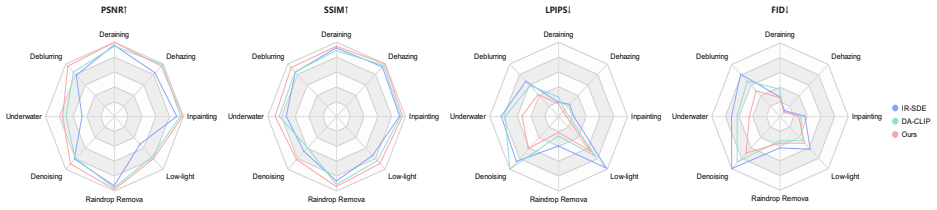
- The multi-stage design reduces the performance gap between linear restoration tasks and blind enhancement tasks, as shown by the paper's average PSNR, SSIM, LPIPS, and FID across eight tasks improving on both unified baselines.
- Performing final calibration in the wavelet low-frequency domain with only 10 denoising steps suggests that high-frequency detail can be handled deterministically, lowering inference cost while preserving perceived quality.
- The combination of distortion metrics (PSNR, SSIM) and perceptual metrics (LPIPS, FID, MUSIQ, VIF) improving together indicates the framework can be both faithful and visually pleasing, not just one or the other.
Reading between the lines
- If the small-data claim transfers to a controlled setting, an obvious extension is to measure how performance scales with training subset size (100, 200, 500 images) to find the minimum viable data budget for each degradation.
- The wavelet-split design suggests a general recipe for other generative restoration models: spend diffusion steps on low-frequency structure and use deterministic feature cleanup on high frequencies; this could be tested by swapping the feature gain module for other denoisers.
- Because the paper evaluates deblurring on BSD rather than GoPro and does not state whether one joint model or separate per-task models were trained, a direct controlled comparison on the standard benchmark with identical training subsets would clarify the scope of the unification claim.
- The CLIP text-guidance component likely makes results sensitive to prompt wording; a robustness test across positive and negative prompt sets would show whether the reported perceptual gains are stable.
Editorial analysis
A structured set of objections, weighed in public.
Referee Report
Summary. The paper proposes CycleRDM, a three-stage diffusion inference framework for unified image restoration and enhancement across nine degradation types. The method combines a multi-stage degraded-to-normal mapping, wavelet-domain low-frequency calibration, a feature gain module for high-frequency components, CLIP-based multimodal text guidance, and Fourier-domain losses. The authors claim that CycleRDM is significantly superior to task-specific and unified baselines on reconstruction and perceptual metrics while using only up to 500 training images per task. The paper reports quantitative comparisons on deraining, dehazing, denoising, deblurring, raindrop removal, inpainting, low-light enhancement, underwater enhancement, and backlit enhancement, along with ablations of the proposed components.
Significance. If the central claim were fully supported, a single architecture that outperforms task-specific state-of-the-art methods while training on only ~500 images per task would be a practically valuable advance for all-in-one image restoration. The paper also contributes a plausible architectural combination of multi-stage diffusion, wavelet-domain refinement, and multimodal guidance, and it includes ablation studies demonstrating that each component contributes to the reported performance. However, the empirical evidence as presented does not yet substantiate the data-efficiency and superiority claims, because the comparisons are not controlled and a key training-protocol detail is missing.
major comments (5)
- [§4.1 and Table 2(c)] The deblurring experiment is evaluated on the BSD dataset, whereas most compared baselines (MTRNN, DID-Anet, MSDI-Net, DeepRFT, etc.) report results on GoPro in their original papers. The paper does not state that the baseline numbers were recomputed on BSD. Consequently, the apparent advantage of CycleRDM (e.g., 29.056 vs. DeepRFT's 28.995) mixes different test sets and is not a valid head-to-head comparison. The authors should either re-evaluate all methods on the same test set or report results on the standard GoPro benchmark.
- [§4.1 and Tables 2-6] The paper compares CycleRDM, trained on up to 500 random images per task, against published baseline numbers obtained with full training datasets. No baseline is retrained on the same 500-image subsets or under the same training protocol. As a result, the central claim of being 'significantly superior' with only a small number of training samples is not supported; the observed differences could be due to training-set composition, test-set choice, or metric computation rather than the proposed architecture. A controlled comparison, at least for the unified baselines IR-SDE and DA-CLIP, is required to substantiate the data-efficiency claim.
- [§4.1, Table 1, and §4.4] The manuscript never states whether all nine tasks are trained jointly in one shared model or whether separate models are trained per task. The abstract's 'unified' framework and the claim of 'requiring only a small number of training samples' depend on this detail. If separate models are trained per task, the unification claim reduces to a collection of task-specific results, and the total amount of training data across tasks is not 'small' in the unified sense. The authors must clarify the training protocol and, if separate models are used, adjust the claims accordingly.
- [Table 1 and §4.4] Table 1 lists the Backlight task with a training phase of 0 images, and Section 4.4 reports backlit enhancement results on BackLit300 without describing any training procedure for that task. A diffusion model cannot be trained with zero training images; this is either a typo, an omission of a zero-shot or adaptation mechanism, or a fundamental gap in the experimental description. Please explain how the backlight model was obtained and how the results in Table 5(b) were produced.
- [Eq. (10) and Tables 2-6] The content loss Lcontent in Eq. (10) includes MSE and SSIM terms, and the reported evaluation metrics are PSNR and SSIM. This means part of the reported distortion metrics are directly optimized during training. While this is common in image restoration, the paper's claim of 'significantly superior' reconstruction quality is weakened when comparisons are made without matched training protocols. The authors should explicitly acknowledge this optimization-evaluation overlap and discuss whether the baselines also optimize SSIM/MSE during training.
minor comments (4)
- [§4.4 and Fig. 5] There are several typographical and grammatical errors, such as 'enhancement. enhancement.' and 'And CyclerRDM can reach an effective balance...' These should be corrected before publication.
- [§4.3 and Table 2] The caption of Table 2 does not state which test set is used for each task, and the section text inconsistently names datasets (e.g., 'RESIDE-6k' and 'RESIDE-6K'). Please standardize the dataset terminology and clearly specify the evaluation protocol for each row.
- [§3.2] The sentence describing the forward diffusion time steps says 'we only set the time step of the forward diffusion process to 200' but later says 'we can perform fewer forward diffusion time steps in the third stage.' Please clarify the exact number of training and inference steps for each stage.
- [§5] The limitation section states that the model has not been trained to recover multiple degradations in the same scene. This limitation should be mentioned in the abstract or introduction, as it affects the claim of generalization to realistic mixed degradations.
Circularity Check
No circularity: CycleRDM is an empirical architecture paper whose claims rest on held-out test evaluations, not on a derivation chain that reduces to its own inputs.
full rationale
The paper does not present a formal derivation of its central claim; it proposes an architecture and evaluates it across nine restoration and enhancement tasks. The training objective Lcontent in Eq. (10) includes MSE and SSIM terms, which are related to the reported PSNR and SSIM metrics, but this is ordinary supervised training and is not circular: the reported numbers are computed on held-out test sets after training, so the benchmark results are genuine predictions rather than quantities forced by construction. The paper's comparison to published baselines involves differences in training-set size, test-set choice, and protocol (e.g., deblurring evaluated on BSD rather than GoPro), but these are experimental-control and comparability concerns, not circularity. No load-bearing self-citations appear: citations to prior wavelet-diffusion works such as WaveDM [10] and WCDM [11] are external prior art, not the authors' own work, and no uniqueness theorem or ansatz is imported from the authors' own prior publications. The 'inspired by [10,11]' design choice is an ordinary use of related work, not a circular premise. Accordingly, there is no self-definitional step, no fitted parameter renamed as a prediction, and no derivation chain whose conclusion is equivalent to its assumptions.
Assumptions & free parameters
free parameters (6)
- Stage loss weights tau_1, tau_2, tau_3 =
1, 1, 0.9
- CLIP content layer weights omega_l =
omega_0-3 = 1, omega_4 = 0.5
- Total loss weights gamma_1, gamma_2 =
0.2, 0.3
- FFT loss weights theta_1, theta_2 =
0.5, 0.5
- Training subset size per task =
500 per task except backlight (0)
- Diffusion time steps and inference steps =
T = 200 training, 10 implicit inference steps
assumptions (5)
- standard math The standard DDPM forward and reverse Gaussian diffusion formulation (Eqs. 1-4) is valid for image restoration conditioning.
- domain assumption The wavelet low-frequency subband contains the structure needed for diffusion calibration, and the high-frequency subband can be cleaned by a feature gain module.
- domain assumption CLIP text-image semantic similarity provides useful appearance guidance for all nine degradation types.
- ad hoc to paper Published baseline scores from full-data training are comparable to CycleRDM trained on 500 random images under common metrics.
- ad hoc to paper A single shared network is trained across all tasks, or if per-task networks are trained, the unified claim still holds.
Cite this review
Pith. "Pith review of Unified Image Restoration and Enhancement: Degradation Calibrated Cycle Reconstruction Diffusion Model." pith.science (2026). https://pith.science/paper/C7XYNTUA
@misc{pith2026241214630,
  author       = {Pith},
  title        = {Pith review of: Unified Image Restoration and Enhancement: Degradation Calibrated Cycle Reconstruction Diffusion Model},
  year         = {2026},
  howpublished = {\url{https://pith.science/paper/C7XYNTUA}},
  note         = {Machine review of arXiv:2412.14630}
}
read the original abstract
Image restoration and enhancement are pivotal for numerous computer vision applications, yet unifying these tasks efficiently remains a significant challenge. Inspired by the iterative refinement capabilities of diffusion models, we propose CycleRDM, a novel framework designed to unify restoration and enhancement tasks while achieving high-quality mapping. Specifically, CycleRDM first learns the mapping relationships among the degraded domain, the rough normal domain, and the normal domain through a two-stage diffusion inference process. Subsequently, we transfer the final calibration process to the wavelet low-frequency domain using discrete wavelet transform, performing fine-grained calibration from a frequency domain perspective by leveraging task-specific frequency spaces. To improve restoration quality, we design a feature gain module for the decomposed wavelet high-frequency domain to eliminate redundant features. Additionally, we employ multimodal textual prompts and Fourier transform to drive stable denoising and reduce randomness during the inference process. After extensive validation, CycleRDM can be effectively generalized to a wide range of image restoration and enhancement tasks while requiring only a small number of training samples to be significantly superior on various benchmarks of reconstruction quality and perceptual quality. The source code will be available at https://github.com/hejh8/CycleRDM.
Figures


Figures from the paper (5 more)


Reference graph
Works this paper leans on
-
[1]
Simple baselines for image restoration
Liangyu Chen, Xiaojie Chu, Xiangyu Zhang, and Jian Sun. Simple baselines for image restoration. In European conference on computer vision, pages 17–33. Springer, 2022
2022
-
[2]
Pugan: Physical model-guided underwater image enhancement using gan with dual-discriminators
Runmin Cong, Wenyu Yang, Wei Zhang, Chongyi Li, Chun-Le Guo, Qingming Huang, and Sam Kwong. Pugan: Physical model-guided underwater image enhancement using gan with dual-discriminators. IEEE Transactions on Image Processing , 2023
work page 2023
-
[3]
Generative diffusion prior for unified image restoration and enhancement
Ben Fei, Zhaoyang Lyu, Liang Pan, Junzhe Zhang, Weidong Yang, Tianyue Luo, Bo Zhang, and Bo Dai. Generative diffusion prior for unified image restoration and enhancement. In Proceedings of the IEEE/CVF Conference on Computer Vision and Pattern Recognition , pages 9935–9946, 2023
work page 2023
-
[4]
Unsu- pervised underwater image restoration: From a homology perspective
Zhenqi Fu, Huangxing Lin, Yan Yang, Shu Chai, Liyan Sun, Yue Huang, and Xinghao Ding. Unsu- pervised underwater image restoration: From a homology perspective. In Proceedings of the AAAI Conference on Artificial Intelligence , volume 36, pages 643–651, 2022
work page 2022
-
[5]
Uncertainty inspired underwater image enhancement
Zhenqi Fu, Wu Wang, Yue Huang, Xinghao Ding, and Kai-Kuang Ma. Uncertainty inspired underwater image enhancement. In European conference on computer vision, pages 465–482. Springer, 2022
work page 2022
-
[6]
Lime: Low-light image enhancement via illumination map estimation
Xiaojie Guo, Yu Li, and Haibin Ling. Lime: Low-light image enhancement via illumination map estimation. IEEE Transactions on image processing , 26(2):982–993, 2016
work page 2016
-
[7]
Gans trained by a two time-scale update rule converge to a local nash equilibrium
Martin Heusel, Hubert Ramsauer, Thomas Unterthiner, Bernhard Nessler, and Sepp Hochreiter. Gans trained by a two time-scale update rule converge to a local nash equilibrium. Advances in neural information processing systems, 30, 2017. 27
work page 2017
-
[8]
Global structure-aware diffusion process for low-light image enhancement
Jinhui Hou, Zhiyu Zhu, Junhui Hou, Hui Liu, Huanqiang Zeng, and Hui Yuan. Global structure-aware diffusion process for low-light image enhancement. Advances in Neural Information Processing Systems, 36, 2024
work page 2024
Show all 55 references
-
[9]
Contrastive semi-supervised learning for underwater image restoration via reliable bank
Shirui Huang, Keyan Wang, Huan Liu, Jun Chen, and Yunsong Li. Contrastive semi-supervised learning for underwater image restoration via reliable bank. In Proceedings of the IEEE/CVF conference on computer vision and pattern recognition , pages 18145–18155, 2023
2023
-
[10]
Wavedm: Wavelet-based diffusion models for image restoration
Yi Huang, Jiancheng Huang, Jianzhuang Liu, Mingfu Yan, Yu Dong, Jiaxi Lyu, Chaoqi Chen, and Shifeng Chen. Wavedm: Wavelet-based diffusion models for image restoration. IEEE Transactions on Multimedia, 2024
2024
-
[11]
Low-light image enhancement with wavelet-based diffusion models
Hai Jiang, Ao Luo, Haoqiang Fan, Songchen Han, and Shuaicheng Liu. Low-light image enhancement with wavelet-based diffusion models. ACM Transactions on Graphics (TOG) , 42(6):1–14, 2023
2023
-
[12]
Lightendiffusion: Unsupervised low-light image enhancement with latent-retinex diffusion models
Hai Jiang, Ao Luo, Xiaohong Liu, Songchen Han, and Shuaicheng Liu. Lightendiffusion: Unsupervised low-light image enhancement with latent-retinex diffusion models. arXiv preprint arXiv:2407.08939 , 2024
2024 arXiv
-
[13]
Musiq: Multi-scale image quality transformer
Junjie Ke, Qifei Wang, Yilin Wang, Peyman Milanfar, and Feng Yang. Musiq: Multi-scale image quality transformer. In Proceedings of the IEEE/CVF international conference on computer vision , pages 5148–5157, 2021
2021
-
[14]
Contrast enhancement based on layered difference repre- sentation of 2d histograms
Chulwoo Lee, Chul Lee, and Chang-Su Kim. Contrast enhancement based on layered difference repre- sentation of 2d histograms. IEEE transactions on image processing , 22(12):5372–5384, 2013
2013
-
[15]
All-in-one image restoration for unknown corruption
Boyun Li, Xiao Liu, Peng Hu, Zhongqin Wu, Jiancheng Lv, and Xi Peng. All-in-one image restoration for unknown corruption. In Proceedings of the IEEE/CVF Conference on Computer Vision and Pattern Recognition, pages 17452–17462, 2022
2022
-
[16]
Embedding fourier for ultra-high-definition low-light image enhancement
Chongyi Li, Chun-Le Guo, Man Zhou, Zhexin Liang, Shangchen Zhou, Ruicheng Feng, and Chen Change Loy. Embedding fourier for ultra-high-definition low-light image enhancement. arXiv preprint arXiv:2302.11831, 2023
2023 arXiv
-
[17]
Learning degradation representations for image deblurring
Dasong Li, Yi Zhang, Ka Chun Cheung, Xiaogang Wang, Hongwei Qin, and Hongsheng Li. Learning degradation representations for image deblurring. In European Conference on Computer Vision , pages 736–753. Springer, 2022
2022
-
[18]
Iterative prompt learning for unsupervised backlit image enhancement
Zhexin Liang, Chongyi Li, Shangchen Zhou, Ruicheng Feng, and Chen Change Loy. Iterative prompt learning for unsupervised backlit image enhancement. In Proceedings of the IEEE/CVF International Conference on Computer Vision , pages 8094–8103, 2023
2023
-
[19]
Twin adversarial contrastive learning for underwater image enhancement and beyond
Risheng Liu, Zhiying Jiang, Shuzhou Yang, and Xin Fan. Twin adversarial contrastive learning for underwater image enhancement and beyond. IEEE Transactions on Image Processing , 31:4922–4936, 2022. 28
2022
-
[20]
Repaint: Inpainting using denoising diffusion probabilistic models
Andreas Lugmayr, Martin Danelljan, Andres Romero, Fisher Yu, Radu Timofte, and Luc Van Gool. Repaint: Inpainting using denoising diffusion probabilistic models. In Proceedings of the IEEE/CVF conference on computer vision and pattern recognition , pages 11461–11471, 2022
2022
-
[21]
Image restoration with mean-reverting stochastic differential equations
Ziwei Luo. Image restoration with mean-reverting stochastic differential equations. In International Conference on Machine Learning (ICML) , 2023
2023
-
[22]
Gustafsson, Zheng Zhao, Jens Sj¨ olund, and Thomas B
Ziwei Luo, Fredrik K. Gustafsson, Zheng Zhao, Jens Sj¨ olund, and Thomas B. Sch¨ on. Controlling vision-language models for multi-task image restoration. In The Twelfth International Conference on Learning Representations, 2024
2024
-
[23]
Fourier priors-guided diffusion for zero-shot joint low-light enhancement and deblurring
Xiaoqian Lv, Shengping Zhang, Chenyang Wang, Yichen Zheng, Bineng Zhong, Chongyi Li, and Liqiang Nie. Fourier priors-guided diffusion for zero-shot joint low-light enhancement and deblurring. InProceed- ings of the IEEE/CVF Conference on Computer Vision and Pattern Recognition...
2024
-
[24]
Defocus image deblurring network with defocus map estimation as auxiliary task
Haoyu Ma, Shaojun Liu, Qingmin Liao, Juncheng Zhang, and Jing-Hao Xue. Defocus image deblurring network with defocus map estimation as auxiliary task. IEEE Transactions on Image Processing , 31:216–226, 2021
2021
-
[25]
Intriguing findings of fre- quency selection for image deblurring
Xintian Mao, Yiming Liu, Fengze Liu, Qingli Li, Wei Shen, and Yan Wang. Intriguing findings of fre- quency selection for image deblurring. In Proceedings of the AAAI Conference on Artificial Intelligence, volume 37, pages 1905–1913, 2023
1905
-
[26]
A database of human segmented natural images and its application to evaluating segmentation algorithms and measuring ecological statistics
David Martin, Charless Fowlkes, Doron Tal, and Jitendra Malik. A database of human segmented natural images and its application to evaluating segmentation algorithms and measuring ecological statistics. In Proceedings Eighth IEEE International Conference on Computer Vision. IC...
2001
-
[27]
A generalized physical- knowledge-guided dynamic model for underwater image enhancement
Pan Mu, Hanning Xu, Zheyuan Liu, Zheng Wang, Sixian Chan, and Cong Bai. A generalized physical- knowledge-guided dynamic model for underwater image enhancement. In Proceedings of the 31st ACM International Conference on Multimedia , pages 7111–7120, 2023
2023
-
[28]
Multi-temporal recurrent neural networks for progressive non-uniform single image deblurring with incremental temporal training
Dongwon Park, Dong Un Kang, Jisoo Kim, and Se Young Chun. Multi-temporal recurrent neural networks for progressive non-uniform single image deblurring with incremental temporal training. In European Conference on Computer Vision , pages 327–343. Springer, 2020
2020
-
[29]
U-shape transformer for underwater image enhancement
Lintao Peng, Chunli Zhu, and Liheng Bian. U-shape transformer for underwater image enhancement. IEEE Transactions on Image Processing , 2023
2023
-
[30]
Attentive generative adversarial network for raindrop removal from a single image
Rui Qian, Robby T Tan, Wenhan Yang, Jiajun Su, and Jiaying Liu. Attentive generative adversarial network for raindrop removal from a single image. In Proceedings of the IEEE conference on computer vision and pattern recognition, pages 2482–2491, 2018
2018
-
[31]
Ffa-net: Feature fusion attention 29 network for single image dehazing
Xu Qin, Zhilin Wang, Yuanchao Bai, Xiaodong Xie, and Huizhu Jia. Ffa-net: Feature fusion attention 29 network for single image dehazing. In Proceedings of the AAAI conference on artificial intelligence , volume 34, pages 11908–11915, 2020
2020
-
[32]
Single image deraining using bilateral recurrent network
Dongwei Ren, Wei Shang, Pengfei Zhu, Qinghua Hu, Deyu Meng, and Wangmeng Zuo. Single image deraining using bilateral recurrent network. IEEE Transactions on Image Processing , 29:6852–6863, 2020
2020
-
[33]
Live image quality assessment database release 2
H Sheikh. Live image quality assessment database release 2. http://live. ece. utexas. edu/research/qual- ity, 2005
2005
-
[34]
Unsupervised multi-branch network with high-frequency enhancement for image dehazing
Hang Sun, Zhiming Luo, Dong Ren, Bo Du, Laibin Chang, and Jun Wan. Unsupervised multi-branch network with high-frequency enhancement for image dehazing. Pattern Recognition, 156:110763, 2024
2024
-
[35]
Multi- stage image denoising with the wavelet transform
Chunwei Tian, Menghua Zheng, Wangmeng Zuo, Bob Zhang, Yanning Zhang, and David Zhang. Multi- stage image denoising with the wavelet transform. Pattern Recognition, 134:109050, 2023
2023
-
[36]
Maxim: Multi-axis mlp for image processing
Zhengzhong Tu, Hossein Talebi, Han Zhang, Feng Yang, Peyman Milanfar, Alan Bovik, and Yinxiao Li. Maxim: Multi-axis mlp for image processing. In Proceedings of the IEEE/CVF conference on computer vision and pattern recognition, pages 5769–5780, 2022
2022
-
[37]
Image quality assessment: from error visibility to structural similarity
Zhou Wang, Alan C Bovik, Hamid R Sheikh, and Eero P Simoncelli. Image quality assessment: from error visibility to structural similarity. IEEE transactions on image processing , 13(4):600–612, 2004
2004
-
[38]
Deep retinex decomposition for low-light enhancement
Chen Wei, Wenjing Wang, Wenhan Yang, and Jiaying Liu. Deep retinex decomposition for low-light enhancement. arXiv preprint arXiv:1808.04560 , 2018
2018 arXiv
-
[39]
Unpaired learning of deep image denoising
Xiaohe Wu, Ming Liu, Yue Cao, Dongwei Ren, and Wangmeng Zuo. Unpaired learning of deep image denoising. In European conference on computer vision, pages 352–368. Springer, 2020
2020
-
[40]
Image de-raining transformer
Jie Xiao, Xueyang Fu, Aiping Liu, Feng Wu, and Zheng-Jun Zha. Image de-raining transformer. IEEE Transactions on Pattern Analysis and Machine Intelligence , 2022
2022
-
[41]
Upt-flow: Multi-scale transformer-guided normalizing flow for low-light image enhancement.Pattern Recognition, 158:111076, 2025
Lintao Xu, Changhui Hu, Yin Hu, Xiaoyuan Jing, Ziyun Cai, and Xiaobo Lu. Upt-flow: Multi-scale transformer-guided normalizing flow for low-light image enhancement.Pattern Recognition, 158:111076, 2025
2025
-
[42]
Snr-aware low-light image enhancement
Xiaogang Xu, Ruixing Wang, Chi-Wing Fu, and Jiaya Jia. Snr-aware low-light image enhancement. In Proceedings of the IEEE/CVF conference on computer vision and pattern recognition , pages 17714– 17724, 2022
2022
-
[43]
Implicit neural representation for cooperative low-light image enhancement
Shuzhou Yang, Moxuan Ding, Yanmin Wu, Zihan Li, and Jian Zhang. Implicit neural representation for cooperative low-light image enhancement. In Proceedings of the IEEE/CVF International Conference on Computer Vision , pages 12918–12927, 2023
2023
-
[44]
Deep joint rain detection and removal from a single image
Wenhan Yang, Robby T Tan, Jiashi Feng, Jiaying Liu, Zongming Guo, and Shuicheng Yan. Deep joint rain detection and removal from a single image. In Proceedings of the IEEE conference on computer vision and pattern recognition, pages 1357–1366, 2017. 30
2017
-
[45]
Sparse gradient regu- larized deep retinex network for robust low-light image enhancement
Wenhan Yang, Wenjing Wang, Haofeng Huang, Shiqi Wang, and Jiaying Liu. Sparse gradient regu- larized deep retinex network for robust low-light image enhancement. IEEE Transactions on Image Processing, 30:2072–2086, 2021
2021
-
[46]
Robust unpaired image dehazing via density and depth decomposition
Yang Yang, Chaoyue Wang, Xiaojie Guo, and Dacheng Tao. Robust unpaired image dehazing via density and depth decomposition. International Journal of Computer Vision , pages 1–21, 2023
2023
-
[47]
Self-augmented unpaired image dehazing via density and depth decomposition
Yang Yang, Chaoyue Wang, Risheng Liu, Lin Zhang, Xiaojie Guo, and Dacheng Tao. Self-augmented unpaired image dehazing via density and depth decomposition. In Proceedings of the IEEE/CVF conference on computer vision and pattern recognition , pages 2037–2046, 2022
2022
-
[48]
Degradation-removed multiscale fusion for low-light salient object detection
Nana Yu, Jie Wang, Hong Shi, Zihao Zhang, and Yahong Han. Degradation-removed multiscale fusion for low-light salient object detection. Pattern Recognition, page 110650, 2024
2024
-
[49]
Restormer: Efficient transformer for high-resolution image restoration
Syed Waqas Zamir, Aditya Arora, Salman Khan, Munawar Hayat, Fahad Shahbaz Khan, and Ming- Hsuan Yang. Restormer: Efficient transformer for high-resolution image restoration. In Proceedings of the IEEE/CVF conference on computer vision and pattern recognition , pages 5728–5739, 2022
2022
-
[50]
Multi-stage progressive image restoration
Syed Waqas Zamir, Aditya Arora, Salman Khan, Munawar Hayat, Fahad Shahbaz Khan, Ming-Hsuan Yang, and Ling Shao. Multi-stage progressive image restoration. In Proceedings of the IEEE/CVF conference on computer vision and pattern recognition , pages 14821–14831, 2021
2021
-
[51]
The unreasonable effectiveness of deep features as a perceptual metric
Richard Zhang, Phillip Isola, Alexei A Efros, Eli Shechtman, and Oliver Wang. The unreasonable effectiveness of deep features as a perceptual metric. In Proceedings of the IEEE conference on computer vision and pattern recognition, pages 586–595, 2018
2018
-
[52]
A prior guided wavelet-spatial dual attention transformer framework for heavy rain image restoration
Ronghui Zhang, Jiongze Yu, Junzhou Chen, Guofa Li, Liang Lin, and Danwei Wang. A prior guided wavelet-spatial dual attention transformer framework for heavy rain image restoration. IEEE Trans- actions on Multimedia , 2024
2024
-
[53]
Deep convolutional dictionary learning for image de- noising
Hongyi Zheng, Hongwei Yong, and Lei Zhang. Deep convolutional dictionary learning for image de- noising. In Proceedings of the IEEE/CVF conference on computer vision and pattern recognition, pages 630–641, 2021
2021
-
[54]
Real-world video deblurring: A benchmark dataset and an efficient recurrent neural network
Zhihang Zhong, Ye Gao, Yinqiang Zheng, Bo Zheng, and Imari Sato. Real-world video deblurring: A benchmark dataset and an efficient recurrent neural network. International Journal of Computer Vision, 131(1):284–301, 2023
2023
-
[55]
Multi-stream fusion network with generalized smooth l 1 loss for single image dehazing
Xinshan Zhu, Shuoshi Li, Yongdong Gan, Yun Zhang, and Biao Sun. Multi-stream fusion network with generalized smooth l 1 loss for single image dehazing. IEEE Transactions on Image Processing , 30:7620–7635, 2021. 31
2021
Reviewed August 11, 2026 · model on record in the stance chip above.
Discussion (0). Continue with ORCID to comment.