Ontological Knowledge Blocks: Executable Compliance and Profile-Based Validation for Trustworthy AI Systems
Pith reviewed 2026-05-25 04:31 UTC · model grok-4.3
The pith
Ontological Knowledge Blocks formalize regulatory obligations for AI as machine-executable 5-tuples with SHACL rules.
A machine-rendered reading of the paper's core claim, the machinery that carries it, and where it could break.
Core claim
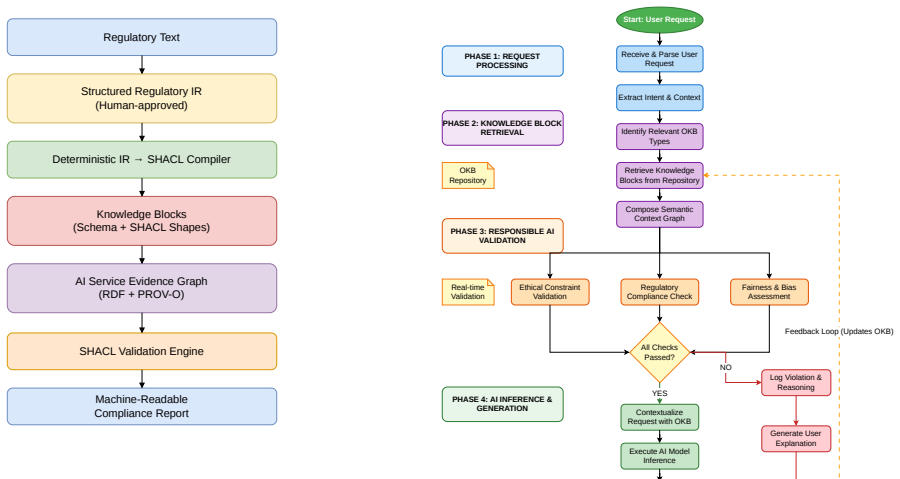
We formalize an OKB as a 5-tuple that binds normative obligations to an RDF/OWL concept schema, executable SHACL validation rules, explicit evidence requirements, and PROV-O provenance links. A deterministic regulatory compiler translates structured Intermediate Representation (IR) records into composable KB modules, enabling profile-based governance reconfiguration without modifying service code.
What carries the argument
The Ontological Knowledge Block (OKB) as a 5-tuple linking obligations to schemas and SHACL rules, together with the deterministic regulatory compiler that produces executable modules from IR records.
If this is right
- Governance profiles can be swapped by selecting different OKB modules without any changes to the AI service implementation.
- Violation detection is strictly additive when multiple profiles are applied together.
- Validation latency remains low, between 12.6 ms and 100.3 ms across tested cases.
- Profile equivalence testing identifies the Combined profile as the most comprehensive.
Where Pith is reading between the lines
- The framework could support compliance in other AI application areas like finance or healthcare by defining new profiles.
- Community contributions to OKB libraries might accelerate adoption across different regulatory environments.
- Integration with existing AI pipelines would require mapping service outputs to the defined evidence graphs.
Load-bearing premise
Regulatory obligations can be losslessly captured in structured Intermediate Representation records such that the deterministic compiler produces KB modules whose SHACL validations correctly reflect the original normative intent.
What would settle it
Running the regulatory compiler on a known regulation and then having legal experts compare the resulting SHACL constraints against the original text to check for missing or altered requirements.
Figures


read the original abstract
AI-enabled services deployed in critical digital infrastructure are subject to governance obligations spanning transparency, accountability, fairness, and traceability. Compliance today remains documentation-centric: obligations are described in prose, audits rely on static checklists, and verification depends on manual review. Such approaches do not scale to automated AI systems. This paper introduces Ontological Knowledge Blocks (OKBs), a programmable governance infrastructure that compiles regulatory obligations into machine-checkable constraints over structured evidence graphs. We formalize an OKB as a 5-tuple that binds normative obligations to an RDF/OWL concept schema, executable SHACL validation rules, explicit evidence requirements, and PROV-O provenance links. A deterministic regulatory compiler translates structured Intermediate Representation (IR) records into composable KB modules, enabling profile-based governance reconfiguration without modifying service code. We implement two prototypes and evaluate them in an AI-assisted HPC resource allocation scenario across 24 validation runs and four governance profiles. Results demonstrate profile-sensitive validation, strictly additive violation accumulation, SHACL validation latency between 12.6 ms and 100.3 ms, and profile equivalence testing confirming Combined as the strictly most comprehensive profile. All artefacts are released as open source.
Editorial analysis
A structured set of objections, weighed in public.
Referee Report
Summary. The paper introduces Ontological Knowledge Blocks (OKBs) formalized as a 5-tuple binding normative obligations to an RDF/OWL concept schema, executable SHACL validation rules, explicit evidence requirements, and PROV-O provenance links. A deterministic regulatory compiler translates structured Intermediate Representation (IR) records into composable KB modules, enabling profile-based governance reconfiguration in AI systems without modifying service code. Evaluation in an AI-assisted HPC resource allocation scenario across 24 validation runs and four governance profiles reports profile-sensitive validation, strictly additive violation accumulation, SHACL latencies of 12.6-100.3 ms, and profile equivalence confirming the Combined profile as most comprehensive. All artefacts are released as open source.
Significance. If the compiler preserves normative intent, the approach offers a scalable, programmable alternative to documentation-centric compliance for AI services in critical infrastructure, with dynamic profile reconfiguration as a key practical advantage. The concrete evaluation metrics, open-source release, and use of standard technologies (SHACL, PROV-O, RDF/OWL) provide a reproducible demonstration of runtime feasibility that strengthens the contribution.
major comments (1)
- [Abstract (regulatory compiler and IR description)] The central claim that the deterministic compiler produces KB modules whose SHACL validations correctly reflect the original normative intent (Abstract) rests on the assumption that structured IR records capture obligations losslessly. No formal semantics for the IR or preservation proof is supplied for conditional, disjunctive, or context-sensitive obligations; the single-scenario prototype with 24 runs demonstrates runtime behavior but cannot establish semantic fidelity. This is load-bearing for the profile-reconfiguration guarantee.
minor comments (1)
- [Abstract] The abstract reports specific numerical results (24 runs, latency bounds) but does not indicate the exact number of obligations or profiles tested; adding this detail would improve reproducibility.
Simulated Author's Rebuttal
We thank the referee for the constructive review and the recommendation for major revision. We address the single major comment point-by-point below.
read point-by-point responses
-
Referee: [Abstract (regulatory compiler and IR description)] The central claim that the deterministic compiler produces KB modules whose SHACL validations correctly reflect the original normative intent (Abstract) rests on the assumption that structured IR records capture obligations losslessly. No formal semantics for the IR or preservation proof is supplied for conditional, disjunctive, or context-sensitive obligations; the single-scenario prototype with 24 runs demonstrates runtime behavior but cannot establish semantic fidelity. This is load-bearing for the profile-reconfiguration guarantee.
Authors: We agree that the manuscript provides no formal semantics for the IR nor a preservation proof covering conditional, disjunctive, or context-sensitive obligations. The IR is a manually authored structured format that encodes the specific obligations appearing in the evaluated HPC governance profiles; the compiler then performs a deterministic syntactic translation to SHACL, evidence requirements, and PROV-O links. The 24-run evaluation confirms that the generated modules produce the expected profile-sensitive violations and additive accumulation, thereby demonstrating practical profile reconfiguration. However, this empirical behavior does not constitute a general semantic-fidelity argument. In the revised manuscript we will (i) state the design assumptions of the IR more explicitly and (ii) add a dedicated limitations paragraph acknowledging the absence of formal semantics or preservation proofs for complex obligation forms. revision: yes
Circularity Check
No significant circularity; formalization and implementation are independent
full rationale
The paper defines OKB as a 5-tuple and describes a deterministic compiler translating IR to SHACL modules, then evaluates via open-source prototypes in an HPC scenario. No equations, fitted parameters, or self-citations appear in the provided text that would reduce any output to inputs by construction. The central claims rest on the explicit implementation and release rather than self-definitional loops or renamed known results. This is self-contained against external benchmarks (the released code and 24 validation runs), matching the default non-circular outcome.
Axiom & Free-Parameter Ledger
axioms (1)
- domain assumption Regulatory obligations can be captured without loss of normative meaning in structured Intermediate Representation records
invented entities (1)
-
Ontological Knowledge Block (OKB)
no independent evidence
Reference graph
Works this paper leans on
-
[1]
European Union, “Regulation (EU) 2024/1689 of the European Parlia- ment and of the Council laying down harmonised rules on artificial intelligence (Artificial Intelligence Act),”Official Journal of the Euro- pean Union, 2024. [Online]. Available: https://eur-lex.europa.eu/eli/reg/ 2024/1689/oj
work page 2024
-
[2]
2023, doi: 10.6028/NIST.AI.100-1
National Institute of Standards and Technology,Artificial Intelligence Risk Management Framework (AI RMF 1.0), NIST AI 100-1, Jan. 2023, doi: 10.6028/NIST.AI.100-1. [Online]. Available: https://nvlpubs.nist. gov/nistpubs/ai/NIST.AI.100-1.pdf
-
[3]
The global landscape of AI ethics guidelines,
A. Jobin, M. Ienca, and E. Vayena, “The global landscape of AI ethics guidelines,”Nature Machine Intelligence, vol. 1, pp. 389–399, 2019, doi: 10.1038/s42256-019-0088-2
-
[4]
The Ethics of AI Ethics: An Evaluation of Guidelines,
T. Hagendorff, “The Ethics of AI Ethics: An Evaluation of Guidelines,” Minds and Machines, vol. 30, pp. 99–120, 2020, doi: 10.1007/s11023- 020-09517-8
-
[5]
Model Cards for Model Reporting,
M. Mitchellet al., “Model Cards for Model Reporting,” inProc. ACM FAT*, 2019, doi: 10.1145/3287560.3287596
-
[6]
URL https://cacm.acm.org/research/ datasheets-for-datasets/
T. Gebruet al., “Datasheets for Datasets,”Communications of the ACM, vol. 64, no. 12, pp. 86–92, 2021, doi: 10.1145/3458723
-
[7]
RDF 1.1 Concepts and Abstract Syntax,
W3C, “RDF 1.1 Concepts and Abstract Syntax,” W3C Recom- mendation, Feb. 2014. [Online]. Available: https://www.w3.org/TR/ rdf11-concepts/
work page 2014
-
[8]
Shapes Constraint Language (SHACL),
W3C, “Shapes Constraint Language (SHACL),” W3C Recommendation, Jul. 2017. [Online]. Available: https://www.w3.org/TR/shacl/
work page 2017
-
[9]
W3C, “PROV-O: The PROV Ontology,” W3C Recommendation, Apr. 2013. [Online]. Available: https://www.w3.org/TR/prov-o/
work page 2013
-
[10]
Open Policy Agent (OPA) Documentation,
Open Policy Agent, “Open Policy Agent (OPA) Documentation,” ac- cessed Feb. 2026. [Online]. Available: https://www.openpolicyagent.org/ docs/latest/
work page 2026
-
[11]
Towards an ontology for process compliance with the (machinery) legislations,
B. Gallina, G. L. Steierhoffer, T. Young Olesen, E. Parajdi, and M. Aarup, “Towards an ontology for process compliance with the (machinery) legislations,”J. Software: Evolution and Process, vol. 37, no. 1, Art. e2728, Jan. 2025, doi: 10.1002/smr.2728
-
[12]
Regulatory Compliance- aware System Change Management via an Ontology-based Approach,
B. Gallina, M. Schweizer, and H. Dibowski, “Regulatory Compliance- aware System Change Management via an Ontology-based Approach,” inProc. 32nd EuroSPI, CCIS, vol. 2657, Springer, pp. 245–259, 2025, doi: 10.1007/978-3-032-04288-0 15
-
[13]
B. Gallina, H. Dibowski, and M. Schweizer, “An Ontology-based Representation for Shaping Product Evolution in Regulated Industries,” inProc. 21st ICSR, LNCS, vol. 14614, Springer, 2024, doi: 10.1007/978- 3-031-66459-5 6
-
[14]
A SHACL-Based Approach for Enhancing Automated Compliance Checking with RDF Data,
K. Anim, L. Robaldo, and A. Z. Wyner, “A SHACL-Based Approach for Enhancing Automated Compliance Checking with RDF Data,” Information, vol. 15, no. 12, Art. 759, 2024, doi: 10.3390/info15120759
-
[15]
Ethical AI: To- wards Defining a Collective Evaluation Framework,
A. K. Sharma, D. Kyosev, and J. M. Kunkel, “Ethical AI: To- wards Defining a Collective Evaluation Framework,” inProc. IEEE COMPSAC 2025, pp. 1665–1670, 2025, doi: 10.1109/COMP- SAC65507.2025.00344
-
[16]
Global AI Regulations for FAIR and Ethics in High-Risk Use Cases: A Comparative Review,
A. K. Sharma, D. Kyosev, C. Anich, R. K. Ojha, and J. M. Kunkel, “Global AI Regulations for FAIR and Ethics in High-Risk Use Cases: A Comparative Review,” inProc. IEEE COMPSAC 2026 (STPSA Workshop), IEEE, 2026
work page 2026
-
[17]
Iterative, “Data Version Control (DVC),” accessed May 2026. [Online]. Available: https://doc.dvc.org/user-guide APPENDIXA EVIDENCEGRAPHCASES FORPROFILE-BASED VALIDATION This appendix provides the concrete RDF evidence graphs used in the evaluation. Each case is anevidence graphdescrib- ing one scheduling decision and its associated artefacts. The profiles...
work page 2026
discussion (0)
Sign in with ORCID, Apple, or X to comment. Anyone can read and Pith papers without signing in.