REVIEW 4 major objections 5 minor 41 references
Spike-Train Level Backpropagation for Training Deep Recurrent Spiking Neural Networks
T0 review · 4 major / 5 minor · reviewed 2026-08-14 · deepseek-v4-flash
Pith's one-line read By treating spike trains as differentiable aggregate signals, ST-RSBP trains deep recurrent spiking networks without unrolling them in time, surpassing prior spiking and non-spiking baselines on speech and image benchmarks.
desk verdict A genuine extension of HM2-BP to recurrent spiking networks with strong empirical wins, but the load-bearing fitted derivative is under-validated. read the letter →
The pith
A machine-rendered reading of the paper's core claim, the machinery that carries it, and where it could break.
The reading
What carries the argument
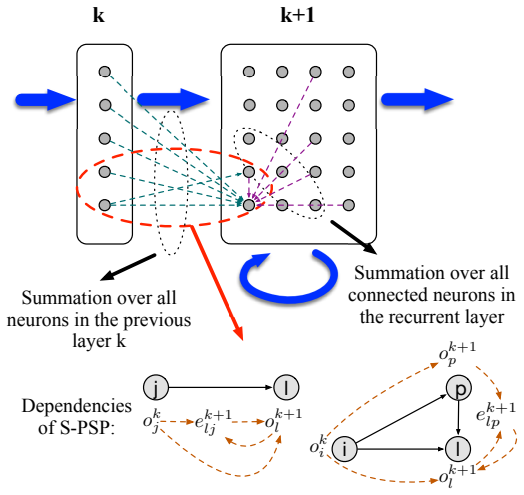
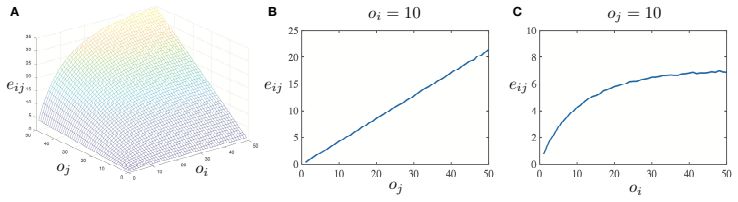
The key object is the S-PSP, the spike-train-level post-synaptic potential: the accumulated normalized contribution of a presynaptic neuron's spike train to a postsynaptic neuron's membrane potential right before each postsynaptic spike. It converts spike trains into quantities $a_i$ and $o_i$ that obey ANN-like relations, letting the rate-coded loss be differentiated through hidden recurrent layers. Recurrent backpropagation solves the linear system in Eq. (20), while the spike-level derivative $\partial e_{ij}/\partial o_j$ is taken as $e_{ij}/o_j$ and $\partial e_{ij}/\partial o_i$ is read from a third-order polynomial fitted offline to random spike-train simulations of LIF neurons.
What would settle it
Record the actual spike trains during ST-RSBP training and numerically perturb a single weight to estimate the true gradient of the rate-coded loss; compare with ST-RSBP's analytic gradient for the same sample. A systematic mismatch that grows as firing rates leave the ranges covered by the offline random simulations would show the fitted derivative is the load-bearing approximation.
Extended reading notes
Core claim
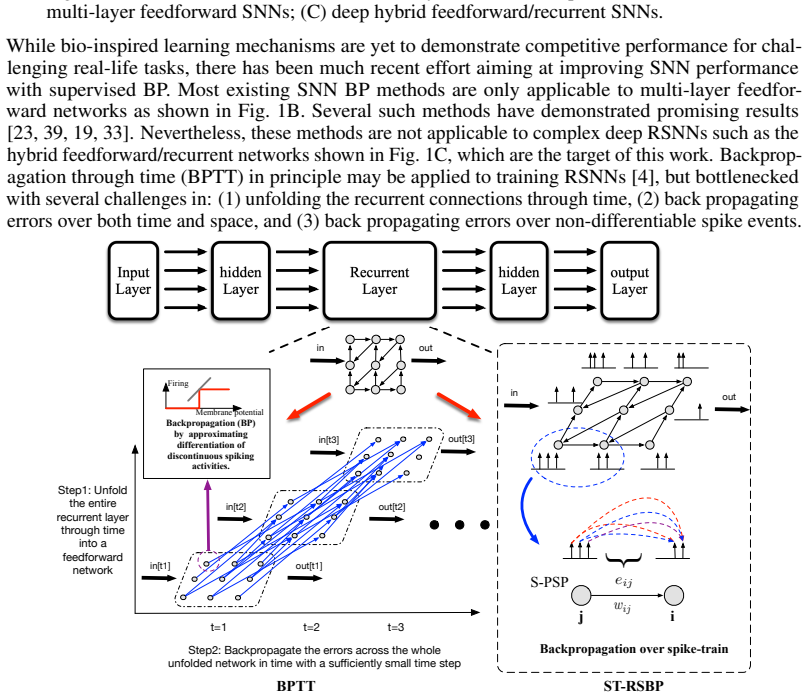
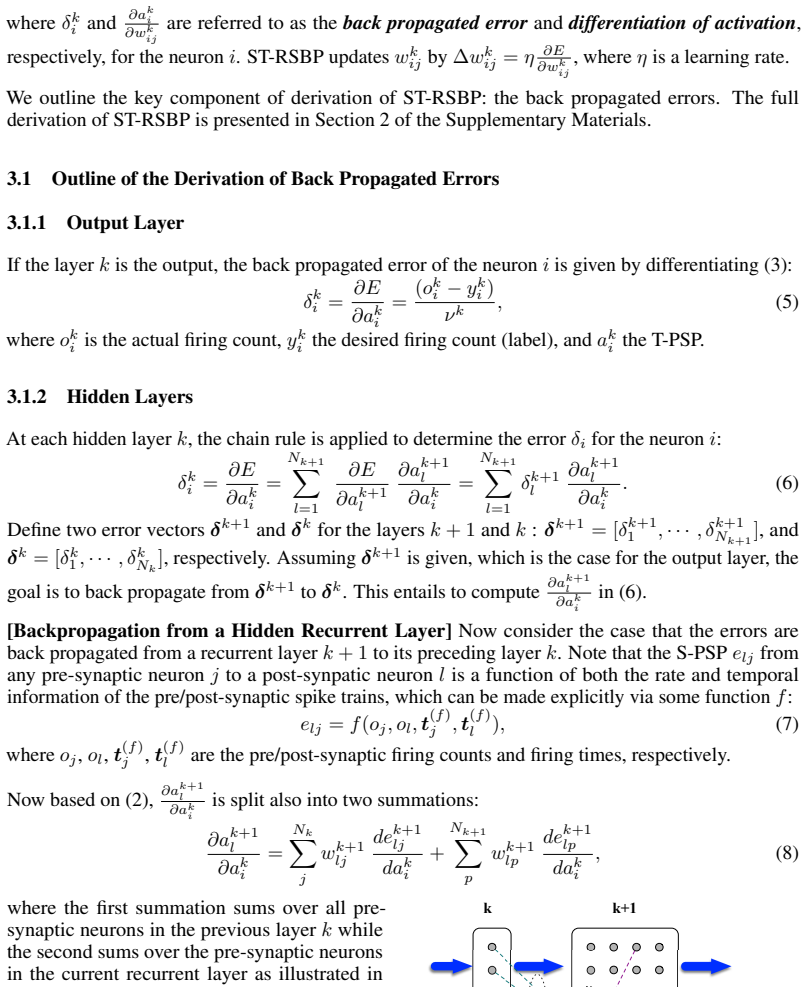
The paper's central claim is that the non-differentiability of spikes can be handled without temporal unrolling or waveform smoothing. Each synapse's aggregate effect is summarized by the spike-train-level post-synaptic potential $e_{ij}$, the accumulated contribution of the presynaptic spike train to the postsynaptic neuron's membrane potential just before each of its firings. Because the firing count satisfies $o_i \approx a_i/\nu$, the total post-synaptic potential $a_i = \sum_j w_{ij} e_{ij}$ behaves like a conventional ANN pre-activation, so the chain rule applies at the level of whole spike trains. For recurrent layers, the needed cross-layer derivatives form a coupled linear system $\Omega P = \Phi + \Theta P$, whose solution $P = (\Omega - \Theta)^{-1}\Phi$ propagates errors without unrolling time; for feedforward layers the formula simplifies to a diagonal form. The paper argues that this computes gradients of the true rate-coded loss more faithfully than smoothing-based methods and avoids vanishing or exploding gradients because no temporal unrolling occurs.
Load-bearing premise
The gradient formulas rest on treating each synapse's aggregate spike-train effect as a differentiable function of firing counts, with one derivative measured offline from random spike-train simulations; if real training spike trains differ from those simulations, the backpropagated gradients are systematically biased.
Editorial extensions
If this is right
- Deep RSNNs with multiple feedforward and recurrent layers can be trained end-to-end under a rate-coded loss, making recurrent spiking models a practical option for temporal tasks such as speech recognition.
- Because the backward pass does not unroll the network in time, training avoids the exploding and vanishing gradient failure mode and the computational cost of point-by-point backpropagation through time.
- On feedforward spiking CNNs, ST-RSBP improves over HM2-BP with the same model complexity, indicating that the more accurate spike-train derivative treatment also benefits standard feedforward training.
- The reported results imply that spike-based recurrent networks can match or exceed conventional recurrent models such as LSTM and GRN on neuromorphic speech benchmarks, narrowing the accuracy gap that previously favored non-spiking networks.
Reading between the lines
- If the fitted derivative $\partial e_{ij}/\partial o_i$ is the main approximation, then refitting that polynomial online during training, as firing statistics drift, could improve robustness and possibly accuracy; the paper fixes it offline before training.
- Because the S-PSP is defined for any all-or-none spiking neuron model, the same spike-train-level linear-system backpropagation could extend beyond LIF neurons to adaptive or conductance-based models, though the paper only demonstrates LIF.
- The reported gains are on accuracy at matched parameter counts; whether the advantage persists at matched inference energy or latency on event-driven hardware remains untested and would be a natural next check.
- The avoidance of vanishing gradients concerns the backward-pass structure, but long temporal dependencies in the hidden state are not directly probed by the four datasets, so tasks requiring very long memory remain an open question.
Signed reviews
Editorial analysis
A structured set of objections, weighed in public.
Referee Report
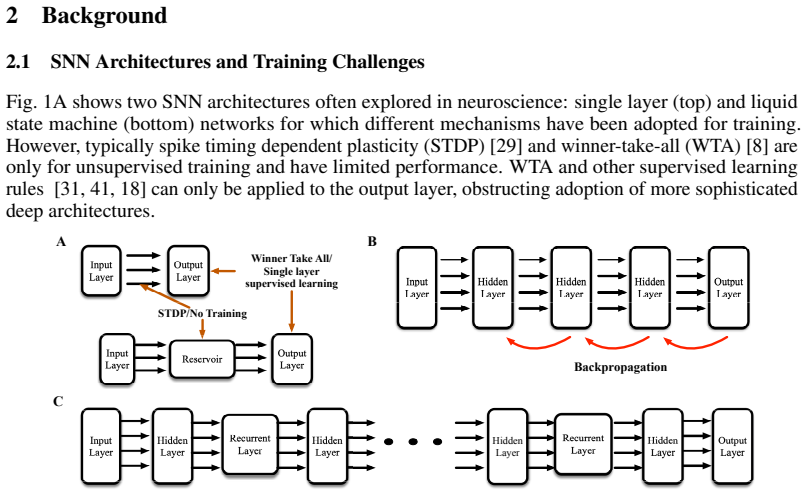
Summary. The paper proposes ST-RSBP, a spike-train level backpropagation algorithm for training deep recurrent spiking neural networks (RSNNs) without unfolding the network through time. The method defines spike-train level post-synaptic potentials (S-PSPs) and total PSPs (T-PSPs), and derives error backpropagation through recurrent layers by solving a linear system of partial derivatives. The S-PSP derivatives with respect to pre- and post-synaptic firing counts are obtained empirically: the pre-synaptic derivative is approximated linearly, and the post-synaptic derivative is fit with a third-order polynomial from random spike-train simulations (Supplementary Section 2.3). Experiments on TI46-Alpha, TI46-Digits, N-TIDIGITS, Fashion-MNIST, and MNIST spiking CNN report state-of-the-art accuracies, with the CUDA implementation released on GitHub.
Significance. If the empirical derivative approximations are valid under the spike statistics encountered during training, ST-RSBP is a substantial contribution: it provides a tractable supervised training rule for deep RSNNs that avoids BPTT, demonstrates strong results across speech and image benchmarks, and ships reproducible GPU code. The paper explicitly identifies a weakness in the HM2-BP linearity assumption and improves on it with a polynomial fit, which is a genuine step forward. However, the fitted derivative is the linchpin of the entire gradient computation, and its validation is currently incomplete; the manuscript's claim that ST-RSBP is 'rigorously derived' overstates the status of this empirically fitted component. The release of source code is a clear strength, but it does not substitute for an analysis of the approximation's range of validity.
major comments (4)
- [Supplementary Section 2.3; Eqs. (19), (23), (25), (26)] The derivative ∂e_ij/∂o_i is obtained by fitting a third-order polynomial to 500 random spike-train simulations per (o_i, o_j) pair with uniformly random spike times. This fitted derivative enters every backpropagated error and every differentiation-of-activation matrix in the algorithm. The manuscript provides no evidence that the fit remains accurate when recurrent layers produce correlated, non-uniform spike trains, nor does it report the polynomial coefficients, so the approximation is not independently checkable or reproducible from the text alone. This is a load-bearing component: if the fit is systematically biased during training, the claimed accuracy gains are not guaranteed. Please either derive this derivative analytically, validate the fit on spike statistics actually encountered during training, or release the fitted coefficients along with a sensitivity analysis.
- [Eq. (1) and Supplementary Eq. (7)] The approximation o_i ≈ a_i/ν replaces an integer firing count with a continuous value and is used throughout the chain rule in Eqs. (9), (10), (23), (25), and (26). The error of this substitution is never quantified, and it is applied uniformly to all layers, including those with low firing counts where discreteness effects are largest. Since the loss function is defined on firing counts, the accuracy of this approximation directly affects the correctness of the gradient. Please provide a bound or empirical characterization of the approximation error, or demonstrate that training is insensitive to it.
- [Eqs. (7)-(10) and Supplementary Eq. (12)] The S-PSP e_ij is defined in Supplementary Eq. (6) as an explicit function of both pre- and post-synaptic firing times, yet the chain rule in Eqs. (9) and (10) differentiates only with respect to firing counts, completely discarding the dependence on spike timing. The main text states that temporal effects are captured in the backward pass, but the derivation as written does not propagate errors through firing times. This is an inconsistency between the definition of S-PSP and the derivative computation, and it should be either resolved by including time-dependent derivatives or explicitly acknowledged as a modeling approximation.
- [After Eq. (13)] The matrix inversion (Ω − Θ)^{-1} is approximated by a first-order Taylor expansion to avoid matrix factorization, but no condition is given for when this expansion is valid (e.g., a spectral radius or norm bound on ΘΩ^{-1}), nor is any error analysis provided. Since this approximation affects the backpropagated error in recurrent layers, the paper should state the validity condition and report how it was checked in the experiments.
minor comments (5)
- [Section 4.3 heading] The heading 'TI46-Digits Speech Datasest' contains a typo; it should read 'Dataset'.
- [Section 2, paragraph 2] The word 'spatio-temproally' should be 'spatio-temporally'.
- [Abstract] The phrase 'state-of-art' should be 'state-of-the-art'.
- [Supplementary Section 2.3] Beyond the coefficients, please specify the exact functional form of the fitted polynomial, the range of o_i and o_j over which it was fit, and how the derivative is extrapolated outside that range.
- [Table 6] The comparison with SLAYER uses different network sizes (12C5-p2-64C5-p2 versus 15C5-P2-40C5-P2-300); please clarify whether the comparison is intended to be at similar model complexity or simply to report the best published result on MNIST.
Circularity Check
No significant circularity: the derivation chain is self-contained and the empirical S-PSP derivative fit is not a fitted prediction of the benchmark results.
full rationale
The ST-RSBP derivation is self-contained rather than circular. The backpropagation equations in the main text (Eqs. 4-13) and the Supplement (Eqs. 9-26) follow by ordinary chain-rule differentiation of the rate-coded loss E = 1/2||o - y||^2 combined with the stated approximation o_i ≈ a_i/ν. The only empirically determined quantities are the S-PSP derivatives ∂e_ij/∂o_j ≈ e_ij/o_j and the third-order polynomial fit for ∂e_ij/∂o_i described in Supplementary Section 2.3. These derivatives are components of the gradient estimator; they are calibrated offline from random spike-train simulations, not fitted to the TI46, N-TIDIGITS, Fashion-MNIST, or MNIST labels. The reported accuracies are measured after actual training runs with released CUDA code, so the state-of-the-art claims are not statistically forced by the derivative fit. The reliance on HM2-BP [19], which shares authors with this paper, supplies the S-PSP concept and a comparison baseline, but the recurrent-layer extension in Eqs. (8)-(13) and the improved polynomial derivative are new content, and the benchmarks are external and reproducible. The empirical derivative fit may raise a correctness or robustness concern if recurrent spike statistics differ from the random simulations used for the fit, but that concern is about approximation quality, not circularity: no predicted quantity is defined in terms of the target result, and no fitted parameter is renamed as a prediction.
Assumptions & free parameters
free parameters (7)
- Third-order polynomial coefficients for ∂e_ij/∂o_i =
not reported in paper
- Ratio approximation ∂e_ij/∂o_j ≈ e_ij/o_j =
identity (no extra parameters)
- Firing thresholds ν_k =
10 mV typical, range 5-20 mV
- Desired output firing counts =
35 target, 5 non-target
- Learning rate η =
0.001
- Time constants τ_m, τ_s =
64 ms, 8 ms
- Refractory period, synaptic delay, reset voltage =
2 ms, 1 ms, 0 mV
assumptions (5)
- domain assumption o_i ≈ a_i / ν_i, i.e., firing count is proportional to T-PSP
- ad hoc to paper e_ij is a differentiable function of pre/post firing counts (and times) and its derivative w.r.t o_i is a third-order polynomial in o_i for fixed o_j
- ad hoc to paper ∂e_ij/∂o_j ≈ e_ij / o_j
- ad hoc to paper The matrix (Ω - Θ) inverse can be replaced by a first-order Taylor expansion without materially affecting training
- domain assumption Firing-time dependence of S-PSP is not propagated through the chain rule; only firing-count dependencies are used
Cite this review
Pith. "Pith review of Spike-Train Level Backpropagation for Training Deep Recurrent Spiking Neural Networks." pith.science (2026). https://pith.science/paper/CB5H5V4Y
@misc{pith2026190806378,
  author       = {Pith},
  title        = {Pith review of: Spike-Train Level Backpropagation for Training Deep Recurrent Spiking Neural Networks},
  year         = {2026},
  howpublished = {\url{https://pith.science/paper/CB5H5V4Y}},
  note         = {Machine review of arXiv:1908.06378}
}
read the original abstract
Spiking neural networks (SNNs) well support spatiotemporal learning and energy-efficient event-driven hardware neuromorphic processors. As an important class of SNNs, recurrent spiking neural networks (RSNNs) possess great computational power. However, the practical application of RSNNs is severely limited by challenges in training. Biologically-inspired unsupervised learning has limited capability in boosting the performance of RSNNs. On the other hand, existing backpropagation (BP) methods suffer from high complexity of unrolling in time, vanishing and exploding gradients, and approximate differentiation of discontinuous spiking activities when applied to RSNNs. To enable supervised training of RSNNs under a well-defined loss function, we present a novel Spike-Train level RSNNs Backpropagation (ST-RSBP) algorithm for training deep RSNNs. The proposed ST-RSBP directly computes the gradient of a rated-coded loss function defined at the output layer of the network w.r.t tunable parameters. The scalability of ST-RSBP is achieved by the proposed spike-train level computation during which temporal effects of the SNN is captured in both the forward and backward pass of BP. Our ST-RSBP algorithm can be broadly applied to RSNNs with a single recurrent layer or deep RSNNs with multiple feed-forward and recurrent layers. Based upon challenging speech and image datasets including TI46, N-TIDIGITS, Fashion-MNIST and MNIST, ST-RSBP is able to train RSNNs with an accuracy surpassing that of the current state-of-art SNN BP algorithms and conventional non-spiking deep learning models.
Figures
Figures from the paper (4 more)


Reference graph
Works this paper leans on
-
[1]
Deep learning using rectified linear units (relu)
Abien Fred Agarap. Deep learning using rectified linear units (relu). arXiv preprint arXiv:1803.08375 , 2018
arXiv 2018
-
[2]
Truenorth: Design and tool flow of a 65 mw 1 million neuron programmable neurosynaptic chip
Filipp Akopyan, Jun Sawada, Andrew Cassidy, Rodrigo Alvarez-Icaza, John Arthur, Paul Merolla, Nabil Imam, Yutaka Nakamura, Pallab Datta, Gi-Joon Nam, et al. Truenorth: Design and tool flow of a 65 mw 1 million neuron programmable neurosynaptic chip. IEEE Transactions on Computer-Aided Design of Integrated Circuits and Systems , 34(10):1537--1557, 2015
work page 2015
-
[3]
Feature representations for neuromorphic audio spike streams
Jithendar Anumula, Daniel Neil, Tobi Delbruck, and Shih-Chii Liu. Feature representations for neuromorphic audio spike streams. Frontiers in neuroscience , 12:23, 2018
work page 2018
-
[4]
Long short-term memory and learning-to-learn in networks of spiking neurons
Guillaume Bellec, Darjan Salaj, Anand Subramoney, Robert Legenstein, and Wolfgang Maass. Long short-term memory and learning-to-learn in networks of spiking neurons. In Advances in Neural Information Processing Systems , pages 787--797, 2018
work page 2018
-
[5]
Error-backpropagation in temporally encoded networks of spiking neurons
Sander M Bohte, Joost N Kok, and Han La Poutre. Error-backpropagation in temporally encoded networks of spiking neurons. Neurocomputing , 48(1-4):17--37, 2002
work page 2002
-
[6]
A unified architecture for natural language processing: Deep neural networks with multitask learning
Ronan Collobert and Jason Weston. A unified architecture for natural language processing: Deep neural networks with multitask learning. In Proceedings of the 25th international conference on Machine learning , pages 160--167. ACM, 2008
work page 2008
-
[7]
Loihi: A neuromorphic manycore processor with on-chip learning
Mike Davies, Narayan Srinivasa, Tsung-Han Lin, Gautham Chinya, Yongqiang Cao, Sri Harsha Choday, Georgios Dimou, Prasad Joshi, Nabil Imam, Shweta Jain, et al. Loihi: A neuromorphic manycore processor with on-chip learning. IEEE Micro , 38(1):82--99, 2018
work page 2018
-
[8]
Unsupervised learning of digit recognition using spike-timing-dependent plasticity
Peter U Diehl and Matthew Cook. Unsupervised learning of digit recognition using spike-timing-dependent plasticity. Frontiers in computational neuroscience , 9:99, 2015
work page 2015
Show all 41 references
-
[9]
Fast-classifying, high-accuracy spiking deep networks through weight and threshold balancing
Peter U Diehl, Daniel Neil, Jonathan Binas, Matthew Cook, Shih-Chii Liu, and Michael Pfeiffer. Fast-classifying, high-accuracy spiking deep networks through weight and threshold balancing. In Neural Networks (IJCNN), 2015 International Joint Conference on , pages 1--8. IEEE, 2015
2015
-
[10]
Backpropagation for energy-efficient neuromorphic computing
Steve K Esser, Rathinakumar Appuswamy, Paul Merolla, John V Arthur, and Dharmendra S Modha. Backpropagation for energy-efficient neuromorphic computing. In Advances in Neural Information Processing Systems , pages 1117--1125, 2015
2015
-
[11]
Spiking neuron models: Single neurons, populations, plasticity
Wulfram Gerstner and Werner M Kistler. Spiking neuron models: Single neurons, populations, plasticity . Cambridge university press, 2002
2002
-
[12]
Neuro-inspired speech recognition with recurrent spiking neurons
Arfan Ghani, T Martin McGinnity, Liam P Maguire, and Jim Harkin. Neuro-inspired speech recognition with recurrent spiking neurons. In International Conference on Artificial Neural Networks , pages 513--522. Springer, 2008
2008
-
[13]
Deep learning
Ian Goodfellow, Yoshua Bengio, and Aaron Courville. Deep learning . MIT press, 2016
2016
-
[14]
Deep neural networks for acoustic modeling in speech recognition: The shared views of four research groups
Geoffrey Hinton, Li Deng, Dong Yu, George E Dahl, Abdel-rahman Mohamed, Navdeep Jaitly, Andrew Senior, Vincent Vanhoucke, Patrick Nguyen, Tara N Sainath, et al. Deep neural networks for acoustic modeling in speech recognition: The shared views of four research groups. IEEE Sig...
2012
-
[15]
Gradient descent for spiking neural networks
Dongsung Huh and Terrence J Sejnowski. Gradient descent for spiking neural networks. In Advances in Neural Information Processing Systems , pages 1433--1443, 2018
2018
-
[16]
Spiking deep networks with lif neurons
Eric Hunsberger and Chris Eliasmith. Spiking deep networks with lif neurons. arXiv preprint arXiv:1510.08829 , 2015
2015 arXiv
-
[17]
Large-scale model of mammalian thalamocortical systems
Eugene M Izhikevich and Gerald M Edelman. Large-scale model of mammalian thalamocortical systems. Proceedings of the national academy of sciences , 105(9):3593--3598, 2008
2008
-
[18]
Ap-stdp: A novel self-organizing mechanism for efficient reservoir computing
Yingyezhe Jin and Peng Li. Ap-stdp: A novel self-organizing mechanism for efficient reservoir computing. In 2016 International Joint Conference on Neural Networks (IJCNN) , pages 1158--1165. IEEE, 2016
2016
-
[19]
Hybrid macro/micro level backpropagation for training deep spiking neural networks
Yingyezhe Jin, Wenrui Zhang, and Peng Li. Hybrid macro/micro level backpropagation for training deep spiking neural networks. In Advances in Neural Information Processing Systems , pages 7005--7015, 2018
2018
-
[20]
Adam: A method for stochastic optimization
Diederik P Kingma and Jimmy Ba. Adam: A method for stochastic optimization. arXiv preprint arXiv:1412.6980 , 2014
2014 arXiv
-
[21]
Imagenet classification with deep convolutional neural networks
Alex Krizhevsky, Ilya Sutskever, and Geoffrey E Hinton. Imagenet classification with deep convolutional neural networks. In Advances in neural information processing systems , pages 1097--1105, 2012
2012
-
[22]
Deep learning
Yann LeCun, Yoshua Bengio, and Geoffrey Hinton. Deep learning. nature , 521(7553):436, 2015
2015
-
[23]
Training deep spiking neural networks using backpropagation
Jun Haeng Lee, Tobi Delbruck, and Michael Pfeiffer. Training deep spiking neural networks using backpropagation. Frontiers in neuroscience , 10:508, 2016
2016
-
[24]
Tidigits speech corpus
R Gary Leonard and George Doddington. Tidigits speech corpus. Texas Instruments, Inc , 1993
1993
-
[25]
TI 46-word LDC93S9 , 1991
Mark Liberman, Robert Amsler, Ken Church, Ed Fox, Carole Hafner, Judy Klavans, Mitch Marcus, Bob Mercer, Jan Pedersen, Paul Roossin, Don Walker, Susan Warwick, and Antonio Zampolli. TI 46-word LDC93S9 , 1991
1991
-
[26]
A computational model of filtering, detection, and compression in the cochlea
Richard Lyon. A computational model of filtering, detection, and compression in the cochlea. In Acoustics, Speech, and Signal Processing, IEEE International Conference on ICASSP'82. , volume 7, pages 1282--1285. IEEE, 1982
1982
-
[27]
Real-time computing without stable states: A new framework for neural computation based on perturbations
Wolfgang Maass, Thomas Natschl \"a ger, and Henry Markram. Real-time computing without stable states: A new framework for neural computation based on perturbations. Neural computation , 14(11):2531--2560, 2002
2002
-
[28]
A million spiking-neuron integrated circuit with a scalable communication network and interface
Paul A Merolla, John V Arthur, Rodrigo Alvarez-Icaza, Andrew S Cassidy, Jun Sawada, Filipp Akopyan, Bryan L Jackson, Nabil Imam, Chen Guo, Yutaka Nakamura, et al. A million spiking-neuron integrated circuit with a scalable communication network and interface. Science , 345(619...
2014
-
[29]
Phenomenological models of synaptic plasticity based on spike timing
Abigail Morrison, Markus Diesmann, and Wulfram Gerstner. Phenomenological models of synaptic plasticity based on spike timing. Biological cybernetics , 98(6):459--478, 2008
2008
-
[30]
Biologically motivated algorithms for propagating local target representations
Alexander G Ororbia and Ankur Mali. Biologically motivated algorithms for propagating local target representations. arXiv preprint arXiv:1805.11703 , 2018
2018 arXiv
-
[31]
Supervised learning in spiking neural networks with resume: sequence learning, classification, and spike shifting
Filip Ponulak and Andrzej Kasi \'n ski. Supervised learning in spiking neural networks with resume: sequence learning, classification, and spike shifting. Neural computation , 22(2):467--510, 2010
2010
-
[32]
Bsa, a fast and accurate spike train encoding scheme
Benjamin Schrauwen and Jan Van Campenhout. Bsa, a fast and accurate spike train encoding scheme. In Neural Networks, 2003. Proceedings of the International Joint Conference on , volume 4, pages 2825--2830. IEEE, 2003
2003
-
[33]
Slayer: Spike layer error reassignment in time
Sumit Bam Shrestha and Garrick Orchard. Slayer: Spike layer error reassignment in time. In Advances in Neural Information Processing Systems , pages 1412--1421, 2018
2018
-
[34]
Best practices for convolutional neural networks applied to visual document analysis
Patrice Y Simard, David Steinkraus, John C Platt, et al. Best practices for convolutional neural networks applied to visual document analysis. In ICDAR , volume 3, pages 958--962, 2003
2003
-
[35]
Spilinc: Spiking liquid-ensemble computing for unsupervised speech and image recognition
Gopalakrishnan Srinivasan, Priyadarshini Panda, and Kaushik Roy. Spilinc: Spiking liquid-ensemble computing for unsupervised speech and image recognition. Frontiers in neuroscience , 12, 2018
2018
-
[36]
Deep neural networks for object detection
Christian Szegedy, Alexander Toshev, and Dumitru Erhan. Deep neural networks for object detection. In Advances in neural information processing systems , pages 2553--2561, 2013
2013
-
[37]
Backpropagation through time: what it does and how to do it
Paul J Werbos. Backpropagation through time: what it does and how to do it. Proceedings of the IEEE , 78(10):1550--1560, 1990
1990
-
[38]
Analysis of liquid ensembles for enhancing the performance and accuracy of liquid state machines
Parami Wijesinghe, Gopalakrishnan Srinivasan, Priyadarshini Panda, and Kaushik Roy. Analysis of liquid ensembles for enhancing the performance and accuracy of liquid state machines. Frontiers in Neuroscience , 13:504, 2019
2019
-
[39]
Spatio-temporal backpropagation for training high-performance spiking neural networks
Yujie Wu, Lei Deng, Guoqi Li, Jun Zhu, and Luping Shi. Spatio-temporal backpropagation for training high-performance spiking neural networks. arXiv preprint arXiv:1706.02609 , 2017
2017 arXiv
-
[40]
Fashion-mnist: a novel image dataset for benchmarking machine learning algorithms
Han Xiao, Kashif Rasul, and Roland Vollgraf. Fashion-mnist: a novel image dataset for benchmarking machine learning algorithms. arXiv preprint arXiv:1708.07747 , 2017
2017 arXiv
-
[41]
A digital liquid state machine with biologically inspired learning and its application to speech recognition
Yong Zhang, Peng Li, Yingyezhe Jin, and Yoonsuck Choe. A digital liquid state machine with biologically inspired learning and its application to speech recognition. IEEE transactions on neural networks and learning systems , 26(11):2635--2649, 2015
2015
Reviewed August 14, 2026 · model on record in the stance chip above.
Discussion (0). Continue with ORCID to comment.