REVIEW 2 major objections 4 minor 112 references
A practical guide to methodological considerations in the controllability of structural brain networks
T0 review · 2 major / 4 minor · reviewed 2026-08-14 · deepseek-v4-flash
Pith's one-line read Brain controllability metrics shift with modeling choices, and a new metric shows brain energy landscapes are more homogeneous than rewired networks.
desk verdict Useful sensitivity guide with a broken complexity-metric validation; fix the null-model statistics and it's publishable. read the letter →
The pith
A machine-rendered reading of the paper's core claim, the machinery that carries it, and where it could break.
The reading
What carries the argument
The machinery is the linear controlled system $\dot{x}(t) = Ax(t) + B_\kappa u_\kappa(t)$, with $A$ the weighted structural adjacency matrix (233 nodes, zero diagonal) and $B_\kappa$ selecting control nodes. From this come the controllability Gramian $W_{\kappa,T} = \int_0^T e^{At} B_\kappa B_\kappa^\top e^{A^\top t} dt$ and the four metrics: average controllability, modal controllability $\phi_i = \sum_{j=1}^{N} (1 - e^{\lambda_j(A)}) v_{ij}^2$, minimum control energy, and optimal control energy. The paper's new complexity metric $C$ measures the spread of the eigenvalue distribution of $W_{\kappa,T}^{-1}$, capturing the heterogeneity of minimum control energy across all possible state transitions. The spatial adjacency matrix counts face-touching voxels between parcels and is averaged with $A$ to form a combined connectivity matrix.
What would settle it
Recompute average controllability, minimum control energy, and the complexity metric on the same ten connectomes after replacing the linear noiseless model with a stochastic or nonlinear neural mass model, or after replacing $A$ with a functional or effective connectivity matrix. If the short-horizon and fast-stabilization control regimes and the brain's lower complexity relative to null models vanish or reverse, then the reported properties belong to the linear tractography model rather than to brain architecture.
Extended reading notes
Core claim
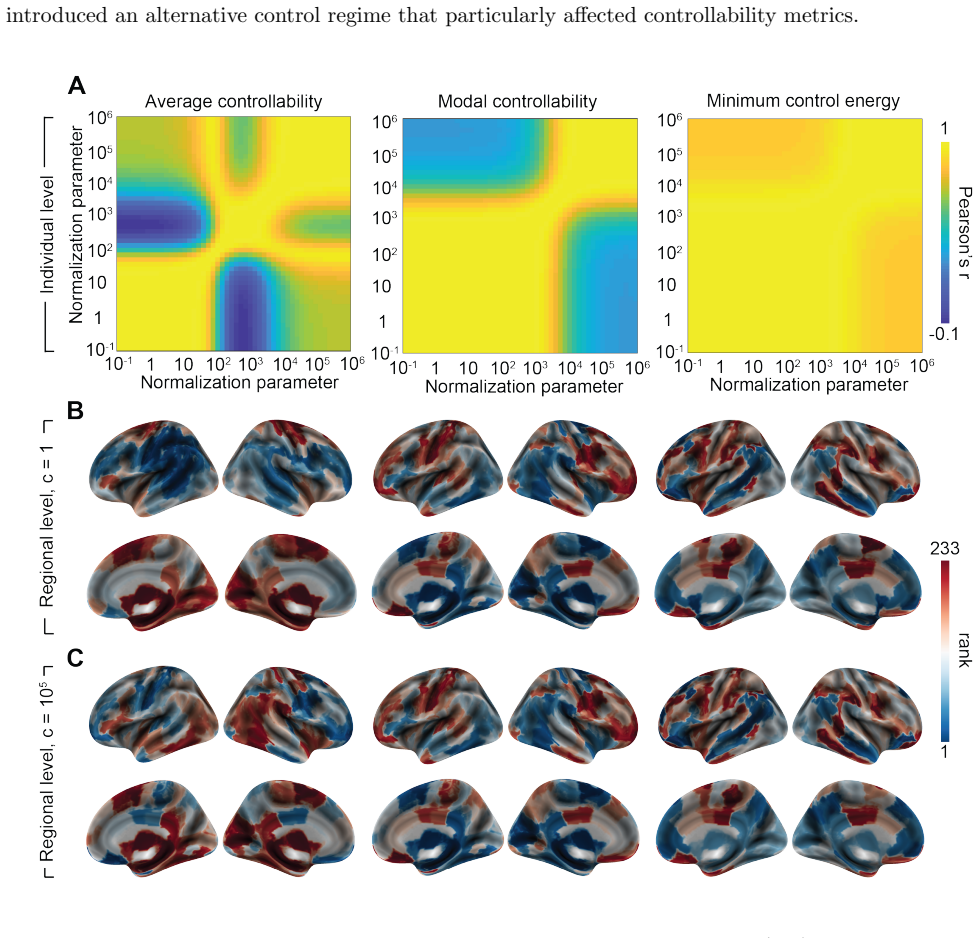
The central claim is that controllability statistics of structural brain networks should be interpreted relative to the modeling choices that produced them. Under the standard linear time-invariant model $\dot{x} = Ax + B_\kappa u_\kappa$, the paper shows that discrete versus continuous time, the time horizon $T$, the normalization parameter $c$, and the size and composition of the control set $B_\kappa$ each shift metric values enough to change regional rankings and even introduce qualitatively different control regimes. The authors therefore recommend verifying results in the alternative time system, checking multiple time horizons, scaling $c$ to the largest eigenvalue of $A$, and controlling sufficiently many regions. The paper further defines spatial adjacency connectivity as the count of face-touching voxels between parcels and energy landscape complexity as the interquartile range of the eigenvalues of the inverse controllability Gramian. It shows that the spatial adjacency measure is complementary to tractography-based connectivity, and that the brain's energy landscape complexity is lower than all three null models tested.
Load-bearing premise
The load-bearing premise is that the linear, time-invariant, noise-free equation $\dot{x} = Ax + B_\kappa u_\kappa$, with $A$ taken from deterministic tractography streamline counts and diagonal zeroed, adequately captures the neural dynamics that controllability metrics describe; the paper itself states that linearity, time invariance, and noise-freedom are approximations.
Editorial extensions
If this is right
- Studies comparing controllability results across datasets must report time system, time horizon, normalization parameter, and control set size, since each shifts the metrics enough to change regional rankings.
- Control energy drops exponentially as control set size grows, so partial control sets produce energy estimates that are reliable only above roughly 28–30% of nodes and can follow qualitatively different state trajectories than full-brain control.
- Short time horizons and fast stabilization form a distinct control regime, so results obtained at one time scale should not be extrapolated to another without rechecking the alternative.
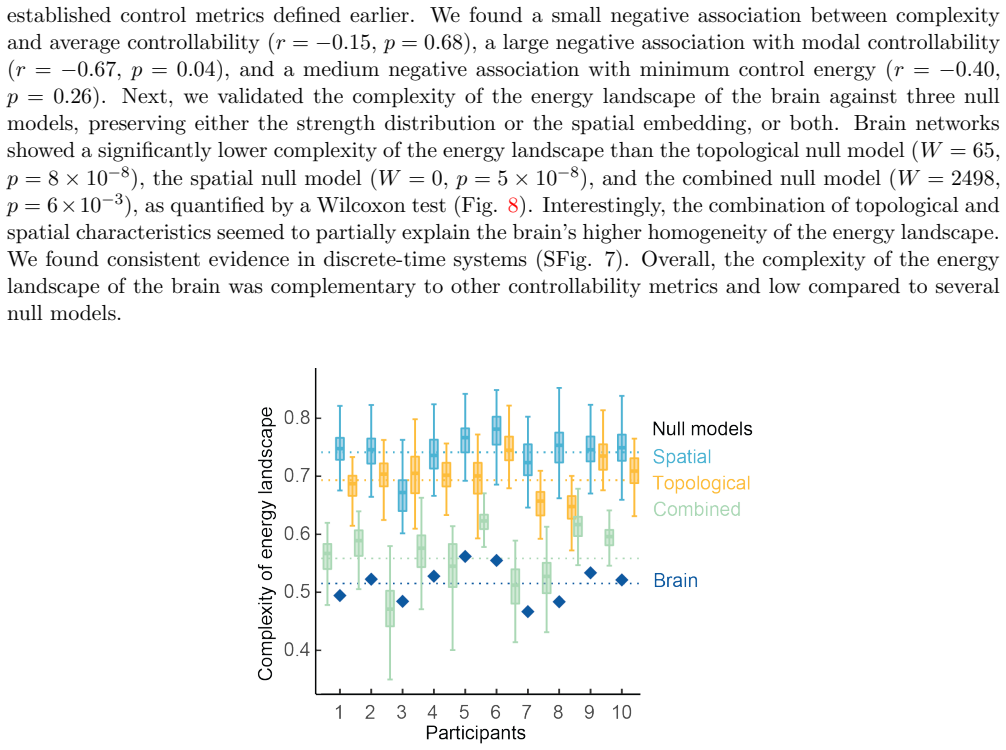
- The lower complexity of the brain's energy landscape relative to all three null models indicates that diverse state transitions require more similar control energy in brain networks than in rewired networks.
- Spatial adjacency connectivity is complementary to tractography-based connectivity, suggesting that combining both measures may capture controllability information that either measure alone misses.
Reading between the lines
- If the complexity metric proves reproducible, it could be tested as a state-independent marker in disorders where neural dynamics become rigid or stereotyped; this is not tested in the paper.
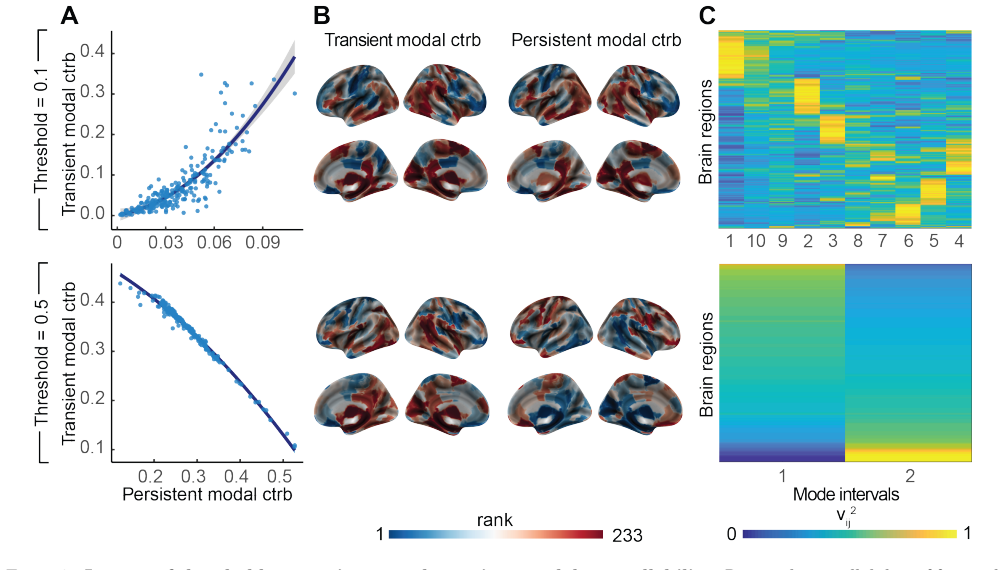
- The trade-off between controlling fast and slow modes at the 50% threshold suggests a testable regional specialization: subcortical regions favor fast-mode control and frontoparietal regions favor slow-mode control in larger samples.
- Because the energy landscape metric is built on the inverse Gramian with full-brain control, applying it to partial control sets will require regularization or a different estimator; the paper notes the inverse Gramian is ill-conditioned for small control sets.
- One could test whether the alternative control regimes induced by short horizons and fast stabilization correspond to stimulation protocols of different durations in intracranial recording data, linking the modeling regimes to observable neural responses.
Signed reviews
Editorial analysis
A structured set of objections, weighed in public.
Referee Report
Summary. This paper is a methodological primer for network control theory applied to structural brain networks. Using diffusion imaging data from ten healthy adults, the authors systematically vary four modeling choices—time system, time horizon, normalization, and control set size—and quantify how these choices affect average controllability, modal controllability, minimum control energy, and optimal control energy. They also propose two extensions: a spatial-adjacency structural connectivity measure S, and a new complexity metric C defined as the interquartile range of eigenvalues of the inverted controllability Gramian. The paper reports that modeling choices can induce qualitatively different control regimes, that S provides information complementary to tractography-based connectivity, and that brain networks have significantly lower energy-landscape complexity than several null models. It closes with concrete modeling recommendations.
Significance. If the sensitivity results hold, the paper fills a genuine need in an active field: it provides an accessible, systematic account of how seemingly arbitrary choices affect commonly used controllability metrics, and it gives actionable recommendations. The treatment of the linearity and noise assumptions is unusually transparent, and the null-model framework for the new complexity metric is a principled way to validate a derived quantity. The regional-level correlations are mostly strong and based on a large number of regions, which supports the main sensitivity claims. The paper is less convincing on the individual level, where n = 10 yields wide confidence intervals and many non-significant correlations. The validation of the complexity metric, which is highlighted in the abstract and discussion, currently rests on internally inconsistent statistics and weak complementarity evidence, so the central claims about C are not yet fully supported.
major comments (2)
- [§4.8, Eq. (9); §3.9; Fig. 8] The headline null-model validation of the complexity metric C is internally inconsistent. The text reports Wilcoxon W = 65, 0, 2498 with p = 8×10⁻⁸, 5×10⁻⁸, and 6×10⁻³ for the topological, spatial, and combined null models. With n = 10 participants, a Wilcoxon signed-rank statistic cannot exceed 55, so W = 65 and W = 2498 are impossible under that test; moreover, a signed-rank W = 0 would have exact two-sided p ≈ 0.002, not 5×10⁻⁸. If a two-sample rank-sum test against the null instantiations is intended instead, the test is not described, and the sample sizes are ambiguous because §3.9 states 1000 random instantiations per model while the Fig. 8 caption states 100. No per-subject C values or code are provided to resolve the discrepancy. Since the claimed lower complexity of brain energy landscapes is the only direct validation of C and is emphasized in the abstract and discussion, this issue must be fixed by re-analyzing the data and reporting the exact test, sample sizes, and per-subject values before the central claims about C can be assessed.
- [§4.8] The complementarity of C with existing controllability metrics is asserted but rests almost entirely on n = 10 correlations. The reported Pearson correlations are r = -0.15 (p = 0.68) with average controllability, r = -0.67 (p = 0.04) with modal controllability, and r = -0.40 (p = 0.26) with minimum control energy. Two of these are not statistically significant, and the one nominally significant result would not survive correction for multiple comparisons. The statement that the complexity metric is 'complementary' to existing controllability metrics therefore goes beyond the evidence reported. Please provide confidence intervals and clearly framed effect-size statements, or temper the complementarity claim to reflect the preliminary nature of this evidence.
minor comments (4)
- [Fig. 8 caption vs. §3.9] The number of null-model instantiations is inconsistent: §3.9 says 1000 per model, while the Fig. 8 caption says 100. Please reconcile these numbers and state the exact test used.
- [References] Reference [10] contains malformed BibTeX text in the author field and should be corrected.
- [§4.5] The reported mean control energies (e.g., meanmin = 43.8 and meanopt = 56.0) are given without units or a clear statement of the normalization of the state vectors; please define these units explicitly.
- [General] The paper would benefit from a data and code availability statement, especially for the new complexity metric whose validation currently cannot be reproduced from the manuscript alone.
Circularity Check
No load-bearing circularity: the new complexity metric and spatial-adjacency measure are closed-form functions of the Gramian and anatomy, and the sensitivity analyses vary modeling choices rather than fitting them to outcomes; self-citations are present but not load-bearing.
full rationale
The paper's central contributions are an empirical sensitivity analysis and two proposed extensions. Average and modal controllability, minimum/optimal control energy, and the Gramian are standard quantities (Eqs. 2, 4, 7, 8). The new complexity metric C_{kappa,T} (Eq. 9) is defined directly as the IQR of the eigenvalues of the inverted controllability Gramian; no parameter is fitted to the headline outcome. The claim that C is lower in brain networks than in topological, spatial, and combined null models is an empirical comparison to nulls that preserve graph features but do not encode C. Likewise, the spatial adjacency network S is defined geometrically from face-touching voxels, and the 'complementary information' claim comes from correlating controllability metrics computed from A and S; no quantity is renamed and then recovered. The modeling-choice analyses (time system, horizon, normalization, control-set size) vary one parameter while holding others fixed and report correlations; these are descriptive, not fitted predictions. The paper does cite substantial prior work by its own authors (e.g., refs. 11, 30, 31, 35, 36) for metric definitions and earlier controllability results, but those citations are not used to force the present conclusions: the null-model comparison and sensitivity results stand on the paper's own computations from the 10-subject dataset. The paper's acknowledged limitations (Section 5, 'Methodological considerations': linearity, time-invariance, noise, restricted state transitions) bear on model validity and generalizability, not on circularity. A separate internal-consistency concern in Section 4.8 (W=65 with n=10 is impossible for a Wilcoxon signed-rank test, and the text states 1000 null instantiations while the Figure 8 caption says 100) is a reproducibility/statistical-reporting problem, not a circularity one; the absence of code or per-subject C values prevents independent audit of that statistic, but auditability is not circular inference.
Assumptions & free parameters
free parameters (5)
- normalization parameter c =
default c=1; sensitivity range 0.1 to 10^6; recommended c=0.01*|lambda_max|
- time horizon T =
T=3 for control energies (approximated by 1000 steps), infinite for average controllability
- relative energy weight rho =
rho=1
- time step dt =
dt=0.001
- fast/slow mode threshold =
10%, 20%, 30%, 40%, 50% fastest and slowest modes
assumptions (6)
- domain assumption Neural activity dynamics are adequately approximated by the linear time-invariant model x_dot = Ax + Bu (Eqs. 1-2).
- domain assumption The structural connectivity matrix A, with edge weights as tractography streamline counts and zero diagonal, is a valid linear operator for brain state dynamics.
- domain assumption The controllability Gramian W_kappa,T exists and is invertible for the control sets used, including single-node control for average and modal controllability and full-brain control for the complexity metric.
- domain assumption The cost function J in Eq. 4 with equal weighting rho=1 is an appropriate normative model for brain state transitions.
- domain assumption Null models preserving strength distribution, spatial embedding, or both are appropriate benchmarks for the complexity of the energy landscape.
- standard math Modal controllability is only formalized for symmetric adjacency matrices, and brain networks are treated as undirected symmetric graphs.
Cite this review
Pith. "Pith review of A practical guide to methodological considerations in the controllability of structural brain networks." pith.science (2026). https://pith.science/paper/CBG7IEHU
@misc{pith2026190803514,
  author       = {Pith},
  title        = {Pith review of: A practical guide to methodological considerations in the controllability of structural brain networks},
  year         = {2026},
  howpublished = {\url{https://pith.science/paper/CBG7IEHU}},
  note         = {Machine review of arXiv:1908.03514}
}
read the original abstract
Predicting how the brain can be driven to specific states by means of internal or external control requires a fundamental understanding of the relationship between neural connectivity and activity. Network control theory is a powerful tool from the physical and engineering sciences that can provide insights regarding that relationship; it formalizes the study of how the dynamics of a complex system can arise from its underlying structure of interconnected units. Given the recent use of network control theory in neuroscience, it is now timely to offer a practical guide to methodological considerations in the controllability of structural brain networks. Here we provide a systematic overview of the framework, examine the impact of modeling choices on frequently studied control metrics, and suggest potentially useful theoretical extensions. We ground our discussions, numerical demonstrations, and theoretical advances in a dataset of high-resolution diffusion imaging with 730 diffusion directions acquired over approximately 1 hour of scanning from ten healthy young adults. Following a didactic introduction of the theory, we probe how a selection of modeling choices affects four common statistics: average controllability, modal controllability, minimum control energy, and optimal control energy. Next, we extend the current state of the art in two ways: first, by developing an alternative measure of structural connectivity that accounts for radial propagation of activity through abutting tissue, and second, by defining a complementary metric quantifying the complexity of the energy landscape of a system. We close with specific modeling recommendations and a discussion of methodological constraints.
Figures


Figures from the paper (5 more)


Reference graph
Works this paper leans on
-
[1]
Emerging concepts for the dynamical organization of resting-state activity in the brain
G Deco, V K Jirsa, and A R McIntosh. Emerging concepts for the dynamical organization of resting-state activity in the brain. Nature Reviews Neuroscience, 12(1):43, 2011
2011
-
[2]
Great expectations: using whole-brain computational connectomics for understanding neuropsychiatric disorders
G Deco and M L Kringelbach. Great expectations: using whole-brain computational connectomics for understanding neuropsychiatric disorders. Neuron, 84(5):892–905, 2014
2014
-
[3]
Learning, memory, and the role of neural network architecture
A M Hermundstad, K S Brown, D S Bassett, and J M Carlson. Learning, memory, and the role of neural network architecture. PLoS computational biology, 7(6):e1002063, 2011
2011
-
[4]
Structural foundations of resting-state and task-based functional connectivity in the human brain
A M Hermundstad, D S Bassett, K S Brown, E M Aminoff, D Clewett, S Freeman, A Frithsen, A Johnson, C M Tipper, M B Miller, et al. Structural foundations of resting-state and task-based functional connectivity in the human brain. Proceedings of the National Academy of Sciences , 110 (15):6169–6174, 2013
2013
-
[5]
Structurally-constrained relationships between cognitive states in the human brain
A M Hermundstad, K S Brown, D S Bassett, E M Aminoff, A Frithsen, A Johnson, C M Tipper, M B Miller, S T Grafton, and J M Carlson. Structurally-constrained relationships between cognitive states in the human brain. PLoS computational biology, 10(5):e1003591, 2014
2014
-
[6]
Recurrent network models of sequence generation and memory
K Rajan, C D Harvey, and D W Tank. Recurrent network models of sequence generation and memory. Neuron, 90(1):128–142, 2016
2016
-
[7]
Distributed synchrony in a hebbian cell assembly of spiking neurons
N Levy, D Horn, I Meilijson, and E Ruppin. Distributed synchrony in a hebbian cell assembly of spiking neurons. Advances in Neural Information Processing Systems , 11, 1999
1999
-
[8]
Spike-time-dependent plasticity and het- erosynaptic competition organize networks to produce long scale-free sequences of neural activity
I R Fiete, W Senn, C ZH Wang, and R HR Hahnloser. Spike-time-dependent plasticity and het- erosynaptic competition organize networks to produce long scale-free sequences of neural activity. Neuron, 65(4):563–576, 2010
2010
Show all 112 references
-
[9]
Linear systems, volume 156
T Kailath. Linear systems, volume 156. Prentice-Hall Englewood Cliffs, NJ, 1980
1980
-
[10]
Controllability of complex networks
Y-Y Liu, J-J Slotine, and journal=nature volume=473 number=7346 pages=167 year=2011 pub- lisher=Nature Publishing Group Barab´ asi, A-L. Controllability of complex networks
2011
-
[11]
Controllability metrics, limitations and algorithms for complex networks
F Pasqualetti, S Zampieri, and F Bullo. Controllability metrics, limitations and algorithms for complex networks. IEEE Transactions on Control of Network Systems , 1(1):40–52, 2014
2014
-
[12]
Complex brain networks: graph theoretical analysis of structural and functional systems
E Bullmore and O Sporns. Complex brain networks: graph theoretical analysis of structural and functional systems. Nature reviews neuroscience, 10(3):186, 2009
2009
-
[13]
On the nature and use of models in network neuroscience
D S Bassett, P Zurn, and J I Gold. On the nature and use of models in network neuroscience. Nat Rev Neurosci, 19(9):566–578, 2018
2018
-
[14]
A dynamical systems view of motor preparation: implications for neural prosthetic system design
K V Shenoy, M T Kaufman, M Sahani, and M M Churchland. A dynamical systems view of motor preparation: implications for neural prosthetic system design. In Progress in brain research, volume 192, pages 33–58. Elsevier, 2011
2011
-
[15]
Characterization of state transitions in spatially distributed, chaotic, nonlinear, dynamical systems in cerebral cortex
W J Freeman. Characterization of state transitions in spatially distributed, chaotic, nonlinear, dynamical systems in cerebral cortex. Integrative Physiological and Behavioral Science, 29(3):294– 306, 1994. 26
1994
-
[16]
Controllability of linear dynamical systems, contributions to differential equations 1 (1963), 189–213
R E Kalman, Y-C Ho, and K S Narendra. Controllability of linear dynamical systems, contributions to differential equations 1 (1963), 189–213. MR, 155070(27):5012
1963
-
[17]
Stimulation-based control of dynamic brain networks
S F Muldoon, F Pasqualetti, S Gu, M Cieslak, S T Grafton, J M Vettel, and D S Bassett. Stimulation-based control of dynamic brain networks. PLoS Comput Biol , 12(9):e1005076, 2016
2016
-
[18]
White matter network architecture guides direct electrical stimulation through optimal state transitions
J Stiso, A N Khambhati, T Menara, A E Kahn, J M Stein, S R Das, R Gorniak, J Tracy, B Litt, K A Davis, et al. White matter network architecture guides direct electrical stimulation through optimal state transitions. arXiv preprint arXiv:1805.01260 , 2018
2018 arXiv
-
[19]
Medial temporal lobe functional connectivity predicts stimulation-induced theta power
E A Solomon, J E Kragel, R Gross, B Lega, M R Sperling, G Worrell, S A Sheth, K A Zaghloul, B C Jobst, J M Stein, S Das, R Gorniak, C S Inman, S Seger, D S Rizzuto, and M J Kahana. Medial temporal lobe functional connectivity predicts stimulation-induced theta power. Nat Commu...
2018
-
[20]
Network controllability in the inferior frontal gyrus relates to controlled language variability and susceptibility to tms
J D Medaglia, D Y Harvey, N White, A Kelkar, J Zimmerman, D S Bassett, and R H Hamilton. Network controllability in the inferior frontal gyrus relates to controlled language variability and susceptibility to tms. Journal of Neuroscience, pages 0092–17, 2018
2018
-
[21]
Functional control of electrophysiological network architecture using direct neurostimulation in humans
A N Khambhati, A E Kahn, J Costantini, Y Ezzyat, E A Solomon, R E Gross, B C Jobst, S A Sheth, K A Zaghloul, G Worrell, S Seger, B C Lega, S Weiss, M R Sperling, R Gorniak, S R Das, J M Stein, D S Rizzuto, M J Kahana, T H Lucas, K A Davis, J I Tracy, and D S Bassett. Functiona...
2019
-
[22]
Optimization of energy state transition trajectory supports the development of executive function during youth
Z Cui, J Stiso, G L Baum, J Z Kim, D R Roalf, R F Betzel, Shi Gu, Z Lu, C H Xia, R Ciric, et al. Optimization of energy state transition trajectory supports the development of executive function during youth. bioRxiv, page 424929, 2018
2018
-
[23]
Locally stable brain states predict suppression of epileptic activity by enhanced cognitive effort
S F Muldoon, J Costantini, W R S Webber, R Lesser, and D S Bassett. Locally stable brain states predict suppression of epileptic activity by enhanced cognitive effort. Neuroimage Clin, 18:599–607, 2018
2018
-
[24]
Sex differences in network controllability as a predictor of executive function in youth
E J Cornblath, E Tang, G L Baum, T M Moore, A Adebimpe, D R Roalf, R C Gur, R E Gur, F Pasqualetti, T D Satterthwaite, et al. Sex differences in network controllability as a predictor of executive function in youth. NeuroImage, 188:122–134, 2019
2019
-
[25]
Motor, cognitive, and affective areas of the cerebral cortex influence the adrenal medulla
R P Dum, D J Levinthal, and P L Strick. Motor, cognitive, and affective areas of the cerebral cortex influence the adrenal medulla. Proc Natl Acad Sci U S A , 113(35):9922–9927, 2016
2016
-
[26]
Feeding the brain and nurturing the mind: Linking nutrition and the gut microbiota to brain development
M S Goyal, S Venkatesh, J Milbrandt, J I Gordon, and M E Raichle. Feeding the brain and nurturing the mind: Linking nutrition and the gut microbiota to brain development. Proc Natl Acad Sci U S A , 112(46):14105–14112, 2015
2015
-
[27]
Network control principles predict neuron function in the Caenorhabditis elegans connectome
G Yan, P E Vrtes, E K Towlson, Y L Chew, D S Walker, W R Schafer, and A L Barabsi. Network control principles predict neuron function in the Caenorhabditis elegans connectome. Nature, 550 (7677):519–523, 2017
2017
-
[28]
Caenorhab- ditis elegans and the network control frameworkfaqs.Philosophical Transactions of the Royal Society B: Biological Sciences, 373(1758):20170372, 2018
E K Towlson, P E V´ ertes, G Yan, Y L Chew, D S Walker, W R Schafer, and A Barab´ asi. Caenorhab- ditis elegans and the network control frameworkfaqs.Philosophical Transactions of the Royal Society B: Biological Sciences, 373(1758):20170372, 2018. 27
2018
-
[29]
Autaptic connections shift network excitability and bursting
L Wiles, S Gu, F Pasqualetti, B Parvesse, D Gabrieli, D S Bassett, and D F Meaney. Autaptic connections shift network excitability and bursting. Sci Rep, 7:44006, 2017
2017
-
[30]
Role of graph architecture in controlling dynamical networks with applications to neural systems
J Z Kim, J M Soffer, A E Kahn, J M Vettel, F Pasqualetti, and D S Bassett. Role of graph architecture in controlling dynamical networks with applications to neural systems. Nature physics, 14(1):91, 2018
2018
-
[31]
Controllability of structural brain networks.Nature communications, 6:8414, 2015
S Gu, F Pasqualetti, M Cieslak, Q K Telesford, B Y Alfred, A E Kahn, J D Medaglia, J M Vettel, M B Miller, S T Grafton, et al. Controllability of structural brain networks.Nature communications, 6:8414, 2015
2015
-
[32]
Human cognition involves the dynamic integration of neural activity and neuromodula- tory systems
J M Shine, M Breakspear, P T Bell, K A Ehgoetz Martens, R Shine, O Koyejo, O Sporns, and R A Poldrack. Human cognition involves the dynamic integration of neural activity and neuromodula- tory systems. Nat Neurosci, 22(2):289–296, 2019
2019
-
[33]
Fronto-limbic dysconnectivity leads to impaired brain network controllability in young people with bipolar disorder and those at high genetic risk
J Jeganathan, A Perry, D S Bassett, G Roberts, P B Mitchell, and M Breakspear. Fronto-limbic dysconnectivity leads to impaired brain network controllability in young people with bipolar disorder and those at high genetic risk. Neuroimage Clin, 19:71–81, 2018
2018
-
[34]
Temporal lobe epilepsy: Hippocampal pathology modulates connectome topology and controllability
B C Bernhardt, F Fadaie, M Liu, B Caldairou, S Gu, E Jefferies, J Smallwood, D S Bassett, A Bernasconi, and N Bernasconi. Temporal lobe epilepsy: Hippocampal pathology modulates connectome topology and controllability. Neurology, 92(19):e2209–e2220, 2019
2019
-
[35]
Optimal trajectories of brain state transitions
S Gu, R F Betzel, M G Mattar, M Cieslak, P R Delio, S T Grafton, F Pasqualetti, and D S Bassett. Optimal trajectories of brain state transitions. Neuroimage, 148:305–317, 2017
2017
-
[36]
Optimally controlling the human connectome: the role of network topology
R F Betzel, S Gu, J D Medaglia, F Pasqualetti, and D S Bassett. Optimally controlling the human connectome: the role of network topology. Scientific reports, 6:30770, 2016
2016
-
[37]
Human brain networks in health and disease
D S Bassett and E T Bullmore. Human brain networks in health and disease. Current opinion in neurology, 22(4):340, 2009
2009
-
[38]
Cognitive network neuroscience
J D Medaglia, M-E Lynall, and D S Bassett. Cognitive network neuroscience. Journal of cognitive neuroscience, 27(8):1471–1491, 2015
2015
-
[39]
Comparative connectomics
M P Van den Heuvel, E T Bullmore, and O Sporns. Comparative connectomics. Trends in cognitive sciences, 20(5):345–361, 2016
2016
-
[40]
From maps to multi-dimensional network mechanisms of mental disorders
U Braun, A Schaefer, R F Betzel, H Tost, A Meyer-Lindenberg, and D S Bassett. From maps to multi-dimensional network mechanisms of mental disorders. Neuron, 97(1):14–31, 2018
2018
-
[41]
Developmental increases in white matter network controllability support a growing diversity of brain dynamics
E Tang, C Giusti, G L Baum, S Gu, E Pollock, A E Kahn, D R Roalf, T M Moore, K Ruparel, R C Gur, et al. Developmental increases in white matter network controllability support a growing diversity of brain dynamics. Nature Communications, 8(1):1252, 2017
2017
-
[42]
Brain state stability during working memory is explained by network control theory, modulated by dopamine d1/d2 receptor function, and diminished in schizophrenia
U Braun, A Harneit, G Pergola, T Menara, A Schaefer, R F Betzel, Z Zang, J I Schweiger, K Schwarz, J Chen, G Blasi, A Bertolino, D Durstewitz, F Pasqualetti, E Schwarz, A Meyer- Lindenberg, D S Bassett, and H Tost. Brain state stability during working memory is explained by ne...
2019
-
[43]
Colloquium: Control of dynamics in brain networks
E Tang and D S Bassett. Colloquium: Control of dynamics in brain networks. Reviews of Modern Physics, 90(3):031003, 2018
2018
-
[44]
Linear dynamics & control of brain networks
J Z Kim and D S Bassett. Linear dynamics & control of brain networks. arXiv preprint arXiv:1902.03309, 2019
1902 arXiv
-
[45]
On how network architecture determines the dominant patterns of spontaneous neural activity
R F Gal´ an. On how network architecture determines the dominant patterns of spontaneous neural activity. PloS one, 3(5):e2148, 2008
2008
-
[46]
Predicting human resting-state functional connectivity from structural connec- tivity
CJ Honey, O Sporns, Leila Cammoun, Xavier Gigandet, Jean-Philippe Thiran, Reto Meuli, and Patric Hagmann. Predicting human resting-state functional connectivity from structural connec- tivity. Proceedings of the National Academy of Sciences , 106(6):2035–2040, 2009
2009
-
[47]
Experience-dependent structural plasticity in the adult human brain
A May. Experience-dependent structural plasticity in the adult human brain. Trends in cognitive sciences, 15(10):475–482, 2011
2011
-
[48]
Modular segregation of structural brain networks supports the development of executive function in youth
G L Baum, R Ciric, D R Roalf, R F Betzel, T M Moore, R T Shinohara, A E Kahn, S N Vandekar, P E Rupert, M Quarmley, P A Cook, M A Elliott, K Ruparel, R E Gur, R C Gur, D S Bassett, and T D Satterthwaite. Modular segregation of structural brain networks supports the development...
2017
-
[49]
How do efficient coding strategies depend on origins of noise in neural circuits? PLoS Comput Biol , 12(10):e1005150, 2016
B A Brinkman, A I Weber, F Rieke, and E Shea-Brown. How do efficient coding strategies depend on origins of noise in neural circuits? PLoS Comput Biol , 12(10):e1005150, 2016
2016
-
[50]
Adaptive coding for dynamic sensory inference
W F Mlynarski and A M Hermundstad. Adaptive coding for dynamic sensory inference. Elife, e32055, 2018
2018
-
[51]
Slope-based stochastic resonance: how noise enables phasic neurons to encode slow signals
Y Gai, B Doiron, and J Rinzel. Slope-based stochastic resonance: how noise enables phasic neurons to encode slow signals. PLoS Comput Biol , 6(6), 2010
2010
-
[52]
Brain signal variability is parametrically modifiable
D D Garrett, A R McIntosh, and C L Grady. Brain signal variability is parametrically modifiable. Cereb Cortex, 24(11):2931–2940, 2014
2014
-
[53]
Networks, noise and models: reconceptualizing the brain as a complex, distributed system
M Breakspear and A R McIntosh. Networks, noise and models: reconceptualizing the brain as a complex, distributed system. Neuroimage, 58(2):293–295, 2011
2011
-
[54]
Mechanisms of zero-lag synchronization in cortical motifs
L L Gollo, C Mirasso, O Sporns, and M Breakspear. Mechanisms of zero-lag synchronization in cortical motifs. PLoS Comput Biol , 10(4):e1003548, 2014
2014
-
[55]
A computa- tional study of stimulus driven epileptic seizure abatement
P N Taylor, Y Wang, M Goodfellow, J Dauwels, F Moeller, U Stephani, and G Baier. A computa- tional study of stimulus driven epileptic seizure abatement. PLoS One, 9(12):e114316, 2014
2014
-
[56]
The theory of optimal processes
V G Boltyanskii, R V Gamkrelidze, and L S Pontryagin. The theory of optimal processes. i. the maximum principle. Technical report, TRW SPACE TECHNOLOGY LABS LOS ANGELES CALIF, 1960
1960
-
[57]
Linear systems theory
J P Hespanha. Linear systems theory. Princeton university press, 2018
2018
-
[58]
Context-dependent architecture of brain state dynamics is explained by white matter connectivity and theories of network control
E J Cornblath, A Ashourvan, J Z Kim, R F Betzel, R Ciric, G L Baum, X He, K Ruparel, T M Moore, R C Gur, et al. Context-dependent architecture of brain state dynamics is explained by white matter connectivity and theories of network control. arXiv preprint arXiv:1809.02849, 2018. 29
2018 arXiv
-
[59]
Structural control energy of resting-state functional brain states reveals inefficient brain dynamics in psychosis vulnerability
D Zller, C Sandini, M Schaer, S Eliez, D S Bassett, and D Van De Ville. Structural control energy of resting-state functional brain states reveals inefficient brain dynamics in psychosis vulnerability. bioRxiv, 703561, 2019
2019
-
[60]
Structural controllability of symmetric networks
T Menara, D Bassett, and F Pasqualetti. Structural controllability of symmetric networks. IEEE Transactions on Automatic Control, 2018
2018
-
[61]
Optimal sensor and actuator location for descriptor systems using generalized gramians and balanced realizations
B Marx, D Koenig, and Didier Georges. Optimal sensor and actuator location for descriptor systems using generalized gramians and balanced realizations. In Proceedings of the 2004 American Control Conference, volume 3, pages 2729–2734. IEEE, 2004
2004
-
[62]
Optimal sensor and actuator location for unstable systems
H R Shaker and M Tahavori. Optimal sensor and actuator location for unstable systems. Journal of Vibration and Control , 19(12):1915–1920, 2013
1915
-
[63]
Measures of modal controllability and observability for first-and second-order linear systems
AMA Hamdan and AH Nayfeh. Measures of modal controllability and observability for first-and second-order linear systems. Journal of guidance, control, and dynamics , 12(3):421–428, 1989
1989
-
[64]
Nipype: a flexible, lightweight and extensible neuroimaging data processing framework in python
K Gorgolewski, C D Burns, C Madison, D Clark, Y O Halchenko, M L Waskom, and S S Ghosh. Nipype: a flexible, lightweight and extensible neuroimaging data processing framework in python. Front Neuroinform, 5, 08 2011. ISSN 1662-5196
2011
-
[65]
A reproducible evaluation of ants similarity metric performance in brain image registration
B B Avants, N J Tustison, G Song, P A Cook, A Klein, and J C Gee. A reproducible evaluation of ants similarity metric performance in brain image registration. Neuroimage, 54(3):2033–2044, 2011
2011
-
[66]
Generalized q-sampling imaging
F-C Yeh, V J Wedeen, and W-Y I Tseng. Generalized q-sampling imaging. IEEE transactions on medical imaging, 29(9):1626–1635, 2010
2010
-
[67]
Deterministic diffusion fiber tracking improved by quantitative anisotropy
F-C Yeh, T D Verstynen, Y Wang, J C Fern´ andez-Miranda, and W-Y I Tseng. Deterministic diffusion fiber tracking improved by quantitative anisotropy. PloS one, 8(11):e80713, 2013
2013
-
[68]
Local termination pattern analysis: a tool for comparing white matter morphology
M Cieslak and ST Grafton. Local termination pattern analysis: a tool for comparing white matter morphology. Brain imaging and behavior , 8(2):292–299, 2014
2014
-
[69]
Conserved and variable architecture of human white matter connectivity
D S Bassett, J A Brown, V Deshpande, J M Carlson, and S T Grafton. Conserved and variable architecture of human white matter connectivity. Neuroimage, 54(2):1262–1279, 2011
2011
-
[70]
Mapping the human connectome at multiple scales with diffusion spectrum mri
L Cammoun, X Gigandet, D Meskaldji, J P Thiran, O Sporns, K Q Do, P Maeder, R Meuli, and P Hagmann. Mapping the human connectome at multiple scales with diffusion spectrum mri. Journal of neuroscience methods , 203(2):386–397, 2012
2012
-
[71]
The connectome mapper: an open-source processing pipeline to map connectomes with mri
A Daducci, S Gerhard, A Griffa, A Lemkaddem, L Cammoun, X Gigandet, R Meuli, P Hagmann, and J-P Thiran. The connectome mapper: an open-source processing pipeline to map connectomes with mri. PloS one, 7(12):e48121, 2012
2012
-
[72]
B. T. Yeo, F. M. Krienen, J. Sepulcre, M. R. Sabuncu, D. Lashkari, M. Hollinshead, J. L. Roffman, Smoller J. W., L. Zllei, J. R. Polimeni, B. Fischl, ... Liu, H., and R. L. Buckner. The organization of the human cerebral cortex estimated by intrinsic functional connectivity. Jo...
2011
-
[73]
Benchmarking measures of network controllability on canonical graph models
E Wu-Yan, R F Betzel, E Tang, S Gu, F Pasqualetti, and D S Bassett. Benchmarking measures of network controllability on canonical graph models. Journal of Nonlinear Science, pages 1–39, 2018
2018
-
[74]
The control of brain network dynamics across diverse scales of space and time
E Tang, G L Baum, D R Roalf, T D Satterthwaite, F Pasqualetti, and D S Bassett. The control of brain network dynamics across diverse scales of space and time. arXiv preprint arXiv:1901.07536 , 2019
1901 arXiv
-
[75]
Complex network measures of brain connectivity: uses and interpreta- tions
M Rubinov and O Sporns. Complex network measures of brain connectivity: uses and interpreta- tions. Neuroimage, 52(3):1059–1069, 2010
2010
-
[76]
The contribution of geometry to the human connectome
J A Roberts, A Perry, A R Lord, G Roberts, P B Mitchell, R E Smith, F Calamante, and M Break- spear. The contribution of geometry to the human connectome. Neuroimage, 124:379–393, 2016
2016
-
[77]
Controllability transition and nonlocality in network control
J Sun and A E Motter. Controllability transition and nonlocality in network control. Physical review letters, 110(20):208701, 2013
2013
-
[78]
The fundamental advantages of temporal networks
A Li, S P Cornelius, Y-Y Liu, L Wang, and A-L Barab´ asi. The fundamental advantages of temporal networks. Science, 358(6366):1042–1046, 2017
2017
-
[79]
Advancing neuromodulation using a dynamic control framework
P Afshar, X Wei, M Lazarewicz, R Gupta, G Molnar, and T Denison. Advancing neuromodulation using a dynamic control framework. Conf Proc IEEE Eng Med Biol Soc , 2011:671–674, 2011
2011
-
[80]
Distributed control in a mean-field cortical network model: implications for seizure suppression
S Ching, E N Brown, and M A Kramer. Distributed control in a mean-field cortical network model: implications for seizure suppression. Phys Rev E Stat Nonlin Soft Matter Phys , 86(2 Pt 1):021920, 2012
2012
-
[81]
Emerging technology for advancing the treatment of epilepsy using a dynamic control framework
S Stanslaski, J Giftakis, P Stypulkowski, D Carlson, P Afshar, P Cong, and T Denison. Emerging technology for advancing the treatment of epilepsy using a dynamic control framework. Conf Proc IEEE Eng Med Biol Soc , 2011:753–756, 2011
2011
-
[82]
Optimal control based seizure abatement using patient derived connectivity
P N Taylor, J Thomas, N Sinha, J Dauwels, M Kaiser, T Thesen, and J Ruths. Optimal control based seizure abatement using patient derived connectivity. Front Neurosci, 9:202, 2015
2015
-
[83]
Controlling seizure propagation in large- scale brain networks
S Olmi, S Petkoski, M Guye, F Bartolomei, and V Jirsa. Controlling seizure propagation in large- scale brain networks. PLoS Comput Biol , 15(2):e1006805, 2019
2019
-
[84]
Closed-loop control of a fragile network: application to seizure-like dynamics of an epilepsy model
D Ehrens, D Sritharan, and S V Sarma. Closed-loop control of a fragile network: application to seizure-like dynamics of an epilepsy model. Front Neurosci, 9:58, 2015
2015
-
[85]
Parameter estimation for maximizing controllability of linear brain-machine interfaces
S Gowda, A L Orsborn, and J M Carmena. Parameter estimation for maximizing controllability of linear brain-machine interfaces. Conf Proc IEEE Eng Med Biol Soc , 2012:1314–1317, 2012
2012
-
[86]
Learn- ing in brain-computer interface control evidenced by joint decomposition of brain and behavior
J Stiso, M-C Corsi, J O Garcia, J M Vettel, F De Vico Fallani, T H Lucas, and D S Bassett. Learn- ing in brain-computer interface control evidenced by joint decomposition of brain and behavior. psyArxiv, en69j, 2019
2019
-
[87]
Spectral fingerprints of large-scale neuronal interactions
M Siegel, T H Donner, and A K Engel. Spectral fingerprints of large-scale neuronal interactions. Nature Reviews Neuroscience, 13(2):121, 2012
2012
-
[88]
Magnetoencephalography for brain electrophysiology and imaging
S Baillet. Magnetoencephalography for brain electrophysiology and imaging. Nature neuroscience, 20(3):327, 2017. 31
2017
-
[89]
Observability and controllability of nonlinear networks: The role of symmetry
A J Whalen, S N Brennan, T D Sauer, and S J Schiff. Observability and controllability of nonlinear networks: The role of symmetry. Phys Rev X , 5:1, 2015
2015
-
[90]
Intrinsic dynamics induce global symmetry in network controllability
C Zhao, W X Wang, Y Y Liu, and J J Slotine. Intrinsic dynamics induce global symmetry in network controllability. Sci Rep, 5(8422), 2015
2015
-
[91]
Effects of symmetry on the structural controllability of neural networks: A perspective
A J Whalen, S N Brennan, T D Sauer, and S J Schiff. Effects of symmetry on the structural controllability of neural networks: A perspective. Proc Am Control Conf, 2016:5785–5790, 2016
2016
-
[92]
Robust multiobjective controllability of complex neuronal networks
Y Tang, H Gao, W Du, J Lu, A V Vasilakos, and J Kurths. Robust multiobjective controllability of complex neuronal networks. IEEE/ACM Trans Comput Biol Bioinform , 13(4):778–791, 2016
2016
-
[93]
Controlling neural network responsiveness: tradeoffs and constraints
H Keren and S Marom. Controlling neural network responsiveness: tradeoffs and constraints. Front Neuroeng, 7:11, 2014
2014
-
[94]
Enabling controlling complex networks with local topological information
G Li, L Deng, G Xiao, P Tang, C Wen, W Hu, J Pei, L Shi, and H E Stanley. Enabling controlling complex networks with local topological information. Sci Rep, 8(1):4593, 2018
2018
-
[95]
Control of multilayer networks
G Menichetti, L Dall’Asta, and G Bianconi. Control of multilayer networks. Sci Rep, 6:20706, 2016
2016
-
[96]
Multiobjective identification of controlling areas in neuronal net- works
Y Tang, H Gao, and J Kurths. Multiobjective identification of controlling areas in neuronal net- works. IEEE/ACM Trans Comput Biol Bioinform , 10(3):708–720, 2013
2013
-
[97]
A constrained evolutionary computation method for detecting controlling regions of cortical networks
Y Tang, Z Wang, H Gao, S Swift, and J Kurths. A constrained evolutionary computation method for detecting controlling regions of cortical networks. IEEE/ACM Trans Comput Biol Bioinform , 9(6):1569–1581, 2012
2012
-
[98]
Identifying controlling nodes in neuronal networks in different scales
Y Tang, H Gao, W Zou, and J Kurths. Identifying controlling nodes in neuronal networks in different scales. PLoS One, 7(7):e41375, 2012
2012
-
[99]
Realistic control of network dynamics
S P Cornelius, W L Kath, and A E Motter. Realistic control of network dynamics. Nat Commun, 4:1942, 2013
1942
-
[100]
Networkcontrology
A E Motter. Networkcontrology. Chaos, 25(9):097621, 2015
2015
-
[101]
Structure-based control of complex networks with nonlinear dynamics
J G T Za˜ nudo, G Yang, and R Albert. Structure-based control of complex networks with nonlinear dynamics. Proceedings of the National Academy of Sciences , 114(28):7234–7239, 2017
2017
-
[102]
Statistical mechanics of influence maximization with thermal noise
C W Lynn and D D Lee. Statistical mechanics of influence maximization with thermal noise. European Physics Letters, 117, 2017
2017
-
[103]
The energy landscape of neurophysiological activity implicit in brain network structure
S Gu, M Cieslak, B Baird, S F Muldoon, S T Grafton, F Pasqualetti, and D S Bassett. The energy landscape of neurophysiological activity implicit in brain network structure. Sci Rep, 8(1):2507, 2018
2018
-
[104]
Controllability analysis of the neural mass model with dynamic parameters
X Liu, J Gao, G Wang, and Z W Chen. Controllability analysis of the neural mass model with dynamic parameters. Neural Comput, 29(2):485–501, 2017
2017
-
[105]
Large-scale dynamic modeling of task-fMRI signals via subspace system identification
C O Becker, D S Bassett, and V M Preciado. Large-scale dynamic modeling of task-fMRI signals via subspace system identification. J Neural Eng , 15(6):066016, 2018. 32
2018
-
[106]
A dynamical systems framework to uncover the drivers of large-scale cortical activity
A Ashourvan, S Pequito, M Bertolero, J Z Kim, D S Bassett, and B Litt. A dynamical systems framework to uncover the drivers of large-scale cortical activity. bioRxiv, 638718, 2019
2019
-
[107]
Identifying nonlinear dynamical systems via generative recurrent neural networks with applications to fMRI
G Koppe, J Toutounji, P Kirsch, S Lis, and D Durstewitz. Identifying nonlinear dynamical systems via generative recurrent neural networks with applications to fMRI. arXiv, 1902:07186, 2019
1902
-
[108]
Anatomical accuracy of brain connections derived from diffusion mri tractography is inherently limited
C Thomas, Q Y Frank, M O Irfanoglu, P Modi, K S Saleem, D A Leopold, and C Pierpaoli. Anatomical accuracy of brain connections derived from diffusion mri tractography is inherently limited. Proceedings of the National Academy of Sciences , 111(46):16574–16579, 2014
2014
-
[109]
Superficial white matter fiber systems impede detection of long-range cortical connections in diffusion mr tractography
C Reveley, A K Seth, C Pierpaoli, A C Silva, D Yu, R C Saunders, D A Leopold, and Q Y Frank. Superficial white matter fiber systems impede detection of long-range cortical connections in diffusion mr tractography. Proceedings of the National Academy of Sciences , 112(21):E2820– E...
2015
-
[110]
Tractography: where do we go from here? Brain connectivity, 1 (3):169–183, 2011
S Jbabdi and H Johansen-Berg. Tractography: where do we go from here? Brain connectivity, 1 (3):169–183, 2011
2011
-
[111]
Evaluation and statistical inference for human connectomes
F Pestilli, J D Yeatman, A Rokem, K N Kay, and B A Wandell. Evaluation and statistical inference for human connectomes. Nature methods, 11(10):1058, 2014
2014
-
[112]
Dynamics and control at feedback vertex sets
B Fiedler, A Mochizuki, G Kurosawa, and D Saito. Dynamics and control at feedback vertex sets. i: Informative and determining nodes in regulatory networks. Journal of Dynamics and Differential Equations, 25(3):563–604, 2013. 33
2013
Reviewed August 14, 2026 · model on record in the stance chip above.
Discussion (0). Continue with ORCID to comment.