REVIEW 1 major objections 4 minor 58 references
Pseudomagnetotransport in Strained Graphene
T0 review · 1 major / 4 minor · reviewed 2026-08-07 · deepseek-v4-flash
Pith's one-line read A scaling transformation for strained graphene preserves the pseudomagnetic field and low-energy Dirac physics, making micrometer-scale device transport simulations feasible.
desk verdict A genuinely useful scaling method for strained-graphene transport, with the snake-state results pushed into a regime where the scaling error is not yet benchmarked. read the letter →
The pith
A machine-rendered reading of the paper's core claim, the machinery that carries it, and where it could break.
The reading
What carries the argument
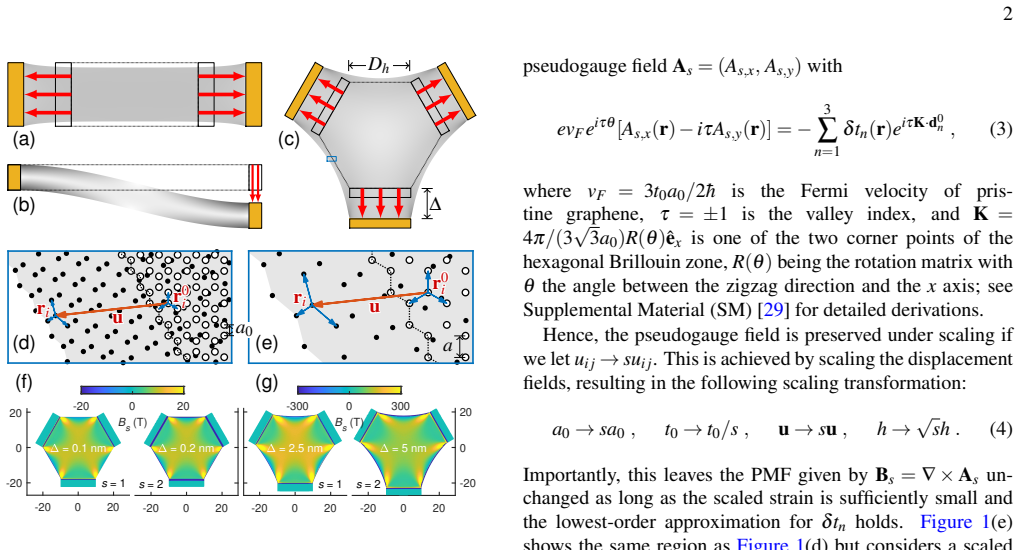
The load-bearing object is the scaling transformation of Eq. (4): $a_0 \to s a_0$, $t_0 \to t_0/s$, $\mathbf{u} \to s\mathbf{u}$, $h \to \sqrt{s}h$. It works because the pseudogauge field in lowest order depends on the strain tensor $u_{ij} = [\partial_i u_j + \partial_j u_i + (\partial_i h)(\partial_j h)]/2$, which scales linearly; the displacement-scaling part compensates for the fact that bond-vector differences are sampled over the scaled lattice vectors, $\mathbf{u}(r+s d^0_n)-\mathbf{u}(r) \approx s (d^0_n \cdot \nabla)\mathbf{u}(r)$. The pseudogauge-field relation of Eq. (3) connects the hopping modulations to $\mathbf{A}_s$ and is what the scaling must preserve.
What would settle it
A direct check is to compare the local density of states or two-terminal conductance of a scaled strained ribbon at $s=4$ against $s=1$ for a pseudomagnetic field above 3 T; the authors report in the Supplemental Material that the conductance plateaus deviate from the predicted positions in exactly this regime. Experimentally, measuring the transverse-focusing peak positions in a bent graphene ribbon under strong bending would test whether the scaled model's predictions hold at large strain.
Extended reading notes
Core claim
The central claim is that strain-induced pseudogauge fields survive a coarse-graining of the graphene lattice. Starting from the tight-binding Hamiltonian with hopping amplitude $t_{ij}=t_0\exp[-\beta(|r_i-r_j|/a_0-1)]$, the strain enters through a modulation $\delta t_n = -t_0\beta \sum_{ij} u_{ij} d^0_{n,i}d^0_{n,j}/a_0^2$, which produces the pseudogauge field via $ev_F e^{i\tau\theta}[A_{s,x}-i\tau A_{s,y}] = -\sum_n \delta t_n e^{i\tau K \cdot d^0_n}$. Under the scaling $a_0 \to s a_0$, $t_0 \to t_0/s$, $\mathbf{u} \to s\mathbf{u}$, $h \to \sqrt{s} h$, the strain tensor $u_{ij} \to s u_{ij}$, so $B_s = \nabla \times \mathbf{A}_s$ is unchanged and the low-energy Dirac physics is preserved. This is confirmed numerically by comparing pseudo Landau levels of a triaxially strained flake at $s=1,2,3,4$. Applied to a bent zigzag ribbon, the model yields transverse pseudomagnetic focusing with valley-polarized current; applied to an S-shaped ribbon, it yields pseudomagnetic snake states localized at the sign change of $B_s$, both producing experimentally visible conductance oscillations.
Load-bearing premise
The method assumes the displacement field varies slowly enough that the bond-vector change can be linearized as $(d^0_n \cdot \nabla)\mathbf{u}(r)$; when the scaled strain becomes large this breaks down, and the pseudomagnetic field is no longer preserved, as the authors demonstrate for large displacements and at $s=4$ for fields above 3 T.
Editorial extensions
If this is right
- Quantum transport in micrometer-sized strained graphene devices with nearly uniform pseudomagnetic fields becomes computationally feasible without full atomistic resolution.
- A bent graphene ribbon acts as a strain-only valley splitter: transverse pseudomagnetic focusing sends one valley toward the collector and the other away, with conductance peaks that are asymmetric between inward and outward bending.
- In an S-shaped ribbon, pseudomagnetic snake states bound to the sign change of $B_s$ propagate oppositely for the two valleys and produce conductance oscillations as the strain is tuned.
- When a real magnetic field and a pseudomagnetic field coexist, the Landau-level ladder is $E_m(B_z \pm B_s)$, and the zeroth Landau level changes sublattice support at $B_z = B_s$, giving a handle to distinguish strain effects from magnetic ones.
Reading between the lines
- The same scaling could be applied to other Dirac materials with strain-tunable gauge fields, or to moiré systems where lattice relaxation creates pseudogauge fields, potentially enabling transport simulations of twisted multilayers at realistic moiré periods.
- Because the scaling fails for large scaled strain, the practical sweet spot is moderate pseudomagnetic fields (below roughly 3 T at $s=4$); pushing to the hundreds-of-tesla regime of nanobubbles would need higher-order bond-length corrections.
- The predicted valley-polarized focusing could be tested as a strain-only valley filter: a bent ribbon with two closely spaced contacts should show a nonlocal conductance signal that reverses when the bending direction is flipped, without any external magnetic field.
- A natural numerical follow-up is to compute the full shot-noise or Fano factor of the focusing peaks, which would indicate whether the valley-polarized current is also phase-coherent, an aspect the conductance oscillations alone do not reveal.
Editorial analysis
A structured set of objections, weighed in public.
Referee Report
Summary. This paper extends the scalable tight-binding model for graphene to strained systems. The proposed scaling transformation (Eq. 4) changes the lattice spacing, hopping amplitude, in-plane displacement field, and out-of-plane displacement field such that the pseudogauge field is approximately unchanged. The authors benchmark the transformation by comparing pseudo Landau levels for scaling factors s = 1 to 4, including coexisting real and pseudomagnetic fields. They then apply the method to quantum transport in two mesoscopic devices: a bent zigzag ribbon with transverse pseudomagnetic focusing and valley-polarized current (Fig. 3), and an S-shaped ribbon with a sign-changing pseudomagnetic field giving rise to pseudomagnetic snake states and conductance oscillations (Fig. 4). The paper argues that the method enables quantum transport simulations of micrometer-scale strained graphene devices with realistic geometries.
Significance. If the scaling method is fully validated, it is a practically valuable extension of the earlier scalable tight-binding model: it makes quantum transport calculations of micron-scale strained graphene devices computationally feasible and produces concrete, falsifiable transport signatures such as focusing peaks and snake-state oscillations. The analytic derivation of the scaling law and the s = 1 to 4 Landau-level benchmarks are genuine strengths, as is the authors' explicit acknowledgment of deviations for large displacements (Fig. 1g) and at s = 4 for Bs above about 3 T (SM S5). The principal concern is that the quantitative transport predictions, especially the high-field snake-state results, are made in regimes where this scaling validity has not been demonstrated.
major comments (1)
- [§4, Fig. 4; SM S5] The snake-state simulations in Fig. 4 are performed at s = 2 with Bs up to approximately 6 T. The scaling benchmark in SM S5 shows that for s = 4 the two-terminal conductance plateaus begin to deviate from the unscaled positions for Bs greater than about 3 T. Because the error in the linearized bond-vector expansion of Eq. (S21) grows with the product of the scaling factor and the local strain, the (s = 2, Bs approximately 6 T) regime used in Fig. 4 is comparable to the (s = 4, Bs approximately 3 T) regime in which the benchmark already fails. No s = 1 comparison is reported for the S-shaped geometry or for this Bs range; the s = 1 transport results in SM S5 use a smaller, uniformly bent ribbon at lower fields. The conductance oscillations in Fig. 4 are a central prediction, so the high-Bs peaks could be shifted or distorted by the scaling approximation rather than representing the physical device. The authors should either provide a scaling-convergence check for this geometry (for example, an s = 1 calculation on a smaller equivalent S-shaped device, or a direct comparison of the implemented PMF profile against the target profile over the full Bs range) or restrict the quantitative claims to the regime where the scaling has been validated.
minor comments (4)
- [SM S5] The 1.1 conversion factor used to convert the strain parameter u0 to the pseudomagnetic field Bs is mentioned only in the Supplemental Material; since it sets the horizontal axes of Figs. 3 and 4, it should be stated in the main text and its sensitivity should be discussed.
- [Abstract] The abstract states that the scaling is valid as long as the atomic displacements vary slowly with respect to the scaled lattice, but the benchmarks in Fig. 1(g) and SM S5 show that large local strain also breaks the scaling; the stated validity condition should include a small-strain requirement.
- [Fig. 2(b)] In the inset of Fig. 2(b) the plotted quantity is D/s^2, while the text says that the peak height scales with the area as s^2; a sentence clarifying the normalization would prevent confusion.
- [Conclusions] The conclusion mentions realistic device dimensions up to one micron, but the two main transport simulations use ribbons of width 600 nm and 206 nm; the micron-scale statement is supported only by the triaxial flake in SM S8 (Dh = 1500 nm), so the wording should be adjusted or the SM result should be cited.
Circularity Check
No significant circularity: the scaling transformation is derived from a linearized hopping expansion and independently benchmarked against unscaled s=1 transport and analytic Landau levels; the 1.1 pseudomagnetic-field-axis correction is a transparent calibration, not a load-bearing prediction.
full rationale
The central scaling transformation (Eq. 4) is constructed from the lowest-order hopping expansion in SM S2, not imported from a fit or from a self-citation. It is then independently validated: SM S5 compares two-terminal conductance of the same bent zigzag ribbon at s=1, s=2, and s=4, finding the quantum-Hall-like steps at the same positions for s=2; the main text compares local-density-of-states maps against the analytic Landau-level formula Eq. (5) for s=1,...,4. These are direct numerical checks of the scaling approximation, so the central claim does not reduce to its inputs. The only fitted element is the 1.1 conversion factor in SM S5 used to label the pseudomagnetic-field axis; the paper states explicitly that it is a correction chosen to match pseudo-Landau-level positions to the s=1 conductance steps. This calibration affects the horizontal-axis labeling, but it does not generate the conductance oscillations, the valley-polarized focusing, or the snake-state current maps, which are direct tight-binding outputs. Self-citations (Ref. 26 for the scalable tight-binding model, Ref. 32 for elastic screening) are background inputs; the strained extension is checked against unscaled s=1 calculations in the same paper, so these citations are not load-bearing. The s=4 deviations at Bs > 3 T and the absence of an s=1 benchmark for the S-shaped snake-state geometry are validity and accuracy concerns, not circularity. Overall, the paper is self-contained against its own unscaled benchmarks and external analytic results.
Assumptions & free parameters
free parameters (1)
- PMF conversion factor 1.1 =
1.1
assumptions (5)
- domain assumption Central force approximation for strain-dependent hopping, t_ij = t0 exp(-beta(|r_i-r_j|/a0 - 1)), with beta = 3.37 and t0 = 3 eV.
- domain assumption The change in hopping delta t_n is linearized in the strain tensor, and the scaling law is valid only when the scaled strain is small.
- domain assumption Continuum elasticity with Lame coefficients lambda = 3.3 eV/Angstrom^2 and mu = 9.4 eV/Angstrom^2, and neglect of optical displacement contributions modeled by a reduction factor kappa with beta*kappa approximately 1.
- domain assumption Neglect of the scalar deformation potential due to volumetric strain, justified by screening for slowly varying strain.
- domain assumption The idealized displacement profiles (bent ribbon Eq. S39, S-shaped tanh profile, triaxial strain) produce the intended pseudomagnetic field profiles in the continuum limit.
Cite this review
Pith. "Pith review of Pseudomagnetotransport in Strained Graphene." pith.science (2026). https://pith.science/paper/CBJJU4RN
@misc{pith2026250521056,
  author       = {Pith},
  title        = {Pith review of: Pseudomagnetotransport in Strained Graphene},
  year         = {2026},
  howpublished = {\url{https://pith.science/paper/CBJJU4RN}},
  note         = {Machine review of arXiv:2505.21056}
}
read the original abstract
In graphene, long-wavelength deformations that result in elastic shear strain couple to the low-energy Dirac electrons as pseudogauge fields. Using a scalable tight-binding model, we consider analogs to magnetotransport in mesoscopic strained graphene devices with nearly uniform pseudomagnetic fields. In particular, we consider transverse pseudomagnetic focusing in a bent graphene ribbon and show that a focused valley-polarized current can be generated with characteristic conductance oscillations. Importantly, our scaling method allows for quantum transport calculations with realistic device geometries, and leaves the Dirac physics and pseudogauge fields invariant as long as the atomic displacements vary slowly with respect to the scaled lattice. Our results show that pseudomagnetotransport is a promising new route for graphene straintronics, and our scaling method provides a new framework for the modeling, design, and interpretation of straintronics experiments and applications.
Figures


Figures from the paper (1 more)

Reference graph
Works this paper leans on
-
[1]
M. I. Katsnelson and K. S. Novoselov, Graphene: New bridge between condensed matter physics and quantum electrodynam- ics, Solid State Communications Exploring graphene, 143, 3 (2007). 6
work page 2007
-
[2]
Excellence initiative – research university
for both signs of Bs. The peaks are not symmetric around Bs = 0 due to the change in lead distance for bending inwards and outwards, see Fig. 3(a). For u0 > 0 the probe spacing is reduced and higher Bs is needed for commensurate cyclotron orbits. Conversely, for u0 < 0, the probes get further apart, re- quiring lower Bs and leading to more densely spaced ...
arXiv 2024
-
[3]
M. A. H. V ozmediano, M. I. Katsnelson, and F. Guinea, Gauge fields in graphene, Physics Reports 496, 109 (2010)
work page 2010
-
[4]
N. N. T. Nam and M. Koshino, Lattice relaxation and energy band modulation in twisted bilayer graphene, Physical Review B 96, 075311 (2017)
work page 2017
-
[5]
V . M. Pereira, A. H. Castro Neto, and N. M. R. Peres, Tight- binding approach to uniaxial strain in graphene, Physical Re- view B 80, 045401 (2009), publisher: American Physical Soci- ety
work page 2009
-
[6]
N. Levy, S. A. Burke, K. L. Meaker, M. Panlasigui, A. Zettl, F. Guinea, A. H. C. Neto, and M. F. Crommie, Strain-Induced Pseudo-Magnetic Fields Greater Than 300 Tesla in Graphene Nanobubbles, Science 329, 544 (2010)
work page 2010
-
[7]
P. Nigge, A. C. Qu, E. Lantagne-Hurtubise, E. Marsell, S. Link, G. Tom, M. Zonno, M. Michiardi, M. Schneider, S. Zh- danovich, G. Levy, U. Starke, C. Gutiérrez, D. Bonn, S. A. Burke, M. Franz, and A. Damascelli, Room temperature strain- induced Landau levels in graphene on a wafer-scale platform, Science Advances 5, eaaw5593 (2019)
work page 2019
- [8]
Show all 58 references
-
[9]
Guinea, M
F. Guinea, M. I. Katsnelson, and A. K. Geim, Energy gaps and a zero-field quantum Hall effect in graphene by strain engineer- ing, Nature Physics 6, 30 (2010)
2010
-
[10]
Liu and H.-Z
T. Liu and H.-Z. Lu, Analytic solution to pseudo-Landau levels in strongly bent graphene nanoribbons, Physical Review Re- search 4, 023137 (2022), publisher: American Physical Soci- ety
2022
-
[11]
Ho, C.-H
S.-C. Ho, C.-H. Chang, Y .-C. Hsieh, S.-T. Lo, B. Huang, T.-H.- Y . Vu, C. Ortix, and T.-M. Chen, Hall effects in artificially cor- rugated bilayer graphene without breaking time-reversal sym- metry, Nature Electronics 4, 116 (2021)
2021
-
[12]
J. Mao, S. P. Milovanovi ´c, M. An ¯delkovi´c, X. Lai, Y . Cao, K. Watanabe, T. Taniguchi, L. Covaci, F. M. Peeters, A. K. Geim, Y . Jiang, and E. Y . Andrei, Evidence of flat bands and correlated states in buckled graphene superlattices, Nature 584, 215 (2020)
2020
-
[13]
S. P. Milovanovi´c, M. An¯delkovi´c, L. Covaci, and F. M. Peeters, Band flattening in buckled monolayer graphene, Physical Re- view B 102, 245427 (2020)
2020
-
[14]
V . o. T. Phong and E. Mele, Boundary Modes from Periodic Magnetic and Pseudomagnetic Fields in Graphene, Physical Review Letters 128, 176406 (2022)
2022
-
[15]
De Beule, V
C. De Beule, V . o. T. Phong, and E. J. Mele, Network model for periodically strained graphene, Physical Review B107, 045405 (2023)
2023
-
[16]
M. T. Mahmud, D. Zhai, and N. Sandler, Topological Flat Bands in Strained Graphene: Substrate Engineering and Op- tical Control, Nano Letters 23, 7725 (2023)
2023
-
[17]
Šrut Raki ´c, M
I. Šrut Raki ´c, M. J. Gilbert, P. Sarkar, A. Aishwarya, M. Polini, V . Madhavan, and N. Mason, Interaction Effects and Non-Integer Pseudo-Landau Levels in Engineered Periodi- cally Strained Graphene, Nano Letters25, 41 (2025), publisher: American Chemical Society
2025
-
[18]
A. L. R. Manesco, J. L. Lado, E. V . S. Ribeiro, G. Weber, and D. R. Jr, Correlations in the elastic Landau level of sponta- neously buckled graphene, 2D Materials 8, 015011 (2020)
2020
-
[19]
A. L. R. Manesco and J. L. Lado, Correlation-induced valley topology in buckled graphene superlattices, 2D Materials 8, 035057 (2021)
2021
-
[20]
Q. Gao, J. Dong, P. Ledwith, D. Parker, and E. Khalaf, Untwist- ing Moiré Physics: Almost Ideal Bands and Fractional Chern Insulators in Periodically Strained Monolayer Graphene, Phys- ical Review Letters 131, 096401 (2023)
2023
-
[21]
Settnes, S
M. Settnes, S. R. Power, and A.-P. Jauho, Pseudomagnetic fields and triaxial strain in graphene, Physical Review B 93, 035456 (2016)
2016
-
[22]
S. P. Milovanovi ´c and F. M. Peeters, Strain controlled valley filtering in multi-terminal graphene structures, Applied Physics Letters 109, 203108 (2016)
2016
-
[23]
Ortiz, N
W. Ortiz, N. Szpak, and T. Stegmann, Graphene nanoelectrome- chanical systems as valleytronic devices, Physical Review B 106, 035416 (2022), publisher: American Physical Society
2022
-
[24]
Zhang, Y
Y . Zhang, Y . Kim, M. J. Gilbert, and N. Mason, Electronic transport in a two-dimensional superlattice engineered via self- assembled nanostructures, npj 2D Materials and Applications 2, 1 (2018)
2018
-
[25]
Zhang, Y
Y . Zhang, Y . Kim, M. J. Gilbert, and N. Mason, Magnetotrans- port in a strain superlattice of graphene, Applied Physics Letters 115, 143508 (2019)
2019
-
[26]
Zhang, W
X. Zhang, W. Ren, E. Bell, Z. Zhu, K.-T. Tsai, Y . Luo, K. Watanabe, T. Taniguchi, E. Kaxiras, M. Luskin, and K. Wang, Gate-tunable Veselago interference in a bipo- lar graphene microcavity, Nature Communications 13, 6711 (2022), publisher: Nature Publishing Group
2022
-
[27]
M.-H. Liu, P. Rickhaus, P. Makk, E. Tóvári, R. Maurand, F. Tkatschenko, M. Weiss, C. Schönenberger, and K. Richter, Scalable Tight-Binding Model for Graphene, Physical Review Letters 114, 036601 (2015), publisher: American Physical So- ciety
2015
-
[28]
Kapfer, B
M. Kapfer, B. S. Jessen, M. E. Eisele, M. Fu, D. R. Danielsen, T. P. Darlington, S. L. Moore, N. R. Finney, A. Marchese, V . Hsieh, P. Majchrzak, Z. Jiang, D. Biswas, P. Dudin, J. Avila, K. Watanabe, T. Taniguchi, S. Ulstrup, P. Bøggild, P. J. Schuck, D. N. Basov, J. Hone, and...
2023
-
[29]
Neek-Amal, L
M. Neek-Amal, L. Covaci, K. Shakouri, and F. M. Peeters, Electronic structure of a hexagonal graphene flake subjected to triaxial stress, Physical Review B 88, 115428 (2013)
2013
-
[30]
See Supplemental Material at [insert url] for a derivation of the pseudogauge field, the scaling law, more on pseudo LLs in scaled strained graphene, and more details on the transport calculations
-
[31]
L. M. Woods and G. D. Mahan, Electron-phonon effects in graphene and armchair (10,10) single-wall carbon nanotubes, Physical Review B 61, 10651 (2000)
2000
-
[32]
Suzuura and T
H. Suzuura and T. Ando, Phonons and electron-phonon scatter- ing in carbon nanotubes, Physical Review B65, 235412 (2002)
2002
-
[33]
De Beule, R
C. De Beule, R. Smeyers, W. N. Luna, E. Mele, and L. Covaci, Elastic Screening of Pseudogauge Fields in Graphene, Physi- cal Review Letters 134, 046404 (2025), publisher: American Physical Society
2025
-
[34]
T. Low, F. Guinea, and M. I. Katsnelson, Gaps tunable by electrostatic gates in strained graphene, Physical Review B 83, 195436 (2011)
2011
-
[35]
M. M. Fogler, F. Guinea, and M. I. Katsnelson, Pseudomagnetic Fields and Ballistic Transport in a Suspended Graphene Sheet, Physical Review Letters 101, 226804 (2008)
2008
-
[36]
Guinea, B
F. Guinea, B. Horovitz, and P. Le Doussal, Gauge fields, ripples and wrinkles in graphene layers, Solid State Communications Recent Progress in Graphene Studies, 149, 1140 (2009)
2009
-
[37]
Gibertini, A
M. Gibertini, A. Tomadin, M. Polini, A. Fasolino, and M. I. Katsnelson, Electron density distribution and screening in rip- pled graphene sheets, Physical Review B 81, 125437 (2010). 7
2010
-
[38]
Sohier, M
T. Sohier, M. Calandra, C.-H. Park, N. Bonini, N. Marzari, and F. Mauri, Phonon-limited resistivity of graphene by first- principles calculations: Electron-phonon interactions, strain- induced gauge field, and Boltzmann equation, Physical Review B 90, 125414 (2014)
2014
-
[39]
S.-Y . Li, Y . Su, Y .-N. Ren, and L. He, Valley Polarization and Inversion in Strained Graphene via Pseudo-Landau Levels, Val- ley Splitting of Real Landau Levels, and Confined States, Phys- ical Review Letters 124, 106802 (2020), publisher: American Physical Society
2020
-
[40]
Taychatanapat, K
T. Taychatanapat, K. Watanabe, T. Taniguchi, and P. Jarillo- Herrero, Electrically tunable transverse magnetic focusing in graphene, Nature Physics9, 225 (2013), publisher: Nature Pub- lishing Group
2013
-
[41]
Zwierzycki, P
M. Zwierzycki, P. A. Khomyakov, A. A. Starikov, K. Xia, M. Talanana, P. X. Xu, V . M. Karpan, I. Marushchenko, I. Turek, G. E. W. Bauer, G. Brocks, and P. J. Kelly, Calculating scattering matrices by wave function matching, physica status solidi (b) 245, 623 (2008), https://on...
2008 doi
-
[42]
Kolasi ´nski, B
K. Kolasi ´nski, B. Szafran, B. Brun, and H. Sellier, Interference features in scanning gate conductance maps of quantum point contacts with disorder, Physical Review B 94, 075301 (2016), publisher: American Physical Society
2016
-
[43]
Datta, Electronic Transport in Mesoscopic Systems , Cam- bridge Studies in Semiconductor Physics and Microelectronic Engineering (Cambridge University Press, Cambridge, 1995)
S. Datta, Electronic Transport in Mesoscopic Systems , Cam- bridge Studies in Semiconductor Physics and Microelectronic Engineering (Cambridge University Press, Cambridge, 1995)
1995
-
[44]
Chaves, L
A. Chaves, L. Covaci, K. Y . Rakhimov, G. A. Farias, and F. M. Peeters, Wave-packet dynamics and valley filter in strained graphene, Physical Review B 82, 205430 (2010), publisher: American Physical Society
2010
-
[45]
Rickhaus, P
P. Rickhaus, P. Makk, M.-H. Liu, E. Tóvári, M. Weiss, R. Mau- rand, K. Richter, and C. Schönenberger, Snake trajectories in ultraclean graphene p-n junctions, Nature Communications 6, 6470 (2015), publisher: Nature Publishing Group
2015
-
[46]
P. D. Ye, D. Weiss, R. R. Gerhardts, M. Seeger, K. von Klitzing, K. Eberl, and H. Nickel, Electrons in a Periodic Magnetic Field Induced by a Regular Array of Micromagnets, Physical Review Letters 74, 3013 (1995), publisher: American Physical Society
1995
-
[47]
L. S. Cavalcante, A. Chaves, D. R. da Costa, G. A. Farias, and F. M. Peeters, All-strain based valley filter in graphene nanorib- bons using snake states, Physical Review B 94, 075432 (2016), publisher: American Physical Society
2016
-
[48]
P. A. Pantaleón, H. Sainz-Cruz, and F. Guinea, Designing Moiré Patterns by Shearing, ACS Nano 18, 28575 (2024), publisher: American Chemical Society
2024
-
[49]
X. Ma, Z. Liu, J. Cai, K. Watanabe, T. Taniguchi, X. Xu, J.-H. Chu, and M. Yankowitz, Giant elastoresistance in magic-angle twisted bilayer graphene (2025), arXiv:2505.10506 [cond-mat]
2025 arXiv
-
[50]
Guinea, B
F. Guinea, B. Horovitz, and P. Le Doussal, Gauge field induced by ripples in graphene, Physical Review B 77, 205421 (2008)
2008
-
[51]
S. P. Milovanovi ´c, M. v. Tadi ´c, and F. M. Peeters, Graphene membrane as a pressure gauge, Applied Physics Letters 111, 043101 (2017)
2017
-
[52]
D.-H. Kang, H. Sun, M. Luo, K. Lu, M. Chen, Y . Kim, Y . Jung, X. Gao, S. J. Parluhutan, J. Ge, S. W. Koh, D. Giovanni, T. C. Sum, Q. J. Wang, H. Li, and D. Nam, Pseudo-magnetic field-induced slow carrier dynamics in periodically strained graphene, Nature Communications 12, 50...
2021
-
[53]
S. P. Milovanovi ´c, L. Covaci, and F. M. Peeters, Strain fields in graphene induced by nanopillar mesh, Journal of Applied Physics 125, 082534 (2019)
2019
-
[54]
De Beule, V
C. De Beule, V . o. T. Phong, and E. J. Mele, Roses in the nonperturbative current response of artificial crystals, Proceed- ings of the National Academy of Sciences 120, e2306384120 (2023)
2023
-
[55]
Amorim, A
B. Amorim, A. Cortijo, F. de Juan, A. G. Grushin, F. Guinea, A. Gutiérrez-Rubio, H. Ochoa, V . Parente, R. Roldán, P. San- Jose, J. Schiefele, M. Sturla, and M. A. H. V ozmediano, Novel effects of strains in graphene and other two dimensional mate- rials, Physics Reports Novel...
2016
-
[56]
Kang and O
J. Kang and O. Vafek, Pseudomagnetic fields, particle-hole asymmetry, and microscopic effective continuum Hamiltonians of twisted bilayer graphene, Physical Review B 107, 075408 (2023), publisher: American Physical Society
2023
-
[57]
M. O. Goerbig, From the Integer to the Fractional Quantum Hall Effect in Graphene (2022), arXiv:2207.03322 [cond-mat]
2022 arXiv
-
[58]
Pseudomagnetotransport in Strained Graphene
D. R. da Costa, A. Chaves, G. A. Farias, L. Covaci, and F. M. Peeters, Wave-packet scattering on graphene edges in the pres- ence of a pseudomagnetic field, Physical Review B 86, 115434 (2012), publisher: American Physical Society. S1 Supplemental Material for “Pseudomagnetotr...
2012
Reviewed August 7, 2026 · model on record in the stance chip above.
Discussion (0). Sign in to comment.