REVIEW 1 major objections 1 minor 37 references
Dimensional Distribution Emotion State: Leveraging Valence and Arousal as a Common Embedding Space for Visual Emotion Analysis
T0 review · 1 major / 1 minor · reviewed 2026-06-29 · grok-4.3
Pith's one-line read Representing emotions as distributions over valence and arousal dimensions enables deep learning models to train on multiple visual emotion datasets together.
desk verdict DDES is a valence-arousal distribution representation plus multi-dataset pipeline for art emotion prediction, but the abstract gives no numbers to back the claimed advantages. read the letter →
The pith
A machine-rendered reading of the paper's core claim, the machinery that carries it, and where it could break.
The reading
What carries the argument
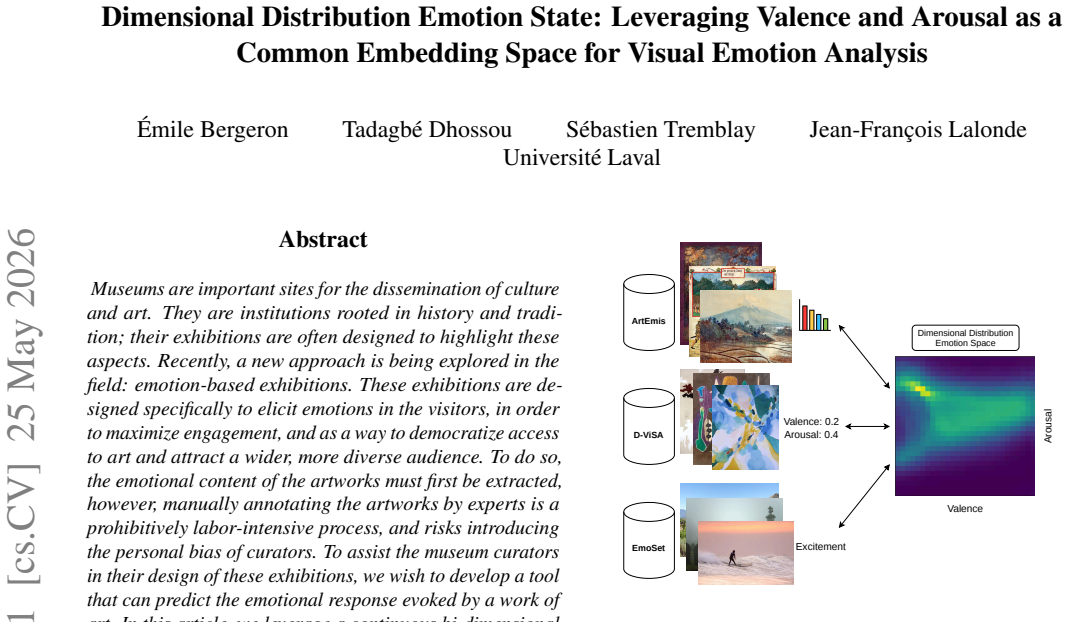
Dimensional Distribution Emotion State (DDES), which encodes an image's evoked emotion as a distribution rather than a category or single point inside the two-dimensional valence-arousal plane.
What would settle it
Training a model with DDES on combined datasets from multiple sources yields lower accuracy or poorer generalization than training the same architecture on any single source dataset alone.
Extended reading notes
Core claim
The central claim is that modeling visual emotions as probability distributions in the valence-arousal space, termed Dimensional Distribution Emotion State (DDES), creates a common embedding that supports multi-dataset training pipelines and yields multiple advantages over categorical labels and traditional single-point dimensional representations while maintaining similar baseline performance.
Load-bearing premise
Valence and arousal dimensions supply a sufficient common space that captures the variations needed to improve training across different emotion datasets.
Editorial extensions
If this is right
- Models can draw training examples from several labeled emotion datasets at the same time.
- Emotion predictions gain the ability to express uncertainty or blends of feelings through the distribution output.
- The representation keeps prediction performance on par with existing categorical and dimensional baselines.
- The pipeline reduces reliance on any single large annotated collection for building visual emotion tools.
Reading between the lines
- This approach could lower the cost of collecting new emotion labels by reusing existing datasets from different sources.
- The same distribution format might transfer to predicting emotional responses in video or user-generated images.
- Museum exhibition design tools could use the output distributions to rank candidate artworks by expected emotional impact.
Editorial analysis
A structured set of objections, weighed in public.
Referee Report
Summary. The manuscript introduces a new emotion representation called Dimensional Distribution Emotion State (DDES) that leverages valence and arousal dimensions as a shared embedding space. It proposes a multi-dataset training pipeline and claims that DDES offers multiple advantages over standard categorical and dimensional representations while achieving similar baseline performance on visual emotion prediction tasks, particularly for applications in museum exhibition design.
Significance. If the empirical claims hold, the work could support improved cross-dataset generalization in continuous emotion models by exploiting a common valence-arousal space, which is relevant for cultural heritage applications. The modest framing (similar performance plus unspecified advantages) limits immediate impact, but reproducible multi-dataset results would strengthen the contribution.
major comments (1)
- [Abstract] Abstract: the assertions that DDES 'provides multiple advantages' and exhibits 'similar baseline performance' are presented without any quantitative metrics, ablation studies, dataset details, or performance tables; this is load-bearing because the central claim cannot be evaluated without evidence that the DDES construction and pipeline actually deliver the stated benefits over baselines.
minor comments (1)
- The motivation section references emotion-based exhibitions but lacks citations to specific prior datasets or models in visual emotion analysis that use valence-arousal spaces.
Simulated Author's Rebuttal
We thank the referee for the feedback on our manuscript introducing DDES. We address the single major comment below and agree that the abstract requires strengthening for clarity.
read point-by-point responses
-
Referee: [Abstract] Abstract: the assertions that DDES 'provides multiple advantages' and exhibits 'similar baseline performance' are presented without any quantitative metrics, ablation studies, dataset details, or performance tables; this is load-bearing because the central claim cannot be evaluated without evidence that the DDES construction and pipeline actually deliver the stated benefits over baselines.
Authors: The full manuscript contains experimental results, performance tables, and ablation studies in the dedicated experiments section that support the claims of similar baseline performance with advantages in cross-dataset settings and other aspects. However, we agree the abstract is too high-level and does not reference these elements. We will revise the abstract to include concise quantitative highlights, dataset details, and pointers to the supporting tables and ablations. revision: yes
Circularity Check
No significant circularity in derivation chain
full rationale
The paper introduces DDES as a new representation leveraging valence-arousal space and a multi-dataset pipeline, with claims of advantages over existing representations but similar baseline performance. No equations, derivations, fitted parameters renamed as predictions, or self-citation chains appear in the abstract or described content. The central premise is an empirical proposal for a shared embedding space rather than a mathematical reduction to inputs by construction. This is self-contained against external benchmarks with no load-bearing self-referential steps.
Assumptions & free parameters
invented entities (1)
-
Dimensional Distribution Emotion State (DDES)
Cite this review
Pith. "Pith review of Dimensional Distribution Emotion State: Leveraging Valence and Arousal as a Common Embedding Space for Visual Emotion Analysis." pith.science (2026). https://pith.science/paper/CC7RCN3O
@misc{pith2026260526262,
  author       = {Pith},
  title        = {Pith review of: Dimensional Distribution Emotion State: Leveraging Valence and Arousal as a Common Embedding Space for Visual Emotion Analysis},
  year         = {2026},
  howpublished = {\url{https://pith.science/paper/CC7RCN3O}},
  note         = {Machine review of arXiv:2605.26262}
}
read the original abstract
Museums are important sites for the dissemination of culture and art. They are institutions rooted in history and tradition; their exhibitions are often designed to highlight these aspects. Recently, a new approach is being explored in the field: emotion-based exhibitions. These exhibitions are designed specifically to elicit emotions in the visitors, in order to maximize engagement, and as a way to democratize access to art and attract a wider, more diverse audience. To do so, the emotional content of the artworks must first be extracted, however, manually annotating the artworks by experts is a prohibitively labor-intensive process, and risks introducing the personal bias of curators. To assist the museum curators in their design of these exhibitions, we wish to develop a tool that can predict the emotional response evoked by a work of art. In this article, we leverage a continuous bi-dimensional emotion space to enhance emotion representations and the training process of deep learning models. Drawing inspiration from existing categorical and dimensional emotion representations, we introduce a new representation, Dimensional Distribution Emotion State (DDES), along with a pipeline for multi-dataset training. We show that DDES provides multiple advantages compared to widely used representations while exhibiting similar baseline performance.
Figures


Figures from the paper (2 more)


Reference graph
Works this paper leans on
-
[1]
Artemis: Affec- tive language for visual art.CoRR, abs/2101.07396, 2021
Panos Achlioptas, Maks Ovsjanikov, Kilichbek Haydarov, Mohamed Elhoseiny, and Leonidas Guibas. Artemis: Affec- tive language for visual art.CoRR, abs/2101.07396, 2021. 1, 2, 3
-
[2]
Guibas, and S
Panos Achlioptas, Maks Ovsjanikov, Leonidas J. Guibas, and S. Tulyakov. Affection: Learning affective explanations for real-world visual data.IEEE/CVF Conf. Comput. Vis. Pattern Recog., 2022. 3, 8
2022
-
[3]
Bradley and Peter J
Margaret M. Bradley and Peter J. Lang. Measuring emotion: The self-assessment manikin and the semantic differential. Jour. of Behav. Ther. and Exp. Psy., 25(1):49–59, 1994. 2
1994
-
[4]
Bradley and Peter J
Margaret M. Bradley and Peter J. Lang. Affective norms for english words (anew): Instruction manual and affective ratings. InTechnical report C-1, 1999. 2, 5
1999
-
[5]
Alarc˜ao, and Manuel Jos´e Fonseca
Filipe Galvao, Soraia M. Alarc˜ao, and Manuel Jos´e Fonseca. Predicting exact valence and arousal values from eeg.Sensors, 21, 2021. 3
2021
-
[6]
Eemo- bench: A benchmark for multi-modal large language models on image evoked emotion assessment
Lancheng Gao, Ziheng Jia, Yunhao Zeng, Wei Sun, Yiming Zhang, Wei Zhou, Guangtao Zhai, and Xiongkuo Min. Eemo- bench: A benchmark for multi-modal large language models on image evoked emotion assessment. InACM Int. Conf. Multimedia, 2025. 3, 6, 1
2025
-
[7]
Image emotion distribution learn- ing with graph convolutional networks
Tao He and Xiaoming Jin. Image emotion distribution learn- ing with graph convolutional networks. InInt. Conf. Multim. Retr., 2019. 3
2019
-
[8]
M. G. Kendall. A new measure of rank correlation. Biometrika, 30(1-2):81–93, 1938. 5
1938
Show all 37 references
-
[9]
D-visa: A dataset for detecting visual senti- ment from art images
Seoyun Kim, ChaeHee An, Junyeop Cha, Dongjae Kim, and Eunil Park. D-visa: A dataset for detecting visual senti- ment from art images. InIEEE/CVF Int. Conf. Comput. Vis. Worksh., 2023. 2, 3
2023
-
[10]
Emotic: Emotions in context dataset.IEEE Conf
Ronak Kosti, Jos ´e Manuel ´Alvarez, Adri `a Recasens, and `Agata Lapedriza. Emotic: Emotions in context dataset.IEEE Conf. Comput. Vis. Pattern Recog. Worksh., 2017. 3, 8
2017
-
[11]
Enhancing dimensional image emotion detection with a low-resource dataset via two-stage training.IEEE Trans
SangEun Lee, Seoyun Kim, Yubeen Lee, Jufeng Yang, and Eunil Park. Enhancing dimensional image emotion detection with a low-resource dataset via two-stage training.IEEE Trans. Cogni. Dev. Systems, 17(3):455–464, 2025. 3
2025
-
[12]
A convnet for the 2020s.IEEE/CVF Conf
Zhuang Liu, Hanzi Mao, Chao-Yuan Wu, Christoph Feicht- enhofer, Trevor Darrell, and Saining Xie. A convnet for the 2020s.IEEE/CVF Conf. Comput. Vis. Pattern Recog., 2022. 4
2022
-
[13]
Findingemo: An image dataset for emotion recognition in the wild
Laurent Mertens, Elahe'Yargholi, Hans Op de Beeck, Jan Van den Stock, and Joost Vennekens. Findingemo: An image dataset for emotion recognition in the wild. InAdv. Neural Inform. Process. Syst., 2024. 3
2024
-
[14]
Mikels, B.L
J.A. Mikels, B.L. Fredrickson, and G.R. et al Larkin. Emo- tional category data on images from the international affective picture system. InBehavior Research Methods, 2005. 2, 3
2005
-
[15]
ArtELingo: A million emotion annotations of WikiArt with emphasis on diversity over lan- guage and culture
Youssef Mohamed, Mohamed Abdelfattah, Shyma Al- huwaider, Feifan Li, Xiangliang Zhang, Kenneth Church, and Mohamed Elhoseiny. ArtELingo: A million emotion annotations of WikiArt with emphasis on diversity over lan- guage and culture. InEmpi. Meth. in Nat. Lang. Proc., 2022. 2, 3
2022
-
[16]
It is okay to not be okay: Over- coming emotional bias in affective image captioning by con- trastive data collection
Youssef Mohamed, Faizan Farooq Khan, Kilichbek Haydarov, and Mohamed Elhoseiny. It is okay to not be okay: Over- coming emotional bias in affective image captioning by con- trastive data collection. InIEEE/CVF Conf. Comput. Vis. Pattern Recog., 2022. 2, 3
2022
-
[17]
Mohammad
Saif M. Mohammad. Obtaining reliable human ratings of valence, arousal, and dominance for 20,000 english words. In Ann. Conf. of the Ass. for Comp. Lingu., 2018. 2, 3, 5, 1
2018
-
[18]
Mohammad and Svetlana Kiritchenko
Saif M. Mohammad and Svetlana Kiritchenko. An annotated dataset of emotions evoked by art. InLang. Res. and Eval. Conf, 2018. 3, 6
2018
-
[19]
Dimensional emotion detec- tion from categorical emotion
Sungjoon Park, Jiseon Kim, Seonghyeon Ye, Jaeyeol Jeon, Hee Young Park, and Alice Oh. Dimensional emotion detec- tion from categorical emotion. InEmpi. Meth. in Nat. Lang. Proc., 2021. 3
2021
-
[20]
Egon S. Pearson. The test of significance for the correlation coefficient.Jour. Amer. Stat. Asso., 26(174):128–134, 1931. 6
1931
-
[21]
The Nature of Emotions.American Scientist, 89(4):344, 2001
Robert Plutchik. The Nature of Emotions.American Scientist, 89(4):344, 2001. 7
2001
-
[22]
A circumplex model of affect.Jour
James Russell. A circumplex model of affect.Jour. Pers. Soc. Psy., 39:1161–1178, 1980. 2
1980
-
[23]
Savchenko
A. Savchenko. Emotieffnets for facial processing in video- based valence-arousal prediction, expression classification and action unit detection.IEEE Conf. Comput. Vis. Pattern Recog. Worksh., pages 5716–5724, 2023. 3
2023
-
[24]
David W. Scott. Multivariate density estimation: Theory, practice, and visualization. InWiley Series in Probability and Statistics, 1992. 4
1992
-
[25]
Striegl, JW
J. Striegl, JW. Richter, L. Grossmann, B. Br ˚astad, M. Got- thardt, C. R ¨uck, J. Wallert, and C. Loitsch. Deep learning- based dimensional emotion recognition for conversational agent-based cognitive behavioral therapy. InPeerJ Comp. Sci., 2024. 3, 5
2024
-
[26]
Dawn of the transformer era in speech emotion recognition: Closing the valence gap.IEEE Trans
Johannes Wagner, Andreas Triantafyllopoulos, Hagen Wier- storf, Maximilian Schmitt, Florian Eyben, and Bj¨orn Schuller. Dawn of the transformer era in speech emotion recognition: Closing the valence gap.IEEE Trans. Pattern Anal. Mach. Intell., 45:10745–10759, 2022. 3
2022
-
[27]
Struc- tured and sparse annotations for image emotion distribution learning.Assoc
Haitao Xiong, Hongfu Liu, Bineng Zhong, and Yun Fu. Struc- tured and sparse annotations for image emotion distribution learning.Assoc. Adv. of Art. Int., 2019. 3
2019
-
[28]
Joint image emo- tion classification and distribution learning via deep convolu- tional neural network
Jufeng Yang, Dongyu She, and Ming Sun. Joint image emo- tion classification and distribution learning via deep convolu- tional neural network. InIJCAI, 2017. 3
2017
-
[29]
A circular-structured representation for visual emo- tion distribution learning
Jingyuan Yang, Jie Li, Leida Li, Xiumei Wang, and Xinbo Gao. A circular-structured representation for visual emo- tion distribution learning. InIEEE/CVF Conf. Comput. Vis. Pattern Recog., 2021. 1, 3, 2
2021
-
[30]
Emoset: A large-scale visual emotion dataset with rich attributes
Jingyuan Yang, Qirui Huang, Tingting Ding, Dani Lischinski, Daniel Cohen-Or, and Hui Huang. Emoset: A large-scale visual emotion dataset with rich attributes. InIEEE/CVF Int. Conf. Comput. Vis., 2023. 2
2023
-
[31]
M. S. M. Yik, J. A. Russell, and L. F Barrett. Structure of self-reported current affect: Integration and beyond. InJour. Pers. Soc. Psy., 1999. 2
1999
-
[32]
Emoart: A multidimen- sional dataset for emotion-aware artistic generation
Cheng Zhang, Hongxia Xie, Bin Wen, Songhan Zuo, Ruox- uan Zhang, and Wen-Huang Cheng. Emoart: A multidimen- sional dataset for emotion-aware artistic generation. InACM Int. Conf. Multimedia, 2025. 3
2025
-
[33]
Train- ing a small emotional vision language model for visual art comprehension
Jing Zhang, Liang Zheng, Meng Wang, and Dan Guo. Train- ing a small emotional vision language model for visual art comprehension. InEur. Conf. Comput. Vis., 2024. 1, 3
2024
-
[34]
Ji, and Guiguang Ding
Sicheng Zhao, Hongxun Yao, Yue Gao, R. Ji, and Guiguang Ding. Continuous probability distribution prediction of image emotions via multitask shared sparse regression.IEEE Trans. Multimedia, 19:632–645, 2017. 3 Dimensional Distribution Emotion State: Leveraging Valence and Arou...
2017
-
[35]
How would you rate the valence/arousal this image evokes in the viewer? The level of valence/arousal this image evokes in the viewer is
Adapting large pre-trained VLMs for emo- tion prediction In the main section of this paper, we train models specifically for the task of predicting the emotional response evoked by artworks. In this section, drawing inspiration from EEmo- Bench [6], our goal is to determine wh...
-
[36]
Experiments withDDES-NETtraining Additional experiments with DDES-NETunder the single- dataset training and combined training settings outlined in sec
Additional results 7.1. Experiments withDDES-NETtraining Additional experiments with DDES-NETunder the single- dataset training and combined training settings outlined in sec. 4. The results are reported in tab. 5. These experiments serve to explore research directions orthogo...
-
[37]
Full emotion sets The following are the full emotion sets used in datasets mentioned in sec
Implementation details 8.1. Full emotion sets The following are the full emotion sets used in datasets mentioned in sec. 4.2. EEmo-BenchThe full set of emotions is:joy, surprise, fear, disgust, sadness, anger and neutral. WikiArt EmotionsThe full set of emotions is:agree- able...
Reviewed June 29, 2026 · model on record in the stance chip above.
Discussion (0). Continue with ORCID to comment.