REVIEW 3 major objections 4 minor 31 references
GS-NBV: a Geometry-based, Semantics-aware Viewpoint Planning Algorithm for Avocado Harvesting under Occlusions
T0 review · 3 major / 4 minor · reviewed 2026-08-06 · deepseek-v4-flash
Pith's one-line read The paper claims that constraining viewpoint search to a 1D picking ring and scoring views by fruit-stem visibility and occlusion lets a robot arm find a pickable avocado view under heavy occlusion within two planning iterations.
desk verdict A clever 1D viewpoint-sampling idea for avocado picking, but the 100% success claim only validates the planner's own picking score, not actual harvestability. read the letter →
The pith
A machine-rendered reading of the paper's core claim, the machinery that carries it, and where it could break.
The reading
What carries the argument
The load-bearing object is the picking ring: the 1D circle in the fruit's $x$-$y$ plane that defines where an avocado may be grasped, and the same circle is used as the viewpoint search space. The paper adds a picking score $s_{\mathrm{pick}} = s_{\mathrm{dis}}(1 - s_{\mathrm{occ}})$, where $s_{\mathrm{dis}}$ is a binary discoverability flag requiring the fruit and peduncle to be visible and overlapping or within five pixels, and $s_{\mathrm{occ}}$ is the fraction of the fruit's surrounding contour curve that has depth closer than the fruit's minimum depth plus 0.06 m. A fruit is declared pickable when $s_{\mathrm{pick}} > 0.9$. The planner's utility score for ranking viewpoints is the expected semantic information gain from the semantic OctoMap multiplied by $e^{-\lambda d}$, with $\lambda = -1$ so that more distant viewpoints are preferred; this promotes exploration along the ring while occlusion measurements shrink the candidate arc from both sides. This combination reduces raycasting cost and gives the planner its two-iteration convergence.
What would settle it
Run the same planner in a simulated or physical orchard where the avocado hangs with its true axis more than 30 degrees from vertical, or attempt an actual grasp after the planner reports a pickable view; if the reported 100 percent pickable-view success does not lead to successful peduncle cuts because the axis error pushes the gripper into the fruit, the central claim that the picking score identifies a harvestable viewpoint would be falsified.
Extended reading notes
Core claim
On the paper's own terms, the central discovery is that the avocado's picking geometry—a circumferential ring around the fruit where a harvesting end-effector can grasp and detach it—also organizes viewpoint search. Starting from a partially occluded view, the planner detects the fruit, estimates its position and axis, builds a semantic occupancy map of the region of interest, and restricts candidate camera poses to a 0.21 m radius circle around the fruit, minus the arc behind the tree and minus arcs already blocked by newly discovered obstacles. Four evenly spaced viewpoints on that shrinking arc are evaluated by a utility score that combines expected semantic information gain and motion cost, and the camera moves to the best one. The paper reports that this procedure achieved a 100% success rate in both of its simulated occlusion scenarios, with a pickable view found within two planning iterations, whereas the two comparison methods succeeded in at most 60 percent of trials.
Load-bearing premise
The load-bearing premise is that the picking score—fruit and peduncle visible and the surrounding contour curve at least 90 percent unoccluded—is a sufficient stand-in for a real harvestable grasp, even though the estimated fruit axis can be off by 22 to 30 degrees.
Editorial extensions
If this is right
- In both simulated occlusion scenarios, the planner reports a picking score above 0.9 in every trial, needing on average 1.5 planning iterations in the first group and 1.2 in the second.
- Restricting the search to a 1D ring makes each viewpoint-evaluation pass take about 1.5 s, roughly 2.5 times faster than the sampling-based comparison method.
- A fruit position estimate with mean error of 0.02-0.04 m is sufficient to define a reliable picking ring, even though the fruit axis estimates carry 22-30 degree errors.
- The planner's output is directly usable by an end-effector designed for canonical and front avocado views, since the picking score only accepts views in which the fruit and peduncle appear together.
Reading between the lines
- The authors leave implicit that the 1D-ring reduction should transfer to other peduncle-cut fruits, such as litchi, grapes, or peppers, whenever the graspable region forms a ring around the fruit.
- A physical harvest would still face the 22-30 degree fruit-axis error, so the reported 100 percent success is about finding a clear viewpoint, not about a successful grasp; real picking would likely require re-orienting or extra observations before the end-effector contacts the fruit.
- A direct test of the geometric prior would be to hang the avocado with its axis more than 30 degrees from vertical; the planner's bounded-axis assumption predicts failure or a misleading ring, which would expose the method's limit.
Signed reviews
Editorial analysis
A structured set of objections, weighed in public.
Referee Report
Summary. The paper proposes GS-NBV, a geometry-based, semantics-aware viewpoint planner for avocado harvesting in occluded settings. The planner detects a partially visible avocado, estimates its position and axis, constrains candidate camera viewpoints to a 1D picking ring around the fruit, samples four viewpoints on that ring, and scores them with a utility function that combines semantic information gain, a visibility-and-occlusion picking score spick, and a distance term. The camera is moved iteratively until spick > 0.9. The method is evaluated in a Gazebo simulation against SC-NBVP and GNBV in two static groups (one with an added occlusion board), with 10 trials per group. The paper reports a 100% success rate for GS-NBV, lower planning iterations, and faster sampling-based planning than SC-NBVP, alongside open-source code.
Significance. The algorithmic idea of reducing the viewpoint search space to a 1D ring and evaluating candidate views with a cheap picking score is sensible, and the public code is a concrete strength. The efficiency comparison and the qualitative demonstration that the planner can escape occluded initial views are plausible. However, the central harvesting claim is not established: the success metric is identical to the planner's own stopping condition and contains no term for pose accuracy, grasping configuration, or peduncle reachability, while the reported fruit-axis errors are 22-30 degrees and the final Group-2 view is from below the fruit. The contribution is therefore best described as a viewpoint planner that reliably reaches its internal pickability condition, with the step from that condition to actual avocado harvesting remaining unsupported.
major comments (3)
- [Section II, Algorithm 1, Section IV-D] The evaluation's 'success rate' is self-referential: a run is counted as successful exactly when spick = sdis * (1 - socc) exceeds 0.9, which is the same condition under which the while loop in Algorithm 1 terminates. Consequently, the reported 100% success rate in Section IV-D measures how often the planner reaches its own internal stopping condition, not whether the resulting viewpoint enables avocado harvesting. The abstract and conclusion present this rate as harvesting success; supporting that claim requires an external metric, such as an actual simulated or physical picking attempt, or at least a demonstration that spick correlates with end-effector picking success.
- [Section II, Section III-A.2, Table III, Section IV-E] The picking score spick contains no term for 6D pose accuracy, grasping configuration, or peduncle reachability, yet Section IV-E asserts that the large fruit-axis error 'does not hinder their ability to identify viable picking views.' Table III reports axis errors of 22.63 +/- 7.37 degrees in Group 1 and exactly 30.00 +/- 0.00 degrees in Group 2, with the latter value equal to the artificial cap introduced in Section III-A.2. With such errors, the estimated picking ring is tilted well away from the true ring, and Section IV-D reports that GS-NBV's final Group-2 view is 'from below the fruit,' which is not the canonical/front view that Section I motivates as necessary for avocado picking. The load-bearing assertion that spick > 0.9 implies a harvestable view is therefore unsupported; the authors should either incorporate axis error into the success metric or validate the proxy against a concrete picking action.
- [Section IV-A, Section IV-C, Table I] The evidence base is too thin for the robustness claims made in the abstract and conclusion. Only two static scenes with a single fruit were tested, each with 10 trials and no statistical tests or confidence intervals on success rates. The baselines were fine-tuned by the authors, and the comparison does not control for prior geometric information: GS-NBV is given the picking-ring radius and a fruit-centered ROI, while the baselines search larger or differently structured spaces. This may explain both the speed advantage in Section IV-C and the success-rate margin, but it makes the reported 100% versus 30-60% improvement difficult to interpret. Additional trials, multiple fruit poses and occlusion configurations, and ablations that remove or perturb the ring prior are needed to substantiate the claimed advantage.
minor comments (4)
- [Section III-C.1, Table I] The text calls lambda a 'motion cost penalty' and writes the utility as Gsem * e^{-lambda * d}, but Table I sets lambda = -1, making the factor e^{d} and thus rewarding more distant viewpoints. Please either rename the coefficient or clarify the sign convention.
- [Section III-A.1] The YOLOv8 instance segmentation is fine-tuned on 108 images with leave-one-out cross-validation, but no detection or segmentation accuracy (e.g., mAP, F1, or mask IoU) is reported; please add these metrics to support the perception pipeline's reliability.
- [Section IV-C] The sentence 'the time consumption of GNBV is zero' is ambiguous: Table II shows zero only for the viewpoint-sampling subprocess, while the overall NBV planning time for GNBV is 0.461 seconds. Please rephrase to indicate that only the sampling time is zero.
- [Table III, Section IV-D] The number of planning iterations is reported as a single mean without variance, and the success-rate explanation for SC-NBVP's improvement in Group 2 would benefit from clarification: the text says right-side viewpoints 'generate high SC scores' and are 'less likely to be selected,' which seems contradictory; please spell out the causal mechanism.
Circularity Check
The reported 100% success rate is the planner's own stopping condition spick > 0.9; the metric excludes the 22–30° axis error, so the harvesting-relevant claim reduces to the paper's internal scoring definition.
-
self definitional
[Section II (Picking score definition), Algorithm 1 lines 6–11, Section IV-B (Evaluation Metrics)]
"Picking score (spick): Success rate of fruit picking from the current view defined as spick = sdis ∗ (1 − socc). A fruit is considered pickable if spick > 0.9. ... if spick > 0.9 then planningFlag← False; exit() // planning succeed ... Successful rate is the percentage of successful pickable viewpoints out of 10 trials."
The success metric is exactly the predicate that stops the planner. Algorithm 1 exits when spick > 0.9, and Section IV-B defines a successful planning process as one where the fruit is fully discoverable with unoccluded rate exceeding 0.9, i.e., spick > 0.9 with sdis = 1. Therefore the claimed 100% success rate measures how often the algorithm reaches its own loop-exit condition. The metric contains no term for fruit-axis accuracy, grasping configuration, or peduncle reachability, so the headline does not independently validate that the final view is usable for avocado harvesting.
-
self definitional
[Section IV-E (Fruit Pose Estimation Results and Analysis)]
"In both groups, none of the planners accurately estimated the fruit axis, which poses additional challenges for the final picking step (beyond the scope of this paper but planned for future work). However, this limitation does not hinder their ability to identify viable picking views under heavy occlusion."
This assertion is true by construction because 'viable picking view' is defined as spick > 0.9, and spick ignores axis error. With fruit-axis errors of 22.63±7.37° in Group 1 and exactly 30.00±0.00° in Group 2 (the artificial cap from Section III-A.2), a view can score above 0.9 while the estimated picking ring is tilted far from the true vertical axis. The paper itself notes that GS-NBV's final Group-2 view is 'from below the fruit,' which is not the canonical/front view argued to be required. Hence the claim 'does not hinder their ability to identify viable picking views' reduces to 'axis error is not part of the scoring function,' not to any evidence about harvestability.
1 more flagged steps
-
self citation load bearing
[Section I (Introduction), Section III-C.2 (Viewpoint Planning Algorithm)]
"Hence, 6D pose information is required so that specific viewpoints (canonical view [CV] and front view [FV] [12]) can be assessed to determine picking points. ... Since the ideal picking points lie along the picking ring, we defined a sampling space, P, on a 0.21 m radius circle in 3D space centered at f pos"
The 1D picking-ring prior is the load-bearing geometric reduction that constrains the entire viewpoint search space. Its only cited justification is [12], the authors' own prior work (J. Zhou, X. Song, K. Karydis). The paper does not independently derive or validate that the x-y plane ring is the optimal or reachable picking set for avocados, and the picking score used for success does not verify that the final view is one of the CV/FV viewpoints defined in [12]. The central search-space premise therefore rests on a self-citation chain rather than on evidence established within this paper.
full rationale
The main circularity is the success metric: spick = sdis*(1 - socc) is both the objective the planner optimizes and the criterion used to declare success, so the reported 100% success rate is the planner's own stopping condition, not an independent measure of harvestability. The paper's own data show fruit-axis errors of 22–30°, including the capped 30.00±0.00° in Group 2, and its claim that this 'does not hinder' identifying viable views is valid only because the scoring function excludes axis error. Comparing against SC-NBVP and GNBV under the same spick metric provides some independent algorithmic evidence that GS-NBV reaches this internal objective more reliably, but it does not break the circularity of the harvesting claim. The picking-ring/CV-FV prior is imported from the authors' prior work [12], which is load-bearing for the search-space reduction and is not independently justified in this paper. These issues are partially offset by the fact that the planner can fail to reach its own threshold (baselines do fail), so the result is not a logical tautology; however, the headline success rate still reduces by construction to the planner's exit condition. Score 6 reflects partial circularity of the central success claim rather than a wholly vacuous derivation.
Assumptions & free parameters
free parameters (10)
- Picking ring radius R =
0.21 m
- Pose update gain k =
0.7
- Axis angle bound =
30 degrees
- Occlusion depth offset d_offset =
0.06 m
- Picking score threshold =
0.9
- Motion cost coefficient lambda =
-1
- Number of candidate viewpoints n =
4
- Viewpoint dissimilarity radius =
0.1 m
- Sampling arc =
270 degrees
- ROI cube size =
0.2 x 0.2 x 0.3 m
assumptions (5)
- domain assumption The avocado axis deviates at most 30 degrees from the z-axis due to gravity
- domain assumption The picking ring and canonical/front views from [12] describe optimal avocado picking points
- ad hoc to paper Fruit is pickable iff fruit and peduncle are visible within 5 pixels and occlusion rate is below 0.1
- domain assumption The ROI cube (0.2 x 0.2 x 0.3 m) always contains the full fruit and peduncle despite initial pose error
- domain assumption Simulation in Gazebo with a potted avocado model and YOLOv8 trained on 108 synthetic images is representative of real occluded avocado orchards
Cite this review
Pith. "Pith review of GS-NBV: a Geometry-based, Semantics-aware Viewpoint Planning Algorithm for Avocado Harvesting under Occlusions." pith.science (2026). https://pith.science/paper/CCG46YUJ
@misc{pith2026250623369,
  author       = {Pith},
  title        = {Pith review of: GS-NBV: a Geometry-based, Semantics-aware Viewpoint Planning Algorithm for Avocado Harvesting under Occlusions},
  year         = {2026},
  howpublished = {\url{https://pith.science/paper/CCG46YUJ}},
  note         = {Machine review of arXiv:2506.23369}
}
read the original abstract
Efficient identification of picking points is critical for automated fruit harvesting. Avocados present unique challenges owing to their irregular shape, weight, and less-structured growing environments, which require specific viewpoints for successful harvesting. We propose a geometry-based, semantics-aware viewpoint-planning algorithm to address these challenges. The planning process involves three key steps: viewpoint sampling, evaluation, and execution. Starting from a partially occluded view, the system first detects the fruit, then leverages geometric information to constrain the viewpoint search space to a 1D circle, and uniformly samples four points to balance the efficiency and exploration. A new picking score metric is introduced to evaluate the viewpoint suitability and guide the camera to the next-best view. We validate our method through simulation against two state-of-the-art algorithms. Results show a 100% success rate in two case studies with significant occlusions, demonstrating the efficiency and robustness of our approach. Our code is available at https://github.com/lineojcd/GSNBV
Figures

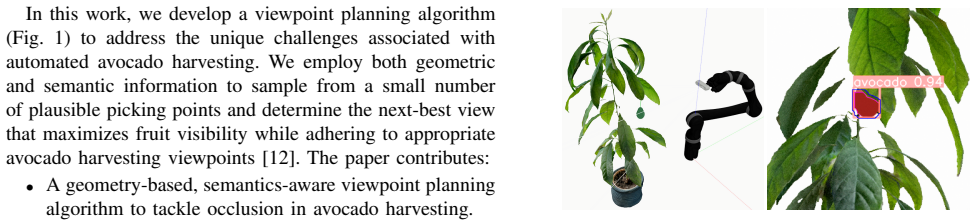

Figures from the paper (3 more)


Reference graph
Works this paper leans on
-
[1]
Australian vegetable growing farms: an economic survey, 2011-12 and 2012-13,
H. Valle, T. Caboche, M. Lubulwa et al., “Australian vegetable growing farms: an economic survey, 2011-12 and 2012-13,” ABARES Research Report, no. 14.01, 2014
work page 2011
- [2]
-
[3]
A robot for harvesting sweet- pepper in greenhouses,
J. Hemming, C. W. Bac, B. A. van Tuijl, R. Barth, J. Bontsema, E. Pekkeriet, and E. Van Henten, “A robot for harvesting sweet- pepper in greenhouses,” International Conference of Agricultural Engineering, 2014
work page 2014
-
[4]
Crops: high tech agri- cultural robots,
J. Bontsema, J. Hemming, and E. Pekkeriet, “Crops: high tech agri- cultural robots,” International Conference of Agricultural Engineering, 2014
work page 2014
-
[5]
Evaluation of a strawberry-harvesting robot in a field test,
S. Hayashi, K. Shigematsu, S. Yamamoto, K. Kobayashi, Y . Kohno, J. Kamata, and M. Kurita, “Evaluation of a strawberry-harvesting robot in a field test,” Biosystems Engineering, vol. 105, no. 2, pp. 160–171, 2010
work page 2010
-
[6]
T. Li, Q. Feng, Q. Qiu, F. Xie, and C. Zhao, “Occluded apple fruit detection and localization with a frustum-based point-cloud-processing approach for robotic harvesting,” Remote Sensing , vol. 14, no. 3, p. 482, 2022
work page 2022
-
[7]
Soft gripper for small fruits harvesting and pick and place operations,
E. Navas, R. R. Shamshiri, V . Dworak, C. Weltzien, and R. Fern´andez, “Soft gripper for small fruits harvesting and pick and place operations,” Frontiers in Robotics and AI , vol. 10, p. 1330496, 2024
work page 2024
-
[8]
Develop- ment of a dual-arm rapid grape-harvesting robot for horizontal trellis cultivation,
Y . Jiang, J. Liu, J. Wang, W. Li, Y . Peng, and H. Shan, “Develop- ment of a dual-arm rapid grape-harvesting robot for horizontal trellis cultivation,” Frontiers in Plant Science , vol. 13, p. 881904, 2022
work page 2022
Show all 31 references
-
[9]
Computer vision-based localisation of picking points for automatic litchi harvesting applications towards natural scenarios,
J. Zhuang, C. Hou, Y . Tang, Y . He, Q. Guo, Z. Zhong, and S. Luo, “Computer vision-based localisation of picking points for automatic litchi harvesting applications towards natural scenarios,” Biosystems Engineering, vol. 187, pp. 1–20, 2019
2019
-
[10]
Au- tonomous sweet pepper harvesting for protected cropping systems,
C. Lehnert, A. English, C. McCool, A. W. Tow, and T. Perez, “Au- tonomous sweet pepper harvesting for protected cropping systems,” IEEE Robotics and Automation Letters , vol. 2, no. 2, pp. 872–879, 2017
2017
-
[11]
Fruit detection for strawberry harvesting robot in non-structural environment based on mask-rcnn,
Y . Yu, K. Zhang, L. Yang, and D. Zhang, “Fruit detection for strawberry harvesting robot in non-structural environment based on mask-rcnn,” Computers and Electronics in Agriculture , vol. 163, p. 104846, 2019
2019
-
[12]
Design of an end-effector with application to avocado harvesting,
J. Zhou, X. Song, and K. Karydis, “Design of an end-effector with application to avocado harvesting,” in IEEE International Conference on Advanced Intelligent Mechatronics (AIM) , 2024, pp. 1241–1246
2024
-
[13]
Fruit mapping with shape completion for autonomous crop monitoring,
S. Marangoz, T. Zaenker, R. Menon, and M. Bennewitz, “Fruit mapping with shape completion for autonomous crop monitoring,” in IEEE 18th International Conference on Automation Science and Engineering (CASE), 2022, pp. 471–476
2022
-
[14]
Robotic harvesting of the occluded fruits with a precise shape and position reconstruction approach,
L. Gong, W. Wang, T. Wang, and C. Liu, “Robotic harvesting of the occluded fruits with a precise shape and position reconstruction approach,” Journal of Field Robotics, vol. 39, no. 1, pp. 69–84, 2022
2022
-
[15]
Panoptic mapping with fruit completion and pose estimation for horticultural robots,
Y . Pan, F. Magistri, T. L¨abe, E. Marks, C. Smitt, C. McCool, J. Behley, and C. Stachniss, “Panoptic mapping with fruit completion and pose estimation for horticultural robots,” in IEEE/RSJ International Confer- ence on Intelligent Robots and Systems (IROS) , 2023, pp. 4226–4233
2023
-
[16]
Safe leaf manipulation for accurate shape and pose estimation of occluded fruits,
S. Yao, S. Pan, M. Bennewitz, and K. Hauser, “Safe leaf manipulation for accurate shape and pose estimation of occluded fruits,” arXiv preprint arXiv:2409.17389, 2024
2024 arXiv
-
[17]
Single-shot 6dof pose and 3d size estimation for robotic strawberry harvesting,
L. Li and H. Kasaei, “Single-shot 6dof pose and 3d size estimation for robotic strawberry harvesting,” in IEEE/RSJ International Conference on Intelligent Robots and Systems (IROS) , 2024, pp. 4988–4993
2024
-
[18]
Convolutional neural networks for the hass avocado classification using labview in an agro-industrial plant,
J. E. C. de la Cruz and O. J. V . Ramirez, “Convolutional neural networks for the hass avocado classification using labview in an agro-industrial plant,” in IEEE XXVII International Conference on Electronics, Electrical Engineering and Computing (INTERCON) , 2020, pp. 1–4
2020
-
[19]
V olume estimation models for avocado fruit,
M. Mokria, A. Gebrekirstos, H. Said, K. Hadgu, N. Hagazi, W. Dubale, and A. Br ¨auning, “V olume estimation models for avocado fruit,” Plos One, vol. 17, no. 2, pp. 1–14, 2022
2022
-
[20]
Nbv-sc: Next best view planning based on shape completion for fruit mapping and reconstruction,
R. Menon, T. Zaenker, N. Dengler, and M. Bennewitz, “Nbv-sc: Next best view planning based on shape completion for fruit mapping and reconstruction,” in IEEE/RSJ international conference on intelligent robots and systems (IROS) , 2023, pp. 4197–4203
2023
-
[21]
Graph-based view motion planning for fruit detection,
T. Zaenker, J. R ¨uckin, R. Menon, M. Popovi ´c, and M. Bennewitz, “Graph-based view motion planning for fruit detection,” in IEEE/RSJ International Conference on Intelligent Robots and Systems (IROS) , 2023, pp. 4219–4225
2023
-
[22]
Efficient occlusion avoidance based on active deep sensing for harvesting robots,
T. Sun, W. Zhang, X. Gao, W. Zhang, N. Li, and Z. Miao, “Efficient occlusion avoidance based on active deep sensing for harvesting robots,” Computers and Electronics in Agriculture , vol. 225, p. 109360, 2024
2024
-
[23]
Vision-assisted avocado harvesting with aerial bimanual manipulation,
Z. Liu, J. Zhou, C. Mucchiani, and K. Karydis, “Vision-assisted avocado harvesting with aerial bimanual manipulation,” Advanced Robotics Research, p. 202500003, 2024
2024
-
[24]
Hierarchical tri-manual planning for vision-assisted fruit harvesting with quadrupedal robots,
Z. Liu, J. Zhou, and K. Karydis, “Hierarchical tri-manual planning for vision-assisted fruit harvesting with quadrupedal robots,” arXiv preprint arXiv:2409.17116, 2024
2024 arXiv
-
[25]
Ultralytics YOLO,
G. Jocher, A. Chaurasia, and J. Qiu, “Ultralytics YOLO,” Jan. 2023. [Online]. Available: https://github.com/ultralytics/ultralytics
2023
-
[26]
Gradient-based local next-best-view planning for improved perception of targeted plant nodes,
A. K. Burusa, E. J. van Henten, and G. Kootstra, “Gradient-based local next-best-view planning for improved perception of targeted plant nodes,” in IEEE International Conference on Robotics and Automation (ICRA), 2024, pp. 15 854–15 860
2024
-
[27]
Octomap: An efficient probabilistic 3d mapping framework based on octrees,
A. Hornung, K. M. Wurm, M. Bennewitz, C. Stachniss, and W. Bur- gard, “Octomap: An efficient probabilistic 3d mapping framework based on octrees,” Autonomous robots, vol. 34, pp. 189–206, 2013
2013
-
[28]
Real-time voxel based 3d semantic mapping with a hand held rgb-d camera,
Z. Xuan and F. David, “Real-time voxel based 3d semantic mapping with a hand held rgb-d camera,” https://github.com/floatlazer/semantic slam, 2018
2018
-
[29]
View planning for grape harvesting based on active vision strategy under occlusion,
T. Yi, D. Zhang, L. Luo, and J. Luo, “View planning for grape harvesting based on active vision strategy under occlusion,” IEEE Robotics and Automation Letters , vol. 9, no. 3, pp. 2535–2542, 2024
2024
-
[30]
Viewpoint plan- ning for fruit size and position estimation,
T. Zaenker, C. Smitt, C. McCool, and M. Bennewitz, “Viewpoint plan- ning for fruit size and position estimation,” in IEEE/RSJ International Conference on Intelligent Robots and Systems (IROS), 2021, pp. 3271– 3277
2021
-
[31]
[Online]
Moveit.ros.org. [Online]. Available: https://github.com/moveit/moveit
Reviewed August 6, 2026 · model on record in the stance chip above.
Discussion (0). Continue with ORCID to comment.