Perfect Absorption in the Strong Coupling Regime via Degenerate Critical Coupling
Pith reviewed 2026-06-26 03:36 UTC · model grok-4.3
The pith
Degenerate critical coupling at polariton branch crossing enables near-unity absorption in sub-100 nm structures.
A machine-rendered reading of the paper's core claim, the machinery that carries it, and where it could break.
Core claim
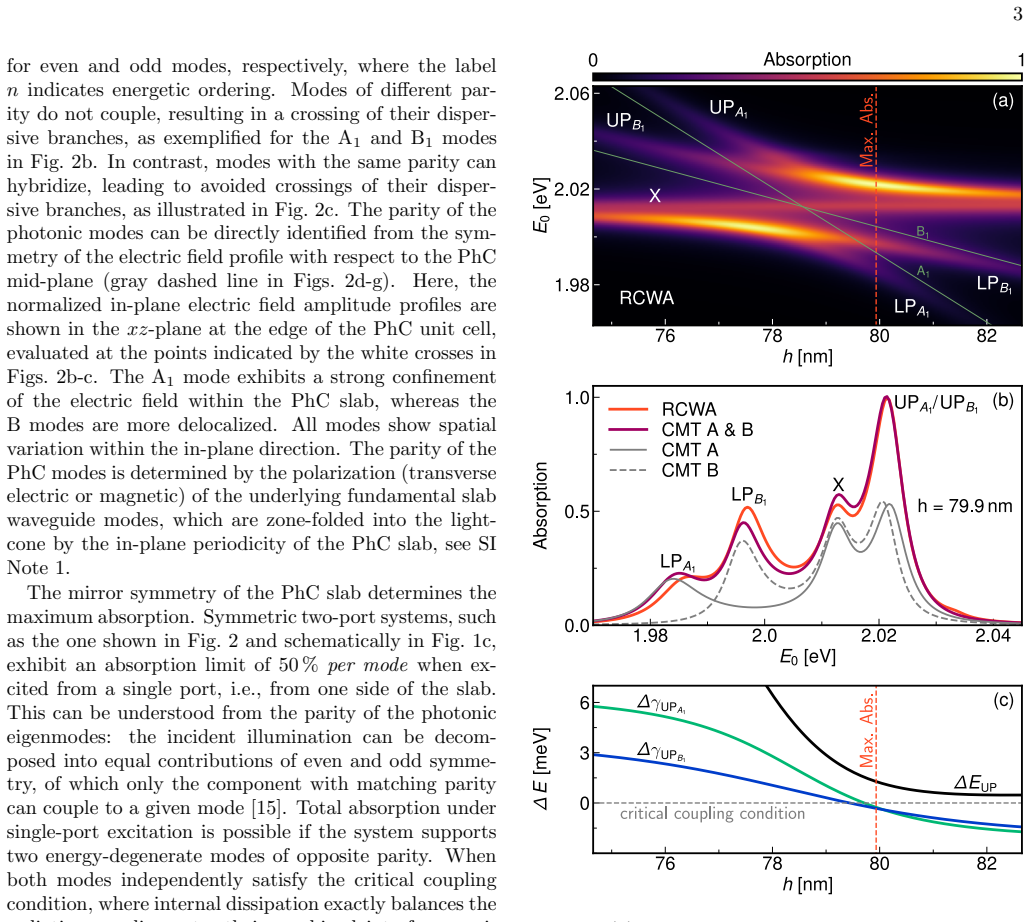
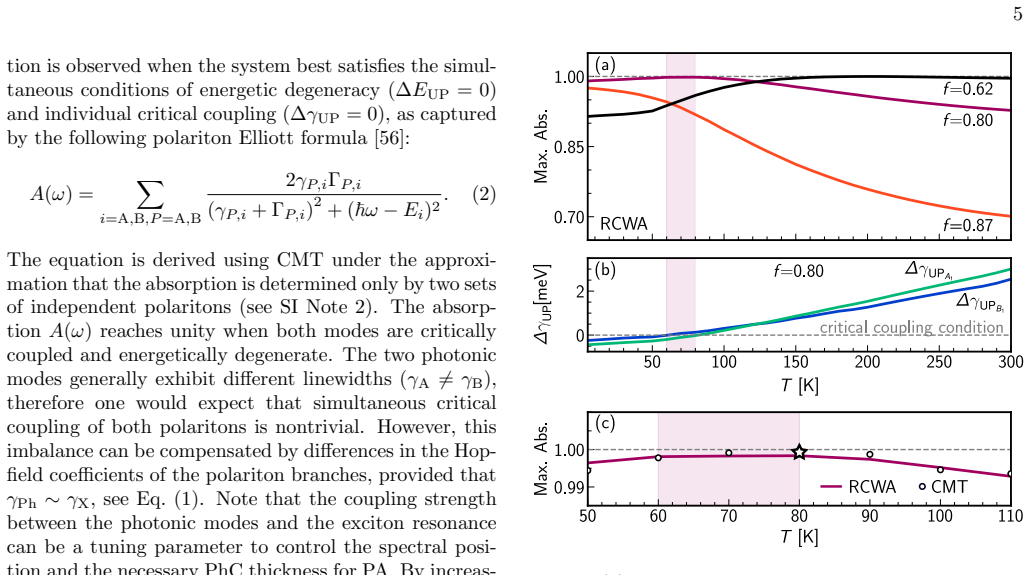
Through rigorous solution of Maxwell's equations, the authors demonstrate that degenerate critical coupling at the crossing of two polariton branches produces single-port perfect absorption of exciton-polaritons exceeding 99.8 percent in a photonic crystal structure thinner than 100 nm. The effect holds under realistic Gaussian beam excitation and can be realized across temperatures and excitonic materials by adjusting the photonic crystal geometry.
What carries the argument
Degenerate critical coupling at the crossing of two polariton branches, which satisfies the condition for single-port perfect absorption.
If this is right
- Enables efficient light-matter coupling in metal-free, ultra-compact structures.
- Direct implications for development of polaritonic logic devices, sensors, and energy-harvesting platforms.
- The absorption remains robust under realistic Gaussian beam excitation.
- The approach can be extended across different temperatures and excitonic materials by geometry tailoring.
Where Pith is reading between the lines
- Geometry adjustments could allow the same absorption performance with other 2D materials beyond the specific semiconductor studied.
- The method might apply to similar strong-coupling systems that support multiple polariton branches.
- If fabrication precision improves, the approach could enable even thinner devices while maintaining the crossing condition.
Load-bearing premise
The photonic crystal geometry parameters can be chosen so the two polariton branches cross exactly at the degenerate critical coupling point, without scattering, fabrication imperfections, or material losses that would reduce absorption below near-unity.
What would settle it
An experimental measurement of absorption below 99 percent at the polariton branch crossing under single-beam excitation would falsify the near-unity absorption result.
Figures
read the original abstract
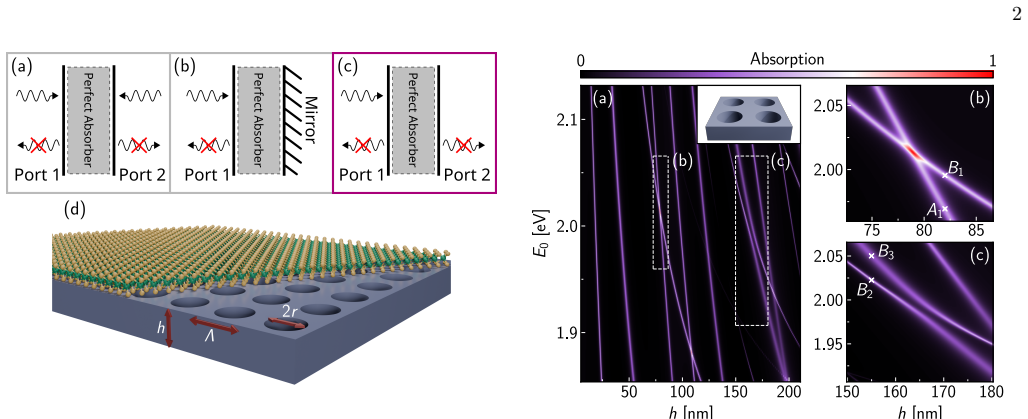
Perfect absorption (PA) represents a fundamental limit of light-matter interaction and a means to maximize nanoscale energy conversion. While PA is now a well-established phenomenon, both the theoretical feasibility and a practical mechanism for achieving it under single-beam excitation within the strong coupling regime is unknown. Through rigorous solution of Maxwells equations for a compact photonic crystal (PhC) architecture incorporating a two-dimensional semiconductor, we present a general method based on degenerate critical coupling for single-port PA of exciton-polaritons. At the crossing of two polariton branches, we achieve near-unity absorption exceeding 99.8 \% in a structure thinner than $100\,$nm. This effect is robust under realistic Gaussian beam excitation, and can be realized across different temperatures and excitonic materials by tailoring the PhC geometry. Our results establish a strategy for enabling efficient light-matter coupling, with direct implications for the development of metal-free, ultra-compact polaritonic logic devices, sensors, and energy-harvesting platforms.
Editorial analysis
A structured set of objections, weighed in public.
Referee Report
Summary. The manuscript claims that by solving Maxwell's equations for a photonic crystal incorporating a 2D semiconductor, degenerate critical coupling at the crossing of two exciton-polariton branches enables single-port perfect absorption exceeding 99.8% in a structure thinner than 100 nm. The effect is presented as robust under Gaussian beam excitation and realizable across temperatures and materials by geometry tuning.
Significance. If the numerical demonstration holds and the required simultaneous satisfaction of branch crossing and exact rate matching is achieved, the result would establish a practical route to near-unity absorption in the strong-coupling regime for compact, metal-free polaritonic devices. The direct Maxwell-equation approach provides a concrete, in-principle reproducible numerical protocol.
major comments (2)
- [Results section (absorption spectra and parameter table)] Results section (absorption spectra and parameter table): the central claim of >99.8% absorption requires explicit demonstration that the chosen PhC geometry parameters place the polariton-branch crossing exactly at the frequency where the two modes have identical radiative and non-radiative decay rates to the single port; without tabulated values of those rates (or an explicit detuning metric) at the operating point, it cannot be verified that residual mismatch is smaller than the linewidth.
- [Method / geometry optimization subsection] Method / geometry optimization subsection: the assumption that a multi-parameter search over lattice constant, hole radius, etc., converges to a point satisfying both branch crossing and degenerate critical-coupling condition simultaneously must be supported by showing the final extracted rates or a convergence plot; any unaccounted scattering channel from the PhC lattice would violate the reported absorption value.
minor comments (2)
- Figure captions for the Gaussian-beam robustness test should state the beam waist and incidence angle explicitly.
- The abstract states 'rigorous solution of Maxwell's equations' but the main text would benefit from a brief statement of the numerical method (FDTD vs. FEM) and convergence criteria used.
Simulated Author's Rebuttal
We thank the referee for their detailed and constructive report. The comments identify opportunities to improve the verifiability of the central claims. We address each major comment below and will incorporate the requested information in a revised manuscript.
read point-by-point responses
-
Referee: Results section (absorption spectra and parameter table): the central claim of >99.8% absorption requires explicit demonstration that the chosen PhC geometry parameters place the polariton-branch crossing exactly at the frequency where the two modes have identical radiative and non-radiative decay rates to the single port; without tabulated values of those rates (or an explicit detuning metric) at the operating point, it cannot be verified that residual mismatch is smaller than the linewidth.
Authors: We agree that tabulated decay rates would allow direct verification of the degenerate critical-coupling condition. In the revised manuscript we will add to the Results section a table reporting the radiative and non-radiative decay rates extracted for each polariton branch at the operating frequency, together with a detuning metric. These quantities are obtained from the same full-wave simulations that yield the absorption spectra; the values confirm that the rate mismatch lies well below the linewidth, consistent with the reported absorption exceeding 99.8%. revision: yes
-
Referee: Method / geometry optimization subsection: the assumption that a multi-parameter search over lattice constant, hole radius, etc., converges to a point satisfying both branch crossing and degenerate critical-coupling condition simultaneously must be supported by showing the final extracted rates or a convergence plot; any unaccounted scattering channel from the PhC lattice would violate the reported absorption value.
Authors: The optimization procedure was constructed to enforce both conditions simultaneously. In the revised Methods section we will report the final extracted decay rates at the optimized geometry and include a short description of the convergence behavior of the search. Because the absorption is obtained from a direct, full-wave solution of Maxwell’s equations for the complete structure, every scattering channel—including those arising from the photonic-crystal lattice—is already included in the computed fields and the resulting absorption value. revision: yes
Circularity Check
Numerical Maxwell solution is self-contained; no circular reductions
full rationale
The paper derives its central result (near-unity absorption at polariton branch crossing) via direct numerical solution of Maxwell's equations on a specified PhC geometry with a 2D semiconductor. Absorption is obtained from the computed fields under single-port excitation; the degenerate critical-coupling condition is used as an external design target that the geometry is optimized to meet, not as a self-referential definition or fitted input renamed as prediction. No load-bearing self-citations, uniqueness theorems, or ansatzes imported from prior author work are indicated in the provided text. The result is therefore independent of its own outputs.
Axiom & Free-Parameter Ledger
free parameters (1)
- Photonic crystal geometry parameters
axioms (1)
- standard math Maxwell's equations govern the electromagnetic response of the photonic crystal plus 2D semiconductor structure.
Reference graph
Works this paper leans on
-
[1]
and water waves [28]. Experimental realizations of PA have typically re- quired either two-port configurations that demand pre- cise interferometric alignment between two counter- propagating waves (coherent perfect absorption, Fig. 1a) [4, 5, 14] or bulky one-port geometries with a highly re- flective back mirror and a single incident channel (a Sal- isb...
Pith/arXiv arXiv 2026
-
[2]
Optical absorbers based on strong interference in ultra-thin films.Laser & Photonics Reviews, 10(5):735–749, 2016
Mikhail A Kats and Federico Capasso. Optical absorbers based on strong interference in ultra-thin films.Laser & Photonics Reviews, 10(5):735–749, 2016
2016
-
[3]
Coherent perfect absorbers: lin- ear control of light with light.Nature Reviews Materials, 2(12):1–14, 2017
Denis G Baranov, Alex Krasnok, Timur Shegai, Andrea Al` u, and Yidong Chong. Coherent perfect absorbers: lin- ear control of light with light.Nature Reviews Materials, 2(12):1–14, 2017
2017
-
[4]
En- gineering optical absorption in graphene and other 2d materials: advances and applications.Advanced Optical Materials, 7(20):1900595, 2019
Qiang Li, Jun Lu, Prince Gupta, and Min Qiu. En- gineering optical absorption in graphene and other 2d materials: advances and applications.Advanced Optical Materials, 7(20):1900595, 2019
2019
-
[5]
Co- herent perfect absorbers: time-reversed lasers.Physical review letters, 105(5):053901, 2010
YD Chong, Li Ge, Hui Cao, and A Douglas Stone. Co- herent perfect absorbers: time-reversed lasers.Physical review letters, 105(5):053901, 2010
2010
-
[6]
Time-reversed lasing and inter- ferometric control of absorption.Science, 331(6019):889– 892, 2011
Wenjie Wan, Yidong Chong, Li Ge, Heeso Noh, A Dou- glas Stone, and Hui Cao. Time-reversed lasing and inter- ferometric control of absorption.Science, 331(6019):889– 892, 2011
2011
-
[7]
Perfect coupling of light to surface plas- mons by coherent absorption.Physical review letters, 108(18):186805, 2012
Heeso Noh, Yidong Chong, A Douglas Stone, and Hui Cao. Perfect coupling of light to surface plas- mons by coherent absorption.Physical review letters, 108(18):186805, 2012
2012
-
[8]
Controlling light-with-light without nonlinearity
Jianfa Zhang, Kevin F MacDonald, and Nikolay I Zhe- ludev. Controlling light-with-light without nonlinearity. Light: Science & Applications, 1(7):e18–e18, 2012
2012
-
[9]
Engineering radia- tive coupling of excitons in 2d semiconductors.Optica, 6(11):1443–1448, 2019
Jason Horng, Yu-Hsun Chou, Tsu-Chi Chang, Chu-Yuan Hsu, Tien-Chang Lu, and Hui Deng. Engineering radia- tive coupling of excitons in 2d semiconductors.Optica, 6(11):1443–1448, 2019
2019
-
[10]
Near-unity light absorption in a monolayer ws2 van der waals heterostructure cavity
Itai Epstein, Bernat Terres, Andre J Chaves, Varun- Varma Pusapati, Daniel A Rhodes, Bettina Frank, Valentin Zimmermann, Ying Qin, Kenji Watanabe, Takashi Taniguchi, et al. Near-unity light absorption in a monolayer ws2 van der waals heterostructure cavity. Nano letters, 20(5):3545–3552, 2020
2020
-
[11]
Perfect absorption by an atomically thin crys- tal.Physical Review Applied, 14(2):024009, 2020
Jason Horng, Eric W Martin, Yu-Hsun Chou, Emmanuel Courtade, Tsu-chi Chang, Chu-Yuan Hsu, Michael-Henr Wentzel, Hanna G Ruth, Tien-chang Lu, Steven T Cun- diff, et al. Perfect absorption by an atomically thin crys- tal.Physical Review Applied, 14(2):024009, 2020
2020
-
[12]
Achieving near-perfect light absorption in atomically thin transition metal dichalcogenides through band nesting
Seungjun Lee, Dongjea Seo, Sang Hyun Park, Nezhueytl Izquierdo, Eng Hock Lee, Rehan Younas, Guanyu Zhou, Milan Palei, Anthony J Hoffman, Min Seok Jang, et al. Achieving near-perfect light absorption in atomically thin transition metal dichalcogenides through band nesting. Nature communications, 14(1):3889, 2023
2023
-
[13]
Per- fect absorption and strong coupling in supported mos2 multilayers.ACS nano, 17(4):3401–3411, 2023
Adriana Canales, Oleg Kotov, and Timur O Shegai. Per- fect absorption and strong coupling in supported mos2 multilayers.ACS nano, 17(4):3401–3411, 2023
2023
-
[14]
Complete optical absorption in periodically patterned graphene.Physical review letters, 108(4):047401, 2012
Sukosin Thongrattanasiri, Frank HL Koppens, and F Javier Garc´ ıa de Abajo. Complete optical absorption in periodically patterned graphene.Physical review letters, 108(4):047401, 2012
2012
-
[15]
Coherent perfect absorption and transparency in a nanostructured graphene film.Optics express, 22(10):12524–12532, 2014
Jianfa Zhang, Chucai Guo, Ken Liu, Zhihong Zhu, Weimin Ye, Xiaodong Yuan, and Shiqiao Qin. Coherent perfect absorption and transparency in a nanostructured graphene film.Optics express, 22(10):12524–12532, 2014
2014
-
[16]
Total ab- sorption by degenerate critical coupling.Applied Physics Letters, 104(25), 2014
Jessica R Piper, Victor Liu, and Shanhui Fan. Total ab- sorption by degenerate critical coupling.Applied Physics Letters, 104(25), 2014
2014
-
[17]
Total absorption in a graphene monolayer in the optical regime by critical coupling with a photonic crystal guided resonance.Acs Photonics, 1(4):347–353, 2014
Jessica R Piper and Shanhui Fan. Total absorption in a graphene monolayer in the optical regime by critical coupling with a photonic crystal guided resonance.Acs Photonics, 1(4):347–353, 2014
2014
-
[18]
Coherent control of light interaction with graphene.Optics letters, 39(18):5345– 8 5347, 2014
Shraddha M Rao, Julius JF Heitz, Thomas Roger, Niclas Westerberg, and Daniele Faccio. Coherent control of light interaction with graphene.Optics letters, 39(18):5345– 8 5347, 2014
2014
-
[19]
Electrically tunable co- herent optical absorption in graphene with ion gel.Nano letters, 15(3):1570–1576, 2015
Vrinda Thareja, Ju-Hyung Kang, Hongtao Yuan, Kaveh M Milaninia, Harold Y Hwang, Yi Cui, Pieter G Kik, and Mark L Brongersma. Electrically tunable co- herent optical absorption in graphene with ion gel.Nano letters, 15(3):1570–1576, 2015
2015
-
[20]
Nanophotonic engineering of far-field thermal emitters
Denis G Baranov, Yuzhe Xiao, Igor A Nechepurenko, Alex Krasnok, Andrea Al` u, and Mikhail A Kats. Nanophotonic engineering of far-field thermal emitters. Nature materials, 18(9):920–930, 2019
2019
-
[21]
Photonic design principles for ultrahigh-efficiency photovoltaics.Nature materials, 11(3):174–177, 2012
Albert Polman and Harry A Atwater. Photonic design principles for ultrahigh-efficiency photovoltaics.Nature materials, 11(3):174–177, 2012
2012
-
[22]
Coherent control of photocurrent in a strongly scattering photoelectrochemical system.ACS photonics, 3(3):449–455, 2016
Seng Fatt Liew, S´ ebastien M Popoff, Stafford W Sheehan, Arthur Goetschy, Charles A Schmuttenmaer, A Douglas Stone, and Hui Cao. Coherent control of photocurrent in a strongly scattering photoelectrochemical system.ACS photonics, 3(3):449–455, 2016
2016
-
[23]
Resonant cavity-enhanced (rce) photodetectors.IEEE Journal of Quantum Elec- tronics, 27(8):2025–2034, 1991
Katsumi Kishino, M Selim Unlu, J-I Chyi, J Reed, L Ar- senault, and Hadis Morkoc. Resonant cavity-enhanced (rce) photodetectors.IEEE Journal of Quantum Elec- tronics, 27(8):2025–2034, 1991
2025
-
[24]
Organic sub-bandgap schottky barrier photodetectors with near-infrared coher- ent perfect absorption.ACS Photonics, 8(9):2618–2625, 2021
Yeonghoon Jin, Hyung Suk Kim, Junghoon Park, Se- unghyup Yoo, and Kyoungsik Yu. Organic sub-bandgap schottky barrier photodetectors with near-infrared coher- ent perfect absorption.ACS Photonics, 8(9):2618–2625, 2021
2021
-
[25]
Massively degen- erate coherent perfect absorber for arbitrary wavefronts
Yevgeny Slobodkin, Gil Weinberg, Helmut H¨ orner, Kevin Pichler, Stefan Rotter, and Ori Katz. Massively degen- erate coherent perfect absorber for arbitrary wavefronts. Science, 377(6609):995–998, 2022
2022
-
[26]
Op- tical coherent perfect absorption and amplification in a time-varying medium.Nature Photonics, pages 1–7, 2026
Emanuele Galiffi, Anthony C Harwood, Stefano Vezzoli, Romain Tirole, Andrea Al` u, and Riccardo Sapienza. Op- tical coherent perfect absorption and amplification in a time-varying medium.Nature Photonics, pages 1–7, 2026
2026
-
[27]
An equivalent realization of coher- ent perfect absorption under single beam illumination
Sucheng Li, Jie Luo, Shahzad Anwar, Shuo Li, Weixin Lu, Zhi Hong Hang, Yun Lai, Bo Hou, Mingrong Shen, and Chinhua Wang. An equivalent realization of coher- ent perfect absorption under single beam illumination. Scientific reports, 4(1):7369, 2014
2014
-
[28]
Ultra-thin metamate- rial for perfect and quasi-omnidirectional sound absorp- tion.Applied Physics Letters, 109(12), 2016
Noe Jim´ enez, Weichun Huang, Vicent Romero-Garc´ ıa, Vincent Pagneux, and J-P Groby. Ultra-thin metamate- rial for perfect and quasi-omnidirectional sound absorp- tion.Applied Physics Letters, 109(12), 2016
2016
-
[29]
Perfect res- onant absorption of guided water waves by autler-townes splitting.Physical Review Letters, 131(20):204002, 2023
L-P Euv´ e, Kim Pham, Richard Porter, Philippe Petit- jeans, Vincent Pagneux, and Agn` es Maurel. Perfect res- onant absorption of guided water waves by autler-townes splitting.Physical Review Letters, 131(20):204002, 2023
2023
-
[30]
Broadband absorption enhancement in solar cells with an atomically thin active layer.Acs Photonics, 3(4):571–577, 2016
Jessica R Piper and Shanhui Fan. Broadband absorption enhancement in solar cells with an atomically thin active layer.Acs Photonics, 3(4):571–577, 2016
2016
-
[31]
Perfect single-sided radiation and absorption without mirrors.Optica, 3(10):1079–1086, 2016
Hengyun Zhou, Bo Zhen, Chia Wei Hsu, Owen D Miller, Steven G Johnson, John D Joannopoulos, and Marin Soljaˇ ci´ c. Perfect single-sided radiation and absorption without mirrors.Optica, 3(10):1079–1086, 2016
2016
-
[32]
Metamaterial electromagnetic wave absorbers.Advanced materials, 24(23):OP98–OP120, 2012
Claire M Watts, Xianliang Liu, and Willie J Padilla. Metamaterial electromagnetic wave absorbers.Advanced materials, 24(23):OP98–OP120, 2012
2012
-
[33]
Fano resonances in nanoscale structures.Re- views of Modern Physics, 82(3):2257–2298, 2010
Andrey E Miroshnichenko, Sergej Flach, and Yuri S Kivshar. Fano resonances in nanoscale structures.Re- views of Modern Physics, 82(3):2257–2298, 2010
2010
-
[34]
Experimental realization of a terahertz all-dielectric metasurface absorber.Optics express, 25(1):191–201, 2017
Xinyu Liu, Kebin Fan, Ilya V Shadrivov, and Willie J Padilla. Experimental realization of a terahertz all-dielectric metasurface absorber.Optics express, 25(1):191–201, 2017
2017
-
[35]
Near-unity absorption in van der waals semiconductors for ultrathin optoelectronics.Nano letters, 16(9):5482– 5487, 2016
Deep Jariwala, Artur R Davoyan, Giulia Tagliabue, Michelle C Sherrott, Joeson Wong, and Harry A Atwater. Near-unity absorption in van der waals semiconductors for ultrathin optoelectronics.Nano letters, 16(9):5482– 5487, 2016
2016
-
[36]
Colloquium: Excitons in atomically thin transition metal dichalcogenides.Reviews of Modern Physics, 90(2):021001, 2018
Gang Wang, Alexey Chernikov, Mikhail M Glazov, Tony F Heinz, Xavier Marie, Thierry Amand, and Bern- hard Urbaszek. Colloquium: Excitons in atomically thin transition metal dichalcogenides.Reviews of Modern Physics, 90(2):021001, 2018
2018
-
[37]
Exciton optics, dynamics, and transport in atomically thin semiconductors.APL Ma- terials, 10(10), 2022
Raul Perea-Causin, Daniel Erkensten, Jamie M Fitzger- ald, Joshua JP Thompson, Roberto Rosati, Samuel Brem, and Ermin Malic. Exciton optics, dynamics, and transport in atomically thin semiconductors.APL Ma- terials, 10(10), 2022
2022
-
[38]
Exciton physics and device application of two-dimensional transition metal dichalcogenide semiconductors.njp 2D Materials and Applications, 2:29, 2018
Thomas Mueller and Ermin Malic. Exciton physics and device application of two-dimensional transition metal dichalcogenide semiconductors.njp 2D Materials and Applications, 2:29, 2018
2018
-
[39]
Photonic-crystal exciton-polaritons in monolayer semiconductors.Nature communications, 9(1):713, 2018
Long Zhang, Rahul Gogna, Will Burg, Emanuel Tu- tuc, and Hui Deng. Photonic-crystal exciton-polaritons in monolayer semiconductors.Nature communications, 9(1):713, 2018
2018
-
[40]
Nonlinear polaritons in a monolayer semiconductor coupled to optical bound states in the continuum.Light: Science & Applications, 9(1):56, 2020
Vasily Kravtsov, Ekaterina Khestanova, Fedor A Benimetskiy, Tatiana Ivanova, Anton K Samusev, Ivan S Sinev, Dmitry Pidgayko, Alexey M Mozharov, Ivan S Mukhin, Maksim S Lozhkin, et al. Nonlinear polaritons in a monolayer semiconductor coupled to optical bound states in the continuum.Light: Science & Applications, 9(1):56, 2020
2020
-
[41]
Meta- surface integrated monolayer exciton polariton.Nano Letters, 20(7):5292–5300, 2020
Yueyang Chen, Shengnan Miao, Tianmeng Wang, Ding Zhong, Abhi Saxena, Colin Chow, James Whitehead, Dario Gerace, Xiaodong Xu, Su-Fei Shi, et al. Meta- surface integrated monolayer exciton polariton.Nano Letters, 20(7):5292–5300, 2020
2020
-
[42]
Polaritonic chern insulators in monolayer semiconductors.Physical Review Letters, 130(4):043801, 2023
Li He, Jingda Wu, Jicheng Jin, Eugene J Mele, and Bo Zhen. Polaritonic chern insulators in monolayer semiconductors.Physical Review Letters, 130(4):043801, 2023
2023
-
[43]
Strongly enhanced light– matter coupling of monolayer ws2 from a bound state in the continuum.Nature Materials, 22(8):964–969, 2023
Eugenio Maggiolini, Laura Polimeno, Francesco Todisco, Anna Di Renzo, Bo Han, Milena De Giorgi, Vin- cenzo Ardizzone, Christian Schneider, Rosanna Mastria, Alessandro Cannavale, et al. Strongly enhanced light– matter coupling of monolayer ws2 from a bound state in the continuum.Nature Materials, 22(8):964–969, 2023
2023
-
[44]
Kraus, Jamie M
Eleonora P. Kraus, Jamie M. Fitzgerald, Carlos Maciel- Escudero, and Ermin Malic. Engineering strong coupling in ultra-compact photonic crystal/2d material platforms. arXiv, 2026
2026
-
[45]
Polariton transport in 2d semiconductors: Phonon- mediated transitions between ballistic, superdiffusive and exciton-limited regimes.Science Advances, 11:46, 2025
Jamie M Fitzgerald, Roberto Rosati, and Ermin Malic. Polariton transport in 2d semiconductors: Phonon- mediated transitions between ballistic, superdiffusive and exciton-limited regimes.Science Advances, 11:46, 2025
2025
-
[46]
Femtosecond switch- ing of strong light-matter interactions in microcavities with two-dimensional semiconductors.Nature Commu- nications, 16(1):6490, 2025
Armando Genco, Charalambos Louca, Cristina Cru- ciano, Kok Wee Song, Chiara Trovatello, Giuseppe Di Blasio, Giacomo Sansone, Sam A Randerson, Peter Claronino, Kyriacos Georgiou, et al. Femtosecond switch- ing of strong light-matter interactions in microcavities with two-dimensional semiconductors.Nature Commu- nications, 16(1):6490, 2025
2025
-
[47]
Perfect energy-feeding into strongly coupled systems and interferometric control of polariton absorption.Nature Physics, 10(11):830–834, 2014
Simone Zanotto, Francesco P Mezzapesa, Federica Bianco, Giorgio Biasiol, Lorenzo Baldacci, Miriam Ser- 9 ena Vitiello, Lucia Sorba, Raffaele Colombelli, and Alessandro Tredicucci. Perfect energy-feeding into strongly coupled systems and interferometric control of polariton absorption.Nature Physics, 10(11):830–834, 2014
2014
-
[48]
Polaritonic coher- ent perfect absorption based on self-hybridization of a quasi-bound state in the continuum and exciton.Optics Express, 31(3):4691–4700, 2023
Xin Gu, Xing Liu, Xiao-Fei Yan, Wen-Juan Du, Qi Lin, Ling-Ling Wang, and Gui-Dong Liu. Polaritonic coher- ent perfect absorption based on self-hybridization of a quasi-bound state in the continuum and exciton.Optics Express, 31(3):4691–4700, 2023
2023
-
[49]
Switching polariton screening in mos2 microcavity to- ward polaritonics.Science Advances, 11(8):eadr7202, 2025
Ashok Mondal, Chandan Biswas, Pramod Ghising, By- oung Hee Moon, Ki Kang Kim, and Young Hee Lee. Switching polariton screening in mos2 microcavity to- ward polaritonics.Science Advances, 11(8):eadr7202, 2025
2025
-
[50]
Magneto-optics of anisotropic exciton polaritons in two- dimensional perovskites.Nano Letters, 25(21):8519– 8526, 2025
Jonas K K¨ onig, Jamie M Fitzgerald, and Ermin Malic. Magneto-optics of anisotropic exciton polaritons in two- dimensional perovskites.Nano Letters, 25(21):8519– 8526, 2025
2025
-
[51]
Scattering-matrix treat- ment of patterned multilayer photonic structures.Phys- ical Review B, 60(4):2610, 1999
DM Whittaker and IS Culshaw. Scattering-matrix treat- ment of patterned multilayer photonic structures.Phys- ical Review B, 60(4):2610, 1999
1999
-
[52]
Temporal coupled-mode theory for the fano resonance in optical resonators.Journal of the Optical Society of America A, 20(3):569–572, 2003
Shanhui Fan, Wonjoo Suh, and John D Joannopoulos. Temporal coupled-mode theory for the fano resonance in optical resonators.Journal of the Optical Society of America A, 20(3):569–572, 2003
2003
-
[53]
Coupling and decoupling of polaritonic states in multimode cavities.Physical Review B, 103(24):L241407, 2021
M Balasubrahmaniyam, Cyriaque Genet, and Tal Schwartz. Coupling and decoupling of polaritonic states in multimode cavities.Physical Review B, 103(24):L241407, 2021
2021
-
[54]
Observation of photon-mode decoupling in a strongly coupled multi- mode microcavity.The Journal of Chemical Physics, 154(12), 2021
Kyriacos Georgiou, Kirsty E McGhee, Rahul Jayaprakash, and David G Lidzey. Observation of photon-mode decoupling in a strongly coupled multi- mode microcavity.The Journal of Chemical Physics, 154(12), 2021
2021
-
[55]
Two-dimensional semiconductors in the regime of strong light-matter cou- pling.Nature communications, 9(1):2695, 2018
Christian Schneider, Mikhail M Glazov, Tobias Korn, Sven H¨ ofling, and Bernhard Urbaszek. Two-dimensional semiconductors in the regime of strong light-matter cou- pling.Nature communications, 9(1):2695, 2018
2018
-
[56]
D. E. Aspnes and A. A. Studna. Dielectric functions and optical parameters of si, ge, gap, gaas, gasb, inp, inas, and insb from 1.5 to 6.0 ev.Phys. Rev. B, 27:985–1009, Jan 1983
1983
-
[57]
Twist angle tuning of moir´ e exciton polari- tons in van der waals heterostructures.Nano Letters, 22(11):4468–4474, 2022
Jamie M Fitzgerald, Joshua JP Thompson, and Er- min Malic. Twist angle tuning of moir´ e exciton polari- tons in van der waals heterostructures.Nano Letters, 22(11):4468–4474, 2022
2022
-
[58]
Displacement-sensitive photonic crystal structures based on guided resonance in photonic crystal slabs.Ap- plied physics letters, 82(13):1999–2001, 2003
Wonjoo Suh, MF Yanik, Olav Solgaard, and Shanhui Fan. Displacement-sensitive photonic crystal structures based on guided resonance in photonic crystal slabs.Ap- plied physics letters, 82(13):1999–2001, 2003
1999
-
[59]
Suspended photonic crystal membranes in algaas het- erostructures for integrated multi-element optomechan- ics.Applied Physics Letters, 116(26), 2020
Sushanth Kini Manjeshwar, Karim Elkhouly, Jamie M Fitzgerald, Martin Ekman, Yanchao Zhang, Fan Zhang, Shu Min Wang, Philippe Tassin, and Witlef Wieczorek. Suspended photonic crystal membranes in algaas het- erostructures for integrated multi-element optomechan- ics.Applied Physics Letters, 116(26), 2020
2020
-
[60]
Edgar, Seth Ariel Tongay, and Itai Epstein
Matan Meshulam, Anabel Atash Kahlon, Yonatan Ger- shuni, Thomas Poirier, James H. Edgar, Seth Ariel Tongay, and Itai Epstein. Temperature-dependent op- tical and polaritonic properties of excitons in hbn- encapsulated monolayer tmds.Advanced Optical Materi- als, 14(7):e02535, 2026
2026
-
[61]
Ex- citonic linewidth and coherence lifetime in monolayer transition metal dichalcogenides.Nature communica- tions, 7(1):13279, 2016
Malte Selig, Gunnar Bergh¨ auser, Archana Raja, Philipp Nagler, Christian Sch¨ uller, Tony F Heinz, Tobias Korn, Alexey Chernikov, Ermin Malic, and Andreas Knorr. Ex- citonic linewidth and coherence lifetime in monolayer transition metal dichalcogenides.Nature communica- tions, 7(1):13279, 2016
2016
-
[62]
extended zone
Raymond C Rumpf. Improved formulation of scattering matrices for semi-analytical methods that is consistent with convention.Progress In Electromagnetics Research B, 35:241–261, 2011. Supplementary Information: Perfect Absorption in the Strong Coupling Regime via Degenerate Critical Coupling Eleonora P. Kraus, 1, 2,∗ Jamie M. Fitzgerald, 1, 2 Carlos Maciel...
2011
-
[63]
S. G. Tikhodeev, A. Yablonskii, E. Muljarov, N. A. Gippius, and T. Ishihara, Quasiguided modes and optical properties of photonic crystal slabs, Physical Review B66, 045102 (2002)
2002
-
[64]
E. P. Kraus, J. M. Fitzgerald, C. Maciel-Escudero, and E. Malic, Engineering strong coupling in ultra-compact photonic crystal/2d material platforms, arXiv (2026), arXiv:2604.12779 [physics.optics]
Pith/arXiv arXiv 2026
-
[65]
X. Chen, C. Chardin, K. Makles, C. Ca¨ er, S. Chua, R. Braive, I. Robert-Philip, T. Briant, P.- F. Cohadon, A. Heidmann,et al., High-finesse fabry–perot cavities with bidimensional si3n4 photonic-crystal slabs, Light: Science & Applications6, e16190 (2017)
2017
-
[66]
Quaranta, G
G. Quaranta, G. Basset, O. J. Martin, and B. Gallinet, Recent advances in resonant waveguide gratings, Laser & Photonics Reviews12, 1800017 (2018)
2018
-
[67]
Lalanne and D
P. Lalanne and D. Lemercier-Lalanne, Depth dependence of the effective properties of sub- wavelength gratings, J. Opt. Soc. Am. A14, 450 (1997)
1997
-
[68]
Yeh,Optical Waves in Layered Media(J
P. Yeh,Optical Waves in Layered Media(J. Wiley and Sons, 1988)
1988
-
[69]
Ciers, J
J. Ciers, J. G. Roch, J.-F. Carlin, G. Jacopin, R. Butt´ e, and N. Grandjean, Propagating polaritons in iii-nitride slab waveguides, Physical Review Applied7, 034019 (2017)
2017
-
[70]
S. Fan, W. Suh, and J. D. Joannopoulos, Temporal coupled-mode theory for the fano resonance in optical resonators, Journal of the Optical Society of America A20, 569 (2003)
2003
-
[71]
W. Suh, Z. Wang, and S. Fan, Temporal coupled-mode theory and the presence of non- orthogonal modes in lossless multimode cavities, IEEE Journal of Quantum Electronics40, 1511 (2004)
2004
-
[72]
J. M. Fitzgerald, J. J. Thompson, and E. Malic, Twist angle tuning of moir´ e exciton polaritons in van der waals heterostructures, Nano Letters22, 4468 (2022)
2022
-
[73]
Kini Manjeshwar, K
S. Kini Manjeshwar, K. Elkhouly, J. M. Fitzgerald, M. Ekman, Y. Zhang, F. Zhang, S. M. Wang, P. Tassin, and W. Wieczorek, Suspended photonic crystal membranes in algaas het- erostructures for integrated multi-element optomechanics, Applied Physics Letters116(2020)
2020
-
[74]
Baffou and R
G. Baffou and R. Quidant, Thermo-plasmonics: using metallic nanostructures as nano-sources of heat, Laser & Photonics Reviews7, 171 (2013). 13
2013
-
[75]
M. Meshulam, A. A. Kahlon, Y. Gershuni, T. Poirier, J. H. Edgar, S. A. Ton- gay, and I. Epstein, Temperature-dependent optical and polaritonic properties of exci- tons in hbn-encapsulated monolayer tmds, Advanced Optical Materials14, e02535 (2026), https://advanced.onlinelibrary.wiley.com/doi/pdf/10.1002/adom.202502535. 14
discussion (0)
Sign in with ORCID, Apple, or X to comment. Anyone can read and Pith papers without signing in.