REVIEW 3 major objections 6 minor 1 cited by
Cuff-KT: Tackling Learners' Real-time Learning Pattern Adjustment via Tuning-Free Knowledge State Guided Model Updating
T0 review · 3 major / 6 minor · reviewed 2026-08-07 · deepseek-v4-flash
Pith's one-line read Knowledge-tracing models lose accuracy when learners' ability shifts mid-course; Cuff-KT adapts them by generating personalized parameters at inference time, reporting average AUC gains of 10% under intra-learner shift and 4% under…
desk verdict Useful applied paper with a potentially serious label-leakage ambiguity; the 10%/4% AUC gains need a code check before they can be trusted. read the letter →
The pith
A machine-rendered reading of the paper's core claim, the machinery that carries it, and where it could break.
The reading
What carries the argument
The load-bearing mechanism is a two-module parameter generator. Its controller is a selection gate: it scores learners with $score_j = KL_j imes ZPD_j$, where $KL_j$ is the KL divergence between the learner's normalized knowledge-state distributions at timestep $k/2$ and $k$, and $ZPD_j$ is a normalized rate-of-change of the learner's overall correct rate, discounted by the learner's actual response count. Its generator is a small feed-forward network: separate question and response sequences go through a GRU, then through state-adaptive attention whose weights are the product of a difficulty-change term and a recency term, are summed, and are mapped through a low-rank factorization to a weight and bias that replace the KT model's output-layer parameters. The design converts "update the model for this learner" into "compute a vector for this learner," which is why no backpropagation is required at adaptation time.
What would settle it
Concretely, re-run Table 1 on assist15 with a causal mask that blocks any interaction after the response being predicted; if the Cuff-KT AUC advantage over DKT nearly disappears, the original loss allowed label leakage. Separately, re-run Table 2 with randomly chosen learner groups instead of DKT-sorted groups; the 4% average inter-learner gain should vanish if the split, not the method, was doing the work.
Extended reading notes
Core claim
On its own terms, the paper's central claim is that model adaptability under RLPA can be achieved by parameter generation rather than parameter optimization. The controller computes, for each learner, a value score equal to the product of two change measures: a fine-grained KL divergence between normalized knowledge-state distributions over concepts at the middle and current timesteps, and a coarse-grained ZPD score based on the change in overall correct rate, weighted by how many questions the learner has answered. The generator embeds questions and responses separately, runs each through a GRU-based sequential feature extractor, applies state-adaptive attention that up-weights interactions with large difficulty changes or long time gaps since the same concept, sums the question and response representations, and produces the dynamic layer's weight and bias through a low-rank factorization with rank 1 by default. Because the updated parameters come from a forward pass, no gradient computation is needed at adaptation time, and the paper demonstrates this by improving all five backbones on all five datasets and by showing the gain persists when Cuff-KT is combined with full fine-tuning.
Load-bearing premise
The load-bearing premise is that the loss in Eq. 15 is computed without label leakage, meaning predictions of each response use only earlier interactions, although the paper never states this; if the model saw the full sequence, the reported gains collapse, and the 4% inter-learner gain also assumes the DKT-based split mirrors real group shifts.
Editorial extensions
If this is right
- A deployed KT model equipped with Cuff-KT can adapt to a learner's changing behavior during a session, since parameter generation is a forward pass rather than a gradient update.
- The same generator can be attached to any of the five tested architectures, and by the paper's model-agnostic claim to other sequence models, by choosing which layer to treat as the dynamic layer.
- The controller's value scores give teachers and tutoring systems a direct signal for which learners are progressing or slipping fastest, turning the adaptation mechanism into an attention indicator.
- Cuff-KT remains beneficial when combined with full fine-tuning, so it can be used as a complement to gradient-based updates when real-time constraints are relaxed.
- The default rank-1 low-rank decomposition keeps the extra parameter budget small while still lifting AUC, so the approach scales to large learner populations.
Reading between the lines
- Editorial inference: if the causal-conditioning gap is closed, a streaming variant could regenerate parameters after every response inside a session, giving a model that continuously re-fits to a single learner in real time.
- Editorial inference: the inter-learner split in Sec. 4.1.3 sorts learners by DKT-computed knowledge-state change, which may concentrate the shift; random or naturally occurring group partitions would test whether the 4% average gain transfers to less artificial settings.
- Editorial inference: the state-adaptive attention weights, defined as difficulty change times recency, are a generic importance-weighting scheme, so the same mechanism could be applied to other distribution shifts in educational data, such as performance under fatigue or across course transitions.
Editorial analysis
A structured set of objections, weighed in public.
Referee Report
Summary. The paper introduces a new task, Real-time Learning Pattern Adjustment (RLPA), for knowledge tracing (KT), covering intra-learner and inter-learner distribution shifts. To address RLPA, the authors propose Cuff-KT, composed of a controller that assigns value scores to learners and a generator that produces personalized dynamic-layer parameters for selected learners without fine-tuning. The generator uses a sequential feature extractor, a state-adaptive attention mechanism, and low-rank decomposition. The paper reports experiments on five KT datasets and five backbone models, claiming an average relative AUC improvement of 10% under intra-learner shift and 4% under inter-learner shift at negligible time overhead, with significance tests and released code.
Significance. If the reported gains are valid, Cuff-KT would be a valuable model-agnostic, tuning-free adapter for knowledge tracing that improves prediction under distribution shifts with low computational cost. The empirical scope is a strength: five datasets, five structurally different backbones, five random seeds, and statistical significance tests. The availability of code and datasets supports reproducibility. The RLPA task formulation itself, distinguishing intra- and inter-learner shifts, is a useful framing for the KT community. However, the main empirical claim is currently not internally secured because the description of the generator's temporal conditioning is ambiguous, and because the headline accuracy evaluation omits the controller that is part of the proposed method's definition.
major comments (3)
- [§3.2.2, §3.2.3, Eq. (15)] The manuscript never states that the generator's parameters used to compute each prediction r̂_i in the loss (Eq. 15) are produced from interactions strictly before i. The generator is defined at time-step k on the full prefix {(c_i,r_i)}_{i=1}^k (Eq. 7), and a single parameter set is generated from S_k (Eqs. 12–14). If that same parameter set is used to score every i=2..k+1 in the training loss, then each r̂_i may depend on r_i and later responses, inflating the reported AUC gains in Tables 1 and 2 through label leakage. The only explicit leakage discussion (end of §3.2.2) concerns converting DKVMN and stableKT into an applicable form, not temporal conditioning of the generator. The authors must specify and verify in code that, for each i, the generator's inputs are {(c_j,r_j)}_{j<i}; if not, the experiments must be rerun under a leak-free protocol.
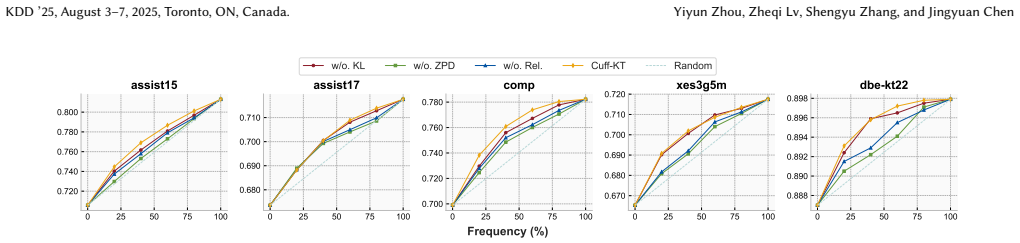
- [§4.3 vs. §3.2.1 and Abstract] The main prediction experiments (Tables 1 and 2) explicitly state that "the generator in Cuff-KT generates parameters for all learners independently of the controller" (§4.3, first sentence). Thus the headline claim that Cuff-KT significantly improves KT performance does not actually evaluate the full controller+generator method defined in §3.2.1–§3.2.2. The controller's contribution is only assessed in §4.2 for learner-selection frequency under intra-learner shift, not as part of the main accuracy comparisons. Since the title, abstract, and contributions emphasize controllability, the empirical support for the full method is missing; the main tables should either include the controller-selected variant, or the claims should be narrowed to the generator component.
- [§4.1.3] The inter-learner shift groups are constructed by sorting learners according to changes in their DKT-computed knowledge states between intermediate and current timestamps. Because the evaluation defines the shift using the same knowledge-state signal that the method and its DKT backbone model, the reported 4% average inter-learner gain is not shown to generalize to naturally occurring group shifts. A split based on an external grouping variable (e.g., course, semester, or school) would be needed to support the inter-learner claim in a way that transfers outside this construction.
minor comments (6)
- [Eq. (9)] The definition of dist_d in Eq. (9) only handles the i=1 case explicitly; for i>1 with no previous occurrence of concept c_i, the denominator in the second fraction is zero, making the expression undefined. Please add an explicit branch for the zero-occurrence case, similar to Eq. (10).
- [§3.2.1] The parenthetical assumption that the knowledge state at k/2 is trustworthy and sufficiently different from the state at k is presented without justification or sensitivity analysis; since the controller is not used in the main accuracy experiments, this assumption should at least be discussed in terms of its impact on the controller's selection quality.
- [§4.3] The phrase "independently of the controller" is important and should be explained in the experimental setup: is this a deliberate ablation, and are there results for the full Cuff-KT with controller in the main tables or appendix?
- [Throughout] There are several typos and grammatical slips: "trackle" should be "tackle" (last paragraph of §1), "inserted into into any layer" (§1), "shifit" (§4.4), and "to make them compatible with our Cuff-KT in order to avoid label leakage" is awkwardly phrased.
- [Figure 4 and Table 5] The captions and labels for Figure 4 and Table 5 are not fully self-contained; in particular, Figure 4 should state what exactly is being measured and which metric is displayed, and Table 5 would benefit from a statement that parameter sizes are in thousands.
- [§4.1.2] The claim that LoRA is not included as a baseline because it "leads to severe overfitting" is asserted without supporting experiments or a reference; if this is a known result in this setting, a citation would help.
Circularity Check
Eq. 15 as written lets the generator condition early predictions on their own labels; the 10%/4% AUC claim is not causally secured.
-
self definitional
[Sec. 3.2.2-3.2.3, Eqs. 7-15]
"At time-step k, the SFE takes {(c_i,r_i)}^k_{i=1} as input ... Finally, parameters (i.e., weight and bias) are generated through S_k for the dynamic layer: weight = S_k W_w + b_w, bias = S_k W_b + b_b. ... L = - sum_{i=2}^{k+1} r_i log(\hat r_i) + (1-r_i) log(1-\hat r_i)."
As written, the dynamic-layer weight and bias are functions of S_k, which is built from the full response sequence {(c_i,r_i)}_{i=1}^k (Eqs. 7, 11, 12). Eq. 15 then trains and evaluates \hat r_i for every i=2..k+1. If the same generated parameter set is used across all steps, each early prediction \hat r_i (i<=k) is scored by a layer whose parameters encode the target r_i itself; SAA also uses unmasked softmax over X_k (Eq. 8), so no causal mask is specified. The paper never states that a fresh parameter set is generated from the prefix up to i-1 for each i. Consequently the headline relative-AUC gains (10% and 4%) are not secured as genuine predictions: under the literal equations they reduce to a function of the labels being predicted.
full rationale
The only structurally circular element I can exhibit in the written equations is the temporal conditioning of the generator. Eqs. 7-14 define the dynamic parameters from the full prefix S_k, including r_i, and Eq. 15 scores every \hat r_i over i=2..k+1 without ever stating that the generator is re-run on the causal prefix 1..i-1 for each i. Under the equations as written, early predictions can depend on their own targets, so the headline AUC gains are not guaranteed to be predictions; this is a self-definitional/leakage circularity. The controller's knowledge-state-based selection, the ZPD score, and the group construction are heuristics or evaluation splits, not derivations that reduce to fitted targets. The citation [59] for converting DKVMN and stableKT is a self-citation and is load-bearing for those two backbones, but the main claim also rests on three directly applicable backbones, and the conversion is an implementation detail rather than a derived prediction; I therefore treat it as a minor concern. Because the central 'prediction' claim is not causally secured by the stated equations, the score is 6 rather than 2.
Assumptions & free parameters
free parameters (4)
- low-rank rank =
1 (default)
- embedding dimension d =
32
- ZPD and KL smoothing constants =
1 (additive constants in Eqs 4 and 5)
- selection frequency =
varies (Figure 4)
assumptions (4)
- ad hoc to paper Knowledge state at time-step k/2 is trustworthy and sufficiently different from the state at k to differentiate learners.
- domain assumption The recent fine-tuning segment's distribution reflects the upcoming test segment's distribution.
- domain assumption ZPD can be quantified as the rate of change of overall correct rate.
- standard math Standard math background: attention, GRU, low-rank decomposition, and Adam optimization work as expected.
Cite this review
Pith. "Pith review of Cuff-KT: Tackling Learners' Real-time Learning Pattern Adjustment via Tuning-Free Knowledge State Guided Model Updating." pith.science (2026). https://pith.science/paper/CD4ZWJPP
@misc{pith2026250519543,
  author       = {Pith},
  title        = {Pith review of: Cuff-KT: Tackling Learners' Real-time Learning Pattern Adjustment via Tuning-Free Knowledge State Guided Model Updating},
  year         = {2026},
  howpublished = {\url{https://pith.science/paper/CD4ZWJPP}},
  note         = {Machine review of arXiv:2505.19543}
}
read the original abstract
Knowledge Tracing (KT) is a core component of Intelligent Tutoring Systems, modeling learners' knowledge state to predict future performance and provide personalized learning support. Traditional KT models assume that learners' learning abilities remain relatively stable over short periods or change in predictable ways based on prior performance. However, in reality, learners' abilities change irregularly due to factors like cognitive fatigue, motivation, and external stress -- a task introduced, which we refer to as Real-time Learning Pattern Adjustment (RLPA). Existing KT models, when faced with RLPA, lack sufficient adaptability, because they fail to timely account for the dynamic nature of different learners' evolving learning patterns. Current strategies for enhancing adaptability rely on retraining, which leads to significant overfitting and high time overhead issues. To address this, we propose Cuff-KT, comprising a controller and a generator. The controller assigns value scores to learners, while the generator generates personalized parameters for selected learners. Cuff-KT controllably adapts to data changes fast and flexibly without fine-tuning. Experiments on five datasets from different subjects demonstrate that Cuff-KT significantly improves the performance of five KT models with different structures under intra- and inter-learner shifts, with an average relative increase in AUC of 10% and 4%, respectively, at a negligible time cost, effectively tackling RLPA task. Our code and datasets are fully available at https://github.com/zyy-2001/Cuff-KT.
Figures


Figures from the paper (5 more)



Forward citations
Cited by 1 Pith paper
-
MadaKV: Adaptive Modality-Perception KV Cache Eviction for Efficient Multimodal Long-Context Inference
MadaKV adaptively splits the KV cache budget by attention-head modality preference and compensates across layers, cutting cache memory by 80-95% and speeding decoding by 1.3-1.5x with small accuracy loss.
Reference graph
Works this paper leans on
-
[1]
Ghodai Abdelrahman, Sherif Abdelfattah, Qing Wang, and Yu Lin. 2022. Dbe-kt22: A knowledge tracing dataset based on online student evaluation. arXiv preprint arXiv:2208.12651 (2022)
work page Pith review arXiv 2022
-
[2]
Ghodai Abdelrahman, Qing Wang, and Bernardo Nunes. 2023. Knowledge tracing: A survey. Comput. Surveys 55, 11 (2023), 1–37
work page 2023
-
[3]
Marta Antón and Próspero N García. 2021. Dynamic assessment. InThe Routledge handbook of language testing . Routledge, 171–186
work page 2021
-
[4]
Markus M Breunig, Hans-Peter Kriegel, Raymond T Ng, and Jörg Sander. 2000. LOF: identifying density-based local outliers. In Proceedings of the 2000 ACM SIGMOD international conference on Management of data . 93–104
2000
-
[5]
Tri Cao, Jiawen Zhu, and Guansong Pang. 2023. Anomaly detection under distribution shift. In Proceedings of the IEEE/CVF International Conference on Computer Vision. 6511–6523
work page 2023
-
[6]
Jerry S Carlson and Karl Heinz Wiedl. 1992. Principles of dynamic assessment: The application of a specific model. Learning and Individual differences 4, 2 (1992), 153–166
work page 1992
-
[7]
Varun Chandola, Arindam Banerjee, and Vipin Kumar. 2009. Anomaly detection: A survey. ACM computing surveys (CSUR) 41, 3 (2009), 1–58
2009
-
[8]
Albert T Corbett and John R Anderson. 1994. Knowledge tracing: Modeling the acquisition of procedural knowledge. User modeling and user-adapted interaction 4 (1994), 253–278
work page 1994
Show all 65 references
-
[9]
Paul Covington, Jay Adams, and Emre Sargin. 2016. Deep neural networks for youtube recommendations. In Proceedings of the 10th ACM conference on recommender systems. 191–198
2016
-
[10]
Mingyu Feng, Neil Heffernan, and Kenneth Koedinger. 2009. Addressing the assessment challenge with an online system that tutors as it assesses. User modeling and user-adapted interaction 19 (2009), 243–266
2009
-
[11]
Aritra Ghosh, Neil Heffernan, and Andrew S. Lan. 2020. Context-Aware Attentive Knowledge Tracing. In Proceedings of the 26th ACM SIGKDD International Con- ference on Knowledge Discovery & Data Mining (Virtual Event, CA, USA) (KDD ’20). Association for Computing Machinery, New ...
2020
-
[12]
Wenkang Han, Wang Lin, Liya Hu, Zhenlong Dai, Yiyun Zhou, Mengze Li, Zemin Liu, Chang Yao, and Jingyuan Chen. 2025. Contrastive Cross-Course Knowl- edge Tracing via Concept Graph Guided Knowledge Transfer. arXiv preprint arXiv:2505.13489 (2025)
2025 arXiv
-
[13]
Zeyu Han, Chao Gao, Jinyang Liu, Sai Qian Zhang, et al . 2024. Parameter- efficient fine-tuning for large models: A comprehensive survey. arXiv preprint arXiv:2403.14608 (2024)
2024 arXiv
-
[14]
Douglas M Hawkins. 2004. The problem of overfitting. Journal of chemical information and computer sciences 44, 1 (2004), 1–12
2004
-
[15]
Junxian He, Chunting Zhou, Xuezhe Ma, Taylor Berg-Kirkpatrick, and Graham Neubig. 2021. Towards a unified view of parameter-efficient transfer learning. arXiv preprint arXiv:2110.04366 (2021)
2021 arXiv
-
[16]
Neil Houlsby, Andrei Giurgiu, Stanislaw Jastrzebski, Bruna Morrone, Quentin De Laroussilhe, Andrea Gesmundo, Mona Attariyan, and Sylvain Gelly. 2019. Parameter-efficient transfer learning for NLP. In International conference on machine learning. PMLR, 2790–2799
2019
-
[17]
Edward J Hu, Yelong Shen, Phillip Wallis, Zeyuan Allen-Zhu, Yuanzhi Li, Shean Wang, Lu Wang, and Weizhu Chen. 2021. Lora: Low-rank adaptation of large language models. arXiv preprint arXiv:2106.09685 (2021)
2021 arXiv
-
[18]
Liya Hu, Zhiang Dong, Jingyuan Chen, Guifeng Wang, Zhihua Wang, Zhou Zhao, and Fei Wu. 2023. PTADisc: A Cross-Course Dataset Supporting Person- alized Learning in Cold-Start Scenarios. In Thirty-seventh Conference on Neural Information Processing Systems Datasets and Benchmarks Track
2023
-
[19]
Po-Sen Huang, Xiaodong He, Jianfeng Gao, Li Deng, Alex Acero, and Larry Heck. 2013. Learning deep structured semantic models for web search using clickthrough data. In Proceedings of the 22nd ACM international conference on Information & Knowledge Management . 2333–2338
2013
-
[20]
Minqi Jiang, Songqiao Han, and Hailiang Huang. 2023. Anomaly detection with score distribution discrimination. In Proceedings of the 29th ACM SIGKDD Conference on Knowledge Discovery and Data Mining . 984–996
2023
-
[21]
Firuz Kamalov, David Santandreu Calonge, and Ikhlaas Gurrib. 2023. New Era of Artificial Intelligence in Education: Towards a Sustainable Multifaceted Revolu- tion. Sustainability 15, 16 (2023). doi:10.3390/su151612451
2023 doi
-
[22]
Rabeeh Karimi Mahabadi, James Henderson, and Sebastian Ruder. 2021. Com- pacter: Efficient low-rank hypercomplex adapter layers. Advances in Neural Information Processing Systems 34 (2021), 1022–1035
2021
-
[23]
Diederik P Kingma. 2014. Adam: A method for stochastic optimization. arXiv preprint arXiv:1412.6980 (2014)
2014 arXiv
-
[24]
Max Kuhn, Kjell Johnson, Max Kuhn, and Kjell Johnson. 2013. Over-fitting and model tuning. Applied predictive modeling (2013), 61–92
2013
-
[25]
Wonsung Lee, Jaeyoon Chun, Youngmin Lee, Kyoungsoo Park, and Sungrae Park
-
[26]
Xueyi Li, Youheng Bai, Teng Guo, Zitao Liu, Yaying Huang, Xiangyu Zhao, Feng Xia, Weiqi Luo, and Jian Weng. [n. d.]. Enhancing length generalization for attention based knowledge tracing models with linear biases
-
[27]
Zheng Li, Yue Zhao, Xiyang Hu, Nicola Botta, Cezar Ionescu, and George H Chen. 2022. Ecod: Unsupervised outlier detection using empirical cumulative distribution functions. IEEE Transactions on Knowledge and Data Engineering 35, 12 (2022), 12181–12193
2022
-
[28]
Fei Tony Liu, Kai Ming Ting, and Zhi-Hua Zhou. 2008. Isolation Forest. In 2008 Eighth IEEE International Conference on Data Mining . 413–422. doi:10.1109/ICDM. 2008.17
2008 doi
-
[29]
Qi Liu, Shuanghong Shen, Zhenya Huang, Enhong Chen, and Yonghe Zheng
-
[30]
Zitao Liu, Qiongqiong Liu, Jiahao Chen, Shuyan Huang, Boyu Gao, Weiqi Luo, and Jian Weng. 2023. Enhancing Deep Knowledge Tracing with Auxiliary Tasks. In Proceedings of the ACM Web Conference 2023 (Austin, TX, USA) (WWW ’23). Association for Computing Machinery, New York, NY, ...
2023
-
[31]
Zitao Liu, Qiongqiong Liu, Jiahao Chen, Shuyan Huang, and Weiqi Luo
-
[32]
Zitao Liu, Qiongqiong Liu, Teng Guo, Jiahao Chen, Shuyan Huang, Xiangyu Zhao, Jiliang Tang, Weiqi Luo, and Jian Weng. 2024. Xes3g5m: A knowledge tracing benchmark dataset with auxiliary information. Advances in Neural Information Processing Systems 36 (2024)
2024
-
[33]
Xiangwei Lv, Jingyuan Chen, Mengze Li, Yongduo Sui, Zemin Liu, and Beishui Liao. 2025. Grasp the Key Takeaways from Source Domain for Few Shot Graph Domain Adaptation. Association for Computing Machinery, New York, NY, USA, KDD ’25, August 3–7, 2025, Toronto, ON, Canada. Yiyun...
2025
-
[34]
Zheqi Lv, Zhengyu Chen, Shengyu Zhang, Kun Kuang, Wenqiao Zhang, Mengze Li, Beng Chin Ooi, and Fei Wu. 2023. Ideal: Toward high-efficiency device- cloud collaborative and dynamic recommendation system. arXiv preprint arXiv:2302.07335 (2023)
2023 arXiv
-
[35]
Zheqi Lv, Shaoxuan He, Tianyu Zhan, Shengyu Zhang, Wenqiao Zhang, Jingyuan Chen, Zhou Zhao, and Fei Wu. 2024. Semantic codebook learning for dynamic recommendation models. In Proceedings of the 32nd ACM International Conference on Multimedia. 9611–9620
2024
-
[36]
Zheqi Lv, Wenqiao Zhang, Zhengyu Chen, Shengyu Zhang, and Kun Kuang. 2024. Intelligent model update strategy for sequential recommendation. In Proceedings of the ACM on Web Conference 2024 . 3117–3128
2024
-
[37]
Zheqi Lv, Wenqiao Zhang, Shengyu Zhang, Kun Kuang, Feng Wang, Yongwei Wang, Zhengyu Chen, Tao Shen, Hongxia Yang, Beng Chin Ooi, et al. 2023. Duet: A tuning-free device-cloud collaborative parameters generation framework for efficient device model generalization. In Proceeding...
2023
-
[38]
Hiromi Nakagawa, Yusuke Iwasawa, and Yutaka Matsuo. 2019. Graph-based knowledge tracing: modeling student proficiency using graph neural network. In IEEE/WIC/ACM International Conference on Web Intelligence . 156–163
2019
-
[39]
Shalini Pandey and George Karypis. 2019. A self-attentive model for knowledge tracing. arXiv preprint arXiv:1907.06837 (2019)
2019 arXiv
-
[40]
Shalini Pandey and Jaideep Srivastava. 2020. RKT: Relation-Aware Self-Attention for Knowledge Tracing. In Proceedings of the 29th ACM International Conference on Information & Knowledge Management (Virtual Event, Ireland) (CIKM ’20). Association for Computing Machinery, New Yo...
2020
-
[41]
Adam Paszke, Sam Gross, Francisco Massa, Adam Lerer, James Bradbury, Gregory Chanan, Trevor Killeen, Zeming Lin, Natalia Gimelshein, Luca Antiga, et al. 2019. Pytorch: An imperative style, high-performance deep learning library. Advances in neural information processing system...
2019
-
[42]
Animesh Patcha and Jung-Min Park. 2007. An overview of anomaly detection techniques: Existing solutions and latest technological trends.Computer networks 51, 12 (2007), 3448–3470
2007
-
[43]
Chris Piech, Jonathan Bassen, Jonathan Huang, Surya Ganguli, Mehran Sa- hami, Leonidas J Guibas, and Jascha Sohl-Dickstein. 2015. Deep Knowl- edge Tracing. In Advances in Neural Information Processing Systems , C. Cortes, N. Lawrence, D. Lee, M. Sugiyama, and R. Garnett (Eds.)...
2015
-
[44]
Sidney L Pressey. 1926. A simple apparatus which gives tests and scores-and teaches. Sch. & Soc. 23 (1926), 373–376
1926
-
[45]
Georg Rasch. 1993. Probabilistic models for some intelligence and attainment tests. ERIC
1993
-
[46]
Shuanghong Shen, Zhenya Huang, Qi Liu, Yu Su, Shijin Wang, and Enhong Chen. 2022. Assessing Student’s Dynamic Knowledge State by Exploring the Question Difficulty Effect. In Proceedings of the 45th International ACM SIGIR Conference on Research and Development in Information R...
2022
-
[47]
Shuanghong Shen, Qi Liu, Zhenya Huang, Yonghe Zheng, Minghao Yin, Minjuan Wang, and Enhong Chen. 2024. A survey of knowledge tracing: Models, variants, and applications. IEEE Transactions on Learning Technologies (2024)
2024
-
[48]
Mei-Ling Shyu, Shu-Ching Chen, Kanoksri Sarinnapakorn, and LiWu Chang
-
[49]
Xiangyu Song, Jianxin Li, Taotao Cai, Shuiqiao Yang, Tingting Yang, and Chengfei Liu. 2022. A survey on deep learning based knowledge tracing. Knowledge-Based Systems 258 (2022), 110036
2022
-
[50]
Lev Semenovich Vygotsky and Michael Cole. 1978. Mind in society: Development of higher psychological processes . Harvard university press
1978
-
[51]
Yuchen Xia, Jiho Kim, Yuhan Chen, Haojie Ye, Souvik Kundu, Cong Callie Hao, and Nishil Talati. 2024. Understanding the performance and estimating the cost of llm fine-tuning. In 2024 IEEE International Symposium on Workload Characteri- zation (IISWC). IEEE, 210–223
2024
-
[52]
Lingling Xu, Haoran Xie, Si-Zhao Joe Qin, Xiaohui Tao, and Fu Lee Wang. 2023. Parameter-efficient fine-tuning methods for pretrained language models: A criti- cal review and assessment. arXiv preprint arXiv:2312.12148 (2023)
2023 arXiv
-
[53]
Zhengyi Yang, Xiangnan He, Jizhi Zhang, Jiancan Wu, Xin Xin, Jiawei Chen, and Xiang Wang. 2023. A generic learning framework for sequential recommenda- tion with distribution shifts. In Proceedings of the 46th International ACM SIGIR Conference on Research and Development in I...
2023
-
[54]
Chun-Kit Yeung and Dit-Yan Yeung. 2018. Addressing two problems in deep knowledge tracing via prediction-consistent regularization. In Proceedings of the Fifth Annual ACM Conference on Learning at Scale (London, United Kingdom) (L@S ’18). Association for Computing Machinery, N...
2018
-
[55]
Elad Ben Zaken, Shauli Ravfogel, and Yoav Goldberg. 2021. Bitfit: Simple parameter-efficient fine-tuning for transformer-based masked language-models. arXiv preprint arXiv:2106.10199 (2021)
2021
-
[56]
Jiani Zhang, Xingjian Shi, Irwin King, and Dit-Yan Yeung. 2017. Dynamic key- value memory networks for knowledge tracing. In Proceedings of the 26th inter- national conference on World Wide Web. 765–774
2017
-
[57]
Yue Zhao, Zain Nasrullah, and Zheng Li. 2019. Pyod: A python toolbox for scalable outlier detection. Journal of machine learning research 20, 96 (2019), 1–7
2019
-
[58]
Hanqi Zhou, Robert Bamler, Charley M Wu, and Álvaro Tejero-Cantero. 2024. Predictive, scalable and interpretable knowledge tracing on structured domains. arXiv preprint arXiv:2403.13179 (2024)
2024 arXiv
-
[59]
Yiyun Zhou, Wenkang Han, and Jingyuan Chen. 2025. Revisiting Applicable and Comprehensive Knowledge Tracing in Large-Scale Data. arXiv:2501.14256 [cs.LG] https://arxiv.org/abs/2501.14256
2025 arXiv
-
[60]
Yiyun Zhou, Zheqi Lv, Shengyu Zhang, and Jingyuan Chen. 2025. Disentangled Knowledge Tracing for Alleviating Cognitive Bias. In Proceedings of the ACM on Web Conference 2025. 2633–2645
2025
-
[61]
w/o. ZPD
Yiyun Zhou, Chang Yao, and Jingyuan Chen. 2025. CoLA: Collaborative Low- Rank Adaptation. arXiv:2505.15471 [cs.CL] https://arxiv.org/abs/2505.15471 A Datasets The descriptions of the five benchmark datasets used in our experi- ments are as follows. • assist152: The assist15 da...
2025 arXiv
-
[2003]
In Proceedings of the IEEE foundations and new directions of data mining workshop
A novel anomaly detection scheme based on principal component classifier. In Proceedings of the IEEE foundations and new directions of data mining workshop . IEEE Press Piscataway, NJ, USA, 172–179
-
[2021]
arXiv preprint arXiv:2105.15106 (2021)
A survey of knowledge tracing. arXiv preprint arXiv:2105.15106 (2021)
2021 arXiv
-
[2022]
In Proceedings of the ACM Web Conference 2022
Contrastive learning for knowledge tracing. In Proceedings of the ACM Web Conference 2022. 2330–2338
2022
-
[2023]
arXiv:2302.06881 [cs.LG]
simpleKT: A Simple But Tough-to-Beat Baseline for Knowledge Trac- ing. arXiv:2302.06881 [cs.LG]
Reviewed August 7, 2026 · model on record in the stance chip above.
Discussion (0). Sign in to comment.