REVIEW 5 major objections 4 minor 3 cited by
MVHumanNet++: A Large-scale Dataset of Multi-view Daily Dressing Human Captures with Richer Annotations for 3D Human Digitization
T0 review · 5 major / 4 minor · reviewed 2026-08-16 · deepseek-v4-flash
Pith's one-line read MVHumanNet++ claims the largest multi-view human capture dataset to date, with 4,500 identities, 9,000 outfits, and 645.1 million annotated frames, and shows that downstream reconstruction and generation models improve as training data…
desk verdict MVHumanNet++ is a modest but real extension of the authors' CVPR 2024 dataset; the scale is valuable, but pseudo-label quality in loose clothing and internal inconsistencies need work before I'd trust the annotations fully. read the letter →
The pith
A machine-rendered reading of the paper's core claim, the machinery that carries it, and where it could break.
The reading
What carries the argument
The central object is the MVHumanNet++ dataset itself: a synchronized multi-view capture arrangement (48 cameras at up to 12MP in the primary rig and 24 cameras at 5MP in the secondary rig) plus a largely automatic annotation pipeline. The pipeline runs in stages: human masks are produced by a human-vision segmentation model and refined by a contour post-processing algorithm, 2D keypoints and multi-view triangulation give 3D skeletons, a multi-view body-model fitting procedure is regularized by a variational body-pose prior to prevent twisted joints, and normal estimates feed a Gaussian-splatting surface optimization whose rendered depth becomes the dataset's depth maps. The work of this machinery is to turn raw multi-view video into a reusable, ready-to-train asset: the claimed value is that any downstream model improves predictably as more of these annotated outfits are fed in.
What would settle it
Take a random sample of sequences with loose-fitting clothing (wide skirts, open jackets, loose trousers), hand-correct the masks on a few hundred frames, and measure how often the largest-contour step erases a detached limb, a flapping hem, or a separate garment piece; also compare the Gaussian-splatting-rendered depth maps against multi-view stereo or structured-light depth on a subset. If the error rate is high or the depth errors are systematic, the claimed utility of the annotations for reconstruction across all 9,000 outfits fails.
Extended reading notes
Core claim
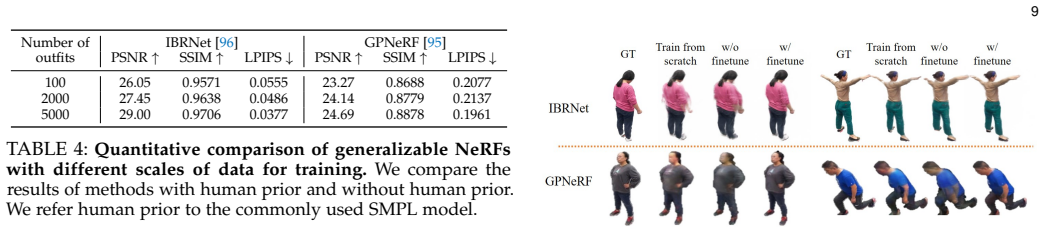
The paper's central discovery is that a deliberately ordinary-data capture strategy, everyday outfits, 500 action types, two outfits per person, and short motion sequences in a calibrated 48- or 24-camera dome, can scale human performance capture to sizes an order of magnitude beyond the closest prior multi-view human dataset, and that the resulting annotations (masks, cameras, keypoints, SMPL/SMPLX parameters, text, normal maps, depth maps) convert that raw scale into measurable gains across 2D and 3D human tasks. Concretely, it reports that generalizable human reconstruction models trained on 5,000 outfits outperform the same models trained on 100 or 2,000 outfits, that pretraining on the dataset and fine-tuning on a smaller public benchmark beats training on that benchmark from scratch, that regenerated SMPL/SMPLX fits with a body-pose prior remove twisting artifacts and improve per-subject animatable reconstruction, and that generative models for 2D, 3D, and multi-view humans improve in image quality scores as training subjects increase. It frames the dataset as the current largest-scale 3D human dataset.
Load-bearing premise
The load-bearing premise is that the fully automatic annotation pipeline, automatically segmented human masks, triangulated keypoints, body-model fitting with a pose prior, and rendered normal and depth maps, produces labels accurate enough for every one of the 9,000 outfits, including loose clothing, without per-frame ground-truth checks; in particular, the mask post-processing step that keeps only the largest outer contour can silently erase body parts that appear detached in loose garments.
Editorial extensions
If this is right
- Scaling training data from 100 to 5,000 outfits raises novel-view synthesis quality for generalizable neural rendering and Gaussian-splatting reconstruction methods, with image-quality scores improving for both scene-level and human-prior baselines.
- A model pretrained on MVHumanNet++ and then fine-tuned on a smaller public human benchmark outperforms the same model trained on that benchmark from scratch.
- The improved SMPL/SMPLX fits, regularized by a body-pose prior, yield higher-fidelity per-subject animatable Gaussian reconstruction than the earlier annotation version.
- Text-conditioned, pose-conditioned human image generation and multi-view human generative models both improve when trained on the larger split of the dataset rather than the smaller split.
- The dataset's rendered depth maps can serve as supervision for generalizable human reconstruction, reducing depth ambiguity when reconstructing humans from unconstrained image pairs.
Reading between the lines
- Editorial inference: if the mask and pose annotations are accurate on loose clothing, the dataset's 60,000 labeled motion sequences could support video-level generative models of humans, not just single-frame reconstruction, a use the paper does not demonstrate.
- Editorial inference: because the depth maps are rendered from the same Gaussian-splatting fits that reconstruction models learn from, downstream gains on depth-supervised tasks may partly reflect alignment between training labels and model family rather than ground-truth geometry; a natural stress test is evaluating on independently captured depth.
- Editorial inference: the paper's pattern of performance improving with scale on every tested task suggests the dataset may behave like a scaling-law resource for human digitization, but the experiments cover only 62% of the data, so whether the trend continues on the full 4,500 identities is untested.
- Editorial inference: the manual text descriptions paired with multi-view images could be used for text-driven avatar generation and retrieval, an application the paper leaves mostly implicit beyond image generation.
Signed reviews
Editorial analysis
A structured set of objections, weighed in public.
Referee Report
Summary. The paper introduces MVHumanNet++, a multi-view human capture dataset claimed to contain 4,500 human identities, 9,000 daily outfits, 60,000 motion sequences, and 645.1 million frames recorded with 48 or 24 synchronized RGB cameras. The dataset is advertised with annotations including human masks, camera parameters, 2D/3D keypoints, SMPL/SMPLX parameters, text descriptions, and newly added normal and depth maps. The authors describe the capture hardware, the recruitment and motion-protocol design, an automated annotation pipeline (Sapiens masks, OpenPose keypoints, EasyMocap SMPL fitting with VPoser, and 2DGS-rendered normal/depth maps), and a series of pilot studies on action recognition, generalizable NeRF and 3DGS reconstruction, text-driven image generation, generative models, and fine-tuning DUSt3R, reporting that larger training subsets yield improved downstream performance.
Significance. If the dataset is released with the claimed scale and usable annotation quality, it would be a valuable community resource for human-centric 3D vision, filling a gap between small-scale multi-view human datasets and large-scale object datasets. The paper's pilot studies provide a concrete demonstration of scaling benefits across several representative tasks, and the addition of normal and depth pseudo-labels is a useful extension over the original MVHumanNet. However, the significance rests on two unverified pillars: the exact scale and composition of the dataset (several counts are internally inconsistent) and the reliability of the automated annotations, especially for loose clothing, which is the regime the paper explicitly targets. The extensive experimental section is a strength, but the lack of quantitative annotation validation weakens the central claim.
major comments (5)
- [§1 and §3.2] The paper gives inconsistent counts of motion sequences. Section 1 states each participant is recorded in 'seven different motion sequences', while Section 3.2 describes a protocol of 12 action sets per participant (six in the first outfit and six in the second) plus in-place A-pose rotations. Neither the abstract's 60,000 motion sequences nor Table 1's 'Actions' column of 500 can be derived from these numbers (4,500 × 7 = 31,500; 4,500 × 12 = 54,000; with rotations the total would differ again). Please define what constitutes a 'motion sequence' (e.g., one performance of one action on one side, or a full outfit session) and reconcile all reported counts in the text, abstract, and Table 1.
- [§3.3, Algorithm 1] Algorithm 1's mask-enhancement step discards all outer contours except the largest one. In loose clothing, the exact regime where the authors note Sapiens masks 'often exhibit noticeable artifacts', human silhouettes can split into multiple connected components (e.g., an arm separated by a segmentation error or a flared skirt occluding the legs). The procedure would delete those components rather than merge them, possibly erasing genuine body parts. Because these masks feed the normal/depth generation (via 2DGS), any mask-conditioned fitting, and the released annotations, this post-processing choice is load-bearing. The paper provides only qualitative visualization (Figs. 6, 8, 9) and no quantitative evaluation (e.g., IoU against manual masks on a sample stratified by garment type, or a multi-view consistency check). Without such validation, the claim that MVHumanNet++ provides reliable masks for 3D human digitization across 9,000 daily outfits is not established.
- [§3.3, Depth Maps and §4.4] The depth maps are rendered from 2D Gaussian Splatting (2DGS) that was itself refined using Sapiens normal maps, and these same depth maps are then used as pseudo-labels to supervise EVA-Gaussian's depth estimator. The paper does not evaluate the accuracy or consistency of the depth pseudo-labels directly, for example by checking multi-view depth agreement or comparing rendered depth against a small set of manual/geometric ground-truth depth on controlled captures. Since the depth maps are presented as a new annotation modality that is 'a reliable source of geometric information', the absence of any direct geometric validation makes it impossible to assess their contribution independently of the downstream rendering metrics.
- [Table 1 and Introduction] The '#Actions' column in Table 1 is ambiguous and the comparison with DNA-Rendering is unverifiable. The MVHumanNet++ text says the dataset contains 500 motion types, while the abstract reports 60,000 motion sequences; Table 1 lists '500' in the #Actions column for MVHumanNet++ and '1187' for DNA-Rendering, yet the introduction claims MVHumanNet++ surpasses DNA-Rendering 'by an order of magnitude in terms of motion'. If #Actions counts action types, 500 < 1187; if it counts sequences, the column mixes units across datasets. Please specify the metric and use consistent units in all comparative statements.
- [Abstract and Conclusion] The abstract and introduction state that MVHumanNet++ 'is publicly available' at a URL, while the Conclusion says 'We plan to release the MVHumanNet++ dataset with annotations publicly'. These two statements directly contradict each other regarding the dataset's availability status. Please correct this inconsistency and clarify whether the dataset is currently downloadable and under what terms.
minor comments (4)
- [Throughout] The manuscript contains several typos and ungrammatical phrases, including 'the emergency of' (should be 'the emergence of'), 'comparsion' in the caption of Fig. 7, and 'we refer human prior' in Section 4.2. A careful proofreading pass is needed.
- [References] References [25] and [87] are the same paper (Pavlakos et al., 'Expressive body capture') and should be merged or cross-referenced. Also, reference [24] contains a typo 'T oG' instead of 'TOG'.
- [§4, first paragraph] The text says experiments used '62% of the available data' and '2800 identities ... amounting to a total of 5500 sets', but 2800 identities × 2 outfits would give 5600 sets. The relation between 2800 identities, 5500 sets, and the 62% figure should be clarified.
- [§4.1] The action-recognition experiment reports training on 'approximately 4000 outfits' and testing on '400 outfits', whereas other experiments in Section 4 use 5500 outfits. Please clarify whether these are intentional subsets and how they relate to the overall 62% split.
Circularity Check
Mild, acknowledged pseudo-label loop in depth maps; core dataset-scale claim is independent and not circular.
-
fitted input called prediction
[Sec. 3.3 (Depth Maps); Sec. 4.4 (Generalizable 3DGS Reconstruction for Human)]
"Inspired by the aforementioned normal-refined 2DGS results, we use 2D Gaussian primitives and multi-view camera parameters to render human depth maps for each view. ... For EVA-Gaussian, we pretrain a depth estimator using rendered human depth maps as ground truth in the first stage, which is then used for Gaussian parameter prediction in the second stage."
The depth maps are not measured independently: they are rendered from a 2DGS fit that was itself regularized by Sapiens normal pseudo-labels derived from the same multi-view RGB frames. EVA-Gaussian's depth estimator is then pretrained with these rendered depths as 'ground truth,' so the depth it predicts is, by construction, a reproduction of the 2DGS/Sapiens geometry rather than a novel measurement. Any downstream claim that EVA-Gaussian 'benefits' from these depth labels inherits the same pseudo-label source. That said, the paper explicitly labels the depth as pseudo-labels, and the reported novel-view metrics use held-out RGB images, so the loop is acknowledged, localized, and not the basis of the dataset's core scale claim.
full rationale
MVHumanNet++ is a dataset paper; its central claims are empirical scale statistics (4,500 identities, 9,000 outfits, 645.1M frames) and pilot-study demonstrations that training on more data improves downstream models. These claims are evaluated with held-out identities/views and standard metrics (PSNR/SSIM/LPIPS, FID, action accuracy), so they do not reduce to the dataset's own definitions. The self-citations to the authors' CVPR 2024 MVHumanNet paper are descriptive (mask pipeline origin, EasyMocap usage) and not load-bearing for the new contributions. The one genuinely circular element is the depth/normal loop: Sapiens normals derived from the same RGB frames regularize 2DGS; depth maps are rendered from that 2DGS; and those rendered depths are used as pseudo-label supervision for EVA-Gaussian's depth estimator. Because the paper calls these labels 'pseudo' and does not use them as the final evaluation ground truth for novel-view synthesis, this is a minor, acknowledged circular loop rather than a forced derivation. No uniqueness theorem, ansatz-smuggling, or renamed-known-result pattern is present. Score 2 reflects the mild pseudo-label loop; the core largest-scale-dataset claim remains independent.
Assumptions & free parameters
free parameters (1)
- Thold (hole area threshold) =
not reported
assumptions (3)
- domain assumption Off-the-shelf models (Sapiens, OpenPose, EasyMocap, VPoser) produce sufficiently accurate annotations on 645M frames without per-frame human review.
- domain assumption Depth maps rendered from normal-refined 2DGS accurately represent scene depth so they can serve as pseudo-labels.
- domain assumption The multi-view capture systems remain synchronized and calibrated across six months of collection.
Cite this review
Pith. "Pith review of MVHumanNet++: A Large-scale Dataset of Multi-view Daily Dressing Human Captures with Richer Annotations for 3D Human Digitization." pith.science (2026). https://pith.science/paper/CDD7KL6E
@misc{pith2026250501838,
  author       = {Pith},
  title        = {Pith review of: MVHumanNet++: A Large-scale Dataset of Multi-view Daily Dressing Human Captures with Richer Annotations for 3D Human Digitization},
  year         = {2026},
  howpublished = {\url{https://pith.science/paper/CDD7KL6E}},
  note         = {Machine review of arXiv:2505.01838}
}
read the original abstract
In this era, the success of large language models and text-to-image models can be attributed to the driving force of large-scale datasets. However, in the realm of 3D vision, while significant progress has been achieved in object-centric tasks through large-scale datasets like Objaverse and MVImgNet, human-centric tasks have seen limited advancement, largely due to the absence of a comparable large-scale human dataset. To bridge this gap, we present MVHumanNet++, a dataset that comprises multi-view human action sequences of 4,500 human identities. The primary focus of our work is on collecting human data that features a large number of diverse identities and everyday clothing using multi-view human capture systems, which facilitates easily scalable data collection. Our dataset contains 9,000 daily outfits, 60,000 motion sequences and 645 million frames with extensive annotations, including human masks, camera parameters, 2D and 3D keypoints, SMPL/SMPLX parameters, and corresponding textual descriptions. Additionally, the proposed MVHumanNet++ dataset is enhanced with newly processed normal maps and depth maps, significantly expanding its applicability and utility for advanced human-centric research. To explore the potential of our proposed MVHumanNet++ dataset in various 2D and 3D visual tasks, we conducted several pilot studies to demonstrate the performance improvements and effective applications enabled by the scale provided by MVHumanNet++. As the current largest-scale 3D human dataset, we hope that the release of MVHumanNet++ dataset with annotations will foster further innovations in the domain of 3D human-centric tasks at scale. MVHumanNet++ is publicly available at https://kevinlee09.github.io/research/MVHumanNet++/.
Figures


Figures from the paper (15 more)




Forward citations
Cited by 3 Pith papers
-
4DHumanDiff: Direct Text-to-4DGS Generation for Consistent 360-Degree Dynamic Humans
A diffusion model trained on 60,000 fitted 4D Gaussian Splatting human clips generates text-prompted, view-consistent dynamic humans directly in 4D, over 10x faster than video-first pipelines.
-
Online Neural Space Time Memory for Dynamic Novel View Synthesis
Neural Space-Time Memory (NSTM) decouples low-frequency memory updates from per-frame synthesis with cross-view attention, enabling real-time minute-long dynamic novel view synthesis from multi-view streams.
-
AnchorCrafter: Animate Cyber-Anchors Selling Your Products via Human-Object Interacting Video Generation
AnchorCrafter adds multi-view object appearance conditioning, depth-based object motion, and hand mesh control to a pose-guided human video diffusion model, letting a cyber-anchor interact with a customized product in...
Reference graph
Works this paper leans on
-
[1]
Segment anything,
A. Kirillov, E. Mintun, N. Ravi, H. Mao, C. Rolland, L. Gustafson, T. Xiao, S. Whitehead, A. C. Berg, W.-Y. Lo, P . Dollar, and R. Girshick, “Segment anything,” in ICCV, 2023
2023
-
[2]
Laion-5b: An open large-scale dataset for training next generation image-text models,
C. Schuhmann, R. Beaumont, R. Vencu, C. Gordon, R. Wightman, M. Cherti, T. Coombes, A. Katta, C. Mullis, M. Wortsman et al., “Laion-5b: An open large-scale dataset for training next generation image-text models,” Advances in Neural Information Processing Systems, vol. 35, 2022
2022
-
[3]
High-resolution image synthesis with latent diffusion models,
R. Rombach, A. Blattmann, D. Lorenz, P . Esser, and B. Ommer, “High-resolution image synthesis with latent diffusion models,” in CVPR, 2022
2022
-
[4]
Objaverse: A universe of annotated 3d objects,
M. Deitke, D. Schwenk, J. Salvador, L. Weihs, O. Michel, E. Van- derBilt, L. Schmidt, K. Ehsani, A. Kembhavi, and A. Farhadi, “Objaverse: A universe of annotated 3d objects,” in CVPR, 2023
2023
-
[5]
Objaverse-xl: A universe of 10m+ 3d objects,
M. Deitke, R. Liu, M. Wallingford, H. Ngo, O. Michel, A. Kusupati, A. Fan, C. Laforte, V . Voleti, S. Y. Gadre et al. , “Objaverse-xl: A universe of 10m+ 3d objects,” arXiv preprint arXiv:2307.05663 , 2023
arXiv 2023
-
[6]
Mvimgnet: A large-scale dataset of multi-view images,
X. Yu, M. Xu, Y. Zhang, H. Liu, C. Ye, Y. Wu, Z. Yan, C. Zhu, Z. Xiong, T. Liang et al. , “Mvimgnet: A large-scale dataset of multi-view images,” in CVPR, 2023
2023
-
[7]
Zero-1-to-3: Zero-shot one image to 3d object,
R. Liu, R. Wu, B. Van Hoorick, P . Tokmakov, S. Zakharov, and C. Vondrick, “Zero-1-to-3: Zero-shot one image to 3d object,” in Proceedings of the IEEE/CVF International Conference on Computer Vision, 2023, pp. 9298–9309
2023
-
[8]
Lrm: Large reconstruction model for single image to 3d,
Y. Hong, K. Zhang, J. Gu, S. Bi, Y. Zhou, D. Liu, F. Liu, K. Sunkavalli, T. Bui, and H. Tan, “Lrm: Large reconstruction model for single image to 3d,” 2023
2023
Show all 100 references
-
[9]
https://renderpeople.com/
-
[10]
Function4d: Real-time human volumetric capture from very sparse consumer rgbd sensors,
T. Yu, Z. Zheng, K. Guo, P . Liu, Q. Dai, and Y. Liu, “Function4d: Real-time human volumetric capture from very sparse consumer rgbd sensors,” in CVPR, 2021, pp. 5746–5756
2021
-
[11]
Neural body: Implicit neural representations with structured latent codes for novel view synthesis of dynamic humans,
S. Peng, Y. Zhang, Y. Xu, Q. Wang, Q. Shuai, H. Bao, and X. Zhou, “Neural body: Implicit neural representations with structured latent codes for novel view synthesis of dynamic humans,” in CVPR, 2021
2021
-
[12]
Hu- man3.6m: Large scale datasets and predictive methods for 3d human sensing in natural environments,
C. Ionescu, D. Papava, V . Olaru, and C. Sminchisescu, “Hu- man3.6m: Large scale datasets and predictive methods for 3d human sensing in natural environments,” IEEE transactions on pattern analysis and machine intelligence , vol. 36, no. 7, pp. 1325– 1339, 2013
2013
-
[13]
Ai choreographer: Music conditioned 3d dance generation with aist++,
R. Li, S. Yang, D. A. Ross, and A. Kanazawa, “Ai choreographer: Music conditioned 3d dance generation with aist++,” in ICCV, 2021
2021
-
[14]
Generalizable neural performer: Learning robust radiance fields for human novel view synthesis,
W. Cheng, S. Xu, J. Piao, C. Qian, W. Wu, K.-Y. Lin, and H. Li, “Generalizable neural performer: Learning robust radiance fields for human novel view synthesis,” arXiv preprint arXiv:2204.11798 , 2022
2022 arXiv
-
[15]
Dna-rendering: A diverse neural actor repository for high-fidelity human-centric rendering,
W. Cheng, R. Chen, S. Fan, W. Yin, K. Chen, Z. Cai, J. Wang, Y. Gao, Z. Yu, Z. Lin et al., “Dna-rendering: A diverse neural actor repository for high-fidelity human-centric rendering,” in ICCV, 2023
2023
-
[16]
Humanrf: High-fidelity neural radiance fields for humans in motion,
M. I¸ sık, M. Rünz, M. Georgopoulos, T. Khakhulin, J. Starck, L. Agapito, and M. Nießner, “Humanrf: High-fidelity neural radiance fields for humans in motion,” ACM T ransactions on Graphics (TOG), vol. 42, no. 4, 2023
2023
-
[17]
Panoptic studio: A massively multiview system for social motion capture,
H. Joo, H. Liu, L. Tan, L. Gui, B. Nabbe, I. Matthews, T. Kanade, S. Nobuhara, and Y. Sheikh, “Panoptic studio: A massively multiview system for social motion capture,” in ICCV, 2015
2015
-
[18]
Monocular 3d human pose estimation in the wild using improved cnn supervision,
D. Mehta, H. Rhodin, D. Casas, P . Fua, O. Sotnychenko, W. Xu, and C. Theobalt, “Monocular 3d human pose estimation in the wild using improved cnn supervision,” in International conference on 3D vision (3DV) . IEEE, 2017
2017
-
[19]
Multi-view neural human rendering,
M. Wu, Y. Wang, Q. Hu, and J. Yu, “Multi-view neural human rendering,” in CVPR, 2020
2020
-
[20]
Neural actor: Neural free-view synthesis of human actors with pose control,
L. Liu, M. Habermann, V . Rudnev, K. Sarkar, J. Gu, and C. Theobalt, “Neural actor: Neural free-view synthesis of human actors with pose control,” ACM transactions on graphics (TOG) , vol. 40, no. 6, 2021
2021
-
[21]
Humbi: A large multiview dataset of human body expressions,
Z. Yu, J. S. Yoon, I. K. Lee, P . Venkatesh, J. Park, J. Yu, and H. S. Park, “Humbi: A large multiview dataset of human body expressions,” in CVPR, 2020
2020
-
[22]
Structured local radiance fields for human avatar modeling,
Z. Zheng, H. Huang, T. Yu, H. Zhang, Y. Guo, and Y. Liu, “Structured local radiance fields for human avatar modeling,” in CVPR, 2022
2022
-
[23]
Humman: Multi-modal 4d human dataset for versatile sensing and modeling,
Z. Cai, D. Ren, A. Zeng, Z. Lin, T. Yu, W. Wang, X. Fan, Y. Gao, Y. Yu, L. Pan et al. , “Humman: Multi-modal 4d human dataset for versatile sensing and modeling,” in European Conference on Computer Vision. Springer, 2022
2022
-
[24]
SMPL: A skinned multi-person linear model,
M. Loper, N. Mahmood, J. Romero, G. Pons-Moll, and M. J. Black, “SMPL: A skinned multi-person linear model,” ACM T ransactions on Graphics(T oG), vol. 34, no. 6, 2015
2015
-
[25]
Expressive body capture: 3d hands, face, and body from a single image,
G. Pavlakos, V . Choutas, N. Ghorbani, T. Bolkart, A. A. Osman, D. Tzionas, and M. J. Black, “Expressive body capture: 3d hands, face, and body from a single image,” in CVPR, 2019
2019
-
[26]
Nerf: Representing scenes as neural radiance fields for view synthesis,
B. Mildenhall, P . P . Srinivasan, M. Tancik, J. T. Barron, R. Ra- mamoorthi, and R. Ng, “Nerf: Representing scenes as neural radiance fields for view synthesis,” in ECCV, 2020
2020
-
[27]
3d gaussian splatting for real-time radiance field rendering
B. Kerbl, G. Kopanas, T. Leimkühler, and G. Drettakis, “3d gaussian splatting for real-time radiance field rendering.” ACM T rans. Graph., vol. 42, no. 4, pp. 139–1, 2023
2023
-
[28]
Dust3r: Geometric 3d vision made easy,
S. Wang, V . Leroy, Y. Cabon, B. Chidlovskii, and J. Revaud, “Dust3r: Geometric 3d vision made easy,” in Proceedings of the IEEE/CVF Conference on Computer Vision and Pattern Recognition , 2024, pp. 20 697–20 709
2024
-
[29]
Mvhumannet: A large-scale dataset of multi-view daily dressing human captures,
Z. Xiong, C. Li, K. Liu, H. Liao, J. Hu, J. Zhu, S. Ning, L. Qiu, C. Wang, S. Wang et al., “Mvhumannet: A large-scale dataset of multi-view daily dressing human captures,” in Proceedings of the IEEE/CVF Conference on Computer Vision and Pattern Recognition , 2024, pp. 19 801–19 811
2024
-
[30]
Generative adversarial nets,
I. Goodfellow, J. Pouget-Abadie, M. Mirza, B. Xu, D. Warde-Farley, S. Ozair, A. Courville, and Y. Bengio, “Generative adversarial nets,” in Advances in Neural Information Processing Systems , Z. Ghahra- mani, M. Welling, C. Cortes, N. Lawrence, and K. Weinberger, Eds., 2014
2014
-
[31]
Image-to-image translation with conditional adversarial networks,
P . Isola, J.-Y. Zhu, T. Zhou, and A. A. Efros, “Image-to-image translation with conditional adversarial networks,” in Proceedings of the IEEE conference on computer vision and pattern recognition , 2017
2017
-
[32]
A style-based generator archi- tecture for generative adversarial networks,
T. Karras, S. Laine, and T. Aila, “A style-based generator archi- tecture for generative adversarial networks,” in Proceedings of the IEEE/CVF conference on computer vision and pattern recognition , 2019, pp. 4401–4410
2019
-
[33]
Deepsdf: Learning continuous signed distance functions for shape representation,
J. J. Park, P . Florence, J. Straub, R. Newcombe, and S. Lovegrove, “Deepsdf: Learning continuous signed distance functions for shape representation,” in Proceedings of the IEEE/CVF conference on computer vision and pattern recognition , 2019, pp. 165–174
2019
-
[34]
Occupancy networks: Learning 3d reconstruction in function space,
L. Mescheder, M. Oechsle, M. Niemeyer, S. Nowozin, and A. Geiger, “Occupancy networks: Learning 3d reconstruction in function space,” in Proceedings of the IEEE/CVF conference on computer vision and pattern recognition , 2019, pp. 4460–4470
2019
-
[35]
Learning implicit fields for generative shape modeling,
Z. Chen and H. Zhang, “Learning implicit fields for generative shape modeling,” in Proceedings of the IEEE/CVF Conference on Computer Vision and Pattern Recognition , 2019, pp. 5939–5948
2019
-
[36]
Instant neural graphics primitives with a multiresolution hash encoding,
T. Müller, A. Evans, C. Schied, and A. Keller, “Instant neural graphics primitives with a multiresolution hash encoding,” ACM T ransactions on Graphics (T oG), vol. 41, no. 4, 2022
2022
-
[37]
Insetgan for full-body image generation,
A. Frühstück, K. K. Singh, E. Shechtman, N. J. Mitra, P . Wonka, and J. Lu, “Insetgan for full-body image generation,” in CVPR, 2022
2022
-
[38]
Pifu: Pixel-aligned implicit function for high-resolution clothed human digitization,
S. Saito, Z. Huang, R. Natsume, S. Morishima, A. Kanazawa, and H. Li, “Pifu: Pixel-aligned implicit function for high-resolution clothed human digitization,” in ICCV, 2019
2019
-
[39]
Neural human performer: Learning generalizable radiance fields for human performance rendering,
Y. Kwon, D. Kim, D. Ceylan, and H. Fuchs, “Neural human performer: Learning generalizable radiance fields for human performance rendering,” Advances in Neural Information Processing Systems, 2021
2021
-
[40]
Efficient geometry-aware 3d generative adversarial networks,
E. R. Chan, C. Z. Lin, M. A. Chan, K. Nagano, B. Pan, S. De Mello, O. Gallo, L. J. Guibas, J. Tremblay, S. Khamis et al. , “Efficient geometry-aware 3d generative adversarial networks,” in Proceed- ings of the IEEE/CVF Conference on Computer Vision and Pattern Recognition, 2022
2022
-
[41]
Get3d: A generative model of high quality 3d textured shapes learned from images,
J. Gao, T. Shen, Z. Wang, W. Chen, K. Yin, D. Li, O. Litany, Z. Gojcic, and S. Fidler, “Get3d: A generative model of high quality 3d textured shapes learned from images,” Advances In Neural Information Processing Systems , vol. 35, 2022
2022
-
[42]
Eva3d: Compo- sitional 3d human generation from 2d image collections,
F. Hong, Z. Chen, Y. Lan, L. Pan, and Z. Liu, “Eva3d: Compo- sitional 3d human generation from 2d image collections,” arXiv preprint arXiv:2210.04888, 2022
2022 arXiv
-
[43]
Humangen: Generating human radiance fields with explicit 14 priors,
S. Jiang, H. Jiang, Z. Wang, H. Luo, W. Chen, and L. Xu, “Humangen: Generating human radiance fields with explicit 14 priors,” in Proceedings of the IEEE/CVF Conference on Computer Vision and Pattern Recognition , 2023
2023
-
[44]
Get3dhuman: Lifting stylegan-human into a 3d generative model using pixel-aligned reconstruction priors,
Z. Xiong, D. Kang, D. Jin, W. Chen, L. Bao, S. Cui, and X. Han, “Get3dhuman: Lifting stylegan-human into a 3d generative model using pixel-aligned reconstruction priors,” in ICCV, 2023
2023
-
[45]
Stylegan-human: A data-centric odyssey of human generation,
J. Fu, S. Li, Y. Jiang, K.-Y. Lin, C. Qian, C. C. Loy, W. Wu, and Z. Liu, “Stylegan-human: A data-centric odyssey of human generation,” in ECCV. Springer, 2022
2022
-
[46]
Pifuhd: Multi-level pixel-aligned implicit function for high-resolution 3d human digitization,
S. Saito, T. Simon, J. Saragih, and H. Joo, “Pifuhd: Multi-level pixel-aligned implicit function for high-resolution 3d human digitization,” in CVPR, 2020
2020
-
[47]
Text2human: Text-driven controllable human image generation,
Y. Jiang, S. Yang, H. Qiu, W. Wu, C. C. Loy, and Z. Liu, “Text2human: Text-driven controllable human image generation,” ACM T ransactions on Graphics (TOG), vol. 41, no. 4, pp. 1–11, 2022
2022
-
[48]
Avatarclip: Zero-shot text-driven generation and animation of 3d avatars,
F. Hong, M. Zhang, L. Pan, Z. Cai, L. Yang, and Z. Liu, “Avatarclip: Zero-shot text-driven generation and animation of 3d avatars,” ACM T ransactions on Graphics (TOG), vol. 41, no. 4, pp. 1–19, 2022
2022
-
[49]
Learning transferable visual models from natural language supervision,
A. Radford, J. W. Kim, C. Hallacy, A. Ramesh, G. Goh, S. Agar- wal, G. Sastry, A. Askell, P . Mishkin, J. Clark et al. , “Learning transferable visual models from natural language supervision,” in International conference on machine learning . PMLR, 2021, pp. 8748–8763
2021
-
[50]
Deepfashion: Powering robust clothes recognition and retrieval with rich annotations,
Z. Liu, P . Luo, S. Qiu, X. Wang, and X. Tang, “Deepfashion: Powering robust clothes recognition and retrieval with rich annotations,” in Proceedings of the IEEE conference on computer vision and pattern recognition , 2016, pp. 1096–1104
2016
-
[51]
Dwnet: Dense warp-based network for pose-guided human video generation,
P . Zablotskaia, A. Siarohin, B. Zhao, and L. Sigal, “Dwnet: Dense warp-based network for pose-guided human video generation,” arXiv preprint arXiv:1910.09139 , 2019
1910 arXiv
-
[52]
Gaussianavatar: Towards realistic human avatar modeling from a single video via animatable 3d gaussians,
L. Hu, H. Zhang, Y. Zhang, B. Zhou, B. Liu, S. Zhang, and L. Nie, “Gaussianavatar: Towards realistic human avatar modeling from a single video via animatable 3d gaussians,” in Proceedings of the IEEE/CVF Conference on Computer Vision and Pattern Recognition , 2024, pp. 634–644
2024
-
[53]
Gauhuman: Articulated gaussian splatting from monocular human videos,
S. Hu, T. Hu, and Z. Liu, “Gauhuman: Articulated gaussian splatting from monocular human videos,” in Proceedings of the IEEE/CVF Conference on Computer Vision and Pattern Recognition , 2024, pp. 20 418–20 431
2024
-
[54]
Gart: Gaussian articulated template models,
J. Lei, Y. Wang, G. Pavlakos, L. Liu, and K. Daniilidis, “Gart: Gaussian articulated template models,” in Proceedings of the IEEE/CVF Conference on Computer Vision and Pattern Recognition , 2024, pp. 19 876–19 887
2024
-
[55]
Animatable gaussians: Learning pose-dependent gaussian maps for high-fidelity human avatar modeling,
Z. Li, Z. Zheng, L. Wang, and Y. Liu, “Animatable gaussians: Learning pose-dependent gaussian maps for high-fidelity human avatar modeling,” in Proceedings of the IEEE/CVF Conference on Computer Vision and Pattern Recognition , 2024, pp. 19 711–19 722
2024
-
[56]
Ash: Animatable gaussian splats for efficient and photoreal human rendering,
H. Pang, H. Zhu, A. Kortylewski, C. Theobalt, and M. Habermann, “Ash: Animatable gaussian splats for efficient and photoreal human rendering,” in Proceedings of the IEEE/CVF Conference on Computer Vision and Pattern Recognition , 2024, pp. 1165–1175
2024
-
[57]
Gps-gaussian: Generalizable pixel-wise 3d gaussian splatting for real-time human novel view synthesis,
S. Zheng, B. Zhou, R. Shao, B. Liu, S. Zhang, L. Nie, and Y. Liu, “Gps-gaussian: Generalizable pixel-wise 3d gaussian splatting for real-time human novel view synthesis,” in Proceedings of the IEEE/CVF Conference on Computer Vision and Pattern Recognition , 2024, pp. 19 680–19 690
2024
-
[58]
Generaliz- able human gaussians for sparse view synthesis,
Y. Kwon, B. Fang, Y. Lu, H. Dong, C. Zhang, F. V . Carrasco, A. Mosella-Montoro, J. Xu, S. Takagi, D. Kim et al. , “Generaliz- able human gaussians for sparse view synthesis,” in European Conference on Computer Vision . Springer, 2025, pp. 451–468
2025
-
[59]
Eva-gaussian: 3d gaussian-based real-time human novel view synthesis under diverse camera settings,
Y. Hu, Z. Liu, J. Shao, Z. Lin, and J. Zhang, “Eva-gaussian: 3d gaussian-based real-time human novel view synthesis under diverse camera settings,” arXiv preprint arXiv:2410.01425 , 2024
2024 arXiv
-
[60]
Faust: Dataset and evaluation for 3d mesh registration,
F. Bogo, J. Romero, M. Loper, and M. J. Black, “Faust: Dataset and evaluation for 3d mesh registration,” in Proceedings of the IEEE conference on computer vision and pattern recognition , 2014
2014
-
[61]
Dynamic faust: Registering human bodies in motion,
F. Bogo, J. Romero, G. Pons-Moll, and M. J. Black, “Dynamic faust: Registering human bodies in motion,” in Proceedings of the IEEE conference on computer vision and pattern recognition , 2017
2017
-
[62]
Detailed, ac- curate, human shape estimation from clothed 3d scan sequences,
C. Zhang, S. Pujades, M. J. Black, and G. Pons-Moll, “Detailed, ac- curate, human shape estimation from clothed 3d scan sequences,” in CVPR, 2017
2017
-
[63]
Cross-view action modeling, learning and recognition,
J. Wang, X. Nie, Y. Xia, Y. Wu, and S.-C. Zhu, “Cross-view action modeling, learning and recognition,” in CVPR, 2014
2014
-
[64]
Ntu rgb+ d 120: A large-scale benchmark for 3d human activity understanding,
J. Liu, A. Shahroudy, M. Perez, G. Wang, L.-Y. Duan, and A. C. Kot, “Ntu rgb+ d 120: A large-scale benchmark for 3d human activity understanding,” IEEE transactions on pattern analysis and machine intelligence, 2019
2019
-
[65]
Ntu rgb+ d: A large scale dataset for 3d human activity analysis,
A. Shahroudy, J. Liu, T.-T. Ng, and G. Wang, “Ntu rgb+ d: A large scale dataset for 3d human activity analysis,” in Proceedings of the IEEE conference on computer vision and pattern recognition , 2016, pp. 1010–1019
2016
-
[66]
AMASS: Archive of motion capture as surface shapes,
N. Mahmood, N. Ghorbani, N. F. Troje, G. Pons-Moll, and M. J. Black, “AMASS: Archive of motion capture as surface shapes,” in International Conference on Computer Vision , 2019
2019
-
[67]
http://mocap.cs.cmu.edu/
-
[68]
H. G. Sai Charan Mahadevan, Karunanidhi Durai Ku-mar, https: //mocap.cs.sfu.ca/
-
[69]
Icon: Implicit clothed humans obtained from normals,
Y. Xiu, J. Yang, D. Tzionas, and M. J. Black, “Icon: Implicit clothed humans obtained from normals,” in CVPR, 2022
2022
-
[70]
Snarf: Differentiable forward skinning for animating non-rigid neural implicit shapes,
X. Chen, Y. Zheng, M. J. Black, O. Hilliges, and A. Geiger, “Snarf: Differentiable forward skinning for animating non-rigid neural implicit shapes,” in Proceedings of the IEEE/CVF International Conference on Computer Vision , 2021, pp. 11 594–11 604
2021
-
[71]
Deephuman: 3d human reconstruction from a single image,
Z. Zheng, T. Yu, Y. Wei, Q. Dai, and Y. Liu, “Deephuman: 3d human reconstruction from a single image,” in Proceedings of the IEEE/CVF International Conference on Computer Vision , 2019
2019
-
[72]
Deepmulticap: Performance capture of multiple characters using sparse multiview cameras,
Y. Zheng, R. Shao, Y. Zhang, T. Yu, Z. Zheng, Q. Dai, and Y. Liu, “Deepmulticap: Performance capture of multiple characters using sparse multiview cameras,” in ICCV, 2021
2021
-
[73]
X-avatar: Expressive human avatars,
K. Shen, C. Guo, M. Kaufmann, J. J. Zarate, J. Valentin, J. Song, and O. Hilliges, “X-avatar: Expressive human avatars,” in CVPR, 2023
2023
-
[74]
High-fidelity 3d human digitization from single 2k resolution images,
S.-H. Han, M.-G. Park, J. H. Yoon, J.-M. Kang, Y.-J. Park, and H.-G. Jeon, “High-fidelity 3d human digitization from single 2k resolution images,” in CVPR, 2023
2023
-
[75]
Learning to dress 3d people in generative clothing,
Q. Ma, J. Yang, A. Ranjan, S. Pujades, G. Pons-Moll, S. Tang, and M. J. Black, “Learning to dress 3d people in generative clothing,” in CVPR, 2020
2020
-
[76]
https://web.twindom.com/
-
[77]
https://secure.axyz-design.com/
-
[78]
https://3dpeople.com/
-
[79]
Articulated mesh animation from multi-view silhouettes,
D. Vlasic, I. Baran, W. Matusik, and J. Popovi´ c, “Articulated mesh animation from multi-view silhouettes,” ACM T ransactions on Graphics (TOG), vol. 27, no. 3, pp. 1–9, 2008
2008
-
[80]
Dynamic shape capture using multi-view photometric stereo,
D. Vlasic, P . Peers, I. Baran, P . Debevec, J. Popovi´ c, S. Rusinkiewicz, and W. Matusik, “Dynamic shape capture using multi-view photometric stereo,” in ACM SIGGRAPH Asia 2009 papers , 2009, pp. 1–11
2009
-
[81]
Aist dance video database: Multi-genre, multi-dancer, and multi-camera database for dance information processing
S. Tsuchida, S. Fukayama, M. Hamasaki, and M. Goto, “Aist dance video database: Multi-genre, multi-dancer, and multi-camera database for dance information processing.” in ISMIR, 2019
2019
-
[82]
Real-time deep dynamic characters,
M. Habermann, L. Liu, W. Xu, M. Zollhoefer, G. Pons-Moll, and C. Theobalt, “Real-time deep dynamic characters,” ACM T ransactions on Graphics (T oG), vol. 40, no. 4, 2021
2021
-
[83]
Deepcap: Monocular human performance capture using weak supervision,
M. Habermann, W. Xu, M. Zollhofer, G. Pons-Moll, and C. Theobalt, “Deepcap: Monocular human performance capture using weak supervision,” in CVPR, 2020
2020
-
[84]
Sapiens: Foundation for human vision models,
R. Khirodkar, T. Bagautdinov, J. Martinez, S. Zhaoen, A. James, P . Selednik, S. Anderson, and S. Saito, “Sapiens: Foundation for human vision models,” in European Conference on Computer Vision . Springer, 2024, pp. 206–228
2024
-
[85]
Realtime multi-person 2d pose estimation using part affinity fields,
Z. Cao, T. Simon, S.-E. Wei, and Y. Sheikh, “Realtime multi-person 2d pose estimation using part affinity fields,” in CVPR, 2017, pp. 7291–7299
2017
-
[86]
Easymocap - make human motion capture easier
E. Contributors, “Easymocap - make human motion capture easier.” Github, 2021, https://github.com/zju3dv/EasyMocap
2021
-
[87]
Expressive body capture: 3d hands, face, and body from a single image,
G. Pavlakos, V . Choutas, N. Ghorbani, T. Bolkart, A. A. Osman, D. Tzionas, and M. J. Black, “Expressive body capture: 3d hands, face, and body from a single image,” in Proceedings of the IEEE/CVF conference on computer vision and pattern recognition , 2019
2019
-
[88]
Wonder3d: Single image to 3d using cross-domain diffusion,
X. Long, Y.-C. Guo, C. Lin, Y. Liu, Z. Dou, L. Liu, Y. Ma, S.-H. Zhang, M. Habermann, C. Theobalt et al. , “Wonder3d: Single image to 3d using cross-domain diffusion,” in Proceedings of the IEEE/CVF Conference on Computer Vision and Pattern Recognition , 2024, pp. 9970–9980
2024
-
[89]
Stablenormal: Reducing diffusion variance for stable and sharp normal,
C. Ye, L. Qiu, X. Gu, Q. Zuo, Y. Wu, Z. Dong, L. Bo, Y. Xiu, and X. Han, “Stablenormal: Reducing diffusion variance for stable and sharp normal,” ACM T ransactions on Graphics (TOG), vol. 43, no. 6, pp. 1–18, 2024
2024
-
[90]
2d gaussian splatting for geometrically accurate radiance fields,
B. Huang, Z. Yu, A. Chen, A. Geiger, and S. Gao, “2d gaussian splatting for geometrically accurate radiance fields,” in ACM SIGGRAPH 2024 conference papers , 2024, pp. 1–11
2024
-
[91]
Implicit functions in feature space for 3d shape reconstruction and completion,
J. Chibane, T. Alldieck, and G. Pons-Moll, “Implicit functions in feature space for 3d shape reconstruction and completion,” in 15 Proceedings of the IEEE/CVF conference on computer vision and pattern recognition, 2020, pp. 6970–6981
2020
-
[92]
Channel- wise topology refinement graph convolution for skeleton-based action recognition,
Y. Chen, Z. Zhang, C. Yuan, B. Li, Y. Deng, and W. Hu, “Channel- wise topology refinement graph convolution for skeleton-based action recognition,” in ICCV, 2021
2021
-
[93]
Infogcn: Representation learning for human skeleton-based action recognition,
H.-g. Chi, M. H. Ha, S. Chi, S. W. Lee, Q. Huang, and K. Ramani, “Infogcn: Representation learning for human skeleton-based action recognition,” in CVPR, 2022
2022
-
[94]
Learning discriminative represen- tations for skeleton based action recognition,
H. Zhou, Q. Liu, and Y. Wang, “Learning discriminative represen- tations for skeleton based action recognition,” in ICCV, 2023
2023
-
[95]
Geometry-guided progressive nerf for generalizable and efficient neural human rendering,
M. Chen, J. Zhang, X. Xu, L. Liu, Y. Cai, J. Feng, and S. Yan, “Geometry-guided progressive nerf for generalizable and efficient neural human rendering,” in ECCV. Springer, 2022, pp. 222–239
2022
-
[96]
Ibrnet: Learning multi-view image-based rendering,
Q. Wang, Z. Wang, K. Genova, P . P . Srinivasan, H. Zhou, J. T. Barron, R. Martin-Brualla, N. Snavely, and T. Funkhouser, “Ibrnet: Learning multi-view image-based rendering,” in CVPR, 2021
2021
-
[97]
Lara: Efficient large-baseline radiance fields,
A. Chen, H. Xu, S. Esposito, S. Tang, and A. Geiger, “Lara: Efficient large-baseline radiance fields,” in European Conference on Computer Vision. Springer, 2024, pp. 338–355
2024
-
[98]
Analyzing and improving the image quality of stylegan,
T. Karras, S. Laine, M. Aittala, J. Hellsten, J. Lehtinen, and T. Aila, “Analyzing and improving the image quality of stylegan,” in Proceedings of the IEEE/CVF conference on computer vision and pattern recognition, 2020, pp. 8110–8119
2020
-
[99]
Mv- dream: Multi-view diffusion for 3d generation,
Y. Shi, P . Wang, J. Ye, M. Long, K. Li, and X. Yang, “Mv- dream: Multi-view diffusion for 3d generation,” arXiv preprint arXiv:2308.16512, 2023
2023 arXiv
-
[100]
Blender - a 3d modelling and rendering package,
B. O. Community, “Blender - a 3d modelling and rendering package,” Blender Foundation, 2018, http://www.blender.org
2018
Reviewed August 16, 2026 · model on record in the stance chip above.
Discussion (0). Continue with ORCID to comment.