REVIEW 3 major objections 6 minor 48 references
Finite element modeling of dynamic frictional rupture with rate and state friction
T0 review · 3 major / 6 minor · reviewed 2026-08-14 · deepseek-v4-flash
Pith's one-line read Pure velocity-weakening friction cannot equilibrate a far-field load, so finite-size frictional sliding needs the strengthening-branch law.
desk verdict Useful explicit-FEM study of rate-and-state friction with a real finite-size effect, but the claim that pure velocity-weakening lacks physical validity goes beyond the convergence evidence. read the letter →
The pith
A machine-rendered reading of the paper's core claim, the machinery that carries it, and where it could break.
The reading
What carries the argument
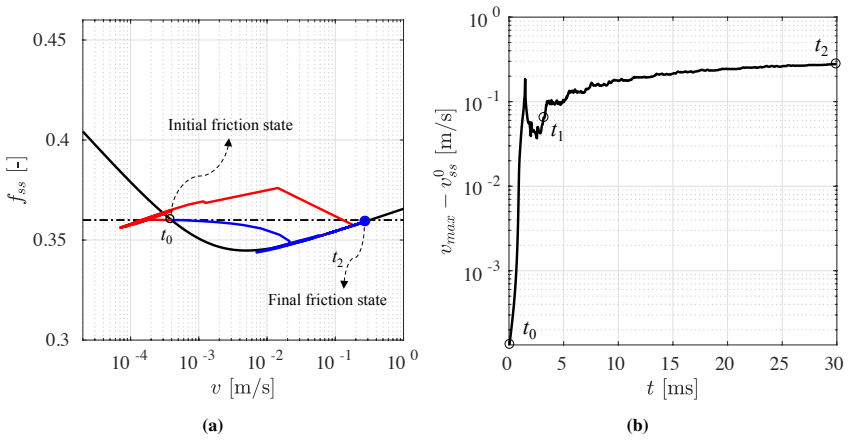
The central object is the rate-and-state friction law, in which the friction coefficient $f$ depends on the slip velocity $v$ and a state variable $\varphi$ (the average lifetime of load-carrying contact asperities) through $f=f_0+a\ln(v/v_*)+b\ln(\varphi/\varphi_*)$ and $\dot\varphi=1-v\varphi/D$, together with a revised law that adds a velocity-strengthening branch at high slip velocity. The numerical machinery is an explicit finite element solver with central-difference time integration and node-to-node contact, which is needed to include finite domain boundaries that boundary integral methods cannot represent. The physical mechanism that carries the argument is the return of reflected elastic waves to the interface: each reflection changes the average slip velocity and shear traction, and the paper shows that these successive changes drive VWS friction to the equilibrium point on its steady-state friction curve while driving VW friction away from any equilibrium. The paper also identifies the finite element internal-node noise that requires time steps far below the CFL stability limit for accurate rate-and-state solutions.
What would settle it
Run the velocity-weakening long-time case with successively refined interface meshes and time steps (for instance, α = 0.01 and element sizes below 1.4 mm): if the runaway acceleration disappears or a steady sliding velocity emerges as resolution improves, the claim that pure VW cannot equilibrate the far-field load would be refuted; if the runaway persists at every resolution, the claim survives.
Extended reading notes
Core claim
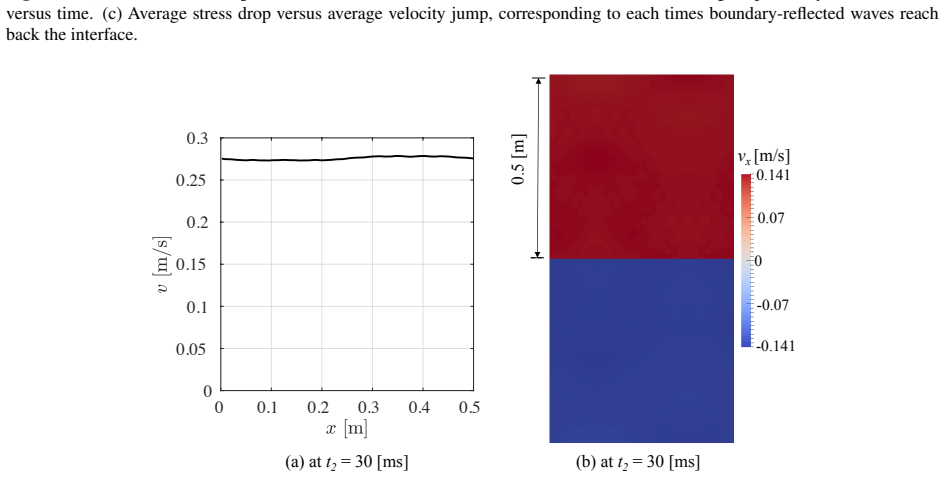
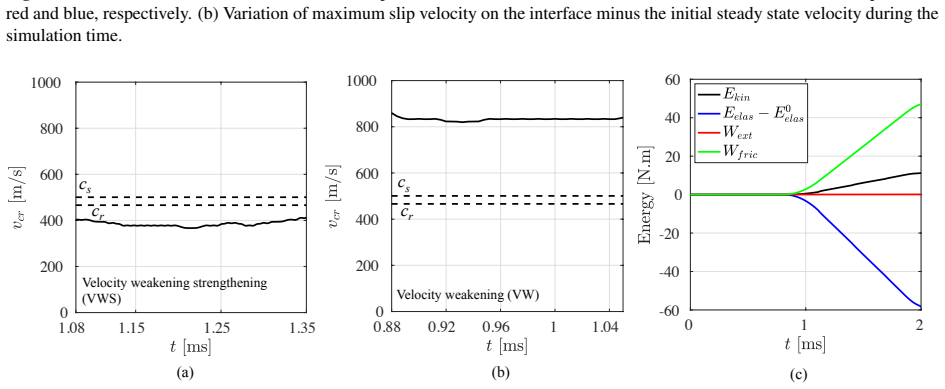
The central claim is that the physically relevant distinction between the two families of rate-and-state friction laws only appears once finite boundaries are included. In an infinite-domain setting, both the pure velocity-weakening law and the velocity-weakening-strengthening law generate rupture fronts with a temporary steady state and a sharp shear-stress drop, so the fracture-mechanics analogy holds. When the blocks have finite height, the waves reflected from the top and bottom boundaries come back to the interface and repeatedly change the slip velocity and shear traction. For the VWS law these repeated impacts push the interface toward the intersection of the steady-state friction curve with the far-field loading line, so the blocks slide uniformly and the stress drop decays to zero. For the pure VW law, the same reflected waves accelerate the interface: the friction coefficient drops as velocity increases, so the interface can never produce enough traction to balance the applied shear stress, and the numerical simulation becomes unstable once reflections arrive. The paper therefore asserts that pure VW friction is not physically valid for the long-term behavior of frictional interfaces in interaction with domain boundaries, whereas VWS friction is.
Load-bearing premise
The conclusion that pure velocity-weakening friction is physically invalid for long-term sliding rests on the assumption that the runaway acceleration seen in the simulations is a real physical instability and not an artifact of the numerical noise that the paper itself shows can destabilize explicit finite element solutions.
Editorial extensions
If this is right
- In finite-size rate-and-state models, pure velocity-weakening friction is only usable for times shorter than the wave-return time; after that it predicts runaway acceleration rather than steady sliding.
- The fracture-mechanics analogy for frictional rupture—a stress drop behind the front—is a finite-time effect that disappears once boundary reflections homogenize the interface.
- Long-term numerical models of frictional interfaces in finite domains should adopt velocity-weakening-strengthening friction if they aim to reproduce steady sliding under constant far-field load.
- Explicit finite element simulation of rate-and-state friction requires time steps orders of magnitude smaller than the CFL limit, and the instability seeded by internal-node noise must be controlled before long-time physics can be extracted.
- The agreement with boundary integral results in the pre-reflection phase establishes finite element simulations as a valid tool for capturing finite-size effects that infinite-domain methods cannot address.
Reading between the lines
- If the VW runaway is physical, then long-term earthquake and laboratory sliding models on finite faults that use pure VW friction may need a high-velocity strengthening cutoff or additional regularization to avoid unbounded acceleration—a modification the paper does not explore.
- A direct numerical test of the paper's central claim would be to refine the mesh and reduce the time step for the VW long-time case; the runaway should persist at every resolution if it is physical, and disappear if it is an artifact of internal-node noise.
- The near-linear relation the paper observes between the average stress drop and the velocity jumps at each reflection suggests a quantitative finite-size radiation-damping law could be derived, extending infinite-domain crack theory to finite blocks.
- Laboratory interfaces that exhibit long-term stable sliding may be those whose friction has a strengthening branch, implying that the VWS form, rather than pure VW, is the safer default for interpreting finite-size experiments.
Signed reviews
Editorial analysis
A structured set of objections, weighed in public.
Referee Report
Summary. This paper presents an explicit-dynamics finite element formulation for rate-and-state friction between finite elastic blocks, with node-to-node contact and central-difference time integration detailed in the appendices. The authors analyze the time-step constraint for steady sliding, attribute the need for very small time steps to noise from internal discretization nodes, and benchmark the early-time rupture response against a boundary integral method. They then study the effect of boundary reflections on long-term sliding for a velocity-weakening (VW) law and a velocity-weakening-strengthening (VWS) law. The main claims are that VWS reaches a global steady-state sliding configuration after multiple reflections, while VW accelerates and becomes unstable, so that pure VW "lacks physical validity" for long-term finite-domain studies.
Significance. If the long-term dichotomy is physical, the paper is a useful contribution to finite-size rate-and-state friction modeling: unlike boundary integral formulations, the FEM captures boundary interactions, and the paper documents a nontrivial numerical-stability requirement (time steps well below the CFL limit) in the studied configuration. The early-time FEM/BIM agreement in Figure 7b is a genuine validation, and the energy accounting and interface-averaged diagnostics in Figures 10-12 are informative. The paper also makes a falsifiable prediction: pure VW friction cannot settle into a steady sliding state after boundary reflections, whereas VWS can. The main weakness is that the key VW prediction is asserted from a single run with no convergence study, in a regime where the authors themselves show that numerical noise can trigger instability.
major comments (3)
- [Section 5.2 (VW perturbation analysis)] The central claim that pure VW friction lacks physical validity in finite systems is supported only by the statement that "the calculations become unstable as soon as the reflected waves reach back the frictional interface." Section 4.2 demonstrates that this explicit FEM develops non-physical oscillations for time steps alpha >= 0.05 (Figure 4) and that the onset time of such oscillations scales linearly with element size (Figure 5b). The VW reflected-wave run uses alpha = 0.02 and 250 interface elements, but no alpha- or h-refinement study is reported for this case. A convergence study (for example alpha = 0.02, 0.01, 0.005 and at least two mesh refinements, reporting the instability onset time, slip-velocity growth rate, and final state) is required to separate a physical VW instability from the discretization noise characterized in Section 4.2; without it, the paper's main conclusion is not established.
- [Section 5.2, final paragraph] The statement that "the pure VW friction cannot generate interface tractions that equilibrate the far field load" is imprecise and, taken literally, incorrect: for the chosen parameters, Equation (4) gives fss = 0.36 at v0_ss = 2.93627e-4 m/s (the purple star in Figure 3b), so the VW law does possess an interface traction that equilibrates the applied shear. What the simulations indicate is that this equilibrium is not stable under perturbations and after boundary reflections. The wording should be changed to "cannot stably maintain" or "does not converge to", and the discussion should distinguish between existence and stability of the equilibrium.
- [Section 5.1.1 and Figure 7b] The FEM/BIM validation is reported only for the maximum slip velocity and only for one discretization (250 interface elements, alpha = 0.02). Since the paper's long-term conclusions are drawn from simulations with this same discretization, a mesh- and time-step-convergence test of the rupture solution, not just of steady sliding, is needed to establish that the VWS/VW differences are not resolution effects. At minimum, a second mesh refinement and a smaller alpha should be reported for the rupture simulations.
minor comments (6)
- [Throughout] The manuscript contains numerous typos (e.g., "purturbed", "corresonding", "seubsequent", "caluclated", "fricition") and should be carefully proofread.
- [Sections 3 and 4.1] There are clear remnants of an earlier draft: orphan headings such as "3.1.2. Contact algorithm", "3.1.3. Frcition algorithm", and "3.2. Spectral element approach" appear in the text, and some equations and figures are numbered inconsistently (Equations 6-10 versus 7-9; "Figure ??" in Section 4.1). These should be cleaned.
- [Figure 1] Figure 1 is duplicated and the captions/panels do not match the text: one copy shows stationary friction curves with a different caption from the other copy, and the panel labels are inconsistent. Please regenerate the figure and a single correct caption.
- [Sections 5.1 and 5.2] The interpretation of the stress drop and radiation damping draws on refs [25,26]; reference [26] is listed as "To be submitted" and reference [25] is an arXiv preprint. The relevant statements should either be demonstrated from equations in the present paper or refer to published/archived versions.
- [Section 4.2] The claim that the instability originates from internal discretization nodes is an inference from the linear tcrit-versus-element-size scaling and the structured/unstructured mesh comparison (Figure 5). A direct test, such as comparing with an interface-only discretization or with nodal filtering, would make the noise-source attribution more conclusive.
- [Figures 4c and 10c] The axis labels in Figure 4c and the legend in Figure 10c are difficult to read; please enlarge the fonts and define the symbols (for example, the "123" marking in Figure 10b).
Circularity Check
No significant circularity: the simulation results are self-contained, and the authors' self-citations are used only for interpretive framing, not as load-bearing derivation.
full rationale
The paper's central results—VWS friction reaching a global steady state after boundary reflections and VW friction accelerating without equilibrating the far-field load—are obtained by explicit finite-element solution of the stated rate-and-state equations (Eqs. 1, 2, and 5) with experimentally motivated PMMA parameters. The constitutive curves are inputs, but the long-term sliding behavior is a simulated outcome, not an imposed fit. No fitted parameter is renamed as a prediction, and no equation in the derivation chain reduces to its own input. The self-citations [25,26] are used to interpret stress drops and radiation damping ('In recent work, we have shown how the stress drop and slip velocity ... can be predicted theoretically from radiation damping [25]' and 'Theoretical arguments [25] can be made to relate these jumps to order of mu/2cs, and will be investigated further in the future'), but these references are not used to define or force the VWS/VW steady-state conclusions. The strongest physical claim about VW is presented as a simulation-based inference ('In any case, the pure VW friction cannot generate interface tractions that equilibrate the far field load'), and while this is debatable and possibly conflates numerical instability with physical behavior, that is a correctness and convergence concern, not circularity. The FEM-BIM comparison uses a coauthor's thesis as a benchmark, but it validates the early-time implementation and does not define the long-term predictions. Accordingly, the derivation chain is self-contained and no circular step is exhibited.
Assumptions & free parameters
free parameters (4)
- Friction parameters f0, a, b, v*, phi*, D =
f0=0.285, a=0.005, b=0.0214 (VW) / b=0.075 (VWS), v*=1e-7 m/s, phi*=3.3e-4 s, D=5e-7 m
- Initial steady-state slip velocity v0_ss =
3.8931e-4 m/s (VWS), 2.93627e-4 m/s (VW)
- State perturbation amplitude eps =
1e-4
- Time step ratio alpha =
0.02 for rupture simulations
assumptions (5)
- domain assumption The two blocks are homogeneous, linear-elastic (PMMA properties) under plane stress.
- domain assumption The interface obeys the rate-and-state friction laws of Equations 1 and 2 (VW) or 5 (VWS), with state evolution phidot=1-v*phi/D.
- domain assumption The node-to-node contact algorithm is valid for small displacements.
- domain assumption Periodic boundary conditions on the lateral sides do not change the long-term interfacial behavior.
- ad hoc to paper The long-time VW instability observed in Section 5.2 is physical and not a numerical artifact of the discretization noise characterized in Section 4.2.
Cite this review
Pith. "Pith review of Finite element modeling of dynamic frictional rupture with rate and state friction." pith.science (2026). https://pith.science/paper/CDHQHKDJ
@misc{pith2026190807826,
  author       = {Pith},
  title        = {Pith review of: Finite element modeling of dynamic frictional rupture with rate and state friction},
  year         = {2026},
  howpublished = {\url{https://pith.science/paper/CDHQHKDJ}},
  note         = {Machine review of arXiv:1908.07826}
}
read the original abstract
Numerous laboratory experiments have demonstrated the dependence of the friction coefficient on the interfacial slip rate and the contact history, a behavior generically called rate and state friction. Although numerical models have been widely used for analyzing rate and state friction, in general they consider infinite elastic domains surrounding the sliding interface and rely on boundary integral formulations. Much less work has been dedicated to modeling finite size systems to account for interactions with boundaries. This paper investigates rate and state frictional interfaces in the context of finite size systems with the finite element method in explicit dynamics. We investigate the long term behavior of the sliding interface for two different friction laws: a velocity weakening law, for which the friction monotonously decreases with increasing sliding velocity, and a velocity weakening-strengthening law, for which the friction coefficient first decreases but then increases above a critical velocity. We show that for both friction laws at finite times, that is before wave reflections from the boundaries come back to the sliding interface, a temporary steady state sliding is reached, with a well-defined stress drop at the interface. This stress drop gives rise to a stress concentration and leads to an analogy between friction and fracture. However, at longer times, that is after multiple wave reflections, the stress drop is essentially zero, resulting in losing the analogy with fracture mechanics. Finally, the simulations reveal that velocity weakening is unstable at long time scales, as it results in an acceleration of the sliding blocks. On the other hand, velocity weakening-strengthening reaches a steady state sliding configuration.
Figures


Figures from the paper (11 more)






Reference graph
Works this paper leans on
-
[1]
D. J. Andrews. Rupture velocity of plane strain shear cracks. Journal of Geophysical Research, 81(32):5679–5687, November 1976
work page 1976
- [2]
-
[3]
C. Marone. Laboratory derived friction laws and their application to seismic faulting. Annual Review of Earth and Planetary Sciences , 26(1):643–696, May 1998
work page 1998
-
[4]
A. Bizzarri and M. Cocco. Slip-weakening behavior during the propagation of dynamic ruptures obeying rate- and state-dependent friction laws. Journal of Geophysical Research, 108(B8), 2003
work page 2003
-
[5]
C. H. Scholz. Earthquakes and friction laws. Nature, 391(6662):37–42, January 1998
work page 1998
-
[6]
J. H. Dieterich. A constitutive law for rate of earthquake production and its application to earthquake clustering. Journal of Geophysical Research: Solid Earth, 99(B2):2601–2618, February 1994
work page 1994
-
[7]
N. Lapusta and J. R. Rice. Nucleation and early seismic propagation of small and large events in a crustal earthquake model: nucleation and early seismic propagation. Journal of Geophysical Research: Solid Earth, 108(B4), April 2003
work page 2003
-
[8]
E. A. Brener, M. Aldam, F. Barras, J. F. Molinari, and E. Bouchbinder. Unstable slip pulses and earthquake nucleation as a nonequilibrium first order phase transition. Physical Review Letters, 121(23), December 2018
work page 2018
Show all 48 references
-
[9]
E. A. Brener, M. Weikamp, R. Spatschek, Y . Bar-Sinai, and E. Bouchbinder. Dynamic instabilities of frictional sliding at a bimaterial interface. Journal of the Mechanics and Physics of Solids, 89:149–173, April 2016
2016
-
[10]
Aldam, M
M. Aldam, M. Weikamp, R. Spatschek, E. A. Brener, and E. Bouchbinder. Critical nucleation length for accelerating frictional slip. Geo- physical Research Letters, 44(22):11,390–11,398, November 2017
2017
-
[11]
R. C. Viesca. Self-similar slip instability on interfaces with rate- and state-dependent friction. Proceedings of the Royal Society A: Mathe- matical, Physical and Engineering Science, 472(2192):20160254, August 2016
2016
-
[12]
X. Lu, N. Lapusta, and A. J. Rosakis. Pulse-like and crack-like dynamic shear ruptures on frictional interfaces: experimental evidence, numerical modeling, and implications. International Journal of Fracture, 163(1-2):27–39, May 2010
2010
-
[13]
X. Lu, A. J. Rosakis, and N. Lapusta. Rupture modes in laboratory earthquakes: E ffect of fault prestress and nucleation conditions. Journal of Geophysical Research, 115(B12), December 2010
2010
-
[14]
A. A. Gabriel, J. P. Ampuero, L. A. Dalguer, and P. M. Mai. The transition of dynamic rupture styles in elastic media under velocity-weakening friction. Journal of Geophysical Research: Solid Earth, 117(B9), September 2012
2012
-
[15]
Zheng and J
G. Zheng and J. R. Rice. Conditions under which velocity-weakening friction allows a self-healing versus a cracklike mode of rupture. Bulletin of the Seismological Society of America, 88(6), 1998
1998
-
[16]
T. L. Anderson. Fracture Mechanics: Fundamentals and Applications. CRC Press, third edition, 2005
2005
-
[17]
Coker, G
D. Coker, G. Lykotrafitis, A. Needleman, and A. J. Rosakis. Frictional sliding modes along an interface between identical elastic plates subject to shear impact loading. Journal of the Mechanics and Physics of Solids, 53(4):884–922, April 2005
2005
-
[18]
Z. Shi, Y . Benzion, and A. Needleman. Properties of dynamic rupture and energy partition in a solid with a frictional interface. Journal of the Mechanics and Physics of Solids, 56(1):5–24, January 2008
2008
-
[19]
X. Lu, N. Lapusta, and A. J. Rosakis. Analysis of supershear transition regimes in rupture experiments: the e ffect of nucleation conditions and friction parameters. Geophysical Journal International, 177(2):717–732, May 2009
2009
-
[20]
Kaneko, N
Y . Kaneko, N. Lapusta, and J. P. Ampuero. Spectral element modeling of spontaneous earthquake rupture on rate and state faults: E ffect of velocity-strengthening friction at shallow depths. Journal of Geophysical Research, 113(B9), September 2008
2008
-
[21]
J. P. Ampuero and Y . Ben-Zion. Cracks, pulses and macroscopic asymmetry of dynamic rupture on a bimaterial interface with velocity- weakening friction. Geophysical Journal International, 173(2):674–692, May 2008
2008
-
[22]
E. M. Dunham, D. Belanger, L. Cong, and J. E. Kozdon. Earthquake Ruptures with Strongly Rate-Weakening Friction and Off-Fault Plasticity, Part 1: Planar Faults. Bulletin of the Seismological Society of America, 101(5):2296–2307, October 2011
2011
-
[23]
B. A. Erickson, E. M. Dunham, and A. Khosravifar. A finite di fference method for o ff-fault plasticity throughout the earthquake cycle. 22 Journal of the Mechanics and Physics of Solids, 109:50–77, December 2017
2017
-
[24]
K. L. Allison and E. M. Dunham. Earthquake cycle simulations with rate-and-state friction and power-law viscoelasticity. Tectonophysics, 733:232–256, May 2018
2018
-
[25]
Barras, M
F. Barras, M. Aldam, M. Roch, E. A. Brener, E. Bouchbinder, and J. F. Molinari. The emergence of crack-like behavior of frictional rupture: The origin of stress drops. arxiv, 2019
2019
-
[26]
Barras, M
F. Barras, M. Aldam, M. Roch, E. A. Brener, E. Bouchbinder, and J. F. Molinari. The emergence of crack-like behavior of frictional rupture: Edge singularity and energy balance. To be submitted, 2019
2019
-
[27]
Geubelle and J
P. Geubelle and J. Rice. A spectral method for three-dimensional elastodynamic fracture problems. Journal of the Mechanics and Physics of Solids, 43(11):1791–1824, 1995
1995
-
[28]
Barras, R
F. Barras, R. Carpaij, P. H. Geubelle, and J. F. Molinari. Supershear bursts in the propagation of a tensile crack in linear elastic material. Physical Review E, 98(6), December 2018
2018
-
[29]
Barras, P
F. Barras, P. H. Geubelle, and J. F. Molinari. Interplay between process zone and material heterogeneities for dynamic cracks. Physical Review Letters, 119(14), October 2017
2017
-
[30]
Belytschko, W
T. Belytschko, W. K. Liu, B. Moran, and K. I. Elkhodary. Nonlinear finite elements for continua and structures . Wiley, Chichester, West Sussex, United Kingdon, second edition, 2014
2014
-
[31]
D. S. Kammer, D. Pino Mu ˜noz, and J. F. Molinari. Length scale of interface heterogeneities selects propagation mechanism of frictional slip fronts. Journal of the Mechanics and Physics of Solids, 88:23–34, March 2016
2016
-
[32]
D. S. Kammer, V . A. Yastrebov, G. Anciaux, and J. F. Molinari. The existence of a critical length scale in regularised friction. Journal of the Mechanics and Physics of Solids, 63:40–50, February 2014
2014
-
[33]
Baillet, V
L. Baillet, V . Linck, S. D’Errico, B. Laulagnet, and Y . Berthier. Finite Element Simulation of Dynamic Instabilities in Frictional Sliding Contact. Journal of Tribology, 127(3):652, 2005
2005
-
[34]
Tonazzi, F
D. Tonazzi, F. Massi, A. Culla, L. Baillet, A. Fregolent, and Y . Berthier. Instability scenarios between elastic media under frictional contact. Mechanical Systems and Signal Processing, 40(2):754–766, November 2013
2013
-
[35]
Meziane, S
A. Meziane, S. D’Errico, L. Baillet, and B. Laulagnet. Instabilities generated by friction in a pad–disc system during the braking process. Tribology International, 40(7):1127–1136, July 2007
2007
-
[36]
T. A. Laursen and V . G. Oancea. On the constitutive modeling and finite element computation of rate-dependent frictional sliding in large deformations. Computer Methods in Applied Mechanics and Engineering, 143(3-4):197–227, April 1997
1997
-
[37]
V . G. Oancea and T. A. Laursen. Dynamics of a state variable frictional law in finite element analysis. Finite Elements in Analysis and Design, 22(1):25–40, May 1996
1996
-
[38]
Tal and B
Y . Tal and B. H. Hager. Dynamic mortar finite element method for modeling of shear rupture on frictional rough surfaces. Computational Mechanics, 61(6):699–716, June 2018
2018
-
[39]
J. H. Dieterich. Modeling of rock friction: 1. Experimental results and constitutive equations. Journal of Geophysical Research, 84(B5):2161, 1979
1979
-
[40]
A. Ruina. Slip instability and state variable friction laws. Journal of Geophysical Research: Solid Earth, 88(B12):10359–10370, December 1983
1983
-
[41]
J. H. Dieterich and B. D. Kilgore. Direct observation of frictional contacts: New insights for state-dependent properties. Pure and Applied Geophysics, 143(1-3):283–302, 1994
1994
-
[42]
J. H. Dieterich. A model for the nucleation of earthquake slip. Das et al Geophysical Monograph, 37, 1986
1986
-
[43]
P. G. Okubo and J. H. Dieterich. State variable fault constitutive relations for dynamic slip.Das et al Geophysical Monograph 37: Earthquake Source Mechanics, 1986
1986
-
[44]
Shibazaki and Y
B. Shibazaki and Y . Iio. On the physical mechanism of silent slip events along the deeper part of the seismogenic zone.Geophysical Research Letters, 30(9), 2003
2003
-
[45]
Bar-Sinai, R
Y . Bar-Sinai, R. Spatschek, E. A. Brener, and E. Bouchbinder. On the velocity-strengthening behavior of dry friction.Journal of Geophysical 23 Research: Solid Earth, 119(3):1738–1748, March 2014
2014
-
[46]
Nagata, M
K. Nagata, M. Nakatani, and S. Yoshida. A revised rate- and state-dependent friction law obtained by constraining constitutive and evolution laws separately with laboratory data. Journal of Geophysical Research: Solid Earth, 117(B2):n/a–n/a, February 2012
2012
-
[47]
F. Barras. When dynamic cracks meet disorder: A journey along the fracture process zone (phd thesis). Ecole Polytechnique F´ ed´ erale de Lausanne (EPFL), (Thesis No. 8956), 2018
2018
-
[48]
A. Curnier. Computational Methods in Solid Mechanics , volume 29 of Solid Mechanics and Its Applications . Springer Netherlands, Dor- drecht, 1994. Appendices A. Time discretization procedure Various time discretization methods are available in the literature to solve Equation...
1994
Reviewed August 14, 2026 · model on record in the stance chip above.
Discussion (0). Continue with ORCID to comment.