QDSP: An Interpretable Structured Learning Framework for Predicting Death or Cerebral Palsy in Very Low Birth Weight Infants
Pith reviewed 2026-06-28 23:46 UTC · model grok-4.3
The pith
QDSP combines quota-guided subspace sampling with differentiable soft decision structures to predict death or cerebral palsy in very low birth weight infants.
A machine-rendered reading of the paper's core claim, the machinery that carries it, and where it could break.
Core claim
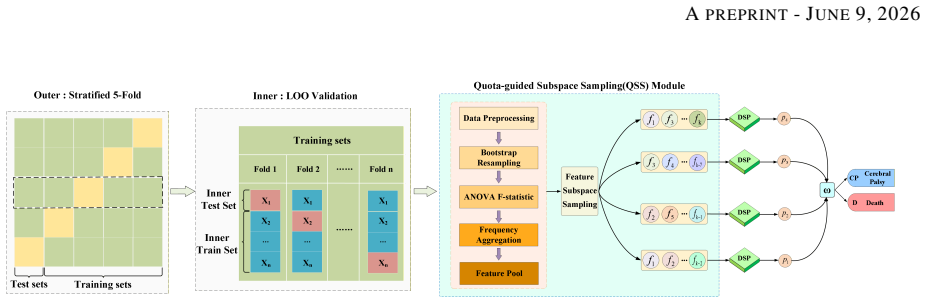
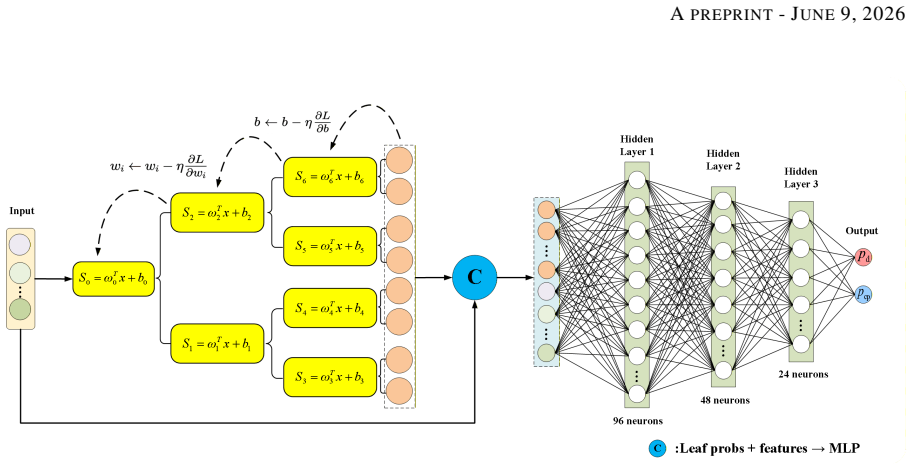
QDSP integrates Quota-guided Subspace Sampling (QSS), which uses bootstrap-based feature consistency to form stability-aware and low-redundancy subspaces, with Differentiable-decision-guided Structure Perception (DSP), which employs soft oblique decision structures to capture nonlinear clinical interactions while preserving traceable decision paths; together these components yield 0.9200 accuracy and 0.9714 AUC on the 51-infant VLBWI cohort and competitive results on external tabular medical data.
What carries the argument
Quota-guided Subspace Sampling (QSS) for stable feature subspaces and Differentiable-decision-guided Structure Perception (DSP) for traceable nonlinear modeling via soft oblique decisions.
If this is right
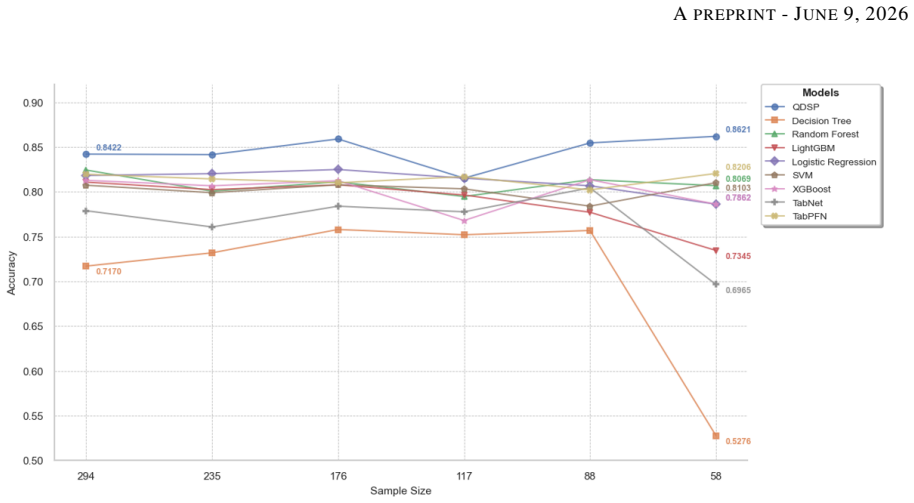
- QDSP reaches 0.9200 accuracy and 0.9714 AUC on the primary 51-infant cohort, exceeding XGBoost, TabNet, and TabPFN.
- The framework maintains competitive discrimination and calibration across three external medical tabular datasets of varying sizes and distributions.
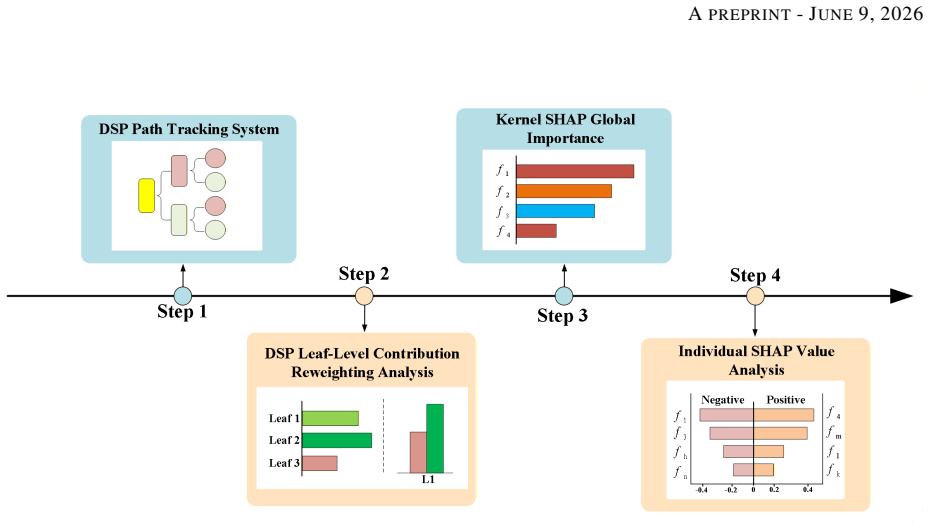
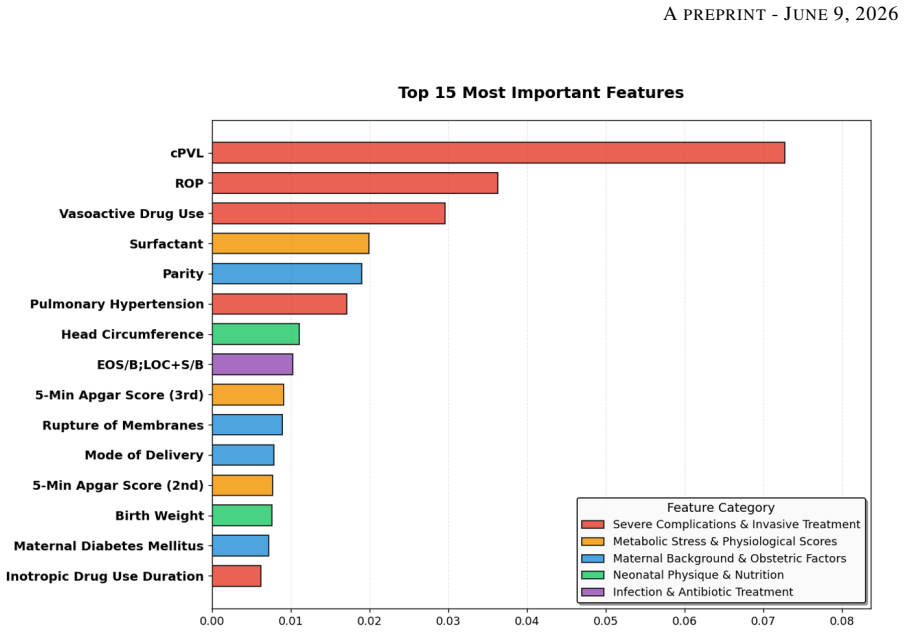
- SHAP-based analyses and differentiable decision-path tracing recover clinically relevant predictors such as cystic periventricular leukomalacia and birth weight.
- The method supplies an interpretable discharge-time risk stratification tool that may support individualized decisions in neonatal intensive care.
Where Pith is reading between the lines
- The same pairing of bootstrap subspace stability and soft oblique decision structures could transfer to other small-sample tabular prediction tasks in medicine where both performance and explanation are required.
- If the consistency estimation in QSS reliably prunes redundancy, the approach may lessen reliance on manual feature selection in similar high-dimensional clinical records.
- Wider adoption would benefit from multi-center validation to test whether the reported calibration holds under differing neonatal care protocols and data collection practices.
Load-bearing premise
The 51-infant primary cohort supplies enough statistical power and diversity for reliable performance comparisons without substantial overfitting in a high-dimensional clinical setting.
What would settle it
An independent replication study on a new VLBWI cohort of comparable or larger size in which QDSP accuracy falls below 0.85 or its AUC drops below 0.90 while XGBoost or TabNet remain higher.
Figures
read the original abstract
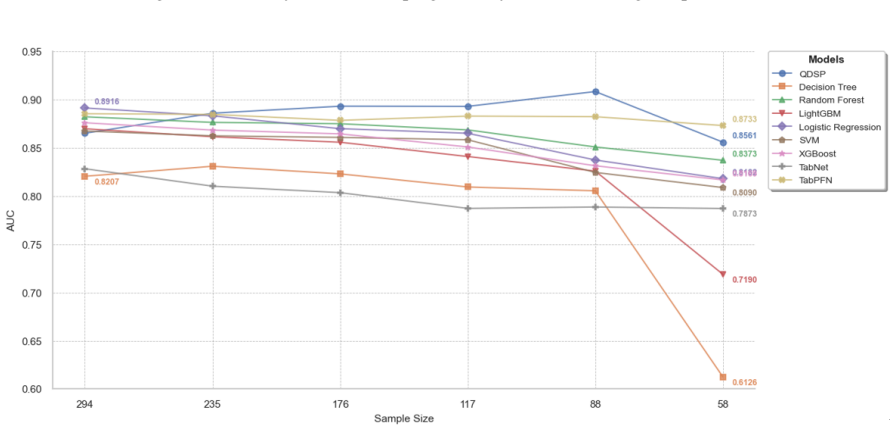
Very low birth weight infants (VLBWI) are at high risk of mortality and severe neurodevelopmental impairment, including cerebral palsy, yet reliable discharge-time prognostic stratification remains challenging in high-dimensional and data-limited clinical settings. To address this problem, we propose QDSP, an interpretable structured learning framework that integrates Quota-guided Subspace Sampling (QSS) and Differentiable-decision-guided Structure Perception (DSP). The QSS module constructs stability-aware and low-redundancy feature subspaces through bootstrap-based feature consistency estimation, whereas the DSP module employs differentiable soft oblique decision structures to model nonlinear clinical interactions while preserving traceable decision evidence. The proposed framework was evaluated on a real-world VLBWI cohort comprising 51 infants and further validated on three public medical tabular datasets. On the primary cohort, QDSP achieved an accuracy of 0.9200 and an AUC of 0.9714, outperforming representative machine learning and deep tabular learning baselines, including XGBoost, TabNet, and TabPFN. Across external datasets, QDSP maintained competitive discrimination and calibration under varying sample sizes and clinical distributions. In addition, SHAP-based analyses and differentiable decision-path tracing identified clinically relevant predictors, including cystic periventricular leukomalacia (cPVL) and birth weight, consistent with established neonatal pathophysiological evidence. These results suggest that QDSP provides an interpretable and robust framework for discharge-time risk stratification in VLBWI and may support early individualized clinical decision-making in neonatal intensive care settings.
Editorial analysis
A structured set of objections, weighed in public.
Referee Report
Summary. The paper proposes QDSP, an interpretable framework integrating Quota-guided Subspace Sampling (QSS) for stable feature subspaces and Differentiable-decision-guided Structure Perception (DSP) for nonlinear modeling with traceable decisions. It evaluates the method on a primary VLBWI cohort of 51 infants, reporting accuracy 0.9200 and AUC 0.9714 that outperform baselines including XGBoost, TabNet, and TabPFN; additional results are shown on three public tabular medical datasets, with SHAP and decision-path analyses highlighting predictors such as cPVL and birth weight.
Significance. If the performance advantage proves robust under proper statistical controls, QDSP could offer a useful interpretable alternative for discharge-time risk stratification in neonatal care, with traceable structures that align with known pathophysiology. The work's emphasis on stability-aware subspaces and differentiable decision paths is a constructive direction for tabular clinical data, though the small primary cohort limits immediate claims of generalizability.
major comments (2)
- [Abstract and Results] Abstract and Results section: The headline metrics (accuracy 0.9200, AUC 0.9714) on the n=51 primary cohort are given as single point estimates with no mention of cross-validation scheme, repeated splits, bootstrap intervals, or paired statistical tests against baselines. In a high-dimensional clinical setting this sample size renders the superiority claim over XGBoost/TabNet/TabPFN statistically fragile and directly load-bearing for the central empirical contribution.
- [§3 (Methodology) and Experiments] Methodology (§3) and Experiments: QSS and DSP each introduce tunable components (bootstrap consistency thresholds, quota parameters, soft decision depth). The evaluation does not state whether hyperparameter search was performed inside nested cross-validation; without this, the reported margin over baselines risks optimistic bias from the small-n regime.
minor comments (2)
- [Abstract] The abstract states validation on 'three public medical tabular datasets' but provides no dataset names, sample sizes, or task definitions; adding these would improve reproducibility.
- [§3.2] Notation for the DSP soft oblique decisions could be clarified with an explicit equation showing how the differentiable structure maps to traceable paths.
Simulated Author's Rebuttal
We thank the referee for these constructive comments on the statistical presentation of our results. We agree that the small primary cohort (n=51) requires explicit reporting of the evaluation protocol, confidence intervals, and hyperparameter procedures to support the performance claims. We will revise the manuscript to address both points directly.
read point-by-point responses
-
Referee: [Abstract and Results] Abstract and Results section: The headline metrics (accuracy 0.9200, AUC 0.9714) on the n=51 primary cohort are given as single point estimates with no mention of cross-validation scheme, repeated splits, bootstrap intervals, or paired statistical tests against baselines. In a high-dimensional clinical setting this sample size renders the superiority claim over XGBoost/TabNet/TabPFN statistically fragile and directly load-bearing for the central empirical contribution.
Authors: We agree that single point estimates without supporting statistical details are inadequate for a small cohort. The revised manuscript will describe the evaluation protocol in detail (including the cross-validation scheme employed on the primary cohort), report bootstrap confidence intervals for accuracy and AUC, and include paired statistical comparisons (e.g., DeLong test for AUC differences) against the baselines. The abstract will be updated to note these additions. These changes will make the superiority claims more robustly supported. revision: yes
-
Referee: [§3 (Methodology) and Experiments] Methodology (§3) and Experiments: QSS and DSP each introduce tunable components (bootstrap consistency thresholds, quota parameters, soft decision depth). The evaluation does not state whether hyperparameter search was performed inside nested cross-validation; without this, the reported margin over baselines risks optimistic bias from the small-n regime.
Authors: The referee is correct that the current text does not specify the hyperparameter procedure. In the revision we will explicitly state that hyperparameters for QSS (consistency thresholds, quota) and DSP (soft decision depth) were selected via nested cross-validation, with an inner loop dedicated to tuning and an outer loop for unbiased performance estimation on the primary cohort. If the original experiments require re-execution to satisfy this, the results will be updated accordingly. revision: yes
Circularity Check
No circularity in derivation chain or performance claims
full rationale
The paper proposes the QDSP framework (integrating QSS bootstrap-based subspace sampling and DSP differentiable decision structures) and reports empirical performance (accuracy 0.9200, AUC 0.9714 on the primary 51-infant cohort; competitive results on three external tabular datasets) as direct evaluation outcomes. No equations, self-citations, or steps reduce these metrics or the method's claimed advantages to quantities defined by the inputs themselves; the derivation remains a standard proposal-plus-validation structure that is self-contained against external benchmarks and does not invoke load-bearing self-referential reductions.
Axiom & Free-Parameter Ledger
Reference graph
Works this paper leans on
-
[1]
M., et al
Pollack M. M., et al. A comparison of neonatal mortality risk prediction models in very low birth weight infants. Pediatrics 2000;105(5):1051–1057
2000
-
[2]
E., Hintz S
Rogers E. E., Hintz S. R. Early neurodevelopmental outcomes of extremely preterm infants. Semin Perinatol. 2016;40(8):497–509
2016
-
[3]
Machine learning techniques for predicting neurodevelopmental impairments in premature infants: a systematic review
Ortega-Leon A., et al. Machine learning techniques for predicting neurodevelopmental impairments in premature infants: a systematic review. Front Artif Intell 2025;8:1481338
2025
-
[4]
Y ., Krebs V
Matsushita F. Y ., Krebs V . L. J., de Carvalho W. B. Identifying clinical phenotypes in extremely low birth weight infants—an unsupervised machine learning approach. Eur J Pediatr 2022;181(3):1085–1097
2022
-
[5]
H., et al
Han J. H., et al. Application of machine learning approaches to predict postnatal growth failure in very low birth weight infants. Yonsei Med J 2022;63(7):640
2022
-
[6]
Feature selection and feature stability measurement method for high-dimensional small sample data based on big data technology
Huang C. Feature selection and feature stability measurement method for high-dimensional small sample data based on big data technology. Comput Intell Neurosci 2021;2021:3597051
2021
-
[7]
An inductive bias for tabular deep learning
Beyazit E., Kozaczuk J., Li B., Wallace V ., Fadlallah B. An inductive bias for tabular deep learning. Adv Neural Inf Process Syst 2023;36:43108–43135
2023
-
[8]
Early predictors of mortality in very low birth weight neonates
Gera T., Ramji S. Early predictors of mortality in very low birth weight neonates. Indian Pediatr 2001;38(6):596– 604
2001
-
[9]
CRIB, CRIB-II, birth weight or gestational age to assess mortality risk in very low birth weight infants? Acta Paediatr 2008;97(7):899–903
Bührer C., Metze B., Obladen M. CRIB, CRIB-II, birth weight or gestational age to assess mortality risk in very low birth weight infants? Acta Paediatr 2008;97(7):899–903
2008
-
[10]
Early prediction of mortality and morbidities in VLBW preterm neonates using machine learning
Shu C.-H., et al. Early prediction of mortality and morbidities in VLBW preterm neonates using machine learning. Pediatr Res 2025;97(6):2056–2064
2025
-
[11]
Predicting mortality risk for preterm infants using random forest
Lee J., et al. Predicting mortality risk for preterm infants using random forest. Sci Rep 2021;11(1):7308
2021
-
[12]
K., et al
Bowe A. K., et al. Prediction of 2-year cognitive outcomes in very preterm infants using machine learning methods. JAMA Netw Open 2023;6(12):e2349111
2023
-
[13]
A multi-task, multi-stage deep transfer learning model for early prediction of neurodevelopment in very preterm infants
He L., et al. A multi-task, multi-stage deep transfer learning model for early prediction of neurodevelopment in very preterm infants. Sci Rep 2020;10(1):15072
2020
-
[14]
Ihlen E. A. F., et al. Machine learning of infant spontaneous movements for the early prediction of cerebral palsy: a multi-site cohort study. J Clin Med 2019;9(1):5
2019
-
[15]
Development and validation of a deep learning method to predict cerebral palsy from spontaneous movements in infants at high risk
Groos D., et al. Development and validation of a deep learning method to predict cerebral palsy from spontaneous movements in infants at high risk. JAMA Netw Open 2022;5(7):e2221325
2022
-
[16]
Stable bagging feature selection on medical data
Alelyani S. Stable bagging feature selection on medical data. J Big Data 2021;8(1):11
2021
-
[17]
Heart disease [Dataset]
Janosi A., Steinbrunn W., Pfisterer M., Detrano R. Heart disease [Dataset]. UCI Machine Learning Repository, 1989
1989
-
[18]
W., Everhart J
Smith J. W., Everhart J. E., Dickson W. C., Knowler W. C., Johannes R. S. Using the ADAP learning algorithm to forecast the onset of diabetes mellitus. In: Proc Symp Comput Appl Med Care. IEEE Computer Society Press
-
[19]
Hosmer D. W. Jr., Lemeshow S., Sturdivant R. X. Applied logistic regression. John Wiley & Sons; 2013
2013
-
[20]
Support-vector networks
Cortes C., Vapnik V . Support-vector networks. Mach Learn 1995;20(3):273–297
1995
-
[21]
H., Olshen R
Breiman L., Friedman J. H., Olshen R. A., Stone C. J. Classification and Regression Trees. Chapman and Hall/CRC; 2017
2017
-
[22]
Random forests
Breiman L. Random forests. Mach Learn 2001;45(1):5–32
2001
-
[23]
LightGBM: A highly efficient gradient boosting decision tree
Ke G., Meng Q., Finley T., Wang T., Chen W., Ma W., et al. LightGBM: A highly efficient gradient boosting decision tree. In: Advances in Neural Information Processing Systems 30; 2017
2017
-
[24]
XGBoost: A scalable tree boosting system
Chen T., Guestrin C. XGBoost: A scalable tree boosting system. In: Proceedings of the 22nd ACM SIGKDD International Conference on Knowledge Discovery and Data Mining; 2016. p. 785–794
2016
-
[25]
O., Pfister T
Arik S. O., Pfister T. TabNet: Attentive interpretable tabular learning. Proceedings of the AAAI Conference on Artificial Intelligence 2021;35(8):6679–6687
2021
-
[26]
TabPFN: A Transformer That Solves Small Tabular Classification Problems in a Second
Hollmann N., Muller S., Purucker L., Krishnakumar A., Korfer M., Hoo G. S., et al. TabPFN: A transformer that solves small tabular classification problems in a second. arXiv preprint arXiv:2207.01848; 2022. 17
work page internal anchor Pith review Pith/arXiv arXiv 2022
discussion (0)
Sign in with ORCID, Apple, or X to comment. Anyone can read and Pith papers without signing in.